

Embrace God's truth with our new book, The Lies that Bind

The Power of the Written Word: Pen Pals for Older Adults

Positive and heartfelt words, even from those we don’t know, can open up a world of connection and help to quell loneliness. For older adults who are unable to get out and about, reading letters can be a means of battling the blues and establishing new relationships. The fact that connection is crucial has become all the more apparent as the issue of social isolation has been pushed to the forefront. It’s no secret that loneliness takes a toll and that older adults face particular challenges, which have been exacerbated by lockdowns.

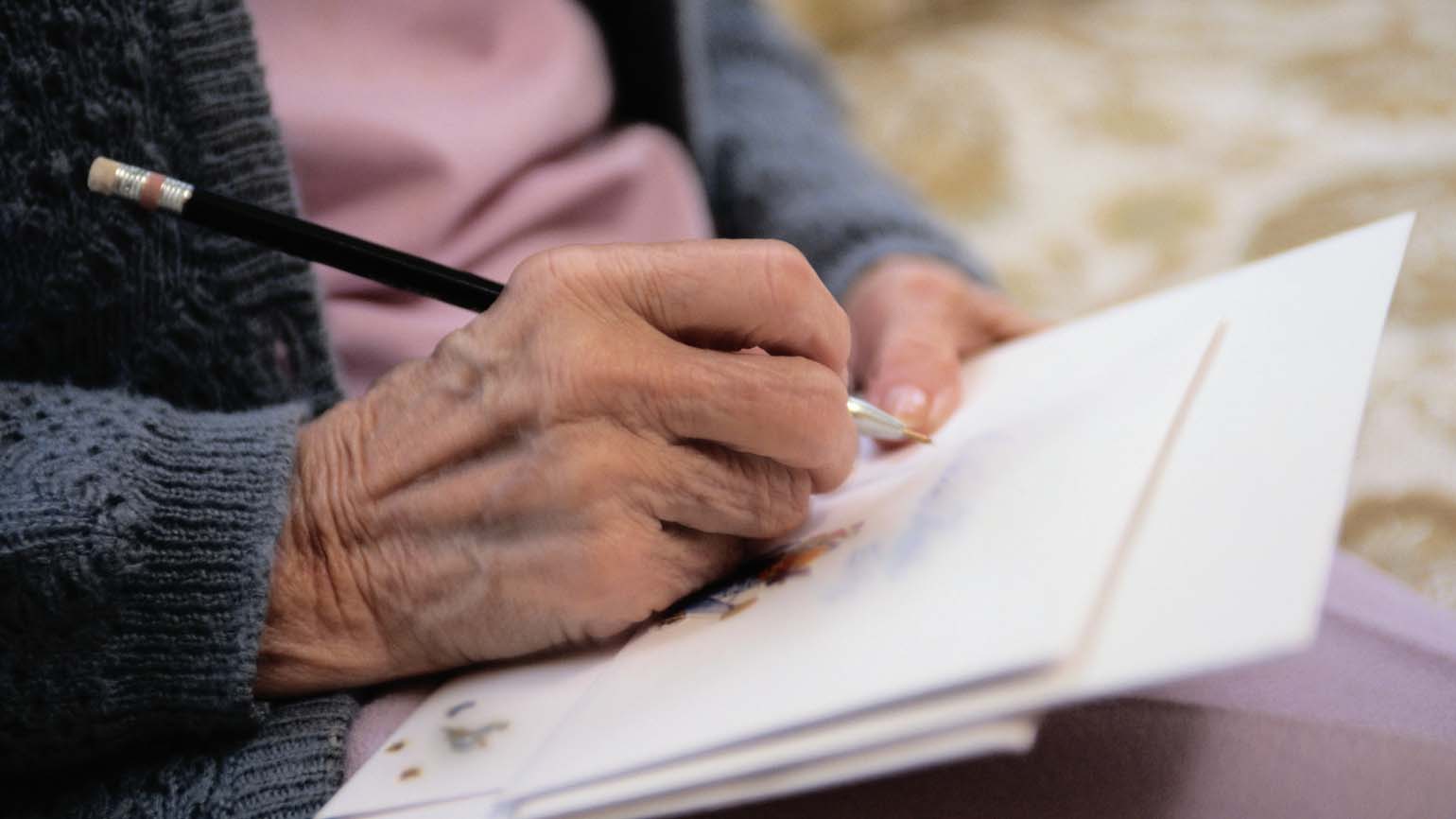
The potential health effects of social isolation are serious. They range from higher rates of depression and anxiety to increased risk of dementia and premature death. So, it’s important for you as a caregiver to find creative ways to help your loved one stay connected with others. One way to broaden social connection is via letter writing. To that end, a number of organizations, from assisted living facilities to home care agencies, have initiated pen pal programs for older adults, some in partnership with school-age kids. A few examples:

  • Village Concepts, an assisted living provider in Washington state, launched a pen pal program at the start of Covid-19 restrictions to help its residents stay connected with the community. It issued a social media call to action to all of its local communities, especially encouraging kids who were at home due to school closures. The response, according to the company’s website, was “epic.”
  • The Meadows of Wadena, a retirement and assisted living facility in Minnesota, formed a letter writing program after its activities director spotted a post in another state asking for pen pals and wanted to try out the concept. “Our residents are very interested and can’t wait to get their letters,” Tami Mench, director of resident services/housing manager, told the Grand Forks Herald.
  • North Carolina’s Victorian Senior Care received such a huge outpouring of letters for its pen pal program that it issued an update on its website notifying letter writers of a slowdown in response times: “We have been overwhelmed with the amount of love and kindness we have received from all over the world and thankful for every bit of it. From sweet encouraging notes, letters about your families and pets, thoughtful gifts, snacks, activities and so much more. Our residents have received thousands of letters and are trying to get responses out as they can.”
  • In addition to combating social isolation among older adults through its in-home care services, Home Instead offers a pen pal program. The website enables letter writers to type their messages into an online form or to uploaded handwritten notes. Suggested topics include favorite hobbies, movies, book and interests. You can also ask the older adult to share a story, fact or opinion with you. Letters are screened for safety and security by a review team.

If you’d like to get your loved one involved in a pen pal program, or wish to write to an older adult yourself, consider contacting your community’s assisted living facilities, in-home care agencies or senior centers. If a facility has an activities director, you may want to start with that person to get a sense of what sort of interest there is. You may find one older adult who wants to receive letters, or several. If you get involved and enjoy the process, you may even want to recruit friends and family members to establish additional connections.

Facilities will likely screen letters, but it’s important to always keep safety and security in mind. Make sure, for instance, that your loved one doesn’t include in snail mail letters or on websites his or her full name or other personal or identifying information. This sort of information includes: mailing address, date of birth, social security number, internet passwords, financial information or travel plans Also make sure that your loved one never sends money or compromising photos to anyone.

The simplest of actions, if sincere, can have great value. When someone puts thoughts and feelings into writing and reaches out to an older person, it can make a real difference. It could be the first step toward forging a meaningful relationship or at least making someone smile.


The Power of Humility

Humility, the quality or state of being humble, is a common theme during Lent. Through His humble acts, Jesus taught us that humility is a powerful force in a world where pride and self-centeredness abide. Humility makes a world of difference in our lives, but pride and self-reliance tend to get in the way. As we are only human, we want to do things our way. Depending on others—even on God—can be a threat to our self-confidence and fragile ego. At times, this can cause us to wait until the last minute to ask for the Lord’s help.

Humility is a life-long spiritual quest. It is the surrender of our will to God’s will. As The Lord’s Prayer states, “…thy kingdom come, thy will be done on earth as it is in heaven.” This prayer teaches us to align our will with heaven’s will and our heart with the ways of God. Humility is not a sign of weakness; on the contrary, it shows that our strength comes from the Lord and reflects the ways of Jesus.

In Christian teachings, true greatness does not come from worldly strength or power, but from humility. As we continue in our Lenten journey, let us learn from Jesus who “…gave up his divine privilege; he took the humble position of a slave and was born as a human being. When he appeared in human form, he humbled himself in obedience to God and died a criminal’s death on a cross.” Let us discover the power of His way, attitude and spirit for daily living. What does humility mean to you? Please share with us.

Lord, teach us the power and ways of humility.

The Power of a Positive Encounter With a Stranger

You probably know that doing good makes you feel good, whether it’s volunteer work or something for a friend. Being the beneficiary of someone else’s good deed also gives you a positive attitude boost, especially a random act of kindness from a stranger. That’s been my experience anyway.

My family and friends have done more for me than I can recount, and I am definitely grateful. But someone I don’t even know doing something nice for me? It’s uncomplicated and most of all, unexpected. And that’s what makes it some kind of wonderful and so restorative to the spirit, like a moment of grace. Or as Colleen Hughes might say, an encounter with an everyday angel.

Community Newsletter

Get More Inspiration Delivered to Your Inbox


Take what happened to me Wednesday night. I left the office at 7:45, almost an hour later than I’d planned, and I was irritated that I would only have time for an abbreviated workout. Then I walked out of our building onto 34th Street and got pelted in the face with little chunks of ice. Freezing rain? Hail? What the Weather Channel people call a wintry mix? Aaagh! And as usual, I had no umbrella.

I made my way over to Park Avenue and waited there miserably for the light, hailstones pinging off my unprotected head. Suddenly a voice came from my left. “Hey, do you need an umbrella?”

I turned. A guy in his mid-20s, rocking the hipster look—vintage-y jacket, skinny jeans, funky glasses. But he clearly had an old-school chivalrous attitude because he was already holding his umbrella over me. “That’s sweet of you,” I said, “but I’m okay. I’m just going to the gym across the street.”

“Then I’ll walk you there,” he said. He escorted me to the door of my gym, shielding me from the hail all the way. He left with his umbrella and my thanks. I watched him disappear into the night, my mood light and upbeat again. Why let little annoyances get to me when there’s a wonderful world out there with people like my umbrella guy in it?

Has a stranger’s act of kindness given you a lift? I’d love to hear about it. Please comment below.

The Power God Gives Us to Comfort Others

When you are hurting and brokenhearted, so many memories can stir up the pain—places, images, even clothing and household items. As a pastor, I see this with some couples going through divorce. The person still at home wants everything out that belonged to the ex. Or the widow might immediately give away items that belonged to her deceased spouse to ease the hurt.

Some wonder if God is even present in the middle of all the grief. But Psalms 34:18 states, “The Lord is close to the brokenhearted; he rescues those whose spirits are crushed.”

One Sunday morning a woman walked into our church a few minutes after worship began. She sat on a bench in the narthex and didn’t enter the sanctuary. John, the facility manager, noticed her alone and crying. He went to check and asked, “Is everything okay?” The woman said, “Today is the one year anniversary of my daughter’s memorial service.” She was overwhelmed with grief and unable to worship with others.

John sat next to her and listened as the grieving mother shared her pain. She talked about her daughter and where they lived before moving to Florida. When the woman mentioned her hometown in West Virginia, John recognized it; he had grown up nearby. John prayed with and for the woman. He asked God to comfort and give her the strength to get through the difficult day.

A few weeks later, the woman sent a thank you note to the church office. She didn’t know who had taken the time to listen and be with her in that time of need, but she wrote, “The act of faith really helped me through that day and still consoles me.”

John’s act of faith had consoled a grieving mother. Unbeknownst to her, God was near her and touched John to be the comforting presence.

When we stop and become attentive to the hurts of others, our hearts are filled with compassion. We become agents of comfort. Scripture teaches us to rejoice with those who rejoice and weep with those who weep. It’s always much easier to rejoice than to weep. But when we spend time with those in pain, we do the work of God and discover the power of His presence. And we find healing for ourselves as well.

The Powerful First Step to Offering Forgiveness

Sin can take place openly or in secret. But when not confessed, it becomes a growing burden. Our conscience tugs at us. The wrongdoing bears down on our souls and minds. We can’t sleep. We find little joy. We can even become sick from the relentless pressure.

Holocaust survivor and author Simon Wiesenthal in his book, The Sunflower: On the Possibilities and Limits of Forgiveness, tells his story of being in a Nazi concentration camp. At one point, he was taken off work detail and ushered to the bedside of a dying member of the SS.

The officer had committed horrific crimes including the murder of a family with a small child. Now on his deathbed, the Nazi officer was tormented by his crimes and wanted to confess and, if possible, receive forgiveness from a Jew. Wiesenthal left the room in silence. He did not offer forgiveness. Years later, he wondered if he had done the right thing.

We don’t need to have committed crimes against humanity to feel the need to confess and be forgiven. Most of us are more like Wiesenthal, wondering if we should have withheld forgiveness. We all have something in our lives that troubles our conscience.

The path to offering forgiveness begins with confession—disclosing the hurt we have held onto and seeking reconciliation. Confession can be an ordeal for many. Not even King David, a man after the heart of God, was exempt from this struggle. But once you are ready to confess, pray and ask for God’s forgiveness. Talk to your pastor or priest or a trusted friend—maybe even the person you have held a grudge against.

Forgiveness doesn’t mean you have to allow people to treat you poorly. It simply means releasing any bitterness or anger about the hurt someone else has caused you.

The psalmist wrote, “When I kept silent, my bones wasted away through my groaning all day long.” The agony of unconfessed sin wore down his mind, body and spirit. Forgiveness was the only thing that could bring healing and restore his joy. Without confession there is no forgiveness.

Why is it so hard to forgive? Pride often gets in the way. We want to remain in control and not show any sign of vulnerability and weakness.

Saying “sorry” wasn’t always practiced when I was growing up. Neither was saying “I forgive you.” You took your licks and moved on. Even today, expressing our deepest human failings and forgiving the failures of others is not the cultural norm.

But until we confess our own failings and open our hearts to forgiveness, we are robbing ourselves of the fullness of God’s grace.

The Positive Power of Working with Your Hands

The old saying goes, “idle hands are the devil’s playground,” meaning that being bored, disengaged and disconnected from physical work leaves too much time and space for your body and mind to fill with negative substitutes.

Neuroscience actually supports this theory. Or at least, research shows that the converse is true—active hands stimulate your brain to produce chemicals that balance emotions and lower anxiety.

Kelly Lambert, a neuroscientist at the University of Richmond, Virginia, has coined a term, “behaviorceuticals” to underscore how just as a drug can alter the chemistry of our brains, positive behaviors can impact our emotional health.

Lambert told CBS News that in the 19th century anxious women were often given the prescription to knit because doctors “sensed it calmed them down some.” This is not to say that anxiety can be cured by knitting. But it does highlight how the repetitive hand movements involved in the craft, combined with the satisfaction of casting off a finished product to wear or give, carries mental health benefits at a deep, biochemical level.

Other research has focused on knitting’s emotional benefits, like one study that showed knitting lowers the heart rate by 11 beats per minute, another that linked knitting with a diminished chance of developing mild cognitive impairment and memory loss, and still others that point to positive benefits in managing chronic pain and depression.

Of course, knitting is not the only way to take your emotional wellbeing into your own hands. Woodworking, gardening, pottery, painting, beading—anything that involves putting your two hands to work will benefit your mental health.

What do you do with your hands to keep them busy and keep yourself calm and happy?

The Positive Power of Telling Your Story

When she died just before her 95th birthday, my grandmother, a published author, left me notes and research for a novel she’d been working on for several years. Paging through the ideas, details and plot twists she imagined, I realized something that inspired me tremendously—at any age, each person has a story to tell.

I brought this mindset to a creative writing course I recently taught at my town’s Senior Center. Our group was small, just four students, but over the course of six weeks, we explored character development, plot outlining, descriptive imagery and editing techniques. The students were a teacher’s dream—positive, respectful, engaged and receptive to feedback. They also did their homework without fail.

Read More: A Guideposts Author’s Writing Life

One student was working on a travel memoir. Another was compiling a family history. A third was mining high school memories for humor. The fourth was diving deep into her imagination. Each was, in one way or another, exploring the line between truth and fiction, memory and creative invention.

This is important work for older adults—research tells us creative pursuits positively impact aging adults in areas ranging from cognitive function to happiness. Organizations like The National Center for Creative Aging coordinate creative programs for seniors nationally, but most towns offer creative writing, dance, music or art programs through senior centers, libraries and community centers.

In the last session of my writing course, I shared a quote from Virginia Woolf: “Every secret of a writer’s soul, every experience of his life, every quality of his mind, is written large in his works.” In other words, every story written with attention and integrity is a “true” story in that it reflects the experiences and perspectives of the writer.

This applies to my grandmother’s historical fiction draft as much as it does to my student’s memoir. And it begs the question—which of your many stories are you ready to tell?

The Positive Power of Humor

Humor is something I take pretty seriously. That might sound paradoxical, but I mean it: in my everyday life, humor is one of the important ways I stay positive. The cliché that laughter is a great medicine is true. Laughing has been scientifically proven to reduce stress and physical tension, boost the immune system and release mood-enhancing endorphins.

I experienced a little of the miraculous healing power of humor just last week. I’d had a rough day and by the end of it, was feeling down on myself. Even sitting in the park and watching the sunset did little to alleviate my foul mood. On the way back to my apartment, I decided to stop for a smoothie. Perhaps it would cheer me up.

Read More: God’s Loving Sense of Humor

While I was in line to order, my negative thoughts crept in: I felt unworthy of such an indulgence. Then came my turn, so I asked for a “power shake.”

A middle-aged woman behind me ordered a power shake too, and her husband jokingly chided her about the calories, since she hadn’t exercised that day. “I’m going tomorrow morning at 6:30, so it counts,” she laughed. That made me chuckle a little.

The smoothie shop employee was in a chipper mood. “Here’s your power,” he said to me, handing me my shake. “That’ll be six dollars for your power. Six dollars of power here.”

“You got a power too?” the woman behind me asked.

“Yeah, I’m going to the gym tomorrow also, so I earned it,” I said. All three of us laughed.

Read More: When a Humorist Battled the Blues

I’d come in for a mood-boosting smoothie—but it was the unexpected laughter that lifted my spirits. A few jokes, and the negative train of thoughts running through my head abruptly stopped. Our banter made me realize the absurdity of doubting whether I was worthy of something that I would enjoy. The woman and I were mocking our tendency to be too hard on ourselves.

Sigmund Freud aptly said that humor is our refusal to let our lives make us suffer.

But beyond that, I think there’s a kind of divine inspiration in these humorous moments–they arise spontaneously, and we react almost without thinking. In doing so we connect to the powerful urge we all have to see things from a more positive perspective.

There was definitely something serendipitous about my encounter with the married couple. They came in just when I needed a little laughter in my life. Who knows what the exchange did for them? Maybe they needed it just as much as I did.

Has a moment of laughter been healing for you? Share your story here.

The Positive Approach to Unpredictability

“Make your plans and you hear God laughing” is a line in the song “Life Changes” by Thomas Rhett. I smile each time I hear this line as it humbles my Type A, plan-ful personality. Finding comfort in life’s unpredictability is easier for some than others.

In my professional life as a therapist, I am never surprised by what clients share with me, be it a life experience, relationship dynamics, fears, goals, hopes, hurts. My job is to use my professional experience and skills to help my clients make plans and take constructive action to help them heal and move forward. It is also my role to empower them to be able to handle the inevitable unpredictabilities of life that lie ahead of them. So much of this empowerment falls in the area of attitude and perspective. This is where I channel Grandpa Peale. No matter what we face, we have a choice of how we respond and act. Undoubtedly, a positive, proactive, focused and thoughtful attitude yields greater benefits then the alternative.

When unwelcome events or experiences have come my way, setbacks that have been deeply painful, I have always been grateful that I have been given a model, in my grandparents and parents, of how to move through such experiences. The pain and suffering are real and should not be diminished. What makes a difference is how we take them in and move forward. How we can use them to build our resiliency and empathy. Not easy, for sure, but, again, far better than the alternative approach.

I was struck by Catherine Marshall’s words while thinking about life’s unpredictability: “Often God has to shut a door in our face so that He can subsequently open the door through which He wants us to go.” May we all find some comfort in that.

The Poor Man’s Steak

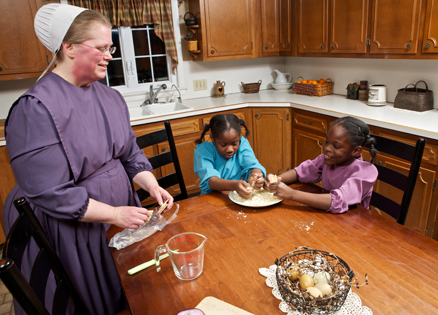
I wasn’t thinking about passing on a spiritual lesson when I made supper that night. I decided on the main dish because it’s tasty and we hadn’t had it in a while, though it’s common fare in Pennsylvania Mennonite homes like ours.

“What’s that called?” my daughter Joyanna, asked, pointing to the meat patties I’d set on the dinner table. She was the youngest of our five children. My husband, Todd, and I had adopted Joyanna and her sister, Annajoy, from Liberia, West Africa, when they were babies. Now Joyanna was four, at that stage of asking a million questions.

“Poor Man’s Steak,” Todd answered. Ground beef patties covered in mushroom gravy, served over mashed potatoes. Like most popular Mennonite meals, it’s perfect for large families: inexpensive, easy to prepare and well-suited for sharing. Also, like a lot of Mennonite foods, it’s got a playful name. Like “Shoofly Pie,” a molasses dessert, or “Chow Chow,” a vegetable relish.

Joyanna’s eyes widened. “What…is it called?” she asked again.

“Poor Man’s Steak,” Todd repeated.

We bowed our heads for grace, then passed around the serving dishes and everyone dug in. Except Joyanna. She pushed the meat away from her potatoes. “Joyanna,” I said, “don’t fill up on potatoes. You need to eat your meat.”

Joyanna looked up at me, her chin quivering. “I don’t want to be poor!”

Oh, my! We’d recently read The Little Match Girl, a story about an impoverished child. Joyanna must have thought if we ate “Poor Man’s Steak” that meant we were poor too. Todd and I tried to explain it was only a name, but with every bite Joyanna forced down came a sob. She was so upset she had to leave the table.

After dinner I talked to her. “Joyanna, can you tell me what little girls need?”

She thought for a moment. “A family, a bedroom, clothes, food.”

“That’s right,” I said. “And you have all that, don’t you?”

She nodded, but I could tell she wasn’t comforted. Suddenly, I had an idea. I got my Bible and opened it to Philippians 4:19. “The Bible tells us, ‘My God shall supply all your need,’” I said. “We’ll never be poor, no matter what we eat, because God takes care of everything we need.”

Joyanna’s eyes lit up and she slowly repeated the verse after me. Now she loves Poor Man’s Steak as much as I do. What a delicious reminder of how richly we’ve been blessed!

Try the Poor Man’s Steak recipe!

The Pooch That Answered a Prayer

I was only a few minutes into my evening walk when the words fell from my lips: “Lord, please bring me a dog.” What? Where had that prayer come from? Okay, so I’d been half-thinking about getting a dog. I would’ve loved one to walk with me. But I hadn’t prayed for one yet.

I hadn’t committed myself yet, and when you pray for something you’re totally committed. You don’t ask God for something you’re not quite sure you can handle.

Three years earlier I was diagnosed with cerebellar ataxia, a neurological disorder that affects my coordination and balance.

“If you don’t walk–you won’t!” my neurologist warned. “Walking will train your brain to remember how to move your body.” That’s when I started walking every night. I desperately wanted to hold on to my freedom.

A few months later our neighbors’ Labrador had puppies. They offered to give one to my 12-year-old daughter, Marilyn, and me. We couldn’t resist! Lugh instantly became part of our little family and came walking with me too.

Then, five months later, a tornado ripped through our town, destroying our home. The only apartment available was dogfree so our neighbors took Lugh in. We visited him often. They were an active family–much more active than I could ever be–and he loved it there.

We’d planned to take him back once we were settled in a house again. But Lugh grew bigger and my symptoms grew worse. I was exhausted and falling more often. When we finally found a home, we made a tough decision: Lugh would stay with them. There was no way I could manage a big strong dog, or maybe any dog.

But I really missed having a dog around. Marilyn did too. A little dog wasn’t the answer. What if they darted between my feet and tripped me? Forget it! Marilyn and I would have to be content with our two cats. I pushed all thoughts of getting a dog out of my mind. Until that prayer flew out of my mouth!

Back home that night I had a strange urge to check out a local shelter online–something I’d never done before. I’m not a big online person, yet I found myself browsing the site for hours. Athletic Labs, spunky Chihuahuas, stately imperious Poodles. All adoptable. But all either too large or too small.

See? This isn’t meant to be. That prayer was just an accident, I thought, reaching to turn off the computer. Just then, the screen flipped to the next page of pets. That’s when I saw her: Lil’ Dog. The most adorable tri-color corgi with melt-your-heart brown eyes. She was perfect!

I filled out a lengthy application, adding a note about my health, our two cats, our history with Lugh, and our vet’s phone number.

Three days later a volunteer from the shelter brought Lil’ Dog over for a home visit. Right away, she scurried behind the woman’s legs.

“I usually foster and rescue big dogs,” she explained, “but a few weeks ago I got a call to check out a flea market that sold puppies from a ‘puppy mill’–an irresponsible dog breeder. Lil’ Dog was living in a chicken wire cage on the ground in the mud and water. She’s only three but she’s already had a lot of pups.”

The woman said that the puppy mill owner had decided that Lil’ Dog was worn out. He had no use for her anymore. My heart broke. How could someone treat an innocent creature this way? She needed food. Attention. Love.

She needed me.

“She’ll require a lot of social training since she’s spent her whole life in a cage,” her foster mom added. “Oh, and there’s another family interested in her too.” Then she looked at my cane and walker parked in the corner. “Do you really think she’d be a good match for you?”

As if on cue, a bit like that accidental prayer, Lil’ Dog trotted out from behind the woman’s legs. She came up beside me and stuck her head under my hand. I melted.

Suddenly, one of our cats ran in and introduced herself with a hiss! Lil’ Dog whimpered and retreated. Then she seemed to think about it and decided that she had to stand up for herself if she was going to stick around here.

She stepped forward and gave a little growl in return. That seemed to settle things. She looked up at me with her wide eyes as if to get my approval. “I think we’ll all get along just fine,” I said, laughing.

The woman turned serious. “Well, I think you might,” she said. “But it isn’t up to me. The Animal Protection and Education Board makes all final decisions…and, well, they think it’s a red flag that you recently gave up a dog.” Then she snapped a leash onto Lil’ Dog’s collar and headed out the door.

Could she be more negative? I tried to hold back the tears. Lord, I prayed, I’m trusting you to bring Lil’ Dog into my life if that’s what you want. If not, please let her find a good home.

Two days later the shelter called. “Hello,” I said, waiting anxiously for their answer.

“Your application to adopt the corgi has been accepted,” they said. I almost dropped the phone!

That weekend Marilyn and I went to pick up Lil’Dog. But when I clipped on her leash and harness, she lunged right between my legs and I fell on top of her! I floundered on the floor, trying to disentangle dog, harness, leash and cane. Marilyn helped me up.

Lil’ Dog trembled, pulling away from me at the end of the leash, terrified, as if she wanted to run back to her cage. Oh, no! This was a bad idea. How could I have been so foolish to think that God had directed me to adopt a dog?

But something, some inner urge, wouldn’t allow me to give up. “Come here, girl,” I coaxed, holding out my hand. Slowly, she stopped fighting to pull away and came toward me. “That’s right. We can learn to walk together, can’t we? We can help each other. We can’t stay in our cages forever.”

I rubbed her soft multi-colored fur. A name came to me: Lily.

Back home, Marilyn and I played with Lily all afternoon. I’d almost forgotten how much fun a dog was, even a timid one like Lily. I thought it would be good to take her with me on my walk that night, get her socialized. But I grew nervous.

What if I fell on top of her again? What if I scared her? She’d spent so much of her life afraid.

I strapped on her harness and leash–this time she stayed put. Success! Step by step, we made our way out of the house and onto the street. Lily was a natural! It was like somehow she knew about my issues. She didn’t tug or pull, just trotted along steadily.

Sometimes she’d stop short if she saw something unfamiliar. After spending her life in a cage, that meant trash cans, bikes and parked cars (even fire hydrants!). Still, she never jerked the leash or threw me off balance. She just knew.

Over the next few months I learned to trust that Lily wouldn’t let me fall. And Lily learned to trust that I wouldn’t let anything hurt her. Whenever we’d approach something that scared her, I’d look down into her sweet brown eyes and walk us closer to it.

“Don’t worry, Lily,” I’d say. “I’m here.” Little by little, she’d step closer too. Before long she was walking bravely down the block, charming everyone in the neighborhood. We made perfect partners.

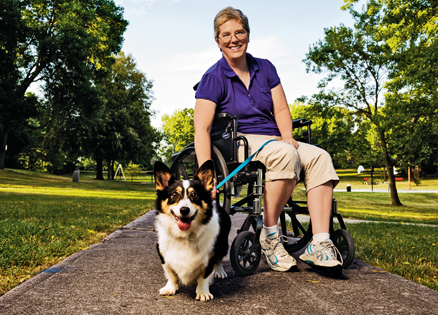
Five years later, my condition has grown worse. I need to use my wheelchair more than I’d like. But Lily doesn’t mind a bit. She’s still walking alongside me every night. And I know someone else walks with us too. The One to whom no prayer is accidental, the One in whom we are always free.

Download your FREE ebook, The Power of Hope: 7 Inspirational Stories of People Rediscovering Faith, Hope and Love

The Perfect Scripture for Your Enneagram Number

In recent years, the Enneagram has gotten a lot of buzz. The Road Back to You, a 2016 book by Ian Morgan Chron and Suzanne Stabile, brought the concept of the Enneagram to a Christian audience. Since then, a slew of podcasts, Instagram accounts and books have emerged exploring how the Enneagram can help people grow in their faith.

But what is it exactly?

Simply put, the Enneagram is an ancient system of categorizing people according to nine personality types. It is represented by a circle with inner triangles connecting the different types. The origins of the system are unclear, although many claim it was created by 4th century Christian mystics.

The nine personality types represented by the Enneagram are:

1. The Moral Perfectionist

2. Supportive Advisor

3. Successful Achiever

4. Romantic Individualist

5. Investigative Thinker

6. Loyal Guardian

7. Entertaining Optimist

8. Protective Challenger

9. Peaceful Mediator

“Each personality (1-9) is characterized by a dominant strength or virtue and a dominant weakness or vice,” wrote Guideposts.org blogger Bob Hostetler in a blog about how knowing your Enneagram number can affect your prayer life.

Recently, many Christians have begun putting the Enneagram to use in their own lives to better understand their relationship with themselves, others and God. Some are using it for marriage counseling, career coaching or for personal growth and understanding.

Beth McCord of Your Enneagram Coach has been speaking about the Enneagram for 17 years. Her new collection of nine books features one for each type and is designed like a daily journal, to help people understand how their personality impacts their relationship with God. She specifically focuses on how the Enneagram can help people grow their faith. Here, she offers a Bible verse that will comfort each personality type along with a brief explanation:

TYPE 1

Psalm 86:5

You, Lord, are forgiving and good, abounding in love to all who call to you.

Because of Christ in you, you are good. He makes you righteous.

TYPE 2

Zephaniah 3:17

The Lord your God is with you, he is mighty to save. He will take great delight in you, he will quiet you with his love, he will rejoice over you with singing.

Because of Christ in you, you are wanted and loved.

TYPE 3

Matthew 11:28-30

Come to me, all who labor and are heavy laden, and I will give you rest. Take my yoke upon you, and learn from me, for I am gentle and lowly in heart, and you will find rest for your souls. For my yoke is easy, and my burden is light.

Because of Christ in you, you are valued for simply being yourself. You can rest in His accomplishments.

TYPE 4

Psalm 139:13-14

For you created my inmost being; you knit me together in my mother’s womb. I praise you because I am fearfully and wonderfully made; your works are wonderful, I know that full well.

Because of Christ in you, you are special. You are seen, loved and valuable.

TYPE 5

Isaiah 40:31

But those who hope in the Lord will renew their strength. They will soar on wings like eagles; they will run and not grow weary, they will walk and not be faint.

Because of Christ in you, you will always be replenished. Your needs are not a problem.

TYPE 6

Joshua 1:9

Have I not commanded you? Be strong and courageous. Do not be afraid; do not be discouraged, for the Lord your God will be with you wherever you go.

Because of Christ in you, you are safe and secure. He is always with you and for you.

TYPE 7

John 4:14

But whoever drinks of the water that I will give him will never be thirsty again. The water that I will give him will become in him a spring of water welling up to eternal life.

Because of Christ in you, you can be completely satisfied. He has planned a magnificent future for you.

TYPE 8

Isaiah 41:10

So do not fear, for I am with you; do not be dismayed, for I am your God. I will strengthen you and help you; I will uphold you with my righteous right hand.

Because of Christ in you, you are protected. You will not be betrayed.

TYPE 9

Ephesians 2:10

For we are God’s handiwork, created in Christ Jesus to do good works, which God prepared in advance for us to do.

Because of Christ in you, your presence matters. God sees you and created you for a specific purpose.