



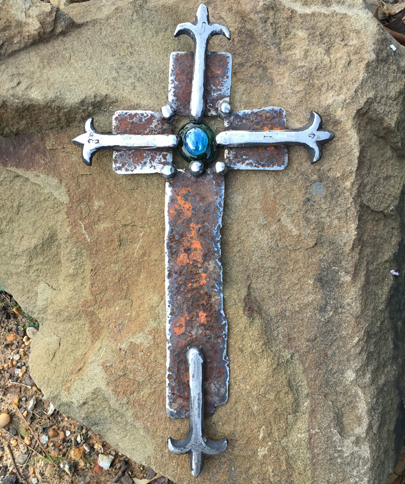
In the April-May 2016 edition of Mysterious Ways, Jim Hinch profiles sculptor Catherine Partain Shamblin, who some years ago, after a contentious divorce, found herself feeling alone and without direction. A mysterious voice told her to make a cross with whatever materials she could find, and now, her beautifully crafted crosses serve as healing agents for Catherine and the people who purchase them.
The Healing Effects of Holiday Music

“Music can lift us out of depression or move us to tears – it is a remedy, a tonic, orange juice for the ear,” according to the famed physician and author Oliver Sacks. “But for many of my neurological patients, music is even more – it can provide access, even when no medication can, to movement, to speech, to life. For them, music is not a luxury, but a necessity.”
Music’s unique ability to touch the heart and soul of someone who lives with a challenging condition—from Parkinson’s or Alzheimer’s to the after-effects of stroke—has a special resonance at holiday time. Traditional tunes, whether sacred orchestral arrangements or jazzy nods to the season, can trigger warm and soothing feelings and happy memories that reach back to earlier times. So, if you’re wracking your brain to come up with the perfect gift for the loved one you care for, consider setting aside some dedicated times to simply sit together and flood your senses with music.
Music has many powerful benefits. Research has shown that it can:
- Boost brain connectivity University of Utah researchers scanned brain regions of dementia patients while they listened to music versus silence, and found that music activates the brain, causing whole regions to communicate. Music with personal significance to the patients had the greatest impact. “This is objective evidence from brain imaging that shows personally meaningful music is an alternative route for communicating with patients who have Alzheimer’s disease,” said Norman Foster, M.D., director of U of U’s Health’s Center for Alzheimer’s Care and Imaging Research. “Language and visual memory pathways are damaged early as the disease progresses but personalized music programs can activate the brain, especially for patients who are losing contact with their environment.”
- Stimulate emotional memories Neuroscientist Kiminobu Sugaya teamed up with his wife, violinist Ayako Yonetani, to teach a popular course, “Music and the Brain,” at the University of Central Florida. It explored how music impacts brain function and human behavior, including by reducing stress, pain and symptoms of depression and improving cognitive and motor skills, spatial-temporal learning and the brain’s ability to produce neurons. “If you play someone’s favorite music, different parts of the brain light up. That means memories associated with music are emotional memories, which never fade out—even in Alzheimer’s patients,” Sugaya said. “Usually in the late stages, Alzheimer’s patients are unresponsive. But once you put in the headphones that play [their favorite] music, their eyes light up. They start moving and sometimes singing. The effect lasts maybe 10 minutes or so even after you turn off the music.”
- Release soothing chemicals Relaxing with music can trigger the release of brain chemicals that regulate mood, reduce aggression and depression and improve sleep, a study at Miami Veterans Administration Medical Center found. Researchers tested the blood of 20 male patients with Alzheimer’s after they participated in a music therapy program for 30 to 40 minutes five times a week for four weeks. The patients’ melatonin, norepinephrine and epinephrine levels had increased significantly at the end of the four weeks.
- Improve physical and psychological well-being Acclaimed soprano Renée Fleming has helped launch Sound Health, an NIH-Kennedy Center initiative to study the impact of music on health and healing. In addition to hosting performances, scientific workshop and community activities, Sound Health has supported research into the science of music. An aim is to help researchers conduct rigorous music-based interventions for brain disorders of aging. Four years ago, as part of the initiative, Fleming spent two hours in an MRI scanner that tracked her brain activity as she sang. “Even listening to music, or thinking about music, can have physical and psychological effects,” according to an article in the NIH Record. “Interestingly, when Fleming was in the MRI machine, the scans showed her brain was most active not while singing or talking, but while imagining she was singing.”
If your loved one enjoys singing or playing an instrument, and is still able to do so, providing encouragement can be a wonderful gift in itself. If you want to play or listen to music together, try to set aside regular times when you won’t feel rushed and harried. If you need a helping hand, you may want to consider hiring an in-home care aide to sing with your loved one or act as deejay with a special playlist of favorite recorded songs.
Another very special gift would be to schedule sessions with a music therapist who can sing or play especially meaningful tunes from your loved one’s life. Learn more information on how to find a music therapist.
‘The Happiness Curve’ Proves Life Gets Better After 50

When author Jonathan Rauch was in his mid-40s, his outlook on life took a strange turn. Instead of waking up energized, ambitious, and optimistic about the future, Rauch was struggling to find a sense of purpose, a motivating reason to get out of bed every day. What was more puzzling is that Rauch had absolutely no reason to feel this way. He was a celebrated journalist, having just won the highest award given to magazine writers. He was in a loving relationship, he had money in the bank, and he wasn’t facing any monumental tests of faith. No cancer threatened his body, there was no loss to grieve. He was as successful as he could hope to be, more so even. Yet, something was missing.
“I wondered if I’d ever be satisfied,” Rauch tells Guideposts.org. “I wondered if there was something wrong with me.”
The journalist in him hungered for answers. He read books, studies, and journals on the effects of aging, looking into the reasons for mid-life malaise and that dreaded of all clichés, the mid-life crisis. It was in his research he stumbled across something surprising, a new way scientists and professionals in the fields of economics, medicine, psychology and so forth were beginning to view aging. It was called “the happiness curve,” a U-shaped model for charting the trajectory of a person’s relative happiness during their lifetime. It changed the game for Rauch.
“We all imagine we’re supposed to be at the peak of our achievement and glory and happiness at midlife and if we’re not it’s a midlife crisis and there’s something the matter with us,” Rauch explains. “So, surprise number one is: that’s totally backwards. The middle of life is a time of transition and vulnerability and, for many people, difficulty.”
Instead of reaching our peak in midlife, the happiness curve shows the exact opposite. Most people begin their lives relatively happy. When you’re in your 20s and 30s, you’re in a time of ambition, a period where you’re fighting to achieve your goals, to start a family, to begin a successful career. It’s a time of opportunity. Once a person reaches their late 40s and early 50s, instead of happiness peaking as we’ve all assumed, the happiness curve shows that the average person will go through a low-point in their life. It’s a dip in the curve, one that can last years but marks a crucial transition period in a person’s life.
For Rauch and those like him – professionally successful people who aren’t facing overwhelming struggle or tragedy during their 40s and 50s – this dip is usually caused by, well, nothing.
“That’s really true, if you’re someone like me and you’re looking around for the problem in your life to blame it on,” Rauch explains. “There is no problem in your life to blame it on. There’s no science behind that and why that would happen to people.”
Still, the data shows it does happen and often. Rauch worked with revered economists like David Blanchflower and Andrew Oswald who study the patterns of human behaviors as part of their work. He also talked to psychologists, neuroscientists, and everyday people experiencing this phenomenon of “the happiness curve.” While his research proved that a midlife dip occurs rather frequently, what alarmed him most was the ideas of why and how a person should handle feeling depressed during that period of transition.
“The problem with the midlife crisis joke is that it’s not completely wrong, but it’s terribly misleading because most people don’t have a crisis at all. They have a gradual, slow sense of dissatisfaction,” Rauch says. “If it gets mishandled it can become a crisis but for most people, they just soldier through it, often in isolation.”
It’s how Rauch dealt with his own midlife slump. Ashamed that he wasn’t happier with his success, feeling ungrateful for all the blessings in his life, Rauch shut down. He didn’t feel comfortable talking about why he was feeling so low because he know he had no rational reason to feel that way.
“People are ashamed or embarrassed, or they hold it in,” Rauch explains. “They think there’s something wrong with them, they think they’re ingrates. That adds to their unhappiness and it becomes a downward spiral. I keep reminding people, just because this happens to first world people doesn’t make it any less of a problem for the people who are stuck in it.”
As Rauch explains, the happiness curve is just the effect of the ticking clock on a person’s life, and that’s not based off privilege.
Because the author experienced midlife malaise himself, and because he met so many people like him who were suffering through the same doldrums of life, Rauch decided to write a book, The Happiness Curve, to explain what happens to people as they age and how others can avoid the emotional and mental pitfalls of time.
The first thing Rauch wants people in their 40s and 50s, who feel pessimistic about the future and unsatisfied with their past, to know is that they’re not alone.
“Understand there’s nothing wrong with you,” Rauch says. “A second thing is don’t let yourself get ashamed or isolated if you can help it. Lots of people go through this, it’s totally natural. It’s normal, it’s not fun but it’s healthy. So, find people you can reach out to, whether its counselors or coaches or friends.”
Another thing to keep in mind as you reach that crucial period of midlife: Impulsiveness is not your friend.
“It’s really hard to know in midlife, if what you’re feeling is a result of time, the effect of aging, or if it’s the effect of other things,” Rauch explains. “I thought there must be something wrong with my career even though technically there was nothing wrong with my career, and I was tempted to just walk in one day and quit, which would’ve been a bad idea. Because of that uncertainty, not what’s going on, we don’t have clear visibility. So sure, change your life, but do it in a rational, calculated, instrumental way that builds on your strengths and your social capital. Don’t do it in a disruptive or impulsive way.”
Most importantly, Rauch wants to shatter the negative stereotype associated with aging. The idea that a person’s life is on the decline once they reach their 40s, that retirement means getting put out to pasture, that happiness can’t be found in a person’s later years, is the worst lie we’ve let ourselves believe according to the writer.
“What’s going on is a value transition,” Rauch says. “It takes a number of years to get through it. But when you do, you’re in a better place because your values have shifted away from ambitions and the social competition treadmill and towards social connection, cooperation, love, friendship — much better sources of happiness.”
It’s why the happiness curve is U-shaped. Once a person gets through the low point of their midlife, happiness increases to surprisingly high levels, a direct result of that value transition when people learn to place things like relationships, family, friendships, and community ahead of more self-centered desires.
“Adult development continues right to the last decades of life and in a very positive way,” Rauch says. “So, busting that negative stereotype of old age will help people in midlife understand how much they have to look forward to.”
The Great Spirit Moved Him to Help House the Nation’s Elders
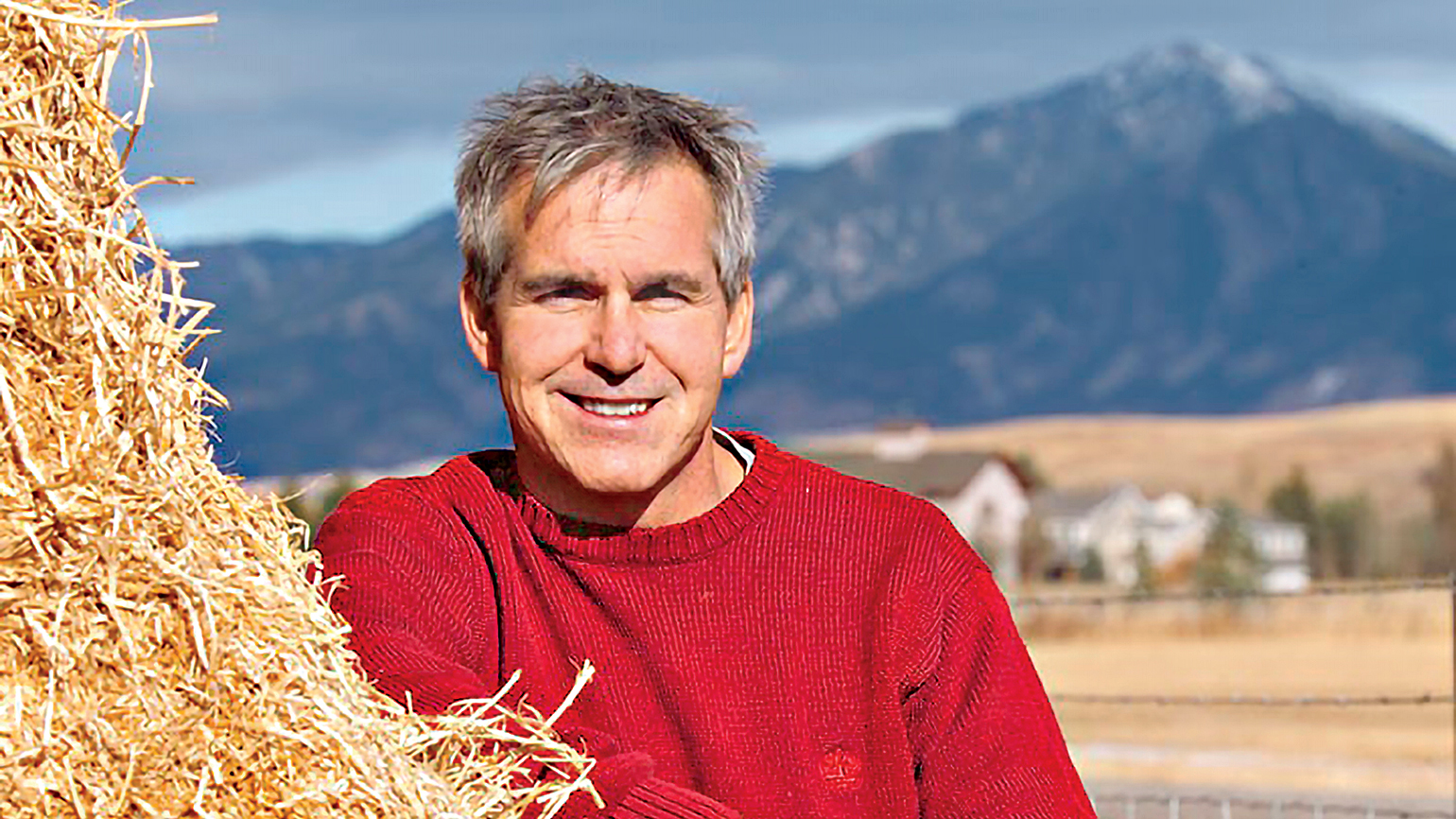
Ten years ago, if you told me I’d give up the business I spent my life putting together to go build houses on Indian reservations instead, I’d have said you were nuts. The Seattle-based loungewear company I started with a partner was cranking out a profit. At 33, I’d just married my longtime sweetheart Anita. I wanted to slow down, have a family, savor life and the rewards of success.
Then I saw that headline.
I was in New Mexico on business and picked up a local paper called Indian Country. There it was on the front page, like an epitaph: “Elders Freeze to Death.” How could such a thing happen here in America, the richest country in the world? I tore out the article and stuck it in my pocket.
That night in my hotel room, meetings done, I read the story again. It seemed so tragic. Somebody—the government, the tribal council—would no doubt do something to make sure it did not happen again. Still, I tucked the clipping into my briefcase instead of throwing it away. Why, I had no idea.
Two weeks later, another business trip. Another headline staring at me from the local paper. “Taos Woman Starts Adopt-A-Grandparent Program for Aging Native Americans.” According to the article, on reservations across the country, thousands of elderly Native Americans struggled not just to make ends meet but simply to stay alive. At the end of the piece there was a number for people interested in volunteering to call. I didn’t stop to think. I just picked up the phone and dialed.
Soon I was matched with a “grandparent”—Katherine Red Feather, of South Dakota’s Pine Ridge Reservation. I dropped her a note introducing myself. “I am seventy-eight years old,” Katherine wrote back, “and blessed with 13 children and seven grandchildren. I am so happy to learn I now have another grandchild! Do you have a wife and children of your own? I hope so, as they are one of the most wonderful gifts the Great Spirit can give a person in this life.”
I told her about Anita, and how she was indeed a godsend. Then I asked Katherine if there was anything I could send her. “Yes,” she wrote. “If it’s not too much trouble, I would very much appreciate a bottle of shampoo and some aspirin. Thank you for your generosity, Grandson.”
Grandson… Katherine was really taking this program seriously. But shampoo? Aspirin? Why wouldn’t she have such basic items? I decided to visit the reservation after my next business trip and look in on Katherine.
Pine Ridge Reservation encompasses the two poorest counties in the United States. So the letter from the Adopt-A-Grandparent program had informed me. But I was not prepared for the reality of that poverty. Rutted dirt roads, dilapidated shacks, rusted-out automobiles with entire families living in them… The dwellings I passed wouldn’t keep a person warm on a chill fall night like this. In the Dakota winter, temperatures sometimes plunged to 60 degrees below zero. How could people freeze to death on a reservation? The answer was right before my eyes.
Katherine’s “house” was a small, busted-up trailer pushed against the body of an old school bus. The trailer door opened and a delicate-looking woman wearing slacks and a simple patterned sweater emerged.
“Grandson! Come in out of the cold.”
The trailer was dark and barely big enough to turn around in, but the three people sitting by the wood stove stood when Katherine led me inside. “This is Robert,” she announced. “My new grandson. Robert, these are my children. They are your family now too.”
Katherine must have seen my confusion. “The Great Spirit has chosen you to be a part of my life,” she told me. “We are one family in his eyes.” We sat down to a simple meal of white bread and beans heated on a propane stove.
There was no running water, so Katherine needed to carry it from a well out back. It was next to an outhouse with a black flag flying overhead. “To scare away the rattlesnakes,” she explained. “They think it’s a hawk.” Katherine took such pains to make me feel at home that it was only at the end of my visit two days later that I could bring myself to ask her, “Isn’t it hard for you to have to fetch wood and water every day?”
Katherine took my hands in hers. “I know how my life must look to you, Grandson, but all of us here live this way. I’m no different than anyone else.”
I couldn’t stop thinking about Katherine once I got home to Seattle. The days grew shorter and colder. I looked out the window of my cozy apartment and imagined my new grandmother in that tiny trailer, huddled over her smoky little stove.
“She needs to be in a place that will keep her warm,” I told Anita one night. “A place where the wind doesn’t blow through the chinks in the walls. Katherine needs a real house.”
A real house. The moment those words left my lips, I knew what I had to do.
At the end of that summer I took two weeks off and went back to Pine Ridge. Anita and a handful of friends came with me. We were going to build Katherine a house. None of us had built so much as a doghouse before, but I figured that with a simple floor plan and plenty of enthusiasm, we could get the job done.
Word got around the reservation. Dozens of Katherine’s neighbors and family members pitched in. Toward the end we worked round the clock, my car headlights trained on the site. Finally the last nail was driven. Katherine’s tribal chairman said a prayer of thanks, and there was a big celebration. It was the first time Katherine had all her relatives together since the Red Feather clan had been divided and made to live on two different reservations years back. She welcomed them all into her house, her eyes brimming with tears of joy.
Anita squeezed my hand, and I knew what we’d done here was bigger than anything I could ever hope to achieve with my business. At last I understood what Katherine meant about all of us being one family.
Back in Seattle, I tried to concentrate on my work. Katherine would be safe and warm this winter. But what about all the neighbors who’d pitched in to build Katherine’s house, only to go home to ramshackle trailers? America has about two million tribal members, and some 300,000 of them are without proper homes. What about all those people?
Building frame houses like we’d done for Katherine was impossible. Too expensive and labor-intensive. I had to come up with a design that was warm, inexpensive and easy to build. A little research and I came across straw bale houses. Built from blocks of straw covered with stucco, they’re ideal for reservations. The straw is plentiful on the Great Plains, and provides extremely effective insulation.
Getting these straw bale houses built on a large scale, though, would take organization. A huge investment of time and energy. Time and energy I wouldn’t have if I kept my day job. I sold my half of the business and started a new venture, the Red Feather Development Group, to help Native Americans get decent housing. Eventually Anita and I moved to Bozeman, Montana, in the vicinity of half a dozen reservations.
To think, none of this would have happened if I hadn’t seen those headlines 10 years ago. Even then I’d known someone would look after elders like my grandmother Katherine. I just never expected that person to be me. But that is how the Great Spirit works.
* * *
The House You Built
Meeting Rob Young at the 2003 Volvo for Life Awards for heroes, I knew his story would be perfect for Guideposts. But even I was surprised at the response from our readers.
“There were sacks of mail from people who’d read my story in Guideposts,” Rob told us. “The Red Feather website was swamped.”
Readers donated more than $100,000 to help build warm homes for Native Americans. They volunteered their services—plumbing, roofing, carpentry. Rob was most moved by folks who donated one dollar and said they had to give something and wished they could give more. In September 2006, readers traveled to the Hopi Reservation in Arizona, to work side by side with Rob on a house for a little boy recovering from leukemia.
“When I saw that story, I just knew I had to get involved,” they said. More volunteers came to Red Feather through Guideposts than any other source. A great example of how Guideposts is and always will be more than a magazine.
—Celeste McCauley
Read Guideposts Readers Get Motivated! to learn more!
For more inspiring stories, subscribe to Guideposts magazine.
The Greatest Gifts: Compassion, Kindness and Love

It has been hard to find answers after the mass shooting at Sandy Hook Elementary. Hard to find hope after the deaths of innocent children and the school staff who gave their lives to protect those in their charge. Prayer has helped. Poetry. Music.
Yet I found the most comfort in an unlikely place: a photograph from an ancient burial site, and the moving story behind it. Australian archaeologists Lorna Tilley and Marc Oxenham excavated the 4,000-year-old Man Bac site, in what is now northern Vietnam, and uncovered one grave that stood out from the rest.
Unlike the other skeletons at Man Bac, which lay straight, the young man buried in this grave was curled in the fetal position, his head pillowed on a rock. Closer examination and analysis of his bones showed that he was born with a disabling fusion of the spine. His condition deteriorated so that he became paralyzed from the waist down in childhood and had minimal use of his arms. Still, the archaeologists determined, he lived for another 10 years with “severe, most probably total, incapacitation.”
He would have been completely dependent on others for survival. The people in his community came through. Their own existence could not have been easy—they lived by hunting and fishing and did not have metal tools—but they took care of this disabled young man, made sure he was fed and protected. And they laid him to rest with the same care.
I was struck by Tilley’s interpretation of this young man’s survival. She believes it shows not only a culture of tolerance but also an individual who, despite being radically different from the people around him, had “a sense of his own worth and a strong will to live.”
This is not the first archaeological find—and it won’t be the last—to demonstrate that prehistoric people, civilizations far less developed than our own, took care of and made accommodations for the chronically ill and disabled so that they could live among them.
Maybe now more than ever, we need these reminders that the greatest gifts we are given—and can give—are compassion, kindness and love.
The Good Things in Life’s Storms

I think I’m beginning to grow duck feathers it’s been so wet here! In the mountains of North Carolina, day after day is filled with a gloomy forecast of rain. So I was thrilled this morning when it wasn’t raining, and I could sit out on my deck and work on my writing deadlines. Other than being dive-bombed by a bird, making an up-close acquaintance of a squirrel who didn’t realize I was sitting there and having a bee come a little too near for comfort, I sure did enjoy those few hours working in God’s creation.
But then, in just the span of a few minutes, a massive storm rolled in. The sky turned from bright sunshine to charcoal gray. The wind picked up in huge gusts that blew green and brown debris from the trees into the air. The dead leaves and bits of greenery hung suspended and then danced around in the wind.
Sudden storms are a lot like life. We’re going along fine, and then, all of a sudden, BAM! But storms don’t last forever. And we can even discover some lovely things about them. The winds get rid of debris that would have piled up in the trees. The rain waters the flowers, and leaves everything freshly-washed.
It’s the same with our souls. Instead of focusing on the hardships of life’s storms, what if we looked for the good things? Storms can strengthen us. They cleanse our souls. They can get rid of debris, the things that don’t need to be in our lives.
Storms are great reminders that even when we’re being pounded, we always have the assurance that God will be with us for every difficult moment. The God who made the storm can certainly calm it, and He will stay with us until those storms are over.
Are you going through a difficult time today? Just tuck your hand into God’s hand and let Him worry about the storm. He’s got it all under control.
The Good Thing About Change

I like putting down roots as evidenced in many areas of my life. I’m married to the same man I exchanged vows with almost 44 years ago. We’ve lived in the same house for 38 years. I’ve gone to the same church for 49 years. And I still have dear friends from my school days.
I obviously don’t like change, but life happens and changes come. I was thinking this morning about some of the changes I’ve seen. I remember when gas stations had attendants who would pump your gas, check your oil and wash your windshield. I remember when many of the buildings in my town had freight elevators with workers who would push the buttons for the floors and pull the gates shut for the doors. Businesses had real live people who would answer the phones. Life was often at a slower, simpler pace. As a kid, I loved going to drive-in movies and playing in the yard all day in the summer. And we never had to worry about locking our doors.
But I’ve also learned that when God brings about change, that’s a good thing. Those changes have allowed me to write books, stories, articles and blog posts—something I’d never thought about doing before but loved. I didn’t like my children growing up so fast, but that brought me six perfect grandbabies—one of the best changes ever.
And now I have another change. This will be the last post for my “Life with a Southern Grandmother” blog. It’s been my privilege and honor to write for Guideposts and for all of you. Your kind comments have touched my heart on so many occasions, and I thank you so much for taking the time to read my posts.
Yes, life changes, but I’m grateful that no matter what happens in our lives, we can always count on one important truth: Jesus’ love for us never changes. And because of that, we can face each new day and each new change with the confidence that He will always be with us.
Love and hugs to all of you. I will miss you!
The God of Before

I have a master’s degree in worry, and without a doubt, I graduated at the top of the class. Yes, I’m good at it! Can you relate?
It doesn’t help that I have a writer’s mind and can visualize each possibly threatening scenario in vivid detail. I’ve imagined axe murderers creeping into my house when something falls over in the basement while I’m home alone.
When a friend posted a photo on Facebook of a snake she’d found inside her house, other people replied on her page sharing about the snakes they’d found in their pots and pans, coiled under their beds, between the couch cushions, and in the toilet. I twitched out of sympathy for her.
For days after that, I made it a point to look in my pots and pans, between my couch cushions, under my bed, and definitely in the toilet. Am I a good friend or what? (And just for the record, any snake that shows up inside my house will immediately become an endangered species. Please spread the word to all of your snake buddies.)
Shucks, there have even been times after receiving medical news that I’ve thought things all the way through to the funeral, with my family sitting in the pews and the spicy aroma of carnations and lilies filling the air.
I imagine that some of you are probably chuckling by now because you’re my worry twin, and others are shaking your heads in disdain because we’re not supposed to worry. I know that–and I’m working on trusting Him more and worrying less–but I want to be real with you, and I suspect that I’m not the only one who worries about things.
So for all of you who have also mastered the art of worry, I want to share something that God showed me this week: He’s the God of “before.”
In Jeremiah 1:5, He says, “Before I formed you in the womb I knew you.” Did you get that? Before we were even born, the God who made the universe knew us. He had a plan for our lives.
Story after story in the Bible shares how He’s always there before we need Him. God put Noah and his family in the ark before the flood began–and He’d already given them a heads-up and the opportunity to prepare for the event.
Baby Moses didn’t drown before God sent Pharaoh’s daughter to rescue him.
God closed the mouths of the lions before Daniel was attacked in the pit. Instead of Daniel being torn apart by powerful teeth and jaws, I suspect he had purring lions for pillows.
God prepared the heart of the king before Esther went to plead for the Jewish people.
The Widow of Zarephath and her son didn’t starve to death before God sent Elijah and a miracle for their provision.
Before Joseph rose to power, God put him in prison–because He knew that the days in the prison were what would lead to the days in the palace.
Goliath didn’t kill David before that young lad found the five smooth stones that God had placed in the brook for him–and they were exactly what he needed to conquer the giant in his life.
God had an escape plan in place before Paul and Silas ended up in that dank prison cell.
The pages of the Bible are filled with numerous stories of how God was there with each person and provided exactly what was needed for each circumstance.
And you know what was most impressive as I thought about this? I can’t find one instance (not one!) where the Bible tells how God was late. Not one verse where it says, “And God showed up after _________.”
Fellow worrywart friends, the God who took care of those men and women back in Bible days is the same God who will take care of us today. We can count on Him to have a plan in place and to be there before we need Him.
So before we drive ourselves crazy worrying about the circumstances and situations in our lives, let’s place our worries into the hands of the One who can handle them without any problem.
And it shall come to pass, that before they call, I will answer; and while they are yet speaking, I will hear. (Isaiah 65:24)
The Gift of Guideposts
I’ll have to keep this blog entry short because I’m busy in Florida spending the weekend with a terrific group of GUIDEPOSTS subscribers and supporters. I’ve met some great people. They’re longtime readers; most of them originally received GUIDEPOSTS as a gift and today they all give the magazine (and Daily Guideposts) as gifts. We’ve also had some great speakers, like Robert Schuller.
Every time I meet readers I’m always amazed at how enthusiastic you are about the magazine. You are the original recyclers—you never throw your GUIDEPOSTS out. You pass it on, giving it to neighbors and friends, or leaving your copy in places like health clubs, beauty salons and doctors’ offices.
So maybe this is as good a time as any to remind you to start your gift subscriptions. Given the difficult times we’re going through, I can’t imagine a more meaningful gift. And it is through your subscriptions and gifts that we can distribute millions of GUIDEPOSTS for free, including 500,000 a year to the military, especially military hospitals.
GUIDEPOSTS—a great way to recycle your faith.
P.S. I’d love to meet you in person too. I’ll be at Silver Dollar City in Branson, Missouri December 5 and 6 as part of a GUIDEPOSTS Christmas story-telling event.
I’ll be sharing some of my favorite GUIDEPOSTS holiday stories as well as giving you readers a chance to ask questions and tell your own stories, have a picture taken and generally get to know one another better. And for you knitters and crocheters we’ll have some fun workshops as part of our Knit for Kids sweater projects. So come by. I’m looking forward to meeting you. For details go to guideposts.com/storyevent.
Edward Grinnan is Editor-in-Chief and Vice President of GUIDEPOSTS Publications.
The Gift of Forgetting
Do we come from somewhere else when we are born and arrive “still trailing clouds of glory,” as the poet Wordsworth wrote?
Do we remember that place? Do we have certain things that we agree to do in the journey of our lives…and then at birth forget?
I have heard that just before we are born an angel puts her forefinger to our lips, and murmurs, “Shhh. Forget.” And that’s why every human has an indentation from the nostrils to the upper lip, where the angel whispered to us of what we agreed to be or do upon this earth. And with her finger to our lips made us then forget.
The Gift of Failure
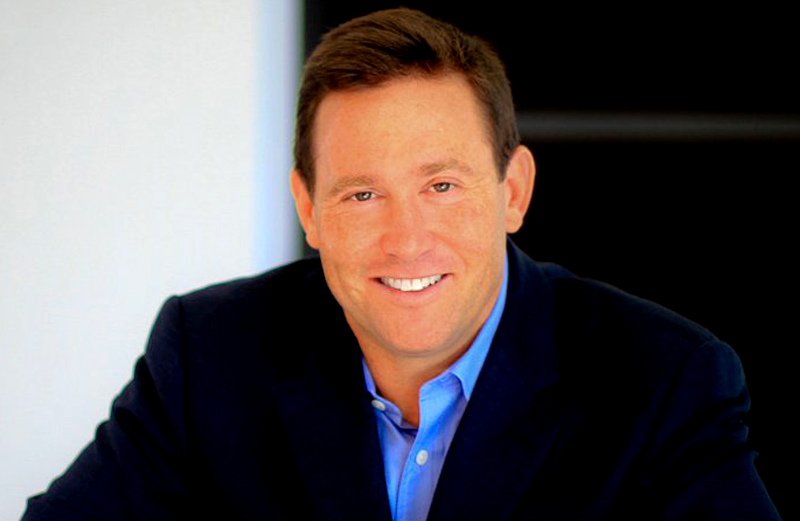
Almost everyone knows that Michael Jordan was cut from his high school basketball team. But most don't know that Walt Disney was once fired from a newspaper for a lack of ideas and his first cartoon production company went bankrupt.
Everyone loves Lucy but Lucille Ball was told that she had no talent and should leave Murray Anderson’s drama school. With all of Dustin Hoffman’s success, it’s hard to believe he worked as a janitor and an attendant in a mental ward because he failed in his first attempt as an actor in New York.
Can you imagine Bob Dylan getting booed off the stage at his high school talent show? What would have happened if Dr. Seuss’s actually burned the manuscript of his first book, which he wanted to do after it was rejected by 27 publishers.
It’s also hard to fathom Steven Spielberg not getting accepted to UCLA film school because of average grades. And it’s easy to forget that Steve Jobs was fired from Apple at 30 and Oprah Winfrey was told she wasn’t fit for television and was fired as a news anchor.*
The fact is everyone fails in life but it is a gift if you don’t give up and are willing to learn, improve and grow because of it.
Failure often serves as a defining moment, a crossroad on the journey of your life. It gives you a test designed to measure your courage, perseverance, commitment and dedication. Are you a pretender who gives up after a little adversity or a contender who keeps getting up after getting knocked down?
Failure provides you with a great opportunity to decide how much you really want something. Will you give up? Or will you dig deeper, commit more, work harder, learn and get better?
If you know that this is what you truly want, you will be willing to pay the price that greatness requires. You will be willing to fail again and again in order to succeed.
On the other hand, sometimes failure causes you take a different path that is better for you in the long run. When I lost my race for city council of Atlanta at the age of 26, I realized politics wasn’t for me. This set me on a new course and ultimately led me to move my family to Florida and find my purpose writing and speaking.
Sometimes we have to lose a goal to find our destiny. Sometimes failure helps us see that we want something else.
Whatever path failure guides you towards, it is always meant to give you a big serving of humble pie that builds your character, gives you perspective, grows your faith and makes you appreciate your success later on. If you didn’t fail, you wouldn’t become the kind of person who ultimately succeeds.
So the next time you fail don’t let it keep you from the life you were born to live and the future you were meant to create. See failure as a test, a teacher, a detour to a better outcome and an event that builds a better you.
Failure is not meant to be final and fatal. It is not meant to define you. It is meant to refine you to be all that you are meant to be.
When you see failure as a blessing instead of a curse you will turn the gift of failure into a stepping stone that leads to the gift of success.
*Thanks to Joe Green, author of The Road to Success Is Paved with Failure for these great examples.
The Gift of Caregiver Respite

Early mornings, I sit beside my living room window and say my prayers. The window faces southeast, toward the rising sun. I perch on a cushioned chest and watch the light gather over my small Wisconsin town. This is where I talk to God and feel the comfort of his presence.
One morning I sat on the chest, opened my Bible and read. It was one of my favorite verses, from Hebrews: “Never will I leave you; never will I forsake you.” The words passed in and out of my mind. I watched the sun rise but I didn’t feel God’s presence. I didn’t feel much of anything.
A few months earlier, my husband, Wayne, had died after battling a rare degenerative disease called multiple system atrophy. The gentle, quiet, clearheaded man I had loved for four decades had become so incapacitated that he couldn’t get out of bed without a mechanical lift.
ENJOYING THIS STORY? SUBSCRIBE TO GUIDEPOSTS MAGAZINE
I’d been Wayne’s caregiver for four years, as he declined from a vigorous hiker to someone who needed a cane, then a walker, then a wheelchair, and finally the lift. I’d taken over all the household tasks—paying bills and planning as well as cooking and cleaning.
On top of it all, I was diagnosed with breast cancer a year into Wayne’s decline. I juggled taking care of him with surgery, chemo and radiation treatments. By the time I was pronounced cancer-free, Wayne needed me around the clock.
And now he was gone. He’d died suddenly and unexpectedly in his sleep the day after his sixty-fifth birthday. It was a merciful end. Part of me knew I should be grateful. Grateful that Wayne had passed peacefully, and that our son Troy had helped so much at the end. I was free from worry and responsibility.
Yet as I sat there by the window and stared out at the gray spring dawn, I didn’t feel grateful. Or free. I didn’t feel any of the feelings I’d expected to feel when Wayne died.
I missed him terribly, yes—especially Wayne as he was before the illness, my steady companion, an excellent father to our boys. But I felt guilty too. Purposeless. Empty.
Every day for four years I’d gotten out of bed knowing exactly what I needed to do for the day. Now I had no clue. All I could think about was ways I’d been a less-than-perfect caregiver. And I wasn’t even a caregiver anymore! What was I supposed to do with myself?
READ MORE: AN ALZHEIMER’S CAREGIVER LEARNS A NEW WAY TO LOVE
God, I asked, are you hearing these questions?
The morning was silent.
I thought back to the day when Wayne was diagnosed, in 2006. He’d gone in for a routine checkup and the doctor noticed subtle imperfections in his gait and his speech that prompted further tests. A few months later, after an MRI and trips to a specialty clinic, we got the horrifying news.
Multiple system atrophy is like Parkinson’s disease on fast-forward. Life expectancy is less than a decade after diagnosis. The disease causes total deterioration of the body.
For four years I watched the man I loved—a strong factory worker, an outdoorsman, a leader in our church—vanish into himself, unable to move, then unable to speak clearly.
I knew nothing about caregiving except whatever I’d learned by being a mom. I’d been an elementary school teacher when Wayne and I married. I left my job when Derrick, our oldest, was born. Then came Troy and Brian. We moved to a house in the country outside Oostburg and raised the boys on two acres surrounded by farms and dairy cows.
I loved that house and I mourned when Wayne and I had to move to an apartment in town, then to the condo where I live now. I just couldn’t keep up with the house and the yard and Wayne’s care. Troy and his wife and kids moved into the house, so it stayed in the family, and we spent holidays there. But my expanse of trees and sky was gone. I made do with my morning perch at the window.
Every day I got Wayne up, helped him dress, prepared his food, got him into and out of the car for doctors’ appointments and helped him back into bed at night. I loved him and I never resented caring for him. But I was exhausted. And frazzled.
I had to learn so many new skills. Balancing the checkbook. Dealing with insurance companies. Sometimes Wayne seemed to deteriorate by the week. I feared every new loss.
Faith was my rock through all of it. I would have collapsed without it.
READ MORE: WHEN YOU’RE LOST, GOD FINDS YOU
Then why did I feel so alone now? So rudderless? It had been four months since Wayne died. I’d made it through the funeral. Sorted out his affairs. Shouldn’t some of the anxiety have lifted by now? I no longer had to face each day as a mountain.
Maybe that was part of the problem. Sometimes I awoke and began running through my mental checklist of things I needed to do for Wayne—only to remember that he was gone. Then a grayness settled over me. I thought of all the things I hadn’t done—told him I loved him enough, concealed my worries and exhaustion from him.
The unvarnished truth was I was a 63-year-old widow who’d lost her main reason for living. My primary accomplishment since Wayne’s death had been writing in my journal and starting a blog about the ups and downs of being a caregiver.
I needed a new direction.
But all I could think about as I stared out the window was caregiving. Was it possible I missed it? Surely not. I missed Wayne with a deep ache. But taking care of someone? I was supposed to feel liberated from that.
I got up and turned on my computer. “Volunteer opportunities, Sheboygan County,” I typed into the search engine. What was I even looking for? A long list of organizations appeared, everything from the Salvation Army to the historical museum. My eyes glazed. Then an entry caught my attention.
“The mission of the Gathering Place is sharing Christ’s love by providing a safe place for people with dementia and offering caregivers respite, education and encouragement.”
Offering caregivers respite. Wayne hadn’t suffered from dementia. But his disease had robbed him of speech and the ability to take care of himself. Boy, I could have used a place like this! For the first time in months I felt a stirring of interest. How fitting it would be to offer someone a respite from the kind of caregiving I’d done.
I called and the director invited me to drop by. The Gathering Place was run by a Lutheran congregation in nearby Sheboygan Falls. A few days later, I pulled up to a modern beige brick church building. I turned off the engine and sat there in the parking lot feeling apprehensive. Would I be able to handle the emotions I was about to experience?
Well, I was here. I should at least go in. I walked through the doors into what felt like a bustling community center. People of all ages—old folks, young volunteers, employees—were talking, listening to music and working on arts and crafts. It was lively and joyful.
I met the director and before I knew it I was sitting in a classroom, helping a woman with an art project. It was obvious that every activity at the Gathering Place was carefully designed to stimulate the minds of participants, helping them to retain memories and thinking skills.
I was glad to help. But I also experienced something more basic, something I’d been missing these past months. A connection with other people. A feeling of being useful, of being needed. I didn’t want to leave when the afternoon ended.
“Did you enjoy your day?” the director asked as I gathered my things.
I nodded.
“So we’ll see you next week?”
“Definitely,” I said.
I returned the following week—and just about every week thereafter. It has been four years since that first afternoon I spent at the Gathering Place. Since then, I’ve met so many wonderful people and have grown in confidence as a caregiver.
Just recently I was helping a woman named Marge with an art project. Marge repeated herself and had trouble remembering what she had done a few minutes earlier. But as we picked colors for her picture, she began telling a wonderful story about how much she’d loved the days when all the neighborhood children would come to her yard to play.
Her long-term memory was sharp and rich. Talking to me helped her to recognize that.
These days I still say my prayers each morning sitting on my chest by the window. I love watching the street come alive with people and color. I no longer feel purposeless or adrift. I know for a certainty what an immense gift the time I spent caring for Wayne had been.
Of course, I’ve long known that we’re called to give thanks for our hardships because they strengthen our faith. But this is deeper. I now understand that caregiving wasn’t just a stage in my life, a temporary hardship. It’s part of who I am. I have a heart for it.
Now God has given me an opportunity to use my experience to help others. I wasn’t liberated from caregiving when Wayne died. Caregivingwas the liberation. Serving others, I became more deeply myself, more the person God made me.
“Never will I leave you; never will I forsake you.” Those words from Hebrews are still some of my favorites in Scripture. I feel their truth every time I read them. I also feel the boundless love of the Caregiver who spoke them.
Learn more about the rewards of being a caregiver.
Did you enjoy this story? Subscribe to Guideposts magazine.