Embrace God's truth with our new book, The Lies that Bind

Remembering His Mom, Years After Losing Her to Alzheimer’s

One grandparent was still alive when I was born: my mother’s father, Poppop Rossiter, who lived with my aunt Cass. My memories of him are vague, though even at a young age I knew there was something wrong with the old man. He would forget my name and who I belonged to. One benefit: He always gave us grandkids a quarter when we came to visit, and toward the end I sometimes got two, even three quarters. It seemingly slipped his mind that he’d already bestowed his largesse. “Did I give you your quarter yet?” he’d say. I wasn’t about to remind him that he had. Poppop died when he fell one morning in the bathroom. There was no mention of Alzheimer’s in the autopsy. There should have been.

Years later Cass began forgetting things. My notoriously voluble and opinionated aunt’s speech deteriorated to gibberish. Then the same symptoms hit her younger sister, Marion. Finally my mother, Estelle, the youngest, began to lose her mind. Eventually all three Rossiter sisters died from Alzheimer’s, my mother last. People say I am just like her. Now I am wondering how much alike—and hoping not that much because some of my older cousins are already showing signs.

Alzheimer’s is a worry that more and more of us share, both for ourselves and for our parents and older relatives. How will we take care of them, and who will take care of us if it comes to it? Will there be a cure? Nearly six million Americans today are living with the disease, and that number will inexorably rise as the population ages. There are 16 million unpaid Alzheimer’s caregivers in our country already.

We are sharing several stories from a special Alzheimer’s care section in the April 2019 issue of Guideposts that will both inform and inspire you. You’ll meet two caregivers of family members, Kristy Dewberry and newsman Richard Lui, and share in their strength and grace. You’ll find out how you and your family can help find a cure through the Alzheimer’s Prevention Registry, hosted by Banner Alzheimer’s Institute. You’ll also hear from our friends at the Alzheimer’s Association. I invite you to visit a new section on our website devoted to Alzheimer’s caregiving. Go to guideposts.org/caregiving.

It is fitting that this special section appears in our April issue. Twenty years ago this month, my mother died after battling the disease for several long years. The early signs went back even longer, really, when I think about it—the odd memory lapse, the strange misunderstanding of something obvious, the unfinished daily crossword that she always used to finish in pen.

I was not there when she died, but my brother and sister were. In fact they were there for her far more than I was, with me in New York and all of them living near Detroit. My brother and his wife moved Mom into a sweet little house right next door to them. My sister made the drive down from East Lansing several times a week. They were the ones whom the wonderful folks at the care facility Mom eventually went to called. So it didn’t seem fair that whenever I showed up, Mom’s eyes would dance and her smile would bloom like a sunburst, even at the end. It made me a little sad.

I spent more than a week with her, though, near the end, so my brother and his wife and kids could take a long delayed vacation and my sister could have a break. Mostly I sat on the love seat in Mom’s room, watching her sleep in a little four-poster bed, framed pictures arrayed on her dresser. In the afternoon, the spring sun would stream in and settle on her like a blanket. Mom waited until I left, my brother and his family returned and my sister came down. Then she died.

I sometimes dream of that little bed. Sometimes I am in it, which is both upsetting and in a strange way reassuring. Mostly though it is about Mom, sleeping peacefully in the light.

For more inspiring stories, subscribe to Guideposts magazine.

Rediscovering a Passion for Music Changed This Mom’s Life

I took a bite of watermelon and wiped away the juice dribbling down my chin. The stirring strains of a Sousa march drifted over from Ester Park’s open stage. I scanned the crowd at this quintessential Fourth of July celebration, looking for my husband, Jim, and four-year-old-daughter, Aurora. People chatted in line waiting on their barbecue. Families lounged on picnic blankets spread on the lawn. In theory, it was a perfect day. Not that I was feeling anything close to perfect.

We were spending the summer in Fairbanks, Alaska. Jim owned a microscope sales and service company, and he’d developed a large social network. He’d always been good at that—fitting in, making friends, finding his niche. Not me. I missed my routines and friends in Montana, where we lived the rest of the year. Even then, I’d been struggling.

I helped Jim with his business, but it wasn’t my passion. And as a newish parent, I’d been feeling disconnected from who I’d been before. Now in Alaska, I felt that sense of disconnection even more. I took care of Aurora. I volunteered at the farm next door to our rented cabin. Life was full of blessings. Yet something was missing.

BROWSE OUR SELECTION OF BOOKS ON POSITIVE THINKING

I finally spotted Aurora and Jim over on the swings, but as I started to make my way toward them a conversation caught my attention. “I can’t stay,” a woman told her friend as they filled their plates. “I’m in the community band, and we have a concert this afternoon.” My ears perked up. Community band? What was that?

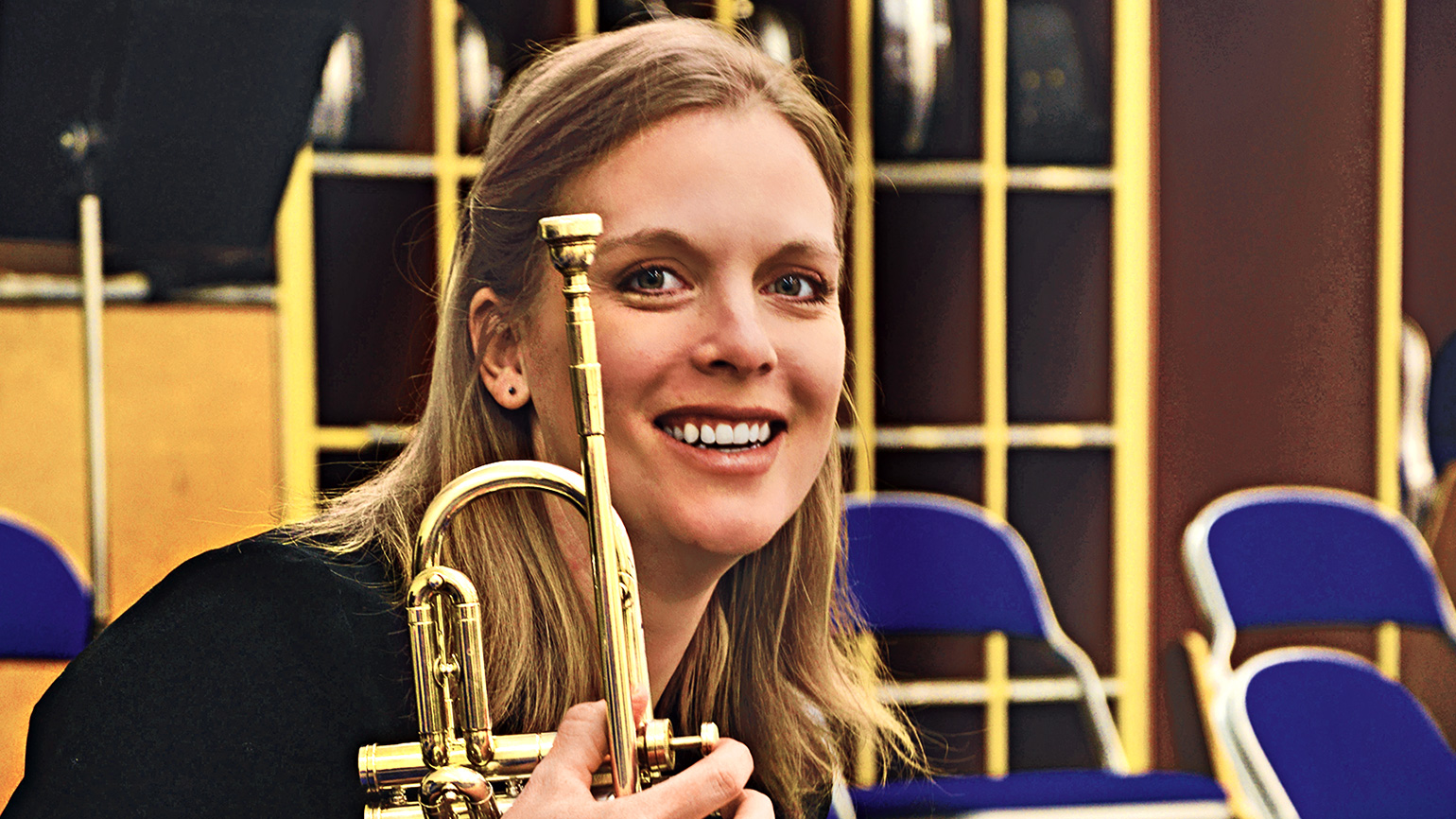
In high school, band had been one of my passions. There’s no clearer sense of purpose than being part of a group that is working together to make music. I could still remember the thrill of every instrument sounding together in perfect harmony. I wasn’t the greatest musician, but my insecurities melted away with a trumpet in my hands.

At college there weren’t as many opportunities for me to play. I wasn’t a music major. I put playing in a soundtrack orchestra on my bucket list, though just for my own pleasure.

On my daily run, I would listen to movie scores. A favorite was the Jurassic Park theme, by John Williams. Its soaring trumpets practically lifted me off the ground. In my mind, I became one of the musicians. I stood on stage hitting every note. But the years ticked by, and my trumpet remained in its case. It hadn’t even occurred to me to bring it to Alaska for the summer.

As soon as we got home from the picnic, I looked up the Fairbanks Community Band. The website explained that it existed to give people of any skill level the opportunity to make music. No auditions. Anyone was welcome. How had I never heard of this before?

I clicked on the band’s calendar. They had an open-air concert coming up. I have to go, I decided, entering the time and date into my calendar.

We were so late on the day of the concert, it had already started by the time we arrived. We settled into our seats while the band prepped for the next number. The first haunting notes of a familiar melody echoed through the pavilion. I gasped. The Jurassic Park theme! Goosebumps prickled my arms. Was God speaking to me?

It seemed the show was over before it started. I wanted to talk to the conductor, but doubt glued me to my seat. It had been so long since I’d last played. Would I even remember how? What if I was terrible? This was a bad idea.

“If you don’t go up there, I will,” Jim said. He had always encouraged my passion for music. “If you don’t take this opportunity to do something just for yourself, Erin, you’ll regret it.” He was right. I gathered my courage and walked to the front. One of the band members smiled. I asked how I could join. “We rehearse once a week,” she told me. “Just come!”

“My trumpet is in Montana,” I said.

“I think we have one you can borrow,” the band manager chimed in.

Twenty years is a long time, and I felt every minute of it when I brought the trumpet to my lips. I couldn’t remember basic note fingerings. My embouchure was weak. And my breath control was nonexistent. The first time I rehearsed the Jurassic Park theme with the band, I couldn’t even keep up on the page, let alone manage any of the high notes I’d played so skillfully in all of my daydreams.

Once I finally found my place, almost every note I played was wrong. Practicing at home was no easier. Just a few notes were enough to send Aurora running from the room. “Too loud, Mama, too loud!” she’d cry.

I struggled on but couldn’t help asking myself if it was pointless. Shouldn’t I be spending more time with Aurora and Jim? Practice was frustrating. I sounded terrible and felt like an impostor in the band. Maybe I was kidding myself, thinking I’d ever be good at this again.

The other band members kept me going. They laughed off my mistakes and helped me improve. Everyone made me feel as if I was part of something, a valued member of the group. Practicing each day still felt scary. But it started to feel brave too.

It’s impossible to disguise mistakes when playing the trumpet. It’s a loud instrument that often carries the melody line in songs. When you can’t hide, you’ve got no choice but to play as confidently as you can. The more I let go of my insecurities, the more things started coming back, like the passion I had in high school. Then one day, Aurora marched into our practice room blasting her own plastic trumpet. We weren’t just making music—we were making memories.

Summer ended, and we returned to Montana. I found a community band in Billings, not too far from where we lived, and signed up.

Everything was going fine until I learned the other third trumpet player would be away for the next performance and I would play his solo in my first concert. “You can do it,” bandmates told me, but I wasn’t so sure. I practiced the part endlessly. Usually it came out right in rehearsal. But not always. What if I messed up during our big show?

We took the stage, the lights dimmed and the audience stilled. The butterflies in my stomach started doing somersaults. I lifted my horn, felt the cold press of the mouthpiece against my lips. The slight tension in my embouchure. The weight of the horn gripped in my hands. Taking in a breath, feeling the air filling my lungs, I said a prayer.

Our conductor lifted his baton. The musicians around me raised their instruments, waiting for the cue.

I kept praying until the conductor gave the downbeat for my entry. Here we go. There was the buzz of air as it passed my lips, blossoming into sound as it vibrated through the horn, becoming music as it exited the bell. One correct note followed another, the tones blending with the lingering melody of the first and second trumpets’ parts. I thought my heart would burst with joy.

Jim and Aurora beamed at me from the audience. I was still light years away from my daydream performance. But I’d learned I didn’t have to be perfect to love playing. After 20 years, I’d rediscovered this simple pleasure and there was nowhere else in the world I wanted to be. No matter what sound came out of my trumpet, by picking it up, I’d hit the right note, one I knew I could hold for the rest of my life.

For more inspiring stories, subscribe to Guideposts magazine.

Redeemed on the Vegas Strip

There are between one and two million sex workers in the United States and Annie Lobert used to be one of them. As she details in her In her new memoir, Fallen, Lobert was a heartbroken teen who suffered under an abusive father and survived molestation and rape before turning to sex work to make fast money and get out of her home state of Minnesota.

From Hawaii to Las Vegas, Lobert experienced natural highs from all of the money she was earning on her own as an independent call girl. “The sex industry is a slippery industry,” she tells Guideposts.org. “It’s very hard to get out of it even if you do feel like you have a choice (which many don’t). The money is so good. The favor is so good. The attention is addictive. The nice jewelry, the presents, the cars, the houses– it’s all so addictive.”

READ MORE: ONE MAN’S JOURNEY TO HELP END HUMAN TRAFFICKING

But this “honeymoon experience,” as she calls it, didn’t last for very long. Her boyfriend whom she trusted and loved beat her one night when she returned home from the strip. He declared that he would be her pimp and she would have to give him all of her money. For the next five years, Lobert was a victim of sex trafficking, doing whatever her trafficker boyfriend demanded that she do, under threat of pain and death.

But it wasn’t just her trafficker that she had to fear; the clients, or ‘johns’ abused her too; one even raped and robbed her at gunpoint, something Lobert says is extremely common.

“You cannot regulate the sex trafficking industry,” she says. “You’re going to be abused. There is no panic button. You can’t avoid that.”

Years of verbal, physical, sexual and emotional abuse led Lobert to believe she was worthless and irredeemable, a strategy sex traffickers often use to keep their workers isolated from their families so they have no one to run to and no way to escape.

Though Lobert managed to get away from one trafficker, she wound up under the control of another who was just as abusive as the first. One day, Lobert found lumps on her neck, and was diagnosed with Hodgkins Lymphoma. She went through chemotherapy and lost all of her hair, but she was still forced to work. She continued going on calls sick, wearing wigs, and continued feeling unloved and unlovable.

Soon Lobert turned to drugs to numb the pain. It was only when she overdosed that she realized she could change. She had a vision of herself dead in her casket with her family all around her saying, “She was just a prostitute.” Lobert cried out to God and begged Him to save her. Miraculously, He did. She felt His love all around her in that moment and she was forever changed.

“The love of God changed me completely. That’s what healed me, a program didn’t heal me; a book didn’t heal me; it was the love of God. It cleaned me. It made me feel worthy. It made me feel like I have a purpose in my life and I have to do the same for other people.”

Lobert’s cancer went into remission and she received counseling for drug abuse and post traumatic stress disorder, which she had developed during the decade she was a sex worker. After treatment, Lobert answered God’s call to return to the Las Vegas strip and minister to other sex workers who are being trafficked. Through her ministry, Hookers for Jesus , she meets sex workers where they are and offers them help to get out of the industry and start new lives in Christ.

At Destiny House, Lobert houses former sex workers and offers them professional counseling, job training, mentorship and Christian teaching to help them become self-sufficient workers free of their past.

“We bring the grace element to these girls. Where everyone else would judge them, we bring the love of God to them that is needed desperately.”

It’s that atmosphere of grace and love, whether in her street ministry or at Destiny House, that Lobert says is the key to getting sex workers out of the industry for good. “If we have people around us who encourage us every time we fall into that sin, it’s easier for us to get back up when we know we’re still loved.”

READ MORE: MIRA SORVINO IN PURSUIT OF JUSTICE FOR TRAFFICKING SURVIVORS

Lobert can’t count the number of people her ministry has actually helped because “each woman is either a mother or a daughter, a sister, an aunt, a friend. They are a part of a community, so when we help them, we help so many other people that we’ll never know about.”

That ripple effect of showing God’s grace and mercy and empowering other people to do the same is exactly why Lobert feels God spared her life. Through her memoir and her ministry, she hopes others in the church will understand the horrific world of sex trafficking and open their eyes, hearts and arms to the survivors of the industry and welcome them into the church without judgment.

“The church worships virginity far too much,” she says. “It’s not our sexuality that makes us pure, it is the love of Christ. Even Jesus said, “The pure in heart will see God.’ So we need to look at each other through the lens of God’s purity.

“If we think well of each other, no matter what we’ve been through, and we don’t judge each other’s pasts, we don’t judge someone that’s been promiscuous, we don’t judge a thief, we don’t judge homosexual people, we don’t judge people–then we’re looking at people with purity. We give them a chance to feel the love of God, which is complete grace and acceptance.”

Annie Lobert’s memoir, Fallen, is available here.

Recovering From Addiction, His Path Leads Him to Help Others

I love my job. I’m the advocacy and education outreach coordinator for the Missouri Recovery Network, a state-funded nonprofit that aims to increase awareness of the realities of drug and alcohol addiction and advocates for quality treatment programs. I travel all over the state, helping communities establish recovery programs and provide other services that addicts need. I train people to revive overdose victims, and I spread the word about what it takes to get people into recovery and committed to sobriety.

I bring a special experience to my work with addicts.

I used to be one.

A decade ago, I was the last guy you’d hire for my job. I was in my thirties. I’d been using drugs and alcohol since I was a teenager. I smoked dope, shot up meth and ground-up pain pills, sold drugs, drove drunk and served a 16-month prison sentence for burglary.

I hated myself, hated God and hated the world.

Today I’m happily married with two kids. My relationship with God is the foundation of my sobriety. I’m blessed to have a job that enables me to heal the kind of harm I caused all those years that I misused drugs and alcohol.

How did it happen?

I tell my story everywhere I go in Missouri for two reasons. One, I’m living proof that even the most incorrigible addict can get sober and stay sober. More important, I’ve learned some essential lessons about addiction and recovery—the hard way. I know what works and what doesn’t. I’d like to share three of those lessons with you. I hope they’ll help you, your loved ones and anyone else you may know whose life has been harmed by the destructive disease of addiction.

1. Nobody wants to be an addict. Compassion can kick-start recovery.
My own journey to sobriety began with an unexpected offer of friendship. All my life, I believed the worst about people, especially myself. I was sexually abused as a child, my father was an alcoholic and my mom had to work so much to support her family she wasn’t able to take care of my two siblings and me—she sent us to live with her parents until she earned enough to afford a house.

My grandfather beat me severely and sometimes kept me out of school until my bruises healed. My main memories of church were of my parents shouting and cursing at each other in the car on the way there, then smiling and acting all holy when we walked into the sanctuary.

I trusted no one and assumed the world—especially churches—was full of judgmental hypocrites.

Imagine my surprise when a guy named Nate at the Ruby Tuesdays restaurant where I worked in Springfield, Missouri, kept talking to me as if he was actually interested in getting to know me. And Nate was a Christian!

I was in my mid-thirties by that point and trying to straighten out my life—sort of. After failing to graduate high school, serving that prison sentence and working a series of dead-end jobs, I went back to school and set my sights on becoming a social worker to help people like me. I swore off hard drugs (mostly), but I still got blackout drunk every night. I cursed a blue streak and made sure Nate knew I thought Christians were full of it.

He befriended me anyway. Nate’s wife, Becca, would come by the restaurant at closing time, and the three of us would talk. I kept trying to bait them by making fun of Christianity. They responded by inviting me to their church. I laughed off that invitation for months until Becca mentioned an upcoming church barbecue. I’m a sucker for good barbecue.

“I’m not drinking any of that Christian Kool-Aid,” I said.

“You don’t have to,” she said. “Just eat the barbecue.”

To my amazement, everyone at church was as nice as Nate and Becca. No judgment. No hard sell. Just good conversation—and barbecue.

For the first time in my life I felt as if someone liked me just for me. I didn’t know it then, but that was the start of my recovery.

2. Addicts need spiritual grounding.
There’s a reason 12-step programs begin with turning to a higher power. Addicts misuse drugs and alcohol for one reason—to fill a hole that, in the end, only God can fill.

That was my story. By the time I met Nate and Becca, I’d been feeling like a giant black hole for decades. Drinking and using drugs numbed my pain and gave me at least the illusion of belonging. If you can call hanging out with other addicts belonging.

I thought I was too broken even for God. That’s why I lashed out at other people’s faith.

Then one night, after I started attending Nate and Becca’s church occasionally (“Just to hang out, not because I believe any of this baloney,” I told them), I pulled out of the parking lot of a bar where I’d been drinking. I was drunk. In my rearview mirror, I saw a police car pull out behind me.

I panicked. I had been volunteering at a drug treatment center as part of my social work degree. I was so good at rationalizing my addiction, I didn’t even recognize how crazy that was. All I knew at the moment was my future was about to collapse. That cop would pull me over. I’d get busted, lose my volunteer work and flunk my degree.

I was startled to hear myself praying: “God, if you get me home without getting pulled over, I’ll go to Nate and Becca’s church every Sunday.”

I turned a corner. The cop turned the corner too.

I promised to give up drugs, then turned another corner. The cop stayed right behind me.

One by one, I swore off every bad behavior I could think of. Drinking. Driving drunk. Cussing. The cop followed me all the way home. I pulled into my garage—and the police car disappeared into the night.

I promptly passed out. When I woke up the next morning, I told myself all those promises were stupid. I got ready to go to a Super Bowl party. I was driving to the party, looking forward to getting wasted, when a song came on the radio I didn’t like. I looked for another station and landed on a patch of dead air. For some reason, I waited to see what would come on.

Out of nowhere, a song started up. The lyrics were loud and clear: “I wish you could see me now. I wish I could show you how I’m not who I was.” It was Brandon Heath, a Christian singer. The words kept repeating. I found myself pulling to the side of the road. I heard a voice: Go home, David. You can do this. I burst into tears. Then I turned around and drove home.

Next Sunday, I went to Nate and Becca’s church and joined the Celebrate Recovery group, a 12-step program rooted in Christian principles. I’ve been sober ever since.

Not every addict needs a dramatic spiritual awakening like that. But only an authentic relationship with a higher power can occupy the void that drugs and alcohol fail to fill.

3. People in recovery need to help others.
Addicts face a long list of things not to do. Don’t drink. Don’t use. Avoid triggers. What should they do instead?

Maybe this sounds counterintuitive, but I think people in recovery, even the ones who suffer most, need to reach out to others. They need to form new, mutually supportive friendships. They need to volunteer and become useful in their communities. They need to practice being a positive influence on other people, especially other suffering addicts seeking relief.

That’s what I realized as soon as I entered recovery. Except for Nate and Becca, almost all my friends were drinkers, drug users and partiers. I had no hope of staying sober if I hung out with people like them. I would have to find new friends.

And I had to find new things to do. For decades, I’d spent my free time looking for a fix, getting high or getting drunk. Just because I’d heard God’s voice in my car, and just because I’d committed to going to church and attending Celebrate Recovery, didn’t mean I suddenly felt great about myself and was ready to live a new life.

What was I going to do with all those hours I used to blot out with drugs and alcohol? I knew I needed more God in my life, so I started with church. How could I spend more time around church people? I joined a Christian softball team. I volunteered. I didn’t think I had much to offer, but I knew church was a better place to hang out than a bar.

Right away I found out that it felt good to do things for other people. I felt useful. Needed. I’d never felt like that before. Never.

I wanted more. Outside church, I found there were few organizations that give addicts productive things to do. So a few friends and I started an organization of our own. We called it Better Life in Recovery.

We hosted some gatherings and volunteered at a local school cleanup day. We expanded to bowling nights, movies, 5K races, river cleanups, speaking in schools—anything we could find that was positive, helpful and would keep us surrounded by good people. The organization grew and caught the attention of the Missouri Recovery Network. That’s how I got the job I have now.

My main message as I travel around Missouri is that people with substance use disorders are not evil, hopeless or lost souls. In fact, they are closer to recovery than they think. They have what it takes to get sober and become positive members of their families and communities. Turning to God starts them on the road. Not all people in recovery find church. But they all find something greater than drugs and alcohol to believe in. If they surround themselves with people committed to sobriety and if they get out of the house and make themselves useful, they stand a high chance of success.

Family members and communities can make all of that possible by doing what worked for me. Look for what’s good in addicts and help them see what you see. Introduce them to positive people and find ways for them to help serve others.

Above all, never give up. That night I got followed by the cop car, anyone would have thought I was a hopeless drunk. I was a drunk. And a drug addict. But not hopeless. Less than 24 hours later, I was hearing the voice of God and deciding, once and for all, to get sober.

We do not know when that moment will come for someone. But there are ways to make the moment come faster—and make it last. That’s what recovery is all about. Addicts hear the call of God and respond. The rest of us become voices amplifying that call. Together we are louder and brighter than the dark song of addiction.

For more inspiring stories, subscribe to Guideposts magazine.

Rebekah Lyons’ 6-Step Morning Routine to Reduce Anxiety

This article is based on information provided by Home Instead Senior Care.

People with Alzheimer’s disease may at times deal with emotions related to loss, as well as with boredom. It is not unusual for them to react to these feelings by rummaging through drawers, closet or cupboards. In a misguided effort to hold onto familiar possessions, they may hoard or hide them away. When you understand that unmet needs are partly behind your loved one’s behaviors, you can better deal with them. The following tips can help you understand the behaviors and develop methods to cope with the hiding and rummaging.

Handling Rummaging

People with Alzheimer’s display a variety of repetitive behaviors, including rummaging through drawers or papers. This particular behavior can be triggered by nervousness, boredom, anger, or vulnerability.

These tips can help you as a caregiver:

· Appreciate that this curious system is a function of the disease that can’t simply be stopped.

· Try to identify what brings on the behavior.

· Focus on the person more generally, rather than dwelling on the behavior.

· Redirect annoying or problematic rummaging to a less problematic alternative.

· Put together a dedicated box or drawer for this behavior.

· See if you can come up with other activities involving the hands, as a way to channel the nervous energy. These could involve balling yarn, working with hand tools, or playing with worry beads.

· Speak reassuringly and use positive body language.

What to Consider When Your Loved One Hides or Misplaces Things or Rummages

· Don’t overreact if items go missing. Stay calm.

· Help your loved one maintain a regular routine.

· Keep valuables locked away.

· Pay attention to daily mail.

· Encourage positive rummaging.

· Keep an eye on your loved one to determine whether he or she is hiding things.

· Think about installing a surveillance camera in the home if items continually come up missing.

· Regularly check the trash before it is put out.

· Get duplicates of items to replace things more quickly and smoothly.

Soothing Ways to Talk About Hiding and Misplacing Items or Rummaging

“Dad, I’m sorry we can’t find your book. I’ll look for it later. I am sure it will turn up.”

“Dad, I probably misplaced the remote control myself. Don’t worry, I’ll find it.”

“Dad, it looks like you’re looking for something in the drawer. Can I help you?”

“Mom, your scarf is not in this drawer. Why don’t we take a walk and look for it later.”

“Let’s leave your glasses on your dresser, Mom, where we know we can both find them.”

“Mom, I know you’re upset you can’t find your make-up compact. Let’s go to the store and get a new color!”

Tips to Prevent Your Loved One From Rummaging or Misplacing and Hiding Items

· Get organized.

· Take charge of valuables.

· Use creativity.

· Regularly check your loved one’s usual hiding places.

· Look through the garbage whenever you’re taking it out.

· Make sure your loved one is occupied with activities throughout the day.

3 Tips for Caregivers of People Who Rummage or Hide and Misplace Things

· Clear away clutter.

· Stress can wear on you. Allow yourself to take breaks.

· Stay as organized as possible. It will make your life run more easily and efficiently.

Ragnar Relay: 36 Hours of Inspiration

What is a Ragnar Relay Race? One team, 12 runners, two vans of six people, three legs of the relay per runner, covering close to 200 miles over two days and one night. Late this winter I was asked to join such a team to participate in the Cape Cod Ragnar Relay Race, from Hull, Massachusetts (South Shore) to Provincetown, Massachusetts (the very tip of the Cape). With not a lot of thought, other than checking my calendar and with my boss, I said yes, which included taking the as-yet-unclaimed longest leg for the team.

With life as full as we all know it can be, I squeezed in running more consistently and at greater lengths to train for the race. Still, I felt some pangs of nervousness. I did not question whether I could complete my three required legs of the relay (you are not disqualified for walking), but I wondered: How would my body fare? Would I get any sleep at all in the van (where we lived for 36 hours)? The five teammates in my van, Van 1, are great pals, easygoing, supportive, fun and hilarious. Like me, they were all doing this relay to enjoy the experience, to be challenged and to step away from the daily routine. We had no expectations of each other. There was no better situation to be in for running a relay.

I have pushed myself physically before, in triathlons and half marathons (not many of either), but not since my college days had I been on an athletic team with a goal. I have coached teams since college, but that is not quite the same as being a participant.
Our first runner took off at 6:30 a.m. on a drizzly Friday morning in May. The rest of us then took our turns running in relay order. Once we in Van 1 completed our first legs, Van 2’s runners did theirs. The pattern went on for approximately 31 hours. Our final team member arrived in Provincetown, with us to greet her, at 12:30 p.m. on Saturday.

There were day runs, middle of the night runs and early morning runs for our van. There were brief stops for food, a catnap here and there, lots of hydrating, no showers, enthusiastic cheering, many pit stops and an incredibly wonderful number of laughs. There were teams running to support causes. There were families and friends running in honor or memory of a loved one. There were teenagers and octogenarians. There was a man who juggled throughout his running legs (he used glow-in-the-dark balls during his nighttime runs). There were encouraging t-shirts on runners and supportive signs held by people along the routes.

The energy that comes with hundreds of people sharing a common goal is palpable and invigorating, even stress reducing. What better time to let the demands of your work and home life, the list of to-do’s, slip away? The beauty of seashore towns, the salty breeze and friendly people are tonics, not to mention being in a position to offer support, encouragement and humor to other participants, not just your team, but hundreds of others.

A recent thought and act from the OurPrayer Daily Scripture & Reflection newsletter caught my eye:

Be with someone who brings out the best in you, not the stress in you. –Anonymous

Grasp every opportunity to offer encouragement to others.

I felt very fortunate to be asked to join an effort that gave me the opportunity to be enveloped by others who supported me and whom I could support as well. Participating in the Ragnar Relay Race gave me the chance to push myself athletically, to see the Cape on foot, to be energized and encouraging, and to be surrounded by a tremendous team of game and fun friends. Not a bad gig for 36 hours.

Rev. Pablo Diaz on Hope and Recovery

Pablo Diaz: I want to share with you about believing that recovery is possible through hope. Addiction affects people of all ages, nationalities, professions, class, race. Addiction not only impacts a person who is addicted, but impacts their family, loved ones, their friends and co-workers. In the United States, there are 21 million individuals battling addiction under the age of 12. If not treated properly, addiction will destroy your family, marriage, business, a community, and even a country.

According to the Surgeon General’s report of 2016, every 19 minutes, an American dies of an overdose. One in seven individuals will face substance abuse. Let’s begin. Count.

Audience members: 1. 2. 3. 4. 5. 6. 7.

Pablo: One in seven—that’s staggering to think that 1 in 7 of Americans will face substance abuse. Now, let me give you the economic impact. The economic impact is $442 billion a year as a result of drugs, alcohol, and addiction in this country—staggering.

But the reality is that addiction is more than statistics. Addiction is about people. For every person addicted, there’s a name, agenda, a family, a history. The sad part of it is that when you battle addiction, you lose, ultimately, the opportunity to exercise the great potential given to you by your creator. You lose the opportunity to express the greatness that you have as an individual. And ultimately, you can lose your life.

Pastor David Beddoe, whose story was in the “Guideposts” January issue of 2018, who battles addiction himself, said the following. “Addiction is not about good or bad people. Addiction is about people who are suffering and want to be made whole.”

I know firsthand the impact of addiction on a family. My wife’s family battled addiction for many years. They lost four siblings connected to the drugs and alcohol. No one overdosed, but the impact of it over long haul—even my father-in-law, a career vet, 29 years and 10 months in the reserve, struggled with his own experience of war and drank quietly, for he was a reserved man. I remember asking, can I marry your daughter? He said, yes. And that was the end of the conversation—quiet. At the age of 62, he passed away.

You see, when you’re battling addiction as an individual—as a family, you feel alone and isolated. You can feel defeated, depleted, in despair. It is in these moments that we must remember the words of that great prophet in the “Book of Lamentations,” in the Hebrew scripture. “Lamentation” is comprised of five different poems that speak about the anguish, the agony, the pain, and the suffering the community, the people of God were experiencing as the Babylonians had invaded and destroyed their land.

Chapter 3, the following verse—”Yet I dare to hope. Yet I dare to hope when I remember the Lord’s faithful love. His mercies never cease. Great is his faithfulness—his mercies anew every single morning.”

Hope, hope, hope—a four-letter word that has power that infused the human spirit, that brings optimism, that breaks through with possibilities, that breaks through with a sense that all things can change. Hope—hope is that light that cracks through the darkness and paves a wave to say, here’s a role that you can take that is different and that can give you the recovery that you need.

Hope is the small whisper in the heart that doubts—quiets the doubts of the mind and the voices of despair and defeat. Hope is the courage that comes to us and the strength that comes within us to say, I am going to hold on one more day. That’s what hope is. It’s that light at the end of the tunnel—hope.

Sometimes, like Jimmy Santiago Baca, author and poet writes, “You must hold on to the ledge of hope.” Or as Dr. Martin Luther King said, “We must accept the finite disappointment, but never lose the infinite hope.” No matter what your circumstances are, recovery is possible.

I remember a young man named Charlie. Charlie came to church that Sunday morning. I was a pastor serving this congregation. And Charlie walked in and attended service. And I got a chance to meet him. He looked fragile, worn out, tired. As we sat, he said, I’m tired of living a life of drugs. I feel ashamed for all the pain I’ve cost my beloved, wonderful mother. I don’t want to be an addict. I’m exhausted from treatments and relapses and from all the drugs that I’ve taken. I want to be a loving, caring father.

I befriended him, and we journeyed for quite a while. I provided pastoral care. He agreed to get treatment and go for counseling and get the care that he needed. And together, we journeyed. And the family that loved him was there to support him. The weeks and the months went by. And the years went by. And Charlie was able to overcome a drug and alcohol addiction.

Now, I also remember the words of that young Jewish girl in World War II who kept a diary in hiding, who didn’t live to see her future, but whose words continue to inspire us. Ann Frank wrote, “Where there is hope, there is life. It fills us with courage and makes us strong again.” Hope—that four-letter word that I love, hope.

When a young person walks into a recovery center rehab because they want to break the addiction, hope is present. When resentment and anger and bitterness and loneliness is no longer ruling the heart, hope prevails. When a person is clean from their addiction and free from what bounded their heart and their bodies and their mind, hope wins.

How about when a mother and a daughter are reunited because the daughter’s made whole again, and the mother holds the daughter in on her arms and says, that’s my little girl. She’s come home. She is the young girl that I once knew.” Or the father embraces a son and says, here’s my son. He’s no longer bound by addiction.

So let us not lose hope, the infinite hope in us. Let us hold onto the ledge of hope—loosely, tightly, but never letting go. For as long as we have, hope we have life. As long as we have hope, we have courage. As long as we have hope, we become strong again. As long as we hold onto the ledge of hope, and we hold onto it tightly or loosely, the possibilities of recovery, of redemptions, of being made whole again, becomes real. Hope, for today gives me faith for tomorrow.

Pure Grace

It was the men’s figureskating finals of the 1988 Winter Olympics. I was 16 and already had racked up my share of skating titles. Someday I’d be in the Olympics. In fact, it was my dream.

That night I lay on our living room floor excitedly watching the battle of the Brians in Calgary: American Brian Boitano facing Brian Orser in his home territory of Canada. Both of them had been world champions. Both of them deserved to win.

Community Newsletter

Get More Inspiration Delivered to Your Inbox


Naturally I was rooting for Brian Boitano, a northern Californian like me. We’d skated on the same ice. I held my breath in amazement. Boitano pulled off an amazing eight triple jumps, almost flawless. The gold medal! I jumped in the air when his score went up.

But what happened next is what I’ll never forget. Brian sat in front of the camera with his coach, surrounded by a crush of journalists scribbling in notebooks, lights flashing, the TV interviewer holding a microphone up to him.

Brian was talking about his career and his medal, talking to the whole world. A tremor went through me, then a terrible sinking feeling. I could never be in the Olympics, I thought. No way could I talk in public like that. I’d freeze. Just the idea of a press conference terrified me.

You see, I loved skating partly because I didn’t have to talk. I could express myself with camel spins, split jumps and spirals. I didn’t have to stand up and give a speech like some teachers expected.

Public speaking was one class in high school I would never take. I could feel the blood rush to my face if I thought a teacher was going to call on me. I stared at my shoes. Please, please, let someone else talk, I’d pray. I was sure I’d get my words jumbled up and make a fool of myself.

What if journalists asked me questions like they asked Brian: “When did you first learn to skate?” “Where did you grow up?” “Tell us about your family.” I’d freeze up like the ice beneath my skates!

And yet, there was so much I would love to say, about my family and all the support they’d given me. About following my dream of being a figure-skating champion.

Why should a dream have some part of it that was so scary? Why would I have to do something I feared in pursuing something I loved?

Then I would fantasize: Maybe if they did a profile of me I could let the pictures speak for themselves, like a slide show.

I could find a snapshot of my maternal grandfather in his Army uniform, the only non-Caucasian in his platoon during World War II. A second-generation Japanese-American, he fought against the Nazis in Europe.

His wife, my grandmother, stayed in an internment camp in Colorado, barracks of rough cabins, families crowded on top of each other. Even with her husband a soldier in the U.S. Army, she didn’t feel safe in the outside world. Anti-Japanese sentiment ran too deep.

“Where was your mother born?” a journalist could ask.

“My mother was born in an internment camp,” I would have to say, “on January 1, 1945.” A New Year’s gift, they called her. I had a picture of the camp.

I would also look for a picture of me as a child: dark-haired, round-faced and my tiny legs and feet in casts. I was born with club feet, pointing inward and curled under. For the first 18 months of my life they were in plaster casts. Then I had to be fitted with special corrective shoes with a metal bar connecting them. I remember the bar clanking on the hardwood floors when I tried to walk. I was quite a sight.

No wonder I yearned to do something graceful when I was finally free of that thing. First it was ballet, then baton twirling. Speechless magic! I could show you a photo of my older sister, Lori, and me with our batons. But what I really wanted was to go ice skating like Lori.

We rented skates and I slid out tentatively on the ice, my mom holding my hands, my legs wobbly and unsure. We made a few turns on the rink, me slipping and sliding. And then something happened. I could do it! I could stand on the ice and skate all on my own.

Something inside of me clicked. This is me, I thought. This is what I am meant to do. It felt like pure grace had found me. I burst into tears when I had to return the rented skates. I thought I’d never get them back!

Every child has dreams. But dreams need to be nurtured and shaped or they’ll fade. My parents encouraged me to take lessons and a group class. I was intimidated by all the other kids, scared when I had to skate in front of them by myself, but I stuck with it.

Teachers, too, saw something in me that I couldn’t begin to see in myself. “Try this,” they urged. “Try that.” A jump, a turn, a figure-eight pattern that cut elegantly through the ice, leaving my marks behind. Things that seemed impossible became second nature.

I was given a Dorothy Hamill doll, dressed in a miniature version of the red costume she wore in the 1976 Olympics when she won gold. Not that I ever thought I would do the same, but a seed had been planted. I had something to aim for.

I took my Dorothy Hamill doll with me to the rink and let her watch me skate.

Of course, it was work, all that training, but as long as you have a goal in your head and you’re working toward it, gaining skills, gaining strength and ability, you don’t always realize how hard it is.

Up at four to get on the ice at five o’clock and train before school. Back to the rink at the end of the day. It wasn’t like school. I never had that feeling of wanting to sink in my chair and hide behind my desk. I didn’t mind being in the limelight in a skating program.

I wasn’t shy Kristi staring at her feet. I was someone else on the ice. Happy, confident, free. Some people express themselves by speaking eloquently, telling jokes or singing beautifully. I expressed myself with my skating. Everything I was feeling inside could come out on the ice.

I worked myself up to a level where I was the Junior American champion and skating in competitions with people I had admired only from afar, like Brian Boitano. That was what was so intimidating about watching Brian in his press conference. He was so calm, unflappable, quick and funny.

I clicked off the TV in a funk. My coach insisted I was Olympic caliber, but I could only imagine falling apart in front of a camera. Live? In front of the whole world?

I would rather die, I told myself. Why would God give me this gift, something I was so grateful for, and then add something that made it impossible?

The next day I was at the rink. As usual. I was practicing a combination of jumps that had once seemed impossible. I could remember seeing others doing them and thinking, I’ll never be able to do that. Almost like having to skate across the ice by myself that first day of class. But look, now I could.

Same thing can happen to you when you talk to people, the thought came to me. A strong, insistent thought.

You can do this, Kristi, the same way you learned to do a triple Lutz and triple Salchow. You didn’t do it all at once. But step by step, you learned. You took a big challenge and chopped it down to bite-sized pieces.

I worked very hard the next few years—on the ice and especially off. After competitions journalists talked to me and although my heart pounded every time I spoke to them, I got to know them. They became familiar faces. And they got to know me.

Slowly I learned that the best approach was simply to be myself. To be honest and gracious and do my best, just like on the ice, to answer their questions. So when my big moment came four years after Brian’s, I was ready.

Sometimes I think my biggest accomplishment at Albertville was not winning the gold but talking to the press afterward. When you do the thing you fear most you put an end to fear.

I am still shy. I don’t love giving a speech, though I am always grateful and honored to be asked. I might look composed and relaxed, but I have to take several deep breaths to calm myself.

I’m glad I have this challenge because it helps me as a mom, helps me remember what my girls are going through, with all the challenges kids face these days.

Fear can stop you dead in your tracks. Fear can kill a dream. But facing a fear is empowering. What are you afraid of? What one thing scares you more than anything else? This year, walk right up to it and conquer it, step by step.

Watch and listen as Kristi reveals the three people who most inspired her!

More stories from Winter Olympians!

Download your FREE ebook, Rediscover the Power of Positive Thinking, with Norman Vincent Peale

Protecting Yourself from Physical Injury as a Family Caregiver

As any good family caregiver knows, the job requires a constant eye to safeguarding your loved one against physical injury—from eliminating fall risks to taking over the driving. But what about your own injury risks? With so much of your focus placed on the needs of the person in your care, you can place yourself in harm’s way.

“Caregivers are notorious for neglecting their own health,” Lisa Winstel, chief operating officer of Caregiver Action Network (CAN), told Guideposts.org. “A caregiver can suffer because they’re not going to take the time for routine care that could help keep them healthy.”

While your overall well-being is fundamental to your success as a caregiver, it’s not only easy to forget routine self-care, but to disregard important steps that can help you avoid injury.

“Full disclosure: I’ve got bad knees,” Winstel said. “I was talking to my orthopedist and he asked what I do for a living. I was telling him and he was like, ‘Oh, terrific! I have a patient who really needs to get a knee replacement and she won’t because if she’s recovering, there’s nobody to take care of her husband.’ So his patient is causing herself repeated harm and constant pain, because she can’t stop her caregiving, in her mind.”

Whether it means getting help from others or learning how to reduce your own risks, Winstel shared these suggestions to help you avoid getting hurt:

Learn how to handle daily activities better. “Let’s say your mom lives with you and she has Alzheimer’s, and your goal is to keep Mom with you as long as possible,” Winstel said. “That means that every day you’re starting with getting Mom on and off the toilet, in and out of the shower, teeth-brushing … If you’ve got an elderly couple where the care flows from the person who can give it to the person who needs it, something as simple as folding up a transport chair and putting it into the trunk for somebody who has arthritis can really be painful, as well as exacerbate the arthritis and actually cause injury. Or let’s say you’re caring for somebody with limited mobility or a movement disorder. Just getting somebody out the door and into a car—things that we all take for granted can become a huge challenge and risk.” An estimated 60% of family caregivers assist their loved ones with activities of daily living (ADLs) such as eating, bathing and showering, grooming, mobility, and using the toilet. To help these caregivers, CAN has launched a new set of articles and videos with practical tips on how to safely handle these activities.

Reducing and removing bbstacles that could lead to injuries for you. “Think in terms of how to reduce your own fall risk,” she said. “It may be something as simple as automatic night-lights, so if you have to get up in the middle of the night to care for somebody, the lights will come on. Have all of your light bulbs changed to some form of a long-lasting bulb so that you’re not getting up on chairs and stepladders. Remove trip hazards. You usually think of throw rugs, but there are lots of other types of trip hazards. I’m looking at my floor, thinking, ‘Physician, heal thyself.’ There are two dog toys that could really wipe me out, and a pair of shoes that didn’t get put away. If I were to be helping somebody with a walker or a wheelchair, if my head turned, I could trip.”

Understand your loved ones’ possible health changes and symptoms. Dementia can cause aggressive behavior, so it’s important to learn how to avoid physical altercations. “It’s something that caregivers hesitate to discuss,” Winstel said. “If you say, ‘Dad was acting crazy last night and he hit me,’ you don’t want somebody to say you have to put him in a home. You want to figure out a way to make it work. Sometimes it can’t work. I’m not saying that you always have to keep everyone at home. But if having someone at home with you is your goal, there are ways that you can do that more safely.” CAN’s Lighting Your Way digital tool provides information to help caregivers better understand some of the lesser known behavioral and psychological symptoms that can accompany dementia and what can be done about them.

Ask for help and don’t be too hard on yourself. “Give yourself a break,” Winstel said. That may mean in-home care, if it’s feasible. If so, Winstel said, “you definitely want to make sure that you get somebody who has the skills and experience you need to be helpful. If you’re going to have another family member or friend come and help you, definitely have a family meeting. Discuss who’s going to be responsible for what. Have lots of good, open conversation. Let everybody else know what’s going on with the loved one you’re caring for. Help doesn’t even have to be in the house with you. Maybe you can say, ‘I’ll take care of Mom in the house but somebody else can manage her finances.’ Your brother’s in North Carolina—maybe he can handle the bills. You can relieve your burden with other family members other than with hands-on help. And don’t be too hard on yourself. You’re handling a lot. You’re not failing if you need to ask for help. Asking for help is a sign of strength!”

Learn more information on ways to safely care for a loved one with dementia.

Promise in the Manger

Dust covered the top of the crates I dragged out of storage. They didn’t exactly scream holiday spirit.

It had been years since I’d opened Mom’s collection of Christmas decorations. Without her around to appreciate it, why decorate the house?

“Let’s see what’s inside!” my fiancée said.

The excitement in Stephanie’s eyes made the effort seem worth it. This year. Maybe.

I pulled open the first box and lifted out a three-foot-tall ceramic tree. Stephanie unwound the cord and plugged it in. Multicolored lights flickered to life. “Your mother sure knew how to celebrate,” Stephanie said.

That was an understatement. Christmas was Mom’s favorite time of year. She believed it was filled with promise and acted accordingly.

Each December our house became transformed. Mom wrapped garland around the banisters, stacked holiday dishes on the buffet and set out her hand-painted Santa’s workshop. The house reeked of Christmas.

After Mom died my family tried to celebrate Christmas the way we used to, but for me it just wasn’t the same. It was as if I had a big hole in my life where Mom used to be. A big hole where Christmas used to be.

Every year since I’d think about putting up the old decorations at my own place. Thinking was as far as I got. Then Stephanie and I got serious about a future, maybe starting a family of our own. I told her about the decorations in storage.

“Look!” Stephanie said, digging into another crate. “A little church—with real stained-glass windows.”

Mom liked to run her finger up the steeple, peering inside as if imagining a quaint Christmas service. Now maybe Stephanie would care for the little church the way Mom did.

I started on another crate and unwrapped the piece on top. At the first glimpse of blue I knew it was Mary, her expression as soft as I remembered.

Next I unwrapped a figure with an elaborate crown—the first of the three wise men. The next piece I identified before I even unwrapped it. Those two points could only be the ears of the donkey that carried Mary and Joseph to Bethlehem.

Pieces lined up perfectly before me as the pile of tissue paper grew: the angel with her trumpet, the lowly shepherd with a lamb slung over his shoulders, simple Joseph in his brown robe. Only one more to go. I know what this one is, I thought as I peeled off the tissue paper to reveal…a lamb?

But where…. The box was empty. “Where’s baby Jesus?” I said, searching through the pile of tissue paper.

“He must be there. Did you check his manger?” Stephanie said.

I held up the cattle’s trough that served as his bed. “It’s empty. And Jesus is nowhere to be found. But he can’t be missing. He’s the most important part.”

Stephanie and I rummaged through all the wrapping paper scattered across the floor. “He was there for Mom’s last Christmas,” I said. “She never would have lost him.”

Hours later every box was empty and every bit of tissue paper laid out flat in a tall stack. Still no baby Jesus. Holding the empty manger in my hand, the aching feeling of loss washed over me again.

The most important part of Christmas was missing just as surely as the most important piece of Mom’s nativity set. I shouldn’t have hoped to make Christmas the way it used to be.

“We should just pack the nativity back into the crate,” I said.

“Not yet,” said Stephanie, putting her arm around me. “We’ve come this far. I’ll go to the hobby store tomorrow and find another baby tiny enough to fit.”

I couldn’t say no. At least the nativity set would be complete, even if my Christmas never would be.

The next night Stephanie showed up at my door empty-handed. “I couldn’t find a single baby to fit that manger,” she said. “I’m sorry.” She came inside and put the manger down between Mary and Joseph. We stood there staring at it. Empty, I thought. With nothing to fill it.

Stephanie reached out with her finger and pushed the little bed more securely between Mary and Joseph.

“You know, it really is a beautiful set,” she said. “I’m going to imagine the manger isn’t empty at all. I’m going to imagine it’s filled with new life. Our new life together as a family, and the new life Jesus promises us with his birth.”

I considered what she said. Wasn’t that the real reason Mom loved Christmas? Wasn’t that why she decorated and celebrated? This was the season of promise. The season of what might be.

Instead I’d been dwelling on what wasn’t. I had to stop looking back with sadness. Stephanie was right: It was time to look ahead with joy. “I think I know where the baby Jesus is,” I said.

Stephanie looked at me hopefully. “Where?”

“He’s with Mom up in heaven.”

One day I’d see them both. But for now Stephanie and I had a perfect nativity set to display at Christmas. We’ll celebrate our eighth together this year.

Our daughter will help us unpack Mom’s decorations—the ceramic tree, the little church, and the nativity scene with a manger that is full to the brim with memories. Memories and promise.

Download your free ebook Angel Sightings: 7 Inspirational Stories About Heavenly Angels and Everyday Angels on Earth.

Preserving Memories for Your Loved One with Dementia

Remaining socially and mentally engaged has alleviated her husband Bob’s symptoms of Alzheimer’s disease, Luanne Bole-Becker says. She’s onto something. Research has shown that talking to people with dementia about their lives creates positive emotions, reduces stress and improves their quality of life.

A wonderful way to connect with your loved ones is by capturing and preserving their memories. Here are tips from the experts at Home Instead Senior Care on how to make it a fulfilling experience for everyone involved:

Ask open-ended questions. Dementias typically erode short-term memory first, so it’s often rewarding to recall events from further in the past. Try questions like “What did you do for fun when you were little?” or “What was your favorite job?” Work up to deeper questions like “What are you most grateful for?” or “How would you like to be remembered?”

For more ideas, search conversation starters at caregiverstress.com or go to storycorps.org.

Listen patiently. Your family member might struggle for words. Keep listening for as long as they want to share. Let their reactions guide you. If they’re eager to talk, ask for more details. If there’s something they can’t remember or don’t want to get into, move on.

Use photos, music, objects and scents. Of all the senses, smell has the most direct connection to the parts of the brain where memories are stored. Aromas can unlock rich memories even when verbal and visual cues fail. Flowers, a campfire, sawdust, cookies baking, pine…any scents that are significant to your loved one can work.

Create a memory box. The sense of touch stimulates memories. What items hold special meaning for your family member? Some ideas: a military medal, trip souvenirs, gardening gloves, seashells, jewelry. Collect the items in one place so they’re easy to pull out when needed.

Be ready to capture reminiscences at family gatherings. Keep a video camera, a voice-recording app on your phone, a laptop, or a journal and pen handy.

Integrate memory gathering into daily activities. At mealtime, talk about favorite recipes and the stories that go with them. Ask about pictures and keepsakes while you’re cleaning. Something on TV might trigger a recollection.

For free training for family caregivers, including local workshops, online classes and videos, visit HelpforAlzheimersFamilies.com.

Preparing for Promotion

If there’s one thing I’ve learned in life, it’s this—promotion takes preparation.

That truth was never more evident than when I took a magazine feature writing position at a worldwide ministry, only to be informed I’d actually be doing something entirely different…and I wasn’t thrilled about it.

My editor explained that they had a greater need for another ghostwriter, so I would be fulfilling that role. During my years at Indiana University journalism school, I’d been told to “find my voice.” So, I’d been working hard every day since college graduation to do just that. Now, my new boss was telling me: “Lose your voice, and find somebody else’s.”

That just didn’t make sense to me.

“Let me get this straight,” I answered. “I’m going to be taking somebody else’s thoughts and words from a sermon or a presentation, and then I’m going to write an article weaving all of those thoughts together in that person’s voice? With no byline?”

“Exactly,” my editor answered. “That’s why it’s called ‘ghostwriting.’ You are invisible.”

Little did I know, not only was God working out some of that stubborn pride from my heart, but also He was preparing me for a role that would be a great blessing in my life—spiritually, professionally and financially.

I was able to learn to ghostwrite while getting paid to do so and being mentored by one of the best ghostwriters in the business who happened to work two offices over from me. It wasn’t an especially easy season in my life, but it was one of preparation, though I didn’t know it then.

A few years later, I was offered the assignment of a lifetime, ghostwriting a book for a celebrity I greatly respected. That book ended up being a New York Times bestseller, which opened up numerous ghostwriting doors for me. Over the years, I’ve been able to ghostwrite for many wonderful people, and it’s been a privilege to help them tell their stories.

But I wouldn’t have had those awesome opportunities without that season of preparation at the worldwide ministry.

You know, there are examples of preparation preceding promotion throughout God’s Word. Take Esther, for example. She was just living her life as a lovely young Jewish girl in Persia when she ran smack dab into her destiny—becoming the queen and ultimately saving the Jews from annihilation.

However, to step into that destiny she had to go through a year’s worth of beauty treatments (Esther chapter 2). God was preparing her both spiritually and physically. Had she not gone through those 12 months of preparation, she wouldn’t have been in position for that promotion.

So, let me ask you, are you experiencing a season of preparation? If so, don’t be discouraged or grow weary in the waiting. Just know that you are being prepared for promotion, and rejoice in it!