


Embrace God's truth with our new book, The Lies that Bind

Praying for Her Son’s Sobriety

Two guys walked up to us in the strip mall parking lot just as my husband and I were about to get in our car. They were carrying a cooler. Something about them gave me a strange vibe, so I opened the passenger door and climbed in.

“Would you like to buy some banana bread?” I heard one of the men ask David.

What do they really want? I wondered.

“No, thanks,” David said. “My wife makes the best banana bread.”

“I understand,” the man said. “Please take this, though.” He handed David some sort of paper.

“Sure,” David said casually, no tension in his voice as he opened the driver’s-side door. He’s a retired Houston cop, and if alarm bells weren’t ringing for him, I figured there was nothing to worry about.

Besides, it wasn’t as if I didn’t have enough on my mind. The oldest of my three kids, my son Wesley, had been addicted to drugs since his early teens. But I’d never seen him as hopeless as he was now, at 20.

Lately every time my phone rang, I expected it to be the morgue asking me to come identify his body.

Really, I’d worried a lot about Wes right from the start. Changes that other toddlers got used to with just a little fussing totally threw him. Everyday things like wearing long sleeves, taking timeouts and putting on sunscreen triggered huge tantrums that took him forever to come down from.

It tore at my heart to see the frustration and misery in his big blue eyes. Even worse, sometimes there was nothing I could do to ease his pain. It was as if he didn’t want me to help him.

The only place I could turn was my faith. Every night when I tucked Wes into bed, I would lay one hand on him and ask God aloud to protect him, our family and anyone we knew who was having a tough time.

Then I’d say a silent prayer, not wanting to put pressure on my little boy, who already struggled with so much. God, please make life easier for Wesley, I prayed. Bring him peace.

I hoped he’d grow out of his oversensitivity once he was in school, but if anything, his moods grew more extreme. At one point, I tried making all his food from scratch, hoping that if I eliminated additives and preservatives it might help him.

We took him to a chiropractor, an acupuncturist, a psychologist and a psychiatrist, who diagnosed Wes with ADHD and put him on medication. Thank you, Lord, I thought. This is what I’ve been praying for. The meds didn’t bring him much relief, though.

When Wes was a teenager, I took a job as a flight attendant, which had me away from home only on weekends so it wouldn’t disrupt the kids’ routines. Still, he had frightening outbursts—he’d bang his head against the wall, beat things with his fists.

I worried about his younger sister and brother too. They weren’t getting as much attention from me and Wes’s behavior had to be traumatizing for them.

Wes’s dad and I had our own issues—dealing with a troubled child puts a tremendous strain on a marriage and ours wasn’t the strongest—but we did everything we could for Wes. We gave him love. We gave him rules. He broke them all.

Wes was over at a friend’s one day when I called to check in. He sounded off, his words slurred. “You okay, Wes?” I asked.

“Yeah, Mom…” he mumbled. “I’m… fine.”

He’s lying, I thought. The minute Wes got home, I confronted him. He admitted to smoking pot. “But I don’t have a problem,” he said. I dropped to my knees and sobbed. I knew life was a constant struggle for Wes, but drugs at 14?

“Why couldn’t I have seen this coming and stopped it?” I cried out to God. “Why didn’t you? You say in your Word that you love Wes and me, so why are you allowing this to happen?”

Wes was right. He didn’t have a problem. He had a full-blown addiction. He was caught at school hiding a joint. I found more pot and a pipe in the attic above his room. From there it was tranquilizers, narcotic painkillers, hallucinogens.

When Wes was 16, his dad and I divorced and Wes went to live with him. Even though we weren’t in the same house, his addiction consumed me.

I managed to keep things together at home, barely, and take care of my other two kids. On the road, though, I’d lock myself into my hotel room and scream, not caring who heard me. I was that desperate to release my own pain.

God, why haven’t you brought my son the peace I asked for? Can’t you see he’s suffering? Don’t you care?

If it hadn’t been for another flight attendant I met at work, a wonderful man named David, my spirit would have been completely broken. David was kind, supportive and strong. His background as a narcotics officer gave him insight and understanding about my son’s struggles. And mine.

“We’re going to get through this. So will Wes,” he told me. “We’ve got God on our side.” Having David in my life made me want to believe that again, hope again.

David and I got married when Wes was 17. As much joy as our marriage brought me, it was tempered by the heartache of watching my son plummet further and further into the hell of addiction.

I can’t remember how many times I confronted him, pleaded with him to get clean. Or how many times he landed in hospitals or rehab, only to start using again as soon as he got out.

Now Wes was 20 and I felt like I was in mourning, with the terrible grief of a mother who knows her child is lost to her, beyond prayer, beyond hope.

I wanted to rest my head against the dash and cry. Instead I put on my seat belt and watched the two guys walk away with their cooler. And their banana bread. What was that all about, anyway?

David got in the driver’s seat. “I think you need to see this,” he said, handing me the paper he’d been given.

It was a flyer. “Victory Family Center: The Road to Recovery Starts Here” the front proclaimed. A shiver ran down my spine.

David had started to drive away. “Wait!” I said. “Turn around.”

Back in the parking lot we spoke to one of the men with the banana bread.

“Victory Family Center has a six-month live-in recovery program,” he told us. “Residents participate in daily chapel services, group sessions, Bible studies and various work activities designed to motivate and build character. All our services are free.”

To help support the center, residents sold banana bread, which also gave them an opportunity to tell others about the ways God had worked in their lives.

I felt that shiver again, and I knew he had to be at work right here and right now. I called Wes on my cell phone. “There’s this place I think you should check out,” I said. “It’s a rehab center that really focuses on God. Please just see how it is. Not for me. For yourself.”

Silence. Was he going to hang up or tell me to stay out of his life? I braced myself.

“Yeah, okay,” Wes said. “I’ll go, I guess.”

David was the one who took Wes to Victory Family Center that very night. I couldn’t bring myself to go. If he refused to check himself in, I wouldn’t be able to take it. As soon as David got home, I ran to him. “Please tell me he stayed,” I said. “Please tell me something good.”

“The first thing the counselors did was open their arms and hug Wes,” he said. “They told him they loved him and were there for him no matter what.”

On my first visit to the Victory Family campus, I saw that love in action. The place was very structured—no TVs, no couches to lounge on. Every resident was given a job, something to take responsibility for. “I love it here,” Wes told me. “I feel like I have a purpose.”

Still, after he finished up the six months, he relapsed. But now I understood that relapse was part of the disease. He got clean again and recommitted to Victory Family for a two-year program.

He traveled all over the Houston area with a cooler full of banana bread, helping addicts get on the road to recovery. Helping others get straight helped him stay straight. David and I talked to him all the time, and we visited regularly with his sister and brother too.

One afternoon David and I took Wes out for lunch. “Mom, if I hadn’t gone through everything that I did,” Wes said, “I never would have changed or given my life to Christ.” His big blue eyes were filled with light, with life—and something else I couldn’t quite put my finger on.

“I’m so proud of you, Wes,” I said to him. “I…”

Before I could finish, he spoke again.

“And, Mom, when I wake up in the morning I am at peace. And when I go to bed at night, I have peace.”

My deepest prayer for my son was answered, a miracle as sweet as banana bread.
Pray, Hope and Don’t Worry

Another long night in my 15-year-old son Lenny’s room. Another night with worries that kept me awake. I sat up and looked over at Lenny’s bed. At least he was sleeping soundly.

The room was quiet. No equipment beeping here. This wasn’t the emergency ward. It was a rehabilitation hospital where Lenny had been sent to recover from a severe spinal cord injury.

I’d dropped everything–my sixth-grade teaching job, life at home with my husband and our two daughters–to devote full time to Lenny’s care. Lenny had broken his neck while snowboarding with friends. He was paralyzed from the chest down. As always when I couldn’t sleep I was praying.

I’d been praying a long time, ever since that February day when my cell phone rang at the restaurant where I was having a wedding anniversary lunch with my husband, Len. “I’m with ski patrol,” a stranger’s voice said. “Your son’s been in an accident.”

At the emergency room I saw Lenny on a stretcher, his neck engulfed in a huge brace. “Don’t cry, Mom. I’m okay,” he told me. “I just can’t feel anything.”

I’d prayed all through Lenny’s surgery. Doctors took bone from his hip and fused it to the broken vertebra in his neck. I’d prayed for him in ICU and for strength to comprehend the magnitude of what our family was entering into. Medical jargon and forms to fill out and treatments to authorize came flying at us.

“Every spinal cord injury is different,” doctors kept saying, which I realized was their way of tamping down my expectations. Lenny was transferred to the rehab hospital and I prayed for good therapists and signs of progress.

But we’d been in this hospital for months, Lenny enduring grueling physical therapy for hours every day, and he didn’t seem much closer to walking.

He could jiggle his feet–sometimes. He could stand while holding onto bars in the therapy room–sort of. He could make his legs do what his brain told them to do–but not consistently, especially with his right leg.

Early in his treatment I’d overheard someone say Lenny had about a five-percent chance of walking again and making a complete recovery. I held on to that five percent.

I prayed for that five percent. I took extended leave from my job and camped out at this hospital to help Lenny reach that five percent. We were still somewhere in the other 95 percent.

I gazed at Lenny breathing softly in his bed. He was a happy, upbeat kid, fun to be around. He had probably comforted me through this whole ordeal more than I’d comforted him. But even he was getting frustrated and discouraged at his lack of progress.

Most of all, Lenny loved sports and using his body to its full potential. That’s what broke my heart. Baseball, lacrosse, football, basketball–he’d played them all. He had friends from all of his teams.

He looked up to his coaches, really responded to their mentoring. I despaired to think of him losing that side of his life completely.

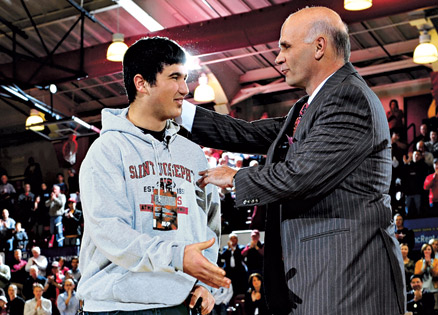
I thought I had hit on the perfect motivator one day when I overheard one of Lenny’s therapists say, “Hey, Lenny, your last name’s Martelli. Any relation to Coach Phil Martelli?”

He was talking about the basketball coach at Saint Joseph’s University in Philadelphia, celebrated for transforming a tiny Catholic university basketball program into a national powerhouse.

Lenny brightened. “Coach Phil? No, we’re not related. But still it would be really cool to meet him.”

Quick as I could I was on the phone to the Saint Joseph’s athletic office asking if maybe Coach Phil could send Lenny a note. Imagine my surprise when an hour later my cell phone rang and the coach himself told me he wouldn’t be sending an encouraging note–he’d be coming to visit Lenny.

“How does Wednesday afternoon at four work for you?” he asked.

“Um, Wednesday afternoon would be great,” I stammered. I figured it was better not to tell Lenny in case the coach ended up not being able to make it.

But sure enough, at four o’clock sharp on Wednesday, Coach Phil strode into the hospital room and shook my astonished son’s hand. We compared family notes. No, we weren’t even distantly related.

“We share a great last name, anyway,” said Coach Phil. Then he turned serious. “Tell me, Lenny, how’s the rehab coming?”

Lenny’s grin faded. “Still can’t walk,” he mumbled.

Coach Phil wasn’t fazed.

“You’re rebuilding, Lenny. That takes time,” he said. “I’ll make you a deal. When you’re walking again–and notice I say when not if–I’m going to have you join me at the Saint Joseph’s basketball arena and we’re going to walk to the center of the court together and wave to the fans. That will be this upcoming season. What do you say?”

Lenny looked at Coach Phil. I knew that expression on my son’s face. It was that determined, “I’m not going to give up” look he wore when one of his coaches asked him to push himself to the next level. “Okay, Coach,” he said, “that’s a deal.”

Lenny worked even harder in physical therapy, and Coach Phil called regularly to check in on him. I searched all over for more exercises to do with Lenny in his room. I made sure he kept up with his schoolwork and got plenty of visits from his friends.

But the five percent I’d been clinging to, the miraculous results I’d been praying for? We were still waiting for that.

What was left for us to try? I wondered. Or did I need to let go of that five percent and face the fact that Lenny was a part of that 95 percent who would never fully recover?

Maybe it was time for me to pray for something else–for fortitude to walk whatever path the Good Lord set for us and thank him for my son’s life.

I looked down at my hand. I was clutching a prayer card that someone had given to us. On it was a picture of Padre Pio, an Italian friar born in the nineteenth century who went on to become a saint. Padre Pio’s simple advice to believers was: Pray, Hope and Don’t Worry.

But how could I not worry? I’d tried everything and my son was not recovering. A bit of light filtered into Lenny’s room from his window and I held the card up to read the prayer printed on one side.

At the end of the prayer I was supposed to state what I was asking for. “I confidently beseech you, Lord, to grant me the grace of healing for my son.” I said those words over and over. The prayer was so short. It seemed tiny compared to the monumental miracle we needed.

I said the prayer until it seemed that I was saying it in my sleep.

I sat up with a jolt. Had I dozed off? Well, I was awake now, because I realized that Lenny and I weren’t alone in the room. A figure stood by the door.

I squinted to try to see more clearly. It wasn’t a doctor or a nurse. It was a man wearing a long robe made of rough fabric and tied around the waist by a rope. Okay, I thought, this is weird. There’s a friar in the room with me. I should have been freaking out. But I wasn’t.

The figure radiated peace and calm. He walked slowly to Lenny’s bedside and stood looking down at my son. He then laid his hand on Lenny’s right leg, the one that always gave him the most trouble in therapy. The hand rested there for a moment, then the figure backed out of the room.

I let out a long breath. What on earth had just happened? I looked at the prayer card again. Pray, Hope and Don’t Worry. Relief began to trickle through me, then surged, as mysterious as the figure of the old friar who had just visited.

For the first time in ages I did not feel worried. I leaned back, closed my eyes and dropped back to sleep.

The next day in the therapy room, two therapists put their arms around Lenny’s waist and shoulders. He stood, able to put weight on his legs. “Let’s try something new,” they said.

“Okay,” said Lenny. “What do you want me to do?”

“Walk.”

Lenny took a step with his left foot, then another with his right. All of a sudden, before any of us quite realized what was happening, he was walking. Supported by the two therapists, he made it to the end of the hallway and then turned around.

“Whoa,” he said, looking startled. “How did I get here?” A huge grin and he answered his own question. “I walked!” He headed back up the hall toward me. “Mom!” he cried. “I’m walking!”

Lenny’s progress was rapid after that amazing–dare I say, miraculous?–night. He walked farther and farther, step by step, each day, first with someone supporting him, then using the bars along the hallway and finally using nothing but a pair of canes.

Soon he was back home getting ready to return to school.

A few months later, leaning on his canes, he indeed walked out onto the Saint Joseph’s University basketball court to wild applause, just like Coach Phil promised he would. Not if, when.

Today Lenny is back at school and doing everything he used to do, except sports.

I still can’t say for certain what really happened that night in Lenny’s hospital room. Obviously, God performed a miraculous work of healing. But I think there’s a little more to it than that. Maybe the real miracle is in those simple words of Padre Pio’s: Pray, Hope and Don’t Worry.

I’d wanted healing for Lenny and I’d worried I wasn’t doing enough to make it happen. I’d forgotten God has his own timing and his own way of working.

The doctors, the physical therapy, the visits from Lenny’s friends, the wonderful visit from Coach Phil–those were all part of the miracle of Lenny’s healing. There’s a saying, “Give time, time.” Perhaps time is one of the greatest healing miracles of all.

Maybe Padre Pio did visit us that night not so much to heal Lenny as a reminder from God that healing was already underway. Pray, Hope and Don’t Worry. These days I do all three.

Download your FREE ebook, True Inspirational Stories: 9 Real Life Stories of Hope & Faith.

16 Norman Vincent Peale Quotes About Positivity

Norman Vincent Peale (1898 – 1993) was a clergyman, speaker, and author best known for his best-selling book The Power of Positive Thinking. He was also pastor of Marble Collegiate Church in New York City, one of the oldest continuous Protestant congregations in North America, and hosted The Art of Living, a radio program on the air for a record-setting 54 years. In 1945, Peale, along with his wife, Ruth Stafford Peale, and others founded Guideposts magazine. And in 1984, President Ronald Reagan awarded Dr. Peale the Presidential Medal of Freedom, the highest civilian honor in the United States.

Even after his death on Christmas Eve in 1993, Peale’s writings on positivity endure. Whether we are facing grief, financial troubles, or job loss, his wise words can lead us to a place of hope. Here are 16 powerful Norman Vincent Peale quotes:

Positive Thoughts for Every Challenge

Now faith is being sure of what we hope for and certain of what we do not see. (Hebrews 11:1, NIV)

I love the expression, “Never underestimate the power of perspective.”

In fact, I just ordered a wall plaque with that exact saying for my office so I’ll constantly be reminded of that truth.

Having positive thoughts is so important. Truly, it can change the whole atmosphere. I was recently reminded of that truth during my bible study time as I read the story of the prophet Elisha found in Second Kings, Chapter 6.

Do you remember the story of Elisha and his servant when they were being attacked by King Aram’s army? King Aram was very angry with Elisha because Elisha was always spoiling his plans to destroy Israel. Every time King Aram and his troops would plan an attack against the Israelites, Elisha would warn the King of Israel. Finally, King Aram could stand it no more, so he sent his army to kill Elisha.

That night, King Aram’s army surrounded the city where Elisha and his servant were sleeping. When they awoke the next morning, the situation appeared grim. Elisha’s servant panicked, saying, “Oh, my lord, what shall we do?” Elisha didn’t panic. Instead, he prayed, “O Lord, open his eyes so he may see.”

At that moment, the Lord opened the servant’s eyes, and he saw the hills full of horses and chariots of fire, totally surrounding and protecting them. Suddenly, King Aram’s army didn’t seem quite so threatening.

You might say the servant got a new perspective. He went from total panic to “bring it on!” Once he saw that God had their backs, he was no longer fearful.

That’s what we all need—healthy, positive thoughts. Why not ask God to help you see every situation through His eyes. Ask Him to help you see your world differently, so that you can face every challenge with a positive attitude. If you’ll walk in faith, not fear, you’ll enjoy every day so much more and face every obstacle with a “bring it on” attitude.

Pray this with me:

Father, thank You for loving me and for always having my back. Help me, Lord, to walk in faith, not fear, and to have a positive attitude no matter what is going on around me. I trust You, Lord. In the Mighty Name of Jesus, Amen.

Positive Thinking Tip: Take a Nap!

Sorry, I should have finished this blog last Friday. Or at least over the weekend. But between the gray, dreary fall weather and the cold I was fighting, I kept succumbing to one of my very favorite temptations: the afternoon nap. Something we deem absolutely necessary for children’s wellbeing yet consider laziness or, at best, an indulgence, for ourselves. Why is that, when we adults are the ones more likely to be sleep-deprived?

Well, I’m here to say, bring back the nap! And not just on weekends, either. Napping is good for your health, your positive attitude and your performance. Cornell psychology prof and sleep researcher James B. Maas has found that a 15- to 20-minute power nap (he coined the term) helps people be more productive, alert and cheerful the rest of the day. (My naps were longer and I didn’t accomplish more than usual afterward—thanks to my cold—but I certainly felt better, physically and mood-wise.)

Two recent studies show more positives to napping. Matthew Walker of UC Berkeley tested a group of adults on fact-based memories. He had them learn 100 pairs of faces and names, then match them up. Afterward, half the group was allowed to take an afternoon nap of up to 90 minutes. The other half stayed awake. When they were tested again in the evening, those who didn’t nap saw their performance drop by 10 percent. The nappers, meanwhile, actually improved 10 percent.

Allegheny College researchers Ryan Brindle and Sarah Conklin had their study participants either stay awake or take up to an hour-long nap during the day, then measured their blood pressure during and after a mental stress test. Blood pressure rose in both groups during the test (they had to do complex subtracting exercises in their heads, which would definitely cause me stress) but afterward, the people who napped for at least 45 minutes had significantly lower blood pressure readings than the non-nappers, indicating better cardiovascular recovery from stress.

You probably can’t sleep for 45 minutes during the workday, but try a power nap. I bet you’ll wake up feeling refreshed. Happy napping!

Now, if you’ll excuse me, I’m going to lie down and close my eyes for 15 minutes…

Positive Thinking Tip: Take a Minute Vacation

It’s an exciting time here at the Guideposts editorial office. Not only are we putting out our mainstays, Guideposts and Angels on Earth, but we’re also putting together two other publications: this year’s special keepsake holiday edition, The Joys of Christmas 2012, plus (drum roll, please) the first-ever issue of Mysterious Ways magazine.

It’s also a very busy time, since the same staff is working on all four publications. Hard to take a day, let alone a whole week, off with so much going on. But I know taking the occasional break is key to staying positive. So what have I been doing?

When I feel my positive attitude drooping, I take a minute vacation. I’m not certain of the origin of the phrase, but I think it comes from a prayer by Wilferd Arlan Peterson, who wrote inspirational essays for the Sunday newspaper supplement This Week: “Slow me down, Lord… Teach me the art of taking minute vacations, of slowing down to look at a flower, to chat with an old friend or make a new one, to pat a stray dog…”

Anything that takes your mind to an unhurried place (or time or both) will work. Need some inspiration for your minute vacation?

Look at photos from your favorite actual vacation. Or be like me and take a vicarious vacay—check out Kevin Russ’s photostream of his road trip out west (the guy took all of those stunning shots with his iPhone!).

Watch a video meditation, like our video on the beauty of flowers.

Eat some juicy, just-ripe fruit (berries are great right now). Or a piece of really good chocolate.

Read a poem or prayer that transports you. Read it out loud even, so you can hear the rise and fall and rhythm—the music—of the words. One I came across recently is “Our Valley” by poet laureate Philip Levine. I saw just the one line “wait on the wind, catch a scent of salt, call it our life” on a poster and felt compelled to look up the rest.

Speaking of music, sit back and listen to a song with a mellow vacation vibe.

Enough from me. Enjoy your minute vacation!

Positive Thinking Tip: Swim in Your Own Lane

My colleague Rick Hamlin uses his morning commute as a time for prayer, and he often reads from Psalms on the subway. Now that I’m commuting by subway (our new office is a little too far to walk), I’ve taken to reading on the train too. Nothing quite as edifying as Scripture—I’m usually working my way through The New York Times Magazine that I didn’t get to over the weekend.

That’s what I was reading this morning when I came across a piece of surprisingly uplifting advice. I was surprised, anyway, because it came up in an article about why there are still so few women in science. The writer, Eileen Pollack, recalled being the only female student in her introductory physics class freshman year at Yale. That was intimidating enough, but worse was seeing the boys in the class breeze through the material while she struggled to grasp the basics.

She got a 32 on the midterm. Disheartened, she went to her professor, Michael Zeller, for permission to drop the class. Clearly her dismal grade meant she wasn’t any good at physics, she said.

“Just swim in your own lane,” Professor Zeller told her.

What was that supposed to mean?

He explained that he’d been on the swim team as an undergrad. He was a strong swimmer yet he kept coming in second in races. Until his coach pointed out what was holding him back: “You keep looking around to see how the other guys are doing. Keep your eyes on your own lane, swim your fastest and you’ll win.”

It was good advice for Eileen Pollack, who not only stuck it out in the intro course but ended up majoring in physics and graduating with highest honors.

It’s also good advice for keeping a positive attitude. Don’t fall into the trap of constantly comparing yourself to other people. You’ll just end up feeling less than.

Swim in your own lane. Try your best. You just might discover that it’s even better than you expected.

Positive Thinking Tips: Snap Out of It!

Last week I blogged about a neat trick with a pencil that gives your attitude an instant lift. That reminds me of another simple yet surprisingly effective positive thinking technique. All you need for this one is a rubber band—and a willingness to change your attitude.

Slip the rubber band on your wrist like a bracelet. Every time you have a negative thought, snap the band—hard enough that it stings—and literally snap yourself out of that downer mindset.

Then—and this is important—replace the negative thought with a positive thought, one that’s affirmative and empowering. If you constantly put yourself down, try building yourself up. Instead of berating yourself, How could I be so stupid? remind yourself, Everyone makes mistakes. I’m smart and determined. Here’s how I’ll learn from this one…

If you tend to think the worst in a stressful situation, look for a bright spot. Say your flight’s delayed. Nothing ever goes right for me, you moan. Snap! Hey, I can call my old friend and catch up. Or, Wow, I actually have time to read my favorite magazine cover to cover. (I hope it’s Guideposts!)

Keep at it and you’ll see your negative thought patterns transformed into positive thinking.

Need some real-life inspiration? Read Guideposts Writers Workshop alum and frequent contributor Susan Karas’s terrific story about how a little green rubber band helped her shed not only a few pounds but also what was really weighing her down—her negative attitude.

Positive Thinking Tips: How to Fight Your Fears

There are two kinds of fear: normal and abnormal. Normal fear is necessary for our protection. But abnormal fear is something altogether different. It’s a crippling affliction that produces painful symptoms, such as depression, anxiety and, in some cases, physical illness.

The only fear we should have is the fear of God and doing wrong. That fear doesn’t mean being scared; rather, it’s an awe-filled respect of God and of what is right. We should walk unafraid. But that’s not easy; we have to consciously build up our faith.

1. Practice Affirmation
You may know some people who have become absolutely fearless. These are people of profound faith. “That is what I would like to be,” you may say. “I’m tired of being afraid of possible catastrophes, of other people, of illness. I want to be free from fear.”

The first thing you must realize is that most of the things we’re afraid of probably will never happen. One absolute and positive way to let go of your fears is to practice the form of prayer known as affirmation—not the prayer that asks for something, but the prayer that affirms. Instead of praying, “O Lord, please deliver me from fear. I’m so upset and anxious.” Rather, affirm that God is already doing it, and you will let go of fear.

Believe that God loves and watches over you that He is taking care of you this very moment and, therefore, you need not be afraid.

One of the elders of Marble Collegiate Church, where Rev. Norman Vincent Peale served as pastor for over 50 years, related an experience he had in the hospital. At one point, he was gripped by fear. “But,” he said, “I knew that many people were praying for me. So I began to affirm that these prayers were taking effect and that the Lord was hearing my own prayers. As I did this, all of a sudden every vestige of fear seemed to leave me. I was at peace and rest, and felt absolutely confident.”

2. Stand Up to Fear
Fear can’t really be avoided; it has to be met head on. If you’re not willing to go to the heart of what you’re afraid of, fear will haunt you constantly. President Theodore Roosevelt once said, “I have often been afraid, but I wouldn’t give in to it. I made myself act as though I was not afraid, and gradually my fear disappeared.”

One example of where fear might present itself is when you’re trying something new. When a child enters a new school, or when a man or woman starts a new job, they are bound to be at least a little fearful. But, if they act with confidence and faith, fear will vanish and be replaced with a glowing sense of accomplishment.

3. Let Fear Motivate You

Kenneth McFarland, a wonderful speaker, once told this story:  A man who worked until midnight every night usually walked home. One beautiful moonlit night, he thought he would walk through the cemetery, rather than around it, because the way was considerably shorter. He did this for several nights, until the moon began to wane. By then, however, he knew the path through the cemetery, and even though it was absolutely dark, he felt he could walk through safely.

But, one night, as he walked along in the darkness, his feet suddenly went out from under him, and he found himself grabbing dirt and sliding into a newly dug grave. He tried his best to get out, but he was too short and the grave was too deep. All he could do was pull a lot of loose dirt down on himself. Being a practical man, he reasoned that the grave diggers would come back the next morning. So he pulled his coat around him, huddled into a corner of the grave and tried to sleep.

An hour later, another man came along through the cemetery. All of a sudden he too slid into the grave—at the other end—and started making futile efforts to climb out. Finally, as he stood contemplating his situation, the first man spoke up and said, “Boy, you’ll never get out that way.” But the second man did—like a shot!

You see, this second man (and for that matter, the first one, too) had the potential for getting out of that hole; but the potential needed motivation. This story illustrates that the potential for lifting ourselves up out of defeat is within you, within me, within everyone. It just needs a strong catalyst.

Positive Affirmation
Respect God, do what is right, and you will walk unafraid.

Positive Thinking Tip: Read Fiction!

Do you want to be a more positive person? Since you’re reading this blog, I bet your answer is yes. Here’s something you can do that will help you have a more positive attitude toward other people and better interactions with them. And it’s something that might surprise you: Read fiction.

You’re probably wondering, Can an imaginary world change how we act in real life, even make us better people? Lovers of literature (bookworms like me) have long believed so, and now neuroscientists have found evidence to back that up. It turns out that in terms of brain activity, there isn’t much of a difference between reading about an experience and actually experiencing it. Studies using functional MRI (fMRI) scans have shown that a description of a movement stimulates the same region of the brain as performing that movement. For example, reading a sentence about kicking a ball lights up the part of the motor cortex that controls leg movement.

Community Newsletter

Get More Inspiration Delivered to Your Inbox


Same goes for social interactions. Raymond Mar, a psychology professor at York University in Toronto, reviewed dozens of fMRI studies and found that the brain areas we use to comprehend stories (in which fictional characters interact) overlap with the brain areas we use in real-life interactions to understand the thoughts, emotions and motivations of others.

Other research by Mar and Keith Oatley, a cognitive psychologist at the University of Toronto, takes that connection further. One study found that people who read a lot of fiction are more empathic (they were significantly more accurate at guessing the mental state of others in a standard psychological test) and socially intelligent (they were also better at interpreting social cues in video clips of interactions) than those who don’t read much fiction.

But is it that more socially adept people are inclined to read fiction or vice versa? In a subsequent study, Mar and Oatley controlled for personality traits associated with social intelligence and randomly assigned people to read either a short story or an essay. Still, the fiction readers “showed a stronger understanding of social situations” than the non-fiction readers. The conclusion? As Oatley puts it, reading fiction “measurably enhances our abilities to empathize with other people.”

And the better able you are to understand other people’s thoughts and feelings, the more positive your interactions with them will be. Which brings me back to what I said at the beginning. Want to become a more empathic, understanding and positive person? Pick up a good novel and dive in!

Positive Thinking Tip: Look at Art

An ad caught my eye recently, from the Metropolitan Museum of Art. It showed an art collection splashed across the sides of city buses—paintings by Sargent, Picasso and Warhol and a photograph by Walker Evans. (Who expects to see great works of art on public transportation?)

What held my attention was the quote that accompanied the collection, from actress and writer Kristen Wiig. For the new ad campaign, the Met asked celebrities to choose their favorite works of art and tell what the museum means to them. I love what Kristen Wiig said: “Art is proof that anything is possible.”

She so perfectly expresses why I think looking at art is such a wonderful way of staying positive. I’d even argue that art appreciation is a form of positive thinking. It’s a reminder that there are no limits to the imagination, to where our minds can take us.

And by art, I don’t mean only what’s displayed in museums. There are works of art all around us, all over the web. Here are just a few examples I’ve come across lately, each inspiring in its in own way:

Hand-painted walls by Ava Roth
My jaw dropped when I saw this on Design*Sponge. Ava Roth painted the walls of her dining room freehand, bit by bit, over the course of a year, turning it into a wooded wonderland. This is my favorite section because of the wolf; click through above to see the whole room.

“Meet me in the sunshine” by Dominique Falla
Dominique Falla, an artist based in Australia, has a whole series of these works, which she calls “tactile typography.” Created with the simplest materials—nails and string—and infinite patience.

“Dark Side of the Lens” by Mickey Smith
This video from surf photographer/filmmaker and self-described “Cornish gypsy” Mickey Smith is mesmerizing. I think it has the feeling of a prayer—awestruck and grateful.

Positive Thinking Practice: Nobody’s Perfect!

It was after 10 p.m. on Christmas Eve, but you wouldn’t know it from our house. My twin sister, Barbara, and I pressed our noses up to the big picture window in the living room, searching the Detroit streets for our father’s ’39 Chevy.

“Mom and Dad have got to be home soon,” Barbara said.

“Sure they will,” I said. “They’ll bring the tree, I bet. Then we can decorate. Maybe they got held up in traffic. Or something happened with the car.”

I didn’t look Barbara in the eye when I said it. We were only 10, but this wasn’t the first time we’d been left alone at night, anxiously waiting for our parents. They weren’t stuck in traffic. This late on Christmas Eve the streets were empty. Our parents were surely in a bar somewhere, drinking, not even thinking about us. But they couldn’t forget us completely on Christmas Eve, could they? Of course they could, I answered myself. They’d let us down so many times before. Why believe in them now? Why believe in anything?

We waited and waited, but Mom and Dad didn’t come home. “I’m going to bed,” I said finally, turning from the window. “There’s nothing to wait for.”

Barbara grabbed my arm. “Let’s hang up our stockings,” she said. “We can do that, at least.”

We rummaged around in Dad’s dresser and pulled out his largest pair of socks. They looked sad hanging on the mantel. Sad like Barbara and me. “Tomorrow everything will look like Christmas,” Barbara said dreamily. “When we wake up there will be lights and a tree, presents…”

“And Jimmy!” I said, feeling joyful for the first time that night. “He’ll come early in the morning and be here all day!”

Jimmy was our older brother and the one thing I could always believe in. Even when he got married and moved out of the city, Jimmy was always there when we needed him, with his big smile and even bigger laugh. He made sure Barbara and I had everything we needed for school. He brought groceries by if Mom and Dad forgot to shop. He took us to the doctor if we got sick and stayed with us when our parents left us alone for long stretches. That’s what I would put faith in this Christmas. Jimmy. He’d never let me down.

“When he comes in the door,” I said as we climbed into our beds, “he’ll say ‘Ho ho ho!’ like Santa.”

Jimmy will make it feel like Christmas, I thought as I drifted off to sleep. I don’t need anything else.

A loud noise woke me up. “What is it?” I whispered in the dark. The clock showed it was a little after midnight. A long way from Christmas morning.

“The front door just slammed,” said Barbara. “Mom and Dad are home!”

Loud, hysterical sobs rang through the house. “How could you let this happen?” Mom screamed.

“How could I let it happen?” Dad yelled back. “It’s not my fault!”

Barbara and I clung to each other as the yelling continued. A few minutes later footsteps stumbled up the stairs. Our bedroom door burst open and Mom turned on the light. Her face was streaked with tears. Her hair was disheveled. “We have something to tell you,” she announced, her words slurred. “There will be no Christmas in this house tomorrow. Just stay in bed.”

Dad pushed his way in beside her. “I picked up your gifts from layaway on the way home from work,” he said. “I got them right on time. Your mom and I were visiting friends.”

I squeezed Barbara’s hand. We both knew what <em>that</em> meant.&nbsp;

“Someone broke into the car and stole everything!” Dad said. “Even the tree tied to the roof! Just took it in the street! Of all the low-down, dirty…”

Dad let loose a tirade. I felt like I might be sick. It was a relief when they shut our door and continued their argument in their own room. Barbara and I clung to each other. Even though it was after midnight, Mom called up Jimmy and told him the story. I could hear every word through our bedroom door. How I longed to run to the phone myself, to hear Jimmy’s voice, imagine his kind smile as he found a way to make things better. He was the one person we could count on. But even Jimmy couldn’t fix this. How could he find all that stuff?

“So forget about Christmas this year,” Mom finished up on the phone. “It’s canceled. And one other thing:&nbsp;I’m leaving your father!”

“Mom’s leaving?” Barbara said.&nbsp;

“What’s going to happen to us?” I whispered. “Where will we live?”

A moment ago no Christmas seemed like the worst thing in the world. Now we were losing our family too. Jimmy couldn’t fix this either. I pulled the covers over my head. There was nothing to go downstairs for. I thought about praying to God and telling him I didn’t need any presents or decorations or Christmas tree. That I just wanted my family back. But God was just another thing I couldn’t believe in.&nbsp;The next morning I woke up early. Barbara was already sitting up.&nbsp;

“We’re not supposed to get out of bed,” I mumbled, pulling the covers back over my head.

“Well, I am,” Barbara said. She climbed out of bed and put on her slippers. “I’m going downstairs.”

“There’s no Christmas down there,” I reminded her, but I pulled on my robe and followed. The house was so quiet, every creak of the staircase echoed off the walls. Mom and Dad were fast asleep in their room. Barbara and I crept to the bottom of the stairs, into the living room and then she grabbed my hand. “Look!” said Barbara.

There, in front of the picture window we’d stared out for so long the night before, stood a magnificent Christmas tree. Big glass balls hung from its branches and underneath were dozens of brightly wrapped packages. Even the old socks on the mantel were stuffed with fruit. It was like a dream.

“Do you see what I see?” I breathed. Maybe I was dreaming.

“Come on!” she said.

We rushed up the stairs into our parents’ room. “You were wrong!” Barbara yelled, jumping onto the bed. “We are having Christmas! Come and look! Hurry!”

Mom and Dad stumbled down the stairs, and stopped short when they saw the Christmas lights. One look at their faces proved they hadn’t provided any of this. But then who did?&nbsp;

Barbara ripped the paper off the biggest box. “It’s a farm set!” she shouted. “Look, animals and everything.”

I went for a big red package with my name on it. Funny, none of the presents were wrapped like the way they usually were at Christmas—haphazardly. Like someone had done it as an afterthought. These presents were so perfect, I almost hated to tear the paper. But I did! “I got a doll house!”&nbsp;

“It’s beautiful, Anne,” said Mom. Her voice was different. Softer. She was truly amazed by the scene around us. She was sitting beside Dad on the couch. She reached for his hand!

Usually, being twins, Barbara and I got identical gifts. This year we didn’t get a single present the same. More proof that nothing about these gifts was ordinary. They were special in every way.

As wonderful as the gifts were, they were all forgotten when we heard Jimmy at the front door. “Ho ho ho!” he called, just like we knew he would. Barbara and I pulled him into the living room and showed him all the presents.&nbsp;

Jimmy looked at my parents in surprise. “I thought…?”

“We don’t know how any of this happened,” Mom said. She moved closer to Dad, and he put his arm around her. “How could all these things just appear?” Dad said. “It’s impossible.”

“Well, you know what they say,” Jimmy said, with that chuckle I loved so well. “Christmas is a time for miracles. That’s your explanation.”

I thought. I didn’t believe in miracles. But what other explanation was there? Maybe God really did send angels to bring us our Christmas and answer the prayer I’d been afraid to make. Maybe there were more things in the world I could believe in. Mom didn’t leave Dad that day—or ever. Together, the two of them got help for their drinking problem. Somehow that Christmas miracle was the push they needed.

In the many years since, I’ve retold the story to my children and grandchildren. I never could figure out any other explanation for all those decorations and presents. “If Mom and Dad didn’t do it, how did it happen?” I said to Jimmy finally during a visit.&nbsp;

He chuckled. His face was lined now with age, and he was not in the best of health, but he still had the same smile and the same laugh. “I guess I can tell you now,” he said. “When Mom called me that night and told me what happened, I knew I had to do something,” he said. “So I called some friends. I still remember going door-to-door in the middle of the night collecting decorations and presents people had to spare. We even found a leftover tree in a vacant lot. Once we had everything I drove to the house. I pried open the basement window, and my friends and I squeezed in. It was just before dawn when we slipped out again. I only wish I could have been there to see your faces when you came downstairs!”

I had the answer to the mystery after all those years. “But we never thanked all those people. Why didn’t you tell us it was you?” I asked, but I realized I already knew the answer. I had always believed in Jimmy, but Jimmy wanted me to see there was something more to believe in. Jimmy gave us our Christmas, but God gave us our miracle.&nbsp;

Sometimes our problems—financial and otherwise—stem from our own bad judgment. A young man came to me quite dejected and depressed. He kept asking himself: “Why did I do it?” What’s wrong with me? I had the opportunity of a lifetime and I blew it!”

This 29-year-old man had been fired from a good position with a prestigious firm because, he said, he had made a serious mistake. Although it seems strange that a company would discharge someone for one blunder, I remembered the words of a prominent businesswoman, who had said to me: “He who stumbles twice on the same stone deserves to break his own neck.” In other words, in her opinion, a person should be allowed one mistake, but not two.

Aren’t we blessed that God allows us so many more slip-ups! In that spirit, here are three suggestions to help you deal with the times you slip up.

1. Learn from Your Mistakes

Every mistake has a positive side and so we can see errors in judgment and mistakes as developmental experiences, something that can help us grow. In fact, it’s partly through trial and error that we develop judgment and mature.

<p>A mistake is not something to be ashamed of. It’s a great teacher. A West Coast minister, a friend of mine, told me about a 19-year-old boy who came to see him. The boy sat with his head in his hands. He then blurted out: “For God’s sake, pastor, help me. I smoked pot for months, and now I’m on crack. I’m all messed up inside. I know I’ve made a terrible mistake. But if I can only get myself straightened out, I’ll never go back to doing drugs again.” The pastor, being a wise man, showed the boy love, respect and esteem. He also referred the boy to doctors who could help him overcome his chemical dependency. “And,” he told this boy, “through faith in God, you can create a chemistry within you that will give you a ‘high’ unlike any drug known to man. Then you will truly ‘come alive’.”

2. Replace Error with Truth

There’s always the temptation to repeat mistakes because so often they stem from an inner tendency of ours. This is an issue we must all understand and address. If our mental or spiritual condition is not right, we can become error prone. The correction for this is, of course, truth.

Have you developed the ability to distinguish between what is error and what is truth? We may try to make error into truth by rationalization, but that’s not possible. The issue is whether you are willing to ask yourself honestly: What will dominate me, truth or error?

3. Eliminate the Cause

We, in greater or lesser degrees, destroy ourselves to the extent that error dominates us. Here’s an exercise that can help us face up to where we are error-prone in our lives.

Take a sheet of paper and write down the really serious mistakes that you’ve made in your lifetime. Now ask yourself: How can you eliminate weaknesses?

A man once told me, “I’ve had a wonderful spiritual experience that I’d like to tell you about.” I initially thought that the man was going to tell me that he was a converted drunk or thief, or that he’d been running around with someone else’s wife and had stopped. But this man’s difficulty was different.

“I was what you’d call a good man,” he said. “I didn’t lie; I didn’t get drunk; I didn’t do immoral things. But, I was just plain dumb. I did the wrong thing so many times, that I felt hopeless and depressed.” The man then said that he had read in my books that anybody can change just about anything in his life, if he’ll turn his life over to God.

Positive Affirmation

Fill your mind with truth, and truth will cast out error.