Embrace God's truth with our new book, The Lies that Bind

Letting Go of Worry

God replied to Moses, “I Am Who I Am. Say this to the people of Israel: I Am has sent me to you.” Exodus 3:14

Worry had returned.

I sat on the porch, while my family slept, and I wondered why nighttime gave it strength.

Earlier in the evening, I’d spent a few hours talking with friends and finding a bit of comfort knowing that worry is a foe most of us battle. It runs through our humanness as a common thread.

That night, on the porch, it was gripping.

I rocked back and forth on our old rocker, the gentle creak breaking the silence of the night, the way that worry had broken into my mind.

So, I sat still, perfectly still. And one thought became powerful and clear:

When worry is gripping, I need to reach for something else.

When I think about it, this is a critical place. This is where faith lives and breathes. This is the tender spot where I release the what-ifs and troubling possibilities. I’m at a place of choosing. Either I hold worry or I open my hands, let it go, and reach for the Lord.

READ MORE: WELCOME REST

I wanted to reach.

I AM is one of my favorite names of God. When the Lord revealed Himself to Moses at the burning bush and commissioned him to stand face-to-face with Pharaoh and lead Israel out of Egypt, Moses was afraid. Anxious. He questioned God. Then he asked, “What if they ask for your name? What do I tell them?”

God’s reply was powerful: I AM WHO I AM.

And He is unchanging. Moses’ God is my God too. He’s the Lord of glory. Strength. Power. Faithfulness. He’s our Provider and Protector.

That same God is present in my circumstances.

Thank you, Lord.

I sat the darkness that evening and spoke His name aloud.

Because of I AM, I can give up control.

Because of I AM, I can trust.

Because of I AM, I can hope.

I looked again at the vast, dark sky, the sky that stretched past where I could see. Suddenly, sitting there, I felt small. Not insignificant and small, but small when compared to His endless power, love and grace. My worry felt smaller too; it was too much for me to hold.

I belong to the great I AM WHO I AM, and when I reach for Him, I can let go.

Letting Go of Regrets

The giant flounder latched onto the hook on my husband’s fishing pole. The water churned as the fish tried to get away, but Paul kept reeling him into shore. That fish was huge–the biggest flounder he had ever seen.

Golfers at the course across the lagoon stopped playing to watch. They cheered Paul on as he reeled…and reeled…and reeled, until the fish got almost to land. And just as Paul started to pull him onto the bank, the unthinkable happened—the line broke.

The golfer audience yelled, “Nooooo!” And my dejected husband kept muttering. “It was the biggest flounder I’ve ever seen. I almost landed it.” And that’s when the “if’s” started. “If only I’d had a stronger test line so it wouldn’t have snapped.” And, “If only I’d had a net with me. I could have pulled him in.”

Read More: Mornings with Jesus Devotional

Those “if only” statements were uttered again when we loaded the fishing equipment into the SUV, when we unloaded the fishing stuff back at the villa, when we got inside the villa, when he changed the line to the new stronger one.

At dinner, I’d finally had enough. I said, “Honey, I’m tired of hearing about it. You didn’t have the stronger fishing line on the pole, and you didn’t have the net with you. All those “if’s” won’t make any difference. Don’t let it ruin our vacation.”

But that night after we went to bed, I started thinking about all the “if only” moments in my own life. If only I hadn’t done that. If only I could do it over again. If only I’d spent more time with my mom (or dad or children or grandparents). If only I’d known we didn’t have much time left together.

But as my husband learned with the monster-sized flounder that got away, all the “if only’s” in the world won’t make any difference. Now, instead of “if only’s,” we’ve decided to look back on moments where we can say, “I’m so glad I did.”

Letting Go of Guilt

Autumn has given us a prize. Balmy air. Trees beginning to gild gold. The boys, my nieces and I walk along the river, chasing every moment of this day.

“Should we stop for ice cream?” I ask. There’s a shop nearby, and I have money in my pocket.

When we get there, I go wild and stray from our one-scoop routine. “Order what you like,” I say. Five children wear smiles that beam wide.

Then I see the gentleman. He’s observing with kind, gentle eyes. The kids tilt their heads to read the menu and murmur about M & Ms and hot fudge. But I watch the gentleman watch my kids.

His shoes have seen miles. There’s a hole at the elbow of his shirt. When he smiles, I can see that he’s missing teeth.

But he reaches to his pocket and begins to count bills.

The clerk asks for our order, and the kids share what they would like. The girl rings our total and the gentleman comes near. “I’d like to pay,” he says. “Your children are well behaved and thankful. I want to give them this treat.”

I’m surprised and am not sure of what to do. Tenderness floods my soul. But I’m worried for this man so I stammer and refuse. “That is very kind, Sir. Thank you. But I can’t. There’s too many, and it’s too much.”

“It’s my pleasure,” he says. He pushes the bills forward.

The clerk looks to the gentleman and back to me. The children are looking too, and I can feel my cheeks turn red.

“Thank you,” I say. “I’m grateful. But I can’t. No.”

Embarrassment flushes his face red, too. He stands for a moment, money in hand. The children thank him, and I fish through my pocket for my own bills. When I turn around, he’s gone.

And for the rest of the day, when the children relay the story to my husband, I berate myself for shaming this man. For taking away the blessing of giving. For deciding what he could and could not do.

I even carry it to bed with me, and in the night, I dream and see that man’s face. I wake with agony in my heart, regret pressing hard and my shame filling my soul. I can forgive others, but it is sometimes so hard to forgive myself.

And it’s here that the Spirit meets me.

There is no condemnation for those who are in Christ Jesus.

It takes a few moments for me to accept this truth. At first I reject it, as I’d rejected the man’s offering. But as I sit, in the hush of the night, I understand that the Lord loves this gentleman. This man is in His care.

I am too.

I’m covered by grace, and I can let go.

And in this, at last, I can find rest.

Letting God Set the Pace

Olympic Stadium, London, August 4, 2012. Minutes before the race of my life, the finals of the men’s 10,000 meters. I wasn’t running. I was a spectator. Below, taking their places, were two runners I’d spent years coaching. Many, many hopes rested on those two men.

Mo Farah, a 29-year-old from England, carried his country’s dream of Olympic gold. Galen Rupp, a 26-year-old from Oregon, had a shot at becoming the first American in decades to medal in an Olympic distance event.

Sometimes at big races coaches get to sit close to the runners. Not at these Olympics. I was in the stands like any other fan. Maybe that was better—better that my runners couldn’t see the tension on my face.

For more than a decade I had led a program called the Nike Oregon Project, an attempt to show the world that, with the right training, Westerners could once again compete in world-class distance running. For years Africans had completely dominated the sport.

The stakes were especially high at this Olympics. Doubts about the project ran rampant in the running world. Our runners had failed to finish higher than eighth place in the 2004 and 2008 games. It’s a vanity project, people said, Alberto Salazar trying to redeem himself.

I knew what they meant. I’d won four major marathons in the early 1980s. Then I flamed out and never won another marathon. I never won an Olympic medal.

Were the doubters right? Was I here for the wrong reasons? I certainly had cause to wonder. I’d made so many poor decisions in my life, in my running career. Yet an almost indescribable calm descended over me in that packed stadium in London. The gun sounded. The runners were off.

I couldn’t help but marvel at the peace I felt inside—the complete opposite of how I’d felt in my own running career. Maybe it was the competitive fire I’d inherited from my father, a hard-driving immigrant from Cuba who expected his kids to be Catholic, anti-communist and high achievers, in that order.

Or maybe it was just my own arrogance. Whatever it was, from the moment I started running in high school, I approached the sport like a one-man army. I ignored coaches’ advice and pushed myself beyond my limits. I bragged about my victories—it was the confidence of a champion, I thought.

I won the New York City Marathon in 1980, followed by two more New York City Marathons, and the Boston Marathon in 1982. Before I turned 25 I was ranked the top distance runner in America.

Then, just as my coaches warned, I began suffering injuries. Stress fractures. Torn tendons. Hamstring strains. I tried physical therapy, surgery, unproven cures. Nothing worked. A few short years after my burst of fame, I was finished, washed up.

Images of my own past races flitted through my mind as I watched Mo and Galen complete the first lap. They were several paces behind the leaders. Their strides looked good, exactly as we’d practiced. I trusted them to conserve their energy until the last few laps, when distance races are won or lost.

That strategy—conserving strength until it’s needed—was the foundation of the Nike Oregon Project.

I thought back to the day when I’d sat down with Nike executives to broach the idea. “I think Americans can win again,” I’d said. But was it true? It seemed as if American distance running had followed the same downward trajectory as my career.

Once regulars on the Olympic medal podium, Americans hadn’t won the men’s 10,000 meters since 1964. In the years since I’d stopped competing, I’d gotten married, had kids and taken a marketing job with Nike that kept me involved with running. But something was missing.

My parents had raised me to believe God is always in charge. Still, I struggled to accept the direction my life had taken. My critics were right about one thing. The Nike Oregon Project was my attempt to find a new path, to find redemption, if you will.

Mo and Galen began lap six. Several African runners held the lead. Suddenly a runner from Uganda stumbled, almost knocking Mo over. Mo lost his stride. The next moment he and Galen were both far behind. I took a deep breath, as if trying to inhale that feeling of calm.

Mo and Galen had 19 laps to catch up. Besides, wasn’t patience the first lesson I taught every Nike Oregon Project runner? “Race when your body’s ready—not before,” I always said. “I won’t let you make the same mistakes I did.” That meant training plans were designed to build slowly and sustainably toward victory.

It also meant an even more important lesson: “You need something bigger in your lives than running. If running is all you care about, like it was for me, you’ll burn yourself out.”

Religious faith is not a prerequisite for becoming a Nike Oregon Project runner. I don’t preach from the sidelines. But I don’t hide my faith, either. And many of my runners are people of faith too, particularly Mo and Galen. Mo is a Muslim, Galen a Christian.

Galen and I pray together before each race, and Mo joins occasionally to pray for family members in need. The two of them have become close friends. They’re roommates on the road. They’re both into soccer. They know each other’s families. They support each other on and off the track.

For years I taught this training philosophy, praying for some sign that it wasn’t, as critics said, just a vanity project. At times I doubted my own motives. Then one day I got a sign—though I had no idea what it meant at the time.

I was walking across the Nike campus with Galen and two other runners. Out of nowhere a crushing pain flashed in my neck. I sank to one knee. The world went black.

I awoke in the hospital. My wife, Molly, was there. “Alberto!” she cried. “You’ve had a heart attack.”

I’d had more than a heart attack. Despite years of running and maintaining my health, a rogue piece of arterial plaque had suddenly blocked blood from entering my heart. The heart muscle seized up.

For 14 minutes I’d lain on the pavement while a doctor and an Army medic recently returned from Iraq—both men just happened to be on the Nike campus that day—performed CPR until an ambulance arrived.

Ordinarily the brain can’t survive more than six minutes without a steady supply of oxygen and nutrients carried by the blood. My heart had stopped pumping blood for 14 minutes. Yet somehow I was alive.

I returned to coaching as soon as I could. But no matter how hard I worked, or how steadily my runners improved, I couldn’t figure out why I’d survived that heart attack. It was a miracle, I knew. A sign, surely. But of what?

A bell clanged. At last, the final lap of the 10,000 meters. Slowly, patiently, just as they had trained to do, Mo and Galen regained positions in the lead pack. They were surrounded by Eritreans, Ethiopians and Kenyans. Tariku Bekele, a talented Ethiopian, was in front.

Now, I thought, focusing my gaze on Mo and Galen. Sprint now. They did. Mo’s legs churned. Suddenly he broke past Bekele into the lead. The others scrambled to catch him. Galen pulled even with Bekele. The pack rounded the final turn and Mo’s lead grew.

A roar erupted in the stadium—an Englishman was about to win! I stood. My heart—my miraculously healed heart— beat harder. Mo was almost to the finish line. Galen and Bekele were battling for second. Mo crossed the line—gold! The next moment Galen shot ahead of Bekele and claimed silver.

You might think that I immediately jumped up into the air and shouted myself hoarse, dancing on my seat. After all, it was the victory I had toiled for. The victory that everyone at Nike, in England, in America, wanted. The victory that critics said would never come.

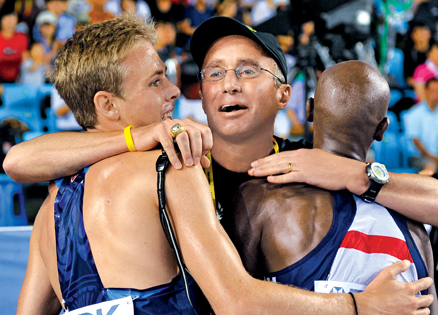
I didn’t dance. Instead, I stared transfixed at something no one else in that giant stadium noticed. It was Mo Farah right after he crossed the finish line. Photographs of that moment show Mo with his hands cupped to his astounded, joyous face. Mo Farah exults in his victory, read the captions.

Mo Farah looks back as Galen Rupp crosses the finish line.

But that’s not what the photographs really show. Mo’s face lit up then not because he won gold—but because he turned around and saw Galen win silver. At the moment of his greatest triumph, Mo wasn’t thinking about himself at all. He was thinking about his friend.

Something bigger in your life than running. All at once, in the rush of victory, I understood why I’d been so calm at the start of the race. I understood why I’d survived my heart attack and why my running career had taken me not to my own Olympic victory, but to this race in London.

Something—no, Someone—bigger than running had brought me here. My youthful mistakes, my brush with death—they were moments of grace, reminders that God is at work even in the midst of our human imperfection and mortality.

Slowly, sometimes painfully, I learned to take the focus off myself and give the lead to God. With Mo and Galen and my other runners, I learned to run a different kind of race, one that takes us beyond winning, a race that is won at the end and not the beginning.

Download your FREE ebook, The Power of Hope: 7 Inspirational Stories of People Rediscovering Faith, Hope and Love

Letting God Be the Judge

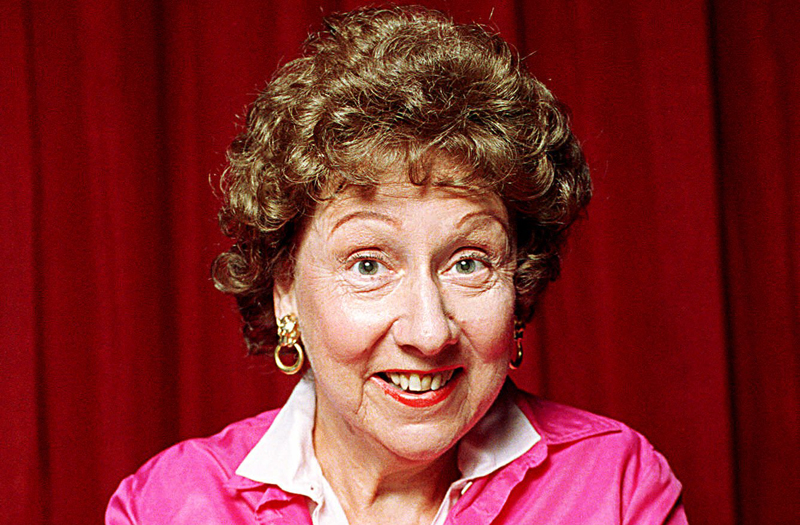
Another light has gone out in the acting world. Jean Stapleton died in New York City on May 31 at age 90 of natural causes. Stapleton, despite her long and varied acting career, was best known for her iconic role of “dingbat” Edith Bunker in All in the Family, the popular and pioneering 70s comedy.

At the height of her popularity, she wrote an article for Guideposts magazine about overcoming her own Archie Bunker problem, that of prejudice.

When I was growing up in New York City, there was one thing that I disliked with a passion and that was calf’s liver. My father, an outdoor advertising salesman, loved calf’s liver, and so my mother saw to it that it often appeared on our dinner table. I would rather go hungry—and often did—than eat it.

The interesting thing is, I never even tasted calf’s liver until I was an adult. I simply disliked the looks of it and knew, beyond all argument, that I would despise it. Today I adore calf’s liver.

It wouldn’t surprise me at all if Archie Bunker hated calf’s liver. If you know Archie from All In The Family, the television comedy series in which I play his dingbat wife Edith, then you know what I mean.

Archie’s a bigot, a super bigot, and we get most of our laughs from his outrageous points of view, his rantings against other races and almost anything new or strange to him.

If it’s true that the bravest man who ever lived was the first fellow to eat an oyster, you have some idea of where Archie would rate for courage—and how he’d camouflage his fear with a loud tirade.

By being extreme, and therefore ridiculous and funny to us, Archie has made millions of people aware of the absurdity of prejudice. I have confessed to my own absurd dealings with liver because it points up something that I was aware of long before Archie came along: Prejudice is an assortment of deceptively small personal judgments—deceptive because of their great cost in our daily lives.

No one will ever know, for example, how many families have been racked by stubborn arguments over long hair. Is prejudice involved? Partly, I think, for at its root, prejudice is a matter of judging—of prejudging really.

We have preconceived opinions that long hair means something about a boy (and therefore about ourselves, since he is our offspring) that may or may not be true.

For myself, I have seen how my own niggling, personal prejudgments often have robbed me of pleasure and peace of mind. There have been times when I have tried to cure these prejudices, and I recall one time in particular when a conscious effort at healing resulted in a crucial breakthrough in my acting career.

It happened a long time ago, in the late ‘40s, after a good many bleak years trying to crack Broadway. Those had been years of constant work, of having a job as a secretary in the shipping department of a railroad company by day; typing manuscripts late at night in exchange for drama lessons; begging time off for summer stock; making precious little progress.

Then one day the chance came to read for one of the Equity Library Theatre productions—shows that our actors union puts on to give us a chance to work and to be seen. The play was The Corn Is Green, and there were two roles in it I felt confident I could handle.

One of them was so miniscule, however, that though I knew it meant a job, there was some doubt as to whether it would be a good showcase. Naturally the tiny part was the one I was offered.

I thought about it a while. “I’ll do it,” I said finally, irritated that they hadn’t given me the larger part.

Ten days before the opening, the actress rehearsing Mrs. Watty fell on some ice and broke her leg. I assumed that I would inherit her role and I wasn’t surprised when Ted Post, the director, came to talk to me. He asked me if I would fill in until he could get somebody else.

“Somebody else! But what about me?” I protested. “I can play her.”

“No,” he said, “you’re too young.”

I didn’t believe him. He just was not being fair. He had it in for me.

I got angry. I got so mad that I couldn’t even sit at the same dinner table with my parents that evening. I had to get up and go to my room and try to collect myself. I had to do something about this injustice or I would burst.

In those days—as well as today—I had my own way of finding help when needed. I took out my Bible. After all, I had been going to Sunday school classes in our church since the age of two. And I also took out my concordance, that remarkable compilation of all the key words in the Bible and where they appear.

I flipped through the pages of the concordance to the “J’s,” mumbling theatrically all the while, “Justice is what I need, justice…” But before I could find “justice” my eyes fell on “judge.”

“For the Lord is our j. Isa. 33:22.”

I picked up the Bible and sped to Isaiah. I had explored Scripture in this fashion many times before, sometimes losing myself for hours in random adventure. Now, Chapter 33 … there it was: “For the Lord is our judge, the Lord is our lawgiver, the Lord is our king; he will save us.”

What was this I was asking about justice? Had I jumped to some emotional conclusion about Ted? Should I pray about this and try leaving justice to the Lord?

I prayed; I relinquished the matter to the Highest Power. My anger disappeared. I was back in the dining room for dessert.

The next day at rehearsal I was no longer driven by an ambition to play Mrs. Watty. I read the part as well as I could and enjoyed doing it, and when Ted found somebody he thought was the right age, I retired with genuine grace.

But that wasn’t the end of the story. Three nights later the producer called me at home and said that the new Mrs. Watty hadn’t worked out. If Ted should ask me, would I be willing to take over? Very quietly I told her I’d be delighted, and the next day Ted said, “You’re too young for it, Jean, but the part’s yours.”

It’s still not the end of the story. Just as all show business sagas ought to unfold, an important agent saw me at the opening. She wasn’t fooled by my make-up. She saw me as a young woman, just right, she decided, for the role of the niece in a touring company of Harvey.

Out of that came my first good job in the theater; I was on my way.

Today, when I get emotional about something I think somebody has done to me, I try to think back to that experience before I start hurling a few hasty, bigoted thunderbolts.

I recall that I never succeeded in changing the director’s opinion of me; nor did I change my own opinion. I had simply left the judging to the Lawgiver, and He decided for both of us.

Recently a friend sent me a sermon entitled, “God and Archie Bunker,” written by the pastor of the Brentwood Presbyterian Church here in California. In that sermon, Dr. Spencer Marsh Jr., who enjoys Archie, nonetheless noted his self-centeredness, his cliché-ridden bravado, his imprisonment inside his own narrow opinions.

He quoted some dialogue from the show, from the night Archie was talking to “our” son-in-law saying, “I’ve been making my way in the world for a long time, sonny boy, and one thing I know—a man better watch out for number one. It’s the survival of the fittess.”

Doctor Marsh said that Archie is out of position, that Archie is a mixed-up person “because the number one slot which he claims, is reserved for God.”

He sees Archie as the elder brother in Christ’s prodigal son parable, the one who stands outside the house grumbling about his rights while the welcome-home party is going on inside. The walls that separate him from the party are self-imposed, self-righteous, judgmental ones.

That’s one reason I worry about prejudice. It could keep me from the party. It could keep me from enjoying the company of other people and what they have to offer just as surely as it almost kept me from the simple pleasure of calf’s liver or, more important, the big break of my career.

And poor Archie, like a lot of us, never listens, never learns. He’ll never know that by blindly pushing away the oyster, he might be missing its pearl.

Let God Define You

Just as I was finishing up my booksigning at the International Christian Retail Show (ICRS) in Orlando a few years ago, I noticed a woman waiting at the edge of the Guideposts booth.

“We just ran out of books,” I explained, as I walked over to her, “but I’d be happy to mail you a copy from my personal stash at home.”

“Oh that’s Ok,” she said. “I actually just want to talk to you.” I smiled but I was actually worried that maybe I’d met her previously and didn’t remember her. Just as I was about to ask if we’d met before, she took my face into her hands, looked me square in the eyes, and said, “Quit saying you’re not a speaker. Stop saying that you’re only a writer. Did God tell you that you’re only a writer and not a speaker?”

I shook my head no, trying to keep my composure. “Then stop saying it. Only say what God says. Let Him define you.”

With that, she removed her hands from my face, walked away, and I never saw her again.

How could she have known? I wondered.

Just the night before, in the privacy of our hotel room, I had said to my husband, “I think I’ll call my sister and see if she wants to speak at that women’s conference that invited me to keynote. After all, she’s the speaker in the family. I’m just a writer.”

I had planned to call that conference director when I returned home from ICRS and give her my sister’s contact information, but apparently God had other plans. It was a turning point in my journey. It was the day I stopped defining myself and started allowing God to define me.

I did call that conference director when I returned home but not to give her my sister’s information. Instead, I called her back and said, “Yes, I’ll do it.”

I can look back now and see that God was preparing me to be both a speaker and a writer—even as far back as my college days at Indiana University when I ended up minoring in Speech Communication. I thought I was just minoring in Speech because many of its requirements overlapped with my journalism major, but it was all a part of God’s plan for my life. He had been guiding my steps all along, and I am so thankful to be on this journey with Him.

Aren’t you?

So, how have you been defining yourself? Are you letting God define you or are you letting others tell you who you are and what you’re called to do?

It’s time to walk in the calling that God has for your life. Don’t let your insecurities or someone else’s opinions keep you in a box, limiting your vision and outreach. He has a plan for your life, and you’re going to love it!

Lessons from My Garden

In my earliest memories I’m in my grandmother’s yard in Steubenville, Ohio, reaching out to touch the soft petals of flowering phlox in lavender, rose and snowy white. She holds my hand as we walk along what we called “hollyhock alley” and sing a favorite hymn: “I come to the garden alone while the dew is still on the roses….”

Everything around me—the rustling leaves, the loamy scent of newly turned earth, the warmth of my grandmother’s attention—assures me that this is a kind of sacred place. Is it any wonder that all my life I’ve made gardens for myself wherever I have lived?

My first apartment was a second-floor Manhattan walkup that looked out onto an air shaft. No light, no soil. I bought an aluminum stand with fluorescent lights to grow marigolds and geraniums.

My next place, and current home, was an apartment with a terrace and river view. I could have a garden here. Only problem: the place was 17 blustery floors up.

I had a carpenter build sturdy planters and I picked up flats of impatiens and zinnias at street fairs, and ordered hardy rose bushes to withstand the city’s whipping winds.

I have to kneel on a narrow swath of brick to work my hands in the soil but when I do, I feel as I did when I was a child. No matter where your garden grows, it enriches your life. Here are some ways how:

Take root.
One night, years ago, while working at a woman’s magazine, I was ready to send off the glossy “Manhattan edition” I edited every month. The publisher rushed in to announce we’d be adding more pages so we needed more articles—fast. Near dawn I finally got home. I was exhausted and missing my family’s garden.

I tossed and turned in bed, fretting. Please help me to calm down, I prayed. Then the pearly glow of first light appeared.

I sat up groggily and noticed the cardboard box that had arrived in the mail the day before. Plants I’d ordered from a catalog! I took the box out to the terrace and tore it open. I tapped the begonia and hollyhock plants out of their containers, tucked them into dirt-filled window boxes and watered.

With the sun at my back and my hands in the soil, I felt connected to the things that really matter, and my worries evaporated like the morning dew.

As I worked, I felt my heartbeat slow down, my body relax, my whole being become quiet and soften. Home is where my garden is, I thought.

A flier in the box caught my eye. “DEVELOP A STRONG ROOT SYSTEM,” it said in bold letters. That’s what a garden does for you, I thought. Keeps you rooted in your values, rituals, traditions. I planted and tended those plants, giving them all the nourishment they needed. And in return, they nourished me spiritually.

Embrace the season.
Nothing compares to the excitement spring brings to a gardener. My garden comes back to life, exuberantly. First, the sunny tops of daffodils poke up, and orange and pink tulips and then those grape hyacinths—how can anything so compact give off such tremendous perfume? Suddenly, my terrace is alive with color and fragrance.

Yet, not long after they appear, those first flowers wither. And year after year, it makes me sad. But by summer, there is new life in the garden: snapdragons and marigolds and the phlox that always bring Grandmother to mind.

Yes, to everything there is a season. We must adapt, grow and change. Instead of lamenting loss and wanting to control nature, I rejoice in each flower that blooms.

There are those times when I feel forlorn, like my roses in winter. I look out on the terrace and remind myself: A garden is never lifeless. Even in winter, when it looks like nothing is happening, life is at work—bulbs storing up energy for next spring, perennials resting, soil breaking down into rich mulch.

And as our gardens go through their seasons of change, so, too, do we, just waiting sometimes to understand the larger purpose in our lives. It will come, as sure as crocuses in spring.

Share the beauty.
My father cut flowers to give to neighbors—especially ones who were sick or feeling down—and for my mother to make centerpieces for her women’s club and choir dinners.

“Why don’t you just leave them in the garden?” I asked, secretly thinking, for me to enjoy.

My dad looked surprised. “We need to pass the pleasure on,” he said.

Dad was right. There’s nothing like a gift from the garden. Guideposts readers have sent me seeds and cuttings from all over the country. I’ve been given bluebonnet seeds from Texas and wisteria tendrils from South Carolina. I have hollyhocks and a nonstop patch of mint from my hometown.

From my own Manhattan neighborhood are violets I dug up years ago from the courtyard of an about-to-be-demolished church. Among this growth and activity, bumblebees and butterflies drift by, and my upstairs neighbor Annie opens her apartment window. “Looks great, Mary Ann!” she calls from above. All of these sweet growing things connect me to a community.

I might live alone, but I never feel lonely in my garden. Digging, snipping, putting my face into a full-blown rose and breathing deeply, I think of how many others in Texas and Ohio and Oregon are doing the same. Gardening is a link to a wide world. The pleasure is multiplied when it’s shared.

Life will bloom again.
Thirteen years ago, my mother died of a heart attack. Next year at the same time my father died. My brother and sister and I dug roses and peonies from his garden to take to our own gardens.

The sadness in my heart seemed insurmountable as I unwrapped those plants, whose roots and stalks looked lifeless. Out on the terrace, I sat on the little wooden chair that my father always used when he was gardening, and put the knobby brown forms into pots.

By summertime, to my astonishment, they had put out breathtaking blossoms. One bush was covered with golden yellow roses, my mother’s favorite.

Stanley Kunitz, in his book The Wild Braid: A Poet Reflects on a Century in the Garden, writes: “The garden instructs us in the principle of life and death and renewal. In its rhythms, it offers the closest analogue to the concept of resurrection available to us.”

As much as I missed my parents, my sorrow was transformed by the scent of yellow roses.

It occurred to me that Jesus first appeared to Mary Magdalene after his crucifixion in a garden. What better place to be reminded that life blooms again and again?

Renewal is always at hand in a garden—be it a country meadow, a suburban yard, even a city windowsill—our own small patch of eternity.

Leaving Your Comfort Zone

Human beings are naturally social creatures. We crave deep connections with others who share our interests and beliefs. But according to a Cigna’s U.S. Loneliness Index, nearly half of American report sometimes or always feeling alone. A quarter of those polled reported rarely or never feeling as though there are people that understand them, while a fifth said they rarely or never feel close to people.

Although forming close relationships sometimes requires time, there are a few simple ways to make friends and begin to build your network of support.

1. Attend a class or event in your area of interest

Workshops, classes, and other events offered in your areas of interest are all appropriate places to meet people. For example, if you like pottery—either to collect or do yourself—consider attending a local pottery shop’s open-house or sign up for a one-day workshop on how to make pottery. If you dream about penning the next great American novel, attend a writing class at your community college or an afternoon seminar with a local author. If you love dance, consider getting involved with the local ballet company, volunteering your time to their programs, or take an adult dance class.

2. Get involved in your church

Your church or parish is another fertile meeting ground for friends. Having faith in common is a great starting point for a deep connection. Most churches offer Bible studies and other discussion groups. Some have committees devoted to serving the poor or ministries for soldiers and veterans. If you tend to alternate your times of church service, consider committing to the same service each week so that you become better acquainted with those regulars.

3. Contribute to a cause

Feel passionate about a certain cause? Think about participating in a walk to raise money for that mission or a rally. You will meet others who share your enthusiasm.

Choose a nonprofit or local foundation whose agenda you believe in. Join a civic association or attend a town hall meeting and contribute your skills. For example, if you feel strongly about the environment, sign up to pick up trash or plant trees with other folks around your neighborhood. Conversations happen more naturally while immersed in a task.

4. Join a support group

My best friends in college were those I met at a local support group. We became close very quickly because we were struggling with similar issues and relied on each other as sounding boards.

Twelve-step support groups are an invaluable place to make connections with others who struggle with addiction, codependency, and family issues related to addiction. However, there are many more kinds of support groups: Christian-based groups, programs for relationship difficulties, and support for depression and other mood disorders.

5. Go online

Talking with someone online is different than chatting over coffee, however, I have been amazed at the level of intimacy exchanged in the online groups in which I participate. Several of my online relationships have led to phone calls and in-person meetings where our bond deepened. Two people I met online became dear friends that I see and talk to regularly. When you search for online forums, you’ll find a dizzying array. Be choosey. You can also create your own. I created two groups for depression. Psych Central hosts online forums on just about any issue.

6. Start a meetup

In 2012, Eileen Bailey was newly divorced and had just sent her daughter to school. She realized she didn’t have many friends. She joined a Meetup group for women over 50 but there were never any activities, so she started one of her own. At the first breakfast, the table was full of women from all walks of life conversing with each other as if they had known each other for years. “We sat there for three hours, soaking in the easy companionship we felt,” Eileen told Guideposts.org. Seven years later, the group still meets for breakfast twice a month. “We go [to] the movies, out to dinner, see plays at local playhouses, and go on trips together. But more than that, we have become friends,” she said. “We have found friendships where once we didn’t think it was possible.” With Meetup, you can search existing groups categorized by your location or interest area. You can find a gaggle of friends with whom to train for a marathon or learn a language or experiment with cooking.

7. Get to know your co-workers

You may be sharing an office space with a half-dozen potential friends and you just haven’t made the effort to get to know them better. You already have one major thing in common, so you can build on that base. When I was new to an organization, I made it a goal to take a different colleague out to lunch each week. As months went by, I felt much more a part of the company and enjoyed several friendships because of those efforts.

8. Befriend friends of friends

As with many people I know, I met my husband through a mutual friend. This provided a level of comfort from the start because I knew he had essentially been vetted by her. Friends are the same way. If you meet someone through another person whom you trust and respect, chances are good that you’ll enjoy a nice connection. Part of the weeding out process has already been done for you.

9. Get creative and have fun

If you apply a little creativity, you will likely come up with many more ways to build your network. The hardest part in forging new connections is putting yourself out there. That’s never easy, as not everyone will reciprocate your gesture. However, if you continue to take the risk and try to connect, you’ll be rewarded with a circle of close, intimate friends.

Learn Success Secrets from Will Smith

What does a treadmill have to do with Will Smith’s success as a movie star and actor?

Everything!

When asked by an interviewer to explain his success, he responded:

“I’m not afraid to die on a treadmill. I will not be outworked. You may be more talented than me. You might be smarter than me. And you may be better looking than me. But if we get on a treadmill together you are going to get off first or I’m going to die. It’s really that simple. I’m not going to be outworked.”

But what about his talent you might ask. After all, he is charismatic, funny and a great actor. Isn’t that the reason for his success? Not according to Will Smith. In fact he considers himself to be slightly above average in the talent category. Rather, he attributes his success to his work ethic.

You may be surprised to hear this because popular opinion says that successful people who have risen to the top of their profession got there because “they were lucky” or “they were chosen” or “they were born with more talent than everyone else.” We overestimate their talent and we underestimate our own.

In my research for Training Camp I found that people such as Will Smith are not super human and they don’t have some mutant gene that makes them better. What makes them stand out is that they work harder. It’s really that simple.

When others are sleeping, they are working. When others are wasting time, they are improving. When others are scattering their energy they are practicing and zoom focusing.

Of course talent is necessary to excel at something but natural ability will only take someone so far. The key is to infuse one’s talent with hard work, passion and a drive for excellence.

So what does Will Smith have to do with you?

Everything!

If you want to take your career or “game” to the next level you must be willing to pay the price that greatness requires. You must be willing to work harder than everyone you know. There’s no easy shortcut. Hard work has been, is and always will be the key to anyone’s success. To be your best you must invest all that you are to become everything you wish to be. Will Smith knows it and now you know it.

Are you willing to pay the price? Let’s hop on the treadmill together!

Download your FREE positive thinking ebook!

Learning to Be Happy at Any Age

I’ve heard it said that happiness is a journey, not a destination. The idea that we can find our way back to happiness at every stop along the journey of life is comforting, reassuring—and, it turns out, supported by research that encourages us to cultivate a positive view of aging.

Psychologists who study aging are exploring the relationship between one’s attitude toward the aging process and the emotional and physical health outcomes that follow. It turns out that a positive view of aging is associated with better overall health, as well as generalized emotional wellness.

This idea can be helpful to young people as well as older adults. A popular class at Yale, nicknamed “the happiness class” but actually titled, “Psychology and the Good Life,” attracted 1,200 undergraduates when it was first offered this year. l Professor Laurie Santos, who created the class, told the Boston Globe that in creating it, “The goal was to rewire the way the students viewed the pursuit of happiness.”

With a positive foundation like the one Santos advocates, we can next set our sights on how we pursue happiness as we age. William Chopik, an assistant professor of psychology at Michigan State University, surveyed more than half a million Americans and found that as people got older, the age they reported they “felt’ actually grew younger.

According to the Washington Post, Chopik surmised this phenomenon could “arise from people feeling good about themselves and their bodies, and coming to the realization that, because of their negative beliefs about what it must feel like to be an older adult that ‘I must not be old.’”

Another study, conducted at the Boston University School of Public Health, connected a positive outlook toward aging with a measure of protection against disease, particularly dementia. Even among those who carry a gene associated with dementia, the risk of developing the disease went down in those who had generally positive views of growing older. “Exposing older individuals to negative age stereotypes exacerbates stress, whereas exposing them to positive age stereotypes can act as a buffer against experiencing stress,” Paola Sebastiani, the study’s author, told the Post.

Happiness through the years—and decades—is, in short, a goal worth pursuing. No matter where you are in your journey, you can take one step closer toward abiding happiness by raising your sights to the joys and benefits of getting older.

Lauren Sisler Opens Up About Her Parents’ Addiction

Sometimes people approach me and ask, “Don’t I know you?” If they’re sports fans, they probably do. In addition to covering sports for AL.com, I’m a sports broadcaster for ESPN and SEC Network. Here in football-crazy Alabama, I get recognized a lot.

The attention is flattering. But it’s also ironic. For a long time, even after I became a presence on TV, I worked very hard to keep myself hidden.

No one knew the real me. Not my coworkers. Not my teammates and mentors during my competitive gymnastics days. Not my closest friends and family members. Not even me.

What was the secret I worked so hard to hide?

My mom and dad were drug addicts. They were wonderful, supportive parents, people of abiding faith and love. But from the time I was a teenager, both were hooked on prescription pain medicine. I was in college when they died, hours apart, from drug overdoses. By that point, they were barely functioning. Their finances were so chaotic, everything they owned was auctioned off to pay bills after they died. My older brother managed to bid on a few keepsakes from our childhood.

That’s what really happened. Here’s the version I told everyone else, including myself: Mom and Dad were normal people who took medication for some chronic pain issues. Their lethargy, financial woes and explosions of anger when pills ran low were just everyday family problems.

“Mom had respiratory failure,” I said after they died. “Dad had heart failure. It was such tragic bad luck they died on the same day.”

It wasn’t bad luck. Mom died after ingesting an entire patch of fentanyl. Dad found Mom dead, ingested his own fentanyl patch, then collapsed and hit his head on the kitchen counter.

My aunt Linda, my mom’s sister, who had often bailed out my parents financially and learned the extent of their drug problem after they died, tried to tell me the truth. I refused to listen. I left the room or talked right over her.

As a child, I was either unaware or too naive to acknowledge the truth. As I got older, shame replaced ignorance. The shame grew so intense, I concocted a separate reality in which my parents’ drug use was normal. How could they be drug addicts if they lived in a nice house and Dad had a job?

The lie worked for years—until suddenly it didn’t. After Mom and Dad died, I reached a breaking point.

I found release in the last place I expected. There’s a reason Jesus says, “The truth shall set you free.” When at last I admitted the truth, I found a freedom I desperately needed.

Looking back, I can trace the start of my family’s problems to the year we moved from Roanoke to rural Giles County in Virginia, where Dad, a Navy veteran, inherited some land. Dad had grown up in the country, and he wanted my brother, Allen, and me to have the same upbringing.

It was a beautiful area, and the house Mom and Dad built was lovely. But Dad’s commute to his biomedical engineering job at the VA medical center more than doubled. Mom’s social life, much of it centered on our old church, shrank to mostly family, especially ferrying Allen and me to sports practices.

Soon after the move, Mom was diagnosed with degenerative disc disease and had multiple surgeries. Feeling isolated and daunted by her condition, she and Dad both fell into depression. Dad had had his own back surgery.

Many people prescribed postoperative pain medication take it when they need it, then stop. Not Mom and Dad. By the time I was in high school, our house was constantly getting shipments— paid for by Dad’s excellent insurance—of 90-day supplies of pills, opioid lollipops and fentanyl patches.

I don’t know who exactly was prescribing all of this medication, maybe the pain management specialist Mom and Dad saw after their surgeries.

For a while, my parents kept up a façade, attending sports competitions for Allen and me, saying good-night prayers with us, keeping tabs on our homework. Gradually, as the drugs’ grip tightened, things fell apart. By senior year, there were shouting matches over who took whose medication.

I’d heard about people getting hooked on prescription pain medicine. Of course such a thing would never happen in my family. Junkies living under highway bridges had a drug problem, not my middle-class parents in their beautiful house with Dad’s respectable job. Addiction was shameful. Scary. Nothing to do with my stable, normal world.

I went to Rutgers University on a gymnastics scholarship. My first Thanksgiving home, Dad collapsed on the living room floor, his face blue. Allen, home from the Navy, tried to revive him. Paramedics took Dad to the hospital.

“Your father had a bad reaction to some medicine,” Mom said at the hospital. She looked at me, as if waiting for me to challenge that explanation. After a moment’s hesitation, I asked, “And he’ll be okay?” Mom nodded.

It was an unconscious decision to go along with Mom’s story. Some part of me must have known it wasn’t the whole truth. But after years of lying to myself, how could I blow things up now?

“How’s your dad?” friends asked.

“Still in the hospital,” I said. “The doctors say he needs further evaluation.”

I also covered up for Mom, who abused not only pain pills but the antidepressants she was prescribed.

My parents’ death certificates both listed “accidental overdose” as the cause of death. “Accidental” meant it wasn’t their fault, right? I convinced myself I wasn’t really lying when I told people they’d died of respiratory failure and heart failure.

But I could forestall reality only so long. Aunt Linda grew alarmed when she realized I hadn’t acknowledged the truth about my parents’ addictions. Several times she tried to explain everything. Sometimes I fought back.

“Mom and Dad were not drug addicts,” I’d insist. “They took medication for pain and had an accident. What are you trying to do, shame our family?”

One day at Rutgers, I hurt my leg at gymnastics practice. Somehow in my mind, the pain from the injury became bound up with my pain over Mom’s and Dad’s death. I said nothing to my coaches about it, even after the pain got so intense I began limping around campus.

My coaches noticed and forced me to see a doctor. “Lauren, you’ve been practicing on a partially broken femur,” he said. “If you’d kept going, you could have broken the bone clean through. That’s a very difficult injury to heal from.”

Here at last was a reality I could not conjure away. Unable to compete, I became depressed. I was prescribed medication for both pain and depression. I was scared to try either one.

When I was back home, Aunt Linda saw my struggle. She sat me down and said, “You can’t do this anymore, Lauren. You have to acknowledge the truth about your parents.”

She told me everything from the beginning. When she finished, I felt an instinctive impulse to deny or run away. Then a new feeling came over me. A sensation of light and space. A glimpse of freedom I didn’t even know I needed.

“Lauren,” Aunt Linda said gently. “You can’t run away from the truth. You can’t control what people think about your parents. What you can control is how you choose to remember them. Do you really think your Mom and Dad are honored by lies? By your denial?”

Aunt Linda’s question haunted me. What had all my lies achieved so far? They sure hadn’t kept Mom and Dad alive. They’d nearly cost me my place on the gymnastics team. The assumption behind the lies was that Mom’s and Dad’s addictions were shameful.

What if that assumption was wrong?

I dug into the truth. I read the postmortem toxicology reports. I peppered Aunt Linda and anyone else who might know what happened with questions. I reevaluated everything.

The story that emerged made perfect, heartbreaking sense. Mom and Dad were wonderful, supportive parents, just as I’d always insisted—except they were ensnared by powerfully addictive medicines and lost control of their lives.

That was a terrible fate. But it was not shameful. It did not mean our family was tainted. It just meant the drugs were potent and Mom and Dad were vulnerable and didn’t find effective treatment in time.

I tried telling a friend the truth. To my great relief, she didn’t judge me. Gradually I opened up to more people. I grew so comfortable with my family’s story, I felt prepared to tell anyone.

I graduated from Rutgers and became a sports journalist. As my career took off, I filmed a segment about my parents for a feature on addiction. I was nervous about making the truth widely public. But I’d already told so many people, it was just one more incremental step.

Today I go out of my way to tell my family’s story. The circumstances of my parents’ deaths are on my bio page on the ESPN website. I tell the story at public speaking events and whenever it seems appropriate on the air.

Addiction is a disease of denial. It thrives in the shadows and in isolation. Sometimes I wonder what would have happened if Mom and Dad had admitted the truth early on and sought treatment. Sometimes I wonder what would have happened if I had admitted the truth earlier. I’ll never know.

What I do know is that the God I pray to is the God who listened when Mom and Dad said those good-night prayers with me. A God of love and not shame. A God of truth.

Read more: Overcoming Denial in Coping with Addiction

For more inspiring stories, subscribe to Guideposts magazine.

Laura McKowen on the ‘Magic’ of Sobriety

When author Laura McKowen first struggled with her addiction to alcohol, she felt she was anything but lucky. She thought people who could drink socially were the lucky ones. In her new book, We Are the Luckiest, the author says that she now feels lucky to be living sober.

McKowen, who has more than 50,000 Instagram followers, is known in recovery circles for sharing her experiences with drinking and her journey to sobriety with honesty and vulnerability. She has shared hundreds of stories, blog posts and podcasts. McKowen says the book is not just about sobriety.

“This is a book about my experience in getting sober from alcohol, but it is really a book for anyone who comes up against big pain or [a] struggle that they cannot seem to overcome,” McKowen told Guideposts.org.

McKowen said she liked alcohol in her mid-twenties, but drinking was normalized, especially in her public relations career. It wasn’t until 2013, after separating from her husband and realizing her drinking was causing problems for her young daughter, that McKowen went to her first Alcoholics Anonymous meeting.

“It was my first sort of formal step towards sobriety, and then I didn’t actually get sober until September 2014,” McKowen said. “It was a full year plus that I was struggling…really wrestling with giving up what I thought was a very big part of my life.”

McKowen said she viewed sobriety as a kind of “death sentence” that would ruin her social life, career and chance at finding love. It forced her, instead, to finally reckon with the damage her drinking had caused. She realized then how lucky she was to be sober.

“There was no dramatic turning point,” McKowen explained. “My turning point was more of just a pure exhaustion. It was just, I can’t feel this way ever again. I couldn’t imagine ever feeling that anxiety of the day after drinking again.”

One idea that helped her on her path to sobriety was taking it one day at a time. McKowen told herself that if she wanted to drink tomorrow she would deal with it then.

“I erased the notion of forever because [the idea that I would never drink again] filled me with so much despair,” she said.

Another thing that helped was, as she put it, “burning all the boats.”

“I was talking to someone recently who said, ‘If you want to stay on the Island, you got to burn all the boats,’” McKowen said. “And I burned all the boats. All these little sneaky ways that I was still hiding or working to keep drinking in my life, like not really being honest with people about where I stood with sobriety.”

McKowen also temporarily removed herself from situations she associated with drinking: concerts, happy hours, dates, changing her route home so she didn’t pass her neighborhood liquor store. She also relied on her faith.

“When I can remember God, when I can remember that I am held in favor in this, in grace [than] I can get perspective that is so necessary to be okay even in really difficult and turbulent times,” McKowen said.

Six years after she stepped foot in her first AA meeting, McKowen has left her job in the public relations industry and dedicated herself to her passions of writing and recovery education. The sobriety she once feared would ruin her life, she now views as magical.

“I thought that it would be a small life and a very sad life,” she said. “And it’s exactly the opposite. Everything that I really wanted all along, which is a direct experience of life and to be able to feel everything completely and to be able to access my joy and my potential, that was all in sobriety, it was never in drinking.”