Embrace God's truth with our new book, The Lies that Bind

Indulge Yourself and Reduce Your Stress

Are these economic doldrums we’re stuck in taking a toll on your positive attitude? Mine too. I’m fortunate—I have a good job and little debt, and I’ve been able to up my donations to charity.

Still I find myself stressing about money more than usual, and acting in austerity mode when it comes to things like dinners out, travel, spa treatments. Sure, these are occasional indulgences even in the best of times, but I’ve cut out the last two almost entirely. You don’t really need a massage. You shouldn’t be spending money treating yourself, not in this economy. You should save it just in case… That’s my thinking.

Or it was, until I came across an article in the science section of The New York Times, a short piece about a recent study on the effects of massage. Participants got 45 minutes of either deep-tissue Swedish massage or light massage. Blood samples were taken before and after. Even the researchers were astounded by the results: Just a single session of massage significantly reduced the level of the stress hormone cortisol and boosted the level of the hormone oxytocin, which is linked to contentment and calmness. I always feel more relaxed after a rubdown but here was proof that massage actually relieves stress. And who doesn’t want less stress these days?

It’s hard to keep thinking positive when you’re worried about negative cash flow. Sometimes you need a little indulgence, especially one guaranteed to make you feel good. Go ahead, treat yourself! Guess where I’m headed as soon as I post this blog?

In Celebration of Chocolate

In his book, In Defense of Food: An Eater’s Manifesto, Michael Pollan tells the story of a researcher who showed the words “chocolate cake” to a group of Americans, asking for their gut-reaction word associations. “Guilt” emerged as the top response.

When the same exercise was done with a group of French people, the top response was quite different—it was “celebration.”

As Valentine’s Day approaches, I’m thinking about the gulf that yawns between “guilt” and “celebration.” Imagining the feeling I get when I take in a forkful of luscious chocolate cake, a spoon of creamy ice cream or a few squares of a favorite chocolate bar, I wonder where my inner French eater might be hiding?

For some people, that little zing of American guilt may be a big part of what makes treats like chocolate so pleasurable. For others, a psychological principle called “the disinhibition effect” means that breaking a healthy eating rule once—like no chocolate on weekdays—actually makes us more likely to break it again, which drains chocolate of its “treat” status.

But I suspect that for most of us, we just like chocolate; it makes us feel good. We enjoy its sweet-bitter flavor balance, we associate it with birthdays, Valentine’s Day and other special occasions, and we feel like the day is a little bit more special when we have some.

We’re in good company—chocolate’s positive associations are centuries-old.

Societies have long associated chocolate with medicine. Aztecs, Mayans and European cultures used various preparations of cacao, the base ingredient in chocolate, for its anti-inflammatory properties that lower cholesterol and treat ailments from diarrhea to headaches to coughs to fatigue. To this day, scientists are learning more about medicinal chocolate—though aficionados are often disappointed to learn that to have health benefits, chocolate needs to be free of the fat and sugar that many of us find so delicious.

Then there’s the tradition of Valentine chocolates. In the 14th century, the poet Chaucer wrote that Saint Valentine’s Day is a day in which birds and other creatures choose their mates. It was 500 years later, though, that historians believe chocolate was first connected with Valentine’s Day. In mid-19th century England, the Victorian sensibilities around public expressions of love met the Cupid- and heart-bedecked boxes of chocolate made by Richard Cadbury. Just step into any grocery, drugstore or sweet shop in February, and you’ll understand that the Western world hasn’t looked back.

But back to Michael Pollan and the invitation to ditch the guilt when it comes to Valentine’s Day chocolate—or any day chocolate. One of Pollan’s rules for a healthy relationship with food is never to eat anything your great-grandmother wouldn’t recognize as food. So if you’re snapping off a piece of a chocolate bar, or smoothing frosting onto a rich cake, you can feel good that you are tucking into food with a special, positive history. Maybe then you can remember to celebrate every single bite.

Important Things: September 11, 2001

It was a September morning like any other. The air was still summer warm. The sky was a brilliant robin’s egg blue. I stepped onto the 8:25 a.m. Metro North commuter train, headed toward my office at Guideposts magazine on 34th Street in New York City.

“Excuse me.” I squeezed between a young woman wearing earphones who was thumbing through the color photo-filled pages of Star Magazine, and a middle-aged gray-bearded man reading The New York Times.

Drat. The dreaded middle seat. Oh, well, at least I don’t have to stand.

I put on my sunglasses and folded my arms tightly across my chest, as though doing so might somehow make me not only smaller, but invisible. Before closing my eyes I sneaked glances at the headlines in my seatmates’ reading material—a microcosm of everyday life in twenty-first century America.

On my left, in Star, there was the insatiable culture of celebrity (“Look Who’s Got Cellulite!”). On my right, in the New York Times, bitter partisan politics (“Campaigning for Mayor: City Voters Have Heard It All”).

Oozing from the pages of both—as well as from the jokes told the night before on the late night TV talk shows—was the prevailing tone of world-weary, been there-done that, above-it-all irony.

I’d just dozed off, when someone’s cell phone chirped. Followed by another, and then another. Passengers began speaking in hushed, urgent tones, something about one of the World Trade Center’s twin towers being hit by a plane. Not a small private plane. A big commercial airliner.

How awful, I thought. What a terrible accident.

Several minutes passed, and a second shrill chorus of cell phones announced a second strike.

This was no accident. We were being attacked.

The bearded man next to me became agitated as he punched the buttons on his cell phone to no avail. “My staff is on the 86th floor of Tower One,” he said. “My God, I hope they’re all right.”

As the train rounded the bend north of 125th Street, passengers across the aisle left their seats to peer out the train’s west windows at the terrifying spectacle of the towers burning.

At Grand Central Station, I wedged myself into the crowd at the Hudson News kiosk, transfixed by the horrifying images on the elevated Fox News TV monitors. Fiery orange explosions. People jumping from the towers. Skirts billowing. A man and woman holding hands as they plummeted.

This can’t be happening.

Walking south on Fifth avenue, I watched aghast as the blue sky filled with black smoke hemorrhaging from ugly gashes in both towers. At street level there was the surreal sensation of being in a 1950s Japanese horror movie. People with radios and cell phones pressed to their ears shouted breaking news.

“They’ve hit the Pentagon!”

“There’s a plane headed for the White House!”

At the office, I frantically tried to phone my husband Tom, who had driven into Manhattan earlier in the morning for a breakfast meeting with a client somewhere in the city… But where exactly? Downtown? Uptown? If only I had asked!

I tried to call our daughter Katy at her New York University dorm downtown, on Greenwich Street. I tried to call my sister in her classroom at Middle School 131 in downtown Chinatown, where she taught sixth grade science. But none of their cell phones were working.

“Did you hear?” A young ashen-faced staffer cried out from her office across the hall. “The south tower has fallen!”

I phoned my mother back at our house in New Canaan, Connecticut, and told her not to worry. I phoned my friend Alison, and told her I couldn’t get in touch with Tom, Katy, or my sister, that they were all downtown, and would she please pray?

“Of course,” she replied. “Oh, my God, Kitty. Are you near a television? The north tower is falling…”

My desk phone rang. It was Tom. He was safe. I sobbed with relief. His breakfast meeting had not been downtown, but just five blocks away on 39th Street at the Williams Club where Tom, an alumnus of Williams College, was a member.

We agreed to meet there, where the staff was busy setting up phone banks, and tables with bottled water and emergency provisions.

As the morning dragged on, men and women covered in white dust, looking like ghosts, staggered up the steps and through the door. Survivors from the horror downtown, they had walked the four miles to the Williams Club in shock.

Once we had finally gotten through to Katy and my sister, and made sure they were safe, and called my mother, and our son Brinck at his high school to reassure them that we were all okay, Tom and I headed for home via the West Side Highway. It was three o’clock in the afternoon.

Across from us on the southbound lane, an endless convoy of ambulances and emergency vehicles from the northern suburbs, including New Canaan, moved toward what the newscaster on the radio was calling “Ground Zero.”

I turned around in my seat and looked south where a dismal dirty gray cloud filled the empty space where the twin towers had stood. It seemed impossible that they were gone.

National Guardsmen, armed with rifles and wearing camouflage uniforms and black boots, stood at the Henry Hudson Bridge toll gates, and inspected our car before letting us pass.

When we finally made it home, Tom and I pulled my father’s flag—the flag that had covered Dad’s casket when he died—out from the darkness of the closet and hung it over the front door. Across the street and next-door, our neighbors had put out their flags, too.

As I stood looking at the flag, I remembered how as a teenager, my father’s patriotism had embarrassed me. At high school football games I wanted to hide when he placed his right hand over his heart and lustily bellowed every word to the Star Spangled Banner.

Back then, my father’s old-fashioned, unapologetic patriotism seemed not only corny, but irrelevant.

Forged by the fires of adversity and sacrifice, his patriotism was the birthright of a different generation—the Greatest Generation—surely something that could never burn in my privileged baby boomer’s heart.

Until now.

The two towers were not all that fell on that awful day. If only for a moment, all that was trivial about everyday American life fell away, too. The culture of celebrity. Partisan politics. Irony. All were unmasked as the cheap, shallow, frivolous imposters that they were.

Rising out of the ruins, all that remained standing were the Important Things: Faith. Family. Friends. Freedom. Essential and enduring, they offered meaning and hope to a nation and people suffering incalculable heartache and loss.

Now, I thought, is the time to say, “I love you.” Now is the time to say, “I’m sorry.” Now is the time to say, “Thank you.” Now is the time to make peace with God. Now is the time. Tomorrow may be too late.

On September 11, 2001, it was all so clear.

This story is excerpted with the author’s permission from her latest book, Heart Songs: A Family Treasury of True Stories of Hope and Inspiration. For information on the Inspiring Voices publishing service that published Kitty’s book, visit their website.

I’m a Positive Thinker, Thanks to My Tiger Mother

By now you’ve probably heard about the Tiger Mother, Amy Chua, whose new memoir—or at least, the infamous excerpt that was published in the Wall Street Journal under the headline “Why Chinese Mothers Are Superior”—has the media and the blogosphere in an uproar. I don’t usually get involved in these debates (after all, here at Guideposts, we’re more about what connects us than what divides us) but I’ve got to jump in on this one. I was raised by a Chinese mother, my own Tiger Mom, and it didn’t turn me into a robotic overachiever with major self-esteem issues and no imagination. Far from it. I’m convinced my upbringing helped make me a confident, resilient, creative person…a positive thinker.

I’ll admit, my mom would be considered somewhat permissive by Ms. Chua’s standards. I know other Chinese mothers in our suburban community thought so. My brother and I were allowed to go on play dates and sleepovers. Except for music lessons, which were non-negotiable, we could choose our own extra-curriculars once we got to junior high (and no, they didn’t have to be math team and science club).

By Western standards, though, my mother would definitely qualify as a Tiger Mother. “Your mom’s so strict!” I got that a lot from my non-Asian friends…and their parents. My brother and I weren’t allowed to watch TV, play video games or eat junk food. We were forced to play the Chinese parents’ chosen instruments: I got the piano, my brother the violin. From an early age, we were assigned chores and the list got longer as we got older. Every skill my mom deemed useful (from manipulating chopsticks to drawing to trigonometry) we had to practice, practice, practice until we were proficient at it. Any grade lower than an A required an explanation and a corrective plan of action.

Sound like crushing expectations? They weren’t. Sure, I complained occasionally (what kid doesn’t?) but really, I didn’t feel downtrodden. In fact, I wound up feeling empowered. Take learning to use chopsticks. Once I understood the motion (“like a bird opening and closing its beak”), Mom had me practice picking up and transferring slippery things—grains of uncooked rice, frozen peas, marbles—from one bowl to another. I tried for a while but all I succeeded at was scattering rice and peas and marbles. So I threw my chopsticks down and declared, “I can’t do this! It’s too hard!”

My mom said calmly, “No, you have to work harder. Tomorrow, practice again.” She made me go back to it day after day until one afternoon, it all came together. Suddenly the chopsticks felt like an extension of my fingers, and I was moving rice, peas, even marbles with ease. Like magic, except I knew it wasn’t. It was my own effort. What a confidence booster, finding out I had it in me to accomplish something I thought was impossible!

Learning not to give up when I ran into a problem helped me develop resilience. So did my mom’s honesty with criticism and praise. She didn’t constantly find fault with what we did but she didn’t go around lavishing praise on every single thing we did either. Whatever she said, we could trust that it was sincere. Mom might not have known the term “constructive feedback” but that’s what she gave—specific, directed at the task and not the person. The grade or test score mattered less than the effort we put into it. If I just dashed something off, even if I got a good grade, my mom would call me on it. And vice versa.

In high school, I was put in Advanced Placement chemistry without having taken regular chemistry, and I got a C+ first quarter. There was no punishment or shame. “It means you don’t have a grasp of the basic concepts,” my mom said. “What can you do to learn them?” I came up with a plan. I borrowed an introductory chemistry textbook and we went over it together, chapter by chapter, every night. I did dozens of practice tests. And I picked the brain of my friend Ted, the chem genius. Slowly but surely, I “got” chemistry and my mom commended me for my hard work. The bonus? I scored high enough on the AP exam to fulfill a college science requirement. To this day, criticism or poor performance doesn’t demoralize me. I see it as an opportunity to grow. It spurs me to work harder and do better next time.

The knock against Chinese-style parenting and education is that it doesn’t foster creativity. Yes, rote repetition can be mind-numbing. But as Ms. Chua points out, Chinese parents “assume strength, not fragility” when it comes to their children’s psyches, and my mom’s operating from that assumption fed rather than stunted my imagination. She wasn’t worried that a setback would crush my spirit, so she didn’t rush to fix my problems (academic, interpersonal, or whatever) for me. Instead she let me come up with solutions on my own (the AP chemistry class was just one example). If one idea didn’t work, I was free to imagine and try something different. I’d call that creative problem-solving.

And I’d have to say thank you to my Tiger Mother for helping me develop such a positive, can-do attitude.

I Blew Out My Knee but I’m Staying Positive

I broke my collarbone when I was too young to remember it and walked on crutches at my college graduation because of a sprained ankle. But I had never injured myself so badly that I ended up in the emergency room. Until Saturday.

I was taking my favorite bootcamp class at the gym, using heavy ropes—the rope is 30 to 40 pounds, 40 to 50 feet long, anchored in the middle and you whip, wave, and swing the ends. A great cardio and strength workout. Only this time while I was doing rope jumping jacks, my left foot landed awkwardly—on the rope instead of the floor—and my knee twisted and buckled. I crumpled to the ground.

Next stop: the ER. X-rays were negative but I knew I’d done something terrible to my knee. MRIs Tuesday confirmed it: complete ACL tear, medial meniscus tear, partial gastroc (calf muscle) tear. I’m having surgery but not until I do several weeks of physical therapy to strengthen the leg and regain full range of motion.

Meanwhile I’m laid up at home. Big black hinged knee brace. Crutches. I’m under doctor’s orders not to move around unless absolutely necessary. It’s torture for an active (some might say hyperactive) person like me. And I never knew it could be so difficult to do everyday things like walk my dog, pick up groceries, carry a plate, take a shower. As you might imagine, staying positive is a challenge.

I’ve been relying on a positive thinking technique I learned from best-selling author, speaker and all-around positive person Jon Gordon: Turn each negative thought into a Power Thought, full of positive energy. Look for the blessing or opportunity in each obstacle. (By the way, I just edited senior editor Evan Miller’s inspiring story on Olympic hurdler Lolo Jones—look for it in your July Guideposts—and discovered Lolo does the same thing. How cool is that?)

For example:

Negative Thought
OMG, who’s going to walk Winky?
Power Thought
Thank you, God, for Cynthia, Chris and everyone else at New York Dog Nanny. They took over Winky’s walks on short notice, and even better, she loves having all these new people to play with her.

Negative Thought
Out of the office a week, probably longer? I’m going to fall so behind on work I’ll never catch up!
Power Thought
Good thing I have a job where I can do almost everything from home—write, edit and discuss stories, look at layouts, post blogs. I’d rather be in the office to talk with coworkers face-to-face but I’m actually getting more editing done at home because I have fewer interruptions.

Negative Thought
I’ve done intense workouts four or five times a week the past three years. I got myself in the best shape of my life. And this is what I get for working so hard to stay fit? Why did I even bother?
Power Thought
Accidents happen. It’s how I pick myself up from them that matters. My orthopedist said being in good shape will make recovery from surgery much smoother. My legs have always been my strength fitness-wise. This is an opportunity to work on the weaker parts of my body—arms, upper body, core. Watch out, Michelle Obama, my triceps are gonna look as good as yours!

Have you found blessings in a bad situation? I’d love to know how.

P.S. Want to know more about Power Thoughts? Read Jon’s article.

Human Resources

Nobody’s got any money. It’s true. Everyone is broke. Most of us have never seen things this bad. I remember my father’s generation talking about the Depression. It always seemed like such a remote period of history, like talking about dinosaurs.

Now it doesn’t seem so distant. Not that we are there yet. But this downturn has really caused people to change the way they live to an extent that I have never seen. And as a Guideposts.com poll revealed last fall, the hard times are compelling folks to not only reassess their finances but their values as well.

One troubling consequence of a downturn like this one is that it produces greater numbers of people in need while generating less money to help them. Donations to non-profits (including GUIDEPOSTS) are down dramatically. So what can we do to help those that need help most?

More and more I hear about people and communities committing time and effort to good causes when money is not available. True, most charities and non-profits need your cash to survive and provide services. But when money is this tight, the only thing some people can still give is their time. Instead of just writing a check, they show up.

That’s a good thing, I think, because volunteerism really does connect us to a cause in a way a simple donation might not. And at the end of this fiscal crisis we just may find out that one of its good consequences is that it has made us all more responsive to the organizations that serve the least of us…in good times and in bad. It’s a great oppurtunity for all of us to get involved.

The other day I heard about two interesting faith-based environmental groups. The first, A Rocha, is an international effort that helps protect the environment in third world countries while also creating essential services and infrastructure such as clean water, health care and education.

The second, Green Hands USA, helps people develop their own community-based environmental projects.

And of course you can always become a GUIDEPOSTS prayer volunteer on ourprayer.org. Help us answer over a half a million annual prayer requests by name and need. In these tough times prayer is the most present help of all, for the pray-er as well as the prayed for.

Have an interesting way to help people when cash is short? I’d love to hear about it.

Edward Grinnan is Editor-in-Chief and Vice President of GUIDEPOSTS.

How Vision Boards Help You Live a More Purposeful Life

Write the vision / make it plain / that they may run and not faint

I didn’t understand the depth of the lyrics to gospel singer Patrick Love’s hit song “Write the Vision,” when I was a kid in the 90s listening to the song on repeat in my mom’s minivan. But as one who loved to write stories and songs, I knew these lyrics were special. They were evidence that the words I loved so much had power, and that God had made it that way.

As I grew in my understanding of God and found the inspiration for my favorite song in the Bible, Habakkuk 2:2, I realized even more the power of words and having a vision. God spoke “Let there be light,” and light came into existence. Since I’m made in God’s image, I began to connect the dots, that the stories and songs and words I write can also bring to life a vision God gave me.

Start each day with encouragement for your soul. Order Mornings with Jesus 2019

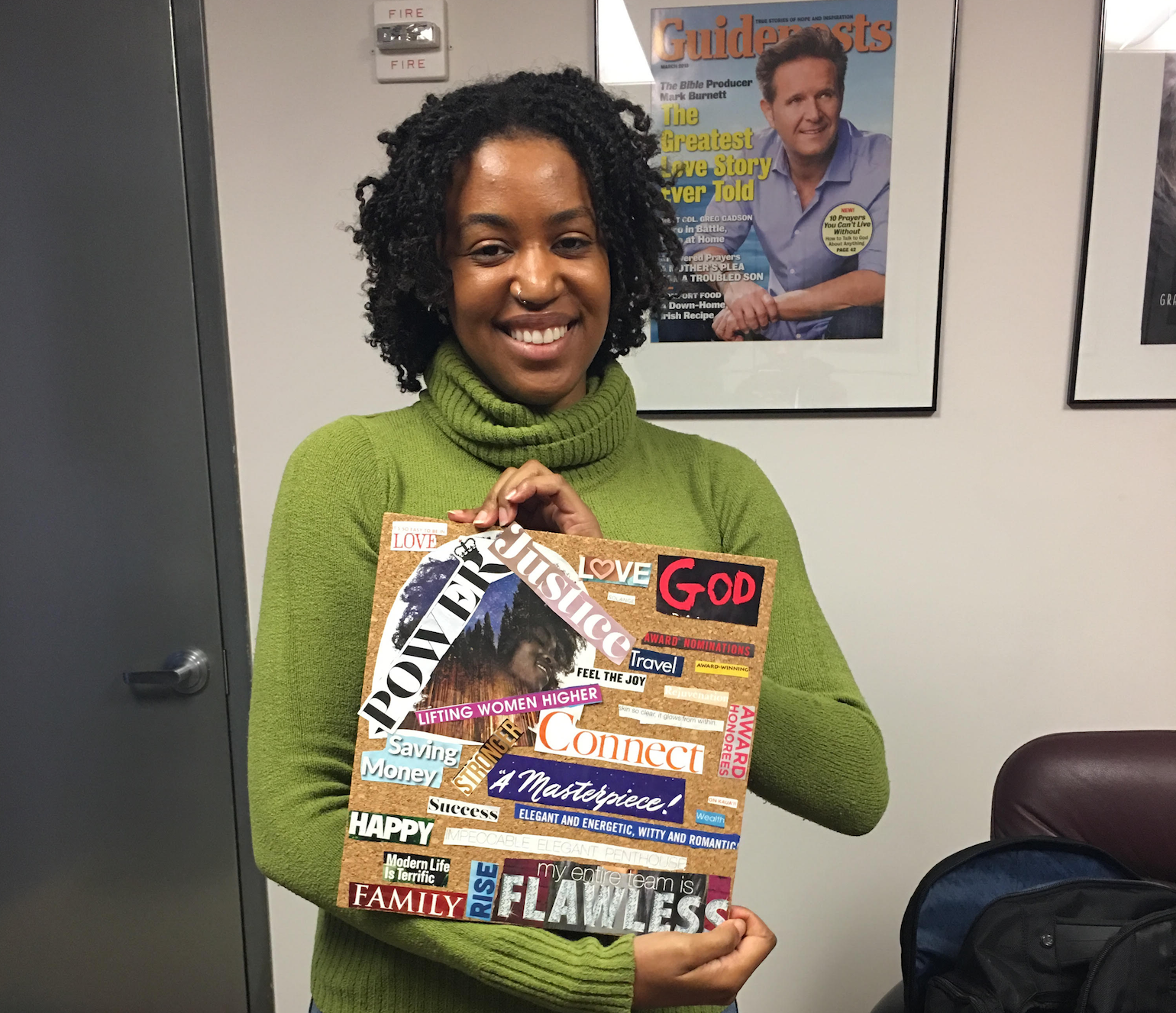
Now, I make it habit at the start of every new year to cut out images and words from magazines and tack them onto a cork board. These words and images express my vision for the next year. In addition to words like “More God,” and “Close Family,” I cut out words that define what I want in my professional life, as well. When I was preparing to publish my debut novel, I cut out the words, “award-winning.” A year after I published my book, it won two awards for best fiction!

Another goal I put on my board from 2015 seemed completely out of reach: a sit-down interview with Oprah. As a professional writer, I’ve

Brooke Obie’s 2015 Vision Board

interviewed all kinds of celebrities and notable people, but interviewing the queen of media just a few years into my career as a professional writer seemed completely out of my reach. I cut out the words, “The Oprah Interview!” and “Oprah Sits Down with Brooke” anyway. And since I was reaching for the moon, I cut out an image of Oprah holding a serving tray from O! Magazine that said, “Summer at Oprah’s” below it and added that to my board, as well.

Fast-forward to 2017 and I received an invitation to interview Oprah about her HBO film, The Immortal Life of Henrietta Lacks, for Guideposts.org! I could hardly believe it. She was so incredibly kind and lovely, and our brief 20 minutes together had me floating on Cloud 9 for days after. I was completely satisfied if I never saw her again, and fully convinced: words are powerful!

But, God wasn’t done bringing my vision to fruition. Just a few months later in October, I received a phone call from Oprah’s Super Soul Sunday crew inviting me to interview her again…at her home! The occasion was her book launch party, The Wisdom of Sundays. Oprah did indeed “sit[ down with Brooke” at a lovely, wood roundtable under oak trees down a short cul-de-sac on her property nicknamed “The Secret Garden.” It wasn’t “Summer at Oprah’s” since it was October, but it was 80 degrees outside! If ever I needed a reminder that with God, nothing and no one is out of my reach, I received the message loud and clear that day.

The images on my vision board didn’t all manifest right away; “Summer at Oprah’s” didn’t happen until 2 years later! But in the time since I’ve been vision boarding, I’ve learned 3 ways vision boarding can help you live a more purposeful life right now.

1) A Deeper Understanding of What Your Purpose Is

When you’re deciding which words, phrases and images to cut out, think about how you want to feel and who you want to be and how those things align with who you know God wants you to be. Instead of cutting out money bags or dollar signs, cut out things that represent the fruit of the spirit: “love, joy, peace, patience, kindness, goodness, gentleness and self-control.” The more specific you can be when creating your vision, the better. One of my favorite phrases on my last vision board is “Okay with your criticism,” which I’ve taken to mean that I can hear criticism (constructive or otherwise) without internalizing it and making someone else’s criticism a part of how I think about myself. This is crucial because, as the vision board practice teaches us, how you think about yourself determines what you will do next. So, once you have the words and images that define your vision for who you want to be and who God wants you to be, you’ll have a clearer picture of what your God-given purpose is.

Brooke Obie and Oprah Winfrey, 2017

2) A New Sense of Responsibility

The vision boarding process doesn’t end once you’ve attached your cutouts to a board. Hang the board someplace where you will see it frequently, providing you with a constant reminder of the decisions you’ve made about who it is that you want to be. Often, we pray to God for the changes we want to make in our lives, but prayer alone is not enough. I didn’t just cut out the words “award-winning novel,” put them on a board, pray about it and watch the awards roll in. I had to write and publish a book, get publicity for it and submit the book for awards consideration. The board is just a reminder of what our God-given vision is. It’s up to us to take the necessary steps to bring that vision to fruition. When we see our lives, our hopes and dreams as something we’re responsible for creating with God, we can get into gear and start doing the work necessary to help God manifest those things in our lives. Don’t just cut out “peace,” for your board, talk to a therapist about what’s taking your peace away and work on solutions to get it back. Don’t just cut out “kindness,” evaluate your life and the way you have been unkind to others and even how others have been unkind to you. Write out a plan of action for how you plan to be kind and experience more kindness in your own life.

3) A New Definition of Life

Best-selling author, producer and preacher DeVon Franklin gives a sermon where he encourages listeners to think about the word “deadline” in a new way. Instead of this looming date on a calendar that fills you with fear and anxiety, he suggests we use the word “lifeline,” instead, because when we’re working on goals that move us toward our life’s purpose, the process renews us, enriches us and gives us more life. It’s the same with your vision board. In Proverbs 29:18, King Solomon writes that “without a vision, the people perish.” When we continue to go through life with our actions unattached to our God-given purpose, we’re directionless, full of deadlines, our unfulfilled potential dying inside of us. But when we connect our goals to the greater purpose of who God has called us to be, we have a vision for ourselves that gives us new life and a new definition of what it means to live. We’re not dreading Monday mornings at work because we can see a deeper purpose in the work we’re doing and the mark we’re pressing toward. When you feel purposeful, you feel more hopeful and at peace and can tap into that more abundant life that Jesus promised us.

How to Worry Less and Trust God More

I was doing my usual morning run in my New York City neighborhood a couple of days ago, and as I passed a streetlamp, I noticed something on it that said, “FBI.”

Oh, no, I thought, the FBI is trying to investigate some crime in the neighborhood. A killing perhaps? Some violence on the subway? Some criminal activity that I hadn’t heard about yet? Oh, dear. Something else to add to my worry list.

Yes, the news is full of stuff to worry about. Diseases, natural disasters and dire reports can allow worries to take overif you let them.

But let me go back to what Jesus said about worry (something I have to remind myself of again and again and again—that’s probably why they say that the well-worn Bible usually belongs to someone who isn’t worn out).

“Can any of you by worrying add a single hour to your life?” Jesus asks. And later observes, “Therefore do not worry about tomorrow for tomorrow will worry about itself. Each day has enough trouble of its own.”

It’s only natural to worry and Jesus understands that. The ability to think ahead is what differentiates us from God’s other creatures and makes us capable of planning. But in the end, much is still outside our control.

So instead of giving myself a Ph.D for worrying, I’d like to be an amateur at it again. Like those birds of the air and the lilies of the field. That’s why in my prayer practice, I make a point of noticing my worries and then giving them back to God.

That includes worrying about a pandemic. Taking care of myself. Washing my hands well as is advised. “For as long as it takes to sing ‘Happy Birthday,’” a colleague noted. But not sending my brain up and down dreamed-up scenarios.

Let me go back to that notice about the FBI that I saw on the streetlamp. Remember where my mind went? All those terrible things I thought.

Guess what? Today when I ran by those signs, I understood why they said FBI. Trailers had been set up, big trucks had moved in, film crews were transporting carts of lighting equipment and long cords.

They were shooting an episode of a TV show called FBI.

Tomorrow indeed will worry about itself.

How to Wash Your Hands with Prayer and Song

When it comes to warding off germs, you’ve probably heard the advice that we’re supposed to wash our hands for 20 seconds, as long as it takes to sing “The ABC Song” or “Happy Birthday” twice. But it occurred to me there might be some other songs—and prayers—that would time out to 20 seconds. Try these:

The Lord’s Prayer
You can say it or sing it, but I’ve never really timed myself before (God willing, I’m concentrating on other things). Turns out, it clocks in at a neat 20 seconds. Maybe a little longer if I go slower. Washing my hands and saying “The Lord’s Prayer.” Now that’s a good use of time. Cleansing to body and soul.

“Amazing Grace”
Everybody’s favorite classic. Whenever I sing it at our church soup kitchen, the guests always join in vociferously. So sing it to yourself (or aloud) when you wash your hands. “I once was lost but now am found/Was blind but now I see…” What great lyrics for any time.

“God Bless America”
I find I become rather enthusiastic with the lathering of the soap when singing this. “…from the mountains, to the prairies, to the oceans, white with foam!” Like my hands. And it’s a good reminder to not only pray for myself but also for others, for our country.

The Doxology
“Praise God from whom all blessings flow, praise Him all creatures here below, praise Him above ye heavenly hosts, Praise Father, Son and Holy Ghost.” A perfect 20 seconds by my watch. Praising God while doing the best thing I can do for my health and the health of others.

“This Little Light of Mine”
Our kids used to sing it, and I still have the lyrics and the tune lodged in my head. It always feels like a happy reminder of what Jesus said to His disciples and all of us: “You are the light of the world.” We are. Let it shine, let it shine, let it shine.

“Holy, Holy, Holy”
Another classic. And when I sing that line, “early in the morning our song shall rise to Thee,” well, doesn’t that make sense when you do that handwashing first thing? Remember that old line, “Cleanliness is next to Godliness?” Put them both together with a healthy habit, a prayer and a song.

I invite you to go through your own mental index of prayers and songs and start using them. Be smart, be careful, don’t give into worry. Do what the medical professionals say. With prayer and song.

How to Wait Patiently for Spring

“How often does your spring come?” asks the author Gary Zukav. “If you are a prisoner of the calendar, it comes once a year. If you are creating authentic power, it comes frequently, or very frequently.”

The spring equinox officially arrived on March 20 at 5:58 p.m. ET, but here in New England where I live, that date can come weeks before we actually take a deep breath and think, “aah, spring.”

Many years ago, I planned a party for my husband, who was returning home after a long overseas deployment with the Army Reserves. The date for the party happened to be March 21, so my unofficial theme was the newness of spring and the fresh start the season represents.

The weather that day was raw, wet and cold. My pastel-colored outfit was almost hilarious in how incongruous it was with the wind chill. But it was warm and happy inside the party, both from the food and music, and from the love of the friends and family who had gathered together to welcome Rob home.

Spring had sprung in my mind, if not in the forecast. I remember that feeling every year, especially when I see spring bulbs pushing toward the light through mud and slush. With enough “authentic power,” as Zukav puts it, we can find the light regardless of the weather.

Waiting for spring is an exercise in patience. It’s also an exercise in presence, because if you live in as fickle a climate as I do, you know how fleeting those tender early days of sunshine are.

Before long, the warmth will build toward its summer crescendo. For now, though, let’s rejoice in our ability to have a fresh, renewed mindset, deploying our positive outlook in the service of frequent springtimes.

How to Use Personal Hardships to Help Others

In life, there are hardships that can change us for the better—or for the worse. How we respond to adversity varies from person to person and depends on the circumstances.

Many find a way to overcome hardship and move forward. They may even learn a lesson and grow from it. However, some people may turn to alcohol and drugs to numb their pain or allow their anger to engulf them. Some, in bitterness, seek revenge. Others turn to isolation.

And then there are those who turn their adversity into a power for good—helping others who have suffered from a similar loss. Instead of letting their pain isolate them from others, they plunge ahead to help those who face their own pain with hope and love.

In his book The Second Mountain, David Brooks tells the story of Sarah Adkins who went through a horrific tragedy. While she was away on a trip with her mother, her husband, who was battling depression, killed their two young sons and then himself.

It took Sarah years to recover from this tragedy. Eventually, she found the strength to turn her pain and anger into power to help others. She started a foundation for women who can’t afford funeral and other costs when their children’s lives are taken, or when there is violence in their home.

Sarah says, “I was going to fight back against what he tried to do to me by making a difference in the world.” Although she still lives with the pain this tragedy has caused, she has used it to help others who go through similar hardships. Thankfully, most of us will never face such an adversity as Sarah’s, but we can all learn from her how to use tragic situations to help others.

Recently, a colleague of mine shared how one of her teen children, who was diagnosed with a heart condition, feels empowered by taking part in a medical test that may help others in the future. This is her teenager’s way of turning illness into a power for good. She refuses to feel defeated by illness even though there are days that she is exhausted by her condition.

When we face hardship, it is up to us to not allow circumstances to take control but to grow from them and possibly help others. This is a choice we must all make. It doesn’t mean that we don’t feel pain, anger or frustration, but it’s finding the courage to reclaim our power and grow from the experience.

How to Use Mindfulness to Reduce Caregiver Stress

Julie Hayes is the Content Manager at Benjamin Rose Institute on Aging.

Compassion and empathy are among the most valuable traits a good family caregiver can have, as they drive you to give your loved one the best possible care. But these qualities can also allow you to pour everything—and then more—into caregiving tasks, often to the exclusion of your own needs and feelings. Your physical, emotional, psychological and spiritual reserves can quickly run dry, given all that caregiving requires of you. It is not uncommon for caregivers to isolate themselves socially and to neglect important aspects of self-care. Continually putting your loved one’s needs first, while you push aside your own, can easily lead to burnout and even beyond, to more significant compassion fatigue.

Self-care is an often-used term for an approach to fighting caregiver stress and burnout. One of the oldest routes to stress reduction is meditation, defined by Verywell Mind as “a set of techniques that are intended to encourage a heightened state of awareness and focused attention.” The practice goes back to ancient times and is embraced by cultures and religions throughout the world. The numerous proven health benefits of meditation include decreased stress and anxiety; better sleep, memory and regulation of emotions; and lowered blood pressure, according to research. Meditation can help to cultivate mindfulness, which combats stress and burnout.

What is mindfulness for stress reduction?

Jon Kabat-Zinn, the originator of what is now known as the Mindfulness-Based Stress Reduction program, defines mindfulness as “awareness that arises through paying attention, on purpose, in the present moment, non-judgmentally.” Mindfulness cultivated through meditation can help those who practice it to:

· Focus on experiences instead of on preconceived judgements and expectations

· Act with deliberation and intention, rather than on ‘autopilot’

· Respond to situations rather than react to them

· Increase awareness of all aspects of a situation, instead of automatically shutting out those that are perceived as confusing or unpleasant

Kabat-Zinn has identified seven necessary attitudes to the cultivation of mindfulness:

1. Non-judging, the practice of being an impartial witness by avoiding snap judgements and reactions, and instead observing the situation as it is

2. Patience, the ability to allow things to unfold at a natural pace

3. Beginner’s Mind, the practice of setting aside experience and expertise to look at something with fresh eyes

4. Trust in yourself, your intuition and your feelings

5. Non-striving, the practice of setting aside a specific agenda, and simply being as you are

6. Acceptance of how things are without judgement of whether things are good or bad

7. Letting go of emotions, thoughts and anxieties you’re holding onto, and letting them be

How can I use mindfulness for stress reduction as a caregiving tool?

Practicing mindful meditation for stress reduction can help you to combat compassion fatigue and burnout. Research compiled by the American Psychological Association shows that mindfulness has benefits such as:

· stress reduction

· increased focus

· a decreased sense of being controlled by emotions

· reduced dwelling over unhappy thoughts

It’s common for caregivers to neglect their own emotions in order to focus more on their loved ones’ needs. Mindfulness for stress reduction is one way to become more aware and accepting of the emotions you may have. Instead of discounting your feelings, you can begin to better recognize their place in your life and more readily come to terms with them.

In addition to its self-care benefits, mindful meditation can also improve the way you care for your loved one. In her book “The Mindful Caregiver: Finding Ease in the Caregiver Journey,” licensed geriatric social worker Nancy Kriseman explains how mindfulness can help caregivers to become more fully present with their loved ones without disengaging. This can allow for greater attentiveness to your loved one’s experiences, in addition to your own. “Embracing a healing presence requires you to just be in the moment together,” Kriseman wrote. “[Mindfulness] can help slow you down some so you can make the best possible decisions for your care recipient. It also helps bring more balance and ease while navigating the caregiving journey.”

How can I bring mindfulness for stress reduction into my busy schedule?

As a caregiver, you have a full plate, and adding mindfulness to it may feel like a lot to fit in. The good news is that there are easy ways to make it a part of your schedule, even on the most hectic of days. You may want to start by exploring a few of these options:

· Try PsychCentral’s 1-Minute Mindful Exercises, which offer simple stretches and even a delicious mindful eating exercise

· Practice breathing techniques with this 3 minute exercise by emotional wellness platform Stop, Breathe & Think, or if you have a bit more time, check out this 20 minute guided meditation by The Mindful Movement.

· Pause for a moment in the middle of something you’re doing in your day to focus on the movements of your body, feel your breath and be aware of whatever’s going on around you.

· Download phone applications enjoyed by fellow meditation practitioners such as Insight Timer; Stop, Breathe & Think; Simple Habit; and #Mindful

· Visit mindful.org’s recommended guided meditations which focus on various areas, including cultivating resilience, practicing non-judgement and shifting out of autopilot.