Embrace God's truth with our new book, The Lies that Bind

Living With Osteoporosis

The cast-iron hamburger skillet gave me away.

I was cooking ground beef for dinner. I went to drain the meat—and I couldn’t lift the skillet. I got it a few inches off the stovetop then it clunked back down. I took a deep breath. What was wrong with me?

Rejoice in All Things in article ad

“Ashley!” I called to my teenage daughter. “Can you give me a hand in the kitchen?”

Ashley came in and laughed when I told her what I needed. “You’re not that old, Mom,” she joked as she drained the meat. She went back to her homework. I went back to making dinner. Maybe it wouldn’t happen again. Maybe I was just tired. Maybe…

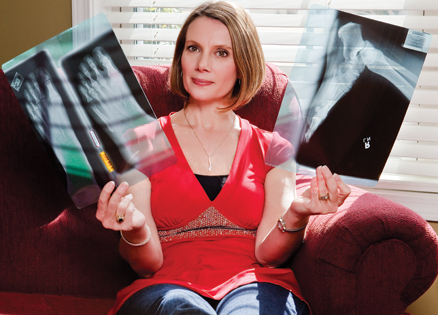
I leaned against the counter. I looked at my arms. I pictured the bones inside them. Who was I fooling? Two years earlier I’d been diagnosed with osteopenia, or low-bone density. I’d done nothing about it. No medication, no exercise, no change in my diet, even though the doctor told me I was a high risk for osteoporosis.

Was I finally paying the price for my denial? I hoped not! I didn’t have time to get sick. I was raising three kids and running a 200-student church preschool. Besides, I was only in my forties. People in their forties don’t get bone disease—right? I’d actually tried medication for a month after the osteopenia diagnosis. But I didn’t really feel like taking the pills. I never refilled the prescription.

I finished mashing some potatoes and took down plates from the cupboard. As long as I was being honest with myself, I might as well admit I’d been ignoring my body a whole lot longer than two years.

It had been twice that long since I first broke my foot helping take care of my ailing grandmother in Oklahoma. I got up in the middle of the night to check on her and tripped over a step. I hobbled around until I got back home. To my annoyance the doctor put me in a cast and told me not to walk. As if!

My husband, Geoff, and the kids offered to cook and clean, but I knew the house wouldn’t run right without me in charge. “That foot took far too long to heal,” the doctor chided me when the cast came off. “I’m recommending that you get a bone-density scan.”

I skipped the scan. The church preschool was just starting up and I still worked my old job, assessing developmentally delayed children for the local school district. That job stressed me out because often I had to convince deeply reluctant parents their children had a problem. My heart ached for those parents. But why did they resist admitting the obvious, especially when treatment was available?

I forgot about my bones until a year later, when I was making my older son Ian’s bed one morning and whacked my foot into an iron bedpost. Broken again! A different doctor also recommended a bone-density scan. When the foot took twice as long to heal as it should have, I finally broke down and got the scan.

I’d never heard of osteopenia. Well, at least it’s not osteoporosis, I thought. The doctor recommended medication, calcium supplements and exercise to strengthen my bones and muscles.

“The longer you wait to make these changes,” he warned, “the more likely your condition will worsen.” I nodded, but inside all I could think was, Not possible. As in, not possible for a young, active woman like me to be hobbled by such an old person’s disease.

I heaped hamburger onto the plates and gave everyone a dollop of mashed potatoes. Had I waited too long? I kept a cheerful face for the rest of the evening, and soon Geoff and I were in bed, lights out. Only then did the fear I’d been suppressing burst forth. Lord! I cried out. What should I do?

I couldn’t help thinking of my great-grandmother and great-aunt, both painfully stooped with osteoporosis in their waning years.

For some reason my mind drifted back to my old school district job. I remembered one mother in particular. I’d just finished assessing her preschool-age daughter in a diagnostic play space, a miniature kitchen. While the little girl made play pies, I calmly told the mother what challenges her daughter would face.

“But that’s not possible,” the mother insisted. “You just don’t know her. She’s fine at home with me.”

Not possible. Those were my words. I remembered the rest of my conversation with the mother, how reassuring I’d been about treatment. How on earth could I have been so good at doling out advice all these years—and so deaf to my own problems?

God had been answering my prayer, telling me what I should do, all along. Every time I ignored my doctors, my family, my own body, I was ignoring the voice of the Healer himself. Denying my problem was denying God the chance to help me.

I made a lot of changes after that night, and no one was more surprised than I to discover just how painless they were. I resumed taking my medication. I took up Jazzercise and loved it. I steamed vegetables for dinner and no one in my meat and potatoes household complained. I even allowed myself a bubble bath each weeknight to reduce stress.

Most of all, I learned to set aside my pride, denial and fear, and listen to that healing voice of God. Praying and writing in my journal each morning, I hear his message loud and clear. My body is a gift. I need to take care of it. And so I do.
Living with Cancer: Sisters with Spirit

I work for a company that makes hospital gowns. I know what you’re thinking: those awful, paper-thin robes that never fit right and leave your you-know-what freezing while you wait nervously to undergo a test or treatment.

Well, those are exactly what we don’t make. We make soft, comfortable, kimono-style robes that help women and men feel good and look great during difficult times. The garments offer easy access for treatment but look less medical than those gowns everyone hates. 

The company is called “Spirited Sisters” because it was started by three gals: my sister Claire, my sister Patty and me. We knew plenty about tests and treatments. From our own experience with cancer we learned to trust the Spirit as it led us, guided us and finally comforted us through a terrible loss. It started with me.

I was used to going to checkups at the dermatologist. It was never a big deal. Years earlier my internist expressed some concern about my basal cells. She recommended that I go to the skin specialist every six months.

Then one day in the spring of 2002 I noticed something a little unusual on my arm. I put it out of my mind until my next appointment. I’d had friends with melanoma—the deadliest type of skin cancer. Whatever I had didn’t look like melanoma to me. I didn’t think it was anything to worry about.

My dermatologist did a biopsy. Five days later I got home to no fewer than five voicemail messages from her. “You have to have this removed immediately,” she said. The urgency in her voice made my heart race. I frantically tried to call her back. I finally reached her. It was a melanoma. It looked nothing like the melanomas I’d seen before, but it comes in many forms. “I’ve already made an appointment for you with a surgeon,” she told me.

I was 52 at the time, with a great career running an interior-design company, my husband, Richard, whom I adored, and two children who needed me. My first thought was, I am going to die. My son, Matthew, was engaged. My next thought was, I’ll never make it to Chicago for his wedding…I’ll have to ask our priest to come to the house and perform the ceremony here.

My daughter, Meaghan, was in college. I won’t get to see her graduate… Richard was also frightened, but calm. “We’ll get through this,” he said, holding me. 

By then it was too late at night to call anyone else. I knew that first thing in the morning I’d call Patty. Not only is she my sister, she’s a psychologist. She’d held the hands of friends as they lived with, and sometimes died from, cancer.

My surgery went well. It was followed by radiation, which was followed by interferon therapy. It was exhausting. You know what really bothered me? Those awful, papery robes they made me wear. They became a symbol of the misery of cancer.

But by Christmas, surrounded by the people I love—including my 41-year-old “baby sister” Claire, visiting from California with her six-year-old little girl, Lilly—I was feeling somewhat hopeful. But something else was worrying me: Claire. She’d always been beautiful, outgoing, charming. She was a high-powered executive and a great single mom. But she didn’t seem like herself. We were in the kitchen together one night and I asked if something was wrong.

“I haven’t been feeling great for a while,” she admitted. “I’ve been having stomach cramps.” I thought it was probably stress. When she and Lilly headed home to San Francisco in early January, she was in pain.

Not long after, my phone rang at work. Claire. She was crying. “What is it?” I asked. I could hardly hear her through the tears. “I have colon cancer,” she said. And by the time it had been diagnosed, it was stage four and had metastasized.

I’d always associated colon cancer with people much older than Claire. This can’t be happening, I thought. I’m the big sister. I’m supposed to take care of everyone. I thought of Claire, my baby sister no matter what age she was, way out there in San Francisco, working so hard and being such a great mom. We all grew up in Massachusetts, but I was the only sister who stayed local.

Now Claire seemed so far away. And with Patty down in Georgia, I felt isolated. Though Claire had an amazing network of friends, it seemed to me we sisters needed to be together.

Patty and I went out as often as we could to help—take Lilly to school, go shopping, offer our shoulders to cry on. Patty and I even took Claire to her chemotherapy treatments. Invariably, we’d roll our eyes at those terrible hospital gowns. “These things are so humiliating,” Claire said. “As if cancer isn’t bad enough!”

“You’d think they could come up with something better,” I said. “These have got to go!” The idea hit all three of us at once.

We quickly came up with a business plan. Patty’s the true fashionista in the family and I have a background in design. Why couldn’t we build a better garment? We started brainstorming. We called our business “Spirited Sisters” because, let’s face it, we were a spirited, feisty group of gals and we always felt such a personal connection to the Holy Spirit. 

Soon, we came up with a line of clothing that would let women who faced hours of treatments preserve their modesty and dignity, and empower them. Why stop at robes? The collection—The Original Healing Threads—includes jackets and pants too. All the soft, comfy pieces have hook and loop closures so they’re easy to open and close, and give doctors access where they need it.

“If we ever make any money from this,” Claire said, “we have to give back. I’ve been lucky—with family and friends helping me out, and my company paying my salary even when I’ve been out sick for a whole year. A lot of single moms with cancer don’t have that kind of support.” Patty and I agreed. We are setting up the Claire Foundation, to help single mothers with life-threatening illnesses—and their kids too.

Claire fought hard. She was the bravest person I ever saw. Near the end of 2005, her doctors told her she had anywhere from three days to three weeks to live. She tried everything—alternative therapies, yoga, acupuncture. She always had a beautifully open mind and figured these things couldn’t hurt. We all took great comfort in prayer. Claire so badly wanted to live, for her daughter, Lilly, for us. But her body gave out.

Losing our sister was painful—but Patty and I had no doubt that Claire was finally at peace, with God. For that we gave thanks. 

We can’t always know the answers to life’s deepest questions: who gets cancer and who doesn’t; who lives and who dies, we can only know that there is a God who loves us, and in that love is a healing that can find us in so many ways.

Learn more about Healing Threads!

Living with Cancer: Game Plan

I’m a coach—a high school golf and basketball coach. That means more than you might think. Coaching is a job. But it’s also an identity. To my players I’m a mentor, an encourager, a disciplinarian and a strategist all rolled into one. Most important, I’m an example. I show my kids how to win games and how to be people of faith and integrity.

That’s actually the part of my work I love best. My office is messy with papers, schedules, books, sports equipment and even a few awards, including my induction into the state’s Basketball Hall of Fame. But nothing means more than watching my players at graduation, seeing them transformed from nervous freshmen into responsible young adults, ready to step out into the world with confidence.

NIVFLB Inarticle ad

Which is why, when it suddenly looked like I might lose my job—might lose my life—a couple of years ago, I didn’t know how to react. I had been coaching at Lutheran West High School for 38 years. When it came to my own health, though, I had no set game plan.

It all started one Friday in the gym. I was 59, working out to keep up with my players and students. I was on the abdominal machine, doing sit-ups with weight resistance. I bet I could increase that weight, I thought, and added a few more pounds to my load. I did a crunch. Ouch. Come on, Coach. Another. Hot pain seared my lower abdomen. What was going on? 

READ MORE: A COACH’S VICTORY

I tried another, tentatively. The pain was so intense, I fell back, gasping. Embarrassed but determined, I finished the workout and staggered to work.

I thought the pain would ease—I just needed to get used to the new weight. But it lasted all that day. And the next. By Sunday, I knew something was wrong. My roommate Cindy drove me to the emergency room, where doctors told me my abdomen was so filled with fluid, they couldn’t make a diagnosis. “You need to see your gynecologist,” they told me. “Right away.”

I’m fine, I told myself the next day in the gynecologist’s waiting room. I pictured myself at the gym, on the court, taking camping trips I so loved in Ohio state parks. But the doctor immediately ordered several tests, including a blood test for ovarian cancer. God, please, no.

Two days later I returned to the gynecologist for the results. The pain had gone away, and so had my worry. I was eager to get back on the ab machine.

“Karen,” the doctor said, coming into the room with a strangely grave expression, “why don’t you sit down?” He opened a chart. “This particular cancer test scores results numerically. A score below 35 is normal. Yours is…” he paused, “900.” I looked at him.

“Of course,” he continued quickly, “there’s always the chance of a false positive. We’ll have to operate to determine that. I’m sorry to have to deliver this news, though.”

I sat stock-still. Me, in the hospital, under anesthesia? Cancer? I couldn’t quite picture it. My mind spun, thinking of my players, the upcoming season—and then, weirdly, my office at school, scattered with trophies and plaques and papers. If I die, who will clean it?

That night, I lay awake, still not comprehending—not admitting—the doctor’s words. My grandmother, my cousin and several others in my extended family had died of cancer. But I was so healthy. I’m an athlete! How can I be a coach if I have cancer? I tried to pray. God, I began, oh, God…. But no coherent prayer came.

Come on, I thought. I prayed every day—for my players, for our games, for people at church, for friends and family. But what was I supposed to pray for now? I’m not going to have cancer, I finally decided. The doctor had said false positive, so that’s what it was going to be.

READ MORE: A CHAMPION COACH WITH FAITH, COURAGE AND COMMITTMENT

Wheeling into the operating room, I felt oddly calm. My pastor and several close friends performed a healing and anointing service. My brothers, who had driven from Missouri, sat outside in a waiting room. False positive, I thought as the anesthesia kicked in.

I came to in a recovery room. When I had stabilized, the surgeon came in and sat by my bedside to discuss the operation with me. “I’ve got some good news and some bad news,” he said. “Which do you want to hear first?”

“The bad,” I said. He took a breath.

“Okay. We removed a nine-inch tumor from your abdomen.” He paused to let that sink in. “You have clear cell carcinoma, the most aggressive kind of ovarian cancer. You need chemotherapy immediately—six treatments three weeks apart.

“Now, I know you teach at school. If everything goes well and you stay on schedule, the treatments should be completed by fall. Of course, you may not really feel like going back in to work.”

“Tell me the good,” I said quietly.

He brightened. “Your cancer is only stage two. That means it hasn’t spread to the lining of your abdomen or, from what we can tell, to the lymph nodes. If the chemotherapy treatments are successful, you could beat this thing.”

Days later I left the hospital, still in a fog. The first chemotherapy treatment was scheduled right away—for June 1, two days before graduation. “You’ll probably have to miss that graduation,” a nurse told me. Oh, no, I won’t, I thought. I hadn’t missed a single graduation in 38 years. Cancer was not going to change that. My students would see the same old Coach Wittrock.

The treatment was pretty straightforward. Nurses hooked up an IV and dripped a combination of three cancer drugs, plus medicine to help with side effects, into my body. It took eight hours. I felt fine. Miss graduation—humph.

The next day, my legs and head throbbed. The day after, I awoke and crawled into the bathroom, sicker than I’d ever felt. I could barely lift my head from the floor. “Cindy,” I croaked, “I need to call the school. I can’t make it to graduation.”

So it went the rest of the summer. Every treatment left me weak and sick, wanting to close my eyes and give up. Nothing I did helped. There was no routine, no workout, no plan that could make me strong enough to withstand those chemo drugs. And they didn’t even come with a guarantee! Cancer, even when apparently in remission, can come back without warning.

Vulnerability without end. How was I supposed to cope with that? How was I supposed to live my life?

One weekend, after I had recovered some from a round of treatment, I decided to get out of the city and do some camping. I needed fresh air, to clear my head, to surround myself with God’s creation. Summer was advancing—which meant school was drawing near. What would happen when I went back—assuming I went back? I wasn’t the same Coach Wittrock. I was thin, bald. I felt sick.

What would students think? Would I be able to get on the court and coach like I had before? What kind of example would I set? The questions themselves exhausted me.

READ MORE: PEAK PERFORMER

I packed fishing gear, drove to my favorite state park and walked to a beautiful lake. I spent a day fishing and reading, listening to wind in the trees, watching the sky reflected in the rippling water. So serene. So whole. God is good, I thought to myself.

Dusk fell and I went to bed in my motor home. Insects chirped. The lake lapped at the shore. Its rhythms lulled me to sleep and I found myself dreaming—more vividly than I usually dream. I saw a white light, brilliant and strong, descend from somewhere above and wrap around me like a blanket. Somehow I knew it was angels. Have they come to take me to heaven? I wondered.

But immediately I knew they hadn’t. They hovered, clearer now, their shapes concrete and yet indistinct. And then they vanished. I woke with a start. It was dark. The lake had stilled. From somewhere, a voice came to my thoughts: You will be healed.

The voice departed as quick as it came. But that word stayed with me. Healed. What did it mean? I thought of a verse from Exodus: “Stand firm and watch for the Lord’s deliverance.” God, I suddenly realized, was going to heal all of me. Not just my strong, athletic body, given back to me, as if nothing had happened. No, he would heal my spirit too. 

Trust in me, the voice seemed to say. I will never forsake you. I sighed, peace settling over me like I hadn’t felt in months. And I drifted back to sleep.

I had more chemotherapy after that—five more rounds, in fact. And I developed an allergic reaction to some of the medication, requiring two final sessions overnight at the hospital. But as the start of school approached, I grew more and more excited.

I was not, I knew, the same Coach Wittrock. I was thinner, balder, weaker—everything that I had feared. But none of that mattered. Dependence on God was my strength—vulnerability, met with prayer and thanksgiving—the example I could set for all of my students.

I arrived the first day of school in a baseball cap. I knew I wasn’t up to coaching full time, full strength, so I asked my assistant coach, a parent volunteer, to help. He was there with me as the students trickled in, gathering around, some of them staring surreptitiously, questions in their eyes.

I explained about the cancer, told them I might miss some days here and there, might not be mixing it up with them as vigorously as I had before. They didn’t seem to care.

“We’re so proud of you, Coach!” someone called out.

“Yeah,” said another. “Great hat too.”

“Let’s practice!” a few cried. And that’s just what we did.

Download your FREE ebook, True Inspirational Stories: 9 Real Life Stories of Hope & Faith.

Living with Cancer: A Message for Survivors

The morning I awoke with a bad sore throat, I was more annoyed than anything else. A bad sore throat meant maybe flu, which meant a trip to the doctor, which meant time missed at work.

I hated missing work. I was a dental hygienist, not long out of college, and my life basically revolved around my job. I wanted to impress my new employers, and I hoped one day to teach dental hygiene. I worked long hours and went straight home to dinner, TV and bed. Friends asked me to join them on vacations sometimes, but I blew them off. I hadn’t traveled much—hadn’t even been on an airplane. I figured vacations could wait. I was 27. I had my whole life ahead of me.

A Journey of Faith In Article Ad - Avail Now

I sat up in bed and stretched my arms, wrapping them around my chest in the December cold. Wait. What’s that? A small lump seemed to press against my left middle finger, under my arm. I felt at it, and for a moment it went away. No, there it was. Definitely a lump. I frowned. I was too young to have breast cancer. What could it be? I sighed. Better go to the doctor. Time missed at work!

Get hope for Breast Cancer here

In the examining room, a physician’s assistant couldn’t even feel the lump, it was so small. Still, to be safe, I asked for an ultrasound. Two weeks later, a radiologist waved an ultrasound paddle across my chest. I waited for him to say, “You have nothing to worry about.” Instead, he frowned, and I realized he was saying words like, “this concerns me” and “might need a biopsy.” I tried to focus. What was he talking about? The room seemed to telescope. “We need to do a mammogram,” the doctor said. “I’ll go prepare the equipment, and someone will bring you when it’s ready.” He walked out, and I was alone.

I grabbed the phone on the examining room wall. Not wanting to worry her, I’d told my mom I’d be Christmas shopping that afternoon—which was true. I’d planned to shop after what I’d assumed would be a quick appointment. I dialed, praying she’d answer. “Mom,” I said when she did. “I’m—I’m at the hospital, the breast care center.” I started crying. “I need you to come down here right now.”

She was there in time to sit with me through the mammogram. She held my hand when the doctor said he definitely needed to do a biopsy—that day, if possible. “I’ll call you with results tomorrow,” he said. He handed me a brochure: “Dealing with a Cancer Diagnosis.” I looked at it, not quite comprehending. Then Mom and I walked out to the parking lot.

It was a clear, cold, late afternoon, already winter dark. I stared at the city lights, the black sky. For some reason, I suddenly pictured myself old—wrinkled, achy, all those things we’re conditioned to dread about old age. I might not know what that’s like, I thought. Might never grow old.

And then a cascade of nevers flooded my mind. Never marry. Never have kids. Never even get on an airplane. Oh! I cried. What had I been doing all my life? The road between my house and the dentist’s office—how often had I driven it? Enough to imprint it like a rut. Would I ever know anything else? I looked at the city lights again, the sky. They seemed to fade, slip through my fingers like sand.

The next morning, Mom, my brother Marty and I met at a café to figure out what to do. The doctor called my cell phone just before we went in, but I already knew what he was going to say. Mom held me in the parking lot then we wiped our eyes and marched into the café. We ordered food and poured through phone books, writing down names of doctors and treatment centers. It felt good to do something.

“Call your friends too,” Mom said. “You know a lot of people in healthcare.” I did. One of them mentioned her mom had recently survived breast cancer. I felt a stir at that word survive. “I’ll have her call you tonight,” my friend said.

That night the phone rang and I heard a friendly, steady voice, about my mom’s age. We talked for awhile about treatment options, and then the woman’s voice grew serious.

“Gayla, listen,” she said, “you’ll think I’m crazy. But I want to tell you something. You are going to be glad you had breast cancer. You will gain from it. You will become a new person. You can’t see that now. But it’s true.”

I said something polite, but soon ended the conversation. What was she talking about? “My whole life ahead of me” now meant a deadly disease. What was good about that?

I set the woman’s words aside and threw myself into treatment the way I’d thrown myself into work. I researched everything online, talked to many doctors. Soon I’d found a surgeon and scheduled a mastectomy and chemotherapy. I knew about recurrence, about survival rates, but I tried not to think about them.

A few days before surgery, my brother Matt spent the night at my house—he knew I was nervous. I awoke around 2:00 A.M., my mind racing. Do something, Gayla, I thought. I swung my legs out of bed and padded to the bathroom. It was clean, but I decided to clean it again. I began scrubbing the sink, the toilet, the bath. Soon my arm ached and I realized I was wiping imaginary spots. I set the sponge down and walked to the guest room. “Matt?” I whispered.

“Hey,” said Matt. “Can’t sleep either?”

“I was cleaning the bathroom.”

Matt turned his light on. He was smiling. “Gayla,” he said quietly, “want me to pray with you?”

I felt myself wobble. “I would really like that.” I sat beside him, and he put his hand on my shoulder. His voice fell into a lulling rhythm, and I found myself thinking again about those words my friend’s mom had said: New person. What did that mean? What kind of person, God? Matt’s voice wove in. “Lord, help us focus on the precious gift of Gayla’s life. It truly is a gift, and we thank you for every day we have with her.” He went on, and I felt suddenly like an ocean liner turning. The gift of life. What had I done with that gift? I groped for images, but all that came was work. “You guys go on without me,” I heard myself say. “Maybe I’ll join you next year.” There might not be a next year, Gayla. It’s time to live. Now. Matt’s voice said, “Amen,” and we sat, silent. Live. Now, a voice seemed to echo. Live.

I had two rounds of surgery, one for each breast, and three months of chemo. It was all awful, especially the chemo, but I knew exactly what I wanted to do the minute the second operation was over. Days later, Mom dropped me off at the Oklahoma City airport. I was bald, wearing a wig of straight brown hair, my torso still wrapped in foot-wide ace bandages. But I didn’t feel like a person with breast cancer. I was a person recovering from cancer, flying all by myself to a survivor’s convention in Washington, D.C.

I walked down the jetway and, for the first time, saw the interior of an airplane. I sat at a window and stared as the plane taxied to position, roared its engines and began heaving down the runway. Grass, pavement, buildings whipped by until, suddenly, the ground fell away and we were flying, the city shrinking, like a toy. The window fogged, then cleared, and I put my hand to my mouth. We were in a cave of clouds, towering walls of gray, a few shafts of sunlight pouring through. And then, just as suddenly, the clouds fell away, and we were above them, above a field of clouds, a kingdom of clouds, light and shadow. I grinned uncontrollably. I was flying! Like I thought I’d never do. My whole life ahead of me.

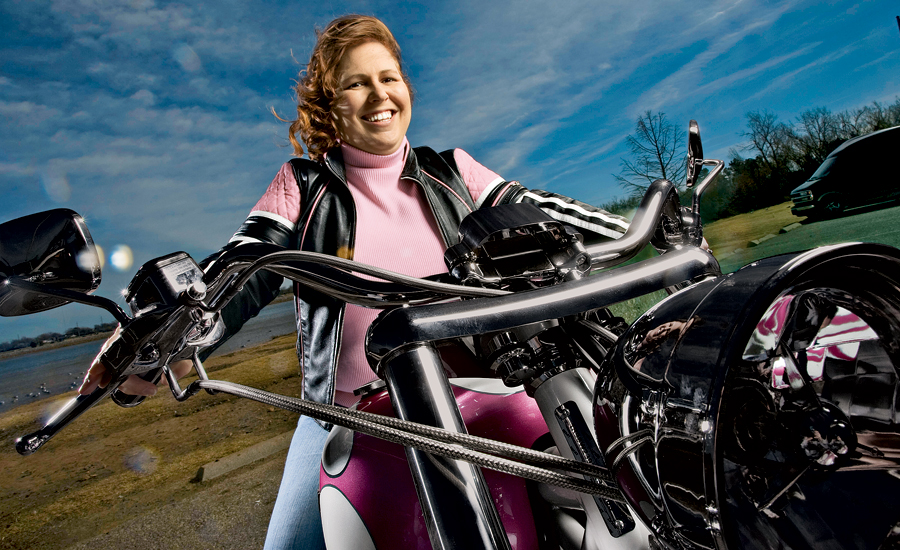
After the breast-cancer convention, I got a motorcycle license and drove a pink, low-slung Ridley up the California coast to raise awareness about young women with breast cancer. I rode the rapids in Colorado, scuba dived and visited a rain forest. Best of all, I met a man named Grant—online!—and married him. We take a cruise with family every year. That’s right, a cruise. A vacation. Time off work. I realize now just how right my friend’s mom was five years ago. I am a new person. A better person. A person who survived cancer, yes, and who may get it again. But that brush with death has taught me the value of life. It’s a gift from God. I don’t intend to waste it.

Living with Cancer: A Cowgirl’s Inspiring Journey

This was it. The very last question after eight days of grueling competition. I waited anxiously with the other four finalists—the bright colors of our Western outfits rivaling a Las Vegas sunset, our long curly hair flowing out beneath the stiff brims of our cowboy hats.

I’d been preparing for this pageant for the last two years, studying every kind of horse and boning up on rodeo knowledge while attending performances all around my home state of North Dakota, riding any horse I could find to improve my horsemanship skills.

Daily Strength for Women in Article ad

Now, the answer to a single question would determine if I’d be crowned Miss Rodeo America 2007.

A hush fell over the crowd as the emcee lifted his microphone. “What,” he asked, looking directly at us, “is the biggest challenge you faced during your year to become Miss Rodeo America?”

How could he pick that question? My eyes flew to my family and friends, 50 strong, cheering madly in the showroom of the Orleans Hotel in Vegas. They had been my support and strength. The only ones who knew that the hair under my hat wasn’t even real.

Miss Rodeo America was a dream I’d been carrying ever since my sister convinced me to run in a queen contest during high school. “You should try it, Ashley,” she urged. “You’re a really good cowgirl.” I’m the youngest of six kids and my entire family rodeoed, so we were going to rodeos and playing in the dirt for as long as I can remember. I competed in barrel racing, pole bending and goat tying, but I always thought rodeo queens were just like any other beauty queens. They couldn’t even ride very well.

It was only when I won that first contest and went on to the national high school competition that I discovered how much work it was. First of all, queens don’t get to ride their own horses. That’s why we have trouble in the saddle. You might just get stuck with the toughest horse the stock contractors have, and you have to be cowgirl enough to ride it.

Find out more about one of Guideposts.org’s sponsors:  Cancer Treatment Centers of America

In college, I’d decided to try for the Miss Rodeo America title. My first official appearance after winning the North Dakota state crown was attending the National Stock Show in Denver in January 2006. During the three-week run, I was tired all the time, and lost a lot of weight, down almost three pant sizes. I knew that something had to be wrong. Really wrong.

The first night I was back in Bismarck I woke up with a terrible pain in my chest, so bad it felt like someone was stabbing me. I couldn’t even sit up in bed. Early the next morning I went to the walk-in clinic. A doctor did an X ray, and it seemed like it took forever for him to come back to the room. He looked at me gravely. “I want you to have a CT scan in the morning,” he said. “And your parents should be here.”

I called them and they came over from Bowman to be with me while I went through a battery of tests. At the end we all sat in a doctor’s office and I listened in a daze. “You have Hodgkin’s lymphoma,” he said. “Cancer of the lymph nodes.”

I grew up on a ranch, where hard knocks are something you get used to—whether lightning strikes a cow or a big hailstorm comes through and wipes out your entire crop. But this news hit me right in the stomach. I was only 21 years old! Too young to be diagnosed with cancer. Right then and there I broke down and cried. All of my hopes and dreams rose up before me—and vanished.

“Hodgkin’s is one of the most treatable forms of cancer,” the doctor reassured me. “But you’ll need to have six months of chemotherapy.” I nodded my head, trying to take it all in.

“Everybody will be praying for you back home,” Mom said, holding my hand.

Sure, I was glad for their prayers—I could use all the help I could get—but I really just wanted things to go back to normal again.

Each week I made out a list of what I had to do—horseback riding, modeling practice, dance, work on my speeches. I had chemo every other Tuesday. On Thursdays the nausea would set in. Then I’d take the day off and lie on the couch, watching TV and sleeping. By the weekend I felt strong enough to go to one of my Miss Rodeo North Dakota appearances. I could sit tall in the saddle and wave to the crowd. You’ll be okay, cowgirl, I told myself. I could fight this.

But the treatments started taking more and more out of me. Instead of resting for one day after chemotherapy, I had to take two or three days off. My hair started falling out too, long curly strands on my pillow when I woke up in the morning. In the shower my hair would clog the drain. 

Hair is so important to a rodeo queen. Big, fluffy, full hair that can fly in a breeze. I’d prepared myself for that day by buying three wigs: Brittany, Brandi and Bridgette. But I left them on their little stands. I didn’t want to wear them. That would be like giving in.

One morning, though, I was taking my hair out of its ponytail and it just stayed in its clump. I stepped in the shower. As soon as I tried to shampoo my hair it fell to the tiles, blocking the drain. I jumped out in frustration, dried off and picked up that clump. I wanted to throw it across the room. It would be like getting rid of the cancer itself. Then I looked in the mirror. I didn’t even recognize myself. I dashed downstairs and picked up Brittany off her stand. 

“Okay, girl, get to work,” I said, brushing back the golden curls. I pulled the elastic cap over my bald head and put a hat on top of my new hair.

I wore those wigs as much as I had to. They made me feel a little more like myself. But they still couldn’t get me through the roughest patches. 

There were days when I went out to my horses and wasn’t strong enough to go for a ride. I would just turn them out and watch them graze. Teedo, my little three-year-old colt, usually trotted off toward the open field. Not now. He seemed to sense that I was feeling really bad.

One summer day I leaned against the fence, my Rodeo Queen dreams far away. I didn’t feel like an upbeat, unbeatable cowgirl anymore. I was weak, too weak to even pray.

“Oh, Teedo,” I whispered as he came up and laid his head on my shoulder, snuffling along my neck with his warm breath. “Am I crazy to try to do this? Should I just give up and let go?”

I leaned into his strong neck and wrapped my arms around it. He stood as still as could be, as if he knew I was too weak to move fast. The wind gently lifted his mane and blew it across my face under the warm North Dakota sun. I buried my nose in his horsey smell, feeling his skin twitch when a fly hit his belly. I remembered what it was like to be riding him, carried swiftly along by his strength. Now I could only lean against his mane. God seemed so far away. Lord, where are you when I need you most? I thought.

Teedo nudged me again, and it was as though God were coming to me at my weakest and speaking to me: I’m here with you. I’m never far away. Don’t give up. I didn’t hear the words as much as feel them flow through me. I thought of all those people who had sent notes and cards and e-mails to me, telling me that they were praying for me, and I felt hope surge through me again. Hope when times are hardest—the heritage of any rancher’s daughter. The crops could fail, droughts could come and go, but God would always be fully present.

All of this went through my head as I stepped up to that microphone in Las Vegas. How could I tell the judges, and the crowd, that just to be standing here on this stage was a miracle? That I had started out the year thinking that I was going to tell people about the wonderful sport of rodeo, and ended it by telling them about hope and hanging on despite it all instead?

The chemotherapy treatments were finally done and at my last check-up the doctor said that the cancer was gone. I knew that I had already fought and won the biggest battle I would ever face in my life.

Even if the flowing hair under my hat wasn’t real, I knew now it was all right. What was real was my battle with cancer, and that is what I told them.

Later, when it was all over, one of the judges placed the Miss Rodeo America crown gently on my head. It felt pretty good, fake curls and all. 

Living the Life God Intended

*Jack LaLanne passed away on January 23, 2011. We remember him with this inspiring story.

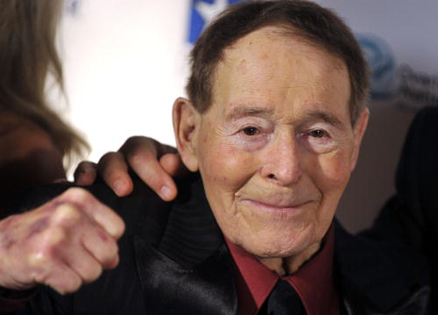
Next time you hop onto an exercise machine and get in a good workout, say a little prayer of thanks for Jack LaLanne. He’s the one who pioneered the way we keep fit today. It never would have happened if his despairing mom hadn’t dragged him to a talk by nutritionist Paul Bragg. “I was 15,” Jack recalls. “A miserable, scrawny kid with a sugar addiction. When I confessed my diet, Mr. Bragg called me ‘a human garbage pail.’ Greatest favor anyone ever did me.”

Journey With Jesus in article ad

Jack swore off sweets and took up exercising, including wrestling and swimming, at the Berkeley, California, YMCA. One day he noticed two husky men who kept a set of barbells in a locked trunk. “Can I work out with those?” the wiry five-foot-four Jack inquired. The bodybuilders guffawed. “How about if I beat you wrestling?” Jack pressed. He pinned them both and got the key to the trunk. He took the weights to a foundry, had a set made for himself, then set up a gym where he developed his own conditioning program.

“At first, I was content simply being in condition,” Jack says. Then he read in the local paper that 17 firemen were being laid off because they couldn’t pass their physicals. He put all 17 on his exercise regimen. Within two months the firefighters were rehired. “When those firemen thanked me for saving their jobs, I knew what I wanted to do with my life: share the well-being I got from being fit with as many people as possible.”

In 1936, when he was 21, Jack opened a health/fitness spa—the first in the U.S. It featured workout machines that he improvised using pulleys, cables and weights—the forerunners of the machines used in gyms today. He promoted his fitness enterprises by celebrating milestones with Houdini-like flair. At 40 he swam from Alcatraz to San Francisco’s Fisherman’s Wharf, handcuffed. At 60 he repeated the feat, this time pulling a rowboat loaded with a half ton of sand. Seventy’s outing was a brisk dip in Long Beach Harbor towing 70 people in 70 boats for a mile and a half.

When Jack announced he’d celebrate birthday number 90 by swimming the 26 miles from Catalina Island to Long Beach, Elaine—Jack’s wife of 50 years and also a fitness nut—put her foot down. So he contented himself with his daily regimen of rising at 5 a.m. for an hour of weight lifting and an hour of resistance exercises in his pool.

He must love to work out, right? “Ha! I hate exercise,” Jack declares. “But I love what it does for me. When I was a sugaraholic teen I didn’t care if I lived or died. Exercise and a healthy diet have made me love every single day of the last 75 years.” Some might even call Jack a fitness evangelist. “Does God love an overweight man who’s never seen the inside of a gym and eats half a chocolate cake and a pint of ice cream daily, then prays each night that he won’t get a heart attack? Yes, God loves him, but he can’t do much about the guy’s prayer. I’m not saying you have to be like me, but everyone should do 30-minute workouts three to four times a week. Make it a lifetime commitment.”

Jack met a 90-year-old who was so frail he was resigned to getting a wheelchair. Under Jack’s tutelage the man doubled his strength in four months. “That’s what I live for,” Jack says. “Helping people make the most of their bodies and live the lives God intended them to.” Got that? If not, you might find Jack knocking on your door not with a Bible, but a set of weights with your name on them.

Living a Life of Intent and Purpose

In his book, Intentional Living, author John Maxwell shares that back in 1976 he received a gift from his assistant. As he unwrapped the gift, he saw that it was a book titled, The Greatest Story Ever Told. He couldn’t wait to read it. 

But when he opened the book, he was shocked to see that the pages were blank. Inside the book was a note that said, “John, your life is before you. Fill these pages with kind acts, good thoughts and matters of your heart. Write a great story with your life.” This excited him, the thought of writing the story of his life.

Pray A Word a Day - 2023 In article

Every day we live out our story through our words, actions and decisions. But we must remember to live with intent, to focus on what matters most in life and to regain that focus when we get sidetracked. Without intent, we can become distracted in matters that don’t add to a life of significance and difference in our world.

Life isn’t perfect nor is it always easy, so we need reminders along the way from a friend, author, blogger, pastor or our inner spirit to re-focus us on the things that matter and makes us come alive.

Read More: Inspiring Billy Graham Quotes

Recently I attended the funeral for one of the elders of my home church. Her son said, “My mom always visited the elderly and sick. Even while sick at the age of 89, she would call people to see how they were doing.”

And when I was viewing online a service for a New York Police Department chaplain, a past colleague of his mentioned how the chaplain called him for several weeks to see how he was doing after retiring. These people live with intent on making their lives matter to others and for God.

Remember, no tomorrow is ever guaranteed. What would you do differently if your doctor told you that you only had a year left to live? What would matter most? We should not wait for these words to be said, but instead live each day with purpose and passion for a life of significance.

Lord, teach us to be intentional with our life through our words, actions, thoughts and love. 

Live a Life of Abundance

One of the great gifts of Jesus Christ is life. “I have come that they may have life, and that they may have it more abundantly” (John 10:10). That means life overflowing.

Of course, this doesn’t mean that our lives will be free of physical difficulty and trouble. In John 16:33 Jesus warns us–and encourages us–with these words: “In this world you will have trouble. But take heart! I have overcome the world.”

Pray A Word a Day - 2023 In article

It is evident that the gift of Almighty God to us is life, and lots of it. We are designed by God to be alive to our fingertips. How could it be otherwise when “in him we live and move and have our being” (Acts 17:28)? We are so constructed that we should be enthusiastic, vital, dynamic, eager. These assertions do not mean that we can be delivered from pain, sorrow, suffering and the difficulties of human existence. These are a part of our humanity.

We have to live with them and deal with them. Life was never made to be easy, but, by the same token, we were never made to be defeated by life. We were designed to rise above it and to live with delight and vigor.

We all have marvelous capacities, every one of us. We have a physical body and it is a precious thing, a tremendous instrument. “Do you not know that you are the temple of God and that the Spirit of God dwells in you?” (1 Corinthians 3:16).  

If you take care of your body, treat it right, use it as the temple of God, it will last for long years, serving your purposes with power and effectiveness. Every day of your life you ought to dedicate your physical body to Almighty God–never desecrate it, never do anything with it that will undermine its vitality.

Then there is the mind. When it is in tune with the creative mind of God, it will serve you well. The Apostle Paul assures us that, if we have surrendered our lives to Him, “we have the mind of Christ” (1 Corinthians 2:16). How exciting that is! The One who created the universe dwells in us, infusing our minds with wholesome thought and Godly wisdom.

And, finally, imbedded deep in your nature is this thing called the soul, the psyche, the personality which is you. It can motivate and move you toward the important things in life. “You will find the Lord your God if you seek Him with all your heart and with all your soul” (Deuteronomy 4:29). And it is with all your soul–as well as your strength–that you are called to love God (Deuteronomy 6:5). When your spirit is in tune with God and God’s power flows through it, you have vitality; bubbling, effervescent waves of life flow through you.

Almighty God never meant us to go crawling through life on our hands and knees. He meant us to be alive. Right now we can be in tune with the life-flowing power of the universe. Regardless of your age or physical condition, if you will yield to it, right now yield to it, let it flow through you…

  • you can be remade
  • you can be refreshed
  • you can be revitalized
  • you can live with power

“I have come that they may have life.” And when you have life, then deep, effervescent happiness bubbles within you.

How alive are you?

Lisa Leonard Shares How ‘Brave Love’ Helps Her Avoid Caregiver Burnout

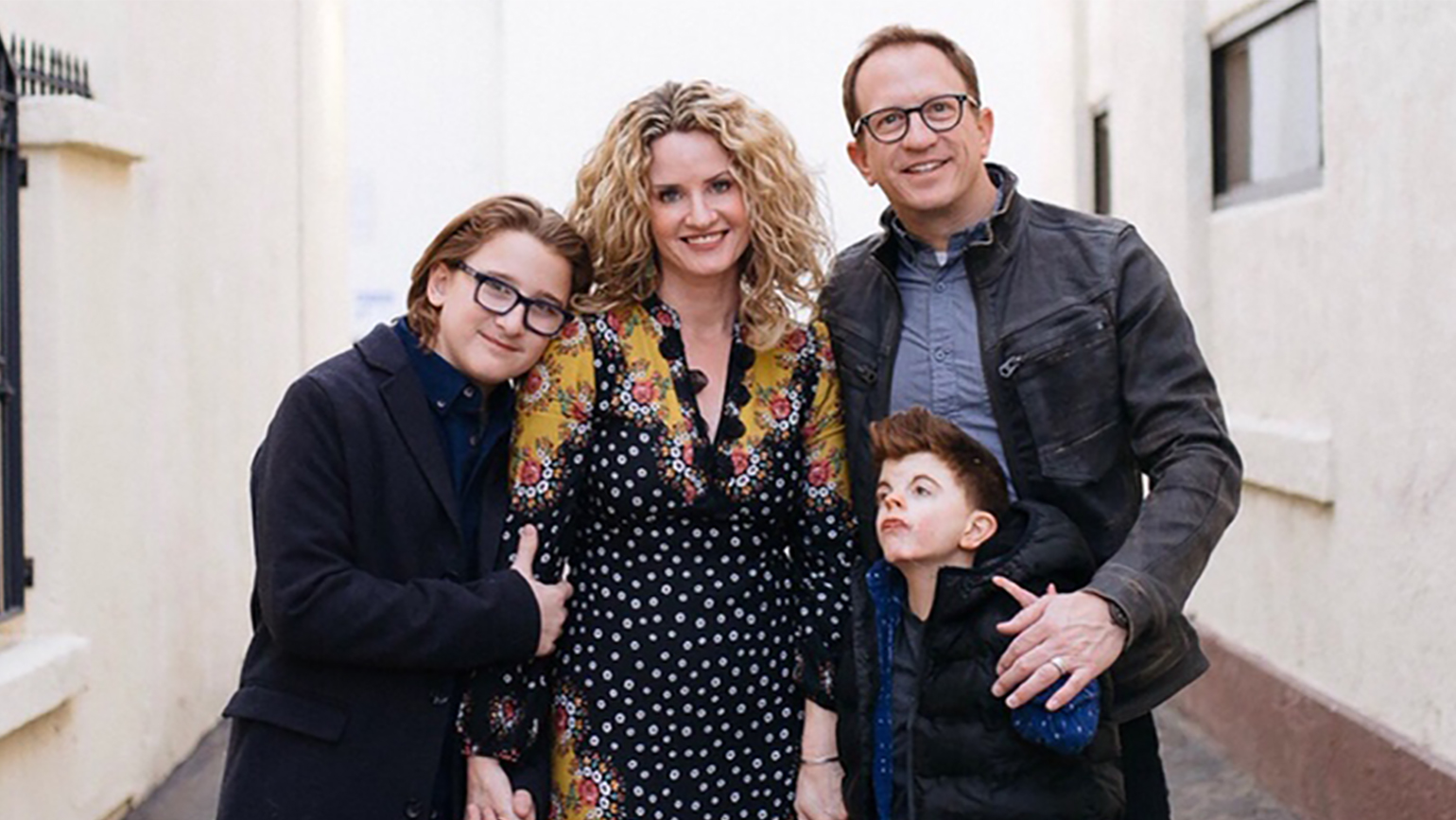
Lisa Leonard started making jewelry as a hobby after giving birth to her eldest son, David. David was born with Cornelia de Lange syndrome, a severe developmental disability. Doctors told Lisa and Stephen, a pastor at the time, that their son would never walk or talk.

In the midst of learning to care for an infant with special needs, Lisa began to take her jewelry-making hobby more seriously. Soon, the business outgrew the kitchen table. Today, Lisa Leonard Designs employs hundreds of people and Stephen serves as President & CEO of the company.

Sugarcreek Amish Mysteries In-Article Ad 2023

From the outside, things looked perfect. But Lisa was struggling. She felt enormous pressure to be the perfect mom, caregiver, wife and designer. In her book, Brave Love, Lisa opens up about her journey to find true love—and herself.

“I really used to think love was giving and serving and making myself less, so I could make other people more,” Lisa told Guideposts.org. “I’ve come to see that the bravest love is showing up as a whole person.”

This feeling that other people’s needs were more important than her own started when Lisa was a child and only grew when she became a wife and mother of two boys.

“Motherhood is a season of giving so much,” Lisa said. “Then our oldest son has special needs and so we’re giving a lot there. With David and his needs, it’s just ongoing and in some ways relentless.”

For years, Lisa felt like she had to do it all: attend to all of David’s caregiving needs, run her business, cook homemade meals for her family every night, and never ask for help.

“Anytime you’re a caregiver, whether its young children or a child with special needs, or an aging parent, there is a certain demand,” Lisa said. “We can try to have healthy boundaries and self-care but it is demanding. It is exhausting. It can be hard to have perspective.”

“It’s very behind the scenes too,” Stephen added. “Caregiving is really important work. It’s probably some of the most significant work any of us ever do in our lives, but there is no credit and most of the time nobody sees it.”

Stephen and Lisa also struggled to navigate the complicated web of grief, joy and pain that came with raising a child with special needs, especially after their younger son, Matthias was born. In Brave Love, Lisa admits how relieved she felt when Matthias was born perfectly healthy.

Do I love this baby more because he doesn’t have a disability? She wondered. Am I betraying David by loving our new baby?

Lisa’s guilt and exhaustion only continued to grow as her business took off.

“I felt like I wasn’t allowed to ask for help,” Lisa said. “I felt like I wasn’t allowed to get so tired I couldn’t care for David.”

Finally, a few years ago, she reached a breaking point. Her marriage was floundering and the demands of business and motherhood had become so draining she wasn’t sure she could do it anymore. She told Stephen she thought they should separate.

“I needed some space to try and regroup and ended up going away for ten days,” Lisa said.

While she was away, Lisa realized how gracious Stephen had been about her taking time for herself. She started wondering, “What else do I think I’m not allowed to ask for? Maybe I need to ask for it.”

She made a list of things that needed to change. She would go for more hikes. She would cook simpler meals. She would hire help for David and take time for herself. And she decided to go home.

Ten days after her departure, Lisa returned home and she and Stephen went to work on their relationship.

“We really had to redefine for ourselves what [rest] looks like so Lisa is very clear that she can [take] breaks,” Stephen said.

The couple said they’ve fought more in the years since Lisa’s trip, but their relationship is stronger.

“It’s something I’ve really been working on is I can’t keep giving out of emptiness,” Lisa said. “I have to at some point rest, ask for help and set boundaries.”

They’ve also decided to accept their feelings rather than denying them, especially when it comes to David and their caregiving responsibilities.

“When you feel grief, or you feel guilt, you’re trying to tell yourself something,” Stephen said.  “Ask yourself ‘why do I feel this?’ [I’ll think] I feel angry right now. I love David and I feel angry about having to change another diaper today.”

On the surface, that feeling of anger might be enough to make Stephen feel guilty for not wanting to change a diaper for his sixteen-year-old son. But when he digs beneath the surface he sees that the anger isn’t really about David at all.

“Why do I feel that?” Stephen asked. “Not because I’m angry at David. Actually that anger is covering that I’m sad about the situation. Then I can process that…and let myself feel sad. We wish David didn’t have Cornelia de Lange syndrome. At the same time, we’re delighted to serve him and to do everything we can to make his life as full as possible.”

For Lis, making self-care a priority has made a huge difference

“One of the big things that I did was started just making ten minutes a day to sit quietly. It was totally transforming for me,” Lisa said.

The couple also had to learn to share their feelings with each other.

“To sit with someone in their grief or their anger or their sadness is such a gift,” Lisa said. “I think we can do that more for each other. To just listen without answers, without quick fixes. Those feelings just need to be felt.”

Years ago, Lisa discovered a simple way to help her navigate how other people treated her son. When David was an infant, they were out for a family lunch and Lisa saw some boys pointing and laughing at her son.

“I felt swallowed up by shame,” she said. Then she made a decision. Instead of wallowing in her shame, she would address the boys directly. She went over and introduced herself and asked them if they had any questions about her son.

“It was really a life changing moment for me to feel like I [wasn’t] ashamed of my son,” Lisa said.

In sharing her family’s story, Lisa hopes that people, women in particular, will feel free to leave shame behind and find peace.

“There is space in our marriage for two whole people,” Lisa said. “There is space in our family for me to be a whole person with needs and wants…Having needs and wants and communicating honestly is a really vulnerable way to live, but that’s where brave love comes from.”

Brave Love is available wherever books are sold

Lifted by the Power of Prayer

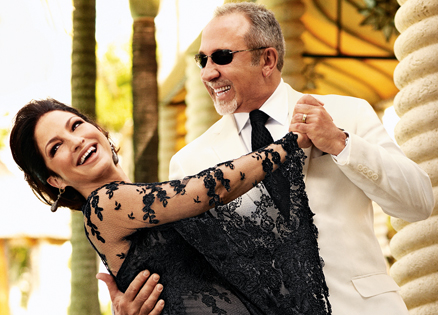
My husband, Emilio, and I have been happily married for 34 years. But now there’s a new man in my life and he’s stolen my heart. Okay, okay…he’s my grandson, Sasha! He’s 10 months old and he’s made me the proudest abuela you’ve ever seen (my cell phone is filled with the photos to prove it!).

I’ve been thinking about what kind of person my grandson will grow up to be. And I’ve thought about my own journey too. I’m a positive person—someone who looks forward instead of in the rearview mirror. But it hasn’t always been easy. I’ve had my ups and downs (I’ll get to those).

Whistle Stop Cafe In Article Ad May 2023

There are certain values that have helped me get on my feet—literally! (I’ll get to that too.) Values I’ve passed on to our two children, Nayib (Sasha’s dad) and Emily, and I’d like to pass on to Sasha.

It’s my prayer that what I’ve learned will help him live his best life, one that is full of immeasurable blessings. I hope they do the same for you. Viva la vida!

Help However You Can
I grew up with two wonderful role models who taught me the importance of giving: my mom and her mother, my grandma Consuelo. They gave fully of themselves—cooking meals for friends in need, volunteering tirelessly at church and keeping their neighborhood clean.

It’s because of their inspiration that I founded the Gloria Estefan Foundation to help local charities and disadvantaged children. But there are things to be done on a smaller scale too.

One day when Nayib was about nine, we were walking along the beach and we spotted a few soda cans in the sand. I picked them up and threw them in a trashcan. “Mom, those aren’t ours,” Nayib said innocently.

I explained to him that if we didn’t preserve the environment it wouldn’t be there for us in the future. Something Mom and Grandma knew. “Besides,” I added, “maybe someone is watching us and will be inspired to help clean up too.”

Nayib and I ended up combing every inch of that beach, making sure there wasn’t a bit of trash left. It’s something he’s kept up to this day. All of our small individual acts can add up to big positive change.

The Power of Prayer Is Real
I knew God was real, but when people talked about “the power of prayer” it seemed so mysterious. Was it something they actually felt? I didn’t understand. But I wanted to.

Then, on a snowy night, March 20, 1990, in northeastern Pennsylvania, my tour bus was slammed by a semitrailer. The impact threw me to the floor, breaking my back in two places (one more millimeter and my spinal cord would have been severed).

I was rushed to Scranton’s Community Medical Center. The doctor, Dr. Ramirez, spoke kindly. “First I’m going to tell you what science says, which is that you may not walk again.” He paused. “However…you play a big part in your recovery.” God, if I have anything to do with it, I’m going to walk again.

The hospital set up a command center for the flood of phone calls and thousands of cards (I read every single one). There were even people on their knees praying in the lobby. From my hospital bed I felt a rush of energy unlike anything I’d felt before. It was as if I’d been plugged into the wall and electrified.

Then it hit me: This was the power of prayer! I was feeling it!

I had surgery to fuse two eight-inch steel rods to my spine. It was uncertain how much mobility I’d have afterward. Rehab was grueling. But each time I wanted to give up I called on the power of those prayers—visualizing each one going straight to my spine, healing me.

Emilio was incredible. He helped me inch forward, step by painful step, until finally I was able to walk on my own.

Three months after the accident I wrote “Coming Out of the Dark” as a thank-you to everyone who’d lifted me up in prayer. Just one year after the accident I walked onstage at the American Music Awards in Miami and performed the song. Dr. Ramirez was in the audience, next to my mom.

“I was inside your back,” he said. “And you shouldn’t have been up there. It’s a miracle.” That’s what the power of prayer is all about.

Music Heals
I might not have been born singing, but music was a part of my life from the moment I came into the world. My mother is the real diva in our family (she won a contest to dub Shirley Temple’s movies into Spanish!) and my father’s family included a famous flautist and a classical pianist.

When I was two, I started talking and singing.

Around that time, Castro took control of Cuba. My parents fled to Miami and moved us into a tiny apartment behind the Orange Bowl. My father joined the ill-fated Bay of Pigs invasion and was captured and jailed in Havana. Every day until his release, two years later, I was terrified for his safety.

Music became my escape. I sat in my room with my guitar, singing and playing for hours. I didn’t shed a tear. Music was my way of crying.

My father came back to the U.S. and joined the Army. He served in Vietnam. Exposure to Agent Orange left him disabled and in a wheelchair. Slowly, he lost his memory too.

As a teen I helped take care of him and my little sister, Becky, while Mom worked as a teacher. It broke my heart to see my strong, handsome father falling apart.

I focused on school, especially music class—my favorite. One day, my senior year, we had a guest speaker: Emilio Estefan of the Miami Latin Boys. He heard a few of us sing, and I thought that was that.

A few months later Mom took me to a wedding and Emilio was performing. He remembered me from that day at my school and said, “Come sing a few songs with us.” I was nervous as anything but I went for it.

Performing transported me to a place where there was no worry, no sadness. “You light up out there,” Emilio said. “The crowd loves you.” Soon I was part of the band, now called the Miami Sound Machine…and Emilio and I fell in love. (I will be forever grateful that my dad lived to see us married.)

I’ve seen the healing power of music in the lives of others too. After one of my concerts I saw a man sitting with his wife, her head scarred and shaved.

“I just want you to know the impact that your song ‘Coming Out of the Dark’ had,” the man said. “My wife was in a car accident and fell into a coma.

"They advised me to disconnect her from life support but I thought, ‘Well, Gloria had a miracle, maybe I can have one too.’ So I bought your song and played it constantly in her room.”

Three months later his wife woke up singing my song (probably because she wanted to hear something else!). But there she was. Alive. Music heals. It’s prayer with notes.

Remember Your Roots
I love this country. For me, the beauty of the United States is that you can become a citizen and still stay true to your heritage. My parents made sure we spoke Spanish and English, and that’s something Emilio and I did with Nayib and Emily too.

And then there’s traditional Cuban food! Every Sunday we gather at my mom’s for dinner. One story she likes to tell is about Grandma Consuelo.

Grandma left Cuba with my grandfather when she was 56 years old. They rented a small house with a backyard facing a little ballpark in Miami. Grandma believed that if you do what you love, people will love what you do. And her love was cooking.

One day, she made croquetas, tamales and pan con lechón (Cuban pork sandwiches) and put them in a shopping cart. She pushed the cart to the ballpark. Everyone was drawn to the delicious smells coming from Grandma’s food, and the very first day, she sold out!

Her business grew and she catered weddings, quinces (fifteenth birthdays) and other occasions, doing all the cooking herself. After Emilio and I were blessed with success, we opened Larios on the Beach, a Cuban restaurant in Miami, as a way to honor Grandma Consuelo and share the food we love with everyone.

Let Your Voice Be Heard
It might be hard to believe, but I used to be pretty shy! It took me a good 10 years to get comfortable being onstage and to express how I felt (you can tell by some of my early stage outfits that I didn’t say no to anyone, especially my stylist).

That’s why I tell my kids, “Don’t be afraid to stand up and say exactly what you feel. Be honest. Be fearless! Because you know something? When you’re dealing with the truth from the get-go, people have to take it or leave it.”

Like the time Emily was a sophomore in high school. She was a star on the basketball team and in the jazz band. Basketball practice was two to three hours a day, including Saturday, then there was band practice. By the time she got home the poor girl was too fried to study hard!

She had an A average but it was slipping. Fast. One day she confided in me, “I really want to quit basketball to focus on my grades and band…but I’m afraid. What if I let down Coach or my teammates get mad at me?”

“It’s good that you care about their feelings, but you need to tell your coach how you feel,” I said. “If you get to the point where you’re not happy playing basketball, that’s when you’re going to let them down.”

It took a lot of guts, but Emily talked to her coach and teammates, who completely understood. Her grades went back up (she got a scholarship to the Berklee College of Music in Boston… I’m her mom, I have to brag a little!) all because she let her voice be heard.

No matter who Sasha grows up to be (of course, if you ask me, he’s going to be a rock star), his life will be centered by love, music, faith and family…including the proudest abuela there ever was.


Download your FREE ebook, A Prayer for Every Need, by Dr. Norman Vincent Peale

Life Would Be Easier If…

I’ve been struggling with irritation toward my husband lately. There are reasons for this, of course. He was in the hospital for a week, and he’s cranky because he hasn’t felt well. Meanwhile, I was at home dealing with the physical and emotional needs of everyone else, so I’m exhausted. There’s also the not-minor matter of how, in times of stress, we all tend to revert to old (and usually undesirable) patterns of behavior. So old arguments tend to take on new life, and none of us are on our best behavior.

Life would be a lot easier if my spouse would change, because then I wouldn’t have to. Life would be easier if God zapped me with an infusion of patience instead of expecting me to address what is going on in my heart. Life would be easier if we didn’t have to deal with stress and complexity and exhaustion. But the one and only thing Scripture tells me is easy is the yoke of Christ. So if I want life to be easier, I guess I need to set down the prickly burden of my pride and take up the smooth yoke of humility. And maybe even say “I’m sorry” first.

Pray A Word a Day - 2023 In article

Life in the Slow Lane Suits NPR’s Amy Eddings

“I can’t wait until this is over.” Lately I’d noticed my husband, Mark, and me saying this to each other a lot. It was our mantra all through the long, bitter Ohio winter, one we felt acutely in our drafty new home.

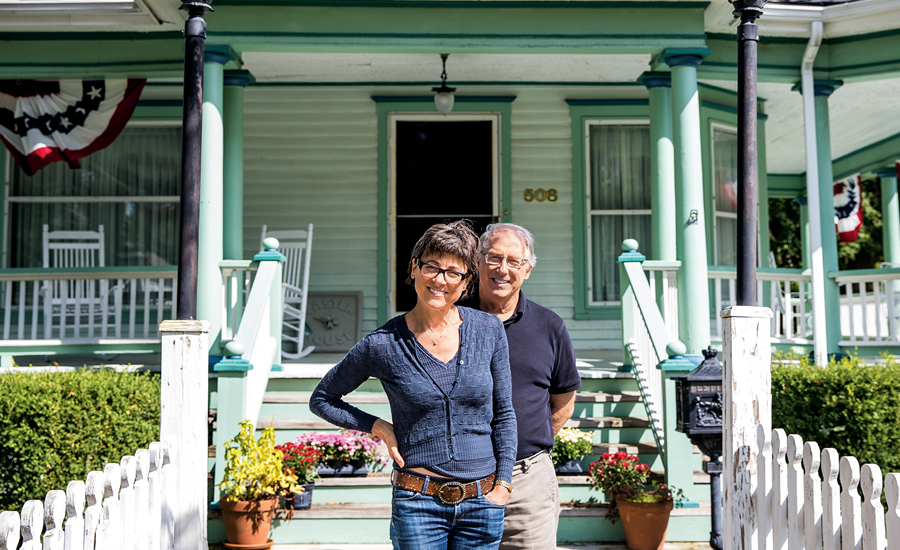
The house was a gorgeous pistachio-colored century-old Queen Anne Victorian in Ada, a village about two hours south of Cleveland, where I’d grown up in the suburbs and where my parents still lived. My sister’s house was down the street from us.

Go For It In Article Ad

Four months earlier, I had quit my high-profile job as a public-radio journalist in New York City. My husband had retired early from his own successful radio career and we had moved to Ada to reconnect with our families, step back from our relentless pursuit of achievements and find a more peaceful, God-centered focus for our lives.

ENJOYING THIS STORY? SUBSCRIBE TO GUIDEPOSTS MAGAZINE!

So far what we’d found was a charming, affordable old house that needed a lot of work.

“I can’t wait until this is over,” Mark and I said with a grimace as we heated soup on a hot plate in the living room while blue-shirted Amish men knocked the plaster from the walls of our outdated kitchen.

And that was only the beginning of the work. The house needed an exterior paint job, new insulation, and drainage for a flood-prone basement. We were planning to build a rental apartment over the freestanding garage to supplement our income, which at the moment consisted of our savings and Mark’s recent inheritance from his mother.

I had hoped to make some money as a freelance journalist. But those hopes were dimming as I found out how difficult and financially unrewarding that work can be. I’d started looking for a full-time job. Meanwhile, the money in our savings account was evaporating by the day.

I thought I’d sensed a clear call from God to leave New York and embrace a different set of values. I thought Mark and I were going to slow down, to live in the heartland—in the full sense of that word—spending more time with the people we cared about.

But here we were in a rambling old house filled top to bottom with noise and dust. We had a to-do list that stretched to the heavens. We were anxious and afraid. What had prompted us to move here? I found it increasingly hard to remember.

“I can’t wait until this is over.” Ironically, it was those very words that had brought us to Ada in the first place. Mark and I had said or thought them nearly every day in our 600-square-foot apartment in Bedford-Stuyvesant, Brooklyn.

There we slept on a sofa bed because our bedroom doubled as the living room. We hauled our dirty clothes two blocks to the Laundromat (and crossed our fingers that the other customers didn’t have bedbugs).

We relied on our smart phones to tell us the weather forecast because we were unable to read the mood of the sky. It was blocked from our view by other buildings and by an acanthus tree that hovered over our back window like a security gate.

“I can’t wait until this is over and we find our Forever Home,” I announced to Mark one day, eyeing the unmade sofa bed. “Because this isn’t it.”

I was the afternoon-drive newscaster and local host of National Public Radio’s All Things Considered at WNYC, the largest public-radio station in the country. I’d been doing the job for 10 years and could easily have done it for 20 more.

It was creative and stimulating. My colleagues were funny and smart. The work was absorbing and important. It paid me well and gave me an audience of hundreds of thousands of listeners.

It was exactly the life I’d hoped for when I moved to New York three decades earlier, escaping what I feared would be a boring, predictable adulthood in suburban Cleveland. So why on earth had I decided to move back to Ohio?

It all started when my husband’s oldest sister, Peggy, came to the end stage of her 20-year battle against breast cancer. Peggy lived in Chicago, where most of Mark’s immediate family was—too far for us to visit regularly. We followed her progress through weekly calls to my mother-in-law.

The distance made us feel helpless. Our calls and the cards we sent—“We’re praying for you!” “We’re thinking of you!”—felt paltry.

Eight months after Peggy died, Mark’s mother too was gone. She went into the hospital for knee-replacement surgery, contracted an infection and didn’t recover.

I began thinking more and more of my own parents, back in Ohio. They were healthy now. But inevitably the time would come when they would need help. What would I do then? Offer them encouragement over the phone?

The summer after Peggy died, Mark and I visited my sister and her family in Ada. We looked forward to these annual trips. We’d sit on my sister’s front porch watching thunderstorms roll past.

We don’t have kids of our own, so we loved taking my nieces to corn mazes or exploring the backyard with them, picking lavender and holding the fragrant blue-gray spikes under our noses. We joked about ditching our jobs and moving to Ada.

We especially liked to dream about buying that spacious Victorian house up the road, the one painted pistachio green with the wraparound porch and attic turret.

Then my sister called to tell us the house was for sale. I knew I’d never leave my Forever Job, even for an Ohio Forever Home. Still, I asked my sister to call the real-estate agent to show us the house when we were in town—just to see what it looked like inside.

It turned out that the seller had dropped the price. Is it a sign from God? Mark and I wondered. No, we said, shaking our heads. We couldn’t leave all we’d built in New York. We just couldn’t.

My sense of what was possible changed the moment the agent let us in the door.

“Oh my God,” I intoned.

I meant it. The house inspired awe and wonder. It was beautiful. Panels of deep brown solid oak reached halfway up the walls. A wide, gracious staircase led to the second floor. There was a formal dining room and a parlor, a vestibule, a fireplace and an attic. And that enchanting little turret that made me feel like a princess in a fairy tale.

My nieces oohed and ahhed and ran upstairs to check out the bedrooms. “Aunt Amy!” the youngest yelled down to us. “I want the purple room when we sleep over!”

I was seized with a need so strong, it almost felt like duty. “We have to live here,” I said, turning to Mark with tears in my eyes.

It was ridiculous, really. All this house, for just Mark and me? But in that moment, standing in the foyer, I envisioned more than just us in this house. I saw it filled with family and friends, old and new. They’d come here for card games and writing workshops, potluck dinners and lectures.

And I saw myself defined by something more than my Forever Job. I was not my talents or my paycheck or my tens of thousands of listeners. I was a daughter, a sister, an aunt, a wife. I was a friend and a mentor. The life that had seemed predictable and boring to a teenager suddenly seemed the kind most worth living.

It felt like a new path was opening before me. A new definition of a life well traveled and well lived.

There was freedom in that path, a sense that I could step away from frenetic New York and take my time exploring alternatives. There was also, as Peggy’s and my mother-in-law’s deaths reminded me, no time at all. If we were going to do this, I thought, we would have to do it now. It would be a leap of faith.

Mark and I bought the house. We packed up our New York apartment, I said goodbye on the air and just like that we were heading to Ohio, into a new life.

We still felt as if we were waiting for that new life to begin.

“I can’t wait until this is over,” Mark and I kept saying as house repairs multiplied and our bank account shrank. When were we going to have that more peaceful, purposeful life we’d moved to Ada to find?

Until, one day, I realized that maybe Mark and I already were living that life. Maybe all the chaos and unpredictability was exactly what we needed. The renovations and the job search were forcing us to slow down, take stock, pray more, appreciate each other more.

Wasn’t that what we came here to do? It was requiring me to keep listening to God, to keep trusting him.

I thought back to that day when I stood in the foyer of this grand old house, suddenly seized with a vision of a different future. A future I never could have imagined back when all I wanted was to escape suburban Cleveland, move to New York City and make it big. God gave me a glimpse of the person I could become if I stepped forward in faith.

I’m still stepping forward. Every day I have to let go of my impatience to get through the messiness of life, knowing that God speaks loudest there. I’m learning to trust that here, now, I’m home at last.

Did you enjoy this story? Subscribe to Guideposts magazine.