Embrace God's truth with our new book, The Lies that Bind

Live a Life of Abundance

One of the great gifts of Jesus Christ is life. “I have come that they may have life, and that they may have it more abundantly” (John 10:10). That means life overflowing.

Of course, this doesn’t mean that our lives will be free of physical difficulty and trouble. In John 16:33 Jesus warns us–and encourages us–with these words: “In this world you will have trouble. But take heart! I have overcome the world.”

It is evident that the gift of Almighty God to us is life, and lots of it. We are designed by God to be alive to our fingertips. How could it be otherwise when “in him we live and move and have our being” (Acts 17:28)? We are so constructed that we should be enthusiastic, vital, dynamic, eager. These assertions do not mean that we can be delivered from pain, sorrow, suffering and the difficulties of human existence. These are a part of our humanity.

We have to live with them and deal with them. Life was never made to be easy, but, by the same token, we were never made to be defeated by life. We were designed to rise above it and to live with delight and vigor.

We all have marvelous capacities, every one of us. We have a physical body and it is a precious thing, a tremendous instrument. “Do you not know that you are the temple of God and that the Spirit of God dwells in you?” (1 Corinthians 3:16).

If you take care of your body, treat it right, use it as the temple of God, it will last for long years, serving your purposes with power and effectiveness. Every day of your life you ought to dedicate your physical body to Almighty God–never desecrate it, never do anything with it that will undermine its vitality.

Then there is the mind. When it is in tune with the creative mind of God, it will serve you well. The Apostle Paul assures us that, if we have surrendered our lives to Him, “we have the mind of Christ” (1 Corinthians 2:16). How exciting that is! The One who created the universe dwells in us, infusing our minds with wholesome thought and Godly wisdom.

And, finally, imbedded deep in your nature is this thing called the soul, the psyche, the personality which is you. It can motivate and move you toward the important things in life. “You will find the Lord your God if you seek Him with all your heart and with all your soul” (Deuteronomy 4:29). And it is with all your soul–as well as your strength–that you are called to love God (Deuteronomy 6:5). When your spirit is in tune with God and God’s power flows through it, you have vitality; bubbling, effervescent waves of life flow through you.

Almighty God never meant us to go crawling through life on our hands and knees. He meant us to be alive. Right now we can be in tune with the life-flowing power of the universe. Regardless of your age or physical condition, if you will yield to it, right now yield to it, let it flow through you…

  • you can be remade
  • you can be refreshed
  • you can be revitalized
  • you can live with power

“I have come that they may have life.” And when you have life, then deep, effervescent happiness bubbles within you.

How alive are you?

Lisa Leonard Shares How ‘Brave Love’ Helps Her Avoid Caregiver Burnout

Lisa Leonard started making jewelry as a hobby after giving birth to her eldest son, David. David was born with Cornelia de Lange syndrome, a severe developmental disability. Doctors told Lisa and Stephen, a pastor at the time, that their son would never walk or talk.

In the midst of learning to care for an infant with special needs, Lisa began to take her jewelry-making hobby more seriously. Soon, the business outgrew the kitchen table. Today, Lisa Leonard Designs employs hundreds of people and Stephen serves as President & CEO of the company.

From the outside, things looked perfect. But Lisa was struggling. She felt enormous pressure to be the perfect mom, caregiver, wife and designer. In her book, Brave Love, Lisa opens up about her journey to find true love—and herself.

“I really used to think love was giving and serving and making myself less, so I could make other people more,” Lisa told Guideposts.org. “I’ve come to see that the bravest love is showing up as a whole person.”

This feeling that other people’s needs were more important than her own started when Lisa was a child and only grew when she became a wife and mother of two boys.

“Motherhood is a season of giving so much,” Lisa said. “Then our oldest son has special needs and so we’re giving a lot there. With David and his needs, it’s just ongoing and in some ways relentless.”

For years, Lisa felt like she had to do it all: attend to all of David’s caregiving needs, run her business, cook homemade meals for her family every night, and never ask for help.

“Anytime you’re a caregiver, whether its young children or a child with special needs, or an aging parent, there is a certain demand,” Lisa said. “We can try to have healthy boundaries and self-care but it is demanding. It is exhausting. It can be hard to have perspective.”

“It’s very behind the scenes too,” Stephen added. “Caregiving is really important work. It’s probably some of the most significant work any of us ever do in our lives, but there is no credit and most of the time nobody sees it.”

Stephen and Lisa also struggled to navigate the complicated web of grief, joy and pain that came with raising a child with special needs, especially after their younger son, Matthias was born. In Brave Love, Lisa admits how relieved she felt when Matthias was born perfectly healthy.

Do I love this baby more because he doesn’t have a disability? She wondered. Am I betraying David by loving our new baby?

Lisa’s guilt and exhaustion only continued to grow as her business took off.

“I felt like I wasn’t allowed to ask for help,” Lisa said. “I felt like I wasn’t allowed to get so tired I couldn’t care for David.”

Finally, a few years ago, she reached a breaking point. Her marriage was floundering and the demands of business and motherhood had become so draining she wasn’t sure she could do it anymore. She told Stephen she thought they should separate.

“I needed some space to try and regroup and ended up going away for ten days,” Lisa said.

While she was away, Lisa realized how gracious Stephen had been about her taking time for herself. She started wondering, “What else do I think I’m not allowed to ask for? Maybe I need to ask for it.”

She made a list of things that needed to change. She would go for more hikes. She would cook simpler meals. She would hire help for David and take time for herself. And she decided to go home.

Ten days after her departure, Lisa returned home and she and Stephen went to work on their relationship.

“We really had to redefine for ourselves what [rest] looks like so Lisa is very clear that she can [take] breaks,” Stephen said.

The couple said they’ve fought more in the years since Lisa’s trip, but their relationship is stronger.

“It’s something I’ve really been working on is I can’t keep giving out of emptiness,” Lisa said. “I have to at some point rest, ask for help and set boundaries.”

They’ve also decided to accept their feelings rather than denying them, especially when it comes to David and their caregiving responsibilities.

“When you feel grief, or you feel guilt, you’re trying to tell yourself something,” Stephen said. “Ask yourself ‘why do I feel this?’ [I’ll think] I feel angry right now. I love David and I feel angry about having to change another diaper today.”

On the surface, that feeling of anger might be enough to make Stephen feel guilty for not wanting to change a diaper for his sixteen-year-old son. But when he digs beneath the surface he sees that the anger isn’t really about David at all.

“Why do I feel that?” Stephen asked. “Not because I’m angry at David. Actually that anger is covering that I’m sad about the situation. Then I can process that…and let myself feel sad. We wish David didn’t have Cornelia de Lange syndrome. At the same time, we’re delighted to serve him and to do everything we can to make his life as full as possible.”

For Lis, making self-care a priority has made a huge difference.

“One of the big things that I did was started just making ten minutes a day to sit quietly. It was totally transforming for me,” Lisa said.

The couple also had to learn to share their feelings with each other.

“To sit with someone in their grief or their anger or their sadness is such a gift,” Lisa said. “I think we can do that more for each other. To just listen without answers, without quick fixes. Those feelings just need to be felt.”

Years ago, Lisa discovered a simple way to help her navigate how other people treated her son. When David was an infant, they were out for a family lunch and Lisa saw some boys pointing and laughing at her son.

“I felt swallowed up by shame,” she said. Then she made a decision. Instead of wallowing in her shame, she would address the boys directly. She went over and introduced herself and asked them if they had any questions about her son.

“It was really a life changing moment for me to feel like I [wasn’t] ashamed of my son,” Lisa said.

In sharing her family’s story, Lisa hopes that people, women in particular, will feel free to leave shame behind and find peace.

“There is space in our marriage for two whole people,” Lisa said. “There is space in our family for me to be a whole person with needs and wants…Having needs and wants and communicating honestly is a really vulnerable way to live, but that’s where brave love comes from.”

Brave Love is available wherever books are sold

Lifted by the Power of Prayer

My husband, Emilio, and I have been happily married for 34 years. But now there’s a new man in my life and he’s stolen my heart. Okay, okay…he’s my grandson, Sasha! He’s 10 months old and he’s made me the proudest abuela you’ve ever seen (my cell phone is filled with the photos to prove it!).

I’ve been thinking about what kind of person my grandson will grow up to be. And I’ve thought about my own journey too. I’m a positive person—someone who looks forward instead of in the rearview mirror. But it hasn’t always been easy. I’ve had my ups and downs (I’ll get to those).

There are certain values that have helped me get on my feet—literally! (I’ll get to that too.) Values I’ve passed on to our two children, Nayib (Sasha’s dad) and Emily, and I’d like to pass on to Sasha.

It’s my prayer that what I’ve learned will help him live his best life, one that is full of immeasurable blessings. I hope they do the same for you. Viva la vida!

Help However You Can
I grew up with two wonderful role models who taught me the importance of giving: my mom and her mother, my grandma Consuelo. They gave fully of themselves—cooking meals for friends in need, volunteering tirelessly at church and keeping their neighborhood clean.

It’s because of their inspiration that I founded the Gloria Estefan Foundation to help local charities and disadvantaged children. But there are things to be done on a smaller scale too.

One day when Nayib was about nine, we were walking along the beach and we spotted a few soda cans in the sand. I picked them up and threw them in a trashcan. “Mom, those aren’t ours,” Nayib said innocently.

I explained to him that if we didn’t preserve the environment it wouldn’t be there for us in the future. Something Mom and Grandma knew. “Besides,” I added, “maybe someone is watching us and will be inspired to help clean up too.”

Nayib and I ended up combing every inch of that beach, making sure there wasn’t a bit of trash left. It’s something he’s kept up to this day. All of our small individual acts can add up to big positive change.

The Power of Prayer Is Real
I knew God was real, but when people talked about “the power of prayer” it seemed so mysterious. Was it something they actually felt? I didn’t understand. But I wanted to.

Then, on a snowy night, March 20, 1990, in northeastern Pennsylvania, my tour bus was slammed by a semitrailer. The impact threw me to the floor, breaking my back in two places (one more millimeter and my spinal cord would have been severed).

I was rushed to Scranton’s Community Medical Center. The doctor, Dr. Ramirez, spoke kindly. “First I’m going to tell you what science says, which is that you may not walk again.” He paused. “However…you play a big part in your recovery.” God, if I have anything to do with it, I’m going to walk again.

The hospital set up a command center for the flood of phone calls and thousands of cards (I read every single one). There were even people on their knees praying in the lobby. From my hospital bed I felt a rush of energy unlike anything I’d felt before. It was as if I’d been plugged into the wall and electrified.

Then it hit me: This was the power of prayer! I was feeling it!

I had surgery to fuse two eight-inch steel rods to my spine. It was uncertain how much mobility I’d have afterward. Rehab was grueling. But each time I wanted to give up I called on the power of those prayers—visualizing each one going straight to my spine, healing me.

Emilio was incredible. He helped me inch forward, step by painful step, until finally I was able to walk on my own.

Three months after the accident I wrote “Coming Out of the Dark” as a thank-you to everyone who’d lifted me up in prayer. Just one year after the accident I walked onstage at the American Music Awards in Miami and performed the song. Dr. Ramirez was in the audience, next to my mom.

“I was inside your back,” he said. “And you shouldn’t have been up there. It’s a miracle.” That’s what the power of prayer is all about.

Music Heals
I might not have been born singing, but music was a part of my life from the moment I came into the world. My mother is the real diva in our family (she won a contest to dub Shirley Temple’s movies into Spanish!) and my father’s family included a famous flautist and a classical pianist.

When I was two, I started talking and singing.

Around that time, Castro took control of Cuba. My parents fled to Miami and moved us into a tiny apartment behind the Orange Bowl. My father joined the ill-fated Bay of Pigs invasion and was captured and jailed in Havana. Every day until his release, two years later, I was terrified for his safety.

Music became my escape. I sat in my room with my guitar, singing and playing for hours. I didn’t shed a tear. Music was my way of crying.

My father came back to the U.S. and joined the Army. He served in Vietnam. Exposure to Agent Orange left him disabled and in a wheelchair. Slowly, he lost his memory too.

As a teen I helped take care of him and my little sister, Becky, while Mom worked as a teacher. It broke my heart to see my strong, handsome father falling apart.

I focused on school, especially music class—my favorite. One day, my senior year, we had a guest speaker: Emilio Estefan of the Miami Latin Boys. He heard a few of us sing, and I thought that was that.

A few months later Mom took me to a wedding and Emilio was performing. He remembered me from that day at my school and said, “Come sing a few songs with us.” I was nervous as anything but I went for it.

Performing transported me to a place where there was no worry, no sadness. “You light up out there,” Emilio said. “The crowd loves you.” Soon I was part of the band, now called the Miami Sound Machine…and Emilio and I fell in love. (I will be forever grateful that my dad lived to see us married.)

I’ve seen the healing power of music in the lives of others too. After one of my concerts I saw a man sitting with his wife, her head scarred and shaved.

“I just want you to know the impact that your song ‘Coming Out of the Dark’ had,” the man said. “My wife was in a car accident and fell into a coma.

"They advised me to disconnect her from life support but I thought, ‘Well, Gloria had a miracle, maybe I can have one too.’ So I bought your song and played it constantly in her room.”

Three months later his wife woke up singing my song (probably because she wanted to hear something else!). But there she was. Alive. Music heals. It’s prayer with notes.

Remember Your Roots
I love this country. For me, the beauty of the United States is that you can become a citizen and still stay true to your heritage. My parents made sure we spoke Spanish and English, and that’s something Emilio and I did with Nayib and Emily too.

And then there’s traditional Cuban food! Every Sunday we gather at my mom’s for dinner. One story she likes to tell is about Grandma Consuelo.

Grandma left Cuba with my grandfather when she was 56 years old. They rented a small house with a backyard facing a little ballpark in Miami. Grandma believed that if you do what you love, people will love what you do. And her love was cooking.

One day, she made croquetas, tamales and pan con lechón (Cuban pork sandwiches) and put them in a shopping cart. She pushed the cart to the ballpark. Everyone was drawn to the delicious smells coming from Grandma’s food, and the very first day, she sold out!

Her business grew and she catered weddings, quinces (fifteenth birthdays) and other occasions, doing all the cooking herself. After Emilio and I were blessed with success, we opened Larios on the Beach, a Cuban restaurant in Miami, as a way to honor Grandma Consuelo and share the food we love with everyone.

Let Your Voice Be Heard
It might be hard to believe, but I used to be pretty shy! It took me a good 10 years to get comfortable being onstage and to express how I felt (you can tell by some of my early stage outfits that I didn’t say no to anyone, especially my stylist).

That’s why I tell my kids, “Don’t be afraid to stand up and say exactly what you feel. Be honest. Be fearless! Because you know something? When you’re dealing with the truth from the get-go, people have to take it or leave it.”

Like the time Emily was a sophomore in high school. She was a star on the basketball team and in the jazz band. Basketball practice was two to three hours a day, including Saturday, then there was band practice. By the time she got home the poor girl was too fried to study hard!

She had an A average but it was slipping. Fast. One day she confided in me, “I really want to quit basketball to focus on my grades and band…but I’m afraid. What if I let down Coach or my teammates get mad at me?”

“It’s good that you care about their feelings, but you need to tell your coach how you feel,” I said. “If you get to the point where you’re not happy playing basketball, that’s when you’re going to let them down.”

It took a lot of guts, but Emily talked to her coach and teammates, who completely understood. Her grades went back up (she got a scholarship to the Berklee College of Music in Boston… I’m her mom, I have to brag a little!) all because she let her voice be heard.

No matter who Sasha grows up to be (of course, if you ask me, he’s going to be a rock star), his life will be centered by love, music, faith and family…including the proudest abuela there ever was.

Download your FREE ebook, A Prayer for Every Need, by Dr. Norman Vincent Peale

Life Would Be Easier If…

I’ve been struggling with irritation toward my husband lately. There are reasons for this, of course. He was in the hospital for a week, and he’s cranky because he hasn’t felt well. Meanwhile, I was at home dealing with the physical and emotional needs of everyone else, so I’m exhausted. There’s also the not-minor matter of how, in times of stress, we all tend to revert to old (and usually undesirable) patterns of behavior. So old arguments tend to take on new life, and none of us are on our best behavior.

Life would be a lot easier if my spouse would change, because then I wouldn’t have to. Life would be easier if God zapped me with an infusion of patience instead of expecting me to address what is going on in my heart. Life would be easier if we didn’t have to deal with stress and complexity and exhaustion. But the one and only thing Scripture tells me is easy is the yoke of Christ. So if I want life to be easier, I guess I need to set down the prickly burden of my pride and take up the smooth yoke of humility. And maybe even say “I’m sorry” first.

Life in the Slow Lane Suits NPR’s Amy Eddings

“I can’t wait until this is over.” Lately I’d noticed my husband, Mark, and me saying this to each other a lot. It was our mantra all through the long, bitter Ohio winter, one we felt acutely in our drafty new home.

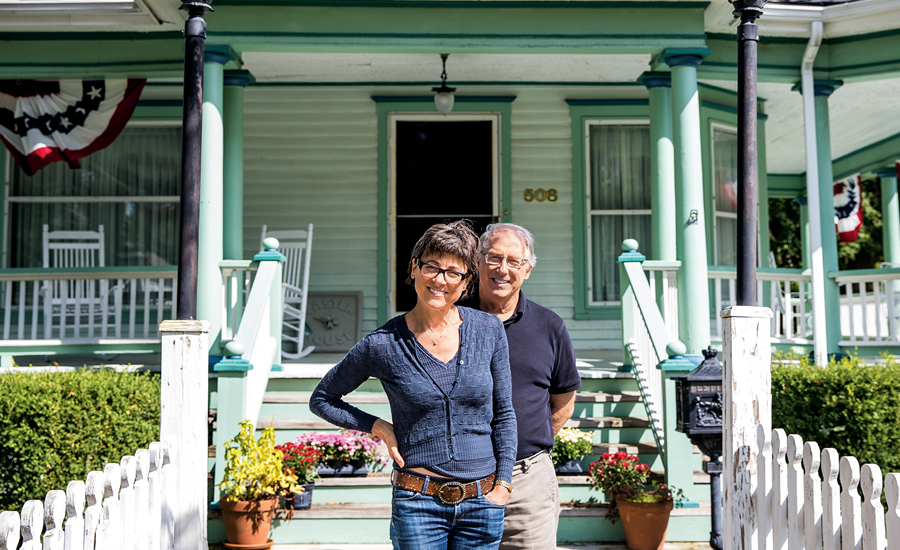
The house was a gorgeous pistachio-colored century-old Queen Anne Victorian in Ada, a village about two hours south of Cleveland, where I’d grown up in the suburbs and where my parents still lived. My sister’s house was down the street from us.

Four months earlier, I had quit my high-profile job as a public-radio journalist in New York City. My husband had retired early from his own successful radio career and we had moved to Ada to reconnect with our families, step back from our relentless pursuit of achievements and find a more peaceful, God-centered focus for our lives.

ENJOYING THIS STORY? SUBSCRIBE TO GUIDEPOSTS MAGAZINE!

So far what we’d found was a charming, affordable old house that needed a lot of work.

“I can’t wait until this is over,” Mark and I said with a grimace as we heated soup on a hot plate in the living room while blue-shirted Amish men knocked the plaster from the walls of our outdated kitchen.

And that was only the beginning of the work. The house needed an exterior paint job, new insulation, and drainage for a flood-prone basement. We were planning to build a rental apartment over the freestanding garage to supplement our income, which at the moment consisted of our savings and Mark’s recent inheritance from his mother.

I had hoped to make some money as a freelance journalist. But those hopes were dimming as I found out how difficult and financially unrewarding that work can be. I’d started looking for a full-time job. Meanwhile, the money in our savings account was evaporating by the day.

I thought I’d sensed a clear call from God to leave New York and embrace a different set of values. I thought Mark and I were going to slow down, to live in the heartland—in the full sense of that word—spending more time with the people we cared about.

But here we were in a rambling old house filled top to bottom with noise and dust. We had a to-do list that stretched to the heavens. We were anxious and afraid. What had prompted us to move here? I found it increasingly hard to remember.

“I can’t wait until this is over.” Ironically, it was those very words that had brought us to Ada in the first place. Mark and I had said or thought them nearly every day in our 600-square-foot apartment in Bedford-Stuyvesant, Brooklyn.

There we slept on a sofa bed because our bedroom doubled as the living room. We hauled our dirty clothes two blocks to the Laundromat (and crossed our fingers that the other customers didn’t have bedbugs).

We relied on our smart phones to tell us the weather forecast because we were unable to read the mood of the sky. It was blocked from our view by other buildings and by an acanthus tree that hovered over our back window like a security gate.

“I can’t wait until this is over and we find our Forever Home,” I announced to Mark one day, eyeing the unmade sofa bed. “Because this isn’t it.”

I was the afternoon-drive newscaster and local host of National Public Radio’s All Things Considered at WNYC, the largest public-radio station in the country. I’d been doing the job for 10 years and could easily have done it for 20 more.

It was creative and stimulating. My colleagues were funny and smart. The work was absorbing and important. It paid me well and gave me an audience of hundreds of thousands of listeners.

It was exactly the life I’d hoped for when I moved to New York three decades earlier, escaping what I feared would be a boring, predictable adulthood in suburban Cleveland. So why on earth had I decided to move back to Ohio?

It all started when my husband’s oldest sister, Peggy, came to the end stage of her 20-year battle against breast cancer. Peggy lived in Chicago, where most of Mark’s immediate family was—too far for us to visit regularly. We followed her progress through weekly calls to my mother-in-law.

The distance made us feel helpless. Our calls and the cards we sent—“We’re praying for you!” “We’re thinking of you!”—felt paltry.

Eight months after Peggy died, Mark’s mother too was gone. She went into the hospital for knee-replacement surgery, contracted an infection and didn’t recover.

I began thinking more and more of my own parents, back in Ohio. They were healthy now. But inevitably the time would come when they would need help. What would I do then? Offer them encouragement over the phone?

The summer after Peggy died, Mark and I visited my sister and her family in Ada. We looked forward to these annual trips. We’d sit on my sister’s front porch watching thunderstorms roll past.

We don’t have kids of our own, so we loved taking my nieces to corn mazes or exploring the backyard with them, picking lavender and holding the fragrant blue-gray spikes under our noses. We joked about ditching our jobs and moving to Ada.

We especially liked to dream about buying that spacious Victorian house up the road, the one painted pistachio green with the wraparound porch and attic turret.

Then my sister called to tell us the house was for sale. I knew I’d never leave my Forever Job, even for an Ohio Forever Home. Still, I asked my sister to call the real-estate agent to show us the house when we were in town—just to see what it looked like inside.

It turned out that the seller had dropped the price. Is it a sign from God? Mark and I wondered. No, we said, shaking our heads. We couldn’t leave all we’d built in New York. We just couldn’t.

My sense of what was possible changed the moment the agent let us in the door.

“Oh my God,” I intoned.

I meant it. The house inspired awe and wonder. It was beautiful. Panels of deep brown solid oak reached halfway up the walls. A wide, gracious staircase led to the second floor. There was a formal dining room and a parlor, a vestibule, a fireplace and an attic. And that enchanting little turret that made me feel like a princess in a fairy tale.

My nieces oohed and ahhed and ran upstairs to check out the bedrooms. “Aunt Amy!” the youngest yelled down to us. “I want the purple room when we sleep over!”

I was seized with a need so strong, it almost felt like duty. “We have to live here,” I said, turning to Mark with tears in my eyes.

It was ridiculous, really. All this house, for just Mark and me? But in that moment, standing in the foyer, I envisioned more than just us in this house. I saw it filled with family and friends, old and new. They’d come here for card games and writing workshops, potluck dinners and lectures.

And I saw myself defined by something more than my Forever Job. I was not my talents or my paycheck or my tens of thousands of listeners. I was a daughter, a sister, an aunt, a wife. I was a friend and a mentor. The life that had seemed predictable and boring to a teenager suddenly seemed the kind most worth living.

It felt like a new path was opening before me. A new definition of a life well traveled and well lived.

There was freedom in that path, a sense that I could step away from frenetic New York and take my time exploring alternatives. There was also, as Peggy’s and my mother-in-law’s deaths reminded me, no time at all. If we were going to do this, I thought, we would have to do it now. It would be a leap of faith.

Mark and I bought the house. We packed up our New York apartment, I said goodbye on the air and just like that we were heading to Ohio, into a new life.

We still felt as if we were waiting for that new life to begin.

“I can’t wait until this is over,” Mark and I kept saying as house repairs multiplied and our bank account shrank. When were we going to have that more peaceful, purposeful life we’d moved to Ada to find?

Until, one day, I realized that maybe Mark and I already were living that life. Maybe all the chaos and unpredictability was exactly what we needed. The renovations and the job search were forcing us to slow down, take stock, pray more, appreciate each other more.

Wasn’t that what we came here to do? It was requiring me to keep listening to God, to keep trusting him.

I thought back to that day when I stood in the foyer of this grand old house, suddenly seized with a vision of a different future. A future I never could have imagined back when all I wanted was to escape suburban Cleveland, move to New York City and make it big. God gave me a glimpse of the person I could become if I stepped forward in faith.

I’m still stepping forward. Every day I have to let go of my impatience to get through the messiness of life, knowing that God speaks loudest there. I’m learning to trust that here, now, I’m home at last.

Did you enjoy this story? Subscribe to Guideposts magazine.

Life Hack: Believe Something Wonderful Will Happen

Last week, my friend texted me bright and early with the link to an article from Inc.com: “57 Easy Ways to Be Happier and More Successful.” I clicked it open right away. How could I not with a title like that?

I browsed through the items. Most made a lot of sense: Don’t gossip; avoid negativity; drink more water. But one item stood out. The article advised waking up every morning with the thought, “Something wonderful is going to happen today.”

That I could easily do. Guideposts founder Norman Vincent Peale is the Father of Positive Thinking, so if it worked for him, why not me?

On my way to work, I repeated those words, even as I walked down a street in my neighborhood that’s typically lined with leaky garbage bags from nearby restaurants. “Something wonderful is going to happen today!” I told myself.

I felt like I was in some old Hollywood musical. Soon, a Fred Astaire look-alike would pop up out of nowhere, do a coordinated dance with garbage bags and convince me to escape with him to Paris.

Well, sadly, that did not happen. But many little wonderful things did happen. I had a fun editorial meeting. A delicious salad for lunch (I know, salad…I was surprised too!). A good conversation with my mom on the phone. And a restful evening.

The next morning, I repeated those words: “Something wonderful is going to happen!” I felt positively breezy as I walked into the office. My salad was delicious yet again. I made excellent progress on my work. I was even more social with my co-workers!

Nothing unusually wonderful happened on either day. But I did have an extra pep in my step and I definitely noticed the little bits of wonderfulness in my day more. To be honest, I think it was just helpful to have a reminder. That God has wonderful things in store for me.

I tend to forget that fact in the midst of a particularly difficult day or when I’m in a bit of a rut. Saying it to myself, though, worked wonders. It’s amazing what hope can do.

I’m going to continue with this little exercise. What about you? Do you have an early morning mantra that gets you ready for the day?

Life Coaching: Because Even Caregivers Need Care

Content provided by the Good Samaritan Society.

First, it was hip surgery. Then a second hip surgery. Next came a broken leg. And a diagnosis of Alzheimer’s disease.

As Arvilla Cherney watched her husband, Gene, grapple with mounting ailments, she found herself thrust into a new role as caregiver.

“It got to where he was in and out of the hospital and rehab, and I had to do it all—take care of him and pay the bills,” she says. “It got to be a struggle as time went on.”

Facing growing medical costs, Gene’s increased needs and her own health challenges, Arvilla became overwhelmed.

So when she heard about a free life coach program for caregivers, she decided to try it.

“I knew this would be a good thing to get me organized with my life,” she says.

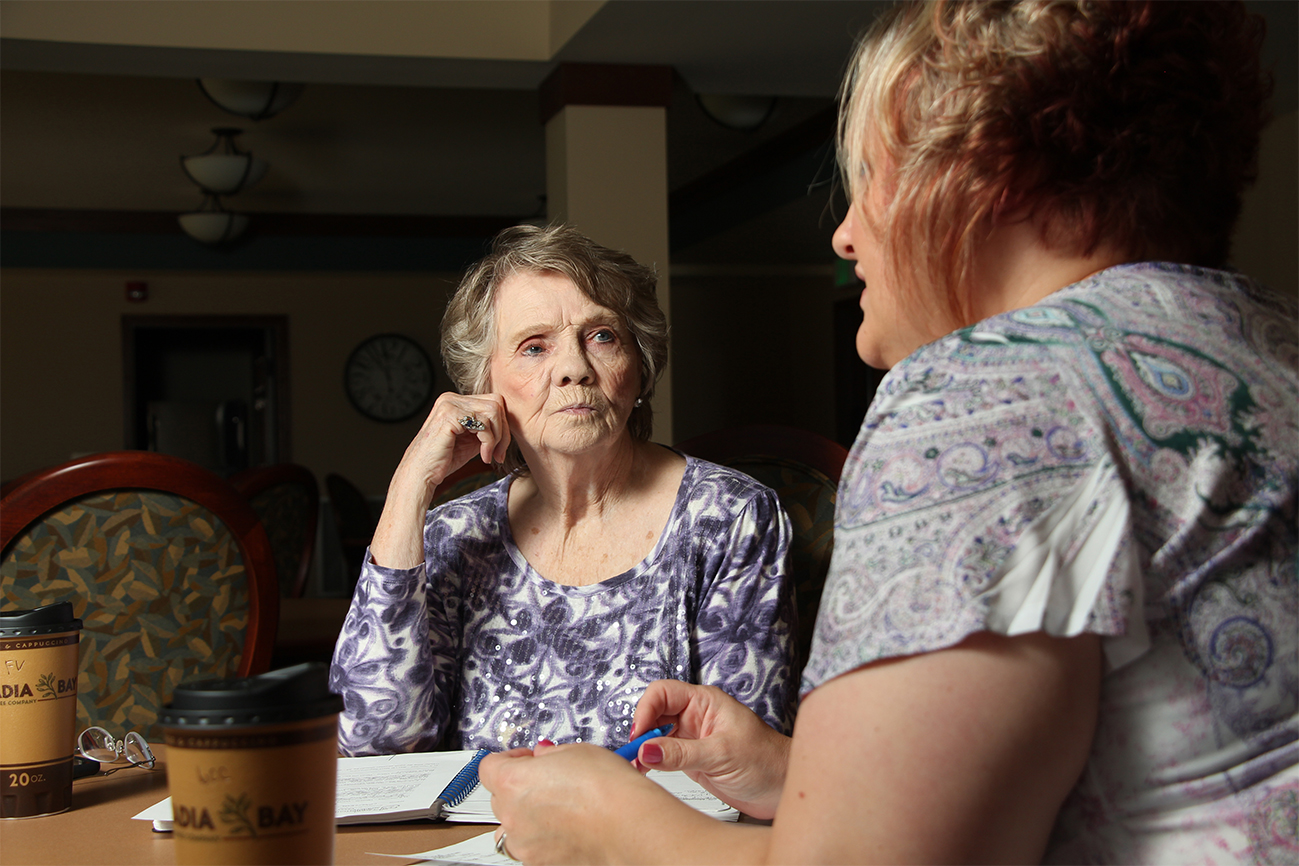
Arvilla met with Tanya Unterbrunner, a life coach who was developing the program with the Good Samaritan Society. Over the course of 12 sessions, Arvilla found a way to balance her needs as a caregiver and an individual.

“Instead of being like, ‘Oh, heavens, here’s a bill I have to pay,’ I found I could be organized and know it was coming,” she says.

Tanya, who has been coaching clients for three years, says Arvilla’s transition wasn’t just about prioritizing various areas of her life—it was about feeling like she had some control over them.

Feeling overwhelmed is common for the nation’s 43.5 million informal caregivers, as many of them care for someone at the expense of their own health and well-being.

Life coaching, as a partnership-based approach to care, can do both.

How life coaching begins

Tanya’s clients begin by filling out a profile assessment about themselves, their family, the person they care for, and whether they share caregiver responsibilities.

They’re asked to consider their expectations and the areas where they want help. From there, questions touch on health, finances and faith.

This gives Tanya a starting point for helping her clients discover their goals, which might look like “I’d like to save for retirement” or “I want to share my faith with my family.”

“Caregivers always talk about who they’re caring for and leave themselves out,” Tanya says. “Even if they say they don’t need help with something, I’m able to pull out different things by talking with them and observing from the outside.”

She recalls a woman who talked about how unprepared her father was as he was dying. Tanya learned the client was afraid that, like her father, she would leave her children without anything to remember her for and with the burden of planning for the end of her life.

“As the coach, I knew there were tools that could help her with all of that,” Tanya says. “So she got an autobiography journal and she is writing in it to leave that as a legacy for her kids.”

In addition, the client set up a life insurance policy and has been talking more with her children about her wishes for her end-of-life interactions.

Not counseling, but looking to the future

Using motivational interviewing techniques to positively frame questions, Tanya asks questions such as “How could you do things differently?” or “What would happen if you asked your sibling to help?”

Whether on the phone, over Skype or in person, she and the client explore what’s holding them back, and how changing behaviors might help.

These questions help clients see a better future, and recognize that they have a hand in what that future will be for them.

This also helps them plan for their future—something only 42 percent of caregivers say they have done, according to a recent AARP caregiving report.

Tanya says this focus on looking forward instead of back makes the life coaching experience different from traditional counseling.

But because this type of client-expert relationship doesn’t have the same sort of board oversight as traditional counseling, life coaching hasn’t been viewed as a healthcare resource in the same way counseling has.

However, with the rise of innovation in healthcare and holistic practices that treat the whole individual rather than just one ailment, the perception of how valuable life coaching can be is slowly changing.

Changing the healthcare system

Margaret Moore, a co-director at the Institute of Coaching at McLean Hospital in Boston, has been researching the benefits of coaching for years.

She and her colleagues at the Harvard Medical School affiliate have found that one of the largest challenges facing the coaching field, including the use of life coaches, is the lack of research data.

In addition, because doctors don’t often use life coaching themselves, they aren’t promoting or documenting its impact on patients, she says.

“Part of the challenge is doctors are so busy they don’t make the time to be coached,” Margaret says. “The pressure and the technology and its huge disruption in the healthcare industry is making life really difficult for them. They could use a coach, but where would they find the time?

“Doctors, like any caregiver, they’re sacrificing their health for their work.”

Learning is the first step

Recognizing that data is a key component in establishing the practicality of any service, Tanya’s team knew they wanted to gather information from the life coaching clients in order to chart the impact of the program.

Because there hasn’t been a lot of research into this particular branch of coaching, Shauna Batcheller, an innovation designer with the Good Samaritan Society, says much of what she’s doing has been a learning process in itself.

“Once I started researching what studies have found about life coaching, I realized I could look at all the factors like efficacy, finding purpose, dealing with stress, and so on,” she says. “There are lots of measurements to use, but how do you account for all the different stages caregivers are in?”

Shauna and her team will use the data gathered from program participants to identify what challenges caregivers face, and what support they’re looking for.

Studying and refining the life coaching program is the organization’s first step into this uncharted territory.

The confidence to care for yourself

Today, Arvilla is nearing the end of her life coaching program—but not her caregiver journey.

She’s grateful for the tactics she’s learned from Tanya; she says the program provided the support and motivation she needed to care for herself first.

“I was reaching a point where I couldn’t get out as much, and that has changed,” she says.

“I was at church the other day, and someone said, ‘You are not old—your body might be, but your mind isn’t, so get going.’ And I thought, ‘Oh, I can get going!’ Because now I know I can think about me.”

For more information visit the Family Caregiver Alliance and Good Samaritan Society.

According to research from the Family Caregiver Alliance, up to 70 percent of caregivers have “clinically significant symptoms of depression.”

Good Samaritan Society’s life coaching for caregivers pilot program may have the opportunity to impact the system for both primary care providers and those working as informal caregivers.

Letting Go of Worry

God replied to Moses, “I Am Who I Am. Say this to the people of Israel: I Am has sent me to you.” Exodus 3:14

Worry had returned.

I sat on the porch, while my family slept, and I wondered why nighttime gave it strength.

Earlier in the evening, I’d spent a few hours talking with friends and finding a bit of comfort knowing that worry is a foe most of us battle. It runs through our humanness as a common thread.

That night, on the porch, it was gripping.

I rocked back and forth on our old rocker, the gentle creak breaking the silence of the night, the way that worry had broken into my mind.

So, I sat still, perfectly still. And one thought became powerful and clear:

When worry is gripping, I need to reach for something else.

When I think about it, this is a critical place. This is where faith lives and breathes. This is the tender spot where I release the what-ifs and troubling possibilities. I’m at a place of choosing. Either I hold worry or I open my hands, let it go, and reach for the Lord.

READ MORE: WELCOME REST

I wanted to reach.

I AM is one of my favorite names of God. When the Lord revealed Himself to Moses at the burning bush and commissioned him to stand face-to-face with Pharaoh and lead Israel out of Egypt, Moses was afraid. Anxious. He questioned God. Then he asked, “What if they ask for your name? What do I tell them?”

God’s reply was powerful: I AM WHO I AM.

And He is unchanging. Moses’ God is my God too. He’s the Lord of glory. Strength. Power. Faithfulness. He’s our Provider and Protector.

That same God is present in my circumstances.

Thank you, Lord.

I sat the darkness that evening and spoke His name aloud.

Because of I AM, I can give up control.

Because of I AM, I can trust.

Because of I AM, I can hope.

I looked again at the vast, dark sky, the sky that stretched past where I could see. Suddenly, sitting there, I felt small. Not insignificant and small, but small when compared to His endless power, love and grace. My worry felt smaller too; it was too much for me to hold.

I belong to the great I AM WHO I AM, and when I reach for Him, I can let go.

Letting Go of Regrets

The giant flounder latched onto the hook on my husband’s fishing pole. The water churned as the fish tried to get away, but Paul kept reeling him into shore. That fish was huge–the biggest flounder he had ever seen.

Golfers at the course across the lagoon stopped playing to watch. They cheered Paul on as he reeled…and reeled…and reeled, until the fish got almost to land. And just as Paul started to pull him onto the bank, the unthinkable happened—the line broke.

The golfer audience yelled, “Nooooo!” And my dejected husband kept muttering. “It was the biggest flounder I’ve ever seen. I almost landed it.” And that’s when the “if’s” started. “If only I’d had a stronger test line so it wouldn’t have snapped.” And, “If only I’d had a net with me. I could have pulled him in.”

Read More: Mornings with Jesus Devotional

Those “if only” statements were uttered again when we loaded the fishing equipment into the SUV, when we unloaded the fishing stuff back at the villa, when we got inside the villa, when he changed the line to the new stronger one.

At dinner, I’d finally had enough. I said, “Honey, I’m tired of hearing about it. You didn’t have the stronger fishing line on the pole, and you didn’t have the net with you. All those “if’s” won’t make any difference. Don’t let it ruin our vacation.”

But that night after we went to bed, I started thinking about all the “if only” moments in my own life. If only I hadn’t done that. If only I could do it over again. If only I’d spent more time with my mom (or dad or children or grandparents). If only I’d known we didn’t have much time left together.

But as my husband learned with the monster-sized flounder that got away, all the “if only’s” in the world won’t make any difference. Now, instead of “if only’s,” we’ve decided to look back on moments where we can say, “I’m so glad I did.”

Letting Go of Guilt

Autumn has given us a prize. Balmy air. Trees beginning to gild gold. The boys, my nieces and I walk along the river, chasing every moment of this day.

“Should we stop for ice cream?” I ask. There’s a shop nearby, and I have money in my pocket.

When we get there, I go wild and stray from our one-scoop routine. “Order what you like,” I say. Five children wear smiles that beam wide.

Then I see the gentleman. He’s observing with kind, gentle eyes. The kids tilt their heads to read the menu and murmur about M & Ms and hot fudge. But I watch the gentleman watch my kids.

His shoes have seen miles. There’s a hole at the elbow of his shirt. When he smiles, I can see that he’s missing teeth.

But he reaches to his pocket and begins to count bills.

The clerk asks for our order, and the kids share what they would like. The girl rings our total and the gentleman comes near. “I’d like to pay,” he says. “Your children are well behaved and thankful. I want to give them this treat.”

I’m surprised and am not sure of what to do. Tenderness floods my soul. But I’m worried for this man so I stammer and refuse. “That is very kind, Sir. Thank you. But I can’t. There’s too many, and it’s too much.”

“It’s my pleasure,” he says. He pushes the bills forward.

The clerk looks to the gentleman and back to me. The children are looking too, and I can feel my cheeks turn red.

“Thank you,” I say. “I’m grateful. But I can’t. No.”

Embarrassment flushes his face red, too. He stands for a moment, money in hand. The children thank him, and I fish through my pocket for my own bills. When I turn around, he’s gone.

And for the rest of the day, when the children relay the story to my husband, I berate myself for shaming this man. For taking away the blessing of giving. For deciding what he could and could not do.

I even carry it to bed with me, and in the night, I dream and see that man’s face. I wake with agony in my heart, regret pressing hard and my shame filling my soul. I can forgive others, but it is sometimes so hard to forgive myself.

And it’s here that the Spirit meets me.

There is no condemnation for those who are in Christ Jesus.

It takes a few moments for me to accept this truth. At first I reject it, as I’d rejected the man’s offering. But as I sit, in the hush of the night, I understand that the Lord loves this gentleman. This man is in His care.

I am too.

I’m covered by grace, and I can let go.

And in this, at last, I can find rest.

Letting God Set the Pace

Olympic Stadium, London, August 4, 2012. Minutes before the race of my life, the finals of the men’s 10,000 meters. I wasn’t running. I was a spectator. Below, taking their places, were two runners I’d spent years coaching. Many, many hopes rested on those two men.

Mo Farah, a 29-year-old from England, carried his country’s dream of Olympic gold. Galen Rupp, a 26-year-old from Oregon, had a shot at becoming the first American in decades to medal in an Olympic distance event.

Sometimes at big races coaches get to sit close to the runners. Not at these Olympics. I was in the stands like any other fan. Maybe that was better—better that my runners couldn’t see the tension on my face.

For more than a decade I had led a program called the Nike Oregon Project, an attempt to show the world that, with the right training, Westerners could once again compete in world-class distance running. For years Africans had completely dominated the sport.

The stakes were especially high at this Olympics. Doubts about the project ran rampant in the running world. Our runners had failed to finish higher than eighth place in the 2004 and 2008 games. It’s a vanity project, people said, Alberto Salazar trying to redeem himself.

I knew what they meant. I’d won four major marathons in the early 1980s. Then I flamed out and never won another marathon. I never won an Olympic medal.

Were the doubters right? Was I here for the wrong reasons? I certainly had cause to wonder. I’d made so many poor decisions in my life, in my running career. Yet an almost indescribable calm descended over me in that packed stadium in London. The gun sounded. The runners were off.

I couldn’t help but marvel at the peace I felt inside—the complete opposite of how I’d felt in my own running career. Maybe it was the competitive fire I’d inherited from my father, a hard-driving immigrant from Cuba who expected his kids to be Catholic, anti-communist and high achievers, in that order.

Or maybe it was just my own arrogance. Whatever it was, from the moment I started running in high school, I approached the sport like a one-man army. I ignored coaches’ advice and pushed myself beyond my limits. I bragged about my victories—it was the confidence of a champion, I thought.

I won the New York City Marathon in 1980, followed by two more New York City Marathons, and the Boston Marathon in 1982. Before I turned 25 I was ranked the top distance runner in America.

Then, just as my coaches warned, I began suffering injuries. Stress fractures. Torn tendons. Hamstring strains. I tried physical therapy, surgery, unproven cures. Nothing worked. A few short years after my burst of fame, I was finished, washed up.

Images of my own past races flitted through my mind as I watched Mo and Galen complete the first lap. They were several paces behind the leaders. Their strides looked good, exactly as we’d practiced. I trusted them to conserve their energy until the last few laps, when distance races are won or lost.

That strategy—conserving strength until it’s needed—was the foundation of the Nike Oregon Project.

I thought back to the day when I’d sat down with Nike executives to broach the idea. “I think Americans can win again,” I’d said. But was it true? It seemed as if American distance running had followed the same downward trajectory as my career.

Once regulars on the Olympic medal podium, Americans hadn’t won the men’s 10,000 meters since 1964. In the years since I’d stopped competing, I’d gotten married, had kids and taken a marketing job with Nike that kept me involved with running. But something was missing.

My parents had raised me to believe God is always in charge. Still, I struggled to accept the direction my life had taken. My critics were right about one thing. The Nike Oregon Project was my attempt to find a new path, to find redemption, if you will.

Mo and Galen began lap six. Several African runners held the lead. Suddenly a runner from Uganda stumbled, almost knocking Mo over. Mo lost his stride. The next moment he and Galen were both far behind. I took a deep breath, as if trying to inhale that feeling of calm.

Mo and Galen had 19 laps to catch up. Besides, wasn’t patience the first lesson I taught every Nike Oregon Project runner? “Race when your body’s ready—not before,” I always said. “I won’t let you make the same mistakes I did.” That meant training plans were designed to build slowly and sustainably toward victory.

It also meant an even more important lesson: “You need something bigger in your lives than running. If running is all you care about, like it was for me, you’ll burn yourself out.”

Religious faith is not a prerequisite for becoming a Nike Oregon Project runner. I don’t preach from the sidelines. But I don’t hide my faith, either. And many of my runners are people of faith too, particularly Mo and Galen. Mo is a Muslim, Galen a Christian.

Galen and I pray together before each race, and Mo joins occasionally to pray for family members in need. The two of them have become close friends. They’re roommates on the road. They’re both into soccer. They know each other’s families. They support each other on and off the track.

For years I taught this training philosophy, praying for some sign that it wasn’t, as critics said, just a vanity project. At times I doubted my own motives. Then one day I got a sign—though I had no idea what it meant at the time.

I was walking across the Nike campus with Galen and two other runners. Out of nowhere a crushing pain flashed in my neck. I sank to one knee. The world went black.

I awoke in the hospital. My wife, Molly, was there. “Alberto!” she cried. “You’ve had a heart attack.”

I’d had more than a heart attack. Despite years of running and maintaining my health, a rogue piece of arterial plaque had suddenly blocked blood from entering my heart. The heart muscle seized up.

For 14 minutes I’d lain on the pavement while a doctor and an Army medic recently returned from Iraq—both men just happened to be on the Nike campus that day—performed CPR until an ambulance arrived.

Ordinarily the brain can’t survive more than six minutes without a steady supply of oxygen and nutrients carried by the blood. My heart had stopped pumping blood for 14 minutes. Yet somehow I was alive.

I returned to coaching as soon as I could. But no matter how hard I worked, or how steadily my runners improved, I couldn’t figure out why I’d survived that heart attack. It was a miracle, I knew. A sign, surely. But of what?

A bell clanged. At last, the final lap of the 10,000 meters. Slowly, patiently, just as they had trained to do, Mo and Galen regained positions in the lead pack. They were surrounded by Eritreans, Ethiopians and Kenyans. Tariku Bekele, a talented Ethiopian, was in front.

Now, I thought, focusing my gaze on Mo and Galen. Sprint now. They did. Mo’s legs churned. Suddenly he broke past Bekele into the lead. The others scrambled to catch him. Galen pulled even with Bekele. The pack rounded the final turn and Mo’s lead grew.

A roar erupted in the stadium—an Englishman was about to win! I stood. My heart—my miraculously healed heart— beat harder. Mo was almost to the finish line. Galen and Bekele were battling for second. Mo crossed the line—gold! The next moment Galen shot ahead of Bekele and claimed silver.

You might think that I immediately jumped up into the air and shouted myself hoarse, dancing on my seat. After all, it was the victory I had toiled for. The victory that everyone at Nike, in England, in America, wanted. The victory that critics said would never come.

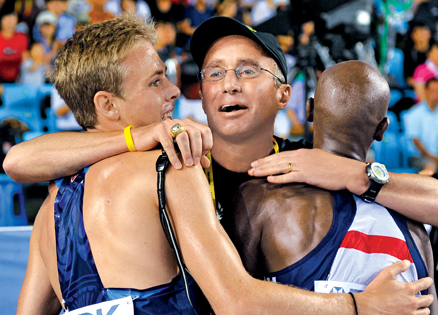
I didn’t dance. Instead, I stared transfixed at something no one else in that giant stadium noticed. It was Mo Farah right after he crossed the finish line. Photographs of that moment show Mo with his hands cupped to his astounded, joyous face. Mo Farah exults in his victory, read the captions.

Mo Farah looks back as Galen Rupp crosses the finish line.

But that’s not what the photographs really show. Mo’s face lit up then not because he won gold—but because he turned around and saw Galen win silver. At the moment of his greatest triumph, Mo wasn’t thinking about himself at all. He was thinking about his friend.

Something bigger in your life than running. All at once, in the rush of victory, I understood why I’d been so calm at the start of the race. I understood why I’d survived my heart attack and why my running career had taken me not to my own Olympic victory, but to this race in London.

Something—no, Someone—bigger than running had brought me here. My youthful mistakes, my brush with death—they were moments of grace, reminders that God is at work even in the midst of our human imperfection and mortality.

Slowly, sometimes painfully, I learned to take the focus off myself and give the lead to God. With Mo and Galen and my other runners, I learned to run a different kind of race, one that takes us beyond winning, a race that is won at the end and not the beginning.

Download your FREE ebook, The Power of Hope: 7 Inspirational Stories of People Rediscovering Faith, Hope and Love

Letting God Be the Judge

Another light has gone out in the acting world. Jean Stapleton died in New York City on May 31 at age 90 of natural causes. Stapleton, despite her long and varied acting career, was best known for her iconic role of “dingbat” Edith Bunker in All in the Family, the popular and pioneering 70s comedy.

At the height of her popularity, she wrote an article for Guideposts magazine about overcoming her own Archie Bunker problem, that of prejudice.

When I was growing up in New York City, there was one thing that I disliked with a passion and that was calf’s liver. My father, an outdoor advertising salesman, loved calf’s liver, and so my mother saw to it that it often appeared on our dinner table. I would rather go hungry—and often did—than eat it.

The interesting thing is, I never even tasted calf’s liver until I was an adult. I simply disliked the looks of it and knew, beyond all argument, that I would despise it. Today I adore calf’s liver.

It wouldn’t surprise me at all if Archie Bunker hated calf’s liver. If you know Archie from All In The Family, the television comedy series in which I play his dingbat wife Edith, then you know what I mean.

Archie’s a bigot, a super bigot, and we get most of our laughs from his outrageous points of view, his rantings against other races and almost anything new or strange to him.

If it’s true that the bravest man who ever lived was the first fellow to eat an oyster, you have some idea of where Archie would rate for courage—and how he’d camouflage his fear with a loud tirade.

By being extreme, and therefore ridiculous and funny to us, Archie has made millions of people aware of the absurdity of prejudice. I have confessed to my own absurd dealings with liver because it points up something that I was aware of long before Archie came along: Prejudice is an assortment of deceptively small personal judgments—deceptive because of their great cost in our daily lives.

No one will ever know, for example, how many families have been racked by stubborn arguments over long hair. Is prejudice involved? Partly, I think, for at its root, prejudice is a matter of judging—of prejudging really.

We have preconceived opinions that long hair means something about a boy (and therefore about ourselves, since he is our offspring) that may or may not be true.

For myself, I have seen how my own niggling, personal prejudgments often have robbed me of pleasure and peace of mind. There have been times when I have tried to cure these prejudices, and I recall one time in particular when a conscious effort at healing resulted in a crucial breakthrough in my acting career.

It happened a long time ago, in the late ‘40s, after a good many bleak years trying to crack Broadway. Those had been years of constant work, of having a job as a secretary in the shipping department of a railroad company by day; typing manuscripts late at night in exchange for drama lessons; begging time off for summer stock; making precious little progress.

Then one day the chance came to read for one of the Equity Library Theatre productions—shows that our actors union puts on to give us a chance to work and to be seen. The play was The Corn Is Green, and there were two roles in it I felt confident I could handle.

One of them was so miniscule, however, that though I knew it meant a job, there was some doubt as to whether it would be a good showcase. Naturally the tiny part was the one I was offered.

I thought about it a while. “I’ll do it,” I said finally, irritated that they hadn’t given me the larger part.

Ten days before the opening, the actress rehearsing Mrs. Watty fell on some ice and broke her leg. I assumed that I would inherit her role and I wasn’t surprised when Ted Post, the director, came to talk to me. He asked me if I would fill in until he could get somebody else.

“Somebody else! But what about me?” I protested. “I can play her.”

“No,” he said, “you’re too young.”

I didn’t believe him. He just was not being fair. He had it in for me.

I got angry. I got so mad that I couldn’t even sit at the same dinner table with my parents that evening. I had to get up and go to my room and try to collect myself. I had to do something about this injustice or I would burst.

In those days—as well as today—I had my own way of finding help when needed. I took out my Bible. After all, I had been going to Sunday school classes in our church since the age of two. And I also took out my concordance, that remarkable compilation of all the key words in the Bible and where they appear.

I flipped through the pages of the concordance to the “J’s,” mumbling theatrically all the while, “Justice is what I need, justice…” But before I could find “justice” my eyes fell on “judge.”

“For the Lord is our j. Isa. 33:22.”

I picked up the Bible and sped to Isaiah. I had explored Scripture in this fashion many times before, sometimes losing myself for hours in random adventure. Now, Chapter 33 … there it was: “For the Lord is our judge, the Lord is our lawgiver, the Lord is our king; he will save us.”

What was this I was asking about justice? Had I jumped to some emotional conclusion about Ted? Should I pray about this and try leaving justice to the Lord?

I prayed; I relinquished the matter to the Highest Power. My anger disappeared. I was back in the dining room for dessert.

The next day at rehearsal I was no longer driven by an ambition to play Mrs. Watty. I read the part as well as I could and enjoyed doing it, and when Ted found somebody he thought was the right age, I retired with genuine grace.

But that wasn’t the end of the story. Three nights later the producer called me at home and said that the new Mrs. Watty hadn’t worked out. If Ted should ask me, would I be willing to take over? Very quietly I told her I’d be delighted, and the next day Ted said, “You’re too young for it, Jean, but the part’s yours.”

It’s still not the end of the story. Just as all show business sagas ought to unfold, an important agent saw me at the opening. She wasn’t fooled by my make-up. She saw me as a young woman, just right, she decided, for the role of the niece in a touring company of Harvey.

Out of that came my first good job in the theater; I was on my way.

Today, when I get emotional about something I think somebody has done to me, I try to think back to that experience before I start hurling a few hasty, bigoted thunderbolts.

I recall that I never succeeded in changing the director’s opinion of me; nor did I change my own opinion. I had simply left the judging to the Lawgiver, and He decided for both of us.

Recently a friend sent me a sermon entitled, “God and Archie Bunker,” written by the pastor of the Brentwood Presbyterian Church here in California. In that sermon, Dr. Spencer Marsh Jr., who enjoys Archie, nonetheless noted his self-centeredness, his cliché-ridden bravado, his imprisonment inside his own narrow opinions.

He quoted some dialogue from the show, from the night Archie was talking to “our” son-in-law saying, “I’ve been making my way in the world for a long time, sonny boy, and one thing I know—a man better watch out for number one. It’s the survival of the fittess.”

Doctor Marsh said that Archie is out of position, that Archie is a mixed-up person “because the number one slot which he claims, is reserved for God.”

He sees Archie as the elder brother in Christ’s prodigal son parable, the one who stands outside the house grumbling about his rights while the welcome-home party is going on inside. The walls that separate him from the party are self-imposed, self-righteous, judgmental ones.

That’s one reason I worry about prejudice. It could keep me from the party. It could keep me from enjoying the company of other people and what they have to offer just as surely as it almost kept me from the simple pleasure of calf’s liver or, more important, the big break of my career.

And poor Archie, like a lot of us, never listens, never learns. He’ll never know that by blindly pushing away the oyster, he might be missing its pearl.