

Embrace God's truth with our new book, The Lies that Bind

Is A.A. for Alcoholics Only?

The opera stage is crowded with outsized characters, and in my long career as a leading soprano I’ve played most of them. Wagner’s Brünnhilde, Strauss’s Salome, Puccini’s Tosca. I’ve sung these and countless other roles around the world, sharing the stage with the likes of Luciano Pavarotti and Plácido Domingo. But there was one role I never came close to mastering—though I played her every day. That role was myself.

Onstage, gathering audiences into the soaring sweep of my voice, I was beloved as one of the opera world’s most passionate, most versatile singers. Offstage, my life was a wreck. I was an alcoholic. A binge eater. Cycling through relationships with abusive men. From childhood I’d felt called by God to sing.

But you would never know that, watching me in my hotel room after a performance, drinking until I passed out, waking up covered in bruises, scrolling through the text messages on my phone to try and figure out what I’d done. I lived by my voice. But it took years, decades, my whole life, really, before I finally accepted that only one Voice could save me from myself.

I’m serious when I say I felt called by God to sing. It happened when I was 14 years old. I was lying in bed early one morning, watching sunlight filter through a gap in my curtains. Suddenly a voice—at once loud and soft, warm and fierce, real and otherworldly—spoke to me with utter clarity. You are here to sing.

That was all. Yet I knew those words came from God, and were meant for me, because I’d been singing, and loving to sing, for almost as long as I could talk. As a toddler I begged my grandmother to put on her vinyl record album of My Fair Lady. I learned all the songs by heart and belted them out in Grandma’s living room, outfitted in her apron and one of her pillbox hats.

I sang at church, at school, in Christmas pageants, wherever I could. I knew there was something special about my voice. I could tell by people’s faces when I sang. Their eyes widened. They smiled, leaned forward. Oh, how I lived for those moments of connection! At one with an audience, I felt at one with myself.

But such moments were fewer than I wanted because my parents, strict Southern Baptists, made it clear that singing for any other reason than to please God was prideful and wrong.

“Who do you think you are?” my dad asked once when he caught me playing the piano and singing show tunes in the living room. He loomed up beside me, his face a mix of awe and fear, as if my voice were a powerful, uncontrollable force. I shut my mouth and slunk away.

There was a reason my parents were so strict, why Dad sometimes spanked me for no reason or washed my mouth out with soap, making sure the washcloth got all the way back to my molars. Theirs was a shotgun wedding.

Mom was just a teenager when I was born. And by the time I was three, I could tell Mom and Dad fought a lot, more than most couples—sometimes over other women at our church. My parents were young and didn’t know how to raise kids. Mom was a curvaceous woman, and Dad, I guess wanting to spare his daughter a lifetime of weight struggles, monitored everything I ate. That backfired. I became obsessed with food, using it to calm my fears that Dad would up and leave us, or that he’d suddenly get mad and spank me.

By the time I heard God so distinctly affirm my teenage singing aspirations, my own feelings about singing—about my life, really—were a tangle. I got praised for singing at church, but punished for it at home. My body produced the voice I lived for. But I was ashamed of my body, which already was bigger than other girls’, and only growing bigger as I binged on food to soothe my anxieties. I feared God didn’t approve of how I used his gift. I stopped listening for more affirmation. I figured I didn’t deserve it.

You’d be amazed how far an artist can go without an ounce of self-esteem. I won major singing competitions in college. Soon I was working as an understudy at famous opera houses, then drawing rave reviews for my own starring roles. I toured the world, singing at Covent Garden in London, La Scala in Milan, the Metropolitan Opera in New York. “One of the most important American singers to come along in years,” The New York Times called me.

If only they knew what my real life was like! I married a man I met in high school. He didn’t love me and cheated on me. After we divorced I took up with a marijuana grower—yes, seriously—who turned me on to hard drinking. He had a terrible temper and once kicked me in the head during an argument.

My weight soared to nearly 300 pounds, so heavy even the critics who loved my voice took notice, and I was passed over for roles because I couldn’t fit costumes and directors said I couldn’t portray romantic heroines. (Which deeply bothers me, this idea that only skinny women deserve love lives—but that’s a different story.)

I tried fad diets and weight-loss drugs, even had a balloon inflated in my stomach. At last I found relief from food cravings through gastric bypass surgery. But even as the pounds started falling off and I could actually buy outfits in regular sizes, my addictions blossomed.

All those feelings of fear and shame I’d carried since childhood—they didn’t go away just because I was thinner or famous. Actually, being famous made them worse. I felt like a fraud. Like a beautiful voice hiding an ugly mess. Even my family was a mess. Mom and Dad had divorced and gotten remarried to other people. They hardly spoke to each other.

Finally, the mess got too ugly even for my voice to hide. I had taken up with yet another damaging man—a member of the Metropolitan Opera chorus who already had a girlfriend when we started dating. No surprise, he refused to commit, and every time he retreated I went on a bender. I was frightened of myself—but not too frightened to drink more.

During a singing trip to China in 2013, I sat in my hotel room drinking all day and passing out by evening, surrounded by empty bottles. I woke up one night in a Chinese hospital room with an IV drip in my arm. “Put her on suicide watch,” a doctor said.

A few weeks later I checked into a rehab center in Miami. I didn’t have high hopes. I’d gone to Alcoholics Anonymous before and never stuck with it. Why would this time be different? The rehab felt like a prison. I didn’t get along with my roommate, Betty, who—like most addicts, I’ve come to learn, including me—was very self-centered.

She always grabbed the same spot on the couch for group therapy sessions, no matter who else wanted to sit there. One day we inmates (what I called the patients) were asked to do a trust exercise: lead one another around the center blindfolded. I got partnered with Betty. She put a blindfold on me and began guiding me through the halls. “I’m right here, Debbie. Follow me. Follow my voice.”

The exercise ended in a courtyard. I took the blindfold off and turned to Betty. Somehow, following her like that had softened my feelings toward her. But she’d already raced off to claim her favorite spot on the couch. For a moment I stood there feeling abandoned. Story of my life, I thought.

But almost as soon as those words entered my mind they vanished. My attention was yanked back to what Betty had said as she led me through the halls: “Follow me. I’m right here, Debbie. Follow my voice.”

My voice. Long ago, I had heard a voice in my childhood bedroom. The voice had told me to sing. And I had spent my life singing. But had I truly followed that voice?

If I had, I wouldn’t have ended up on suicide watch. I wouldn’t be in rehab wondering if it was possible for me to stay sober. I wouldn’t have binged on food and alcohol and men all my life in a frantic effort to numb my gnawing fears. I wouldn’t have felt those fears in the first place because I would have known that, no matter what happened in my childhood, no matter what size I wore, I was loved by God. God loved my voice and wanted me to use it for his glory.

But I had been using my voice to drown out the one Voice that could save me. I looked around the courtyard. Everyone was going in for group therapy and I was there alone, in the stillness and soft tropical air. I breathed in—that breath, so necessary for singing. Only now, I felt God there, deep inside my body, where my voice originated.

You are here to sing.Yes, and it was God who gave me singing, and blessed it, and said it was good. I went inside to group therapy. For the first time I had reason to hope that this time my efforts to stay sober would turn out differently.

And so far they have, although, as we say in AA, it’s one day at a time. My days are happier and more peaceful than they’ve ever been. I still sing leading opera roles, but I’m branching out too, into other kinds of music. And I’ve begun mentoring up-and-coming singers.

“You have to take care of yourself,” I tell my protégés. “Don’t let the work consume you. Your voice is a gift. Use it wisely.”

I wish someone had told me that when I was young. Actually, Someone did. What it took me years to learn was how to listen. I’m right here. Follow me.Those words are the sweetest aria I will ever hear.

This story appeared in the February 2015 issue of Guideposts magazine.

Inviting God to Your Pity Party

I recently had a day full of emails and phone calls with news I didn’t want–someone let me down and things I thought would happen…didn’t. My spirits were low. I thought about throwing a pity party, but it was too much trouble to plan one.

But then I realized that the best answers to making it through times like those are found in God’s Word:

1. God tells us to quit carrying our problems and to give them to Him.
In 1 Peter 5:7, He says, “Casting all your care upon Him, for He cares for you.”

2. God says not to be stressed over situations and to bring requests to Him in prayer.
In Philippians 4:6-7, He says, “Be anxious for nothing; but in everything by prayer and supplication, with thanksgiving, let your requests be made known to God; and the peace of God, which surpasses all understanding, will guard your hearts and minds through Christ Jesus.” Following His plan will bring peace instead of anxiety.

3. God says to wait on Him.
In Lamentations 3:5, He tells us, “The LORD is good unto them that wait for him, to the soul that seeketh him.” Waiting is hard, especially when it’s something that’s close to our hearts, but as my pastor, Rev. Ralph Sexton, always says, “Even when we can’t track Him, we can trust Him.”

4. God says He will comfort us in our distress, and He understands that sometimes, we’re too discouraged to even pray.
In Romans 8:26-28, He reminds us, “Likewise the Spirit helps us in our weakness. For we do not know what to pray for as we ought, but the Spirit himself intercedes for us with groanings too deep for words. And he who searches hearts knows what is the mind of the Spirit, because the Spirit intercedes for the saints according to the will of God. And we know that for those who love God all things work together for good, for those who are called according to his purpose.”

How precious to know that God will come to my pity party, that He will hold me close, He will pray for me, and He will work all things out for my good. And I can promise that He’ll do exactly the same for you.

Investing Wisely for a Meaningful Life

Am I investing my time wisely in things that truly matter? What actually matters and how can I be certain? These are questions we tend to ask ourselves. As humans, we try to answer these questions to the best of our knowledge, and we are forced to do so while making daily investments in our life.

No matter what type of lifestyle you live, most would agree that the time we invest in our families, relationships and faith are the investments that truly matter. Although we may feel this way, the pressure to succeed, conform and give into our prevailing culture is always present. This results in empty souls, loneliness, fragmented relationships and a profound yearning for a meaningful life.

The prophet Isaiah brought God’s word of hope to a community that wound up in exile and captivity. Before Jerusalem’s downfall, the people were relatively prosperous, overly self-confident and materialistic. It is in this context that we hear God’s words, “Come, everyone who is thirsty–here is water! Come, you that have no money–buy grain and eat! Come! Buy wine and milk–it will cost you nothing! Why spend money on what does not satisfy? Why spend your wages and still be hungry? Listen to me and do what I say, and you will enjoy the best food of all.”

This is an invitation from God to all people. The qualifications are a thirst for a meaningful life and a hunger for what can satisfy our inner spirit. No need to spend, because God will provide the wine and milk that will gratify our lives. No matter how much we possess or gain, we will never be satisfied. Our heart and spirit find meaning through non-tangible things–love, peace, grace, forgiveness, acceptance and connections to others.

When we invest in things that don’t give us meaning, we become tired and weary, but it is never too late to change direction. Investments made on developing our inner being and allowing God to change our ways will benefit our family, marriage and children in return.

Come and let God give us the gift of purpose and meaning!

Lord, give me wisdom to invest wisely on the things that matter–a meaningful and purposeful life.

Inspiring Us to Just Do It!

I’m convinced this upcoming year will be a great one for you if you’ll make one simple New Year’s resolution and stick to it in every one of the 365 days this year has to offer. That resolution consists of just two short words.

Each has only two letters. But they’re packed with power. They can generate enormous energy. They can sweep away discouragement and failure. They can make it possible for a person to accomplish just about any worthwhile goal. And what are those two dynamic words? Do it!

Have you got a promising idea? Do it! Do you have a cherished dream? Do it! Do you have a hidden ambition? Do it! Have you some great impulse, some burning desire? Do it!

I’m not just urging action for action’s sake, although action is almost always better than inaction. No, the reason goes much deeper than that.

The reason is that God has a plan for this world of ours, and he’s arranged things so that he requires our help in carrying it out. We are the instruments he has chosen to keep civilization moving toward the goal of a loving and peaceful world. He needs us, just as we need him.

The great psychiatrist Karl Menninger once said he thought the central purpose of each individual’s life should be “to dilute the misery in the world.” Every day each of us is offered opportunities to do just this, sometimes in large ways, sometimes in small.

But often we let inertia or fear or selfishness stop us. We fail to do it.

What we don’t realize, very often, is that if we’ll just take the first step in the right direction, God will support us in the rest of the journey. There’s an old proverb that acknowledges this basic truth: “Begin the thing and ye shall have the power. But those who do not begin have not the power.”

Suppose someone invites you to join a Bible study. Something in you would like to accept, but you find yourself groping for excuses. The time is inconvenient. The teacher might expect too much effort. And so on.

Well, if this invitation comes this year, sweep those objections aside. Tell yourself that Bible study will make you a stronger, wiser person, better fitted to carry out your share of God’s plan. Do it!

Take a few moments every morning and look closely at your life. Is there a frayed relationship that would be helped by a friendly gesture or a word of apology from you? Do it! Is there some deserving charity that could use a contribution, however small? Do it!

Is there some little action—a note to a bereaved person, a visit to a hospital patient—that would help to “dilute the misery in the world”? Don’t just contemplate it. Do it!

Have you ever noticed how many of the majestic healing utterances of Jesus begin with a verb of action? “Go and wash…” “Stretch forth thy hand…” “Take up thy bed…” Jesus knew taking action liberates further energies and is a great builder of confidence.

I believe if there are areas in your life where you put off needed action, these unfulfilled tasks can become a fatigue factor. They are like tiny leaks in your reservoirs of energy.

What holds you back when you flinch from some worthwhile endeavor? Often it’s fear. Insecurity. Lack of faith in your God-given abilities. I can speak with some conviction in this regard because, for years, as a youngster in Ohio and later as a college student, I let an inferiority complex paralyze me.

If I was called upon in class, I’d flounder around even though I knew the answer. It wasn’t until I realized that the fault was mine, not God’s (he doesn’t create inadequate people), and asked him to help me, that I began to get over it.

I’m convinced that when you decide to do something because you think it may advance God’s plan for the world, your chances of failure shrink almost to zero.

Here at Guideposts we have a descriptive sign at our headquarters that reads “People Helping People.” That is the purpose of Guideposts, and all the success we have had stems from it.

I had an idea for a book that I thought might help people, but a well-known expert in the field told me my approach was all wrong. I listened to him for a while, but finally I sat down with a pad and pencil and began to outline a series of chapters.

With the help of my wife, Ruth, I tried to push the fears and hesitations out of my mind and complete the book. Together we did it. Today they tell me that book, The Power of Positive Thinking, has sold over 20 million copies since it first appeared in 1952.

The success of the book, I’m sure, derived from the fact that the principles it contains are based squarely on the teachings of the Bible. There was more than 3,000 years’ worth of wisdom in my book, and I assure you, that wisdom didn’t originate with me. I was just a vessel for it.

So as the new year comes over the horizon, review those actions you keep putting off, those dreams that remain unfulfilled. Ask yourself, “Is this idea a good one? Is it in accord with God’s plan? Will it dilute the misery in the world?”

If you get affirmative answers to those questions, do it! You’ll find this year will be great if you do.

Download your FREE ebook, Rediscover the Power of Positive Thinking, with Norman Vincent Peale

15 Inspiring Quotes for Presidents’ Day

Join us as we remember the wisdom, courage and leadership of United States presidents—like Theodore Roosevelt, Woodrow Wilson, Dwight D. Eisenhower, and John F. Kennedy—with these Presidents’ Day quotes.

The History of Presidents’ Day

Presidents’ Day was established in 1885 in recognition of President George Washington’s birthday in February. It was later referred to as Presidents’ Day, to also honor President Abraham Lincoln’s birthday as well (also in February). In the United States, Presidents’ Day always takes place on the third Monday in February. Since its inception, this day has grown to honor all American presidents.

Presidents’ Day Quotes

Celebrate Presidents’ Day with these motivational and inspirational quotes from America’s leaders.

President Quotes About Life

Portrait of Theodore Roosevelt with presidents day quote

1. Do what you can, with what you have, where you are. —Theodore Roosevelt

2. If wrinkles must be written on our brow, let them not be written on our heart. The spirit should never grow old. —James Garfield

3. Great lives never go out; they go on. —Benjamin Harrison 

4. Live simply, love generously, care deeply, speak kindly, leave the rest to God. —Ronald Reagan

5. In the end, it’s not the years in your life that count. It’s the life in your years. —Abraham Lincoln

Portrait of Abraham Lincoln with a presidents day quote

President Quotes About America

6. We came from many roots, and we have many branches. —Gerald Ford

7. The test of our progress is not whether we add more to the abundance of those who have much; it is whether we provide enough for those who have too little. —Franklin D. Roosevelt

Portrait of Woodrow Wilson with quote for presidents day

8. America lives in the heart of every man everywhere who wishes to find a region where he will be free to work out his destiny as he chooses. —Woodrow Wilson

9. Freedom is the open window through which pours the sunlight of the human spirit and human dignity. —Herbert Hoover

10. We become not a melting pot but a beautiful mosaic. Different people, different beliefs, different yearnings, different hopes, different dreams. —Jimmy Carter

President Quotes About Hard Work

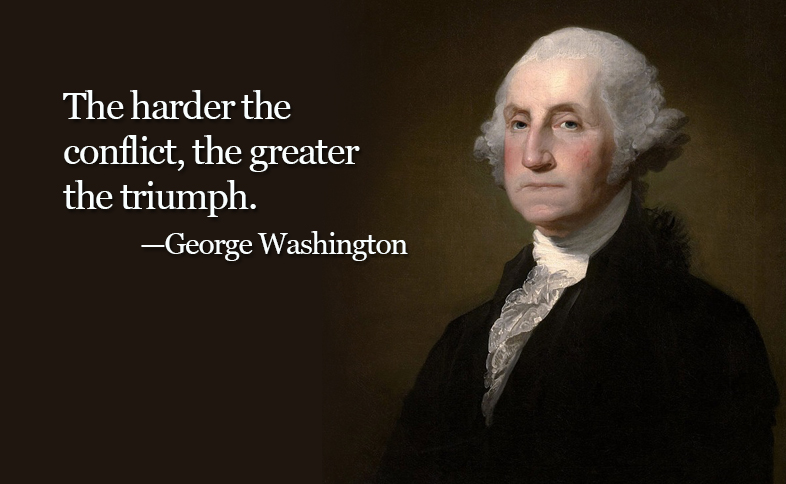
11. The harder the conflict, the greater the triumph. —George Washington

Photo of Dwight D. Eisenhower with a presidents day quote

12. Accomplishment will prove to be a journey, not a destination. —Dwight D. Eisenhower

13. Try and fail, but don’t fail to try. —John Quincy Adams

14. Peace is a journey of a thousand miles and it must be taken one step at a time. —Lyndon B. Johnson

15. One person can make a difference, and everyone should try. —John F. Kennedy

Portrait painting of John F. Kennedy with a presidents day quote

READ MORE ABOUT PRESIDENTS’ DAY:

Inspiring Her Man to Reclaim His Life

I lay in bed next to my husband listening to his labored breathing. Gilbert’s body had to work so hard even when he wasn’t moving. It was terrifying, not knowing if he would wake up in the morning.

Why wouldn’t he just listen to me? I’d tried every way I could think of to help, to save him from himself, but my pleas had only pulled us further apart. I admit, I badgered him about eating too much, too fast, all those fatty foods.

But what was I supposed to do? Gilbert weighed 700 pounds. That wasn’t just overweight. That was obese…morbidly obese. It was all he could do to get out every morning to his part-time job as a school-bus driver.

At night, right after dinner, he would collapse in bed. I’d tuck the kids in and spend the evening alone on Facebook.

We couldn’t go on like this. He was killing himself. And honestly, it felt like I was dying too. I was listless, depressed and short-tempered–at school, where I’m a teacher, and at home. I was just about to turn 40. I was too young to be a widow!

I didn’t marry a 700-pound man. Twenty years earlier, Gilbert had been a lifeguard at our town pool, tall, muscular, confident. I was a camp counselor.

One day one of my campers slipped and broke her leg. Gilbert took charge. He grabbed a broom, snapped it like it was a toothpick and splinted the little girl’s leg with it. My hero.

We started dating a week later. His dream was to become a Marine. I could picture him in uniform, strong, determined, charging into action, like that day he’d come to my camper’s rescue. He asked me to marry him right before he left for boot camp. I didn’t even have to think about it.

I was so proud to go to his boot camp graduation. Just a few months later, he blew out his knee during a training exercise at Camp Lejeune. He had surgery and came home to recuperate. I wanted Gilbert to know I’d always be there for him. That summer, about a year after we’d met, we got married.

Then came the phone call. He’d been declared unfit for duty because of his knee. He was being discharged from the Marines. Gilbert’s dream was crushed. So was he.

I ached for him. Still, I had faith that the confidence and determination I fell in love with would kick in and he would find a new purpose.

But Gilbert just got more and more down. He lay around staring at the TV, polishing off supersize bags of chips, ice cream by the quart. He put on a lot of weight. Getting a job as a truck driver didn’t help. He sat behind the wheel all day, gorging on fast food.

It was emotional eating, an attempt to fill the emptiness he felt at losing his dream. I understand that now. Back then, it frustrated me no end.

To get him to change his eating habits, get back in shape, I tried positive motivation: “Remember how great you felt when you worked out every day?” Guilt: “Don’t you want to set a good example for the kids?” Scare tactics: “Morbid obesity is the second leading cause of preventable death.”

I went on diets–it wouldn’t hurt to lose some weight myself, I figured–hoping he would join me.

Nothing worked. We fell into a toxic cycle–I’d try to “fix” him, he’d resist, we’d fight, I’d give up, then we’d start all over again. Things got worse when Gilbert lost his trucking job and no one would hire him. The only work he could get was driving the school bus 25 hours a week.

Here I was with two kids and a husband I was scared wouldn’t live to see them grow up. I lay there next to him and listened to him draw another ragged breath. God, I prayed, you know how much I love Gilbert. Help me help him. Just show me what to do.

I’d asked my Facebook friends for ideas to make my fortieth a memorable year. “Run a half marathon,” someone suggested. That was crazy. I was totally out of shape. I couldn’t run to my parents’ house, just 100 yards down the road.

Yet now the idea echoed in my mind, like a drumbeat. I wasn’t going to change Gilbert. I’d tried. And tried. The only life I could change was my own.

I started the very next afternoon when I got home from school. I pulled on a pair of shorts, a T-shirt and my old tennis shoes.

Gilbert was sitting on the couch watching TV. He didn’t even look up as I headed out the door in my running gear.

Halfway to my parents’ I bent over, gasping. My feet, my legs ached. I limped back home and snuck past Gilbert, glad for once that he ignored me. I can’t do this, I thought. I’m not a runner.

The next afternoon there was Gilbert plopped on the couch again, chowing down on a barbecue sandwich and fries. I couldn’t take it. I had to get out of there. This time I ran a little farther before I had to stop to catch my breath. At this rate, it’d be years before I could run one mile, let alone 13.1.

But I stuck with it. I found a book that combined a training plan for a half marathon with a Bible study. I even adopted a verse for motivation, Hebrews 12:1: “Let us run with endurance the race that is set before us.”

Over and over I repeated that verse, going a little farther every time. It took me a month before I could run an entire mile. The second mile came easier, though. The third, easier still. But how was any of this helping Gilbert? He barely seemed to notice that I was gone longer and longer on my runs.

In December 2011, six months after I began training, I ran my first half marathon. Everyone, my parents, the kids, even Gilbert, came to cheer me on. I started off well enough, but around mile 9 my legs started feeling like Jell-O. By mile 11, I could hardly put one foot in front of the other.

Runners blew past me. A young woman with a bouncy ponytail went by, not even breathing hard.

I felt so discouraged I almost stopped right there.

Then my eyes caught the words on the back of her T-shirt: You’re not finished with this race. Hebrews 12:1.

If that wasn’t a message meant for me, I don’t know what was.

I took a deep breath. Run. I willed myself to keep going, step after step. Run with endurance.

I surged across the finish line. My kids jumped up and down, cheering. Mom flung her arms around me. My moment of triumph. Except for…

“Where’s Daddy?” I asked my daughter.

She pointed to a parking lot at the top of a hill. I could just make out our car, parked in the front row. “It was too far for him to walk,” she explained. I waved. I saw Gilbert lift his arm with great effort and wave back.

I set a new goal: run a full marathon. My training went great. My marriage, not so much. Gilbert was killing himself and it was too painful to watch. For spring break I took the kids and spent a week at my parents’ house. I needed to get away and think.

I confided in my mom. “I love Gilbert. I don’t want a divorce. But I can’t live with him like this.”

“Love is patient,” Mom reminded me. “Marriage is a long haul, kind of like a marathon.”

That made me think of the race I’d run. How I was about to quit until that young woman with the Bible verse on her shirt passed me, the very same verse I’d claimed for myself.

I’d thought God sent me a message to help me with that race. But it went way beyond that. It was a message about my marriage. You’re not finished. Run with endurance.

The kids and I went home. Okay, God. I’ll be here for Gilbert whenever he’s ready.

Not long after, I got a text from Gilbert while I was at school: “Pls call.” I did. “I need you to get all the food out of the house,” he said. “I’m going on a three-day fast. I don’t want to get into it right now, I just need you to help me.”

The kids and I threw out all the junk food. The rest, we loaded in the car and took over to my parents’. That night, instead of collapsing in bed, Gilbert sat up with me and we talked.

“That week you and the kids were away, I did a lot of soul-searching,” he said. “I’m not the husband or the dad God wants me to be. That I want to be. I have to lose weight.”

I grabbed his hand, almost giddy with relief. “I’ll help you any way I can.”

“You already have,” he said. “You didn’t give up on me or our marriage. I see how you’ve changed. I want to change now, and with God’s help and your support I will.”

The next day he walked from our house to our mailbox at the end of the driveway, about a tenth of a mile. It was torture for him. But he stuck with it. Just as he stuck with smaller portions and healthier foods. “It took me years to gain this weight,” he told me. “It’ll take me a long time to lose it. But I will.” I loved his confidence and determination.

That December, I ran my first marathon. There at the finish line was Gilbert, helping out as a race volunteer, giving out medals to all the runners. He draped my medal around my neck and I wrapped my arms tightly around him.

Today, a year later, Gilbert has lost more than 300 pounds. He walks four miles every day and volunteers as an equipment manager for the high school football team. And he’s training to be a volunteer firefighter. My hero.

Download your FREE ebook, Paths to Happiness: 7 Real Life Stories of Personal Growth, Self-Improvement and Positive Change

Inspiring Filmmaker Crystal Emery Is Redefining What’s Possible

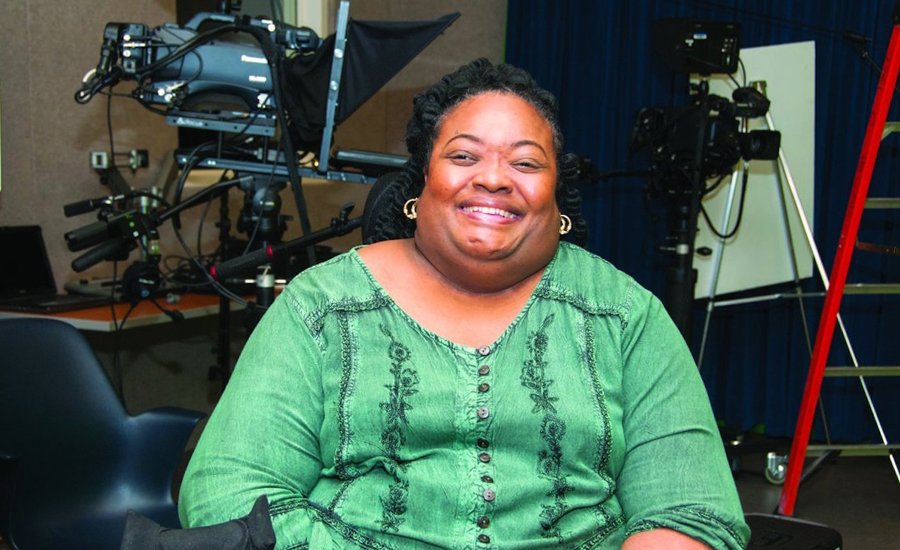
Crystal Emery is an award-winning filmmaker, an author, an actress and a playwright. She also lives with an incurable illness that has left her paralyzed and in a wheelchair for the last 14 years.

These challenges have not kept her from pursuing her purpose, and her latest documentary, Black Women in Medicine is evidence of that. At the time Guideposts.org caught up with Emery, Black Women in Medicine was being released in New York and L.A. to critical acclaim. The inspiring documentary traces the history of Black women in the medical field and all of the obstacles they overcome in pursuit of offering health solutions to the masses.

“I wake up every day and I love what I do,” Emery tells Guideposts.org of why she, like her documentary subjects, keeps going, despite challenges. “And I also love life. When you think of love as being unlimited bliss, then nothing is impossible.”

Her limitless positivity is how she devised a plan to pursue filmmaking, even as she could no longer use her hands.

“It takes a lot of people to move this show,” she shares. “For example, we filmed [Black Women in Medicine] in Washington, D.C. I had to rent a hospital bed, and a Hoyer lift, and had to bring three people because it takes three people to get you out of the wheelchair safely and onto the Hoyer lift to the hospital bed. It takes a lot of effort. I’m not functioning on my own. I can’t use a fork; I can’t wash my face, or wipe my tears, or blow my nose. I have a serious support team.”

Even as a young child with an undiagnosed and debilitating genetic disorder, Emery still chose joy. She had a passion for acting, and wrote and directed her first play in the fifth grade. But in the sixth grade she began experiencing physical complications. She started falling down often, even knocking her hip out of place and being in a body cast for three months. But her left leg never healed properly.

Like this article? Sign up for “Your Weekly Inspiration”, a weekly newsletter of Inspirational stories of hope and faith – Click Here.

“People were saying, ‘Oh you’re lazy,’” Emery shared about the difficulty she had being active after the accident. Still, she maintained her passion for drama, theater and film, even as she began falling down again at the end of her high school years.

“Eventually, [when I was in college,] I went to a neurologist who said, ‘I think you have Charcot-Marie-Tooth (CMT) [disease],’” she said, a an incurable degenerative nerve disease and form of muscular dystrophy that causes muscle weakness and paralysis.

“It wasn’t until the disease started getting worse and I couldn’t act anymore that I thought about directing,” she says of her evolution into filmmaking. “One thing lead to another, and I was working with [famed director and Yale Drama dean] Lloyd Richards and [Pulitzer Prize-winning playwright] August Wilson on Fences, and I met [actor/director] Bill Duke. That’s when I said, ‘You know what, film is what I really want to be doing.’”

At the time, there wasn’t much known about the disease and Emery didn’t know to fear it.

“I didn’t know I was disabled, until I got the wheelchair. I put on a leg brace and kept running around the world,” she said. “Did I know I was going to be a quadriplegic? Never in my wildest nightmare.”

The genetic disorder that would paralyze her body and confine her to a wheelchair progressed slowly.

“It became harder and harder to walk in the late 90s. By 2002, I was using a wheelchair, but I could still use my hands. And then I got really sick and my hands became paralyzed.”

That wouldn’t stop her from a near-30-year career in the arts, producing more than 20 plays, directing several video series and two full-length documentaries, and writing three books.

“When I wrote my first book about my grandmother, real friends volunteered one day a week to come type for me. And through that process, I learned that I could create and write again, [despite CMT].”

Her village of helpers continue to support her as she pursues more of her dreams.

The day Guideposts.org spoke to Emery, a tragedy had just struck a close member of her family. Still, Emery has managed to maintain the same inspiring level of optimism that her films possess, even as her topics highlight the ugliness of racism in America.

“That’s how I am,” Emery said of her positive attitude. “I want my experiences to expand who I am, not contract. That’s how I’ve always been.”

Inspiring 78-Year-Old Grandmother Sets Lifting World Record

Seventy-eight-year-old Nora Langdon has become an inspiration to people of all ages. The grandmother of one spends multiple days a week at the Royal Oak Gym, near her home in Michigan, training for lifting competitions by doing bench presses, squats and deadlifts for three hours at a time. She turns to prayer as a form of encouragement during her workouts.

“When I squat this is what I say: ‘Holy Spirit fall on me,’ and I just do it and I come right on up,” she told the Fox affiliate in Detroit, Michigan.

At the age of 65, Langdon was determined to live a healthier lifestyle. In 2007, she weighed over 210 pounds and often struggled to catch her breath while going up the stairs. She knew it was time for a change.

Nora Langdon in the weight room

“On the first day I started [going to the gym], I went home that night and told myself that I’m never going back again because it was too much for me,” Langdon told Good Morning America. “Then I heard a voice saying, ‘go back.’ So, I went back and here I am today.”

After joining the gym and watching her trainer prepare for a powerlifting meet, she attended his competition and decided to try it herself. She began with the basics—using a broom as a barbell before eventually moving to weights. It wasn’t long before she discovered lifting was her passion.

Langdon has since set 19 world records and quickly became one of Michigan’s best in her age range. She can deadlift 400 pounds, squat 380 and bench press up to 185.

Although Langdon has won 20 of her powerlifting meets and has state, national and world records under her belt, she shows no signs of stopping anytime soon. Her next goal? To powerlift a total of over a thousand pounds, according to her trainer, Art Little.

“She’s really been an asset to the gym, and to me, and to the whole powerlifting field,” Little said. “To see somebody at that age doing what she’s doing it’s a blessing.”

She wants others to know that with motivation and strong faith, anyone her age can get into shape. “You were born to continue until the Lord takes you away,” she said. “Your body was made to exercise and you have to keep it moving in order to stay healthy.”

Inspired to Walk Again

My dad is old school. When he wants to send me something important, he still uses the postal service. One day earlier this year, I opened an envelope to find a note neatly typed on his law-firm letterhead.

Enclosed find a recent Star Ledger article with regard to Rutgers football player Eric LeGrand that I thought may be of interest to you and Guideposts. Love, Dad.

I wasn’t surprised he’d sent a story about football. We both love the game and Dad’s the one who convinced me to try out for my high school team. I’ve written in Guideposts before about how proud he was of my accomplishments on the field.

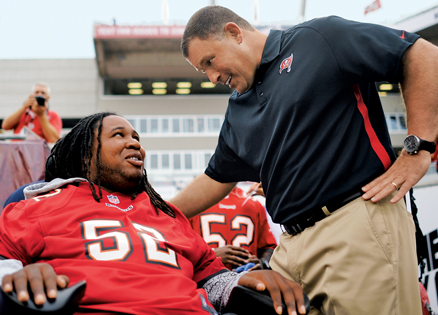
At the top of the article was a photograph of Eric—a big, dreadlocked 21-year-old, strapped into some kind of workout apparatus, his left arm in a sling, hung by taut cords attached to a pulley above.

He looked determined; his eyes fixed intently on his arm, as if the power of his mind, not his muscles, would get it to move. That’s when I remembered: The Rutgers vs. Army football game at the New Meadowlands Stadium, October 16, 2010.

Rutgers had just tied it, 17-17, late in the fourth quarter. On the ensuing kickoff, the teams streaked toward one another. Eric went in for the tackle, smashing helmet first into the returner’s shoulder. Both players sprawled out on the turf near the 25-yard line.

The Army player rose, slowly. Eric didn’t. It seemed like the entire crowd held its breath, thinking, Get up. Jog back to the sideline. Trainers huddled around the motionless player, and the commentators spoke in hushed tones.

The collision had fractured Eric’s C3 and C4 vertebrae, paralyzing him from the neck down. Doctors estimated that Eric had less than a five-percent chance of regaining any motor function—much less be able to walk again.

I edit Mysterious Ways and am constantly on the lookout for miracle stories. But what miracle could there be for Eric? Two years after his injury, he’s bound to a wheelchair and depends on his mother and a nurse for his basic needs.

It can take up to two hours to get him out of bed, showered, dressed and into his wheelchair to start the morning. When his nose itches, he can’t even scratch it himself.

And yet, the article Dad sent told a different story. Here was Eric, looking indomitable in one photo, joyful in the next.

Pushing through experimental rehabilitation therapy. Commentating on a Rutgers game from the press booth. Talking to kids at schools across the country. Sending daily messages to more than 120,000 followers on Twitter.

He’d even been signed to a brief, but real NFL contract with the Tampa Bay Buccaneers by Coach Greg Schiano, who’d coached him at Rutgers. “The way Eric lives his life epitomizes what we are looking for in Buccaneer Men,” Schiano said.

Dad was right, I was inspired. But I still wondered, how could Eric keep hoping for that impossible miracle: to walk again?

I reached out to Eric, but my call went straight to his voicemail.

“This is Eric LeGrand. I want to leave you with a quick message before you go. Never take anything for granted. Each day is a gift. It is a prize of its own. You have to go out there and receive it and enjoy it to the best of your abilities. That’s what I do every day of my life. And always remember: Believe.”

Eric called back a moment later. It was just before his Wednesday rehab session. It’s a serious workout. He straps into specially designed harnesses and electrodes that send the electrical impulses to his muscles his nervous system can’t.

He spends half an hour on a treadmill, then half an hour on a mat, working to balance himself and sit up. He wraps up with an hour on an arm bike, retraining his upper body to move. I asked him about his voicemail message, the word “believe.”

“I believe that everything happens for a reason,” Eric said. “That God is working a miracle through me. Because of all those times I was praying when I was on my deathbed. And the answers God gave me.”

In his first months at the hospital, a ventilator and a feeding tube kept him alive. Doctors said he’d never breathe again on his own. The noise of the machines kept Eric up, and he lay there at night wondering if he’d survive.

“Those months, I just prayed Psalm 23 with my aunt all the time,” Eric said. He found comfort in the messages he got from teammates, friends, fans, even perfect strangers. “I became determined to get off the ventilator,” he said.

Finally, Eric convinced his doctors to let him try to breathe without it. “They told me I wouldn’t last more than a few minutes,” Eric said. “First time I came off I lasted an hour and a half. I knew right then there’s a plan for this whole thing.”

The miracles Eric experienced next were like that—not parting-of-the-Red-Sea-huge, but no less significant. At first, doctors found no muscle response in Eric’s lower body. But in rehab, a needle-prick test caused Eric’s muscles to contract, showing the paralysis was not total.

He once couldn’t sit without toppling over, but he slowly built upper body strength and can now sit up for as long as 15 minutes. He can shrug his shoulders, twitch his biceps and triceps, and even move one of his fingers the tiniest bit.

In May, an electromyogram test showed, for the first time, that some nerves in his spine were sending signals below the level of his injury.

“I can see the progress,” Eric told me. “So how can I not believe miracles can happen?”

Delivering that message is what Eric believes God wants him to do. He wasn’t sure he could. But a visit to a middle school in Jersey City changed his mind.

“You know how middle school kids are; all laughing and jumping around,” Eric said. “But you could hear a pin drop when I spoke. I could tell I was making an impact.”

Afterward, a boy walked up to Eric. “I’m blind,” the boy said. “What advice do you have for somebody with a disability like me?”

A tough question. Recovery from paralysis is rare, but recovering sight, even rarer. How could Eric tell him to just “believe”?

Eric answered from the heart. “You still need to strive,” he said. “You still have a voice, you can still hear, you can still feel. You may not be able to see the world, but you can still affect it in many different ways.”

That’s what Eric has done. He hasn’t stopped pursuing his goals. He’s on track to earn his degree at Rutgers in labor studies in 2013. He always imagined a career in broadcasting after football, and now he hosts a daily radio program and works the pre-game show at Rutgers games.

He’s been contacted about opportunities with ESPN, Fox Sports, ABC and others. He is motivated by faith. That was the answer to my question, the reason my dad sent me the article through the mail.

“When you’re right in the middle of it, it’s hard to see things are going to work out,” Eric said. “But when I get to that light at the end of the tunnel, it’ll all be worth it to look back and say I never gave up.”

He sees his ultimate goal so clearly. He’s back at the Meadowlands, on a beautiful, warm day. In the stands, chanting his name, are his mother, Coach Schiano, friends, relatives, teammates, doctors, nurses, rehab therapists, all the people who supported him.

Eric emerges from the tunnel, standing tall. One foot in front of the other, he walks onto the field. The crowd roars.

Then he reaches that spot near the 25-yard line, the spot where it happened. He suddenly stops—and lies down on the grassy turf. Motionless. The crowd quiets, like they did on that October day.

Eric lies there and stares up at the blue sky. A sky he wasn’t sure he’d see again, when he was stuck in that hospital bed, the ventilator breathing for him. He thinks about the inches, the seconds, the twitches that he celebrated throughout his long rehabilitation. Tiny pieces that added up to a big miracle.

He takes a deep, sweet breath, remembering the power that kept him from giving up—a power greater than fear, than doubt, than the limits of the human body or even the breakthroughs of modern medicine. Then Eric smiles, stands up and jogs to the sideline.

Download your FREE ebook, True Inspirational Stories: 9 Real Life Stories of Hope & Faith

Inspired to Find Her Own Groove

The moment Dwight’s name popped up on my caller ID, my stomach clenched. We’d been dating for more than a year and were going out to dinner Friday night. I knew exactly what he was going to ask. How am I ever going to get out of this?

“Hello,” I said, trying my best to sound relaxed.

“Pick you up around six?” he said. The words I’d been dreading.

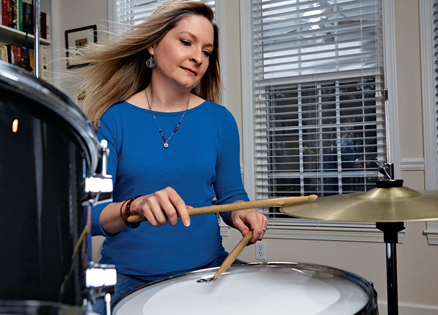
I glanced over at the bulky shapes in the corner of my living room, wedged in next to the dust-covered piano nobody played. A brand-new full set of drums. What would Dwight think of this?

“Or I could just meet you there,” I said hastily. “No reason for you to come all the way out here.”

Silence. Dead silence. My heart was beating like, well, you know. “All right,” he said finally. “But I don’t mind. Wouldn’t you like it if I picked you up?”

“Of course!” I said. I was really crazy about Dwight. He’s an engineer—a sensible, stable guy, someone I could always count on. The opposite of my off-the-wall decision with the drums. “Just not this week. If that’s okay.”

Finally he agreed. I stared at the drum set. What was I thinking? Middle-aged women don’t take up drumming. Maybe painting. Or tennis. Gourmet cooking. Yoga, sure. But not drumming. Definitely not drumming.

It had been embarrassing, the looks I got at the music store when I confessed the drum set was for me, not my kids. Me, a divorced single mom.

There were so many other things I needed to be doing—painting the back porch, writing my novel, catching up on my Bible reading. The laundry, for goodness sake. Sane, constructive activities, like I’d done my whole life.

But worse than that, even after weeks of lessons I was a total flop. Completely uncoordinated. Unable to sustain the most basic beat.

Besides my daughters and my dad, I hadn’t told anybody my strange secret. I knew as soon as word got out people would think I’d lost it. Dwight especially. Even God was probably up there somewhere shaking his head. Or more likely covering his ears.

“This isn’t the talent I gave you,” I could imagine him saying before unleashing a thunderbolt.

But here was the thing. Ever since I was a little girl I’d thought the drums were really cool. My dad had been the leader of a band called the Orbits, and his tales of their gigs around Tuscaloosa, Alabama, had captivated my fertile young imagination.

What could be more awesome than throwing down a backbeat or knocking out a perfect roll, my hands barely visible, just a flurry of motion and that pounding, primal rhythm? Beyond awesome, probably the coolest thing I’d ever do.

If only I weren’t such a klutz. That’s what had always held me back. As a teenager I was constantly dropping things, running into walls and furniture. That’s why my dad had jokingly nicknamed me Grace. Drumming, I knew, required coordination. I was afraid to even try.

Instead I shelved any thought of playing the drums and focused on what I was actually good at. Writing. I loved writing about people who took risks, huge leaps of blind faith. But in those stories no one ever looked like a flop or a fool.

So why had I gone and done this now? Was it some sort of midlife crisis? A need to prove my independence? I’d told myself it was research for my next novel, whose main character was a girl drummer.

I didn’t have the answer. Really, what was the plan? I was never going to be one of the cool kids.

At first I was just going to take lessons without telling anyone. I signed up at the music store at the end of the summer and my teacher patiently showed me how to hold the drumsticks, read music and keep time. Then we moved on to actually drumming—four beats to a measure, over and over. Right, left, right, left.

Simple, no? Not for me. I flailed about like I was swatting bees. “It’s okay, you’re just starting,” Chris, my teacher, said. “And the drums require more grace than any other instrument. You’ll get better the more you practice.”

Grace? That was me all right! At first I didn’t have a drum set, so I arranged pots and pans on the kitchen table. Big mistake. The girls peered at me from the hallway, their hands clapped tightly over their ears. “Mom! Stop!” they groaned. “That sounds horrible!” They were right.

I should have quit right then. But something wouldn’t let me. Persistence or obstinacy, I couldn’t tell you. I broke down and paid $425 for a drum set. Daddy was thrilled when I told him. He came over that very afternoon to help me set it up.

“Drumming is like rubbing your head and patting your tummy,” he said, as he fastened a leg onto the bass drum. “You’ll get the hang of it.” Minutes later he sat on the stool and laid down a groove from the old days.

I watched him rock back and forth, flawlessly alternating the high hat with the bass. I swayed to the beat. Why couldn’t I do that?

At my next lesson I worked on coordination exercises, repeated movements with my hands and feet. Left, left, right, right, left right… Rub your head and pat your tummy? Was Daddy kidding? Why not twirl flaming batons while I was at it?

I couldn’t help but laugh at my clumsiness. Chris laughed too. But it was a kind, understanding chuckle.

“Seriously, am I the worst student you’ve ever had?” I asked, after blowing a pattern. Again.

“Uh, no, I wouldn’t say that,” he said.

“You don’t sound so sure,” I shot back.

He smiled and pointed to the lesson. Sigh. Left, left, right…

I practiced the drums every morning. By then the girls were in school and I could pound away without assaulting anyone’s ears but my own. Chris had taught me a few more backbeats and fills. I went over them again and again. And every so often, when I actually kept a rhythm for just a few beats, I felt like Buddy Rich.

Funny thing about drums: They’re loud. Really, really loud. Bold. Daring. Not like me at all. There was something incredibly freeing about that. Exhilarating. I could feel something in me shaking awake, coming to life.

After practice I rushed to my computer, my mind overflowing with plot points and dialogue, description and character development. A story about a teenage girl who just happens to be one terrific drummer.

Still, my playing had barely progressed at all. I couldn’t hold onto my secret much longer. Dwight was starting to wonder what was going on. Finally, I relented and let him pick me up for our next date, the following Friday.

That night I held him at the door for as long as I could, then said, “Close your eyes. I have a surprise for you.”

I took his hand and led him into the living room. I took a deep breath. Please, don’t let him think I’m a total dork, I prayed. Could I really do this? Did I have a choice? “Okay, you can look,” I said.

He opened his eyes and caught sight of my drum set. “Wow!” he said. “That’s soooo cool.”

He sat down and held the sticks in his hands. Then he pounded out a perfect backbeat.

“You never told me you played the drums,” I said.

“I don’t,” he said. “I was just messing around. Here, you play something for me.”

I wanted to die, right then and there. “No way,” I said. I sat on the couch and covered my face with my hands.

“What’s the matter?”

“I’ve had like a dozen lessons and I still can’t do what you just did,” I said. “I’m awful. I’m always going to be awful. That’s why I didn’t want you to know.”

He didn’t laugh. He didn’t say anything. Slowly I pulled my hands away from my eyes.

“Okay,” he said. “But are you having fun? Do you like playing the drums?”

Fun? What did that have to do with anything? Wasn’t the point to be good at it? All those mornings practicing. Those fleeting moments when I actually nailed a backbeat. The sizzle of the ride cymbal. That deafening, cacophonous sound of me pounding away, oblivious to everything around me.

Fun? It was a blast! The coolest thing I’d ever done. A joy that went beyond awesome, that could only come from…

Maybe God wasn’t covering his ears at my playing after all. Did I dare believe he might actually be urging me on by making me so stubborn?

“I know this sounds crazy,” I said, “but I really do like it. I like it a lot.”

“Well, then, you should keep doing it,” he said. It all sounded so simple and sensible when he said it. Like always.

One day I hope to be able to play an entire song. But until then I’m happy to groove to my own beat. It’s not a secret anymore. No one seems to care that I’m a terrible drummer. They get a kick out of how much fun I’m having.

I finished writing my novel. “I didn’t know you were a musician,” my agent said after she read it. Ha! The biggest thing I’m working on now is planning my wedding. It turns out Dwight didn’t think I was a dork at all. Funny thing about dreams and grace. You never know where they’ll take you. But God does.

Download your FREE ebook, Creativity and Personal Growth: 7 Inspiring Stories On How Crafts Can Change Your Life

Inspired to Craft Comfort

Over dinner, my wife, Jan, and I always talked about our day. Lately, though, our evening talks made me frustrated.

“A woman came into the ER with shortness of breath,” Jan said. Jan had been a cardiac nurse for 10 years. She recognized the warning signs of congestive heart failure. “The patient got to us just in time,” Jan said. “What about you? How was your day?”

“Nothing worth mentioning,” I said, looking down at my plate and rearranging my food with my fork. Jan had made a difference. And with someone’s life. I’d spent the day doing window treatments. Wasn’t there a more fulfilling way for me to help people?

The next day I drove downtown to run some errands. Asheville was a small, artsy town nestled in the Appalachian Mountains. The shop windows were filled with crafts for sale. Especially angels. Anyone could see how popular they were.

I could make angels too, I thought. Really unique angels.

That night Jan and I sat out on the porch swing. I listened to the crickets, watched some lightning bugs shoot across the yard. “I want to start making angels,” I blurted out. “Lots of shops carry angel stuff. The market must be huge.”

Jan rocked the porch swing back and forth with her feet. “You think you can make something beautiful?” she asked.

“I don’t know,” I admitted. “But I’ve got to find meaningful work. I want to touch people. Comfort them. Inspire them. I’ve at least got to try.”

We organized a workplace in the basement, and eventually I came up with a figurine that actually sold locally. I expanded to other towns, and set up shop in an actual studio. I hoped my angels were doing what I intended, but I had no way of really knowing.

One Saturday after working all day, I flipped through a trade magazine. It featured a piece on antique sheep figurines from Germany. The figurines were made of simple materials, like porcelain and real wool, the article said.

Sheep, I thought. There was something so innocent about them, so pure, so…comforting.

“Sheep?” Jan said when I told her about them later. “You want to go from making angels to making sheep?”

“There’s something about them,” I said. “I don’t know, maybe it is crazy.”

“Well,” she said, chuckling, “you certainly won’t have any competition in the marketplace.”

She was right. I had never heard of a modern-day artist who specialized in sheep!

After several weeks researching and tinkering in the studio, I finally had a few sheep figurines I was happy with. I headed for a shop in town. “Nice to see you, Colin,” the owner said. “But we don’t need any more angels yet. I still have a few left to sell.”

“Actually I’m here about my new line,” I said. I handed her one of my new creations.

The shop owner put on the glasses that hung by a chain around her neck and took the sheep figurine from me. “It’s got a nice hefty weight to it. And is this real fur?”

“It sure is. I use wool, mohair and alpaca.”

“You know, I have a girlfriend going through a divorce. This may be just the thing.”

Soon my sheep were selling as well as my angels. One day I got a phone call in my studio. “You don’t know me,” a woman said, “but I bought one of your sheep.”

“I hope there isn’t a problem,” I said. No one had ever called about one of my angels, and I was every bit as careful with my sheep.

“Oh, no,” the caller said. “My mother’s in the hospital recovering from surgery. The room looked so bare until I put a sheep by her bedside. Now every time she looks at it, she smiles. I think it really makes her feel better.”

That was my first contact with a satisfied customer, but not the last. There was the man who ordered some sheep to be used as models for the person carving his wife’s gravestone. The woman who bought six sheep and found herself actually playing with them like a child.

“I’m forty-five years old!” she said. “But every time I touch these sheep I feel so happy.” Every time I heard one of these stories, I thanked God for letting me know that my work had made a real difference in someone’s life.

It’s been almost 20 years since I made the leap to sheep figurines. Now I also make pigs, lions, bison, Nativities and even an angel, but sheep are by far the most popular.

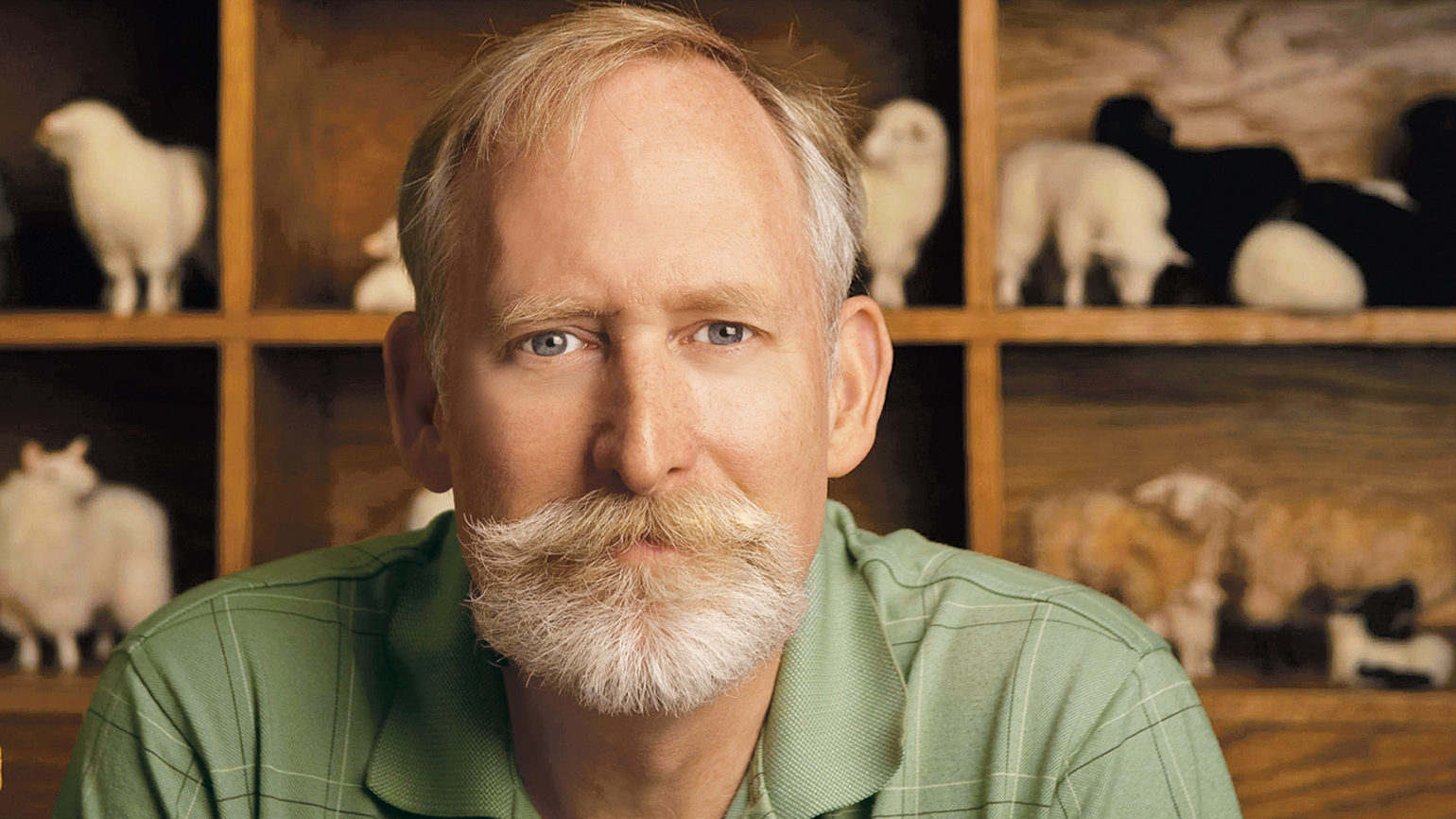
I’ve traveled to more than 11 countries to study sheep, and make over 60 different breeds. I never get tired of hearing how much comfort and joy my collection, Colin’s Creatures, brings to my customers, and I never get tired of thanking the angels that led this shepherd to his flock.

Take a video tour of Colin’s studio.

Download your FREE ebook, Angel Gifts: Inspiring Stories and Angel Crafts to Nurture Your Creativity