Embrace God's truth with our new book, The Lies that Bind

How Vision Boards Help You Live a More Purposeful Life


Write the vision / make it plain / that they may run and not faint

I didn’t understand the depth of the lyrics to gospel singer Patrick Love’s hit song “Write the Vision,” when I was a kid in the 90s listening to the song on repeat in my mom’s minivan. But as one who loved to write stories and songs, I knew these lyrics were special. They were evidence that the words I loved so much had power, and that God had made it that way.

Pray A Word a Day - 2023 In article

As I grew in my understanding of God and found the inspiration for my favorite song in the Bible, Habakkuk 2:2, I realized even more the power of words and having a vision. God spoke “Let there be light,” and light came into existence. Since I’m made in God’s image, I began to connect the dots, that the stories and songs and words I write can also bring to life a vision God gave me.

Start each day with encouragement for your soul. Order Mornings with Jesus 2019

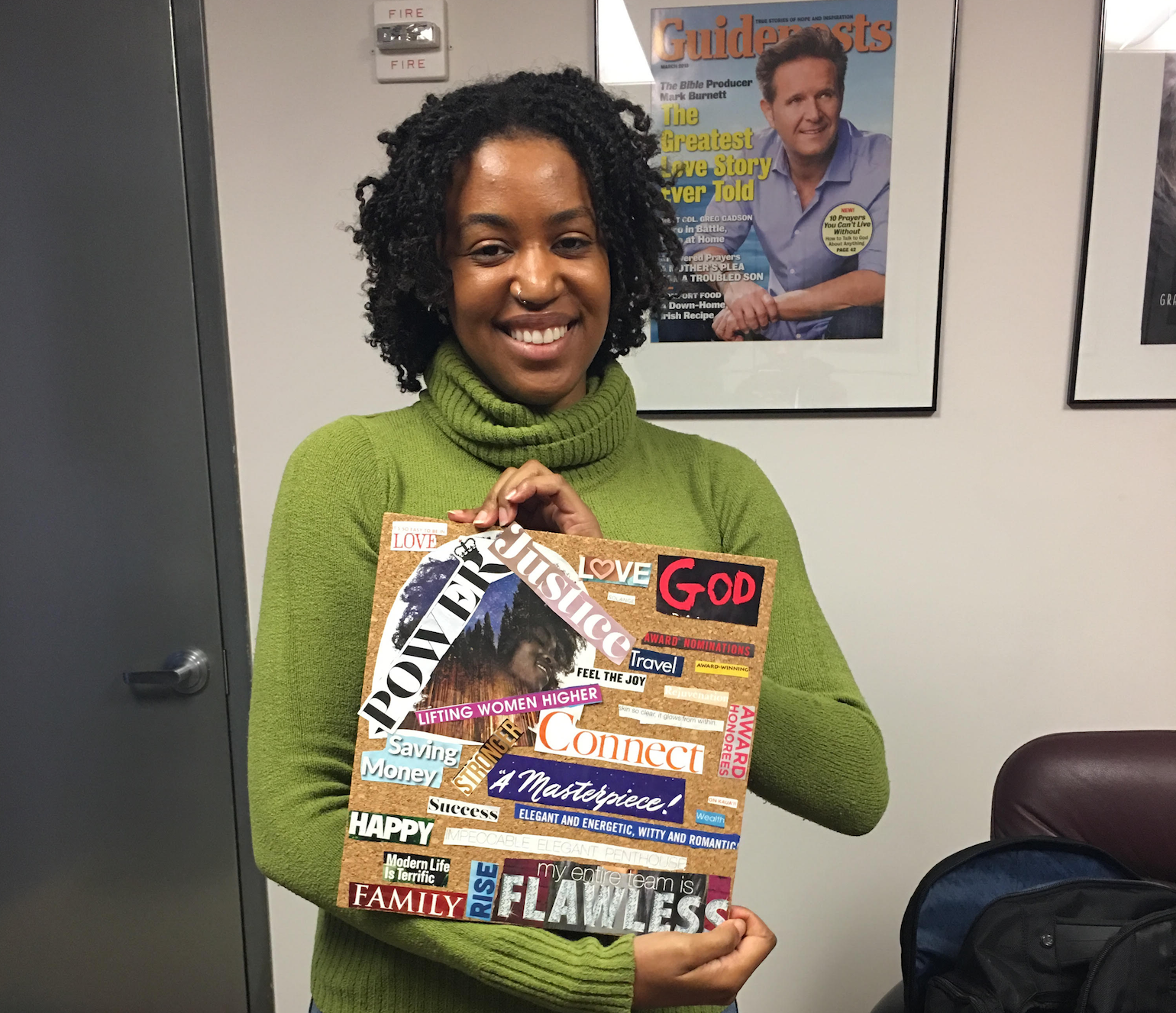
Now, I make it habit at the start of every new year to cut out images and words from magazines and tack them onto a cork board. These words and images express my vision for the next year. In addition to words like “More God,” and “Close Family,” I cut out words that define what I want in my professional life, as well. When I was preparing to publish my debut novel, I cut out the words, “award-winning.” A year after I published my book, it won two awards for best fiction!

Another goal I put on my board from 2015 seemed completely out of reach: a sit-down interview with Oprah. As a professional writer, I’ve

          Brooke Obie’s 2015 Vision Board

interviewed all kinds of celebrities and notable people, but interviewing the queen of media just a few years into my career as a professional writer seemed completely out of my reach. I cut out the words, “The Oprah Interview!” and “Oprah Sits Down with Brooke” anyway. And since I was reaching for the moon, I cut out an image of Oprah holding a serving tray from O! Magazine that said, “Summer at Oprah’s” below it and added that to my board, as well.

Fast-forward to 2017 and I received an invitation to interview Oprah about her HBO film, The Immortal Life of Henrietta Lacks, for Guideposts.org! I could hardly believe it. She was so incredibly kind and lovely, and our brief 20 minutes together had me floating on Cloud 9 for days after. I was completely satisfied if I never saw her again, and fully convinced: words are powerful!

But, God wasn’t done bringing my vision to fruition. Just a few months later in October, I received a phone call from Oprah’s Super Soul Sunday crew inviting me to interview her again…at her home! The occasion was her book launch party, The Wisdom of Sundays. Oprah did indeed “sit[ down with Brooke” at a lovely, wood roundtable under oak trees down a short cul-de-sac on her property nicknamed “The Secret Garden.” It wasn’t “Summer at Oprah’s” since it was October, but it was 80 degrees outside! If ever I needed a reminder that with God, nothing and no one is out of my reach, I received the message loud and clear that day.

The images on my vision board didn’t all manifest right away; “Summer at Oprah’s” didn’t happen until 2 years later! But in the time since I’ve been vision boarding, I’ve learned 3 ways vision boarding can help you live a more purposeful life right now.

1) A Deeper Understanding of What Your Purpose Is

When you’re deciding which words, phrases and images to cut out, think about how you want to feel and who you want to be and how those things align with who you know God wants you to be. Instead of cutting out money bags or dollar signs, cut out things that represent the fruit of the spirit: “love, joy, peace, patience, kindness, goodness, gentleness and self-control.” The more specific you can be when creating your vision, the better. One of my favorite phrases on my last vision board is “Okay with your criticism,” which I’ve taken to mean that I can hear criticism (constructive or otherwise) without internalizing it and making someone else’s criticism a part of how I think about myself. This is crucial because, as the vision board practice teaches us, how you think about yourself determines what you will do next. So, once you have the words and images that define your vision for who you want to be and who God wants you to be, you’ll have a clearer picture of what your God-given purpose is.

        Brooke Obie and Oprah Winfrey, 2017

2) A New Sense of Responsibility

The vision boarding process doesn’t end once you’ve attached your cutouts to a board. Hang the board someplace where you will see it frequently, providing you with a constant reminder of the decisions you’ve made about who it is that you want to be. Often, we pray to God for the changes we want to make in our lives, but prayer alone is not enough. I didn’t just cut out the words “award-winning novel,” put them on a board, pray about it and watch the awards roll in. I had to write and publish a book, get publicity for it and submit the book for awards consideration. The board is just a reminder of what our God-given vision is. It’s up to us to take the necessary steps to bring that vision to fruition. When we see our lives, our hopes and dreams as something we’re responsible for creating with God, we can get into gear and start doing the work necessary to help God manifest those things in our lives. Don’t just cut out “peace,” for your board, talk to a therapist about what’s taking your peace away and work on solutions to get it back. Don’t just cut out “kindness,” evaluate your life and the way you have been unkind to others and even how others have been unkind to you. Write out a plan of action for how you plan to be kind and experience more kindness in your own life.

3) A New Definition of Life

Best-selling author, producer and preacher DeVon Franklin gives a sermon where he encourages listeners to think about the word “deadline” in a new way. Instead of this looming date on a calendar that fills you with fear and anxiety, he suggests we use the word “lifeline,” instead, because when we’re working on goals that move us toward our life’s purpose, the process renews us, enriches us and gives us more life. It’s the same with your vision board. In Proverbs 29:18, King Solomon writes that “without a vision, the people perish.” When we continue to go through life with our actions unattached to our God-given purpose, we’re directionless, full of deadlines, our unfulfilled potential dying inside of us. But when we connect our goals to the greater purpose of who God has called us to be, we have a vision for ourselves that gives us new life and a new definition of what it means to live. We’re not dreading Monday mornings at work because we can see a deeper purpose in the work we’re doing and the mark we’re pressing toward. When you feel purposeful, you feel more hopeful and at peace and can tap into that more abundant life that Jesus promised us.

How to Worry Less and Trust God More

I was doing my usual morning run in my New York City neighborhood a couple of days ago, and as I passed a streetlamp, I noticed something on it that said, “FBI.”

Oh, no, I thought, the FBI is trying to investigate some crime in the neighborhood. A killing perhaps? Some violence on the subway? Some criminal activity that I hadn’t heard about yet? Oh, dear. Something else to add to my worry list. 

New Every Morning Journal In Article Ad A

Yes, the news is full of stuff to worry about. Diseases, natural disasters and dire reports can allow worries to take overif you let them.

But let me go back to what Jesus said about worry (something I have to remind myself of again and again and again—that’s probably why they say that the well-worn Bible usually belongs to someone who isn’t worn out).


“Can any of you by worrying add a single hour to your life?” Jesus asks. And later observes, “Therefore do not worry about tomorrow for tomorrow will worry about itself. Each day has enough trouble of its own.”

It’s only natural to worry and Jesus understands that. The ability to think ahead is what differentiates us from God’s other creatures and makes us capable of planning. But in the end, much is still outside our control.

So instead of giving myself a Ph.D for worrying, I’d like to be an amateur at it again. Like those birds of the air and the lilies of the field. That’s why in my prayer practice, I make a point of noticing my worries and then giving them back to God.

That includes worrying about a pandemic. Taking care of myself. Washing my hands well as is advised. “For as long as it takes to sing ‘Happy Birthday,’” a colleague noted. But not sending my brain up and down dreamed-up scenarios.

Let me go back to that notice about the FBI that I saw on the streetlamp. Remember where my mind went? All those terrible things I thought.

Guess what? Today when I ran by those signs, I understood why they said FBI. Trailers had been set up, big trucks had moved in, film crews were transporting carts of lighting equipment and long cords.

They were shooting an episode of a TV show called FBI.

Tomorrow indeed will worry about itself.

How to Wash Your Hands with Prayer and Song

When it comes to warding off germs, you’ve probably heard the advice that we’re supposed to wash our hands for 20 seconds, as long as it takes to sing “The ABC Song” or “Happy Birthday” twice. But it occurred to me there might be some other songs—and prayers—that would time out to 20 seconds. Try these:

The Lord’s Prayer
You can say it or sing it, but I’ve never really timed myself before (God willing, I’m concentrating on other things). Turns out, it clocks in at a neat 20 seconds. Maybe a little longer if I go slower. Washing my hands and saying “The Lord’s Prayer.” Now that’s a good use of time. Cleansing to body and soul.

NIVFLB Inarticle ad

“Amazing Grace”
Everybody’s favorite classic. Whenever I sing it at our church soup kitchen, the guests always join in vociferously. So sing it to yourself (or aloud) when you wash your hands. “I once was lost but now am found/Was blind but now I see…” What great lyrics for any time.

“God Bless America”
I find I become rather enthusiastic with the lathering of the soap when singing this. “…from the mountains, to the prairies, to the oceans, white with foam!” Like my hands.  And it’s a good reminder to not only pray for myself but also for others, for our country.

The Doxology
“Praise God from whom all blessings flow, praise Him all creatures here below, praise Him above ye heavenly hosts, Praise Father, Son and Holy Ghost.” A perfect 20 seconds by my watch. Praising God while doing the best thing I can do for my health and the health of others.

“This Little Light of Mine”
Our kids used to sing it, and I still have the lyrics and the tune lodged in my head. It always feels like a happy reminder of what Jesus said to His disciples and all of us: “You are the light of the world.” We are. Let it shine, let it shine, let it shine.

“Holy, Holy, Holy”
Another classic. And when I sing that line, “early in the morning our song shall rise to Thee,” well, doesn’t that make sense when you do that handwashing first thing? Remember that old line, “Cleanliness is next to Godliness?” Put them both together with a healthy habit, a prayer and a song.

I invite you to go through your own mental index of prayers and songs and start using them. Be smart, be careful, don’t give into worry. Do what the medical professionals say. With prayer and song.

How to Wait Patiently for Spring

“How often does your spring come?” asks the author Gary Zukav. “If you are a prisoner of the calendar, it comes once a year. If you are creating authentic power, it comes frequently, or very frequently.”

The spring equinox officially arrived on March 20 at 5:58 p.m. ET, but here in New England where I live, that date can come weeks before we actually take a deep breath and think, “aah, spring.”

GP In Article Desktop

Many years ago, I planned a party for my husband, who was returning home after a long overseas deployment with the Army Reserves. The date for the party happened to be March 21, so my unofficial theme was the newness of spring and the fresh start the season represents.

The weather that day was raw, wet and cold. My pastel-colored outfit was almost hilarious in how incongruous it was with the wind chill. But it was warm and happy inside the party, both from the food and music, and from the love of the friends and family who had gathered together to welcome Rob home.

Spring had sprung in my mind, if not in the forecast. I remember that feeling every year, especially when I see spring bulbs pushing toward the light through mud and slush. With enough “authentic power,” as Zukav puts it, we can find the light regardless of the weather.

Waiting for spring is an exercise in patience. It’s also an exercise in presence, because if you live in as fickle a climate as I do, you know how fleeting those tender early days of sunshine are.

Before long, the warmth will build toward its summer crescendo. For now, though, let’s rejoice in our ability to have a fresh, renewed mindset, deploying our positive outlook in the service of frequent springtimes.

How to Use Personal Hardships to Help Others

In life, there are hardships that can change us for the better—or for the worse. How we respond to adversity varies from person to person and depends on the circumstances. 

Many find a way to overcome hardship and move forward. They may even learn a lesson and grow from it. However, some people may turn to alcohol and drugs to numb their pain or allow their anger to engulf them. Some, in bitterness, seek revenge. Others turn to isolation. 

You Got This In Article Ad

And then there are those who turn their adversity into a power for good—helping others who have suffered from a similar loss. Instead of letting their pain isolate them from others, they plunge ahead to help those who face their own pain with hope and love. 

In his book The Second Mountain, David Brooks tells the story of Sarah Adkins who went through a horrific tragedy. While she was away on a trip with her mother, her husband, who was battling depression, killed their two young sons and then himself. 

It took Sarah years to recover from this tragedy. Eventually, she found the strength to turn her pain and anger into power to help others. She started a foundation for women who can’t afford funeral and other costs when their children’s lives are taken, or when there is violence in their home. 

Sarah says, “I was going to fight back against what he tried to do to me by making a difference in the world.” Although she still lives with the pain this tragedy has caused, she has used it to help others who go through similar hardships. Thankfully, most of us will never face such an adversity as Sarah’s, but we can all learn from her how to use tragic situations to help others

Recently, a colleague of mine shared how one of her teen children, who was diagnosed with a heart condition, feels empowered by taking part in a medical test that may help others in the future. This is her teenager’s way of turning illness into a power for good. She refuses to feel defeated by illness even though there are days that she is exhausted by her condition. 

When we face hardship, it is up to us to not allow circumstances to take control but to grow from them and possibly help others. This is a choice we must all make. It doesn’t mean that we don’t feel pain, anger or frustration, but it’s finding the courage to reclaim our power and grow from the experience.  

How to Use Mindfulness to Reduce Caregiver Stress

Julie Hayes is the Content Manager at Benjamin Rose Institute on Aging.

Compassion and empathy are among the most valuable traits a good family caregiver can have, as they drive you to give your loved one the best possible care. But these qualities can also allow you to pour everything—and then more—into caregiving tasks, often to the exclusion of your own needs and feelings. Your physical, emotional, psychological and spiritual reserves can quickly run dry, given all that caregiving requires of you. It is not uncommon for caregivers to isolate themselves socially and to neglect important aspects of self-care. Continually putting your loved one’s needs first, while you push aside your own, can easily lead to burnout and even beyond, to more significant compassion fatigue.

Self-care is an often-used term for an approach to fighting caregiver stress and burnout. One of the oldest routes to stress reduction is meditation, defined by Verywell Mind as “a set of techniques that are intended to encourage a heightened state of awareness and focused attention.” The practice goes back to ancient times and is embraced by cultures and religions throughout the world. The numerous proven health benefits of meditation include decreased stress and anxiety; better sleep, memory and regulation of emotions; and lowered blood pressure, according to research. Meditation can help to cultivate mindfulness, which combats stress and burnout.

What is mindfulness for stress reduction?

Jon Kabat-Zinn, the originator of what is now known as the Mindfulness-Based Stress Reduction program, defines mindfulness as “awareness that arises through paying attention, on purpose, in the present moment, non-judgmentally.” Mindfulness cultivated through meditation can help those who practice it to:

· Focus on experiences instead of on preconceived judgements and expectations

· Act with deliberation and intention, rather than on ‘autopilot’

· Respond to situations rather than react to them

· Increase awareness of all aspects of a situation, instead of automatically shutting out those that are perceived as confusing or unpleasant

Kabat-Zinn has identified seven necessary attitudes to the cultivation of mindfulness:

1. Non-judging, the practice of being an impartial witness by avoiding snap judgements and reactions, and instead observing the situation as it is

2. Patience, the ability to allow things to unfold at a natural pace

3. Beginner’s Mind, the practice of setting aside experience and expertise to look at something with fresh eyes

4. Trust in yourself, your intuition and your feelings

5. Non-striving, the practice of setting aside a specific agenda, and simply being as you are

6. Acceptance of how things are without judgement of whether things are good or bad

7. Letting go of emotions, thoughts and anxieties you’re holding onto, and letting them be

How can I use mindfulness for stress reduction as a caregiving tool?

Practicing mindful meditation for stress reduction can help you to combat compassion fatigue and burnout. Research compiled by the American Psychological Association shows that mindfulness has benefits such as:

· stress reduction

· increased focus

· a decreased sense of being controlled by emotions

· reduced dwelling over unhappy thoughts

It’s common for caregivers to neglect their own emotions in order to focus more on their loved ones’ needs. Mindfulness for stress reduction is one way to become more aware and accepting of the emotions you may have. Instead of discounting your feelings, you can begin to better recognize their place in your life and more readily come to terms with them.

In addition to its self-care benefits, mindful meditation can also improve the way you care for your loved one. In her book “The Mindful Caregiver: Finding Ease in the Caregiver Journey,” licensed geriatric social worker Nancy Kriseman explains how mindfulness can help caregivers to become more fully present with their loved ones without disengaging. This can allow for greater attentiveness to your loved one’s experiences, in addition to your own. “Embracing a healing presence requires you to just be in the moment together,” Kriseman wrote. “[Mindfulness] can help slow you down some so you can make the best possible decisions for your care recipient. It also helps bring more balance and ease while navigating the caregiving journey.”

How can I bring mindfulness for stress reduction into my busy schedule?

As a caregiver, you have a full plate, and adding mindfulness to it may feel like a lot to fit in. The good news is that there are easy ways to make it a part of your schedule, even on the most hectic of days. You may want to start by exploring a few of these options:

· Try PsychCentral’s 1-Minute Mindful Exercises, which offer simple stretches and even a delicious mindful eating exercise

· Practice breathing techniques with this 3 minute exercise by emotional wellness platform Stop, Breathe & Think, or if you have a bit more time, check out this 20 minute guided meditation by The Mindful Movement.

· Pause for a moment in the middle of something you’re doing in your day to focus on the movements of your body, feel your breath and be aware of whatever’s going on around you.

· Download phone applications enjoyed by fellow meditation practitioners such as Insight Timer; Stop, Breathe & Think; Simple Habit; and #Mindful

· Visit mindful.org’s recommended guided meditations which focus on various areas, including cultivating resilience, practicing non-judgement and shifting out of autopilot.

How to Turn Your Goals into Habits

“First we make our habits, then our habits make us.”—Charles C. Noble 

It’s such a simple concept, yet it’s something we don’t always do. It’s not exceedingly difficult to do, and yet I think it’s something that would make a world of difference in anyone’s life.

Walking with Jesus L&E evergreen_in article ad

Break your goals into habits, and focus on putting those habits into autopilot.

When I wrote my Ultimate Guide to Motivation, there were a number of questions about my belief that having one goal to focus on is much more powerful than having many goals. There were questions about my personal goals (such as running a marathon, eliminating debt, and so on) and how I was able to achieve them while working on different projects, and so forth. How can you have one goal that takes a long time, and still work on smaller projects at the same time?

These are excellent questions, and my answer takes a little explaining: I try to turn my goals into habits, and in doing so, I put my goals on autopilot. Turning a goal into a habit means really focusing on it, intensely, for at least a month, to the exclusion of all else. The more you can focus on it, the more it’ll be on autopilot.

But once you put it on autopilot, once a habit is firmly established, you don’t really have to focus on it much. You’ll still do it, but because it’s a habit, you only have to use minimal focus to maintain that habit. The goal becomes on autopilot, and you can focus on your next goal or project or habit.

My Marathon Example
Let’s look at my marathon goal as an example. I was just starting out in running, and I had the brilliant idea to run a marathon within a year. (Btw, that’s not the brightest idea—you should run for a couple years before attempting marathon training, or it’ll be much, much more difficult for you.) So that was my goal, and it was my main focus for awhile.

But in order to achieve that goal, I broke it down into two habits:

1. I had to make running a daily habit.
(While following a training plan I found online)

2. I had to report to people in order to have accountability.
I did this through family, friends and coworkers, through a blog, and through a column in my local newspaper every two weeks. With this accountability, there’s no way I would stop running.

The daily running habit took about a month to form. I focused on this exclusively for about a month, and didn’t have any other goals, projects or habits that were my main focuses. I did other work projects, but they kinda took a backburner to running.

The accountability habit took a couple months, mainly because I didn’t focus on it too much while I was building the running habit. But it stuck, and for that first year of running, I would report to people I knew and blog about my running every day (this was in Blogger blog that has since been deleted), and I would write a column every two weeks for my local paper.

Once those two habits were firmly entrenched, my marathon goal was pretty much on autopilot. I could focus on my debt reduction goal (as an example) without having to worry too much about the marathon. I still had to do the work, of course, but it didn’t require constant focus.

And eventually, I ran the marathon. I was able to achieve this because, all year long, I had the daily running habit and daily accountability habit. I put my marathon goal into autopilot, and that made it much easier—instead of struggling with it daily for an entire year, I focused on it for one month (well, actually two) and was able to accomplish it while focusing on new habits and goals.

“Motivation is what gets you started. Habit is what keeps you going.”—Jim Ryun

Other Applications
This works for many other types of goals, of course. For example:

1. Debt Reduction
I turned this goal into a few different habits, including creating a monthly spending plan, learning to stick to the spending plan, and making automatic debt and savings payments. Once these habits were on autopilot, debt elimination was a sure bet.

2. Weight Loss
The daily exercise habit was an important first step. Then I got into healthier eating habits, one at a time. Recently I added the habit of tracking my calories, and that’s helped a lot.

3. Writing a Book
This was simply setting a time to write, and making myself write during that time, no matter what. Once you have that habit, the book will come.

4. Getting Organized
This is three main habits—designating a spot for everything I own, putting things in their designated spots immediately, and doing a daily processing of your inbox(es).

As you can see, just about any goal can be turned into habits if you think it through. Let’s look more into how to do that.

How to Turn Goals Into Habits
It’s a pretty simple process, but let’s go over it step-by-step:

1. Your goal should be written out very clearly.
The better you can visualize your goal, the easier this will be.

2. Think about the steps needed to get to your goal.
There may be many.

3. Can the goal be accomplished with a series (2-4) of daily or weekly actions?
For example, to save money, you will need to make a savings deposit every payday, before you pay your bills. Through that regular action, the goal will eventually be accomplished. Figure this out, and that’s your habit or series of habits.

4. Figure out the amount of the habit that will need to be done for you to accomplish your goal by your timeline.
By “amount,” I mean that you have to figure out quantity times frequency to get your desired result. For example, I can run every single day but not be prepared to run a marathon if I don’t do enough miles or long runs. So if I’m going to run every day, I have to also know how far (and any other things such as different workouts on different days). If I’m going to have a savings deposit every week, I need to know how much is necessary for each deposit in order to reach my goal. Figure out this “amount” for your habit and make a schedule.

5. Focus on the first habit for at least one month, to the exclusion of all else.
Don’t worry about the other two habits (for example) while you’re trying to form the first habit. For more on forming habits, this article is good place to start.

6. If more than one habit is necessary, start on the second habit after a month or so.
Then you can begin the third, and so on, focusing on one habit at a time until each is firmly ingrained.

7. After all necessary habits are ingrained, your goal is on autopilot.
You will still need to focus on them somewhat, but to a lesser extent. If any of the habit gets derailed, you’ll have to focus on that habit again for one month.

Find more stories on personal growth.

How to Turn Any Vacation into a Pilgrimage

The Camino de Santiago in Spain. Our Lady of Fátima in Portugal. The Via Dolorosa in Israel. Journeying to world-renowned sacred places can leave you forever changed. As Christine Valters Paintner, a Benedictine oblate who lives in Galway, Ireland and leads pilgrimages around the world, points out, God expects us—and even wants us—to go on spiritual adventures. “God calls us regularly to journey, to expand our understanding of the divine presence,” Paintner, who is also the author of The Soul of a Pilgrim, told Guideposts.org via email. 

But you don’t have to go to a famous holy site or travel to the ends of the earth to soak up the same benefits of a traditional pilgrimage. You can have a divine experience right in your own backyard! “A pilgrimage can be taken at home, and can be an entirely inner journey too,” Paintner says. “We can choose to bring the heart of a pilgrim to whatever is happening.” 

GP In Article Desktop

How exactly? Here’s how to turn any vacation, near or far, into a pilgrimage. 

1. Reflect, pray, and listen. 

Before you go on your journey, get quiet within yourself and ask God to help you with any area you might need guidance on. “Is there a question in your life you’d like to discern?” Paintner says. “Hold onto that as a prayer for your time away. Each day, engage in some kind of simple prayer or ritual to remind yourself that God is in this place waiting to speak to you. Listen closely.” 

2. Take time to wander. 

You might be the kind of traveler who plans every moment of vacation—from the first bite of breakfast to bathroom break number seven! But, don’t underestimate the power of seeing where your intuition takes you. “Wandering is a wonderful practice, to let go of the GPS for awhile and see what you discover in the process,” Paintner says. “Some of my most profound experiences have come from stumbling across a place I wouldn’t have found had I stuck to my own plans for things.” 

3. Embrace discomfort. 

Whether it’s going somewhere where English isn’t the primary language or trying something a little scary (escargot, anyone?), a lot of good can come from getting out of your element. “God is often revealed in those places of feeling lost, “ Paintner says. “One of the great gifts pilgrimage offers is disorienting ourselves and opening ourselves to holy disruption, so we can start to loosen some of our ingrained patterns. Other cultures have so much to reveal to us about those places in our lives that have become constrained with a ‘this is the way things are’ sort of mentality.”

4. Carve out quiet time.  

You might be on a family reunion with 50 cousins, or at a water park with screaming children everywhere, but you can still find peace. Make the most of the mornings before everyone’s up or take walks by yourself, Paintner recommends. “Similarly on a tour, find the spaces in the breaks, or even be willing to ‘miss out’ on an excursion to give yourself the gift of time to simply be and listen,” she says. “I have embraced long ago that I don’t need to see everything and there is tremendous freedom in that. Sometimes the less we see and do, the richer our experience becomes.”  

5. Take a social media vacay. 

It might be tempting to post updates from your travels on Facebook or Instagram. But give yourself a break, at least for a little bit. “Intentionally staying off email and social media is a tremendous gift you can give to yourself, even if just for a few hours each day,” Paintner says. “Technology has many gifts, but is often a tool for distraction. Put an auto-reply on your email and let folks know you won’t be responding until you return. Notice what it feels like to not be so connected all the time.” 

6. Put on your photographer cap. 

Like a lot of travelers, you might feel pressure to take photos of all the beautiful sights you encounter. Sometimes it can feel more like work than enjoyment! But seeing life through the lens of a camera can actually be very spiritual, and even contemplative, Paintner says. 

“Leave your camera in your pocket for the first 10 minutes you are in a place and just be there in silence, letting yourself have time to arrive,” she says. “Then look for moments around you that ‘shimmer’ or call to you in some way. Look with soft eyes and use the camera as a tool for receiving the gift of the moment. The camera should help us to see more deeply, not be a substitute for having the experience itself.”

7. Always keep your eyes open. 

There’s opportunity in any adventure for the wondrous to occur. As long as you listen for God’s still, small voice. “It is all about the intention we bring to the experience,” Paintner says. “Are we walking with our eyes open to how the divine might be speaking to us through our encounters with people and places?”

8. Seek the divine in chaos. 

As wonderful as travel is, it comes with a lot of stress. Busy airports. Long taxi queues. Crowded tourist attractions. Paintner suggests taking a deep breath and asking God what he’s trying to reveal to you in those trying situations. “Feeling like we’re not in control is stressful—but let it be part of the adventure,” she says. “How might a flight delay reveal something to you about your own patterns of responding in life? Might you breathe more deeply and remember that God is in the waiting?” 

How to Take Care of Yourself as a Sandwich Generation Caregiver

Branka Primetica, MSW, is the BRI Care Consultation™ Program Manager at Benjamin Rose Institute on Aging

Consider whether this has a familiar ring: You’ve got a work assignment due in the morning, and you need two or three more hours to finish it. All day long, you try to get to it, but your mom has a medical appointment she can’t miss and you need to drive her there and consult with the doctor. One of your children comes down with a cold and the other two need help with schoolwork. When you finally do sit down to your computer in the afternoon, you’re concerned about everyone. Then you get a follow-up call from your mom’s doctor and it breaks your train of thought. By then, dinner has to be made and cleaned up. Your assignment will have to wait until tonight—after you check on your mom and get the kids settled down—and before you sleep.  

God's Constant Presence In Article Ad

If this sounds anything like your life, you’re a member of the “sandwich generation.” The term was coined in the early 1980s to refer to the population of caregivers who simultaneously care for their children and their aging parents, in-laws or other family members. They shoulder numerous responsibilities, including jobs, childcare, household chores and care tasks for their older loved ones. If you are a member of this generation, you can easily find yourself feeling overwhelmed as your responsibilities pile on, and it may feel like there  are never  enough hours in the day to handle it all.

The Covid-19 pandemic has made your demands even more challenging, as you may have to instruct your children at home while you keep up with your job and household tasks. Adding to your stress, you may also have to do more distant caregiving because of social distancing recommendations if your older loved one lives in a separate household, and particularly if he or she has compromised immunity.

The face of the “sandwich generation”

According to 2013 Pew Research Center data, the “sandwich generation” is:

  • 71 percent ages 40-59
  • 19 percent younger than 40
  • 10 percent age 60 and older
  • 21 percent African American
  • 24 percent Caucasian
  • 31 percent Hispanic

According to AARP, women in “Generation X,” those born between 1965 and 1980, have unique challenges, in that more women of that generation are working in addition to trying to manage their own lives compared to their predecessors. Parents are also living longer and have more chronic health conditions that require close monitoring in terms of treatment and care.

Millennials are quickly approaching the “sandwich generation” as they raise children and begin to age alongside their parents. In contrast to the categories “Generation X” and “Millennials,” members of the “sandwich generation” are not defined by age group, but rather by shared circumstances.

Making time for yourself as a “sandwich generation” caregiver

If you are handling the care of an aging loved one while raising your children (and possibly holding down a job as well), it’s important that you find ways to give yourself a break. “Sandwich generation” caregivers frequently face more challenges than their non-caregiving peers – primarily related to caregiving, financial and emotional stressors. While the experience can be very rewarding, it can also be exhausting. So you need to protect your well-being.

Juggling multiple tasks, particularly those that are unplanned, can exact a toll on your emotional and physical health. A good first step is to shut your eyes and envision something you’d like to do for yourself  during the day, even if it’s only for 15-20 minutes. It could be going for a walk or doing a few yoga stretches. Perhaps it’s hitting the drive-through to enjoy your favorite iced drink or dessert. It might be carving out some time to phone a friend or family member for a catch-up.

Setting aside time for yourself to unwind and energize helps to rejuvenate you for visits with your older loved one and to spend quality time with your children and other family members. You may find it easier as a result to slow down and engage in a pleasant conversation with them, which can allow you to build positive memories. Maybe you’ll even feel like revisiting something you and your parent used to love to do together.

But in order to get these stress-relieving breaks, you may need help. To do so, explore your informal and formal support networks. Remember that you don’t have to do it all by yourself. You may be surprised by how many people are waiting to pitch in. Allow yourself to delegate.

Draw up a list of what you do on a daily, weekly or monthly basis related to caring for your older loved one and children, as well as keeping the household in shape. Make a separate list of tasks someone else might be able to handle, even if it’s not on a regular basis. Fight the impulse to say, “It’s easier for me to do it.” Remember to pick your battles. “Don’t sweat the small stuff.” Realize it’s okay to compromise. Opening the door to support can lead to good things you’d never have anticipated.

If you find it difficult to ask for support, or have questions about caregiving, it’s important that you seek professional help. There are local as well as national programs that can provide coaching to families and guidance with caregiving issues and future care planning. Explore the coaching service offered at Benjamin Rose Institute on Aging, WeCare… Because You Do, for caregiving families. In addition, the Family Caregiver Alliance provides caregiver information and support, services and advocacy, while the Eldercare Locator can help you access services near you.

How to Stop Judging and Start Loving

Do you have a tendency to quickly judge someone before getting all the facts? You’re not alone. We’re human and with our conscious and sub-conscious biases, we often jump to conclusions without really knowing a person. And that can lead to false accusations.

Recently, I read a story about a grocery store clerk who wrote a letter to advice-columnist Ann Landers. The clerk wrote that she had seen people buy “luxury” food items—like birthday cakes and bags of shrimp—with their food stamps. The writer went on to say that she thought all people who are on welfare and who treated themselves to such non-necessities were “lazy and wasteful.”

Faithful Paws and Purrs In Article Ad

A few weeks later, Landers’ column was devoted entirely to people who had responded to the grocery clerk’s letter. One woman wrote: “I didn’t buy a cake, but I did buy a big bag of shrimp with food stamps. So what? My husband had been working at a plant for 15 years when it was shut down. The shrimp casserole I made was for our anniversary dinner, and it lasted three days.”

Another woman wrote: “I’m the woman who bought the $17 cake and paid for it with food stamps. I thought the checkout woman in the store would burn a hole through me with her eyes. What she didn’t know is the cake was for my little girl’s birthday. It will be her last. She has bone cancer and will probably be gone in six to eight months.” 

At times we are all guilty of passing judgment based only on what we see. For example, we live in a society that promotes being thin, and we may pass judgment on a person who is overweight. We do this without having any information about their health or medicines they may be taking that can cause weight gain. Also, it takes money and access to buy fresh produce and healthy cuts of meat and fish. 

What if, instead of judging someone, we first seek to get to know them? We will be surprised to discover that most people are fighting their own battles and trying to live the best life they can. The next time you are tempted to make a quick judgment, pause and let love and compassion be your guide. 

How to Stay on the Positive Side of Holiday Music

As the actual 12 Days of Christmas get closer and closer, many of us have heard so much holiday music, it’s starting to make us feel fa-la-la-la lousy!

By now, we’ve been hearing these familiar and favorite songs for weeks. According to a report by the Tampa Bay Times, many major retailers started playing holiday music in their stores before Thanksgiving. One store turned to the holiday channel on October 22!

You Got This In Article Ad

A British psychologist, Linda Blair, studies holiday music and says it can have a detrimental effect on mental health. Here are three ways to stay on the positive side of what—in moderation—can be a joyful aspect of the holiday season.

1) Turn Down the Volume
“Christmas music is likely to irritate people if it’s played too loudly,” Blair told Sky News. If you like hearing your favorite carols while you’re making dinner, lower the volume so it’s pleasing background noise rather than a blaring soundtrack. Tuck a pair of ear buds into your bag while holiday shopping and be ready either to just wear them to dampen loud store music or plug into your mobile device to listen to your own music.

2) Listen Mindfully
“Music goes right to our emotions immediately, and it bypasses rationality,” says Blair. Retailers understand this, which is why they spend big bucks researching which songs slow customers down, which excite them, and—of course—which make them likely to spend more money. Try to make your holiday shopping list before stepping into a music-rich store, so you’re not battling the emotions of the songs while trying to make purchasing decisions. If you feel yourself getting distracted, stop and listen mindfully to the music, to the way it makes you feel and notice it as just one among many sensory aspects of where you are.

3) Sing Along
Another pitfall of holiday music is that it can feel like an unceasing reminder of all we have to do, cook, buy, travel and mail during the holiday season. If you’re listening to carols in the car and feel your stress level rising, lean into the music and sing along! Singing is known to trigger the release of endorphins, brain chemicals that make us feel happy and content. See if belting out a few verses can help you release some of your stress, and leave you fa-la-la-la laughing in the process.

How to Stay Faithful and Focused on God

Do you find it challenging to remain spiritually faithful and focused? I know I do.

There are many things in life that can distract us from our spiritual disciplines of prayer, worship and reading the Bible. I, for one, struggle with staying disciplined during the beautiful Northeastern summers. The warm weather draws me outside in pursuit of my love of sports, travelling and nature. Knowing these days are fleeting, I try to fit in as much as I can while struggling to balance my quiet time with the Lord. 

GP In Article Desktop

Our expectations have a way of distracting us as well. Unanswered prayers, an unexpected change or spiritual frustration with ourselves or even God may cause us to forget who He is and question where He is leading us.

Years ago, I was offered a ministry position of great promise. It was pitched as the ideal job, but within a short period of time I realized it was not. Things weren’t going as planned, and I began to feel discouraged.

This is when my wife first said to me, “Stay faithful and focused.”

These words are wonderful reminders for me to stay calm and keep focused on the right things when I’m being led astray. They help bring me back to that place of meditation and peace, where I can hear God and trust more deeply in Him.

I wanted to give up and find a new job, but I learned to “stay faithful and focused” on the task at hand, but most importantly on the Lord. Thanks to His grace and the words of wisdom from my wife, I worked through my disappointments and disillusionments and endured the situation victoriously.

It’s difficult to remain faithful and focused when things are not going well. Running away from hard situations always seems easier than facing them. But there are many lessons to be learned about being patient, trusting the Lord and staying prayerful, if we discipline ourselves to be focused on Him.

How do you stay faithful and focus? Please share with us.

Lord, give me the strength to keep my eyes fixed on you at all times and to resist the distractions that would pull me away from your presence.