Embrace God's truth with our new book, The Lies that Bind

Having Overcome Addiction, This Acclaimed Chef Gives Back to Others

I was on the Pennsylvania Turnpike, driving an old family car from Pittsburgh to Philadelphia for my younger brother, David, to use when he moved back to the States. Soon, very soon. He was serving in the Israeli military and had only three days left to go. I was born in Israel, and we’d both grown up in Pittsburgh—with an Israeli father. I was thrilled to think of David coming to live with me in Philly.

Outside Lancaster, I got the call. “Call me back immediately,” my aunt said. “As soon as you get home.” I didn’t want to wait that long. I pulled over. “It’s David,” she said. “He’s dead.”

Pray A Word a Day - 2023 In article

It was Yom Kippur, the Jewish holiday also known as the Day of Atonement. David had been shot by three snipers near the Lebanese border. He wasn’t even supposed to be on duty that day, but he’d agreed to sub in for another Israeli soldier, who wanted to go to synagogue. He was positioned behind a boulder in an apple orchard. A trap was set for him, to draw him out of cover. He was only 21 years old.

I got back in the car, desperate to get home. I’d have to make a few calls, book a flight to Israel for the funeral. But there was something else, something even more urgent. As soon as I was in the door of my place, I opened a not-so-secret drawer, got out my rock and stem and did what I needed to do first: Get high on crack cocaine, bury the pain before it buried me.

No one else in my family had any addiction issues. I never saw my mom or my dad drunk or high. But even as a youngster, I was never totally comfortable in my skin. I had a sort of sadness. Maybe it was depression, maybe not. It’s hard to articulate when you’re a kid. From the moment I started experimenting with drugs and alcohol as a teenager, I felt like I had finally found something that made me feel normal. Like everybody else. I could fit in.

When I was 15, my parents decided that we’d move back to Israel—my dad’s home, yet it didn’t feel like mine. I couldn’t wait to return to the States. I came back for college at the University of Vermont. There my drug use spiraled out of control.

Drugs were how I defined who I was. They gave me a network of friends, a way to commiserate on every setback and celebrate every milestone. Without drugs or alcohol, I felt alone and miserable. Why put up with that? After my third semester, I overdosed and landed in the hospital. Not that I thought I was an addict. I’d just partied too hard. I needed to dial it back. Still, it was humiliating. I had to tell my parents, drop out of school and go home.

Back in Israel, I got a job in a bakery. It was just something to do, a way to earn money. And yet in that kitchen, I stumbled upon my career. I discovered how much I loved cooking, savoring the smells and tastes of the place where I was born. The warm mix of pepper, cumin seeds and coriander in Baharat, the lemony tang of sumac, the peppery punch of the condiment called schug. At home I experimented with dishes like fried cauliflower and lamb basturma (the ancient ancestor of pastrami). Just the taste of hummus with lemon, garlic and chickpeas and tahini from the purest sesame seeds made me fall in love with the food of my native land.

I also grew closer to my younger brother, David. As he was finishing up high school and preparing for mandatory military service (something I was able to opt out of), I was enrolling in culinary school in the States. I was learning all those necessary skills, such as how to julienne, brunoise and make (and break) hollandaise sauce—and also drinking way too much—while David entered the Israel Defense Forces infantry unit. With my newly minted culinary degree, I got a job at Vetri, one of the finest Italian restaurants in Philly. There were tons of challenges—just keeping the chocolate polenta from collapsing was enough—but I was moving forward. And getting high all the time.

The summer of 2003, I had three weeks off and returned to Israel. David was on leave from the military, and we spent precious time together, going to the beach, hanging out and eating. I shopped for produce and spices in the open-air markets and sorted through fish caught in the local waters. I found myself looking at the country through the lens of a chef. There were so many ethnic influences, so many different styles of cooking. But the best part was reconnecting with my brother.

It was the last time I’d see him alive.

All through the funeral in Israel, I felt responsible, guilty. As though I could have done something to stop those snipers’ bullets. Addiction will do that to you. It will help you blame yourself for everything. I sat shiva for seven days, mourning with friends and family, remembering David. As soon as I returned to Philadelphia, the floodgates of addiction opened up. I’d lost my brother, after all. I was suffering terribly. I needed consolation, comfort. People had to sympathize.

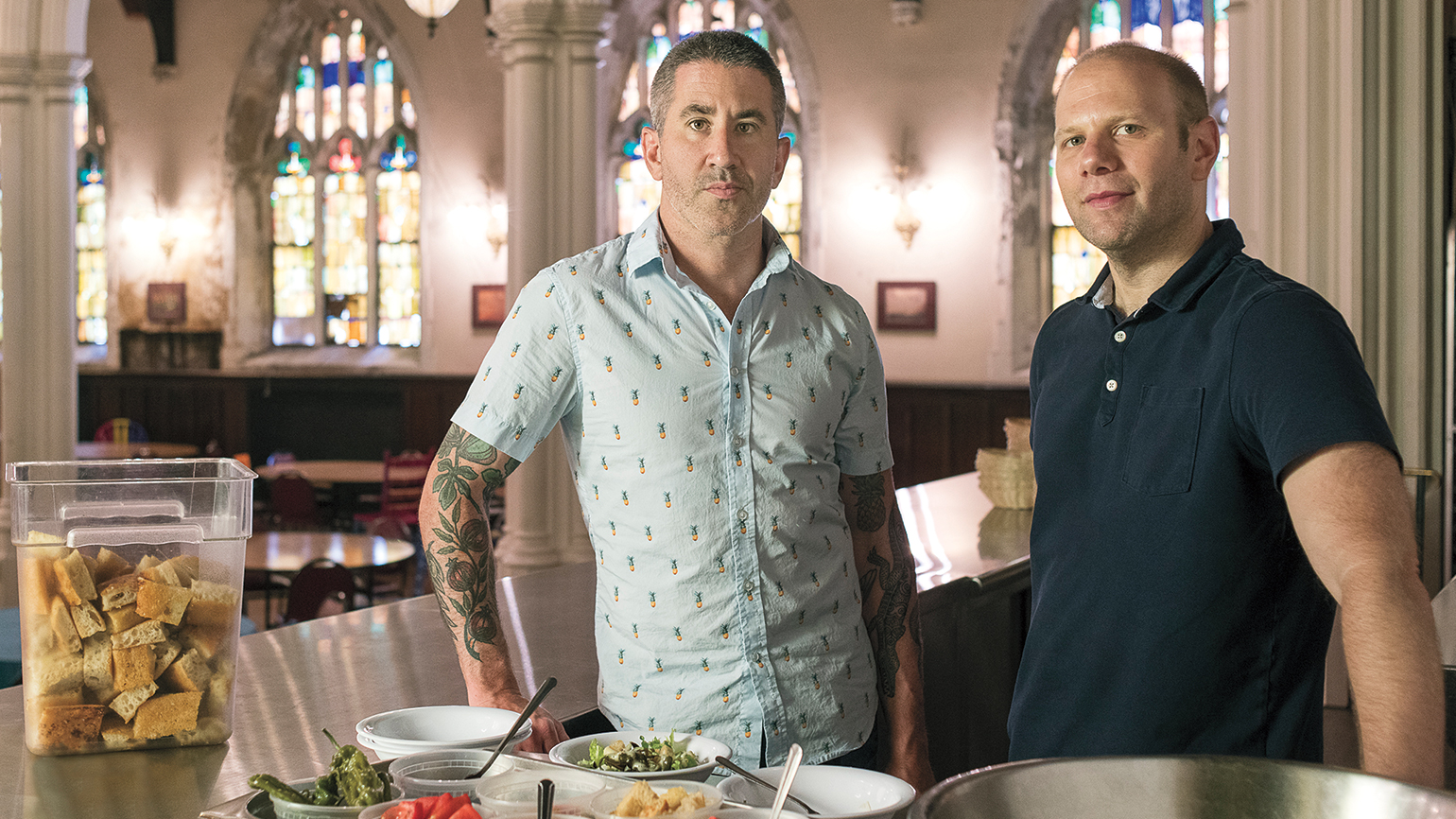
From the outside, it looked as if things were going great. I left Vetri and went to work at Marigold with my new business partner, Steven Cook [pictured on the right above, with Michael at Broad Street Ministry in Philadelphia, Pennsylvania]. I was a celebrated chef. We were getting great reviews. We talked about opening a new place featuring Israeli foods. I met and fell in love with a bright, capable woman named Mary, and the two of us got married. All the while, I was doing my best—or my worst, depending on how you look at it—at hiding my addiction.

Whenever there was a question—I mean, you can sneak out at night to score some crack for only so long without people noticing—I always had an excuse. The death of my brother. Shot down by snipers on one of the holiest days in the Jewish calendar. I did feel guilty about using David as an excuse to get high, but what do you do if you’re a drug addict and you have paralyzing guilt and shame? You use more. Self-pity just makes it easier.

I started snorting heroin. My rationalization? If I took heroin, I would use less crack—denial is amazingly powerful. Soon I was hooked on both. I just couldn’t hide it anymore. Steve and Mary sat me down and did an intervention. They forced me to look at myself, the lies I was telling, the mess I was making of my life, how it affected other people, what I was doing to my body. I couldn’t be a husband like this, couldn’t be a business partner. I was on a road to ruin, my very life hanging in the balance. They took me to rehab, where I detoxed for the first time since college and got serious about getting clean.

Coming back to work, I was fragile. I didn’t trust myself. I was glad to be back in the kitchen, cooking, but I didn’t want to drive by myself anywhere. Who knew where I might end up? I would go to a 12-step meeting first thing in the morning. Then Steve would pick me up with his three-year-old in the car and drop off the kid at day care. I’d look at him and think, If I relapse, if I mess up in any way, it’s going to affect the future of this child. Steve and I were deep into our plans for launching our Israeli restaurant, Zahav. Opening a restaurant is a risky thing, and Steve was counting on me.

After work, Mary would pick me up and drive me home. I got a 12-step sponsor. I went to outpatient rehab for a year. I went to meetings every day. I went to therapy. I had to be honest with every person I knew—my parents, my in-laws, my wife. No lies, no manipulation. No claiming that David’s death was a reason to get high. There was no escape. I had to be a grown-up for the first time in my life. Most of all, I had to be honest with God. I had to turn over to my higher power everything, good and bad.

Zahav opened that spring of 2008. A terrible time to start a new restaurant. World financial markets were in free fall. Nobody was going out to dinner. That first year, we had to make painful staffing cuts. Steve and I stopped taking paychecks. At one point, we were a month away from turning out the lights. Here I was, clean and sober, and life was harder than ever. So was temptation.

But the work itself was healing. I loved being right in the middle of the action at the bread station with my kitchen crew. We had a mission, showing the world that Israeli food was more than hummus and falafel. There aren’t really Israeli restaurants in Israel, as strange as that sounds. There are Bulgarian restaurants and Arabic restaurants, Georgian restaurants and Yemenite restaurants. What connects them is the shared experience of all these old cultures in a new country. This is food that’s meant to be cooked and passed down from generation to generation, or as we say in Hebrew, l’dor v’dor.

In the end, Zahav proved to be more successful than either Steve or I could have ever imagined. On Israeli Independence Day 2017, I was given the James Beard Award for Best Chef, a little like getting the Best Actor Award at the Oscars. I only wished I could share the good news with my brother.

In rehab and in 12-step meetings, I saw how people struggled to put a new life together. One thing that was very important was good food. Good food and proper nutrition, something I knew a lot about. I started serving as a volunteer chef at the Broad Street Ministry in Philadelphia, where we give the hungry and homeless a three-course meal. Guests are waited on, as at one of our own restaurants, and I often recognize people from meetings I’ve been to. Helping them is a way of helping myself. Steve and I feel so strongly about it that all the profits from one of our newer restaurants, The Rooster, go to supporting the ministry.The pain of losing David hasn’t gone away. What’s different is how I deal with it. Not with drugs but by giving, caring for my loved ones, volunteering at Broad Street and staying clean.
Hard Times? Think Positive

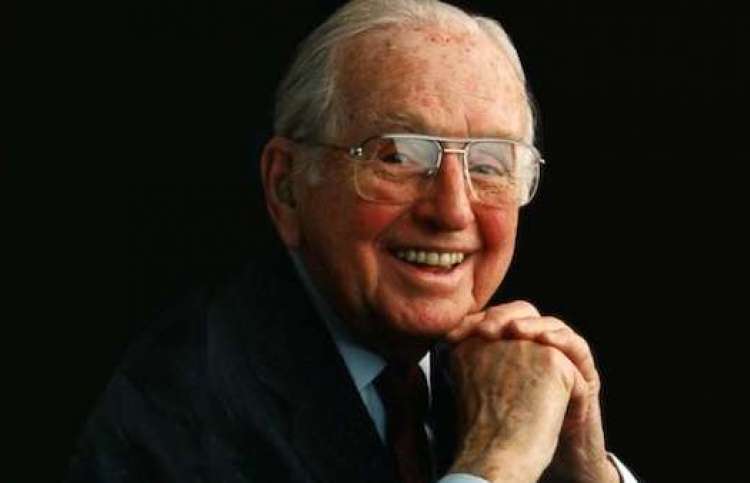
My father, Norman Vincent Peale, might have been a minister, but he cared a lot about how people managed financially.

After all, he, as the son of a preacher himself, didn’t grow up rich, and he and Mother lived through the Great Depression. He would be the first to tell you how much the Bible says about money, and one of his frequent themes as a preacher was God’s abundance.

The Lies That Bind In Article Ad

These days with so many suffering from layoffs and foreclosures and wiped out 401(k)s, I’ve often thought about Dad’s advice on prosperous living—and how it’s just right for today.

Give.
Dad called it the Law of Supply: The world is full of goodness and prosperity, but the only way to realize that is by giving.

Dad found this out in the depths of the Depression. He and Mother had just gotten married and he was the minister at University Methodist Church in Syracuse, New York.

The nation was plunged in gloom and Dad took on a share of his congregation’s fear and anxiety. One sleepless night he went outside and paced frantically in the park. What would happen to the church? What would happen to his family? How would they pay their bills?

It was Mother who sat him down in the living room and reminded him of his priorities. “Things will be fine,” she said. “All we need to do is give.”

“But we don’t have anything to give!” he exclaimed.

“We will give what we have,” she said, “and when we can, we will increase our giving. We will do what we can for others and for the church, and God will take care of us as he always has.”

By giving, you put yourself in God’s care and demonstrate your trust in his providence.

Save.
Thrift and frugality were as natural to my parents as their generosity.

Being prudent didn’t mean being stingy. To do without, to do more with less, to use all that you had, were matters of good stewardship.

One of Dad’s favorite stories was about how Henry Ford didn’t waste a thing in the manufacturing of his famous Model A car.

Ford gave meticulous orders on how the engine blocks were to be crated for shipment to the assembly plants, meticulous because every crate was later used as floor boarding in the cars.

As Dad said, “God gave us abundance not to squander but to cherish.” It’s simple—save more, give more.

Rethink.
When Mother and Dad started Guideposts magazine, things were pretty rocky. Costs were climbing, so a wealthy woman was invited to a meeting of the board of directors in hopes that she’d make a donation.

After hearing a litany of complaints, she stood up and announced that she wouldn’t give a “nickel more,” but she had some good advice for the fledgling publication.

“What I keep hearing here is the word ‘lack’,” she said. “‘We lack subscribers, we lack equipment, we lack money, we lack ideas.’ Well, you’re never going to move ahead until you get rid of those lack thoughts and replace them with prosperity thoughts.”

As Dad would explain many times in the years ahead, the person whose attitude is one of lack will never have enough no matter how much he has.

The positive thinker, on the other hand, will value what he has, even if it is a little. The key is to focus your thinking on the good things God wants to give you. Is it any wonder that once Guideposts followed that wise woman’s advice, it thrived?

Hope.
Dad loved to tell the story of a business friend who kept a print in his office of a beached old scow, the two oars resting dejectedly on the sand. On the horizon is a glimpse of the distant water.

Nothing could have been more hopeless looking than that boat in the sand. But at the bottom of the picture was the caption, “The tide will always come back.”

That picture reminded the man to live in hope. Again and again the Bible counsels us not to be anxious about the future.

Worry blocks creative thinking, shrivels accomplishment and tends to stop the flow of ideas. Worry distances us from God, whereas living in faith brings us peace of mind and closer to him.

Hard times never last. Abundance is as close as the turn of the tide.

Happiness at Work According to Zappos

It was hard to put down Tony Hsieh’s book, Delivering Happiness: A Path to Profits, Passion, and Purpose. Tony is the wunderkind founder and CEO of Zappos, the online shoe company that was bought last year by Amazon.com for more than a billion dollars.

I first heard about Tony on the Catalyst podcast, and was impressed by how serious he is about company culture. Zappos has a policy that every new employee goes through weeks of training that includes the download on everything Zappos. The required reading includes a book by Zappos employees on their company culture. At the end of the initial training, a new employee is offered $2,000 to leave the company if they don’t feel as though they can play a well-integrated contributor to the culture.

GP In Article Desktop

Delivering Happiness tells the story of Tony’s first forays into business, the mistakes he made, and the lessons he learned that ultimately led him to create a very different kind of company than most of us might experience today. Zappos takes their core values seriously, which in this case is to WOW their customers with great service, like free shipping and even surprise upgrades to expedited shipping. It’s especially interesting to see how their focus on customer service has led them to do things other companies won’t do, like not outsource or send their customer service department overseas, which many companies have done to increase profits. Instead, Zappos has found more profit by taking their customers seriously. They also forgo spending much money on advertising. Zappos figures that a happy customer is the best marketing anywhere.
What impresses me the most about Tony and Zappos is the emphasis on culture. We all strive for a deeper sense of faith and hope every day, but sometimes find it hard because we struggle to find communities that likewise support that passion for faith, ones that do it effectively and with a lot of energy and passion. While Zappos is no church, it has accomplished something with which many churches struggle: creating a sense of fun, fellowship, and excitement. It’s no wonder the folks at Catalyst noticed. We should take notice too.

Check out more about the world of Zappos in their blog

Halie’s Rainbows

Brazil, Indiana is a close-knit community, and so is the local high school’s marching band, the Northview Marching Knights, eight-time state champions.

Every Thursday, after practice, the staff gathers for dinner at the home of Bob and Ruth Anne Medworth, director of the band and color guard, respectively. 

Daily Strength for Women in Article ad

The Medworths live only a mile from the high school, so everyone shows up minutes after practice lets out.

On Thursday, October 8, just as he pulled into his driveway, Bob heard sirens. A police car sped past. “It scared me,” he remembers. “I never saw one go by the house so fast.”

Then he began getting text messages: “It’s Halie.”

Halie Hite was a freshman with long dark hair and a ready smile. “She was one of those kids who made it a joy to be a teacher,” says Bob , band director since 1977.

At one band practice, Medworth recalls, he instructed everyone to skip ahead in their set books (the band equivalent of play books) to a different formation. Halie, he says, actually skipped off toward her mark. It became their inside joke.

Tragically, Halie died in the hospital that night from injuries sustained in a car accident. Her many friends—students and teachers—gathered to mourn in disbelief at the high school until the wee hours of the morning.

With a competition the next day, Bob and the high school staff had to decide whether the band’s practices and performances should be canceled. The students all said they wanted to grieve together, and to practice for the big competition that Halie had worked so hard for.

“It was so hard,” says Bob, “You’d hear kids crying during practice.” But they insisted they wanted to do it for Halie.

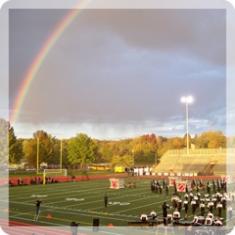
When the day of the regional competition came, just nine days after her death, it was spitting rain. But then, a miraculous sight appeared in the sky that left the band and the stadium audience gasping.

A rainbow arched over the Northview Marching Knights as they were poised to begin. And then a second rainbow appeared. They remained bright throughout their show, and faded just as the band left the field.

“When I saw it I just started crying,” says Makenzie Brown, a good friend of Halie’s.  “I told a judge standing near me, ‘That’s my best friend.’ It made me feel like she was right there watching us.”

The band made it through the regional competition, and the rainbow made its members even more determined to win the state finals on October 31. First, they had to make it through semi-finals, the next Saturday. As Bob Medworth sat in the staff van the morning of the event, a parent hopped in.

“I have to show you something,” she said.
 

Many fans had taken pictures of the rainbow, and noticed something else that was amazing. The Northview Marching Knights show included 11 medieval-looking towers, painted weeks earlier to look like they were made from grey stones. The center tower clearly spelled out Halie’s last name “Hite.”

“When I saw that I had to go off by myself and have another crying session,” says Bob.

Soldiering on once again through their pain, the band won. 
 

The Northview Marching Knights also won the state finals last week, and made up T-shirts for the members and their proud families and fans. In the center? A rainbow.

Update: On September 10, 2010, Halie’s birthday, a rainbow appeared. There had been no rain. The previous evening, her mom had prayed for a sign from Halie on her birthday. Everyone saw that rainbow on their way to school.

Guideposts Remembers Dr. Robert H. Schuller

On April 2, 2015, Rev. Dr. Robert H. Schuller, long-time pastor of the Crystal Cathedral in Garden Grove, California, passed away at 88. Rev. Schuller readily acknowledged Guideposts founder Norman Vincent Peale as an influence on his ministry.

Dr. Peale was, in turn, an admirer of Dr. Schuller’s work–so much so that in the early 1960s, Peale preached at the dedication of Dr. Schuller’s new church in Orange County, south of Los Angeles (Schuller’s first California services were held at a drive-in movie theatre).

The Lies That Bind In Article Ad

We offer Arthur Gordon’s profile of Dr. Schuller, first published in the August 1963 edition of Guideposts, as a tribute to a life well lived and the many lives he impacted in a positive way.

It all started eight years ago last March. The owner of a drive-in theater not far from Disneyland stood in the bright California sunshine listening suspiciously to a stranger from Chicago.

“I was called to this area by several Reformed churches to start a new church,” the stranger said and introduced himself as Robert Schuller. “May we use your drive-in theater until we can build our own church?”

As the theater owner looked at him dubiously, the minister explained that the people would sit in their cars to worship. “I could use the roof of the refreshment stand as a pulpit,” he said.

Robert Schuller went on to say that he had an old electric organ which could be hooked into the theater’s speaker system. He would advertise services in the local paper. “There’s a persistent idea in my head,” he said. “It’s the idea that the greatest churches have yet to be born. Perhaps, here, we have a real opportunity…”

Still doubtful, the theater manager hesitantly agreed. That Sunday, 12 cars appeared.

“Only 12 cars,” one pessimist said, but the young preacher smiled. “That’s 12 more than last week.”

The next Sunday there were a few more cars. In one of them was an old rancher who had lifted his totally paralyzed wife into their car and driven 20 miles to the only kind of service she could attend. No one could know then that without Warren Gray and his invalid wife Rosie, the design of things to come could not have been accomplished.

The drive-in services continued to draw more people each Sunday; a living church fellowship began to grow. Eighteen months later, a beautiful little chapel was dedicated in Garden Grove as the permanent home for a congregation that until then had known only a drive-in theater.

Then the question arose: what to do with the drive-in ministry? How could you forget about people—and there were many by now—like Rosie Gray? After some debate, the church board voted to keep the drive-in ministry going “for as long as Rosie is still with us.”

Nobody expected Rosie to live more than a few weeks, but God kept Rosie alive. Two years passed; Robert Schuller conducted two services each Sunday. It was hard work, but he kept at it because now the idea in his mind had become a vision: a multi-purpose church set in a spacious, landscaped area with part of the congregation worshiping in the sanctuary while the rest worshipped in their cars.

The church he envisaged would cost hundreds of thousands of dollars. The whole idea seemed fantastic since there was only $1,100 in the church’s bank account. Nevertheless, the official board appointed a committee to find ten acres for a new church.

A site was found, but it was expensive. The terms would be $19,000 down and the balance over 15 years. The board voted, by a narrow majority, to take $1,000 out of the bank and open a four month escrow, hoping that somehow, in the next 120 days, the additional $18,000 could be raised.

The escrow was scheduled to close at 4 P.M. on a Friday. By Wednesday, the pastor had a total of $16,000. He felt confident and secure. Two families had promised him $1,000 each any time he needed it. But on Thursday, when he called them, both told him sadly that they were unable to help after all. On Friday morning, in mounting panic, he tried to have the escrow extended. The bank officials said that this was impossible. When he phoned his wife to tell her the bad news, Robert Schuller was sick with despair.

“Honey,” his wife said, “call Warren Gray.”

“That’s impossible,” he replied. “Warren was operated on for cancer only two weeks ago. He’s not even out of bed.”

“Please, Bob,” his wife insisted, “I have a feeling you should call him.”

The dime clinked thinly in the pay phone. The sick old rancher’s voice sounded weak, but suddenly it grew stronger. “You wait right there, Reverend. I have some securities I can cash in the Santa Ana bank… No, of course, I’m not too sick! I have to get up sometime!”

It was 2:30 when the gray-haired rancher, walking stiffly and carefully, came into the bank. Ten minutes later, he handed his pastor a check for $2,000. All he said was, “We need a church for Rosie, you know.”

Robert Schuller's Garden Grove Community ChurchSix months later, they broke ground for the new church. The next day, Rosie Gray died.
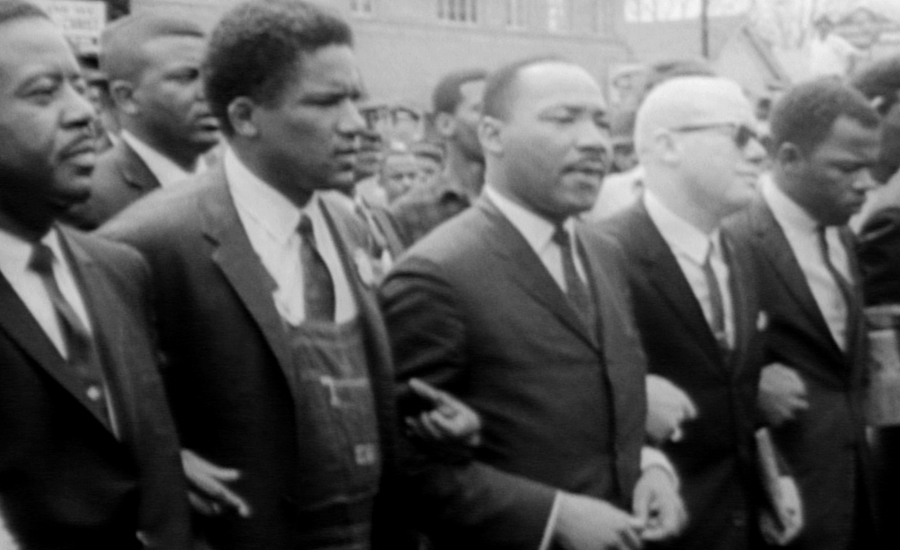
“They also serve,” said Robert Schuller, conducting her funeral, “who only stand and wait.”

Since then, there has been a succession of miracles. Up from the orange groves has risen “a great glass cathedral,” designed by Richard Neutra, one of America’s foremost architects. Now, each Sunday, 1,000 people sit in the sanctuary, looking out across green lawns where 12 towering fountains, symbolic of the 12 Apostles, leap out of a block-long reflection pool.

Beyond the fountains, in a garden-like drive-in area, another 2,000 people are able to worship in their cars. Every sort of person from every walk of life is there-as Christ intended. As the service begins, the huge sections of the glass-walled church slide silently open as if the hand of God were pushing aside man-made walls to let His spirit in. The minister in his pulpit can be seen by every worshipper inside and outside the great building. The majesty of a cathedral, the serenity of a garden and the soaring architecture combine to make a most extraordinary church.

Who wants to go to a “drive-in” church? Disabled veterans, parents with handicapped children, mothers-about-to-be as well as mothers with new babies, people of other faiths who draw strength from the services but do not want to “go into the church,” bereaved people who can — without embarrassment — let their tears flow in the privacy of their car, tourists who want to worship but feel they are not dressed appropriately and always the aged and the infirm.

The Garden Grove Community Church finds room for them all. “And this,” the 36-year-old pastor predicts, “is only the beginning.” With his architect, he is planning an 18-story “Tower of Hope” that will contain offices for a Christian counseling clinic. On the 17th floor will be “the upper room,” where members of the church will conduct a 24-hour prayer vigil. Here, the lights will never go out.

And on the very top of the tower will be “the Little Glass Chapel in the Sky,” always open for meditation and prayer. Somehow, some time, we’ll be able to build it,” says the young pastor.

No doubt they will. As Robert Schuller says, “When you step out on faith and ask the Lord to take over, you had better be ready for miracles—because miracles are going to happen.”

Guideposts Remembers: Dr. Martin Luther King, Jr.

In recent years I have had two very good roles on television: Florence, the wisecracking maid on the series The Jeffersons, and Mary, the mother who holds things together on 227. But 17 years ago, in 1972 when I was just getting started in theater work, I thought I’d never make it as an actress. For that matter, I couldn’t even hold my life together or afford a home of my own.

Back then I had about as much self-confidence as a chicken in a fox’s den. I was recovering from surgery and had been off work for six months from my lob as a United Airlines reservations agent. I’d had some bit parts in local theater groups, but those came and went, not leading to anything bigger.

God's Constant Presence In Article Ad

Worse, as a single mother with three youngsters, I had no place to live. My children were staying with their father while I recuperated in an aunt’s apartment. Lying in bed, staring hopelessly at the wall, I didn’t know what to do or where to turn.

Then one Sunday morning I idly flipped on the television set, and there were actor Robert Young and his wife talking about their faith. I sat right up in bed. As I watched, they told how they had turned to God for guidance in everything. They also talked of their church, which taught that God wants only the best for us, and that if we pray, believing, He hears and will answer.

Can it be true? I wondered.

When I was able to get up and about, I went to that church Robert Young attended. What I heard there made sense; the preacher said that with God we had the ability to focus our thoughts on the good, thus drawing good to us, and the strength to change our lives as quickly as we change our minds.

He also spoke about something my mother had often talked about: stepping out on faith. When God leads you to do the seemingly impossible or to do what appears to make no sense, the preacher said, the worst thing you can do is shake your head and say, “No way, Lord. It won’t work.” That shows no confidence in God, which translates to no confidence in yourself.

As the preacher said, we can’t see down that road, but the Lord can. And if we confidently take that first step, He’ll show us the next and the next, until we reach our goal.

But when I faced that first step, it was scary. After I went back to work part-time with the airline, I started looking for an apartment. The ones I saw were either too expensive, or I couldn’t see raising my daughter, Angela, and sons, Jordan and Dorian, in them.

Then a little voice within me spoke, and I recognized it as God speaking through His Holy Spirit: You don’t want an apartment, Marla. You need a house.

Before, I would’ve just rolled my eyes and dismissed the thought. Where would I even get a down payment? But then, as I thought about it, I remembered that my mother had left the children a little money. Also, I had a mite, and there was the United Airlines credit union.

It wasn’t much…but now I wondered: Shouldn’t I try that first step?

With shaking knees, I headed to a real-estate office. Strange, though—as I did, new confidence was building within me. And when the real-estate agent asked what kind of house I had in mind, I found myself boldly describing one with enough bedrooms for the children and a garden to raise vegetables to help with the food bills.

However, after seeing several houses, my confidence was badly shaken, I found two that were almost right (except neither had a garden), but just when I was about to make an offer, someone else swooped them up, pulling the rug out from under me.

I remembered the minister saying, “When one door closes, a better one opens.” Well, I wasn’t going to just sit staring at the closed one. So I got up and trudged on. Even if my shoes wore out, I decided, my faith wouldn’t.

One of those steps brought me to another real-estate agent. When I arrived at her office, she was on the phone. While waiting, I noticed on her desk a box of photographs of homes. I began leafing through it.

Suddenly, one of the cards was like electricity in my hands. It showed two small houses on one lot. The price seemed to be within my range.

The lady hung up the phone and looked at the card. “That’s out in Inglewood; I’ll take you there.”

When we pulled up in front, I could almost hear that door opening. The two little pale-green stucco houses with tile roofs seemed perfect.

We walked through them. The little one in back would be ideal for Angela to share with one of her girlfriends. The bigger one would have plenty of room for my sons and me.

But when we stepped outside, I caught my breath. There was what the other houses lacked—a large garden of strawberries, zucchini, squash, eggplant and greens. And over the garage, what should I see but a basketball hoop, just the thing for Jordan and his playmates.

The owner, an elderly woman, was excited too. “I just know this place is for you,” she said. “In fact, I’m going to move right away to a house I bought in Anaheim You can move in now.”

“Well, we’ll be in soon,” I said with a laugh.

I had to scrape up $3,000 for a down payment and get a mortgage. Common sense argued that a mortgage for a single mother working part-time was doubtful. But there was enough God-given self-confidence in me by now that I didn’t listen to common sense.

So I walked on. The children gladly lent their money to me. And I had no trouble with the credit union. It was the mortgage that threw me.

After applying to the Federal Housing Administration, I put my need into my church’s prayer box so that everybody in the congregation would lift it up. Even so, I was on pins and needles. After some weeks the real-estate agent said she expected to have an answer in the mail that Friday. If it didn’t arrive till Saturday, she would be in her office Sunday. That afternoon, following church, I had taken the children to Hamburger Hamlet on Wilshire Boulevard. After ordering, I went to the phone booth.

“I hate to tell you, Marla,” said the real-estate lady, “but they turned you down—didn’t think you could handle it.”

I sank against the booth, stunned.

“We do have some recourse,” she suggested.

“What’s that?” I quavered.

“You can appeal in a letter.”

Soon as I got back to my aunt’s place, I started the letter. I don’t think Martin Luther King Jr. worked any harder on his “mountaintop” speech. I went on for three pages telling how I could raise my children in those houses, how the basketball hoop would let me keep an eye on the boys, how the garden would help our budget. Don’t worry about me losing the place, I emphasized; I would fight like a tiger to keep it.

I posted the appeal and continued to put my request in our congregation’s prayer box. For hadn’t the Lord said, “Where two or three are gathered in My name, there will I be also”?

Then several days later the real-estate agent called. “Marla, I can’t believe it,” she cried out. “Your loan application came back approved!

“Thank You, Lord!”

Far more important than getting the house, however, was my new self-confidence. Later, when I began filling small parts in television productions, that self-confidence showed. I’d always done my best to play the role as I thought the director wanted, but now I found myself freer to interpret it. I was more natural, more me.

Then I was called to play a bit as the maid in the first episode of The Jeffersons. In that show, I met the Jefferson family and asked if they honestly and truly lived in such a luxurious high-rise apartment. Mrs. Jefferson answered, “Yes, indeed.”

“How come we overcame,” I asked, “and no one told me?”

It brought down the house and I was invited back again and again until I became a regular.

I believe that when God put us on this earth, He gave us a good dose of self-confidence to make it through life. Trouble is, we drift away from Him and lose it. Best way I know to get it back is to step out on faith with Him. It can be scary at first. But I know that each time I take that step, God takes two big ones for me.

For more inspiring stories, subscribe to Guideposts magazine.

Guideposts’ Guardian Angels

I was dusting off my office shelves yesterday afternoon, something I don’t do very often because a) I hate to dust and b) I wind up reading around in the books as if it was a holiday.

Suddenly it was late afternoon and my bookshelves remained dusty, but I’d re-familiarized myself with my library and the voices of people like Catherine and Peter Marshall, Arthur Gordon, Van Varner and of course, Norman Vincent Peale. Guideposts’ guardian angels, if you will.

Go For It In Article Ad

I spent a lot of the afternoon soaking up Dr. Peale’s advice on worry. I am a worrier, and Dr. Peale is an expert on the topic. I was lucky enough to have started working at Guideposts while he was still visiting in the office. Usually he would gather us up in the conference room for what seemed to amount to a storytelling session with much laughter all around. Then, back at my desk, I’d realize I’d learned something useful and serious. Dr. Peale was like a magician in that respect.

In the opening pages of Stay Alive All Your Life, Dr. Peale’s follow-up to The Power of Positive Thinking, he introduces a dozen or so topics as a reference guide to what he’d cover in the book. The first: How can I stop worrying about things I can’t possibly do anything about? Good question!  I’ve memorized the opening sentence: “The basic secret of overcoming worry is the substitution of faith for fear as your dominant mental attitude.” A tall order, but one worthy of my best efforts.

My bookshelves still need some work, but I’d spent a productive afternoon. I’m not going to worry about the dust; those guardian angels gave me something else to think about.

Guideposts Classics: William Gargan on the Blessings of Acceptance

There’s a question that, sooner or later, all of us seem to ask. When things go against us, when trouble comes or sickness or heartache, our hands go out in a gesture of bewilderment and we ask:

Why me?

Pray A Word a Day - 2023 In article

Or perhaps you’ve heard it as “What have I done to deserve this?” Or “Why pick on me?”

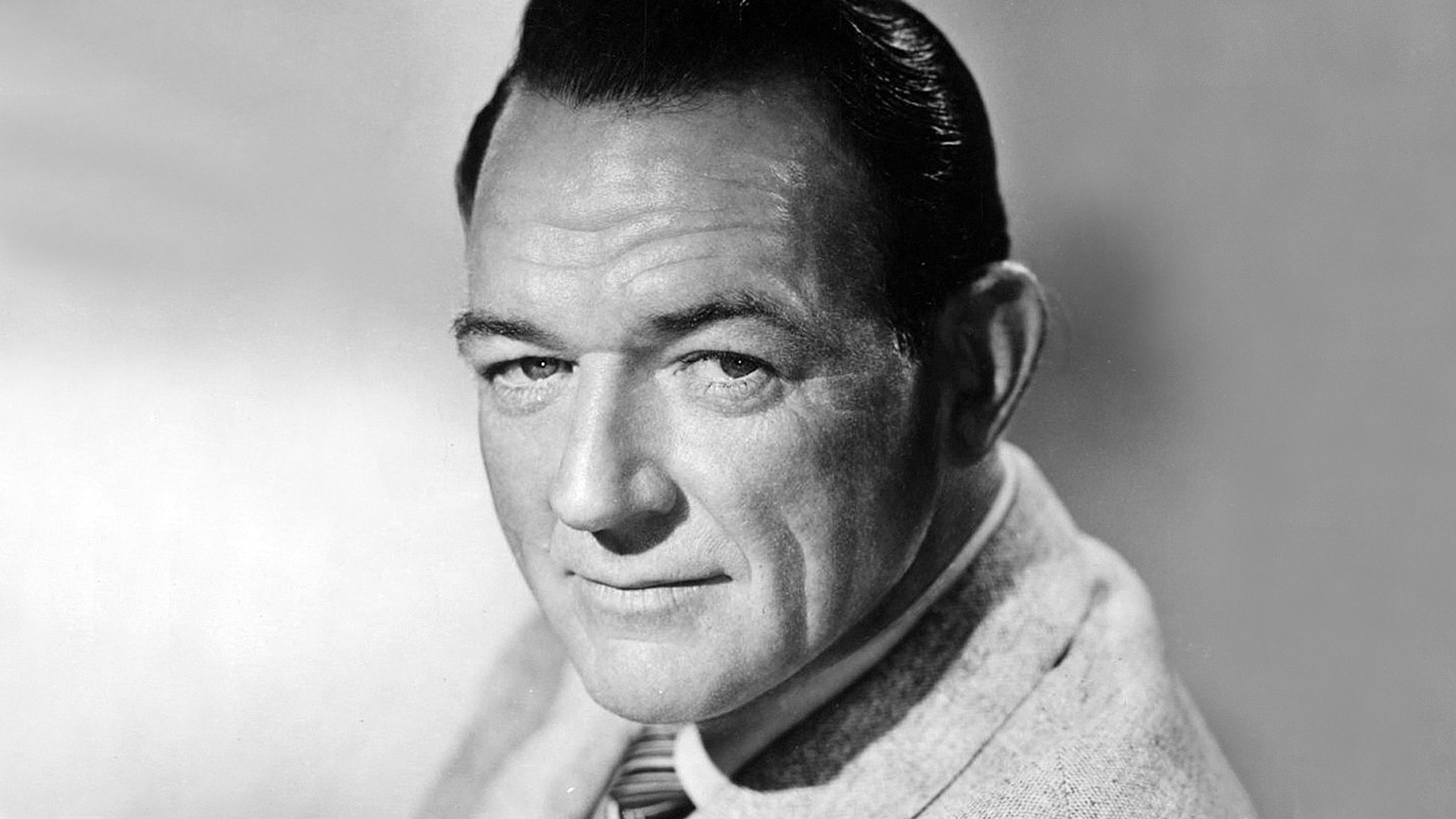
“Two years ago it was my turn to complain to God in just those words —“Why me?”—and yet I could phrase them only in my mind. I lay m a Los Angeles hospital unable to talk. The only way I could communicate words was to write them. My larynx—or voice box—had been removed and I lay there deep, deep in depression.

Here I was, an actor who could not speak. It was like being an athlete who could not run or a painter who could not see. For 35 years I’d been in the entertainment world, in movies, radio, stage, TV. Suddenly it all was over.

Yet, I was told I had reason to be cheerful.

“You’re in good luck, Bill,” the surgeon had said. “Cancer of the larynx is one of the most curable of all cancers. If discovered in time, we can save 90 per cent of our patients.” He smiled. “We got you in time.”

It had been an odd quirk, finding that cancer in me. I had been playing in San Francisco in a drama about politics called The Best Man. Prophetically, I had the part of a president who was a cancer victim.

We were supposed to go on to Chicago, but the play was doing so well that the management decided to keep it in San Francisco for an additional two weeks. God works in wondrous ways. That decision saved my life. By waiting, we lost the theater in Chicago, and the show closed.

Back in Los Angeles, my wife, Mary, got after me. “You have the time now to get that throat of yours looked at,” she said, forcing me to a doctor’s office. For weeks I’d had a sore throat and couldn’t shake it.

The doctor told Mary, not me, about the possibility of a malignancy, and for three days she carried that fear around in her heart. Then, just before I went to hear about the results of some medical tests, Mary tried to ease me into possible bad news. Even so, I was shocked when the verdict came. I had to make a choice, the doctor said. Operate and live; don’t operate and die.

“When do you operate?” I asked angrily. I was so hurt by the news that I was mad.

“In a week or ten days,” he replied. “You’ll need time to put your affairs in order and …”

“I need 24 hours,” I said forcefully. “If you can’t take me then, I’m going down the street.”

We settled on 36 hours.

It is true that when you know that death is near, life becomes intense and you live rapidly and deeply. And you learn things, too, which in all the years before you have not learned. I learned in the confusion of that day and a half that I was unafraid of death.

I didn’t have far to go to talk to God in those 36 hours; He was no stranger. I talked to Him with the same prayer I have used each day for as long as I can remember:

Look down upon me, good and gentle Jesus, whilst before Thy face I humbly kneel, and with burning soul, pray and beseech Thee to fix deep in my heart, live sentiments of faith, hope and charity.

By the time I went into the operating room, I was calm and confident. I remember the last words I spoke. They were for Mary. I looked up at her. “I love you,” I said.

And so the operation was a success, and there I lay in the hospital, totally depressed. I had not feared dying, but now I was afraid to live. Only a few days before my religion had been my strength but now, in self-pity, I began to weaken.

“Why me, God?” I asked with lips that brought forth no sound. “Is this some penance You’re exacting for something I’ve done wrong?”

Every day, many times a day, I continued to say my prayers, but in the gloom I suffered from the injustice I felt had been done me.

In a few weeks the doctor announced, “You’re snapping back so fast, I’m going to make arrangements for your speech lessons.”

I took out my pad and pencil. “Are you nuts?” I wrote.

“Esophageal speech,” he said and went out.

“Never heard of it,” I wrote on my pad, anyway.

So there I was propped up in bed looking like a chipmunk—my face was still puffed up from the operation—when a lady named Teckla Tibbs came in.

“I’ve come to let you hear what esophageal speech sounds like,” she said in a hoarse, mechanical-sounding voice. I must have stared at her somewhat peculiarly. “You won’t talk any better than I do, Bill, but at least,” she said gruffly, “you’ll talk like a member of your own sex!” Her eyes twinkled and for the first time in weeks I felt like laughing.

Teckla Tibbs went on to explain the basic facts of being a laryngectomee. She wore a large flat gold necklace around the lower part of her neck which covered the stoma or hole a surgeon had created in order to join the trachea to it. Since there was no longer any connection between the mouth or nose and the lungs, she breathed, coughed and sneezed through that opening.

“To a large degree I’ve lost my sense of taste and smell, as you probably have,” she told me, “but I can do almost anything I could do before—except swim.”

It was the talking I wanted to learn about. She gave me some literature and after reading it, I began to feel the wonderful warmth of hope kindling inside me.

As soon as I was able to go home, the American Cancer Society telephoned, asking when I could come for my first speech lesson. I went immediately.

It was a grueling half hour in which I struggled in vain to make even the tiniest sound. Esophageal speech is a complicated process of developing false muscles, of forcing air into the esophagus so that its walls vibrate and cause a low-pitched sound. I’d take a sip of water and try to get the air down with it. I’d get the water down and eventually the air with it, but I couldn’t produce the sound I was supposed to be able to make.

At home I practiced desperately. Day after day, Mary worked with me. “If you ask him a question and he doesn’t try to speak, turn your back on him,” the doctors told her. Later, Mary said that was the hardest thing of all for her to do.

It got so that my friends would come in and work with me. Pat O’Brien, Jack Haley, Charlie Ruggles, Dennis Day, Ed Delaney—those guys spent hours trying to force a sound out of me. My old pal, Irving Pinsky of Queens, would call me long distance and demand that I talk to him.

In time, sounds came. First a gasp and a burp and then an “ah” and then an “ee,” and then gradually I began to manipulate these “ahs” and “ees” and “ohs” into words.

Sixteen lessons later I graduated from speech class with a new voice. My teachers approved, but they urged me never to sing a song unless I wanted to empty a theater. Their joke suggested a problem which I had all but forgotten. I had a new voice, but it was not an actor’s voice. How was I to spend my time?

Once again the American Cancer Society was on the phone. Would I make a speech on their behalf? This time it wasn’t necessary to scribble out the question “Are you nuts?” I didn’t ask it, either, but I wanted to. Still, I thought, nobody has misled me yet. They must know what they are doing.

“Sure,” I agreed.

Once again I felt the excitement of stage fright. Some 20 people were there at a luncheon in Palm Springs when I was introduced. I was worried, not knowing if my voice would work or if I could be heard.

“Unaccustomed as I am to public speaking,” I began. There was a laugh and I relaxed. I was home free.

After that the ACS asked if I would help in their fund-raising campaign. That year we managed to triple the quota in Palm Springs. Then I started speaking before “Lost Chord” clubs and other groups of laryngectomees the country over. There are approximately 20,000 of us in the United States today (about ten men to every one woman) and the clubs help new members over those first difficult months.

To sport my stuff again, to show off my special skill before newcomers and give them hope, was more thrilling to me than any play I’d ever been in.

Today I roam all over the country volunteering my services as a speaker. When I tell people that a checkup once a year and a close watch for the seven danger signals could cut cancer deaths by 50 per cent, they’re more inclined to follow my simple advice because of my raspy voice.

In this simple way, I am doing something to help others. I believe that God forever is creating such opportunities for us, but often we are too involved in ourselves to grasp them. That’s why the next time I’m inclined to complain with a petulant “Why me?”—I’ll change that quickly to:

“Why not me, God?”

For more inspiring stories, subscribe to Guideposts magazine.

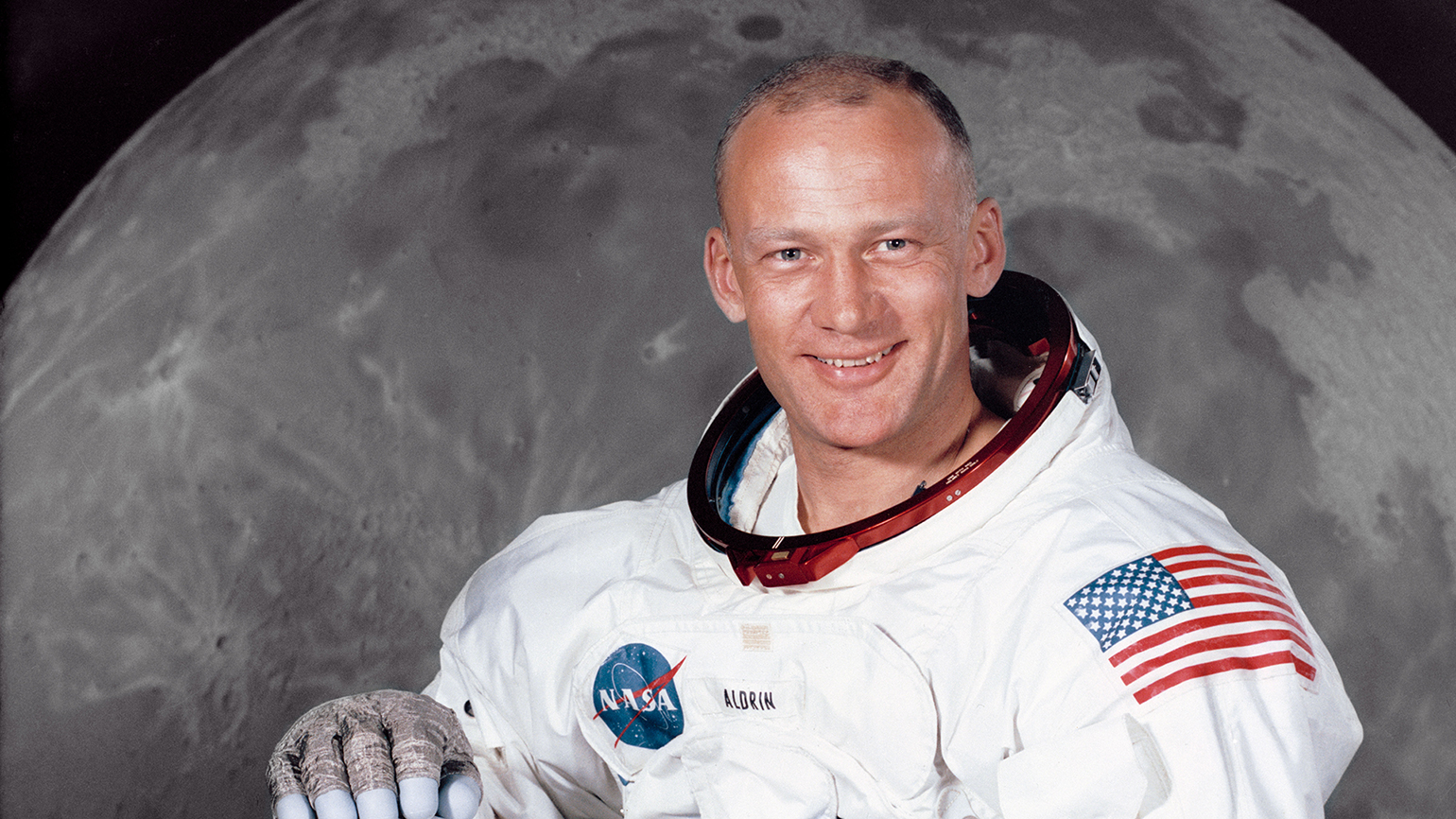
Guideposts Classics: When Buzz Aldrin Took Communion on the Moon

For several weeks prior to the scheduled lift-off of Apollo 11 back in July, 1969, the pastor of our church, Dean Woodruff, and I had been struggling to find the right symbol for the first lunar landing.

We wanted to express our feeling that what man was doing in this mission transcended electronics and computers and rockets.

You Got This In Article Ad

Dean often speaks at our church, Webster Presbyterian, just outside of Houston, about the many meanings of the communion service.

“One of the principal symbols,” Dean says, “is that God reveals Himself in the common elements of everyday life.” Traditionally, these elements are bread and wine—common foods in Bible days and typical products of man’s labor.

One day while I was at Cape Kennedy working with the sophisticated tools of the space effort, it occurred to me that these tools were the typical elements of life today.

I wondered if it might be possible to take communion on the moon, symbolizing the thought that God was revealing Himself there too, as man reached out into the universe. For there are many of us in the NASA program who do trust that what we are doing is part of God’s eternal plan for man.

I spoke with Dean about the idea as soon as I returned home, and he was enthusiastic.

“I could carry the bread in a plastic packet, the way regular inflight food is wrapped. And the wine also—there will be just enough gravity on the moon for liquid to pour. I’ll be able to drink normally from a cup.

“Dean, I wonder if you could look around for a little chalice that I could take with me as coming from the church?”

The next week Dean showed me a graceful silver cup. I hefted it and was pleased to find that it was light enough to take along. Each astronaut is allowed a few personal items on a flight; the wine chalice would be in my personal-preference kit.

Dean made plans for two special communion services at Webster Presbyterian Church. One would be held just prior to my leaving Houston for Cape Kennedy, when I would join the other members in a dedication service.

The second would take place two weeks later, Sunday, July 20, when Neil Armstrong and I were scheduled to be on the surface of the moon.

On that Sunday the church back home would gather for communion, while I joined them as close as possible to the same hour, taking communion inside the lunar module, all of us meaning to represent in this small way not only our local church but the Church as a whole.

Right away questions came up. Was it theologically correct for a layman to serve himself communion under these circumstances? Dean thought so, but to make sure he decided to write the stated clerk of the Presbyterian church’s General Assembly and got back a quick reply that this was permissible.

And how much should we talk about our plans? I am naturally rather reticent, but on the other hand I was becoming increasingly convinced that having religious convictions carried with it the responsibility of witnessing to them.

Finally we decided we would say nothing about the communion service until after the moonshot.

I had a question about which scriptural passage to use. Which reading would best capture what this enterprise meant to us? I thought long about this and came up at last with John 15:5. It seemed to fit perfectly.

I wrote the passage on a slip of paper to be carried aboard Eagle along with the communion elements. Dean would read the same passage at the full congregation service held back home that same day.

So at last we were set. And then trouble appeared. It was Saturday, just prior to the first of the two communion services. The next day Neil Armstrong, Mike Collins and I were to depart Houston for Cape Kennedy.

We were scheduled for a pre-mission press conference when the flight physician arrived and set up elaborate precautions against crew contamination. We had to wear sterile masks and to talk to the reporters from within a special partition.

The doctor was taking no chances. A cold germ, a flu virus, and the whole shot might have to be aborted. I felt I had to tell him about the big church service scheduled for the next morning. When I did, he wasn’t at all happy.

I called Dean with the news late Saturday night. “It doesn’t look real good, Dean.”

“What about a private service? Without the whole congregation?”

It was a possibility. I called the doctor about the smaller service, and he agreed, provided there were only a handful of people present.

So the next day, Sunday, shortly after the end of the 11 o’clock service my wife, Joan, and our oldest boy, Mike (the only one of our three children who was as yet a communicant), went to the church. There we met Dean, his wife, Floy, and our close family friend Tom Manison, elder of the church, and his wife.

The seven of us went into the now-empty sanctuary. On the communion table were two loaves of bread, one for now, the other for two weeks from now. Beside the two loaves were two chalices, one of them the small cup the church was giving me for the service on the moon.

We took communion. At the end of the service, Dean tore off a corner of the second loaf of bread and handed it to me along with the tiny chalice. Within a few hours, I was on my way to Cape Kennedy.

What happened there, of course, the whole world knows. The Saturn 5 rocket gave us a rough ride at first, but the rest of the trip was smooth. On the day of the moon landing, we awoke at 5:30 a.m., Houston time.

Neil and I separated from Mike Collins in the command module. Our powered descent was right on schedule, and perfect except for one unforeseeable difficulty. The automatic guidance system would have taken Eagle to an area with huge boulders. Neil had to steer Eagle to a more suitable terrain.

With only seconds’ worth of fuel left, we touched down at 3:30 p.m.

Now Neil and I were sitting inside Eagle, while Mike circled in lunar orbit, unseen in the black sky above us. In a little while after our scheduled meal period, Neil would give the signal to step down the ladder onto the powdery surface of the moon. Now was the moment for communion.

So I unstowed the elements in their flight packets. I put them and the scripture reading on the little table in front of the abort guidance-system computer.

Then I called back to Houston.

“Houston, this is Eagle. This is the LM Pilot speaking. I would like to request a few moments of silence. I would like to invite each person listening in, wherever and whomever he may be, to contemplate for a moment the events of the past few hours and to give thanks in his own individual way.”

For me this meant taking communion. In the radio blackout I opened the little plastic packages which contained bread and wine.

I poured the wine into the chalice our church had given me. In the one-sixth gravity of the moon the wine curled slowly and gracefully up the side of the cup. It was interesting to think that the very first liquid ever poured on the moon, and the first food eaten there, were communion elements.

And so, just before I partook of the elements, I read the words which I had chosen to indicate our trust that as man probes into space we are in fact acting in Christ.

I sensed especially strongly my unity with our church back home, and with the Church everywhere.

I read: “I am the vine, you are the branches. Whoever remains in me, and I in him, will bear much fruit; for you can do nothing without me.” John 15:5 (TEV)

For more inspiring stories, subscribe to Guideposts magazine.

Guideposts Classics: Shirley Temple’s Happiest Moment

When we drove away from the house on the hill, we left her standing in the California sunshine, a pretty woman in her mid-thirties with blue eyes and chestnut hair and a kind of cheerful serenity about her. Ahead of us, on the horizon, we could see the soaring San Francisco Bay Bridge.

“What are you frowning about?” my wife asked. “That was a wonderful visit. And she’s so friendly and relaxed and … and normal.”

Witnessing Heaven In Article Ad 827x123

“Yes,” I said, “Completely. That’s the trouble.”

Celebrating Guideposts' 75th Anniversary“Trouble? I think it’s marvelous. She was a great movie star and could easily be spoiled and selfish and vain and neurotic. But she’s none of those things. She’s a good wife and mother. She’s a happy person. And not just because she’s a celebrity. In spite of it.”

“I agree with you,” I said. “But as a writer I have a problem. Happiness is tough to write about. It’s like describing a sunset. Once you’ve said it’s beautiful, you’ve said it.”

“There’s a little three-letter word,” my wife said, “that you can apply to anything: why. Why is a sunset? Why is happiness? Why, specifically, is Mrs. Charles Black, formerly the famous Shirley Temple, now a completely balanced and fulfilled human being? Why?”

“She didn’t tell us,” I said glumly.

“Ah,” said my wife, “but she did. She told us, and her house told us, and the pictures of her family told us, and her flowers and her books told us, and her child’s lavender bedroom told us, and her bright sparkling kitchen told us … oh, hundreds of things! If you’d just stop being difficult and think back, you’d see…”

“It’s good to see you,” Shirley Temple had said, “although things are a bit hectic around here. Lori—she’s our 10-year-old—has the measles, and I’m feeling a little headachy myself … I don’t think I’ve ever had them. Have you? That’s good! Come and have some coffee.”

To a writer interviewing a celebrity—or anyone, for that matter—first impressions are important. And they’re not arrived at consciously.

You see your subject; you’re aware of the background; you hear the first conventional phrases. But all the time you are listening on a kind of psychic level, groping for the essence of the person.

This woman: friendly, outgoing, not shy, no self-consciousness, no wariness. This house: comfortable, but not pretentious. Neatness and quietness. A warm center with a feeling of distance surrounding it, perhaps because it’s a hill-top home with a far-reaching view…

“Those pictures?” said Shirley Temple. “Yes, everyone looks happy because they were happy occasions. One was the golden wedding anniversary of my parents. The other was the golden wedding anniversary of my husband Charlie’s parents.

“Imagine having two such events in the same family within six months! And everybody’s still going strong.”

Fifty years and 50 years: a century of wisdom and happiness to draw on. That explains a lot. You can inherit certain things without even knowing that you’ve inherited them: outgoingness, good manners, an instinctive concern for other people, a sense of obligation to life, a feeling of gratitude…

“I’ve been terribly lucky,” Shirley Temple said. “I’ve bad such a wonderful life that the few mishaps or misfortunes seem very small.

“Think of all the things I’ve had! Parents who were strong and wise enough to protect me from the pressures that might have been damaging when I was a little girl. A marvelous girls’ school—Westlake—when I was 12 that brought me out of the make-believe world I’d lived in for so long.

“Now a marriage that’s completely happy. Charlie and I have backgrounds and values so similar that we even think alike! And, of course, three wonderful children.

“Then I have my community activities: I work as a volunteer every Monday at the Children’s Health Council in Palo Alto. And my occasional television work; I like that, so long as it doesn’t interfere with my family. If I thought it bothered Charlie or upset tile children I’d give it up tomorrow.”

Values: a key word when it comes to this business of happiness. You have to know what you want froth life, for yourself, and for others. Take the value of individuality, for instance…

“Charlie and I,” said Shirley Temple, “have a horror of forcing a child into a pattern that may please the parent but is all wrong for the child. We think children should be allowed to develop their own personalities in their own way—within a framework of good manners and good behavior, of course.

“I still get letters, sometimes, from doting mothers who tell me that their little girl looks just like the Shirley Temple of 30 years ago and has even learned some of my old dance routines.

“I always try to discourage them. The little girl that I once was had her place in time and in show business, but she’s gone now, and so is that era.”

Or the value of shared affection:

“Charlie and I almost always eat supper early with the children. We feel that if we all can be together for at least one hour a day, we can give the children a sense of security about family life that they can get in no other way.

“We try to keep that meal apart as a sort of special family hour. No television, no telephone calls, no outside interruptions. We take turns saying a simple grace. Sometimes I read from a set of Bible stories that I loved as a child. My children love them too.”

And the value of perspective:

“When we moved into this house a few years ago, we brought with us a lot of scrapbooks from my child-actress days. And Charlie suggested keeping them here in the living room, but I asked him to put them in the attic.

“They may interest our grandchildren some day. But I believe you have to live in the present, not the past or even the future.

“Charlie’s mother tells a story that expresses my philosophy very well. Once, when he was little, he asked her to name the happiest moment of her life. ‘Why this one, right now,’ she said. ‘But what about the day you were married?’ Charlie wanted to know.

“‘Well.’ she said, ‘my happiest moment then was right then. You can only live the moment you’re living in. So to me that’s always the happiest moment.’ And she’s right, you know: the happiest moment is now!”

The happiest moment is now. Maybe that’s her secret. Maybe that’s why she’s as serene and adjusted and well-balanced as she is.

Ahead of us now the skyscrapers of San Francisco were standing up to greet us. In a few more hours my wife and I would be home again with our own children, our own way of life.

To be yourself, not some artificially assumed personality. To live one day at a time. To accept the joy of being alive in the one moment when you can really feel it—the moment that is now…

“You’ve stopped frowning,” my wife said. “It was a good visit, wasn’t it?”

“Yes,” I said. “Very good.”

For more inspiring stories, subscribe to Guideposts magazine.

Guideposts Classics: Robert Frost and Faith

Robert Frost talks with the subtle indirection that gives such unique quality to his poetry. For weeks after his interview with America’s great poet, Guideposts reporter John Sherrill found the experience meaningful, almost haunting.

The poet, dressed in a gray suit and white shirt open at the neck, was finishing breakfast. His first words were keynotes. Frost looked up. His great eyebrows moved upwards as he spoke.

NIVFLB Inarticle ad

I hope you won’t ask me to put names on things,” he said. “I’m afraid of that.

Yet that was what I had come to do. And one of the first topics we discussed was what God meant to him in his poetry, as for example in “Bereft,” written after the death of his wife:

Where had I heard this wind before
Change like this to a deeper roar?
What would it take my standing there for,
Holding open a restive door,
Looking down hill to a frothy shore?
Summer was past and day was past.
Somber clouds in the west were massed.
Out in the porch’s sagging floor,
Leaves got up in a coil and hissed,
Blindly struck at my knee and missed.
Something sinister in the tone
Told me my secret must be known:
Word I was in the house alone
Somehow must have gotten abroad,
Word I was in my life alone,
Word I had no one left but God.

Frost folded his massive hands—he is a large, well-built man—and spoke softly: “People have sometimes asked me to sum up my poetry. I can’t do that. It’s the same with my feeling about God. If you would learn the way a man feels about God, don’t ask him to put a name on himself. All that is said with names is soon not enough. If you would have out the way a man feels about God, watch his life, hear his words. Place a coin, with its denomination unknown, under paper and you can tell its mark by rubbing a pencil over the paper. From all the individual rises and valleys your answer will come out.”

We reviewed, a little, what I knew about Frost’s life. Perhaps from its rises and valleys a picture would emerge.

Robert Frost was born in 1875 in San Francisco, 3000 miles away from the New England he writes about in most of his poetry. Frost’s family, however, was ninth generation New England, and when his father died, Frost’s mother moved with her son back to Lawrence, Massachusetts, to live with in-laws.

READ MORE: VAN CLIBURN ON TRUE SUCCESS

It was while Frost was living with his grandparents that he bought his first book of poetry. As a boy, Frost’s spending money was at a minimum, but he liked to visit bookstores and browse. “I had gone to Cambridge one day,” Frost recalls, “and I was standing in a bookstore, thumbing through Francis Thompson’s famous religious poem, The Hound of Heaven. I became fascinated with his idea that we are not seeking God, but God is seeking us. I bought the book. I spent my carfare for it, and I had to walk home.”

The distance was 25 miles!

It was in Massachusetts, too, that Robert Frost wrote his first poem. In his high school, no English was taught. Only history, mathematics, Greek. In history one day, Frost learned about Cortez, the Spanish conqueror of Mexico, and on his way walking home that afternoon, Frost composed a long ballad about Cortez.

“I remember the time so clearly,” said Frost. “I recall how there was a wind and darkness. I had never written a poem before, and as I walked, it appeared like a revelation, and I became so taken by it that I was late to my grandmother’s. The next day I took it to the editor of our school paper, and it was published.”

Nothing was quite the same with Robert Frost after that. It isn’t that he suddenly had a burning ambition to become a great poet. It was more of a stirring, a desire somehow to keep poetry in his life even if it meant difficulties.

And the difficulties were not long in coming. It was apparent to those close to Frost that something had happened. He seemed to have lost all ambition. His grandfather thought he was plain lazy, and began bending every effort to get him settled into some respectable work.

Reflecting on those days, Frost spoke of how no one had confidence in his future. “Where is it that confidence and faith separate?” he asked. “…We have confidence in the atom. We can test the atom and prove that it is there. I have seen an old New England farmer try to test God in this same way. He stood in his field during a thunderstorm and held his pitchfork to heaven and dared God to strike him. You just can’t prove God that way.”

Robert Frost must have had faith in his poetry. It certainly couldn’t have been confidence. He submitted to magazines time and again. Most of his work was returned.

And all this while, pressure was great to pin Frost down, to get him to commit himself to a career. Frost evaded the efforts. His grandfather got him a job as a bobbin boy in one of the textile mills in Lawrence, hoping he would rise through the ranks. Frost took the work, but he refused to advance. All the while Frost was steadily writing.

A little later Frost married his childhood sweetheart, Elinor White. His grandfather bought them a farm up in New Hampshire, but Frost refused there, too, to be classified, pigeon-holed. Reports soon began to circulate through the neighborhood that young Frost milked his cows late at night so he wouldn’t have to get up early in the morning. Frost has always preferred to write at night. But the townsfolk called it laziness.

READ MORE: CORRIE TEN BOOM ON FORGIVENESS

Then, to help increase the support of his growing family, Frost began to teach school up in New Hampshire. The school was impressed by the stimulation of Frost’s unorthodox classes, where the students were expected to catch the spirit behind Frost’s teaching, not the exact fact. When Frost was 36, the job of headmaster became vacant. Frost was offered the position.

At last, in the eyes of his hometown folk, Frost was on the verge of redeeming himself. Then he ruined it all by committing what they described as an act of supreme shiftlessness—Frost declined the post of headmaster.

“That would have been the ruin of the poetry in me,” he says. “I’d never have taken up my writing again. People called me lazy. Perhaps they were right. I’ve always been careful to protect this laziness.”

It took a long time to gain recognition—until he was 40 years old in fact—but into his poetry Frost managed to instill some of this same haunting subtleness that he sought in his life. There was a quality about his poetry that the 20th century responded to, and now, after 40 years, Frost is recognized as the dean of American poets.

Often Frost has been asked to interpret the philosophy behind his poetry before a group of students. Each time Frost refuses. He says that the poem’s meaning is as the individual reader interprets it. “It must be personal with you,” he says.

So I won’t try to pin Frost down and say, “This is what he has to say.” But I can say what meeting Frost, learning about his life, reading his poetry, talking with him about his views on religion has meant to me.

When I went to see Frost that day I was hoping, I can see now, to put him quickly into a pigeon-hole in my mind, I’d have liked to pin him clown and classify him.

Robert Frost refused. And that is precisely why his interview haunted me so. Let me put it this way.

Imagine that you see a butterfly, and its beauty is something you want to capture and take home with you.

You catch the butterfly and place it carefully on a cardboard under glass.

And to your sorrow, you haven’t caught the butterfly at all. You can examine the thing that you have under glass, and give it a name. But your relation to it is changed. Where once the butterfly had a subtle, vibrant aliveness, the very act of pinning it down has destroyed it for you.

As we make more and more progress controlling and classifying the material world, we are tempted to try to capture more elusive qualities of the spirit in the same way. It just can’t be done. And that to me was Robert Frost’s message. Frost, through his poetry, his life, was saying:

There is a point beyond which the spiritual side of life must be protected, kept sacred as a personal experience, not captured or tested like the farmer with his pitchfork tried to do. As Frost himself said: “You can’t test a stirring. You can’t pin down the God within you.”

Did you enjoy this story? Subscribe to Guideposts magazine.