Embrace God's truth with our new book, The Lies that Bind

4 Ways to Add Satisfying Texture to Winter Soups

We seek out warmth during wintertime. We find it under cozy blankets, in front of blazing fires and over steaming bowls of satisfying, nourishing soup. Classic soups like tomato or chicken noodle are deliciously eternal, and they don’t need to change a bit. But sometimes we want to infuse our warm comfort food with just a little something more. Adding texture to a bowl of soup does just that. Here are four ideas to bring more bite to your bowl:

1) Crunchy

The list of crispy, crunchy soup toppers is as long as the myriad varieties of soup itself. To offer just a few possibilities:

–Salty tortilla strips are perfect on top of spicy soups or chilies.

–Toasted nuts like walnuts, almonds or pecans bring depth to vegetable soups like cauliflower.

–Croutons are a classic topper for French onion soup but are also a welcome textural contrast in pureed soups.

2) Creamy

Not all textures need to involve our jaw muscles. A dollop of something creamy on top of a bowl of tomato soup or a whole-bean soup like black bean or “beans and greens” creates a pleasant creamy texture amid the plump bites and rich broth. In the “eat with your eyes” category, it also looks beautiful to swirl a spoonful of tangy yogurt or sour cream into a dark bowl of soup.

3) Fresh

The supermarket shelves might not be teeming with fresh, local produce, but that doesn’t mean you can’t get some fresh bites into your soup bowl. Greens like arugula add a peppery flavor to soup, and fresh herbs not only bring a pleasing sprinkle of green to the table, they offer a shot of flavor along with a crisp texture. My favorite soup herb is dill, which I add to chicken soup along with a squeeze of lemon to wake it right up.

4) Filling

Many soups—lentil, split pea,and bean soups come to mind—are rich in protein, which is nutrient-dense, low-fat and supremely satisfying. But to embrace soup as a meal, sometimes you crave an extra infusion of protein. Vegetable soups can always be elevated by a topping of sautéed shrimp or scallops, spicy soups can be cooled with a sliced avocado topping, and a crumble of savory bacon can bring an ordinary bowl into the “luxury” category.

How do you elevate your winter soups with texture?

4 Ways that Storytelling Benefits Older People and Their Caregivers

Julie Hayes is the Editorial Assistant at Benjamin Rose Institute on Aging.

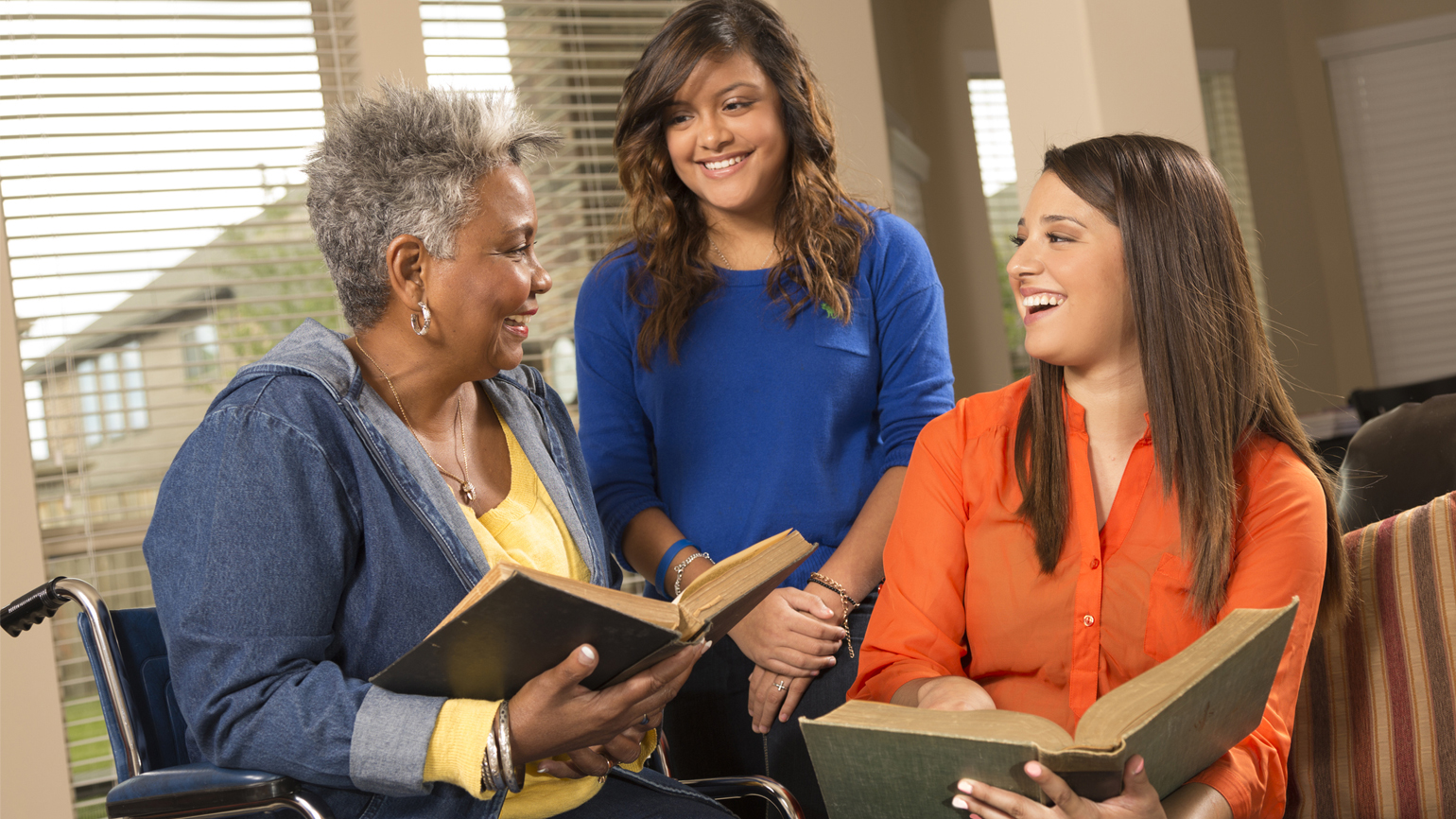
The daily demands of caregiving for an older loved one can be so all-consuming that it’s sometimes difficult to remember that they have many important experiences and memories to share. When you’re managing their care, you may begin to see them first as someone struggling with a set of health conditions. This is especially true when the person is dealing with memory loss. Yet encouraging a connection to important experiences in your loved one’s past by storytelling and reminiscing together is one of the most valuable things you can do as a caregiver.

Research shows that both older adults and their caregivers benefit in a variety of ways from storytelling. When an older person relays tales about the things that have mattered most in his or her life, it helps make the caregiving experience far more personal and rich.

Here are a few of the great perks that come from engaging your loved one in telling life stories:

1. Closer connection and empathy

Reminiscing is an excellent way to keep older adults from being defined by their health circumstances rather than their individuality. LifeBio, a program which supports reminiscence therapy in health care settings and is the subject of a current Benjamin Rose Institute of Aging research project, aims to improve and individualize caregiving by using life stories to build connections and increase empathy between caregivers and their patients or loved ones.

Family caregivers who have taken part in life story programs have said it helped bring them closer to their loved one and gave them a better understanding of the person beyond his or her health condition. Most participants also reported that they felt empowered to use what they had learned about their loved one to provide more empathetic care (Grøndahl VA, Persenius M, Bååth C, Helgesen AK. The use of life stories and its influence on persons with dementia, their relatives and staff – a systematic mixed studies review. BMC Nurs. 2017).

2. Personalized caregiving

The more you know about your loved one’s history and values, the better you can adapt your caregiving to reflect the things that are most important to him or her. Listening to life stories can give you much better insight into your loved one’s likes, dislikes, fears and beliefs, as well as context for certain habits and behaviors. You can bring what you have learned about tastes, values and memories into the care you provide. Stories may also alert you to things that may trigger bad memories, stress or negative feelings.

3. Greater well-being

Storytelling can improve overall resilience and have positive impacts on your loved one’s mental, psychological and emotional well-being. Research has found that engaging in storytelling can lead to higher mental stimulation, improved memory, deeper social connections and increased activeness in older adults.Participants in life story research also generally report higher levels of life satisfaction and greater overall satisfaction with the care they receive (Sierpina, M., & Cole, T. R. (2004). Stimulating creativity in all elders: A continuum of interventions. Care Management Journals, 5(3), 175-182).

4. Lessened care-related stress

As a caregiver, you can also benefit mentally and emotionally from encouraging your loved one to participate in storytelling. Research indicates that improved communication with your loved one can reduce care-related stress, which can prevent burnout and its negative effects, such as depression, anxiety and strain on your relationship. And don’t discount the more obvious benefits of listening to stories. You may just learn a lot about your family and its history, and get some good lessons on facing challenges in your own life!

4 Ways Daily Bible Reading Will Change Your Life

In today’s busy world, it can be difficult to prioritize daily Bible reading. Many of us are dashing about as soon as we wake up, and don’t stop moving until we go to bed at night. Even if the desire is there, life often takes precedence over reading the Bible consistently.

Yet, on the days when I don’t read God’s word because I haven’t stopped moving, I notice something—I’m in a bad mood.

Community Newsletter

Get More Inspiration Delivered to Your Inbox


This is not a coincidence. We were created to operate within a godly rhythm of work and worship. When all we do is work, we’re stretching our body to operate without the essential praise experience we need to replenish ourselves.

If we are to live the lives God designed for us, we must get back to what’s essential for us to thrive. We must move against the grain that tries to quicken our pace, slow down and pick up our Bibles. As a result, we’ll begin to see the world in a new lens, one colored with the hope and optimism we need to face the day.

As I made it a priority to read my Bible in the morning each day, I found my outlook on life was changing for the better.

Here are the four ways reading the Bible each day can change your life:

1) You’ll gain a new insight on your problems.

Bible stories are timeless because they deal with universally human themes like stress, worry, fear, love and hope. The disobedience of the Israelites in the Old Testament, for example, can help you see the messes of your life–and God’s mercy and grace towards you–in a new light. 

Whatever you’re struggling with, let the powerful stories of the Bible better clarify what you’re going through.

2) You’ll see God in a new light.

It’s difficult to notice God throughout your day when you forget how He operates. By reading the Bible each day, you can keep the nature of God and how He works at the forefront of your mind so you’ll always notice when He’s working in your own life.

3) You’ll refocus your attention on what’s important.

When you’re busy, your mind is focused on yourself, what you have to do and how you’re feeling. But reading the Bible expands your perspective. It reorients you back to what’s important, like giving God His due time with you first and attending to your family, friends and neighbors in love.

If you find your mind is stuck on yourself, let the words of the Bible carry you to a godly perspective—that everyone in your day matters.

4. You’ll make better choices.

The Bible teaches us that, “out of the heart the mouth speaks.” Without even being conscious of it, we can store up sinful things in our heart based on what we spend our time thinking about or consuming in the media. Over time, these harmful items can transform our outlook into a negative one and can cause us to act or speak in ways that aren’t godly or loving. That’s why we’re called to guard our hearts against such things. So you need to be intentional about storing up healthy things in our heart.

By reading the Bible each day, we can be sure to maintain a healthy and life-giving soul which will flow out of us in every facet of our lives.

Don’t let your fear of missing a deadline or being late to work stop you from making a daily connection with God first. Slow yourself down and read the Bible each day and watch how your life will change.

4 Tips to Address the Spiritual Side of Caregiving

My mom and I stood at the ship’s bow, braced against the chop. It was July, but a cold wind was ripping through Monterey Bay. Perfect weather, our tour guide assured us. My family was on vacation in California, and we were on a mission to see one thing—humpback whales. My mom, a pharmacist, studied marine biology in college. She’d been itching to go whale watching ever since. Now that we were on the boat, she could barely sit still. “I just love whales,” she said. “They’re so majestic.”

My mom isn’t alone in her love of those creatures. Whales have long fascinated mankind. And for good reason. They aren’t just majestic. They’re downright mysterious, from their massive size—blue whales stretch the length of nearly three school buses—to the haunting songs humpbacks use for communication. Then there’s their personality. Humpback whales, in particular, have been known to display humanlike emotions. Even compassion.

In fact, it was in Monterey Bay that, in May of 2012, researchers with the California Killer Whale Project witnessed something incredible. A pod of orcas—killer whales—attacked a mother gray whale and her calf.

The orcas killed the calf, but before they could eat it or attack the mother, a dozen or so humpback whales showed up. They made loud noises and slapped their tails against the water whenever an orca approached. For six and a half hours, the humpbacks kept up their vigil, protecting the gray.

Incredibly, it wasn’t an isolated incident. For decades, scientists have documented a puzzling phenomenon—humpback whales rescuing other sea creatures. It’s fitting in a way. After all, the most famous whale rescue comes out of the Old Testament: Jonah, the prophet, saved from drowning by a “big fish” that swallowed him and delivered him to shore three days later. Many theologians believe the story hints at Jesus’ death and resurrection. But could the tale indicate there’s more to whales than meets the eye?

Take what happened to Dr. Robert Pitman, a marine ecologist for NOAA Fisheries. On a 2009 research trip to the Antarctic Peninsula, Dr. Pitman and his team encountered two full-grown humpbacks harassing a pod of orcas. “The whole thing seemed a bit odd,” Dr. Pitman says, “because it didn’t seem like an attack.”

It was only after the team reviewed footage of the event that they noticed something else—a small Weddell seal tucked in between the humpbacks. Just out of the orcas’ reach. Had the humpbacks been protecting it? Or was the seal simply in the wrong place at the wrong time?

A couple days later, Dr. Pitman and his crew found out. They took another photo, this time of a humpback clutching a small seal to its belly. The whale was holding the seal out of the water and away from another group of hungry orcas. Again, the humpbacks had stepped in.

Intrigued, Dr. Pitman asked around. Other whale researchers had observed similar encounters. According to a study Dr. Pitman published in Marine Mammal Science, humpbacks intervened with orcas in 115 documented cases from 1951 to 2012. The humpbacks most often worked in pairs and protected a range of animals, from sea lions to sunfish.

The question remains, why do humpbacks show up in times of need, especially if there’s no apparent benefit to them? Are they simply protecting their territory, or is there a more benevolent purpose?

“When a human protects an imperiled individual of another species, we call it compassion,” Dr. Pitman says. “If a humpback whale does so, we call it instinct. But sometimes the distinction isn’t all that clear.”

Especially when that compassion extends to human beings. Nan Hauser, a whale biologist and the president of the Center for Cetacean Research and Conservation, experienced a humpback rescue firsthand. In October 2017, she was snorkeling and filming off the Cook Islands, in the Pacific Ocean. Suddenly, she came face-to-face with two adult humpbacks. One of them, a 50,000-pound male, made a beeline to her.

“He came right toward me,” Hauser recalls. “You have to push yourself to try to get away. But I couldn’t. This whale was relentless. My hand was up against the whale, and he was pushing me. The next thing I knew, he was nudging me and I was on his head.”

Over the next 10 minutes, Hauser struggled to remain calm. “I knew I was going to die,” she says. “He kept trying to put me under his pectoral fin, but I couldn’t go under because I’d drown. I had on just a mask and snorkel. Then he lifted me up, clear out of the water. I looked over and saw the other whale, a female. She was madly tail slapping.”

Then Hauser noticed a third shape in the water. At first, she thought it was another whale. But its tail wasn’t going up and down, and it was swimming from side to side, headed straight for Hauser. It was a 15-foot tiger shark. The whales had been keeping Hauser away from it.

The incident left its mark. Hauser couldn’t help but wonder if the whale had been conscious of her. A year and 15 days after the rescue, something incredible happened.

While out with another research team, Hauser spotted a humpback with markings on its tail similar to those on the one who had rescued her. Whale tail patterns are unique, like human fingerprints. This humpback swam right up to the side of the boat.

“He picked up his head and stared at me,” Hauser said. “He didn’t pay any attention to anyone else.”

She pulled up a photo on her phone of the male whale that had rescued her and compared it to this whale. The tail markings were identical. “We can present [these cases] professionally and scientifically,” Hauser says, “but at the same time, there’s a spiritual aspect to it.”

That’s something I experienced in Monterey Bay when our tour boat came to a stop. The captain had spotted something. Yes! By the bow, we saw two submerged humpbacks, a mother and her calf. My mom and I watched, mesmerized, as the calf—already some three tons—jumped out of the water, returning with a giant splash. We visited with the whales for an hour. But months later, I couldn’t stop thinking about them. Hauser, who’s been studying whales for nearly 30 years, feels the same way.

“They’re sentient beings,” she says. “When you look in their eyes, you can see they know something we don’t know. And it’s that deep wisdom and knowledge we can only hope to one day understand.”

4 Tips from Sleep Experts on Getting a Better Night’s Rest

A good night’s sleep is so important for your mental and physical health—but alas, in these stressful times it can be a challenge for us to lay our heads on our pillows and smoothly drift off into dreamland. There are many “sleep hygiene” tips specialists recommend when a night’s rest is elusive or less than satisfying. Start with these “4 Cs” to set yourself up for success.

1) Consistency
Sleep specialists recommend keeping your bedtime routine as consistent as possible, from the times you lie down for the night and rise in the morning, to the small rituals or activities you do to prepare yourself for sleep, like reading, stretching or wiping down the kitchen counter.

2) Comfort
Make your environment as relaxing and comfortable as possible to maximize the quality of your sleep. From soothing, pleasing colors to soft bed sheets and blankets, to the room temperature that works best for you, to minimizing clutter around your bed, think about what you can do to cue your brain to relax and unwind.

3) Caffeine Care
It’s important to feel satisfied with your food and drink intake before you head off to bed. But there are some things to avoid—particularly sugar and caffeine—too close to bedtime. If you are having trouble falling asleep, ask yourself if there is a simple change you could make to your coffee and tea routines to help ease your transition to dreamland.

4) Close Your Screens
Experts recommend exposure to natural light during the day and limiting light exposure as you prepare for sleep. That may mean shortening your screen time or only watching shows or playing online games on the couch, not in bed. Some of us use our technology to read, watch relaxing programs and generally relax. That’s ok—just be sure to set your device to its “evening” light setting, and try not to use it in bed.

What best practices for healthy sleep would you add to this list?

4 Tips from a Mother Caregiving for Her Mother

When my widowed mother first moved into the in-law apartment attached to our house, I wasn’t so sure it was going to work out.

For as long as I could remember, “prickly” was the best way to describe our relationship. When I was a little girl, I remember thinking how my mother and I were like two negatively polarized magnets fighting an invisible force that pushed us apart.

I loved my mother, but we were different in so many ways. She was comfortable with clutter. I was a bit of a control freak. My idea of fun was alphabetizing the books in my bedroom, while my mother loved to spend the day shopping.

My mother loved when friends stopped by unexpectedly for a cup of tea and a chat. I enjoyed company too, but preferred advance notice. Twenty-four hours. Minimum.

What, I wondered, would it be like with my mother living so close, with nothing separating us but a thin wall?

When it comes to caring for an aging parent, I am no expert. I’m just a woman with my own story to share. Here are the four most valuable lessons I learned.

1. Expect the Unexpected
Many times when caring for my mother, I was reminded of being a new parent; I often found myself paddling in uncharted waters, “making it up” as I went along. There is no one-size-fits-all manual for new parents because every child is different, and the same applies to caring for an aging parent.

Among the variables at play is the nature of the adult child-parent relationship (close/distant, healthy/unhealthy) itself. Add to that financial circumstances; housing arrangements; mental, emotional, physical and spiritual health; and the availability and willingness of the adult child’s siblings to help. Complicating matters even more is the fact that each of these variables is maddeningly fluid.

Inevitably, just when we had established a smooth-as-glass daily routine, a new (often health-related) challenge would crop up, shattering our presumptions. We would then have to pick up the pieces and start over, working to create what we came to call a “new normal.”

For example: When my mother came to live next door in her late 70s, her vision was poor, but she was still able to drive. She could maintain her independence, and so could I.

We found ways to help with her declining vision. My husband installed bright halogen lights in her living room. My sister, who lived an hour away, sent away for a special telephone with big numbers.

We used colorful plastic adhesive buttons to identify the proper settings on her thermostat and microwave. We bought an electronic magnifying monitor to help her read mail.

I didn’t know how bad my mother’s vision had gotten until I saw her stooped in her living room, reaching to pick something off the floor. She grabbed at it and then studied her empty thumb and forefinger. Again she tried to pinch the glimmering spot on the rug. Nothing. Frowning, she turned to me.

“Mom,” I said, “it’s just a patch of sunlight.”

She shook her head, wary to admit something was wrong.

“I don’t think I should be driving anymore,” she said.

With that one sentence, the familiar routine and healthy boundaries we had built suddenly became as blurred as her vision, and for a moment I couldn’t breathe.

If Mom couldn’t drive, who was going to take her to the grocery store? To doctors’ appointments? To visit her friends?

She was going to need help. Lots of it. My life was already so busy with two teenagers, work, a new puppy and managing my own household.

How was I ever going to meet my mother’s needs?

2. Don’t Be Ashamed to Ask for Help
For a while I tried to do it all myself. But inevitably feelings of burden, resentment and guilt piled up like dirty laundry.

It didn’t help when well-meaning friends would say, “Oh, you’re such a good daughter to be taking such good care of your mother.” No, I’m not, I wanted to say. If I were honest, I’d admit that much of what I do for my mother is more about duty than love.

When I picked up my Bible for guidance, I felt only more confused. Especially when I came across the Fifth Commandment: “Honor your father and mother.”

“What does that mean?” I grumbled to my husband. “To honor your mother? I mean, what exactly does God want from me? Is there such a thing as giving up too much for another?”

“I don’t know,” said Tom. “But you’re not the only person dealing with an aging parent. Maybe there’s someone who can help.”

3. Know That You’re Not Alone
The next day, I made an appointment to visit a minister at our church. She was an expert in geriatric pastoral concerns, beloved by many older members of the congregation. Now she leaned forward and listened intently.

“Oh, Kitty,” she said. “It’s so good you came to talk. You’re a classic example of a woman trapped in the sandwich generation.”

I’d heard of the Greatest Generation. The Me Generation. Generation X. But the sandwich generation?

“You’re being squeezed by both generational ends,” she explained. “You’re caught between being a wife and mother, and taking care of your own mother. I imagine you must feel pretty squished.” She smiled sympathetically.

“Yes!” I agreed. “There are days when that’s exactly how I feel.”

“You ask about the Fifth Commandment, what it means to ‘honor’ your mother,” she said. “It’s a good question. The word honor means to respect, to hold in high esteem. It can also imply a certain formality—even distance. God understands that you have primary responsibilities to your husband and children. I don’t think He expects you to be all things to all people all the time.”

“It’s important to realize that you’re not alone,” she said. “More and more of us find ourselves caring for aging parents. There are resources to help you and your mom.” She wrapped her arm around me. “You know, God put us here on Earth to help each other.”

With her help, I learned that our town provided a free service for seniors who needed transportation. And two mornings a week, an energetic woman came to help my mother with her correspondence and errands.

My sister pitched in with frequent visits and took my mother shopping and to her appointments. And all those ladies who liked to stop by for tea and a chat—my mother’s many friends—were only too glad to help. Although my mother could no longer drive, our life together became a “new normal.”

4. Look for God’s Surprises Along the Way
I read once that courage is not about being fearless but about taking action and moving forward despite being afraid. My mother, in the positive way she dealt with her blindness, is probably the most courageous person I have ever known.

Had I not had the opportunity to observe her as she confronted the challenges associated with aging, I never would have fully appreciated her strength and optimism.

Likewise, our two now-adult children were able to witness a woman who faced growing old with incredible grace. My mother was a wonderful role model for our whole family. I only hope when I am older that I can be so brave.

Having my mother live next door to us for the last 12 years of her life was a surprising and unexpected gift. Despite our differences, by the time my mother passed away at age 90, I had grown to respect, understand and love her in a way I would never have dreamed possible.

4 Tips for Overcoming Loneliness When You Have a Chronic Illness

In my 45 years as a registered nurse, I’ve seen how chronic illness and pain can isolate people, taking over their lives until it seems as if there’s no room for friends or family, even God. I know firsthand how dealing with physical and emotional pain can be one of the loneliest experiences you can ever have. It can even have physical and mental health consequences. Loneliness can make a person more at risk for cardiovascular disease, stroke, Type 2 diabetes, depression and a host of other ailments.

It’s a big problem. A study from 2018 found that half of Americans say they feel lonely. But there are things you can do to help you make deeper connections and overcome loneliness. I traveled regularly from our home in West Virginia to the Cleveland Clinic, where I underwent surgery to remove the painful tumors on the inside and outside of my face. I missed a lot of school and was ostracized by the other kids when I did go.

Mom had been a teacher, and she gave me what seemed like a curious assignment. In every waiting room at the clinic, I was to interview a person, then ask what their nurses did that was most helpful. Mom knew my time in hospitals had sparked an interest in one day becoming a nurse.

Over the years, I gained far more than a collection of stories. On every visit, there were patients I recognized, who made a point of talking to me. “How did your test turn out, Roberta?” “Are you still having that dizziness?” “How are things in school?” “You’re going to make a great nurse.” These were people who cared about me, not just as a fellow patient but as a person. It got so I looked forward to going to the Cleveland Clinic and reconnecting with them.

I’ve seen how reaching out to strangers has helped others as well. A couple years ago, I noticed the most joyful man at Starbucks. He’d buy his coffee, then steer his scooter over to a table near the cash register. He chatted up the other customers as they waited in line. Some people already seemed to be acquainted with him. For others, like me, it was clearly their first time. But no one was put off by the man. His greeting was genuine, and it brought a smile to everyone he met. Me included.

One day, I ran into him at the information desk in my doctor’s office. He volunteered there, though I’d never noticed him before. When he spotted me, he said, “Roberta! My friend who always reads a magazine while she sips her chai.” I asked how he was doing, and we enjoyed a short chat. Because he’d made a point of reaching out, we were no longer strangers.

Don’t shut yourself off from others
Chronic illness and pain can make you close yourself off. I’ve seen it happen to my patients and to me. I begin feeling as if I’ve been too much of a burden to my friends. That they’re surely tired of hearing about my aches and pains. I pull back, telling myself they don’t want to spend time with me, despite their repeated invitations to go out for lunch or antique shopping. A few years ago, I underwent my thirty-seventh surgery. My face was bandaged. I felt awful. I stopped answering my phone. Didn’t return messages. You’re turning your back on the very people who are trying to help you, I scolded myself. But it did no good. The voices telling me no one could possibly want me as a friend were even stronger.

Some friends stopped contacting me altogether. I understood. It became a kind of cycle of loneliness since I didn’t return calls.

Then, Bennetta, an old friend, left a message. She was the head nurse in the operating room at a hospital where I’d worked. “I’m getting a group of nurses together for lunch, and we’d really like you to join us,” she said. “It will be so much fun.” I played that message over and over. Someone wanted me!

I desperately wanted to see these old friends. But I’d have to do a load of laundry to have something decent to wear, and I had absolutely zero energy. Then I thought about how Bennetta had always been there for me, encouraging me. “You can do anything you set your heart to, Roberta,” she told me.

Doing the laundry and driving to a restaurant didn’t seem like such a monumental task after all. They were eating at a place just down the road. In an hour, I was ready to go.

I couldn’t believe how happy everyone was to see me. We told stories of the old days, and I laughed until I was crying. When the lunch was over, I didn’t want to leave. At least temporarily, my pain was gone. I had more energy than I’d had in weeks.

I knew the reason why. Connecting with others is actually healing. It releases the body’s natural pain-killing endorphins as well as oxytocin, the bonding or “cuddle” hormone mothers produce when they give birth. That’s why a hug can so often do wonders.

Find a support group
When I was working as a nurse in the VA’s gastroenterology department, I noticed that my patients with Crohn’s disease seemed particularly withdrawn. Gordon, a veteran in his thirties, reminded me a lot of myself. He wanted to meet people, but it was hard for him to take the first step. His depression and loneliness fed off each other. He was losing hope that anything would ever change.

“If I could get a group of Crohn’s patients together, would you join us?” I asked him one day. He was interested. So were the others. They were all ages, different branches of service. The first meeting was a bit awkward—until they realized how much they had in common, things no one else understood. Soon they were crowded around a table, mapping out the restrooms at the mall, a guide in case of emergency.

In the months that followed, I brought in doctors and dietitians to discuss symptom management, diet, stress and lifestyle issues. This new knowledge empowered the patients and gave them a sense of control, but it was much more effective in a group than if I had given them the information individually.

The group forged lasting friendships and planned their own activities, fishing trips and hikes, no longer worried about being within five minutes of a restroom. And Gordon? With the self-confidence he gained, he met the love of his life. The two of them married and found a shared passion in lay ministry. “Thanks,” he told me. “That group changed my life.”

I’d only wanted to help the veterans, but their energy and camaraderie inspired me. I decided to become more active in the neurofibromatosis community and volunteered to become a nurse-advocate for patients and their families. For the first time, I found purpose in this affliction that had brought me such misery and isolation. It was a point of connection. It gave me comfort to meet people who understood what I’ve gone through and introduced me to people who give me strength even today.

Get a pet
Sometimes the most reliable friends are the four-legged variety. There’s an elderly gentleman—Jack—in my neighborhood who ran his own business until illness forced him to retire. His wife died, and he grew even more isolated and lonely. I prayed for him and tried to reach out, but we never quite connected.

Then one day, I looked out to see Jack coming down the sidewalk in his electric wheelchair, an adorable black dog trotting alongside him on a leash. I went outside to ask him about his new companion. “I got him at a shelter,” Jack told me. “This little feller doesn’t leave my side. He just makes my heart feel good.”

I picked up a box of dog biscuits later at the grocery. The next time I saw Jack and his dog pass by, I handed Jack the treats. His face stretched into a wide grin as he tucked them into a bulging canvas bag hanging from his wheelchair. “Will ya look at this?” he said to his furry friend. “Now we have five different kinds.” Seems four other neighbors had come up with the same idea. Jack’s best friend had proved to be a people magnet too.

Deepen your faith
God never wants us to feel lonely, but there are spiritual benefits to alone time. When things are going well, I find myself praying almost in passing, as if I’m too busy enjoying life to give God my full attention. My Bible reading can get shortchanged too.

Last winter, I was given a medication in error; it made me desperately sick. I could barely walk from my bed to a chair. I prayed, a litany of all of my problems and what I needed God to do for me. I rehashed all the times in my life I’d felt down and lonely.

I grew weaker. Too weak to even find the words to pray. And it was there in that silence, in my aloneness, that I clearly heard God’s voice. It wasn’t thunderous. Or even really audible. More a soft beckoning in my spirit that filled the stillness, an absolute knowing.

I will never leave you or forsake you, Roberta.

I began to reflect on the faith walks of my patients. Bryan, a man dying from AIDS, who told me how God was with him every agonizing moment. So many of my hospice patients received comfort beyond measure from the source of all comfort.

Beset by loneliness, I made a startling discovery: I’d never felt God’s presence as I did then. It was only by surrendering that I truly knew his strength. On my desk, I found a note card and wrote to a woman I hadn’t talked to in months, reaching out, reminded again that no matter how isolated we might feel, none of us are ever alone.

For more inspiring stories, subscribe to Guideposts magazine.

4 Tips for Male Caregivers

As families adapt to the massive need of caring for vulnerable loved ones, an increasing number of male caregivers are emerging. While the circumstances of caregiving can be similar for both men and women, the approach to the role can differ. Three decades of serving as a caregiver for my wife with severe disabilities has given me some insight into how to guide men in maintaining their own emotional health throughout their caregiving journey. That lengthy experience unexpectedly intersected with the martial arts I study, and earning my black-belt also provided teachable moments for me as a caregiver. Here are 4 tips for male caregivers that I’ve learned from martial arts.

1) Go with the Flow

When I was first introduced to martial arts, I, like many men in my class, mistakenly relied on my body size and muscles to execute a technique and intimidate an opponent. Referring to how so many men flex, strain, and use body strength to force a technique, we often hear our instructor repeating, “If you muscle up, you’re doing it wrong.”

With that admonition echoing in my mind, I can’t help but see the parallels in my journey as a caregiver. When I try to force an issue with personality, persuasion, or even power, I’m usually doing it wrong. I tend to approach problems by “taking the bull by the horns and wrestling it to the ground.” Serving as a caregiver, however, is not something to be solved, but rather a responsibility we assume and proceed to integrate with our lives. Like trying to navigate rapids on a flowing river, repeatedly fighting the “caregiving whitewater” will simply wear us out. Our strength, no matter how great, is simply not enough to face the torrents of caregiving. We need to seek out physical, emotional and mental support whenever we can, and we need to let go of our desire to fix things that are so beyond our control. Release the need for control and just support our loved one however we can.

2) Breathe

Breathing slowly and purposefully is one of the best things we can do for ourselves. Inhaling for four seconds and then exhaling for eight seconds facilitates calmness. Breathing properly helps us remember our lack of control over most of the challenges facing us, as caregivers. We simply serve as stewards and do the best we can. Straining, while trying to “white-knuckle” through the crisis du jour of caregiving, renders us ineffective at best, harmful at worst. Calming oneself through purposeful breathing remains one of the most effective tools in my caregiving toolkit.

Get practical spiritual advice for everyday challenges in Spiritual Remedies​

3) Address the Closest Need

Some men can look at all the problems in our field of view and subsequently try to tackle all of them at once. The healthier approach is dealing with what is nearest to us. An opponent at a distance can wait until we have subdued the obstacle directly in front of us. Difficult things may lurk on the horizon for caregivers, but fixating and fretting over them is unhealthy. Planning is appropriate, but we better serve ourselves and others by focusing on what lies within our grasp, rather than living in the wreckage of our future.

4) Respond Rather than Anticipate

Trying to predict the behaviors or words of others can launch us into action before events unfold. A recent Hapkido sparring match drove this point home in an uncomfortable way for me. Feeling certain my opponent would throw a punch, I fixated on his shoulder and mentally prepared my move. He surprised me with a roundhouse kick to the chest. The discomfort felt on the mat pales to my embarrassment over the same type of behavior as a caregiver. I’ve lost count of how many times I jumped the gun to quell something before it started, only to get it wrong—and sadly, worsen the situation. Waiting to see how events unfold allows time to respond rather than to mistakenly anticipate a possible outcome.

When someone we love is hurting, suffering, or is impaired, men often leap to action and fight the danger. While a good trait in an emergency, it’s unsustainable in the marathon of caregiving—particularly in relationship dynamics. That impulse to conquer a problem not only exhausts us, it can also easily misdirect us, while simultaneously engaging us in too many battles on multiple fronts. As Don Diego stated to Alejandro in The Mask of Zorro, “Oh, yes, my friend, you would have fought very bravely, and died very quickly.”

While bravery and action remains important, discretionary valor is equally, if not more, essential as a caregiver. That discretion of knowing when to act, speak, or be still—comes with time and practice. If we, as men, must conquer something while serving as a caregiver, then overcoming our desire to feel in control is a worthy objective. The sense of being in control makes us feel better. The goal, however, is not to make ourselves feel better as a caregiver; the goal is to be better. That victory of being better happens for us as caregivers when we calm our hearts, focus on the immediate, and deal with what is—rather than what we anticipate or wish to happen. In equipping ourselves to flow with this raging river rather than fight it, we become healthier caregivers. And healthy caregivers make better caregivers.

Therefore do not be anxious about tomorrow, for tomorrow will be anxious for itself. Sufficient for the day is its own trouble. Matthew 6:34

4 Things Madeleine L’Engle Taught This Author About Cancer

I glanced warily at the IV bag hanging from the pole in my infusion bay. “Isn’t that the poison symbol?” I asked the nurse. He had donned a full gown, mask and gloves to hook up the chemotherapy drugs now coursing through my system.

“Yep,” he said. “We’re trained to handle these drugs carefully.”

“So I’m being poisoned,” I said, trying to joke.

“Basically.” He smiled, but his eyes were sad. “I’m sorry.”

When he left, I took a ragged breath, scared and angry. This was not where I wanted to be.

A year ago, life had been full. Sycamore Creek Church, the United Methodist congregation where my husband, Tom, serves as pastor in Lansing, Michigan, was thriving. Our two boys, ages four and seven, made for a lively household. I’d been offered the fantastic opportunity to write A Light So Lovely, a biography about Madeleine L’Engle, whom I’d long admired and who died in 2007. Her books for children, teens and adults sold in the tens of millions—most famously the Newbery Medal-winner A Wrinkle in Time, which in early 2018 became a Disney blockbuster. That same fall, Madeleine would’ve turned 100. It was a great year for a book about her spiritual legacy.

Then in May 2018, just as final revisions for the manuscript were due, I was diagnosed with Stage I breast cancer. “You’re looking at a left mastectomy,” my doctor told me. “I’d be surprised if you need chemo or radiation. Overall, a good prognosis.”

But things had not gone as expected. In a matter of weeks, my full and energizing life had collapsed into one frightening imperative: Survive.

My book was released in August, not long before I started chemo. Now, as I sat in the infusion center for my fourth round of treatment, powerful drugs pulsing through my veins, I found myself reflecting again on Madeleine’s wisdom and example. In a way, she’d been with me through this entire journey.

Here’s what she’d been teaching me:

When you are weak, God is strong.
At the turning point of A Wrinkle in Time, the main character, Meg Murry, has to return to a dark, dangerous planet to rescue her little brother. Her previous trip there nearly killed her. She balks at going again. She feels angry, frightened and unprepared. But ultimately it’s through those very weaknesses that she finds strength.

Shortly after my diagnosis, I needed Meg’s example. My mastectomy was scheduled for the following week. Tom drove me to the hospital. “How are you feeling about everything?” he asked.

“I’m ready,” I said. “I’m determined. I just want to get this over with.”

He took my hand. “Okay. Let’s go.”

After surgery, I went home, focused on healing. Then my surgeon called.

“The good news is, your lymph nodes are clear. The bad news is, your margins are not. You’ll need to come back for another surgery.”

I had been strong the first time. Now I was weak—in body and spirit. I wasn’t mentally or physically prepared for yet another blow to my system. I didn’t want to go back to the hospital, but I knew there was no choice.

Now I truly understood the challenge Meg faced. As Meg prepares for her second journey to the dark planet, one of her guardian angels sends her with these words: The foolishness of God is wiser than men; and the weakness of God is stronger than men. It’s an echo from 2 Corinthians, in which God tells the Apostle Paul, “My grace is sufficient for you, for my power is made perfect in weakness.”

I began to see that weakness is not failure. God will be strong for us.

It’s okay to be honest about the hard stuff.
In Madeleine’s memoirs The Summer of the Great-Grandmother and Two-Part Invention: The Story of a Marriage, she wrote honestly about her fears and anger in the midst of her mother’s dementia and her husband’s cancer. She admitted, “I cry out of fear for myself.” Like many of Madeleine’s readers, I found that kind of honesty not merely inspiring but freeing. Perhaps that could be a model for my own approach to cancer?

After my surgeries, the oncologist was direct. “The cancer hadn’t spread to your lymph nodes, but testing shows it to be very aggressive, which puts you at high risk for recurrence, ” she said. “Because you are so young, we recommend chemotherapy.”

Tom and I were devastated. We’d been looking forward to a fun summer with the boys while Tom took a long-planned sabbatical. Instead I would have to poison my body, suffer demoralizing side effects such as hair loss and pull back on the activities I enjoyed—all while recovering from surgery.

I wanted to be brave for my family, congregation and readers. But again Madeleine had taught me something important. She gave me permission to tell the truth about cancer, to be angry—even angry at God. She gave me words for sharing what going through chemo was really like.

Just after my third treatment, I took a picture of myself at the infusion center and posted it on social media. My bald head was covered with a chemo cap; I wore a mask to protect my diminished immune system from infection. My eyes above the mask were tired, my thinning brows furrowed with fatigue. It was a not a triumphant image of someone conquering cancer.

“I would take sanctification really any other way, to be honest,” I wrote. “Yet God is still rolling away stones for us in this irrational season, and our human dignity is not for the taking.”

The responses I received astounded me. One friend wrote, “Your posts are the kind of real I crave in the noise of the current world. Thank you for being brave and true enough to share glimpses of your journey.” I had learned from Madeleine to be honest about the hard stuff—and that such honesty was okay.

Redefine what it means to be well.
A theme that cropped up repeatedly in Madeleine’s writings about dark times was a quote from fourteenth-century Christian author Julian of Norwich: “All shall be well, and all shall be well, and all manner of things shall be well.”

In The Rock That Is Higher: Story As Truth, Madeleine tells of how she was once some 3,000 miles from home, on her way to a speaking engagement, when a truck smashed into the car and almost killed her. She was 72 years old, flourishing in a career that had spanned five decades. She had lost her husband several years earlier. Her children and grandchildren were launched in the world. She was, as she later said, as ready to go as she ever would be. As the medical team wheeled her down the hall to emergency surgery, she felt a strange calm, the clear sense that “all shall be well.” Even if she didn’t survive.

Unlike Madeleine, I wasn’t an aging author who’d already lost her husband and launched her offspring into the world. Throughout my chemo treatments, instead of repeating to myself, “All shall be well,” I thought, But I’m not done with life. Hovering in the back of my mind was the fear of cancer’s possible return. My faith in the happy ending had been rocked to its core.

Tom and I recalibrated our understanding of what it means for all to be well. Maybe a long life wasn’t the only definition. As Christians we’ve held to the promise that God has not designed the story of humanity to be, in the end, one big tragedy. God is at work even in our darkest times to bring hope, even if we don’t see the ultimate outcome.

Madeleine was a good example of how our current circumstances may feel dark—we may be walking in the valley of the shadow right now—but darkness doesn’t have the last word.

A cry for help is a cry of faith.
Leafing through the biography, I realized that “all shall be well” wasn’t the only truth Madeleine clung to in hard times. After her son, Bion, died of alcoholism in 1999, she didn’t mention that phrase at all—not that I could find. “Bion’s death has ripped the fabric of the universe,” she read from her journal on a PBS show. She told host Bob Abernethy that when suffering happens, “God comes into the equation. ‘Help.’ And we should never be afraid of crying out, ‘Help.’”

Over the six months of surgeries and chemo, our church family and neighbors stepped up to help us with everything from childcare to meals to lawn care. My doctor and several nurses even made house calls to help with things like checking my blood pressure. When I ended up in the ER for 12 hours due to a blood clot along the PICC (peripherally inserted central catheter), one family after another kept the boys busy, fed and loved—even overnight and into the next day—so my husband could be by my side. We learned to ask for help.

“Maybe the cry for help isn’t any less faithful than claiming that everything will turn out okay,” I told Tom. Madeleine had taught me that simply calling out to God is to acknowledge that God can help, that God does help. Just as we trusted our congregation to show up when we needed them, we could trust God to be there.

Recently I completed my final round of treatment. I’m grateful that Madeleine, from the depths of her own suffering, offered another option for how to cling to faith in dark times. Things may not turn out the way I’m hoping, in ways I’ve assumed they should be. But I can be honest about the hard stuff. I can be weak in the midst of God’s strength. The cry for help is a cry of faith, a beam of light in the darkness.

Madeleine L’Engle had given me exactly what I needed for the journey.

Read our Q&A with Sarah Arthur about Madeleine L’Engle.

For more inspiring stories, subscribe to Guideposts magazine.

4 Rewards to Bridging the Generations

Ashlee Cordell is a Research Assistant and Project Coordinator with the Benjamin Rose Institute on Aging

Many older adults feel isolated from those who are most dear to them, due to the often independent American way of life. It’s not unusual for family members to be largely separated, either by many miles or because of time pressures. This can leave older adults without the crucial support they depend on.

An estimated 27 percent of older adults age 60 years and older live alone in the U.S. and would reap significant rewards from expanding their social networks. According to Generations United, a national organization that focuses on intergenerational collaboration, two in three Americans would like to spend more time with others outside of their age group. A great way to achieve this is via intergenerational programming. It offers a variety of fun and meaningful ways for people of various ages to spend time with one another, with benefits for all. Among the primary rewards of intergenerational programming are:

To enjoy these benefits, your loved one must simply get together with people from another age group. The good news is that there are many positive ways for the generations to mix and mingle. As a start, you may want to explore the following well-established intergenerational programs:

If your loved one is unable to spend time with family and friends on a regular basis, you may want to also explore intergenerational offerings at schools, senior centers and community centers in your area. It’s possible that one or more of your local long-term care facilities may also have such programs, as well. Go to the Intergenerational Program Database on the Generations United website for additional information on intergenerational programs throughout the country. This directory includes a mixture of both one-time and reoccurring programs.

4 Reasons to Keep a Caregiver Journal

Recently, I happened upon a stack of vintage suitcases filled with old journals. The one covered in pink cabbage roses took me back two decades. I opened it to find the notes I’d kept during my mother’s final battle with cancer.

As mom struggled onto the exam table, I had a sinking feeling in my gut. Dr. Huckabee’s eyes locked with mine. “We need a bone scan right away, Roberta.” I didn’t need a scan to give me the heartcrushing news. Nurses know before they know. Mom’s cancer was back.

Two decades later, my body still felt the anxiety in those words. This time there would be no cure. Only care.

But something amazing happened in the moments it took to re-read my caregiver journal. Remembering the devoted attention Mom received her last year on earth, my anxiety became peace. Joy, even. I realized that earth angels had shown up everywhere, often in the most unlikely places. As imperfect as it was, my own caregiving had been part of it all. Many of us know that keeping a journal helps to reduce stress; as an added benefit it is free and can be done anywhere (My car became my favorite spot to journal and pray). But here are four other reasons that keeping a caregiving journal can make you happier, healthier—and a more effective caregiver.

Journaling helps you let go of perfectionism.

I smiled (yes, smiled) as I gazed at the first dozen pages of Mom’s caregiver journal. My entries were written in careful calligraphy with rose-patterned stickers dotting the pages. If her nurse-daughter couldn’t be the perfect caregiver, she could at least cover her errant handwriting. An evening at Bob Evans changed my thinking. After a 10-hour shift at the hospital, I was waiting for a to-go order of Mom’s favorite chicken with noodles. “I’m utterly exhausted,” I wrote in my caregiver journal propped against the counter. “How long can I do this and juggle everything else?” As soon as I’d gotten the words down, an inner voice taunted: What kind of daughter are you anyway? I was ashamed—and quickly blotted out my blemished thinking with large floral stickers. I didn’t realize a little girl was watching: “I paste stickers on my boo-boos too,” she said with a giggle. The sheer absurdity of those stickers turned my grief into giggles. From that moment on, I put my heart on paper with no expectations for performance. And I’ve never forgotten: In journaling and in caregiving, there is no place for perfection.

Journaling helps you feel less alone.

In her eighties, Mom wasn’t a candidate for aggressive treatment. Only chemo to shrink the tumors as a pain-control measure. As an oncology and hospice nurse, I’d cared for many end-of-life patients in similar situations. I knew what her future likely held. And I’d seen it firsthand with my father, who for a full decade had battled excruciatingly-painful bone metastasis from prostate cancer. One evening I stopped to deliver my parents’ evening meal and to set up their meds. I put on a brave front, but before I backed out of their driveway, I made this entry:

What kind of a cruel joke is this, God? Now I have two parents whose cancer has spread to their bone. How much longer can I wear my I’ve-got-it-all-together mask?

Every fiber of my being wanted to be there for my parents. But I was exhausted. Angry at the unfairness of it all. Utterly alone, with not a soul I could admit it to. As I turned the key in the ignition of my Taurus, my eyes fell upon my open journal. My safe place where I could say anything. I wasn’t alone at all. My every word had been heard.

Journaling helps you prioritize.

At the time that I was busy taking my parents to medical appointments, I was also starting over at midlife after a divorce, trying to fix up a tumbledown cabin and juggling a full-time nursing job. There was no end in sight and seemingly no order to anything. Every day my mental To-Do list got longer. One Monday morning, I jotted the week’s tasks in my journal. As I wrote, there was an astonishing order to my thoughts. I was hit with a stunning realization: Some of my entries were absolutely essential—like Mom’s lab work. Others, like those special crackers Dad wanted, could wait. My journal had brought clarity to my jumbled brain. As I separated necessities from niceties, I was able to move some items to the ‘Don’t Do Now’ list. A new sense of calm revitalized me. I became a calmer caregiver too.

Journaling helps you remember the good times.

As I revisited my caregiving journals, I was startled at the pockets of joy I’d missed at the time. An entry about my father’s radiation oncologist brought a smile. Dr. Leponto had eased Dad’s pain, restored his independence, and added 12 more years to his life. He’d improved so much he got to set up at his beloved flea market and play his fiddle in their bluegrass band. Dad had been so fond of Dr. Leponto, he’d wanted a special sweater to wear when he went for his treatments. A lambswool, V-neck cardigan with patch pockets, to be exact. An L.L.Bean mail-order clerk located eight different colors in Dad’s size. My father, who’d never asked for anything in his life, settled the score from his recliner. “Didn’t have me any school clothes growing up. I want them all! Dad’s diagnosis didn’t change—but his outlook sure did. A look back in my journals reminded me how much life was tucked inside those end-of-life moments.

Mom’s sweet smile and endearing ways. Dad’s engaging sense of humor in the worst of circumstances. Without knowing it, I’d collected moments that would sustain me forever. When we journal, not only do we get to live twice, but the life lessons are right there in black and white for us.

4 Practical Financial Tips from a Monk Turned Money Manager

Doug Lynam never expected to go into finance.

Growing up, he hated money. His family was wealthy and he saw firsthand how money could destroy relationships. Lynam spent years searching for a life different from the toxic one he saw his family living. He tried being an anti-materialist hippie and joined the Marines, but it wasn’t until he met a Benedictine monk and joined a monastery that he began to find a sense of purpose.

“It was a community full of love and kindness and support and compassion,” Lynam told Guideposts.org. “I was taking a vow of poverty and I thought that would get me away from the world of money.”

But a few years into his life at the monastery, the community started having financial difficulties. Lynam stepped in to figure out what was going on.

“The community started having some serious financial difficulties,” Lynam said. “I had to jump in and pull the community through bankruptcy. In the process I had to learn everything I could about money management.”

As he worked to clean up the finances of the monastery, Lynam noticed that many of the guests who came to the monks with spiritual problems also had financial problems.

“People would come to me and ask to help pray for them, to get relief from their money struggles and their various crises and I always did that, but I also insisted that we make a budget,” Lynam said.

Lynam’s work with the monks and guests at the monastery reframed his view of money. He stopped believing money was the root of all evil, and began to believe money could be useful.

“Money is a tool that we can use to put our values in action,” Lynam said. “If we have our values straight then money can increase our capacity for love, it can increase our value for service and it allows God’s love to flourish abundantly in our lives in the world around us.”

Lynam eventually left the monastery to work as a financial adviser. Here are four of his most practical financial tips:

1. Identify your financial emotional baggage

Before diving in to the numbers, Lynam recommends people assess their emotional relationship with money.

“The number one thing is to get through that emotional baggage…and see where people’s anxiety around money really lies,” Lynam said. “I call it your money emotional intelligence. People’s emotions around money are very complicated. And everyone has money baggage.

If you haven’t dealt with those underlying emotional issues, you’re always going to be sabotaging [your] financial [life].”

2. Pay yourself first

“The number one [thing] people need to understand is that if you’re always paying bills and spending first, then you’re always going to be broke,” Lynam said.

Lynam advises people to prioritize saving and investing over buying. Before paying bills or buying things, he recommends people put money into savings.

3. Stick to a budget

It might sound obvious, but Lynam said a budget is crucial for financial success.

“The biggest trick to budgeting that I find is helpful for folks is to automate everything,” Lynam said. “Automate your direct deposit, automatically pay your bills that are recurring. Automate your savings, automate your investing.”

Why? Lynam explained that by simplifying big decisions, people are less likely to get wore down with financial decision-making fatigue.

4. Start by saving small

A common mistake Lynam noticed his clients making was trying to jump from saving nothing to saving a large percentage of their income—an unrealistic goal for most people.

“Always try to save a portion of a pay raise,” Lynam said. He advises people to start by saving one percent and increase by one percent each year.

“When you’re starting out it’s really not a realistic goal to save 15 percent of your income,” Lynam said. “A more gradual technique that most people can do is…save one percent this year. Can you save one percent of what comes in the door? And then next year could you save another one percent? And then another one percent?”

Over time this technique allows people to save the 15 to 20 percent that Lynam recommends people set aside to ensure a secure retirement.