Embrace God's truth with our new book, The Lies that Bind

Pray According to God’s Ability, Not Yours

What would you do for your children if you could?

My wife and I were always careful to provide for our son and our daughter, without spoiling them. We did our best to give them good things while also insisting that they learn to save and plan to earn and buy things themselves. While other families we knew gave their children new cars on their 16th birthdays (or soon after), we acquired a used Jeep Cherokee for both of our kids to share once they both had driver’s licenses. Even then, we didn’t give the car to them; they were expected to make payments to us and traded weeks as the primary driver (our daughter, however—who is the older of our two children—would tell you that she got the better end of the deal because her younger brother was grounded so often that she got to drive the Jeep far more often than he did).

Light for Life NASB Study Bible in Article

Still, while I didn’t want to raise spoiled kids (and if you knew them today, I’m sure you would agree that they both matured into thoroughly unspoiled, well-rounded adults), there have been many times I wished I could have given them more—or better—things than our financial situation usually permitted. Disney World, for example (though they visited twice as kids). And college (we sent them both to fine schools, but I wish we hadn’t had to cut as many corners as we did).

Maybe you can identify. Maybe there are things right now that you wish you could do for your children or grandchildren, if you weren’t limited by time, space or resources.

But our Father in heaven is not limited. He is all-knowing, all-seeing, all-powerful. He is not a creature but the Creator. He is no victim of circumstances but the victor over every circumstance. He is not bound by the laws of nature—or by the state of the economy. He transcends every limitation. He owns and controls and rules all. He is your boss’s Boss. He is your king’s King. He is Ruler of Storms and the Hope of the Desolate. When Jesus tells us to pray to “our Father in heaven,” He is telling us to pray in the reality, the awareness, of God’s unlimited ability. In Too Busy Not to Pray, pastor and author Bill Hybels wrote:

Many of us have pressing personal needs and serious problems that ravage our lives, but we don’t ask God for help because somewhere, well beneath our surface layer of faith and trust, we don’t believe God has the power to do anything about them.

The fact is, of course, that God is capable of handling any problem we could bring him. Creating planets isn’t much of a problem for him. Neither is raising the dead. Nothing is too difficult for God to handle—but he’s waiting for us to recognize his power and ask for his help

So when you pray, remember that your Father in heaven is able—abundantly able, infinitely able. He is able to anoint and depose kings. He is able to part waters. He is able to raise the dead. He is able to do what He says He will do (see Romans 4:21, if you don’t believe me). And He “is able to bless you abundantly, so that in all things at all times, having all that you need, you will abound in every good work” (2 Corinthians 9:8, NIV). “For no word from God will ever fail” (Luke 1:37, NIV). “With God all things are possible” (Matthew 19:26, NIV). Nothing is too hard for Him (see Jeremiah 32:17).

Pray in the awareness that God is not limited as earthly parents often are. You don’t have to get the words “just so.” You don’t need to get His attention or convince Him of your need. You don’t need to advise Him in the details. When you ask, He hears. What you ask for, He can give. He knows what His children need and when they need it, and He is able to hear and answer and “bless you abundantly, so that in all things at all times, having all that you need, you will abound in every good work” (2 Corinthians 9:8, NIV).

Adapted from The Red Letter Prayer Life: 17 Words from Jesus to Inspire Practical, Purposeful, Powerful Prayer by Bob Hostetler, Barbour Books.

Pray About the Little Things

Many people don’t pray about the little things because they feel they’re not worth their time. They reserve prayer for those high and mighty occasions when they’ve exhausted every possible human solution and prayer is all that’s left to them. The truth is that they really don’t want to invest prayer energy in things of seemingly little significance. And they’re missing spiritual blessings as a result.

When something breaks your heart—large or small—it isn’t going to escape God’s attention. If you believe that God is able to work out all things, even small ones, for his good purpose and his glory, then of course you should pray about even the tiniest of matters. Your request for God’s work in your financial investments, in the food you’re about to eat, and in your study habits may be just the thing he can use to build his kingdom in your life.

Rejoice in All Things in article ad

Prayer has unbelievable benefits to you, even when you’re just praying about a lost set of car keys. Let’s take a look at some of the advantages of incorporating prayer into even the smallest details of your life. Praying for the little things teaches you to depend on God. When you’re praying, you’re acknowledging your dependence on God. You’re deliberately unplugging from your earthly and human sources of strength and choosing rather to plug in to God’s holy and infinite source.

When you choose to seek God’s leadership, direction, and provision for something as seemingly insignificant as a parking place, the right wording of a letter, or what clothes to wear to the office, you’re acknowledging that you want and need God’s direction in every aspect of your day. You’re inviting Jesus to rule and reign as Lord over every last detail of your life. That’s prayer that teaches you how to depend on him in everything.

If you limit your prayers to just the big, dramatic things in your life, you miss hundreds of opportunities every day for sweet communion with God.

Phyllis Tickle and the Power of Daily Prayer

Phyllis Tickle was the author of  The Divine Hours, a kind of manual for daily, liturgical prayer, along with many other books about prayer and faith. In this excerpt from Phyllis Tickle: A Life, published after her death, discover how she wrote the beloved book, and what it meant to her to pray the divine offices–the Christian prayers said at certain times each day. Here, too, is the powerful and personal prayer of her own creation that she said twice daily.

The readings in prayer manuals usually follow a pattern of Gospels in the morning office, Old Testament or Epistles at midday, and hymns at Vespers, but [as she wrote The Divine Hours] Phyllis relished being able to make these choices, now, for herself and others—including the juxtaposition of the psalms, the refrains, and so on, within each office, to the biblical texts.

Witnessing Heaven In Article Ad 827x123
The book cover of Phyllis Tickle’s
new novel ‘Phyllis Tickle: A Life’

“I caught myself smiling over and over again, my heart light and my spirit soothed by the pleasure of dropping a psalm in place beside a section of the Gospels that had always somehow seemed to me to be its natural and euphemous mate,” she said. Phyllis set to work and  for twenty-two months of ten-hour days, she and a research assistant (her daughter, Rebecca) completed the work. Mother would lay out the various texts, often clipped and taped in place on two-page spreads of a notebook, and daughter would type it all up.

After praying the hours five times a day (Phyllis often skipped the 6:00 p.m. office of vespers in her personal practice) for more than thirty years, stopping to pray throughout the day while compiling the first of The Divine Hours added layers to her experience. . . 

In the same sense of the medieval Benedictine monks, praying “the Hours” was, for Phyllis, “work for God.” But spiritually, the best explanation she ever provided for why she remained faithful to this form of prayer throughout her life was to Bob Abernethy of PBS:

“It is a way of constantly keeping this open. Regardless of how much I sin, regardless of how many errors I make, regardless of how awful I perceive myself to be at times in my decisions and in my reactions to people and in my greed and lust, I’ve still got this core. I’ve still got, in the middle of my day, in the middle of all of my consciousness, this one passageway, this one place that connects me with the Divine, that’s there, that’s solid, that says, “Are you distressed by all these things you are? Are you heartbroken about all these things you have just done? It’s all right. Come here.” When I’m standing in that one place that is the Divine Office, I know God’s in his heaven and I’m part of that heaven.

Unbeknownst to her readers, to whom she was emphasizing the spiritual vitality of non-petitionary (non-Protestant) prayer in these books, and unknown to her closest friends, who simply never asked, Phyllis also prayed twice a day every day—post-nones and pre-compline—a series of prayers, which evolved and changed over time. These prayers asked God for help and guidance. She prayed them by rote, but they were of her own devising.

She seems to have written them out only once, and at the request of her closest friend in prayer, when she was seventy years old. They “constitute a kind of private credo,” she said, used “so to speak, to record the One to Whom I [am] praying, like taking a picture of the unpicturable.”

Strengthen Your Faith with Free eBooks on Prayer, Bible Study and More

Emphasizing that the language of these private prayers has changed slightly over the years, she summarized it on this singular occasion this way. Notice the borrowing of language from both East and West.

Lord Jesus Christ, Son of the living God, have mercy on me, a sinner. (Several times) Lord Jesus, forgive my sins (then named usually.) Take from me every thing, person, desire, pretension, and habit that keeps me from perfectly loving You and serving the Kingdom. I would love the Lord my God with all my heart and all my mind and all my soul and all my strength, and my neighbor as myself. Place Your yoke upon me and give me Your burden and take mine; and keep me on the narrow path and bring me through the straited gate.

May that heart and mind be in me that were also in You, and may I be a living branch of the living vine. Give me clarity of vision, profundity, keenness and quickness of intellect, grace and effectiveness of delivery, humility, focus, energy, and passion. And grant that I may be like that piece of fertile ground You spoke of when You were here: the thorns having been raked away and burned, and the weeds have been pulled and burned as well, and the rocks and stones having been tossed aside, the word may fall, take root, and bear much fruit.

I ask grace. I pray as well for the guidance, correction, and instruction of the Holy Spirit. I pray for the protection, guardianship, communion, and all-encompassing, all-surrounding, total embrace of the Holy Spirit, love and discipline. Open me from the core out that this may be a life of praise and thanksgiving, obedience and charity, humility and service. Grant that I may be filled with the peace of God, the love of God, the fear of God, the Spirit of God, the kingdom of God, the presence of God, the favor of God, the wisdom of God, the ways/works/words/ and worship of God, the knowledge of God, trust and faith.

Oh God, with Whom all things are possible, save my soul, my spirit, my life and those of my husband into Your Kingdom here and hereafter, now and forever; and renew all the component parts of them—our bodies, hearts, minds, souls, and spirits—and grant that our strength may mount up like the eagle in accord with Your purposes and those of the Kingdom.

Excerpted from Phyllis Tickle: A Life by Jon M. Sweeney © 2018 by Jon M. Sweeney. Used by permission of Church Publishing.​

One Simple Word That Can Change Your Day

How do your days typically start?

If you’re like most people, you probably have a fairly set routine. Something like washing your face, brushing your teeth, combing your hair, getting dressed and eating breakfast. Maybe not in that exact order. And maybe you skip breakfast or pick it up on the drive to work.

Pray a Day Vol 2 In Article Ad

Most days, you probably have little time for much else. But sometimes just praying a single word in the morning can transform the direction of your day. One word. What could be simpler? These one-word prayers that make a great start to any day:

1)  Thanks

I confess: I often start my day reluctantly. In a fog. With a bad attitude. My mood changes, however, when the day begins with “thanks.” Thanks for a good night’s sleep. Thanks for hot water. Thanks for indoor plumbing (ever lived without it?). Thanks for toothpaste. Thanks for clothes to wear, food to eat and coffee to drink, hallelujah, amen! 

2)  Come

Ancient Israel’s King David prayed, “Lord, do not be far from me. You are my strength; come quickly to help me” (Psalm 22:19, NIV). We don’t need to pray this because God is far, but because we often need reminders of His presence. “Come” reminds us of our need, of His willing presence, of available strength and help.

3)  Lead

Those who pray the Lord’s Prayer ask for God to “lead us,” though most rush right into the next phrase: “not into temptation.” I like to insert a pause between the phrases so as to ask, first, for God’s leading and guiding in my life, and then for His help in avoiding and turning from temptation. Often all of that can be expressed in the single word: “Lead.”

4)  Bless

Some of us say grace at meals, beginning, “Bless us, O Lord…” It’s a good prayer. And a one-word request for blessing is also a great way to begin a day. “Bless.” It’s a great, and  thoroughly biblical, way to pray. Pray it for yourself. For your day. And for those around you, for those you meet on your commute, for those you share an office with, for those you pass on the sidewalk and more.

Try any or all of these one-word prayers to start your day, and watch what happens. 

One Bible Prayer to Help You Get Through Doubt

Do you wish you had more faith? Less doubt? If you’re anything like me, you have my sympathy. In those moments of doubt your faith may flee, you may question nearly everything and feel as if you’re holding onto faith by a thread. And that’s exactly when prayer can seem harder than usual. We might wish for some kind of treatment or trick that will banish doubt and buttress our faith, small though it may be. There is.

There’s one prayer I use often to pray through doubt, and it happens to be a Bible prayer. I don’t know anyone who’s claimed it as a “life verse,” but it’s been a lifeline to me many times.

A Journey of Faith In Article Ad - Avail Now

It’s a prayer from an occasion right after Jesus’ literal “mountaintop experience” when He and His closest followers came back to earth, literally. A man had brought his son to Jesus for healing but Jesus wasn’t there; He was up on the Mount of Transfiguration. 

So the man located some of Jesus’ disciples among the other nine who had stayed behind. The desperate father told them that his son was possessed by a demon. Those disciples tried to call the demon out of the boy—and failed. When Jesus arrived at the scene, the father explained his son’s predicament and the disciples’ failed efforts. Jesus said, “Bring the boy to me.” The account goes on:

So, they brought him. When the spirit saw Jesus, it immediately threw the boy into a convulsion. He fell to the ground and rolled around, foaming at the mouth.

Jesus asked the boy’s father, “How long has he been like this?”

“From childhood,” he answered. “It has often thrown him into fire or water to kill him. But if you can do anything, take pity on us and help us.”

“‘If you can’?” said Jesus. “Everything is possible for one who believes.”

Immediately the boy’s father exclaimed, “I do believe; help me overcome my unbelief!” (Mark 9:20-24 NIV).

That’s it! That’s the prayer: “I do believe; help me overcome my unbelief!” Is there a more honest prayer in scripture? 

The story goes on to tell how Jesus commanded the demon and delivered the boy. He explained to His baffled disciples that this kind of deliverance happens only as a result of prayer and fasting. But it’s the father’s prayer that has carried me through many doubts and returned me to a place of faith. 

Those eight words do five important things for me:

1)  They affirm (and remind me) that I do still have some faith; I haven’t lost all of it. That’s important, especially when I feel most doubt-ridden.

2)  They admit, honestly, that my faith is small, that unbelief is also working in me.

3)  They include a petition, asking the Lord to help me overcome my unbelief.

4)  They keep the conversation open between me and the Lord. Instead of doubt silencing my prayers and shutting down my communion with God, this prayer keeps us talking (which is perhaps the greatest benefit of all).

5)  And they apply to any situation, because (speaking only for myself, mind you) in virtually every circumstance, my faith is tempered by doubt. Even at my best, doubt still seems present, in some measure, at least.

Try it. “I do believe; help me overcome my unbelief!” Keep this prayer in your heart and mind. Have it ready when doubt assails you. Pull it out when darkness descends. Repeat it often, as frequently as necessary—a single prayer to bolster faith and banish doubt.

Never Give Up on Your Prayers

Many times, an answered prayer is just around the corner, but we give up too soon. This is a key reason why many people miss out on opportunities. Looking back to when I was young and all throughout my teen years, I remember praying for my father to reconnect with God and the church. My family and I prayed long and hard for this for over 20 years.

What would have become of my dad if we had stopped praying for him? It is now approaching his 80th birthday, and he leads the noon prayer service at his church and the food pantry ministry. In response to this answered prayer, I am happy that my family never gave up praying for him even when it seemed impossible. We must remember to never give up on our prayers.

Sweet Carolina Mysteries In Article Ad

Ask the OurPrayer team to pray for you!

What if Thomas Edison, Oprah Winfrey, Steve Jobs and so many others who have made significant contributions to our world gave up before their time? Many fulfilled dreams are just around the corner.

Dr. Norman Vincent Peale’s manuscript, The Power of Positive Thinking, was rejected many times before it was published. Had he given up, his writing wouldn’t have touched the millions upon millions of lives that it has since being published.

If at first you don’t succeed—it means you’re human. If your prayer is not answered, it doesn’t mean that it won’t be or that God hasn’t heard it.  Keep on praying. Keep on working toward your dream. What keeps you going? Please share with us.

Lord, help us to keep on going and not give up.

My Favorite Three-Word Prayer

I can think of three places in the Bible where someone says this prayer. There’s Abraham when he was tested and asked to take his son Isaac up to the mountain and offer him as a sacrifice.

When God first called him, Abraham said, “Here I am.”

Mys of Blackberry Valley In Article Ad

Or in the New Testament in the Book of Acts, the disciple named Ananias was told to go to the man named Saul who had been blinded on the road to Damascus and heal Saul of his blindness through the gift of the Holy Spirit.

When God called to Ananias in a vision, Ananias said, “Here I am.”

And then there was the prophet Samuel when he was a young man serving the old priest Eli. Three times he heard the voice of God calling him and three times he thought it was Eli.

Each time he said to Eli, “Here I am, for you called me.”

“No, I didn’t call,” Eli said again and again until that third time he realized that Samuel had heard the Lord. That’s who was calling him. 

The next time the Lord called, Samuel was ready. “Speak,” he said, “for your servant is listening.”

The Bible is full of many prayers, long and short ones, poetic expressions like the psalms or honest heartfelt pleas like the man who told Jesus, “I believe. Help my unbelief.” (Haven’t we all been there?)

But there’s something straightforward and open about not asking God for anything, not pushing for any favors, but just opening yourself up and saying, “Here I am.” 

When anyone in the Bible says, “Here I am,” something happens.

Put yourself in a quiet place and let your yearning for God be known. “Here I am,” you can say. Let something happen.

Mornings with the Lord

It’s morning. Daylight is a soft promise pressing between the drapes. I push the covers back and head for the kitchen. Time to get the coffee going.

Time for my time with the Lord.

Walking with Jesus L&E evergreen_in article ad

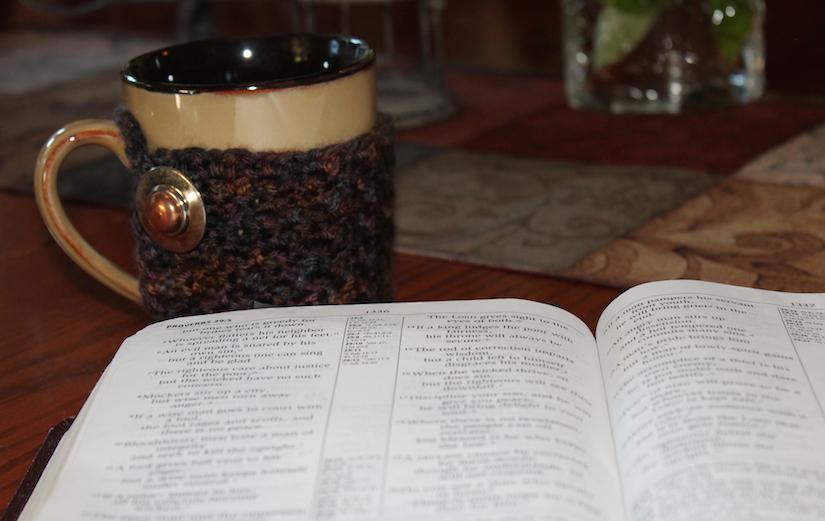
Shawnelle's morning cup of coffee and BibleThe perk of my morning fuel is gentle and slow. But I’m patient, and before long I fill my cup. The house is silent. Still. The frantic of the day is unborn.


I move back to the bedroom for my Bible, and it’s then that I catch a glimpse of morning-me in the mirror in the hall.

Here I am. Disheveled. I’m wearing my favorite frayed robe (the one with the deep pockets that hold everything from scissors to Band-Aids to a Spider Man action figure…magic pockets, the boys say).

My eyes are swollen. It’s easy to tell that Isaiah had a tummy ache, and I was up half the night. I look at my hair. It’s wild mess of tangles and tufts. My only makeup is a shadow of mascara from yesterday. No foundation to cover freckles or smooth out whisper lines of age.

I am clearly a mess. Not at my best. Definitely not looking like a princess daughter about to present herself to the Father King.

But as I stand in there in the hall, I understand that this is okay. In fact, it’s dear because it’s the way God receives us. He welcomes us in our imperfection. He opens His arms to our mess. He invites us to come to Him as we are. Weary and worn. Tattered in our humanness.  

Our gracious God loves us and beckons us in our natural state. He doesn’t wait for us to be fixed up. It’s not His desire for us to look good enough. He doesn’t wait to commune with us until we are cleaned up. Dressed up. Pinned and painted and pressed looking the worthy of the part.

He takes me as I am.

This is the powerful and precious truth of His grace.

I know I need to get moving. These morning moments are numbered. I’m anxious to listen to the Lord as He speaks into my life through His sharper-than- a-sword, living Word.

I’m needing the blessing of sharing my heart, too. To speak my praises and pleas. To hear and be heard. To be stirred by His presence and the intimacy of our love.

There’s no time to be standing, smiling in the mirror.

But the gladness of grace fills me as I continue down the hall.

Thank you, Lord, for your plan of salvation through your son Jesus Christ. Thank you that you take us as we are–messy and stained with sin.

Then you color us clean with grace!

Amen.

Make Prayer Your First Resort, Not Your Last

Too often we treat prayer as a last resort.

“All we can do now is pray,” we say. We’ve tried everything else. We have run out of options. So we pray.

Daily Strength for Women in Article ad

But that just shows that we don’t truly understand the nature of prayer.

We may often feel helpless, especially in times of crisis and tragedy, but that doesn’t mean that prayer is a last resort. Prayer is not inaction. It is not a throwing-up-of-the hands or a folding-of-the-hands-with-a-helpless-sigh. Oh no. Prayer, rightly understood, is action. It is hard work. It is resolve. It is revolution. Prayer should be the source and foundation of all other efforts. After all, God says, “Call on me in the day of trouble” (Psalm 50:15, NIV). And the Bible exhorts us: “in every situation, by prayer and petition, with thanksgiving, present your requests to God” (Philippians 4:6, NIV).

Sure, we know that Jesus prayed so earnestly in the Garden of Gethsemane that “his sweat was like drops of blood falling to the ground” (Luke 22:44, NIV). But there is no reason to think He waited until the last moment to express Himself in prayer; the Gospel accounts depict Him praying repeatedly, as a first resort, not as a last resort:

And rising very early in the morning, while it was still dark, he departed and went out to a desolate place, and there he prayed (Mark 1:35, ESV).

But Jesus often withdrew to the wilderness for prayer (Luke 5:16, NLT).

At about that same time he climbed a mountain to pray. He was there all night in prayer before God (Luke 6:12, The Message).

The fact is, we often turn to prayer in desperation because we failed to pray as a first resort. When we neglect prayer, we are more likely to paint ourselves into corners, so to speak, and end up at our wits’ end. How much better it is to resort to prayer early and often, and in so doing not only follow the example of Jesus, but also guide, and even sanctify, every effort we make in the course of our daily lives. 

Make Prayer Part of Your Daily Routine

Is prayer part of your daily routine, or is it reserved just for seasons of trial? One of the most important factors in handling difficult times is to be a person of prayer before crisis hits.  Here are a few reasons to keep up what I call “peacetime praying.”

1. Peacetime praying builds spiritual momentum.
Prayer brings God’s blessing and God’s provision. A praying person lives with the kind of spiritual momentum and favor that only consistent prayer can bring.

Sweet Carolina Mysteries In Article Ad

2. Peacetime praying produces spiritual intimacy.
Prayer brings you closer to God, and you’ll need all the intimacy with God you can get when life's storms break out. I’m sure this is partly why Paul encouraged us to “pray without ceasing” (1 Thess. 5:17 NASB). He knew firsthand the importance of storing up spiritual intimacy for difficult times of suffering.

3. Peacetime praying provides spiritual perspective.
Consider these lies: If you had been a better Christian, this never would have happened. You deserve the pain you’re feeling. God’s obviously forgotten about you. Have you ever heard any of these lies? I certainly have. And if I don’t have a healthy dose of spiritual perspective, I just might start believing them.

Peacetime praying girds my heart and mind with the spiritual truths I will need to make it through tough times.  Here are a few suggestions to keep consistent prayer time with God:

1. Have a regular prayer time.
Don’t wonder when or if you’ll get to pray again. Have a set time for prayer and protect it. Be as committed to prayer as you are to meals.

2. Have a regular prayer place.
Don’t wonder where you’ll be able to find a quiet place for prayer. Build a location into your discipline of peacetime praying. When your set time for prayer rolls around, be unyielding about staying in your set place.

3. Have a regular prayer plan.
Be systematic about your conversations with God. I use my Bible as my daily prayer guide. I can open it on any day and have plenty to talk to God about. Should the Spirit choose to lead me to different subjects, I try to be sensitive and obedient to that. But when I sit down to talk with God, I know where I intend to go. It takes much of the guesswork and wasted time out of my precious moments with God.

Let God Melt Your Heart of Stone

“Love the Lord your God with all your heart and with all your soul and with all your mind” (Matthew 22:37).

Jesus tells us this is the first and greatest commandment–and it’s perhaps the hardest to keep. Sometimes we can honestly say, “All my longings lie open before you, Lord; my sighing is not hidden from you” (Psalm 38:9). Other times we truly try, but seem to make little progress in giving our whole life to God.

Pray a Day Vol 2 In Article Ad

Why? It’s not always that we have deliberately hardened our hearts. Sometimes it’s like a rock has grown around our fears or worries or hopes, making them impossible to open and impossible to release. But nothing is impossible if we seek God’s help.

These three prayers can help when your heart seems cold and stony:

1. Lord, open my heart through humility.
“I live in a high and holy place, but also with the one who is contrite and lowly in spirit, to revive the spirit of the lowly and to revive the heart of the contrite” (Isaiah 57:15).

2. Lord, open my heart because I am a sinner.
“God, have mercy on me, a sinner” (Luke 18:13). “Cleanse me…and I will be clean; wash me, and I will be whiter than snow” (Psalm 51:7).

3. Lord, open my heart to obedience.
“Don’t you know that when you offer yourselves to someone as obedient slaves, you are slaves of the one you obey—whether you are slaves to sin, which leads to death, or to obedience, which leads to righteousness?” (Romans 6:16).

When we offer God our all, we must offer it with the admission that we are flawed and imperfect, and attached to the flesh in ways we can’t completely see or understand. We offer every weakness and sin, every wart and blemish. And what does God do in return? “I will give you a new heart and put a new spirit in you; I will remove from you your heart of stone and give you a heart of flesh” (Ezekiel 36:26).

Let it be so, Lord Jesus!

John Wesley’s Prayer

John Wesley is close to the office. We’re only half a block away from the John St. Methodist Church, founded in 1766, the oldest Methodist congregation in America.

The current church dates from 1840. Like a lot of churches in New York, it’s open during the day for prayer and meditation.

Faithful Paws and Purrs In Article Ad

I like going there, sitting in the old pews or when the weather is warm, sitting outside in the courtyard where John Wesley reigns supreme in granite with clerical collar and 18th century curls.

Rick Hamlin with statue of John WesleyNo, I’m not a Methodist but I’m grateful for all John Wesley did, for his courageous stand against slavery in an era when it was an acceptable means of commerce, for his passionate preaching, for his zeal in reforming the Church of England of its corruption and lukewarm faith, for his love of his brothers and sisters in Christ, the way he always stressed Jesus great command “to love thy neighbors as thyself.”

I can’t imagine a satisfying life of worship and praise without the glorious hymns written by his brother and co-religionist Charles Wesley: among them, “Hark! The Herald Angels Sing,” “Love Divine, All Loves Excelling,” “Christ the Lord Is Risen Today” and especially at this Advent season, “Come Thou Long Expected Jesus.”

As the story goes, John Wesley, already ordained an Anglican priest, was listening in 1738 to Martin Luther’s preface to the Book of Romans being read aloud when he “felt his heart strangely warmed” and at that moment knew the transforming power of God’s grace, “free in all, and free for all.”

Haven’t we all experienced in faith what it is to have our hearts so “strangely warmed?” Isn’t it what lies behind the desire of all our prayers?

Wesley’s life wasn’t always happy. His marriage was disastrous. He had no children. He faced persecution and constant criticism, but he never quit, preaching in the great out-of-doors a bit like St. Francis before him, when he wasn’t allowed to preach from the pulpit, taking the word to those who wouldn’t have had it.

The disciples of Jesus exist in every era. I pray that I see and recognize them today and hear them, listening to their prophetic call. But how grateful I am to be able to connect with the saints of the past, as I sit outdoors next to that bust of John Wesley.

With him, through him, through Christ, I echo his words, “God grant that I may never live to be useless!” A life lived so intentionally never can be and never is.