

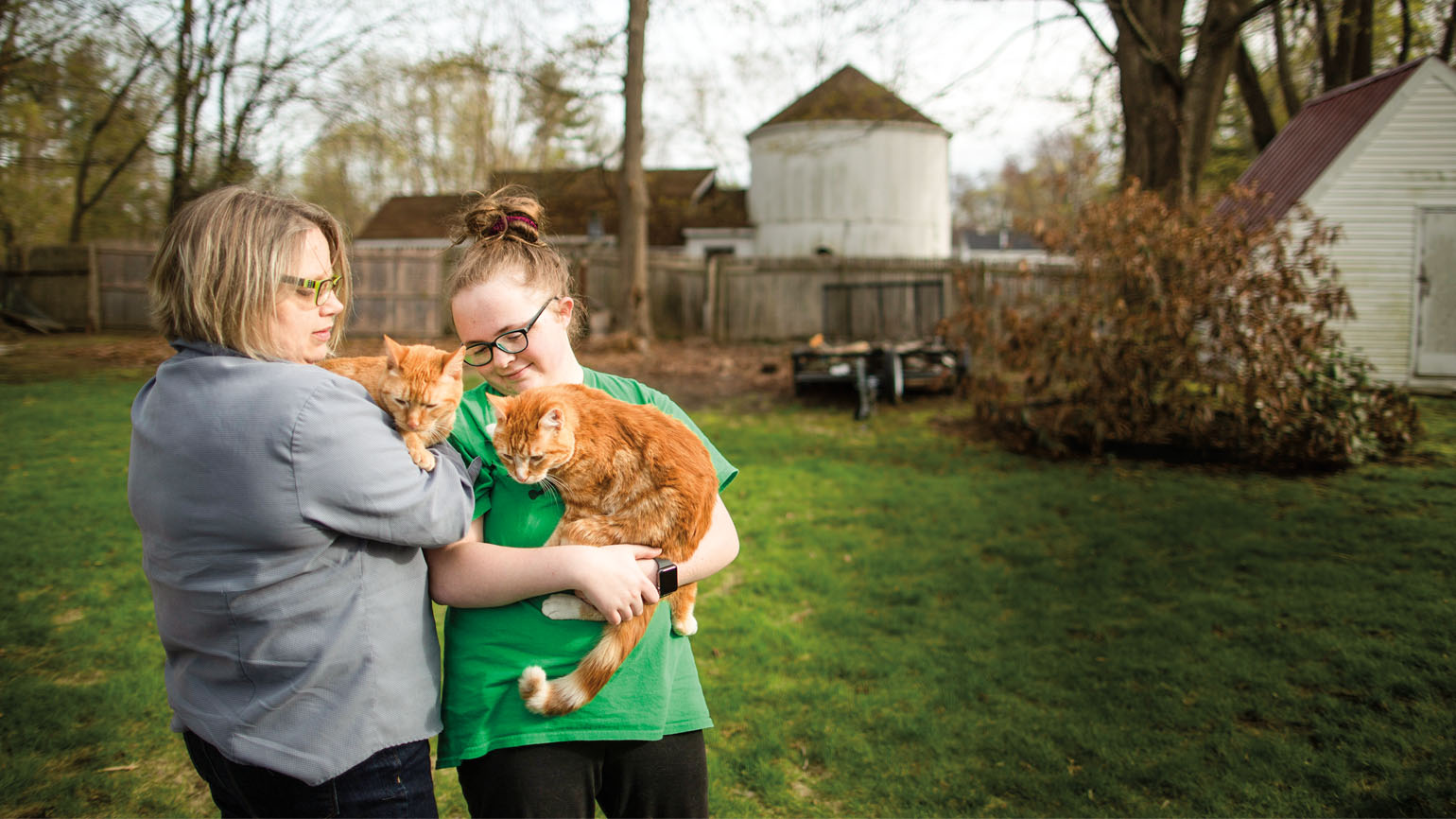
It was the ski trip that did it. I had taken my 11-year-old daughter, Bayleigh, to a Special Olympics Winter Games event at a ski resort here in New Hampshire. Bayleigh has cerebral palsy and had been skiing with an adaptive ski program since she was four. We enjoyed skiing together, and I thought she would have fun at the games. But her anxiety got the better of her. Despite my coaxing and encouragement, she wouldn’t leave our cabin the entire time. It made me sad to see her missing out not only on some great skiing but also on making new friends.
I went home convinced that I had to do something to make Bayleigh face her fears. I fought fiercely for my daughter when people put limitations on her. In fact, I’d been known to go full-on mama bear in her defense, maybe because I was a single mom and I didn’t trust anyone else to look out for my little girl. Still I understood that if she never stepped out from under my protection, she would never grow. Sometimes a person needs to be pushed in order to overcome a challenge and make a breakthrough. I’d seen that in my work as a speech pathologist and in my own journey learning to live with a visual impairment from a traumatic brain injury I’d sustained years ago in a car accident.
Why not use Bayleigh’s love of animals as motivation? We’d been looking for a friend for our cat, Chloe, ever since our other cat died several months earlier. Now I shifted my search to adopting from another state, one far enough away that we would have to take a plane to pick up our new pet. Bayleigh was afraid of flying, going to unfamiliar places and meeting new people. If she wanted another kitty, she’d have to do all those things.
Every day I checked animal rescue websites, looking for a cat that my daughter wouldn’t be able to resist. My search eventually led me to Best Friends Animal Sanctuary in Kanab, Utah. As soon as I read the write-up on Popcorn and Cheddar, a pair of orange tabby kittens, I knew they were meant for us, even though I hadn’t intended to adopt two cats. They were brother and sister, 12 weeks old. Both had been diagnosed with cerebellar hypoplasia—the feline version of cerebral palsy. The female kitten, Cheddar, also had a visual impairment.
I showed their listing to Bayleigh. “What do you think?” I asked.
“Popcorn and Cheddar are like me and you!” she said, her face lighting up. “We have to adopt them!”
“We’ll have to fly all the way to Utah to get them,” I said. “Are you okay with that?”
Bayleigh nodded slowly. That’s progress, I thought. She hadn’t even been willing to consider flying before. As it turned out, the sanctuary arranged to fly the kittens to an airport near us. No need for us to get on a plane, to Bayleigh’s relief—and my disappointment. Would I be able to come up with something else to help her overcome her fears?
The Best Friends staff told us Popcorn and Cheddar’s neurological condition caused them to walk with an unsteady gait and fall down often. They couldn’t climb stairs or jump up onto the couch. Bayleigh and I kitten-proofed our house before their arrival. We covered sharp corners and hung cloth under the kitchen table and chairs to make low hammocks for them to sleep in. We bought a low-profile litter box that would be easier for them to use.
Bayleigh and I were used to making adaptations. We’d done it all her life. She was born six weeks early, and immediately doctors informed me something wasn’t right. At just two days old, my little girl was diagnosed with cerebral palsy. I was told she would never walk, run or be able to live a normal life. Bayleigh defied the doctors’ predictions and took her first steps when she was two and half years old.
I was so proud of how far she’d come. Bayleigh still had her struggles. She had learning disabilities associated with cerebral palsy. School was difficult for her, academically and socially. Being different from her peers bothered her. She hesitated to attempt new things and clammed up around others, particularly in public settings.
Yet she braved the airport not once but twice to pick up the kittens. While we waited for the flight, Bayleigh watched the planes take off. I could see the tension in her body, but she didn’t ask to leave. Minutes before their flight was due to arrive, I got a call from a Best Friends staff member. The kittens weren’t on the flight. During their layover, an airline employee noticed they seemed wobbly and took them to a vet to be checked out. “I explained about their neurological condition,” the staffer said. “But the airline wanted to be sure. They’re spending the night at the vet, and they’ll be on a flight to you tomorrow.”
I was surprised and grateful the airline took such care with our new babies. Bayleigh didn’t even mind having to come back to the airport the next day to get them. We fell in love with Popcorn and Cheddar right away. They were curious, playful and so much fun. We’d had the kittens for only a few days when one of Bayleigh’s friends came over to meet them. I overheard her friend ask, “Will they ever be able to climb the stairs?”
“You never know,” Bayleigh said. “I wasn’t supposed to walk, but now I can run I’m not going to let anyone tell these kittens what they can and can’t do.”
Yes! I’d said that about Bayleigh so often, but this was the first time I heard her take the same stance. I felt like doing a fist pump.
Something shifted in Bayleigh as she watched the kittens grow. It was as if a light switched on: Being different wasn’t a bad thing. It just required an adjustment in perspective. When she taught Popcorn and Cheddar something new, such as how to play with feather toys, she’d say, “It’s all right if it takes you some time to get this. Even a baby step is a step in the right direction.”
Bayleigh adopted this positive, accepting attitude toward herself. One day she was playing with Cheddar and the kitten got startled. Her muscles tensed up, and for a moment she couldn’t move. “Mom, Cheddar’s body is doing what mine does when there’s a fire drill at school,” Bayleigh said. “I hope she’s not scared. It’s just something that happens to our muscles, and it’s okay.”
The kittens’ personalities emerged. Popcorn likes to live life in the fast lane. He does this little hop-roll move to chase toys and our other cat, Chloe. He’s fearless and daring. Cheddar falls down a lot more often than her brother. She moves slowly and carefully, with determination in her eyes. Her condition hasn’t stopped her from learning to walk outside on a leash.

Popcorn and Cheddar thrived despite their challenges, and Bayleigh did the same. “Mom, I want to learn how to ride a bike,” she said one day.
“You already know how to ride.”
“I ride an adapted bike. I want to ride a two-wheeler.”
I was blown away by how Bayleigh’s confidence had blossomed. But it also had me navigating a new parenting path. Could she really handle these bigger tests? Two weeks later, Bayleigh was riding a two-wheeler, and the smile on her face was all the answer I needed.
Welcoming Cheddar and Popcorn into our family has been good for me too. Every other week I put them in a stroller and we walk to the painting class I take at an art studio. Passersby stop to pet them and ask about their condition and how they’re doing. Seeing people accept our cats has made me notice how many people accept Bayleigh too. I used to automatically go on the defensive, but now I see so many folks are cheering for her to do well.
And she has. This past February, Bayleigh and I returned to the Special Olympics Winter Games event. This time I didn’t have to plead with her to leave our cabin or ride the ski lift. She did those things on her own. She introduced herself to other kids and competed in two downhill ski races. She fell a few times and picked herself right back up. She even took home two gold medals.
I’d adopted two kittens with special needs two years ago knowing it would change their lives. I never dreamed that it would change our lives too. Popcorn and Cheddar accomplished something I hadn’t been able to. They helped Bayleigh see that she could be just like them—fearless and determined.
Did you enjoy this story? Subscribe to All Creatures magazine.
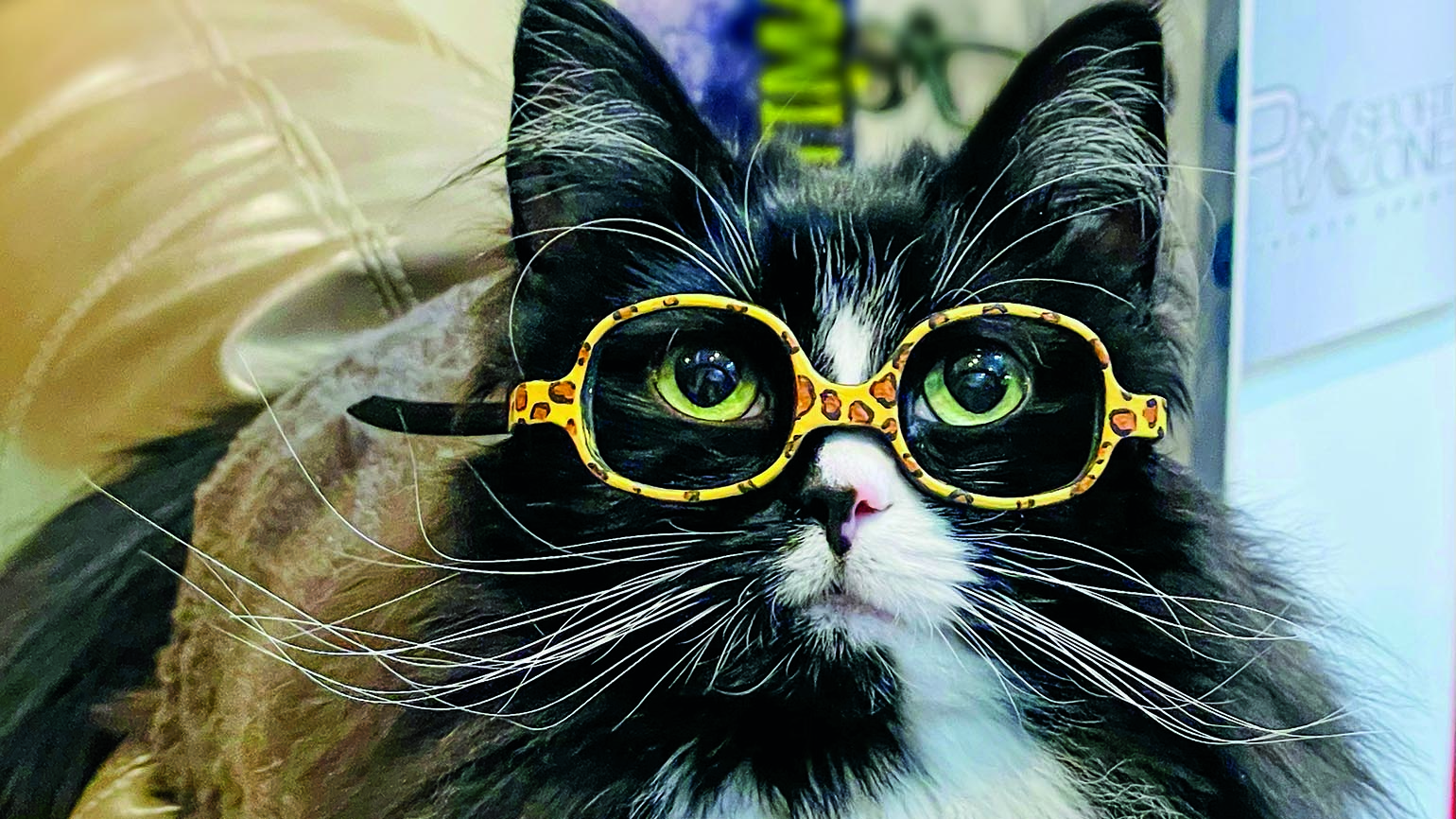
 “She is magic with the kiddos,” says Danielle, whose customers range from four months to 18 years old. “The young children are especially leery after all the testing they’ve gone through. I’ll say, ‘Truffles wants to show you her glasses,’ and she normalizes it for them within just a few minutes.” Truffles also uses her super smarts to allay kids’ fear of testing. She demonstrates how to do a shape test, identifying an apple and a circle with a tap of her paw.