

Embrace God's truth with our new book, The Lies that Bind

A Service Dog Became This Veteran Amputee’s Hero

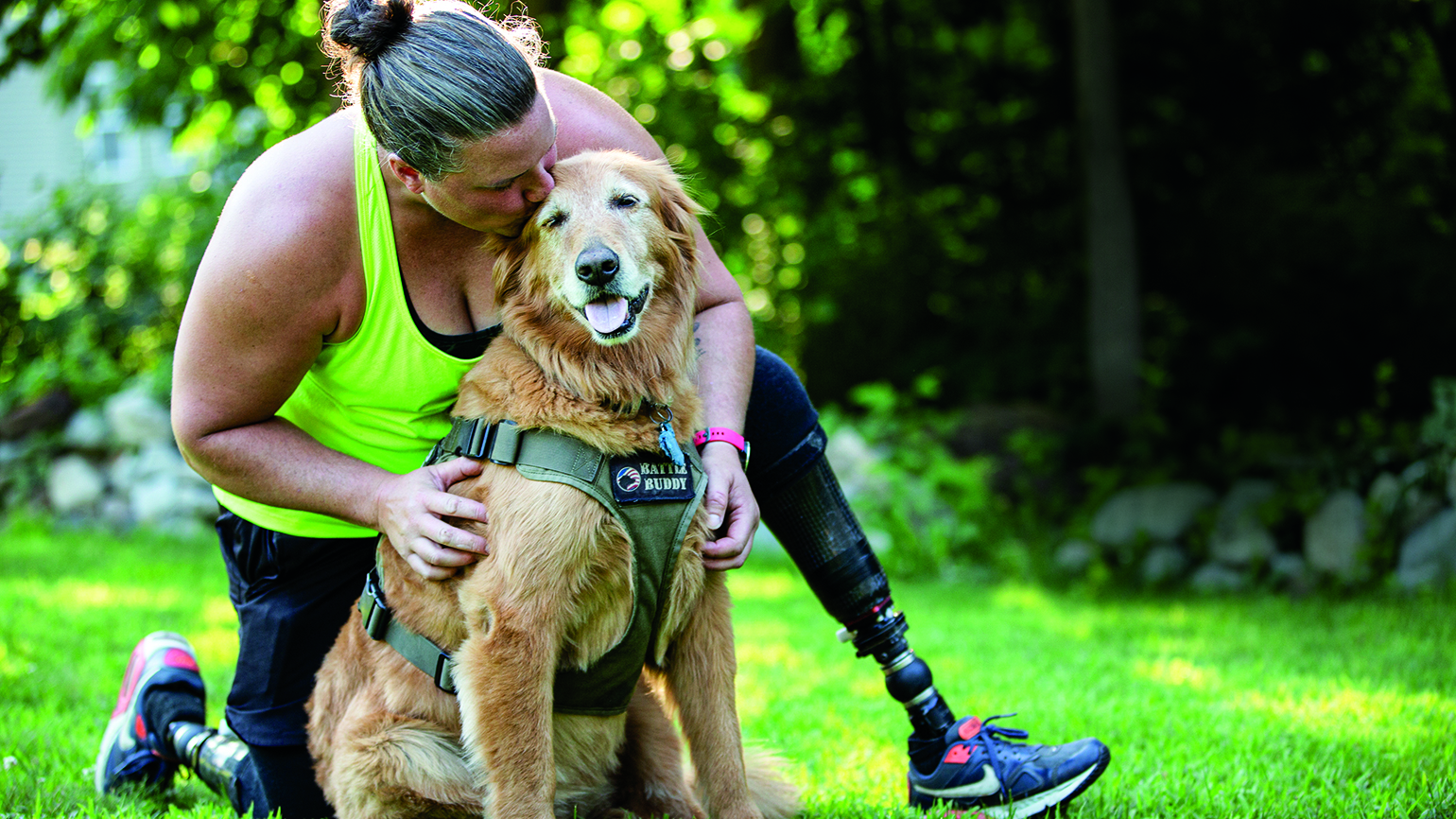
“You’ll never…” I sat in an exam room at the VA hospital in Augusta, Maine, awaiting my team of doctors. I’d served in the Army as a sergeant in the military police. In July 2006 I’d been severely injured during a peacekeeping operation in Korea. Two fingers on my left hand gone. Skull fractures. Spinal cord injury. I had no feeling in my legs below the knees. I lost my memory, the hearing in my left ear and the ability to speak. The head injury led to frequent seizures.

For a year and a half I had surgery after surgery in Texas, where I was stationed, and worked hard to rehab my brain and body. I relearned how to walk, talk and read. Still I had to medically retire from the Army and move home to Maine so my mom and stepfather could help take care of me. I prayed that the doctors here at the VA could tell me what I needed to do in order to live an independent life again.

The doctors came in. One of them went over a list of things they didn’t think I’d be able to do again.

“You’ll never run again,” he said. “Or drive.” Swim. Ride a bike. Shower alone. He handed me the paperwork. The list went on for three pages.

“I can’t live on my own?” I asked.

“Too dangerous,” he said. “What if you have a seizure while you’re cooking? You could burn down the house. You’ll need to have someone with you 24/7.”

My eyes went to the top of the page. It was right there in black and white: “Severely handicapped, 100 percent disabled.”

I was born to move. In high school, I was a multisport athlete. I’d gone to college on a field hockey and track scholarship. I had joined the Army to serve my country, like my grandfather and uncles, and to stay active. I met the male fitness standards as a female soldier. What was the point of living if I couldn’t do anything?

The meeting with the docs ended. I went to the hallway and cried.

MY LIFESAVER

I knew that being wounded or killed in action was possible. But I never imagined I would be caught in this terrible in-between where I was alive but so incapacitated that sometimes I wished I’d died during that mission overseas. I suffered nightmares, depression, PTSD.

There was one thread of hope I held onto, one thing that stuck in my mind from my rehab in Texas. I’d had such a severe seizure one day, I fell down a flight of stairs. A doctor recommended that I get a dog trained to respond to seizures. I looked into it. There was a five-year wait for a seizure dog. No way could I last that long. I called different organizations. A nonprofit in Pennsylvania agreed to train a dog for me, though their specialty was dogs for the visually impaired. A breeder in New Hampshire had a golden retriever puppy who’d done well on service dog temperament tests.
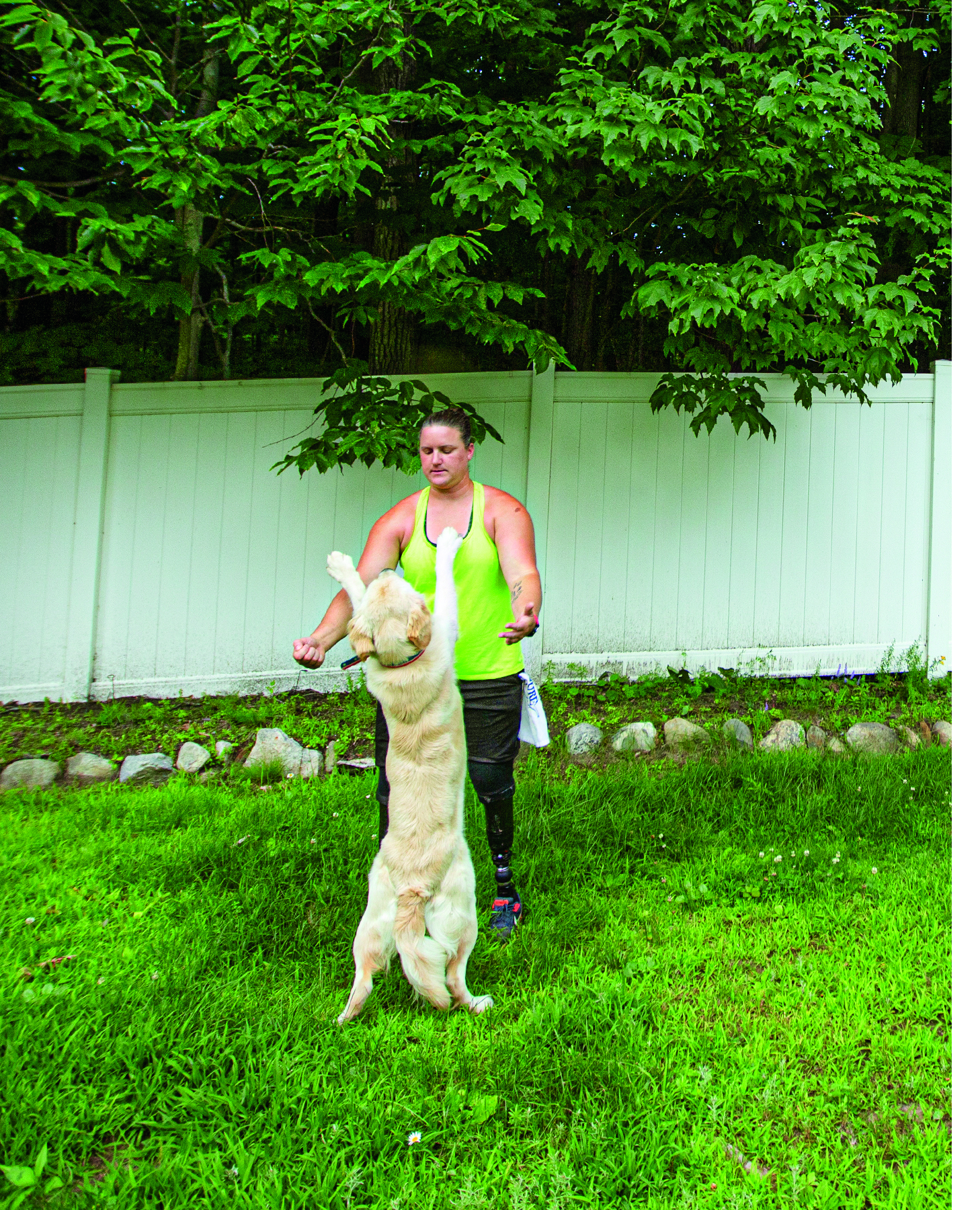
Christy and MoxieI named the pup Moxie. She came to me at nine weeks old. Seeing her adorable fuzzy face made me want to get up in the morning again. I raised her until she was six months old. We bonded so tightly, it was hard to let her leave for training in Pennsylvania.

At 19 months old, Moxie graduated and came back to me. She was trained to respond to my seizures. If I was conscious, she’d fetch my phone so I could call for help. If I didn’t wake up, Moxie knew to open the door, run to the neighbors’ and ring their doorbell. It turned out she could detect my seizures too. She was so attuned to me that she could sense one coming. She’d take my wrist or hand in her mouth and give a little tug to tell me to lie down. She kept her paws on me until the seizure passed and it was safe for me to get up.

Because of Moxie, I was able to get my own place. She was a lifesaver. I mean that literally. There was a time when suicidal thoughts overwhelmed me. I decided to end my life. I planned how I was going to do it. But then Moxie looked at me, and it was as if her eyes reached right into my soul. If I take my life, how long will she be alone before someone finds her? I wondered. How depressed will she be that I’m gone and that she failed to take care of me?

I pulled Moxie close and rested my head against hers. “I won’t do that to you,” I said. “You deserve better.”

THE ATHLETE REAWAKENED

That day I sat in the hallway at the VA crying my eyes out, a Vietnam veteran rolled up in his wheelchair. Neal Williams didn’t need to ask what was wrong. “The doctors don’t know. You’re the one who decides,” he said. “You’re the one who decides what you can and can’t do.” He asked me to come to an event where veterans with disabilities could try adaptive sports like kayaking and biking.

Seriously? I’d just been told I would never be able to move like I used to, and he wanted me to watch people being active? I couldn’t think of anything more demoralizing.

But Neal kept after me. Every time I was at the VA for physical and occupational therapy, he’d bring it up. Finally, just to shut him up, I went to one of the events. Waterskiing. I actually got the hang of it my first time. It reawakened the athlete—and the achiever—inside me.

At a winter sports clinic for disabled veterans, I fell in love with sled hockey. The rules are the same as ice hockey, but we sit in specially designed sleds instead of using skates. Players have two sticks, one to propel ourselves around and the other to hit the puck. Flying across the ice, going after the puck, driving an opponent into the boards—it felt amazing to compete and be part of a team again.

I joined the U.S. Women’s Sled Hockey Team and in 2013 was named USA Hockey’s Disabled Athlete of the Year. Moxie travels with me to every game. She sits on the team bench and watches till the final buzzer, making sure I’m okay. My most devoted fan. My best friend.

UNSTOPPABLE

Worsening nerve pain and torn ligaments in my legs were affecting my game. Veterans who’d lost their legs functioned better than I did. I had my left leg amputated below the knee in May 2015. Then doctors told me I had to stay in my wheelchair to avoid further damage to my right leg. Not an option. In February 2016, I had the leg amputated below the knee.

Nine weeks after the surgery, I was walking on prosthetics. Six months later I ran for the first time since I was injured in the line of duty. I took first place in the shot put and discus at the 2016 Rio Paralympic Trials. I competed in 10 events at the Warrior Games. I’m preparing for the Tokyo Summer Paralympic Games, to be held after the coronavirus pandemic is over. These days I use my wheelchair so rarely, I have to put air in the tires each time.

I earned a degree in therapeutic recreation from the University of Southern Maine. I serve as director of the New England Warriors sled hockey program for veterans and Central Maine Adaptive Sports, a nonprofit that offers adaptive athletic opportunities to individuals of all abilities.
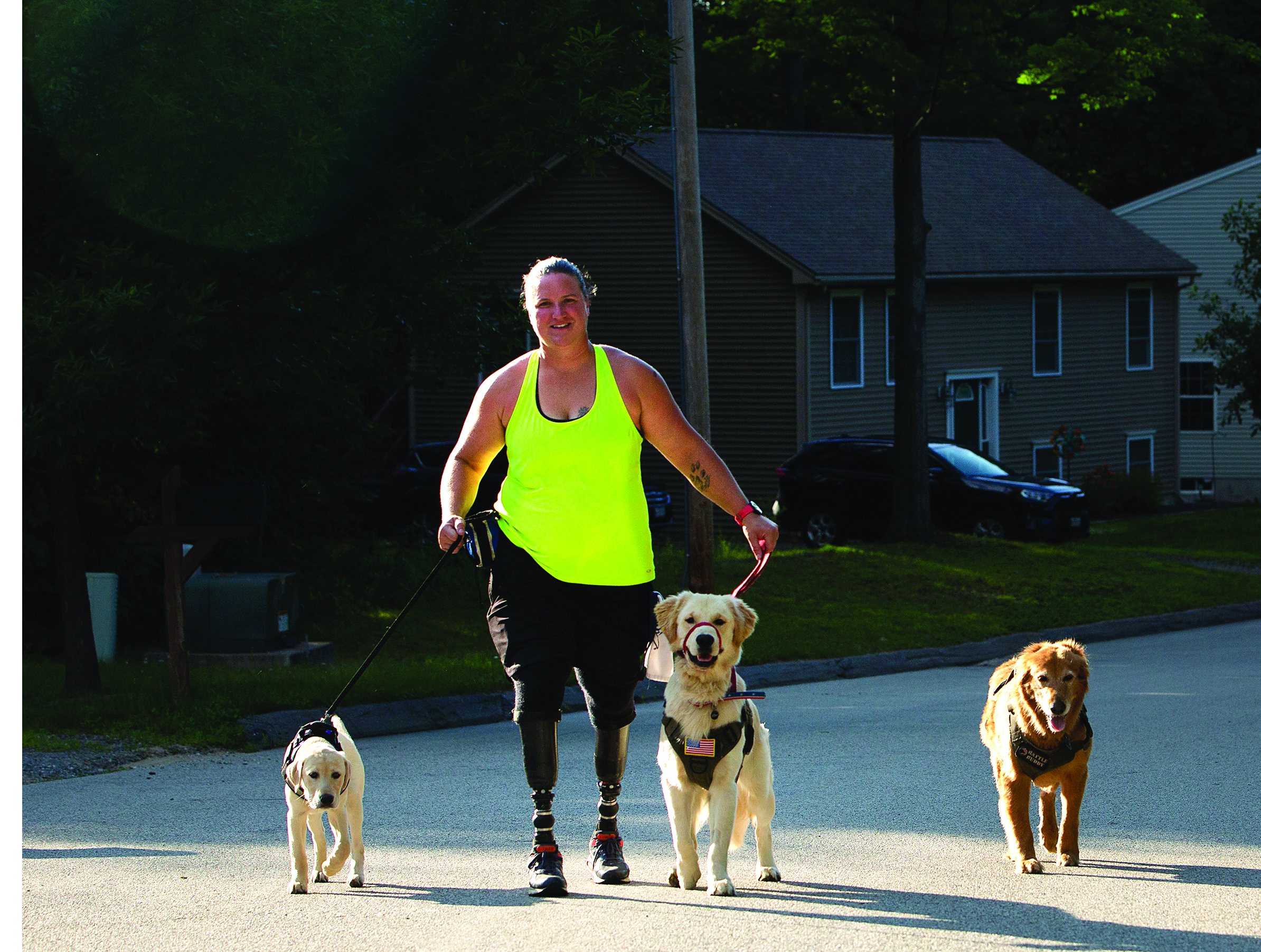
Christy with service dogs Gidget, Douglas and Moxie.I began training service and therapy dogs so that other disabled veterans could experience what I had with Moxie. I’ll never forget Lucky, a yellow Labrador puppy who was born without bones in his right wrist. To some, his bum leg might have been a deal breaker. I saw it as an opportunity for him to do great things. And he has. I placed him at Leeds Central School to show kids that challenges don’t have to stop us from succeeding.

Last year, I cowrote a children’s book with author Eileen Doyon. Lucky: Little Guy, BIG Mission is about two fighters—Lucky and me—who never gave up. The proceeds will help fund Mission Working Dogs, the foundation I started to train more service and therapy dogs in Maine.

Recently, I came across a social media post about a six-month-old golden retriever, Douglas, who needed a new home. I asked if I could train him to be a service dog for a veteran I knew. Turns out, Douglas was meant to stay with me. Moxie, 12, tore both of her Achilles tendons, so now Douglas helps me while she takes it easy.

As for the veteran I had in mind for Douglas? I’m training Gidget, a yellow Lab who Lucky’s breeder donated to my program. These service dogs have given me purpose. The best way I can repay them is helping them live out theirs.

That day at the hospital, the doctors gave me a list of everything I can’t do. Thanks to Moxie, now it’s all about, What can I do next?

Did you enjoy this story? Subscribe to All Creatures magazine.
Artist—and Stroke Survivor—Launches Pet Drawing Project to Support Animal Shelters

California resident Ed Attanasio was running an ad agency and working as a writer when the Covid-19 pandemic began in 2020. In April, he was furloughed from his job and lost all his clients.

“I was in complete shock and thought, ‘What am I going to do to occupy my time?’” he told Guideposts.org.

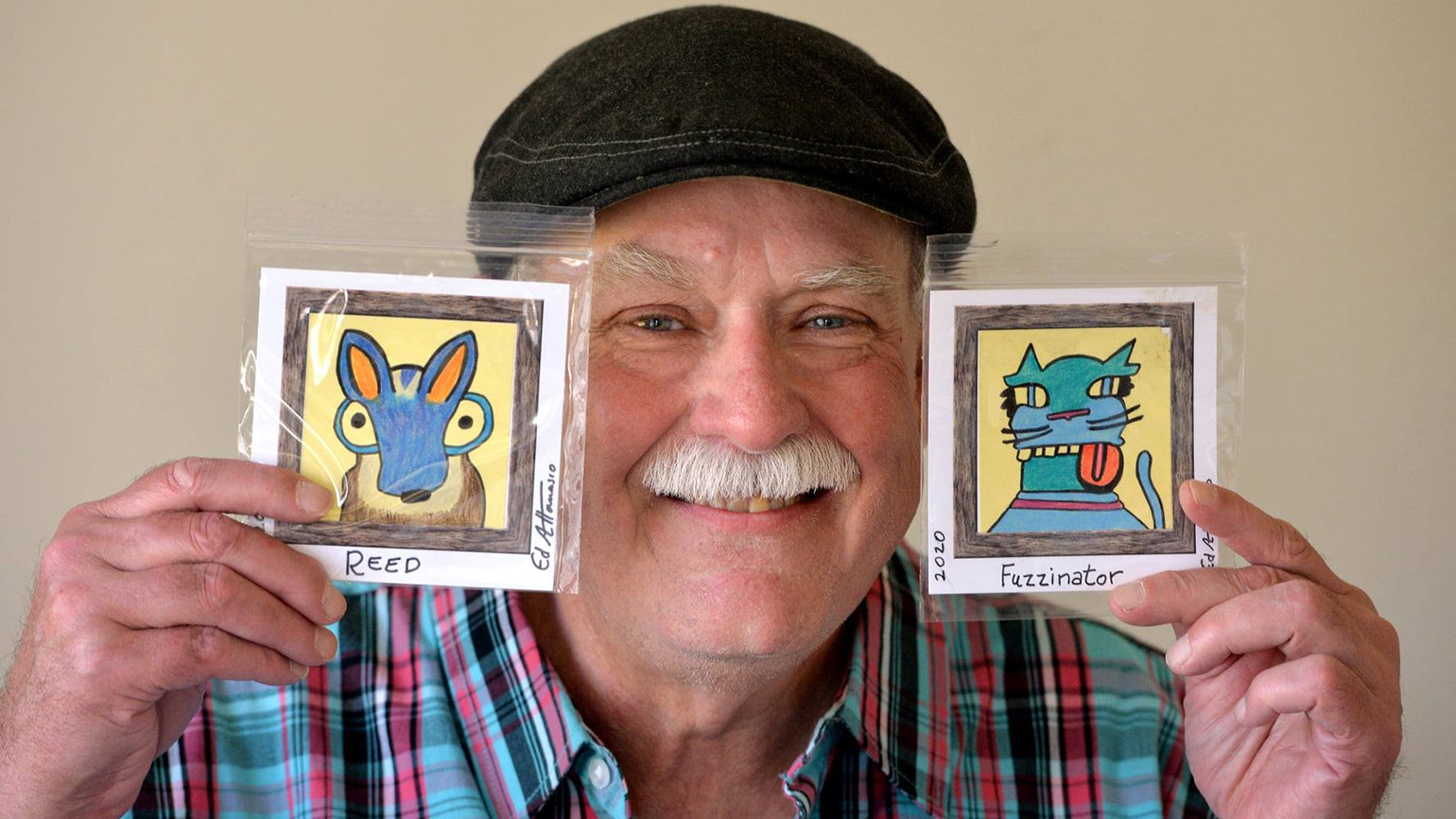
He got a phone call from a friend who was quarantining with his family, asking him to draw some art for his kids. After drawing an abstract portrait of their Boston Terrier, word spread on social media and Attanasio began receiving requests from people who wanted drawings of their own pets.

“I said yes but I didn’t really want to charge,” he said. “I was just creating these art pieces to make people happy.”

That’s when he got the idea to launch the art campaign, Pandemic Pet Project.

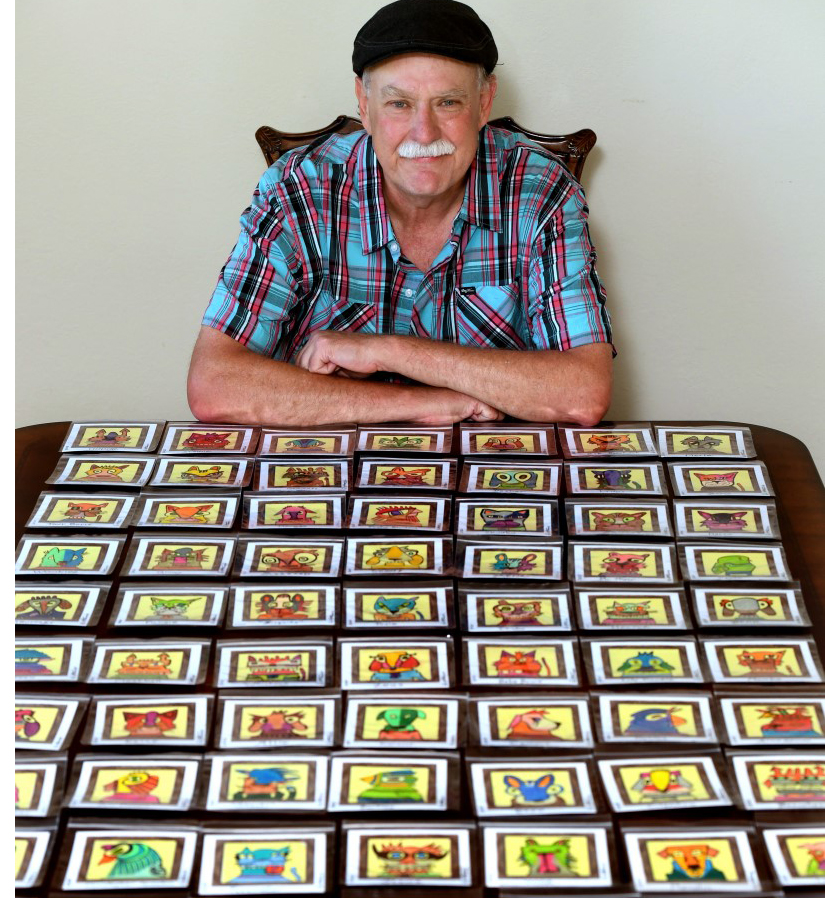
People send photos of their pets to Attanasio through his Facebook page, he then creates one-of-a-kind artwork that is hand-drawn on a 3-by-3 Post-it Note and mails them out once they’re completed. Although the artwork is free, Attanasio asks people to pay it forward by making a minimum $50 donation to an animal rescue organization of their choice. Organizations such as Muttville in San Fransisco, California and Hands, Hearts & Paws in Omaha, Nebraska have received donations thanks to the Pandemic Pet Project.

Since launching Pandemic Pet Project, the artist has completed 1,600 drawings, estimating about $100,000 in donations to animal shelters all around the world. The portraits—of dogs, cats, reptiles, goats and horses—have been sent to all 50 states and 26 countries, including Israel, Ireland and Ecuador.
“The feedback I’ve received is unbelievable,” he says. “I get a lot of messages from people all over the world who tell me my drawings have made their day and it makes me really happy.”

Art is a form of therapy for Attanasio, who began drawing after having a stroke at age 50 in August 2009. After his speech therapist suggested that he engage his brain with activities, he began drawing on Post-It Notes for hours during his 14-month recovery.

“The art represents my personal renaissance, which includes significant life changes such as losing 120 lbs., eating healthier and swimming daily,” he said.

Attanasio credits the success of his art to guardian angels, who he says have “worked behind the scenes” throughout his artistic journey. “Every time I’ve announced that I would wrap it up, I’d receive signs or reasons not to,” he said. He noticed a pattern of dogs at Beauties and Beasts, a rescue in Wichita, Kansas, getting adopted just as their completed portraits would arrive. Not long after deciding to step aside from the campaign, he received an emotional phone call from a woman battling stage 3 lymphoma cancer who told him his drawings, which he posts on Facebook, are the highlight of her day.

“I’ve decided I will do this as long as people want me to,” he said. “I just want to help people and make a difference.”

A Reminder to Focus on Family

I pulled the car into the garage and got out, just like every night for the past 16 years. The difference was, I wouldn’t have a job to go to in the morning. I’d known this day was coming, but that didn’t make it any easier.

I slammed the car door. I was—no, used to be, I reminded myself—a VP in technology for a national bank until it collapsed in the recession.

I’d put my heart and soul into my job, helping build the tech-support department from a few employees into a division running computer networks at branches all over the country.

Not only did I work long hours, I was on call 24 hours a day. Weekends and holidays too. If someone had a tech problem, even at 2:00 A.M. Christmas morning, I was on it.

My kids joked that even though they were the teenagers, I was the one who was glued to my cell phone and had to be told not to text at the dinner table. That’s if I sat down at the table at all. Usually, I would set my plate on the arm of my chair and eat while I checked my laptop.

I paced the dim garage, wanting to kick something, smash it into a million pieces, the way my life felt like it had been smashed to pieces.

I knew I was better off than most people—I’d gotten a decent severance package, and my wife, Michelle, had been able to go to back to work full time as an office manager once we heard my job was threatened.

But our three kids would be going to college—our son, TJ, was a high school senior, and the girls, Sarah and Tara, were in ninth grade—and I wanted to give them the education and opportunities they deserved. God, if I can’t provide for my family, I asked, what good am I?

A shaft of light streamed through the window, as if beckoning me. I opened the garage door and stepped out into our yard. Michelle and I were raising our family in the house I grew up in.

The lawn and flower beds that my mom had tended so carefully were overrun with weeds. There was a Japanese maple in the middle of the yard that I remembered my parents planting when I was a boy. It needed pruning. I kept meaning to get out there but I’d let it go.

Treasure this time.

The thought came out of nowhere. Definitely not from me. But clear, clear as could be. Treasure one of the worst days and biggest losses in my life? I shook my head. I couldn’t get distracted by random thoughts. The clock was ticking. I needed to get busy finding a new job.

I lumbered up to the house, my belly jiggling. I’d put on a lot of weight, let myself go over the years—no time to exercise with my crazy hours.

Michelle greeted me at the door with a hug. “It’s going to be okay,” she said. “We’ll get through this together. I thought we could have a family meeting. The kids have been worried.” I was the parent; I was supposed to do the worrying. The kids were supposed to enjoy being kids.

We got together in the living room. “I’m sorry, Dad,” TJ said. “I know how much your job meant to you.” His concern was mirrored in the girls’ faces. When had they gotten so mature?

“I’ll take care of this,” I told them. “I’m going to work round the clock to find a new job and get our lives back to normal.”

After the kids went to their rooms, Michelle laid her head on my shoulder. “Don’t feel like you have to jump back into something stressful,” she said. “We can get by on my income for a while. Maybe you should think of this time as a break…a sabbatical. You deserve one.”

A sabbatical? Was she kidding? This was no time to rest. If anything, I needed to work even harder.

The next morning I got up before everyone else, made a pot of coffee and opened my laptop. I searched job sites, companies in the area with big tech departments. I e-mailed friends with connections. By then Michelle and the kids were up, the house bustling.

“Take some time for yourself,” Michelle said again before she left for work. “This isn’t a problem you need to solve today.”

By midmorning the quiet of the house was driving me crazy. I missed the buzz of the office. I’d updated my résumé and applied for a couple of jobs. Now what? I walked outside to clear my head. My gaze fell on those overgrown flower beds. At least that was a problem I could do something about.

I found the hoe in the garage, behind an old deflated soccer ball. I hadn’t even been working an hour before my back and arms were aching. I’d only cleared a small patch.

Winded, I made my way to the backyard. Not the beautiful yard we had dreamed of. I’d always planned to fix it up. Another thing I’d let go.

I went inside and checked my e-mail. Nothing.

The kids got home midafternoon. “I’m bored,” Sarah said an hour later. “There’s nothing to do.”

I looked up from my laptop. “I’m sorry, honey,” I said. “I’m busy right now. Maybe later.” She nodded and wandered down the hall.

I turned back to my laptop. But I couldn’t focus on job hunting. I kept thinking about how Sarah and I used to watch a lot of soccer together before I got so busy. Manchester United, in the English Premier League, that was our team.

I went to their web page. There was a game the next day, Saturday, at 5:00 A.M. It wasn’t televised, but we could watch it on the computer.

“Hey, Sarah,” I called down the hall. She was thrilled about my idea, even if it meant getting up at the crack of dawn.

The sun was barely peeking over the horizon when we flipped open the laptop the next day. We cheered so loudly I feared we’d wake up everyone else. “That was awesome,” Sarah said.

“Let’s do it again sometime,” I said.

And we did, every week after. I even got us new matching Manchester United jerseys.

I settled into a new routine. I still applied for jobs. Still put in hours every day in front of the computer. But now I took breaks to do other stuff, the things I’d neglected when I was working all the time.

I started putting in a sprinkler system and the new lawn I’d planned for so long. Just a few hours here and there. But it began to take shape. So did I. With the physical labor, the extra weight dropped off, and I felt healthier than I had in ages.

One day I walked into the empty family room and looked at our pool table, which was gathering dust. The kids were always saying they didn’t have anything to do. I decided it was time the room got used. I cleaned off the table and bought some video games while I was at it.

Soon TJ, Sarah and Tara were bringing their friends over after school. There’d be so many teenagers hanging out in the family room, I took to calling it “the kid zone.” But I was the one having a ball. They were loud. And hungry. No problem. I went to Costco and stocked up on snacks.

Weekends Michelle and I gardened together. The flower beds, the Japanese maple looked great; Mom would’ve been proud. On summer evenings the five of us hung out on the deck while I made dinner on the grill.

One day I noticed TJ sitting alone, looking pensive. I knew he had worries about going to college and where his life was headed. Some of his friends had graduated the year before, and he’d lost touch with them.

“TJ, I know how it feels to lose something,” I began. “I wish I knew how to fix it. But with some things, I’ve discovered, you just have to turn them over to God.”

“I know, Dad,” he said. “I learned that from watching you, how you’ve handled being unemployed. You might have been stressed but you never let it affect our family. You kept us together.”

I looked at my son, and it hit me. This was the last year he’d be home. The girls would be off to college soon too. If I hadn’t had this time with them, I’d be wishing for it, praying for it. Maybe God had answered a prayer I hadn’t even said.

He gave me this time to treasure, to be the husband and father my family needed. I’d had the chance to find a healthy balance between work and home—a balance that even after I landed a new position with a great company, I have made sure to keep.

Download your FREE ebook, Rediscover the Power of Positive Thinking, with Norman Vincent Peale

A Ray of Light at a Mother’s Death

Last week I shared some material from a book I’m finishing for Guideposts about Alzheimer’s and my family, especially our journey with our mother and her dementia. I told about my last conversation with her. This week I want to tell you the rest of the story.

I spent the next few days of that last visit sitting in Mom’s room reading while she slept, hardly noting the comings and goings of aides and nurses. Sometimes I would look up and see Pat, her new best friend, standing at the door clutching her empty but ever-present purse.

I had coffee one afternoon with Colleen Burke, the director of the memory care unit. “How much longer?” I asked.

“Not too much, though some hold on longer than others. It’s a process.”

We’d declined the feeding tube, of course, and Mom had been diagnosed with heart failure, a common complication of Alzheimer’s. I wondered if down deep she was fighting or simply letting go. Rossiters were fighters, Norman-Irish warriors. There was no way to tell. And yet my mom appeared at peace.

I left her on a sunny Saturday morning, giving her one last gentle hug. My brother Joe, his wife Toni and the girls would be back the next day from Florida. My sister Mary Lou was coming down that afternoon. I paused in the doorway to take one last look at the woman who had given birth to me. The room seemed incongruously bright. Her caregivers were attending to her. She was in good hands, God’s hands. Then I turned and headed for the airport. On the way I stopped at a pay phone to call my sponsor.

“I feel so overwhelmed,” I said.

“It’s dying,” he said. “We’re supposed to feel overwhelmed.”

By Monday, April 19, I was in Tucson, Arizona, helping teach a Guideposts writing workshop. Two senior editors were conducting the morning session. I would join them for lunch and the afternoon session then host a dinner that night.

Having once lived in Taos, I love the Southwest, and not just because it reminds me of my raw youth. There is a brute beauty to its landscapes, as if the further west you go the more America is America in its newness and wildness. I might have stayed there forever if I could have found a way.

It was a crisp, cool spring morning, and I was up early thanks to the time zone change. I wanted to hike Picacho Peak, but it would take hours I didn’t have so I settled for the tamer and closer Tumamoc Hill near our hotel.

The path was easy for most of the hike but got steeper higher up, and I was surprisingly breathless when I reached the top at a little over 3,000 feet. I lay on my back and looked up into the great western sky, a few tufts of clouds interrupting the boundless blue, a sky that seemed so vast yet so close. A spear of sunlight hit my eyes, and I remembered that I had forgotten sunscreen and couldn’t stay long like this. I thought of my mother’s love of the sun and how it healed her.

And then I felt something, like a swooning of the soul, a gentle rush as if something were leaving, and at that moment I knew she was gone.

I hiked down quickly. There was a message for me at the hotel desk to call home. I knew already what the call would confirm.

A Proud Father

People fascinate me. I love to watch their mannerisms, how they interact with others, how they fix their hair and what they wear, so it probably is no surprise that I enjoy some of the reality television shows. They’re like a smorgasbord of people-watching for folks like me.

I especially love the try-outs for American Idol. The music is great–or not-so-great–depending on who is at the microphone. I mean, sometimes it’s like the contestants forgot to pack their talent when they left for the show.

And, oh, the people! Cowboys, soldiers, teachers, moms, folks with huge personalities, and others who seem so shy that you’re amazed they didn’t pass out while auditioning for the judges. Add in accordions, banjos, guitars, blue hair, and outrageous outfits, and it’s a feast for the eyes and ears.

Sometimes it’s apparent immediately when special contestants takes their place on the stage–due to their talent, personality or life stories. I love to root for them, silently begging the judges to give them one of the golden tickets to Hollywood.

That’s what happened on one of the shows last week. Host Ryan Seacrest did a preliminary segment about the families who provide wonderful support for the contestants. The camera panned to 15-year-old Ashley, her mom and dad, and her brother.

Ryan asked Ashley about her parents and she told him how both of them had been deaf her entire life. Her eyes sparkled as she shared that over Christmas her dad got a new hearing device that allowed him to hear her sing for the first time.

Ryan said, “What was his reaction?”

Ashley replied, “There’s no words.” Yeah, by this time I was sitting there wiping away tears as I imagined the specialness of that moment for both father and daughter.

In a departure from the norm, Ashley’s whole family walked into the room for her audition. Judge Jennifer Lopez asked Ashley why her family was there, and she told about them being deaf.

And then she shared with the judges about the new technology which allowed her daddy to hear her sing for the first time. She touched the device clipped on her dress, “I’ll sing into this receiver, and it will pick it up and send it to that little box on his chest, and he’ll hear me sing.”

All three judges were visibly moved by the story.

Ashley began to sing. Her daddy’s face beamed with joy and pride as he watched and listened to his daughter.

I was so disappointed for Ashley and her family when none of the judges voted her on to Hollywood. She was obviously crushed as she walked out of the room and down the hall. She vowed to come back again, and then she said the words that made me cry a second time, “I made my dad proud. That’s all that counts.”

The look on Ashley’s dad’s face as he listened to and watched his baby girl melted my heart. It didn’t matter to him that she’d gone off-key or was pitchy in a couple of places. It didn’t matter that she failed.

He was proud of her because she tried. There’s nothing like a father’s love–and that was his girl.

The next clip on the screen showed Ashley snuggled on her dad’s shoulder as he hugged and comforted her. What a special gift for that young girl to know that even when she messes up, her daddy still loves her and is proud of her.

And that made me think about all the times I’ve messed up, all the times when I’ve chased big dreams and failed. I’m so grateful He loves me in spite of that. I’m thankful for all the times He’s comforted me–even when I failed Him. That’s what our loving Father does.

Despite my failures, I hope I’ve made my Father proud. That’s all that counts.

How about you?

Dear Father, my heart’s desire is to make You proud. I’m so grateful that You love me even when I mess up, even when I fail. In the hectic busyness of my days, remind me that serving You is all that really counts. Amen.

A Proud Dad’s Graduation Prayer

Dear Timothy,
We can’t wait for your graduation from college this weekend. We’re thrilled. You’ll be so busy that day you won’t notice the graying dad muttering prayers of thanks into his program, saying amen, amen, amen.

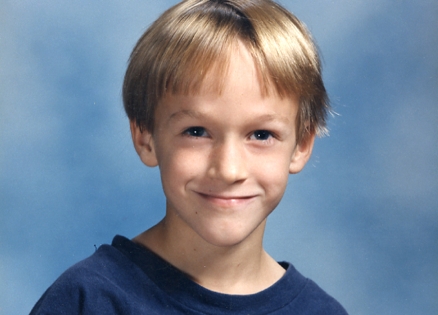
You’ll have to indulge me a little because sitting in my folding chair, I probably won’t be seeing you as you look now, the handsome, tall, clear-eyed history major. I’ll be seeing a picture of you in my head at about age five. (See below.)

You were just that age, Timo, when on Christmas Day you asked me, full of earnest concern, if Mom and I were really Santa. I figured I shouldn’t lie, so I said yes. Then you decided you didn’t want so much truth-telling. “Daddy, you’re teasing me!” you said.

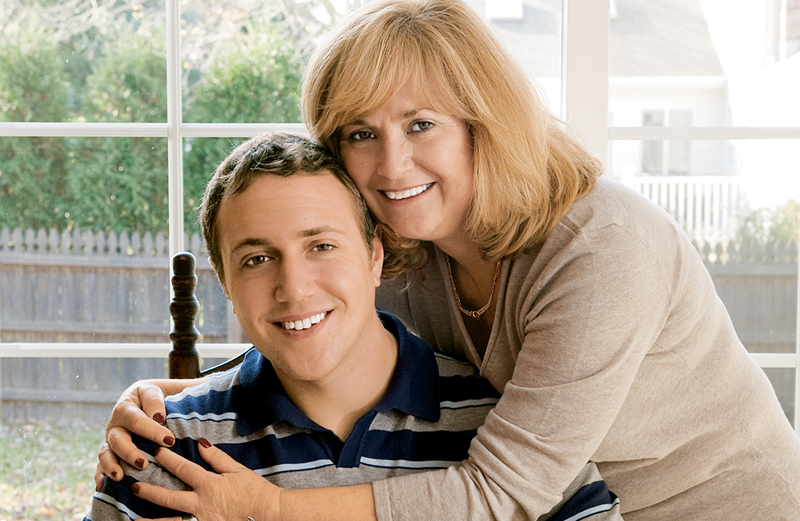
You were only four when you broke your femur at nursery school and had to be in traction at the hospital for 26 days. What a nightmare. How did we ever get through it? But you were a star patient. That gorgeous spring day you were finally released from the hospital, you exclaimed, “Daddy, look at the trees! Look at the flowers! They’re beautiful!” I don’t think you’ve ever stopped looking at nature with such God-given wonder and awe.

You have given your mother and me such pleasure with your singing voice, whether it’s been a solo at church when you were a boy soprano or more recently, with you leaning into a mike and leading your rock band in your skinny jeans. Sorry if I didn’t get all the words, but maybe it’s just as well.

You have been a champion student at college, learning for the love of it, taking challenging courses because you wanted to expand your mind. Who knew what a scholar you would be?

I love the way you ask hard questions about faith and God and why so many in the world still suffer. But then, you also see yourself as one meant to relieve some of that suffering. Go for it, Tim.

You are a constant lesson in prayer because of how you take delight in the moment, fretting not about the future. You’re like Jesus telling us all to consider the lilies. Just a reminder: Graduation is on Saturday at 10 o’clock. Your family will be there. Please show up.

Timo, when I consider how much I love you and your brother, I’m in awe to think how much God could possibly love us, his children. So take it this way: You’ve got two dads looking out for you, one of us probably a little clumsier at it than the other. But know you’re loved.

And please know that I consider myself especially lucky because I have never for a moment wondered how much you loved me back. Happy graduation!

A Prayer for My Daughter on Her Wedding Day

In a few days I will stand before my daughter Christine and her fiancé Taun to officiate their wedding. I knew this day would come, but it once seemed so far away. I remember holding her in my arms when she was born and praying that I would be the best dad for my baby girl.

During every season of her life, my wife Elba and I prayed for her well-being, future decisions, safety, life mate and more. Today she is a beautiful woman living the wonderful life God gave her.

Yes, I have officiated many weddings, but never one of my children’s. When doing so, I will be focused on my pastoral duties, but I know inside my emotions will be running wild.

Read More: 10 Tips for a Lasting Marriage

Like most parents, I want the best for my children, and on that day I will pray that she keeps God at the center of her heart and home. Whether things are going well or not, she will sing praises of thanks to the Lord. I ask God that she will not lean on her own understanding, but seek the wisdom and guidance of the Almighty.

When life challenges weigh her down, she will remember that He is always with her. May she grow in her love for God and Taun, and forgive daily as God has forgiven her. I pray her home be blessed with the love, joy and laughter of children. And I ask God to give them a long and healthy marriage remaining faithful to one another throughout all seasons of life.

Our prayers for our children never cease. Long after the wedding celebration, my prayers will continue daily for Christine and Taun. Please share with us a wedding blessing for my daughter. I would greatly appreciate it.

Lord, thank you for the gift of love and marriage.

A Perfect Thanksgiving

I was a college senior that November when I came across a stunning full-page advertisement in a glossy magazine. The photograph starred a silver-haired, patrician grandfather straight from central casting, poised to carve a resplendent Thanksgiving turkey at the head of a table laden with glittering crystal and gleaming silver.

Grandma stood at his side by a neat stack of blue-and-white china plates. Their grown children and dazzling grandchildren, waiting expectantly at assigned places, were all toothy smiles. They looked as if they had just won the Norman Rockwell Award for Family Harmony.

What I would have given to be a member of a family like that! My grandparents busied themselves at holidays loudly nagging us to get haircuts, to stop smirking or to “show some respect.” I chanced another painful glance at the mocking picture. The children were all in dresses or ties, looking perfect and adorable at their own special kids’ table.

In my disheveled family we would all be jammed together before mix-and-match dishes at a rickety, faded-red Formica horror whose shaky leaf threatened to send the gravy boat plunging into someone’s lap. Not that anyone would take much notice amid all the yelling and chaos.

JOIN US FOR THANKSGIVING DAY OF PRAYER 2018

The dad in the ad beamed at the happy scene from his end of the table, while the mom dandled a newborn. My dad had left us years before. Instead we had Uncle Carl, whose concept of Thanksgiving dinner was to eat it in the listing recliner parked in front of the ever-droning television set.

Over the years I had learned to grit my teeth and endure my family’s sorry behavior. The trouble this year was that my boyfriend was angling for a Thanksgiving invitation. I liked Alan an awful lot, but I had been putting him off until I could think up a plausible excuse. No way was he going to witness this annual fiasco!

I kicked the magazine closed and called my friend Judy. Maybe she would have some ideas.

“If Alan wanted to have Thanksgiving with me,” Judy said, “I’d invite him in a New York minute.”

“Suppose he sits next to my Aunt Florence, which he probably will since no one else can stand to, and she starts going on and on about politics, which she undoubtedly will because that’s all she ever talks about. I’d just die! And so would Alan. Of boredom!”

“What’s wrong with talking politics?” Judy asked.

“She keeps whining about the mayor as if she’s on personal terms with him.”

“Linda…”

“Then there’s my bratty little cousins. Their favorite tricks are slinging cranberry sauce at one another and putting the parts of the dinner they don’t eat, like creamed onions, into their pockets.”

“Oh, come on,” Judy snapped. “No family’s perfect; yours sounds like fun. I bet Alan would—”

“I am not inviting him!” I insisted.

As it happened, I didn’t have to approach Alan about Thanksgiving. The next day he called me and announced, “I telephoned your old number by accident and got your mom’s apartment. She invited me to Thanksgiving dinner! Wasn’t that nice of her?”

Dumbstruck, I felt my head shaking back and forth. No!

“She what?” I finally managed.

“I said I’d bake pumpkin pie….”

“Alan, she hates pumpkin pie.”

“I know. So I’m doing an apple pie.”

“Oh, great,” I replied weakly, but to myself I seethed, When will my mother stop running my life? After we hung up, I said, “Dear God, just this once, could you help my family behave a little more respectably now that Alan will be joining us for Thanksgiving?”

I was right about one thing. In the shuffle for chairs at our table, Alan did end up next to yakky Aunt Florence. Then one of my cousins wondered aloud to his brother, “Do you think I should go to law school or do what you’re doing with your life—waste it?” and the fight was on.

Even before the kids had launched their first cranberry volley, Uncle Carl was comatose in front of the television with his unfinished plate rising and falling in rhythm with his belly.

Meanwhile, Aunt Florence monopolized Alan. “Do you realize, young man, that the West Side Drive project is a complete boondoggle? A boondoggle! The mayor knows the whole story, but he’s just sitting on his hands. I wish….”

I wish I were any place but at this crazy dinner table. God, let the doorbell ring and let it be that family from the magazine telling me I was switched at birth.

The doorbell did ring, but it was yet another cousin—the chronically unemployed one (no doubt Alan would soon hear this sorry saga)—brown-bagging her own macrobiotic meal. By way of greeting she sniffed disdainfully and declared, “I do not eat the carcasses of animals.” Oh, no…I rubbed my throbbing temples and tried to think of something more pleasant—like a root canal.

Keeping the mood lively, Grandma took a bite of apple pie and announced in mid-chew, “I’m having some of Alan’s pie even though it doesn’t agree with me.” By the time coffee came around I had a screaming headache. Alan was very understanding and said he’d take me home. Inwardly I moaned, I’ll never see him again.

Cringing in the front seat of Alan’s car, I prayed he couldn’t see my leaden face in the dark. Suddenly I felt miserable and guilt-ridden for being so ashamed of my family. But I couldn’t help it. I knew they weren’t bad people, that they were doing the best they could. God, you gave me this family. Show me how to be comfortable with them!

“Linda, I can’t remember when I had such a good time,” Alan remarked. “You never told me what a great family you have.”

“I’m sorry about my aunt Florence….”

“Sorry? She knows more about grassroots politics than my poli-sci lecturer.”

“Yeah, and Miss Macrobiotic is a barrel of laughs.”

“But what a character! Your whole family is so honest and uninhibited. Everyone made me feel right at home.”

“The little brats didn’t get on your nerves?” I asked suspiciously.

“Heck, no. In my family youngsters are exiled to the kids’ table. Our holidays feel so staged and dull by comparison, I’m afraid to bring you home. You would be bored.” Alan turned onto my street. “Linda, you don’t know how lucky you are.”

He walked me to the door and hugged me good night. “Thanks again for such a wonderful time. I’ll call later and see how you’re doing.” But I was already doing a whole lot better. There was nothing wrong with my family. What was wrong was me?

Inside my apartment I dug out the magazine with the photograph of the perfect Thanksgiving and studied it again. What was so great about a family from central casting? Frozen in a moment of orchestrated perfection, their happiness was contrived, a false ideal.

My family, with all its blemishes and foibles, was real. They loved me, loved me enough to embrace the boy I had brought home and make him feel welcome as one of us. Beneath the holiday cacophony was a genuine, loving happiness at being together—that was the glue that kept us close as a family.

Even Uncle Carl never missed a holiday meal. And me? Well, wasn’t I just another character in this crazy cast? If a stranger felt at ease with them, why shouldn’t I?

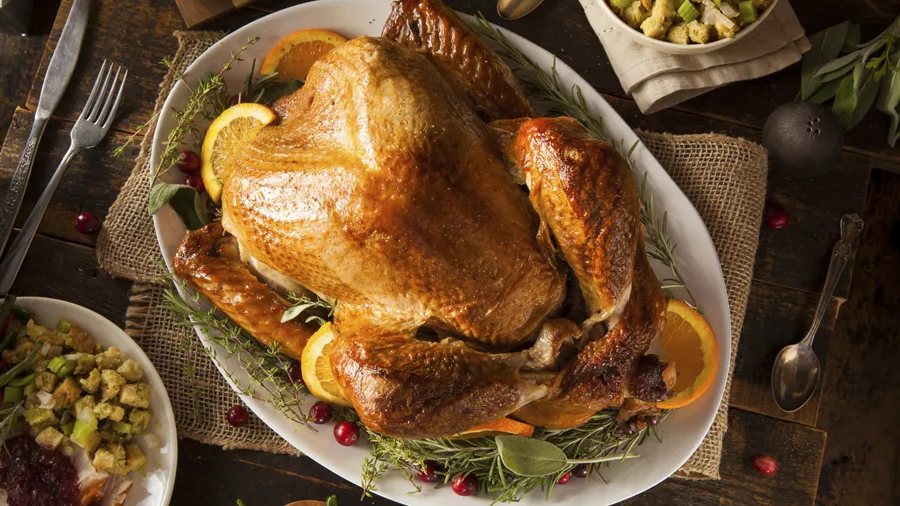
On the way to the kitchen to dig into the care package my mother had sent home with me, I tossed the magazine into the trash. God, thank you for showing me how fortunate I am. Another holiday meal with my family was right around the corner and I was looking forward to it. But I doubted it would beat the perfect Thanksgiving I had just had.

Did you enjoy this story? Subscribe to Guideposts magazine.

A Passover Tradition: Mom’s Brisket

They fled Egypt, grabbing unbaked loaves from their ovens.

As they raced through the desert, the searing sun baked the bread into flat, unleavened cakes. Only when they were safe from the Pharaoh, on the other side of a sea that miraculously parted for them, did the Jews finally have time to celebrate their freedom from slavery, eating the hard crackers we call “matzo.”

On Passover, my family gathers around the dining room table at my parents’ house and reads about that first, modest Seder, just part of the amazing story of the Exodus.

It’s one of the last sections of Scripture we read before our own meal is served…a meal much, much better than the one enjoyed by our ancestors. I have my mom to thank for that.

We eat matzo and other traditional foods to remind us of the difficult life our ancestors endured, but Mom’s cooking also summons memories from not so long ago.

“THE FESTIVE MEAL.” In all capital letters. That’s how it appears in my family’s Hagaddahs, the prayer books that recount the Passover story and contain the holiday blessings.

Our Hagaddahs were published by our Rabbi years ago to help simplify the Passover Seder. Each food on the Seder plate is explained–a green vegetable to symbolize rebirth and renewal, a bitter herb to remind us of the harshness of slavery.

But to some, it wasn’t simple enough. “Can’t we just skip to the meal?” my uncle Mike often joked. I laughed, but I understood. The delicious smells of my mom’s cooking made it hard to wait.

Smudges of sauce, drops of wine blotted onto the pages and crumbs of matzo nestled into the spine of each Hagaddah showed that no one waited until the books were put away to start digging in.

I first learned that Passover food was different when my favorite snack cakes went missing from the cupboard. “This house can’t have any chametz,” Mom explained. Chametz meant breads, cakes, anything that was leavened or contained ingredients used to make bread, like corn.

“Our ancestors didn’t have that, so for Passover we don’t either.” Mom even had my sister, Brooke, and me search the house for stray crumbs.

There was still plenty we could eat. The Passover meal was Mom’s masterpiece. Bowls of pickles, chopped liver and gefilte fish adorned the table. She served her matzo ball soup. Cabbage stuffed with sweet and sour meatballs. And the staple of our Passover dinner–Mom’s brisket.

At one of my first festive meals, Grandma Rita asked if I wanted some. “Biscuits?” I said. Wasn’t that chametz?

“Brisket,” my grandma corrected me. I cut off a tiny bite and chewed it slowly. The meat was spicy, smoky, with a hint of sweetness. The diced onions melted in my mouth. I was hooked.

I wasn’t the only one. My cousin Jeff emptied his plate three times, drawing concerned stares from my health-conscious aunt. It was Grandma Rita’s recipe, but she didn’t mind that my sister and I called it Mom’s brisket.

Over the years, the people at our table changed. My grandparents passed away. We were joined by friends, both Jews and non-Jews. But Mom’s food stayed the same. We wouldn’t have it any other way.

Not long ago Mom suggested we use new Hagaddahs. My sister and I objected. “Look at these,” Mom said. “You can tell what we had for dinner the past ten years.”

“But that’s why we like them,” Brooke said.

It was true. In those books was evidence of years of Grandma Rita’s brisket. Warped pages where Grandpa Sam had dripped brine from the pickle bowl. Tan spots that could have only been from chopped liver that had slipped off a piece of matzo Papa Morey had overloaded.

Somehow, the stains felt appropriate. The pages of the Hagaddahs recalled times God revealed his presence to our ancestors. Now the stains of holiday meals reminded us of more recent blessings–being able to share a good meal with the people we love.

After all, it’s not just the food on the Seder plate that has meaning.

Mom’s festive meal is a miracle in itself–bringing our family together to celebrate the freedom and joy God has brought to all of us.

Try Grandma Rita’s Brisket!

An Odd Fourth of July Farewell

This Fourth of July, Americans throughout the country will sit and stare toward the heavens to watch colorful fireworks explode in the sky. For writer Janna Bialek of North Chevy Chase, Maryland, however, those fireworks will represent more than patriotism. They’ll always remind her of Mom, and her mother’s unusual last wish:

“So, she wanted us to send her up in a firework.”

As Janna wrote in the Washington Post magazine, at first, she thought it was a joke. Sure, her mother always loved watching the family launch fireworks in their Iowa backyard on Independence Day, but to fire her ashes into the sky along with them seemed bizarre. Soon, however, Janna realized she was the only one who didn’t take the request seriously:

“After two days of cleaning out my mother’s apartment, we regrouped at my youngest sister Kayte’s house for Cincinnati chili… Between helpings, her husband, Chuck, brought up the Fourth.

‘Remember, I know that guy in Madison. Do you still want me to call him?’

Then Chuck was on the phone and everyone was paying attention. I tried to figure out what was going on. My 11-year-old nephew, Corwin, a practical-minded savant, said, ‘Be sure you tell him she’s already been cremated.’

I stopped mid-mouthful, realizing that my family actually knew people who could pack fireworks with the ashes of their parents.”

In the end, Janna came around on the idea of the strange farewell:

“The day hadn’t felt like the final send-off of my mother’s ashes; it felt sort of the way it always did. I missed the small, quiet part my mother played, giving directions and telling kids to be careful, taking in all the craziness as if it were a TV show. Then I realized: All that time she was our audience. She just watched, applauding us for simply being who we were—her kids, her grandkids. The Fourth of July might be Independence Day, but for us it was about needing one another.”

There’s no one way to say goodbye to someone you love. In our premiere issue of Mysterious Ways, we shared the story of Donna Teti, who tied messages to purple balloons in memoriam of the twin sister she lost. One of my favorite stories I edited for Guideposts was by our Senior Digital Editor Sabra Ciancanelli, about how a treasure hunt inspired by her sister, Ria, helped the family heal after Ria’s untimely death.

In our August/September issue, we’ll introduce a new section, “Here and Hereafter,” which will provide more stories about the moments surrounding death—before, during, and beyond. Have you said goodbye to a loved one in an unusual way? How did it help your family heal? Did you sense or see evidence of a comforting presence in your midst? Share your experience with us.

An Inspiring Long-Distance Friendship

“Be a sister to every Girl Scout.” That’s the last line of the Girl Scout Law but, to me, the most important one. It’s what led me to Tina Mitchell.

Back in 2005 I was the leader of my fifth grader’s troop here in Larchmont, New York. When Hurricane Katrina devastated the Gulf Coast, the girls asked what we could do for our sisters down South.

I signed us up for a program called Adopt-a-Troop. We were matched with Tina and her sixth graders from Marrero, Louisiana.

I e-mailed her right away: “How can we help?”

Tina said they needed school supplies, holiday presents and, most of all, encouragement. As our girls began to write each other, so did Tina and I.

“I wouldn’t make it without prayer,” she told me.

“My faith is my anchor too!” I responded. That wasn’t all we had in common. We were both only children, volunteers at church and enthusiastic bargain hunters.

Tina and I have been close ever since. I visited her in New Orleans in 2009, and she came up to see me this past summer.

In 2012, when Superstorm Sandy hit my area, Tina and her girls stepped right up to help–by donating dozens of gift cards to a New York church.

No matter what storms we face, I know Tina and I will always be there for each other. Just like sisters.

Download your FREE ebook, Rediscover the Power of Positive Thinking, with Norman Vincent Peale.

Animals and the Afterlife

My friend’s beloved and aged dog died not long ago. My friend was in a state of grief and there I sat helpless to comfort her—for what can assuage the loss of a dog, a cat, a horse, mouse, parrot, or pet snake? Our animal relationships are pregnant with meaning and almost as profound as the loss of a child.

Where do our animals go when they die? I remember when Puck, my Corgi, died. For weeks afterward I could hear the click of his nails on the bare wood floors, as if he were still following me through the house.

I missed him with a physical ache, the way he’d throw himself at the front door each noon to protest the mail that attacked through the brass slot (his ferocity succeeded, for didn’t the invader retreat after Puck’s assault, only to return the next day?). How could such life-force energy just disappear?

The fact that I could hear my dog’s nails on the floor disturbed me. Was it my imagination, forged in the fires of grief? And how was it that after two or three weeks it faded out and stopped?

In Colorado once I was giving a talk on angels, when a woman asked: “Do dogs become angels when they die?” Then she told the following story: She’d had a beautiful Shetland sheepdog in Idaho. It wore a red bandanna around its neck, a hippie dog. When it died, she fell into a depression–inconsolable.

She finally withdrew to a retreat center on the top of a mountain in New Mexico, where she spent her days reading, praying, walking, and recovering from her loss. One day she was hiking in the high mountains when a thunderstorm broke overhead. Lightning flashed. She knew she was in danger.

Some 55 people a year are killed by lightning in the United States and those deaths are most prevalent in the high mountains. The woman had a poor sense of direction, and while hurrying to reach the safety of the retreat, she got lost. She was scared. Suddenly she heard a bark. She looked up.

Through the rain she saw a Shetland sheepdog with a red bandanna around its neck, running back and forth ahead of her. When she took a step toward it, the dog ran down a path. If she hesitated, it came back, barking, inviting her to follow. As it ran down the slope ahead of her, she saw the dog’s plumy tail waving in great circles, like a pinwheel, just as her dog’s used to do. The dog led her to her own cabin at the retreat, turned, and ran away.

Was it her dog? Was it an angel? I have been privileged to know one perfect loving dog, one perfect cat, and now an exceptional horse, each one the full expression of unflinching love.

I think our animals are angels, earth-angels, pointing out for us the steadfast path of love, loyalty, optimism, faith, joy, hope. They teach us everything important about life. And when we grieve their deaths, it is love that we’re expressing in silent song–our grief being a poem proportionate to our love