

Amplify Your Daily Prayers
Have you ever hit the wall prayer-wise? Asked and pleaded till you’ve run out of gas spiritually, only there are still no answers in sight? That’s what happened to me. It was my parents’ 49th wedding anniversary, and I was planning the party. Mom had suffered a stroke, and Dad was wearing himself out taking care of her. “Please, God, make the party a special day for Mom and Dad. They really could use one.”
Then Mom landed in the hospital. Another stroke. So much for their party, I thought, gathering up the old letters I’d been going through to put together a tribute. One paper fluttered to the floor. I picked it up, saw Mom’s familiar handwriting from some 15 years earlier. “I’m overwhelmed by obligations, and I’m not feeling well. The doctors haven’t found anything.” She’d battled depression and other illnesses for decades.

“I left the situation in God’s hands,” Mom’s letter continued. “Then I picked up my Bible. It fell open to Psalm 71. I especially liked verse 18.”
The verse ends with proclaiming God’s strength to future generations. How fitting that I’d come across it now, just as Mom had then. The difference was my mother didn’t fret over what she hadn’t received. She trusted God was sending her an answer, and she searched until she found it.
Could it be that actively seeking God’s answers is as much a part of prayer as the asking? That our prayers are answered more fully than we sometimes realize? Okay, I thought, I’ll start with this party. “God, please show me how to make Mom and Dad’s anniversary special.” I sat there for a long time.
At last, an idea. I’d give a simple tribute to my parents’ courage and trust, in Mom’s hospital room if I had to. Guess what? Mom made it, wheelchair, radiant smile and all. What a celebration of enduring love, my parents’ and God’s, much bigger than I could have planned!
Maybe it’s not that there aren’t answers to each and every one of our prayers. It’s that we don’t know where—and how—to look for them. I decided to catalog prayer requests and answers to see if there was some sort of pattern. Here’s what I’ve come up with:
Sometimes you feel it. You know those moments when you sense the presence of a higher power? That’s one type of answer, God saying, I am with you. Moments like my mom finding a cure for a seemingly hopeless situation in a Scripture about the Lord’s strength. And me receiving the same verse years later. Coincidence?
The more I kept my eyes open after I told God about a problem, the more I noticed signs of his closeness. A comforting song came on the radio while I was stuck in traffic. A friend found a drawing of a dove tacked above her hospital bed. A rash of break-ins in the area had me worrying about safety until someone happened to give me a blanket with the image of an angel guarding a home. Ordinary occurrences, right? What made them extraordinary was how they gave me a lift. Instantly.
Try it. Pray about something, then be on the lookout. I bet you’ll see plenty of answers that God is with you. Even when the circumstances haven’t improved (yet), your attitude will. As my mom would say, hope makes all the difference.
Sometimes you hear it.
Have you ever prayed only to have the strangest phrase or thought pop into your head? Well, if you follow through on the idea, you might find an unlikely solution. Not to mention a whole other category: word answers. Think of these as God telling you, I hear your prayer, and I’m directing your thoughts toward a resolution.
My husband and I came home from our fourth-grader’s curriculum night concerned he wasn’t being challenged in his reading group. Should we have John read newspaper articles to me after school? Ask the local librarian to recommend books?
I prayed for insight. What I got was an odd thought. Have you gotten this fired up about John’s spiritual education?
Before I could protest, “Didn’t you hear me? I was asking about his school progress!” a plan came to mind. I went to John’s room and unearthed a book of children’s Bible stories. We sat down together and read about Adam and Eve. Sure, John had heard the story in Sunday school. This time, though, he asked a million questions. He couldn’t wait to read the next story.
The situation hadn’t changed on its own. What had was my way of dealing with it. Listen for God’s words. Let them enlighten you and guide you. You might even discover, as I did, that you can be your own answer to prayer.
Sometimes you just can’t miss it.
Sure, there are the traditional answers, big yeses like miraculous healings, financial windfalls, new jobs. But then there are the less obvious prayer responses. A stressful work presentation that’s unexpectedly well received, a new medication I read about that eased a friend’s migraines, the brake job my son got the day before a sofa tumbled off a truck driving in front of him on the interstate. Even the resounding no when a book I’d been working on for a year was rejected (it freed me up to do other projects). These answers are God saying, I’m taking action and spurring you to seek my will.
He can have a funny way of doing that. I was trying to help a woman from church work through a crisis. She had trouble opening up, so I prayed, Lord, help me get close to her. Our next visit, she motioned me to the far end of her couch. Her excitable terrier beat me to it. He bounded up and promptly wet the cushion. My friend and I looked at each other and burst out laughing. I had no other place to sit except right next to her, and we really got to talking. Her dog’s antics brought us closer in more ways than one. Call it canine intervention.
God’s at work in all circumstances. Sometimes you have to search for his answer. Other times it jumps right up on your couch and, well, you know the rest. Which brings me to my next point…
Keep track.
My prayer journal used to be a long list of names and maladies. Kind of depressing. Then I shifted my focus and started recording answers. Not just the clear ones but anything and everything. Within two and a half months, I found myself writing, “Answer to prayer #100.” Wow! That’s an answer a day and then some!
I totaled up the types of answers. Only 24 were the traditional action answers I’d counted for most of my life. The rest…43 presence and 33 word answers. A bonus of 76 answers—triple what I would have gotten if I’d stuck with my original method. Pretty mind-blowing, I would say.
Why not triple your answers? Keep your eyes and ears, your heart and mind, open to answers to prayer and keep track of them.
All in good time.
In my journal I also recorded the time between prayer and answer. “Answer #10: an e-mail thanking me for my honesty. Category: presence. Time prayed: 1 day. Answer #11: neighbor’s dad admitted to rehab. Category: action. Time: 3 weeks. Answer #12: an inner yes to make a phone call a friend suggested. Category: word. Time: 1 minute.”
Occasionally I got action answers right away. Usually they took weeks, months, even years. The granddaddy of them all? A story that was published 15 years after I submitted it.
Good thing word or presence answers came within a day. Sometimes minutes. Once I heard about a reliable washing machine repairman the day before I saw a puddle on the laundry-room floor. The instant I uttered a prayer, the guy’s name flashed into my memory.
I think these daily short-term answers are God’s way of reminding us that we remain connected to him, no matter how long it takes for things to work out. And they will, in his time.
In the meantime, we have plenty to keep us busy. Plenty to marvel at. Like “Answer #623: Dad’s spirits lifted by a drive through the countryside to see the leaves changing. Category: presence. Time prayed: daily.”
Sorry, I have to go now. I’m looking for an answer to prayer #624.
A Man of Prayer
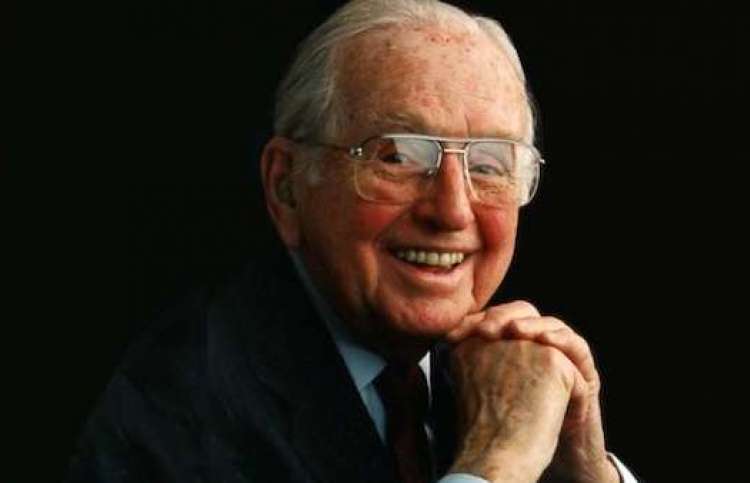
I came to Guideposts in my twenties when our founder, Norman Vincent Peale, was well into his eighties. I remember a man of great charm and warmth, selfdeprecating wit and sweeping spirituality.
In those days, when he gave a speech or a sermon, you would see a short, white-haired, bespectacled man dodder up to the microphone, looking like “an oyster cracker,” in People magazine’s memorable phrase, and you might wonder what the fuss was about. How could this unassuming person have written one of the biggest-selling and most life-changing books of all time, The Power of Positive Thinking?

But the minute he opened his mouth, a remarkable transformation occurred. His voice crackled and boomed. The decades dropped away. He seemed to grow in size and stature. And he radiated confidence. Wow, you thought, I want to have what he has!
Through his words you could see how belief in God and in oneself can be transfiguring. You participated in it with him and found yourself changed. Not long ago I wanted to see if this was still true and recommended Peale’s writings to a thirty-something friend who was going through a rough patch.
“Try this,” I said, handing him a book. He gobbled it up and read more. In the process I saw the knitted brow unclench, the self-absorption lift, the laugh return. It was the kind of transformation that Peale himself underwent at about that same age when he was beset by self-doubt.
What was this power Dr. Peale had, two decades after his death? He would have been quick to tell you that it wasn’t his doing. It was God’s work. Anybody had access to that. In fact, in his 60-plus years of ministry, 52 years served at the same church, Marble Collegiate in New York—an astounding record—he was always stretching and growing.
I remember him coming by the office one day, after his retirement from regular preaching, to pick up a stack of demanding tomes: theologians like Martin Buber, philosophers like William James and a new translation of the Bible.
In his own writings there is a constant effort to show how belief has a practical effect on daily life. His advice is simple and direct.
Read a Bible verse like “Do not be anxious about anything, but in every situation, by prayer and petition, with thanksgiving, present your requests to God” (Philippians 4:6) and let it speak directly to your worries. Don’t let your dark thoughts or fears strangle you, but share them with someone else. Then let them go and trust God.
Peale was always quick to give examples. Sometimes he himself would be Exhibit A, or it might be someone he met on a plane, in his office, at a sales convention or simply in passing. His calling was to connect the dots between our faith and our everyday life. That’s what I remember most about Dr. Peale. He was a man of capacious prayer.
One of his greatest praying lessons was that if you concentrate on one verse of the Bible it can have a transformative effect, whether it is a line of a Psalm like “My flesh and my heart may fail, but God is the strength of my heart and my portion forever” or something from the Sermon on the Mount: “Let your light shine before others, that they may see your good deeds and glorify your Father in heaven.”
You pray it and own it, and the vocabulary of faith becomes second nature.
Of course, Peale had his dark moments when he struggled with low self-esteem, even after his success. His longtime associate, my friend Arthur Caliandro, told me about one summer when Peale seemed to plummet into an intractable funk.
The famous author of The Power of Positive Thinking depressed? Yes, and that’s part of the appeal of Peale. Nobody needed the inspiring words he wrote and spoke more than he did. That’s what gave him his compassion, understanding and humility.
He made no secret of his long struggle with an inferiority complex. With Peale you were always hearing from both the doctor and the patient.
With so much on his shoulders he still managed to be incredibly fun-loving. He reveled in making himself the butt of a joke. Watching some of his sermons or listening to them (go to guideposts.org/ppt for a new app to bring them to your mobile device) I can’t help but laugh along with his congregation.
I remember at his ninetieth birthday party, a celebrity-studded fundraiser at the Waldorf Astoria, he spoke, following many glowing tributes. Standing at the podium in black tie, peering at the crowd through his glasses, he quipped, “I’m nothing more than a gimmick in a tux.”
He had no use for pretense or affectation. Peale was Peale.
Maybe that’s what made it easier for him to drop everything when he saw a person in need. One sad afternoon he came by the Guideposts office when we’d just learned of the sudden death of an editor from a stroke. Her young assistant was devastated.
Dr. Peale sat down next to her, held her hand, bowed his head and prayed in the most remarkable, spontaneous, comforting way. I’ve often wished I had taped him, but now I think that wouldn’t have been necessary because the voice I heard was the one I hear in my head when I read his words.
He brought faith down from the clouds and into those day-to-day situations when you need it most.
Download your FREE ebook, A Prayer for Every Need, by Dr. Norman Vincent Peale
A God You Can Count On

Every few days “Facebook Memories” pops up on my newsfeed with messages or photos I posted several years ago. The ones of my grandbabies always tug at my heart because they’re reminders that those sweet little ones are growing up way too fast.
Other memories are photos from fun times I’ve had at conferences with my crazy writing and film industry buddies, family trips and occasions with friends. Those moments make me smile and remember how blessed I am to have such special folks in my life.

And sometimes, those Facebook Memories provide reminders of a faithful God. That happened one day last week.
Here’s what I’d written years ago: “This morning at the hospital, I stopped at floor #6 and looked at the strip of concrete roof that was my view for the six weeks I spent there after a car wreck. The doctors said I’d never walk normally. They said I’d have arthritis, and I’d have to have a hip replacement within five years. None of that happened, and I just want to thank Him again for all those answered prayers.”
You know, friends, sometimes in the midst of our busy days as we zip from one thing to another, we neglect to remember all those times when God’s been faithful to us. So I’m going to share some faithful memories that popped into my mind today.
I remember a time when we almost lost our business, and there seemed to be no hope. And then a faithful God stepped in and did just what He promised in Psalm 18:19, “He brought me forth also into a large place; he delivered me, because he delighted in me.”
Read More: Mornings with Jesus Devotional
And then there was the time when I stood in a hospital room praying desperate prayers for my son who was in intense pain. He’d been very sick for days. The doctors had run numerous tests but were completely stumped as to what was causing the problem. And then my faithful God did just what He promised in Jeremiah 17:14, “Heal me, O LORD, and I shall be healed…” providing just the answers the doctors needed.
I remember the days following my dad’s suicide. Times when the grief overwhelmed me, when I felt like I couldn’t make it through the day. And then just as He promised in Psalm 46:1, He proved that “God is our refuge and strength, a very present help in trouble.”
I could write for days, thanking Him for the little things that really aren’t so little. For a roof over my head. For a pantry packed with food. For shoes on my feet and the ability to walk in them. The list could go on and on.
How blessed we are to have a God we can count on—who is available whenever we need Him. Take time today to think about the many ways He’s been faithful to you, and then thank Him.
A Better Prayer Than ‘Why?’

A friend of mine died recently. We have been friends for decades. He battled cancer for roughly half the time I knew him. And while he fought valiantly and (I’m sure) gained a victor’s crown in heaven, it was hard to watch him suffer and hard to say goodbye.
Another friend is currently facing a decision to continue debilitating cancer treatments or stop such brutal efforts and make the most of what time she has left on this earth.

At such times I am as prone as anyone to ask God: “Why?” “Why him? Why her? Why must they suffer so much? Why do my prayers for healing seem to go unanswered? Why would someone who has taken such good care of his body, eating well and exercising, be stricken with such a cruel disease? Why would someone who helped so many find herself so helpless when she is most needed by others?”
Read More: 5 Ways to Respond to the Last Words of the Dying
Those are fair questions. But asking God “why” seldom—if ever—results in an answer.
The Bible tells the story of Job, who suffered great loss and pain and repeatedly sought an answer to the question, “Why?” God eventually answered, of course, but not as Job wanted. Job wanted an explanation. God declined to explain, instead asking Job:
“Where were you when I laid the earth’s foundation?
Tell me, if you understand.
Who marked off its dimensions? Surely you know!
Who stretched a measuring line across it?
On what were its footings set,
or who laid its cornerstone—
while the morning stars sang together
and all the angels shouted for joy?
“Who shut up the sea behind doors
when it burst forth from the womb,
when I made the clouds its garment
and wrapped it in thick darkness,
when I fixed limits for it
and set its doors and bars in place,
when I said, ‘This far you may come and no farther;
here is where your proud waves halt’?
“Have you ever given orders to the morning,
or shown the dawn its place,
that it might take the earth by the edges
and shake the wicked out of it?….
“Have you journeyed to the springs of the sea
or walked in the recesses of the deep?
Have the gates of death been shown to you?
Have you seen the gates of the deepest darkness?
Have you comprehended the vast expanses of the earth?
Tell me, if you know all this” (Job 38:1-13, 16-18, NIV).
God never answered Job’s “why” question. God repeatedly—and at length—pointed out that His wisdom and experience so far surpassed Job’s earthly perspective that a satisfactory explanation was impossible. Not because of God’s limitations (Who has none) but because of Job’s.
Read More: How to Pray Healing Prayers
The story shifts, however, when Job says, “Surely I spoke of things I did not understand, things too wonderful for me to know. Therefore I . . . repent in dust and ashes” (Job 42:3, 6, NIV).
That is, Job discovered a better question than “why.” It is a question God is far more likely to answer, which is “What now?” Not “God, you owe me an explanation,” but “God, how should I respond to this?”
When I am treated unfairly, it is natural to feel self-pity and ask, “Why, God?” But when I pray instead, “What now, God?” He shows me how to respond with self-sacrifice instead of self-pity.
When a loved one falls ill or dies, I tend to curse the darkness, asking, “Why, God?” But when I pray “What now, God?” He often helps me light a candle and find ways to ease the suffering of others.
When my plans crumble in my hands, I quickly respond with frustration and ask “Why, God?” But when I pray “What now, God?” He tenderly but firmly suggests a new plan and often calls out of me new strength, determination and resiliency.
So try it. Go ahead and ask, “Why?” (Who knows, maybe you’ll get a better answer than Job). But let that question lead to the better one: “What now?”
A 5-Word Prayer That Always Works

There are times when we hardly know how to pray or what to pray. There are times when our hearts are full of prayers. And there are times when we can’t clearly identify or express our needs. But there is one five-word prayer that works, no matter what.
These days, my life is a jumble of uncertainty. My wife and I plan to relocate to a new part of the country in the near future to be closer to our children and grandchildren. But we have a house to sell (and prepare for sale). Job applications and interviews. And trips to schedule for more interviews. And shopping for a new house. And packing and moving arrangements.

Some decisions can’t be made until other decisions are made. But those pieces can’t fall into place into other pieces are in place. And on and on it goes. It’s crazy-making, so much so that we’re not sure what to pray for. We have no reliable timeline. No specifics to pray for God to bless.
So we turn over and over to the same prayer. A prayer for all seasons. A prayer that expresses our helplessness and our hopefulness. A prayer that contains all our needs and conveys our situation.
It’s just five words: “We are in Your hands.”
What more can we say? We don’t know what the future holds. We don’t know enough at this point to make detailed plans (which is always my go-to move). We have no clear concept of what, when, where or how. We only know Who: “We are in Your hands.”
It works equally well as a corporate prayer (“we”) or individual prayer (“I”):
Are you excited about a new job possibility? “I am in Your hands.”
Facing difficult decisions about the care of a family member? “We are in Your hands.”
Stressed about making your travel connections? “I am in Your hands.”
Adjusting to an abrupt change in circumstances? “We are in Your hands.”
Waiting for a doctor’s diagnosis? “I am in Your hands.”
It may sound too simple. Too non-specific. But those five words have wonder-working power. They’re a prayer of affirmation. A prayer of faith. A prayer of surrender. A reminder that we don’t quite know everything or control much of anything—and that we don’t have to, because we are in the hands of the only One who does.
7 Ways to Question God When You Pray

If you’re like most people, a fair portion of your praying is given to asking…but not questioning. That is, most of us ask God for things—healing, help, a job or simply for strength to get through the day. But we seldom question Him when we pray, despite the fact that the people of God portrayed in the Bible did so fairly often. Here are seven questions from the Bible that can still inform and energize your prayers today:
1) “Am I my brother’s keeper?” (Genesis 4:9, NIV)

You know, of course, that after Cain killed his brother Abel, God came calling and asking, “Where is your brother Abel?” Cain answered, “Am I my brother’s keeper?” We know, of course, that Cain’s cynicism met with God’s judgment. However, it’s still a question we can ask, especially if we ask it when we’re tempted to pass by someone in need or overlook some situation in which we can make a difference. “Am I my brother’s keeper?” can remind us that the answer is always yes.
2) “Why, Lord, do you stand far off? Why do you hide yourself in times of trouble?” (Psalm 10:1, NIV)
The ancient songwriters and singers of the Bible often asked such questions. Honest. Raw. Desperate. Their songs, preserved in the book of Psalms, indicate that God doesn’t mind when we express our frustration and impatience. He may not answer as we would like, but He prefers passion to platitude. And sometimes the very act of voicing our real questions is something like an answer all its own.
3) “How can a young person stay on the path of purity?” (Psalm 119:9, NIV)
Young or old, this question remains relevant today. The psalmist answered it, “By living according to Your word.” That’s a great answer. But maybe it’s not the only one. Maybe, if we ask it about ourselves and our own desires to live uprightly, God will speak more about our specific circumstances.
4) “How long, Lord, must I call for help, but You do not listen?” (Habakkuk 1:2, NIV)
Like the psalmists, the prophet Habakkuk was frustrated by God’s silence—he wasn’t the first, and he’s far from the last. It can be difficult to wait on God. So go ahead. Ask “how long?” Keep asking. It’s a fair question, and even if God doesn’t answer as or when you’d like, you’ll be in good company (see Revelation 6:10).
5) “Lord, how many times shall I forgive?” (Matthew 18:21)
Peter, one of Jesus’ first followers, asked how many times he should forgive a brother or sister, and even suggested what he thought was a generous number. Jesus answered with a seemingly impossible number. But it’s still a good question to ask, even when we know the answer, as it should remind us to keep forgiving…and forgiving…as our Lord does with us.
6) “How will this be?” (Luke 1:34, NIV).
When the angel Gabriel announced to the Virgin Mary that she would give birth to the long-awaited Messiah, she asked, “How will this be?” And the angel supplied a few salient details. We’ll never be in quite that position, but “How will this be?” is nonetheless a helpful question, especially as we read and meditate on the promises of God, which are always sure. The question often is, how will Your promises be revealed to us?
7) “If God is for us, who can be against us?” (Romans 8:31, NIV)
Okay, so this wasn’t a question asked in prayer. It was Paul’s soaring rhetorical question in his Magna Carta of faith, Romans 8. But try asking it in prayer, anyway: “If God is for me, who can be against me?” Ask it often, in faith. Shout it, even. And rest in the certainty of the answer: no one.
Those are just seven questions to ask God in prayer, drawing from the examples of the people of God in ages past. They’re only a beginning of course. There are many more that the people of God portrayed in the Bible asked. Keep your eyes open for such questions as you read, and you may find more questions—and answers—than you ever imagined.
What questions do you want to ask God?
7 Trending Faith and Prayer Topics

Strengthen your faith with these uplifting, faith-filled articles focused on spiritual growth, Bible study, and devotions for men and women. These trending stories, devotions, and prayers are reader favorites. Discover why they are beloved.
1. 7 Prayers of Release
Discover how you can let go of negative emotions through a simple prayer exercise. Use these 7 prayers from ward-winning writer and Guideposts blogger Bob Hostetler to help you let go of feelings of anger, resentment, fear, dependency and shame.

Prayer is an indispensable resource for a grieving heart. These five prayers and Scripture will help you feel comfort in difficult times of loss and grief. If you or someone you know is enduring a season of grief, these prayers will help you find God’s peace and feel his enduring love.
Guideposts Prayer support is a community of praying people from all over the world that pray for millions of prayer requests each year. Send a prayer request 24 hours a day, seven days a week, through Guideposts website, OurPrayer Facebook page and the iPhone App.
Discover the background and life lessons of strong women in the Bible: Mary the mother of Jesus, Ruth, Esther, Elizabeth the mother of John the Baptist and many others. Read their stories in Bible verses and find guidance through their wisdom and experiences.
This insightful prayer technique from Julia Attaway, best-loved Daily Guideposts and blogger will become your go-to prayer when you are frustrated, worried or feel that God is not answering your prayers. Read her blog each week where Julia shares her personal tragedies and triumphs and gives insightful and helpful tips to develop your spiritual life.
6. The Extraordinary Experience of Hearing God’s Voice
Turn to this trusted source for dealing with anxiety or depression, or coping with emotional, financial, or family stress. Each section provides prayers, Bible verses, quotes, articles, devotions and helpful tips to comfort and guide you through life’s challenges.
7 Simple Prayers to Pray Every Day

I used to think prayer was hard. It only counted, I thought, if I spent, oh, a half hour or more on my knees. It had to be focused, orderly and systematic. And, again, the longer the better.
Then I realized that none of my other relationships work that way. I don’t often schedule a “meeting” with my wife in the morning or sit my kids down for a half-hour or hour-long speech (not that they wouldn’t say it sometimes felt that way to them).

My exchanges with family and friends more often come in bite-sized chunks: “Love you!” “Do we need milk?” “Whose turn is it to let the dog out?”
So if you’re anything like me, (1) you have my sympathies, and (2) you might find it more natural, relational and doable to pray a few simple prayers throughout the course of your day.
Ask Guideposts’ OurPrayer team to pray for you!
Here are seven simple prayers, with accompanying scripture references, to show that you’re in good company in praying each one:
1) Here I am. (Isaiah 6:8)
Abraham, Isaac, Jacob, Moses, Samuel, and Isaiah are all recorded as having prayed the “Here I am” prayer. It works best first thing in the morning, a way of reporting for duty and being “present” to God.
2) You are great. (Psalm 86:10, NIV)
A sunrise. Fresh orange juice. A cool breeze. A baby’s smile. A shooting star. Any number of things throughout your day may prompt you to say, with David, “You are great and do marvelous deeds; You alone are God.”
3) Thank you. (Psalm 138:1, The Message)
Certainly at meal times, but even the worst day includes many reasons to tell God, “Thank You! Everything in me says ‘Thank You!’”
4) Help. (Psalm 38:22, KJV)
Whether your need is big or small, every day presents multiple opportunities to pray this simple prayer: “Make haste to help me, O Lord my salvation.”
5) Bless. (Psalm 67:1, NIV)
Whether it’s just one or two words (“bless him”) or more (“May God be gracious to us and bless us and make His face shine on us”), this everyday prayer can be a request to heal, prosper, encourage, strengthen, comfort or deliver someone.
6) Sorry. (Psalm 38:18, ESV)
I won’t tell you how often every day I pray this prayer. Suffice it to say, I have found out the sooner I express my repentance, the better—often using the words of David, “I confess my iniquity; I am sorry for my sin.”
7) I love you. (John 21:17, ESV)
One morning at breakfast, Jesus gave Peter three opportunities to express his love for the Lord, until Peter finally said, “Lord, You know everything; You know that I love You.” “I love You” is a great thing to say many times a day to God.
That’s it. Just seven simple prayers. Some as few as 14 words. But they work in so many situations throughout any given day that they can make prayer more doable, no matter what your schedule may be.
7 Reasons I Pray Daily

The great Christian author and apologist C. S. Lewis famously said, “I pray because I can’t help myself. I pray because I’m helpless. I pray because the need flows out of me all the time, waking and sleeping. It doesn’t change God. It changes me.”
I can say “Amen!” to that. I pray for those reasons. And more:

1) I need God.
Like many people, I am most often driven to prayer because I need something. A job. Healing. Money for car repairs. Those sorts of things. But the more I pray, the more apparent my real need becomes: I need God. He is my source, my strength, my healer, my helper.
2) It clears my head.
I can’t possibly count the number of times I have gone to prayer in confusion—my mind and heart all stressed and twisted and panicked—only to experience a wonderful release and peace by the time I finished praying. I know the truth of the verse, “Thou wilt keep him in perfect peace, whose mind is stayed on thee” (Isaiah 26:3, KJV) because I’ve experienced it.
Ask the OurPrayer team to pray for you!
3) It starts my day right.
For many years I was too busy to pray in the morning. My days began with hurry and progressed in the same way. But at some point, morning prayer became not only a habit but also a blessing. It orders my day. It sets the tone. It gets me going in the right frame of mind and the right orientation of heart.
4) It ends my day right.
I’ve written elsewhere on this blog about the blessing Compline (evening prayers) has been to me. Suffice it to say here that prayer helps my mind review the day, download and offload all the day’s stress and struggles, downshift my brain’s mechanisms, and prepare for rest. At this point, I think I could more easily go to sleep without locking the doors or brushing my teeth than I could without having prayed.
5) It reminds me of a few important things.
Like who God is. Who I am. What matters most. Where I come from and where I am going.
6) Things go better when I pray.
I know God answers prayer because I see those answers on a daily basis. If for some reason I neglect prayer, I feel like I’m not firing on all cylinders, so to speak. Things go wrong. I go wrong. Perhaps most importantly, disappointments and detours that might shake or shatter me if I haven’t prayed more often turn into blips—or even blessings—when I have prayed.
7) I get better as I pray.
Seriously, I shudder to think of the man I would be if I subtracted all the praying I’ve done over the years. Prayer makes me a better man, because prayer brings God and all He is and means to me into motion in me and through me. I am nowhere near good enough or smart enough to go without prayer. Little by little, day by day, I become a more blessed, more joyful, more capable, more focused and more sensitive person than I was just a few days before.
I could go on. Seven reasons barely scratch the surface. I could easily list seven more, I think. So maybe I will, in a future post.
7 Promises of God to Pray

The Bible is full of promises God made to His people, both individually and corporately. (Some have counted as many as 3000 promises in the Bible!) Some promises apply to specific people or situations, such as God’s promise to give Abraham countless descendants (Genesis 15:5).
But many apply to God’s people today and can be prayed and claimed by us in prayer. I asked some of my friends if they regularly prayed any specific promises of God and was blessed by their responses:
1) To Know God’s Heart
Sherrie prays Psalm 25:14 (“The Lord confides in those who fear Him; He makes His covenant known to them”) because, she says, “I want to know the heart of God.”
2) For Healing
Judy says, “Psalm 103:1-5 (‘Praise the Lord, my soul, and forget not all His benefits—who forgives all your sins and heals all your diseases’) has been especially meaningful for me. There have been times when I faced major attacks on my health, and this scripture was an anchor during the storms. And yes, He did answer and heal my diseases.”
3) For Strength
Giselle often prays Psalm 125:1-2 (“Those who trust in the Lord are like Mount Zion, which cannot be shaken but endures forever. As the mountains surround Jerusalem, so the Lord surrounds his people both now and forevermore”).
She says those words sustained and strengthened her when doctors said her son was about to die. She prayed those words, and many others prayed with her. Her son was delivered from death.
4) For Perfect Peace
Janyce says she prays Isaiah 26:3, in which God promises to “keep in perfect peace those whose minds are steadfast, because they trust in [Him].”
5) For God’s Word to Bear Fruit
Betty prays Isaiah 55:11 in which God promises that “my word that goes out from my mouth. . . will not return to me empty, but will accomplish what I desire and achieve the purpose for which I sent it.” In particular, she prays that promise for her children who were raised in the faith but have since wandered.
6) To Lay Hold of God
Linda’s favorite promise to pray is Jeremiah 19:13-14, which says, “‘You will seek Me and find Me when you seek Me with all your heart. I will be found by you,’ declares the Lord.”
7) For Wisdom
Cherrilynn regularly claims God’s promise to supply wisdom: “If any of you lacks wisdom, you should ask God, who gives generously to all without finding fault, and it will be given to you.”
Those seven merely scratch the surface of God’s many promises and His continual willingness to answer prayer. There are many, many more—such as the promise of rest (Matthew 11:28), presence (Hebrews 13:5) and forgiveness (1 John 1:9).
What promise of God will you pray and claim today?
7 Prayers of Paul
Wonder what to say in a prayer for someone else? Wonder if you should even tell them you’re praying for them? Here are seven examples of prayers that the apostle Paul sent in his letters. Most of them are to groups of people, small Christian congregations scattered throughout the Roman Empire, but the last is to one person, Philemon.
What I love about all of Paul’s prayers is his affection for those he is writing to. His words are full of love and that seems a good model for any prayer.
I don’t stop giving thanks to God for you when I remember you in my prayers. (Ephesians 1:16)
I’m thankful for all of you every time I pray, and it’s always a prayer full of joy. (Philippians 1:4)
This is my prayer: that your love might become even more and more rich with knowledge and all kinds of insight. (Philippians 1:9)
May the God of hope fill you with all joy and peace in faith so that you overflow with hope by the power of the Holy Spirit. (Romans 15:13)
We pray for you that you don’t do anything wrong … (2Corinthians 13:7)
Night and day, we pray more than ever to see all of you in person and to complete whatever you still need for your faith. (1Thessalonians 3:10)
Philemon, I thank my God every time I mention you in my prayers because I’ve heard of your love and faithfulness … (Philemon 1:4)