Embrace God's truth with our new book, The Lies that Bind

How ‘Unanswered’ Prayers Draw Us Closer to God

Sometimes prayer doesn’t work. 

That may be an unpopular—even blasphemous—statement. But it’s more or less true, from our human perspective at least. We pray for a healing that never comes. We ask for something to change, and it doesn’t. We plead for answers we never get. But even when a prayer isn’t answered, it still “works.”

Community Newsletter

Get More Inspiration Delivered to Your Inbox


My five-year old grandson, Ryder, sat at the dinner table, nearly in tears. He glared at the three remaining chicken fingers on his plate. His mother had told him to take three more bites of his food—just bites, not even the whole thing—before he could be excused from the table. He complained and cried as though eating three bites (of a food he normally enjoyed) would threaten his very existence.

I sat down beside him. I tried to encourage him, to no avail. 

Then he straightened and looked at me, bright-eyed. “You could eat my chicken for me.” 

“No, buddy, I can’t. Your mom said you have to eat three bites.”

“But if you eat it, she’ll think I did.” 

“But it would still be disobeying your mom. And it would be a lie for us to let her think you ate them.”

“Please?” 

“No, I’m sorry, buddy. But I’ll sit here with you for as long as it takes. We can talk or we can sit quietly, until you manage to eat three more bites.”

His heartfelt entreaty didn’t work. But we sat together and talked a little until he finally managed to finish his meal.

We may not always get our preferred answers to our prayers. We may feel at times as though God isn’t listening, much less cooperating. But prayer still works in such times. It continues the conversation. It reminds us that He is there. And even when—for whatever reasons—we don’t get the answers we crave, prayer still brings comfort and strength from being in His presence and knowing we are not alone.

How to Wait for an Answer to Your Prayers

Not all prayers are answered in the way we hope, but still we continue to pray and trust that God will give us an answer one way or another. This is not always easy to accept, especially when praying for crucial issues such as healing for yourself and loved ones, a financial breakthrough, restoring a relationship or a new job. When issues such as these arise, we pray for a positive response to our request, yet it is His will that is the deciding factor.

Not only are we unable to decide how our prayers are answered, but when they are answered. Prayers call for patience and persistence. How and when our prayers are answered is out of our control. This is a challenge because our natural instinct is to be in control of our situations and circumstances. In prayer, we surrender our control and will to our loving and merciful God whose perspective, view and knowledge of the bigger picture are beyond our comprehension and capacity. As children of faith, we must surrender to the wisdom and guidance of God…a parent who wants what is best for His children. 

Sugarcreek Amish Mysteries In-Article Ad 2023

Tim Keller, author of the book Prayer: Experiencing Awe and Intimacy with God, wrote, “The final thought of every prayer must be for the help we need to accept thankfully from God’s hand whatever he sends in his wisdom. Our Father alone knows what is best; granting our request might, in many cases, be our destruction.” Keller goes on to explain that we must balance restful hope, submission to God’s will and confident hope, as we continue to pray forcefully, believing that God will answer our prayers. In addition, we must avoid asking God to bend His will to ours. It is this delicate balance that helps us continue to pray without discouragement and doubt.

When reading this book, I was reminded of the story of Abraham, who God promised would become the father of all nations. Although he and his wife, Sara, were older, and God’s promise took long to fulfill, the Scripture tell us, “Against all hope, Abraham in hope believed and so became the father of many nations.” Prayer requires us to believe, be patient and pray frequently while trusting God’s will.

Lord, teach us to have a restful and confident hope in You. 

How to Find God When You Feel Depleted

Have you ever felt like the world is caving in on you, like you didn’t have the strength to face one more challenge? As if your mind, body and spirit were depleted? Throughout my life, I have felt this way several times, but looking back, one dark chapter stands out above the rest. At the time, I was 26, working fulltime, going to school, a husband and a father of two. This would be enough to deplete anyone, but on top of all that, my one-year-old son Paul had just had his fourth surgery due to kidney problems. 

Soon after that surgery, the longest and most complicated of the four medical procedures, my wife and I brought him home. Sadly, things got worse. Whenever we touched him, his small body would jerk, and he would cry in agony. Out of fear for our son’s health, I drove my wife and him back to the hospital. With a paper due shortly, I waited impatiently for an update in the seminary library. But when my wife called, the news depleted what was left of my spirit. The doctors thought it was a serious enough issue that they needed to do a spinal tap. The first thing I thought was, “Lord, I don’t think I can handle my son having another illness. I don’t have the strength.” 

Go For It In Article Ad

In the Bible, the Apostle Paul found himself dealing with an issue beyond his own strength and comprehension. As he struggled, the Lord spoke to him, “My grace is sufficient for you, for My power is made perfect in weakness.” In other words, when we are weak, God is strong for us. Though we know this is true, when times are hard we have a tendency to feel powerless. But it is in these times that we must acknowledge our need for the strength of the Lord. We must trust that His hand will carry us, and His presence will empower us. 

In the end, my wife and I received good news. It turned out that my son had a bad reaction to the medication he was prescribed after the surgery, but he would be just fine. It has been years since that day, but the lesson I learned has stayed with me: when we are weak, God is strong for us. It was God who got me through that dark time and it is God who will get me through whatever lies ahead. 

Lord, give us strength and faith to believe You are strong for us.  

How Six Sheets of Yellowed Paper Eased Her Loneliness

Three weeks into this time of social distancing and my emo­tions were melting down.

Around the world, people were sheltering to prevent the spread of Covid-19. You’d think someone like me, a veteran at being alone, would have no prob­lem with isolation. Since my husband John’s death from cancer seven years ago, I’ve managed our 468-acre farm and cattle operation on the North Da­kota prairie by myself. I’ve learned to live with solitude, silence.

extraordinary women of the bible

Yet this forced separation from my neighbors, my community and the co­operative farming arrangements that had taken me years to develop was stretching me to my limit. I was 67. Never had I felt so alone.

It was Maundy Thursday, four days before Easter. How I longed for John’s companionship, his hardy strength and clear-headed wisdom.  “Lord, please let me hear his voice!” I said out loud during my morning prayer time.

It was an unusually bold prayer. Or­dinarily I am content with God’s own ways of communicating. A sudden feel­ing of joy perhaps or a flash of insight amid silence. A memory of something John had said during the many long conversations we shared during our nearly 30-year marriage.

Was it presumptuous to ask for something more direct? It was Holy Week. If ever God might grant such a prayer, it was now.

My partnership with John had been close, and I had not expected to be alone at this stage of my life. We did not have children. The farm was our life’s work, and we worked in a prayer­ful rhythm, alternating solitude, to­getherness, silence and conversation throughout each day.

John was a steady, thoughtful man. He made decisions carefully, writing out plans and goals. He had a way of considering ideas from all sides to ar­rive at a balanced view.

I needed that balance now. The news was full of conflicting opinions about the severity of the pandemic, the im­portance of quarantine, the right gov­ernmental response. I knew my age put me at risk. But I had a farm to run, and I couldn’t do it without help from my neighbors. John would have known how to sort through the confusion.

Since John’s death, I had built up a small community of people I worked with or just visited over coffee. I could endure isolation because there was al­ways human contact to look forward to.

Nothing is as comforting as a hug once in a while, and my two young friends Julia and Mirek were certainly great huggers! They owned Farmtastic Heritage Foods Hub, a farm-to-table restaurant and catering busi­ness they had started in the nearby town of Anamoose. Julia and Mirek sold locally grown and prepared foods, including grass-fed beef from my farm.

I tried to visit them as often as I could to support their business, which had become an outlet for local growers. I loved Julia’s salads and desserts. And I loved even more the warm welcome I got and the sense of community in the restaurant, which occupied an old post office that had been vacant and marked for demolition before Julia and Mirek rescued it.

The restaurant was closed now. Would it survive? If it did, would I be able to hug my friends the next time I visited?

I wondered the same thing about other friends in the area. Here in North Dakota, dropping by for coffee is prime social time. When would I have that again?

I couldn’t visit my older sister, Kar­en. She was rightfully concerned about exposure to the virus, and she knew I had to be in contact with other people to keep the farm going. We mutually agreed not to meet for coffee.

And then there were Tony and Sam. They were my neighbors on either side of the farm, young men in their thirties, just starting their families. John had gotten to know Tony first, supporting his interest in horses. I had known Sam since he was a 17-year-old member of the church youth group John and I used to lead. Now he was married and establishing his own operation.

Life as an independent farmer is challenging in this era of agribusiness consolidation. I let Tony and Sam graze their cattle on 68 acres that John and I owned. John had grazed our cows on that piece of land, but I simply couldn’t manage it. It was too far away from the main farm.

Sam and Tony occasionally helped me on my farm. Some jobs required more raw strength than I had. I called Sam and Tony my “farm cooperators.” We worked shoulder to shoulder, treat­ing a sick calf, pushing a stubborn cow into a trailer, hauling heavy loads. Then we had coffee back at the house or visited outside.

At least we used to. Sam and Tony still came over to help. But we did our best to keep our distance. How long would I have to give up that treasured time with my neighbors?

“John, where are you?” I demanded of his empty chair in the dining room. He had often sat there to do paperwork or just think or pray.
All that day, I listened for him. But all I heard was the wind.

Good Friday came, and my sense of loneliness deepened.

“Please forgive me for not letting you be enough,” I said to God that morning. I still had misgivings about my bold prayer the day before to hear John’s voice. I was in my prayer place by the din­ing room window. I reached for my Bible to read about Jesus’ death, but for some reason I picked up my journal instead.

I opened to the entry for May 1, 2013. I had been at the hospital that day while John underwent surgery. The hospital was run by a religious organization, and there was a crucifix on the wait­ing room wall. I remembered willing myself to envision that cross empty, Jesus already alive and appearing to his friends.

“I proclaim Jesus Christ, risen!” I had written in the journal while pray­ing for a miracle for John. He died a few months later.

I closed my journal, put aside the memories and went outside to do the day’s chores. I pitched hay to the goats, watered the calves, checked cows and horses. Their company did nothing to ease my isolation.

Chores done, I went back to the house and climbed the stairs to my office, where I supplemented farm in­come by writing articles for agricul­tural publications. I passed the room where John had kept his own desk and saw that the two-foot rustic cross on his desk had somehow fallen facedown. I went in to set the cross back in place.

I noticed some papers on the floor, which was odd because I knew this room top to bottom and those papers hadn’t been there before. Maybe they slipped off when the cross fell. I picked them up and put them back on the desk. They were some of John’s old operating budgets for our cattle herd.

That’s when I spotted another stack of papers on top of a small box on the floor beside the desk. Recently I’d been cleaning out the closet in that room and set that box on the floor. But I didn’t remember putting any papers there. Six yellowed sheets were filled with John’s scrawl.

So many farm records in this house. Why did I save them all? But wait! These weren’t budgets. There were paragraphs here, John’s thoughts about something.

I rushed downstairs to the dining room to lay the pages on the table and decipher John’s writing, which was never easy to read.

It dawned on me what these papers were. Long ago, we had mused about John’s writing a weekly column for ru­ral newspapers. He certainly had a lot to say about farming.

Apparently, he’d written a few sam­ple columns but never shared them with me. I didn’t mind. He would have shared his writing only after he was satisfied he’d gotten it right.

I sat at the table with these tangible memories of my husband spread be­fore me. John wrote in his customary self-deprecating manner, his oblique way of coming at an issue, sidestepping hard-and-fast judgments while point­ing toward a hopeful outcome.

One of the columns mentioned walks we used to take around the farm. “We talk, we visit, we discuss,” he wrote. Music to my soul!
Another column spoke of “great and enduring adversities” testing charac­ter. Press on, Raylene, John seemed to be saying.

He signed each column, “The Red Leaf.” That must have been a nod to his Canadian heritage. He’d been born in Manitoba, and we had met when I was working at a Canadian ranch as a young woman.

The more I read, the more peaceful I felt. Here in these pages, discovered by accident on the darkest day of the Christian cal­endar, was the voice I had been longing to hear.

God had answered my prayer in his own time and way. And in that answer came all the other times God had been faithful through the never-ending chal­lenges of farming and making a life in the demanding landscape of the north­ern prairie.

I was alone, yes, walking into an un­certain future.

And yet I was not alone. God was here. So were my years of experience as a farmer and the wisdom of my hus­band, which I still carried in my life and my work.

“There is hope for your future,” God promises in the book of Jeremiah, one of my favorite Bible verses. I believe it, even during this difficult time. A future of love and grace. Of renewed life. Of coffee with my sister and conversa­tions with my neighbors. Hope that flows from a God for whom no prayer is too bold or too big.

For more inspiring stories, subscribe to Guideposts magazine.

How Prayer Helped Build Habitat for Humanity

I’m a dreamer, but I’m also a practical man. It’s my nature. I see things that need doing, and I itch to get them done, and done right. Yet little of what I have accomplished in the last 18 years would have been possible without an element that some wouldn’t think all that practical. Quite simply, this element is prayer. I believe that prayer has given me resources and power beyond my abilities. I have relied on prayer to build something from nothing many times.

Back in 1965, when my wife, Linda, and I were making a new start in our lives, we had no idea of what God expected of us. So we left our home in Montgomery, Alabama, and drove down to Florida with our two children in an effort to find a new perspective on things. I can still remember our first fumbling prayers during that week. “What do You want us to do, Lord? We just want to serve You. We’re at Your disposal.”

Mys of Blackberry Valley In Article Ad

A few months later the Lord led us to Zaire, the old Belgian Congo in Africa, where we visited missionaries of the Christian Church (Disciples of Christ), who pointed out to us the pitiful living conditions of the people there. But, though we didn’t know it at the time, the Lord had an answer for us the very next week after we opened ourselves to Him in our prayer life. On the way home we stopped off to see an old friend who was living in a Christian settlement near Americus, Georgia, called Koinonia Farm. The word “Koinonia” comes from the Greek word for community, and the farm was just that, a community of believers caring for one another.

That day we also met the farm leader, Clarence Jordan, who had founded Koinonia in 1942. He told us how the interracial community had at first thrived by selling eggs and produce at a roadside stand until the Ku Klux Klan organized a boycott against its products and terrorized its residents during the late 1950s and early 1960s. By the time we arrived Koinonia had shrunk to just a handful of people.

From that visit on, Linda and I couldn’t get Clarence Jordan’s vision for a sharing Christian community off our minds. For the next few years I traveled and spoke extensively about the needs we had seen in Africa. I also helped to launch a $10 million fund-raising campaign for a small black church-related college in Mississippi. In June of 1968 we returned to live at Koinonia. We were slow in learning it but this was God’s answer to our prayers.

The first thing we did with Clarence Jordan was to reorganize the farm under the name Koinonia Partners—partners because we would be in partnership with God and with one another. Our first order of business was to construct simple but serviceable homes on 42 lots we laid out on the farm property. These houses were intended for low-income families who were living in tar-paper shacks nearby.

Had any realtor looked at our plans for financing, he would have said we were crazy. We resolved that we would be guided by a Biblical principle laid down in Exodus 22:25. We would charge no interest on our mortgages and make no profit. Furthermore, we would have low monthly payments, spread out over 20 years. Payments would be plowed back into a fund to build more housing.

When we started Partnership Housing in 1968, we didn’t have the money to build one single house. What did we do? We prayed about it. And, having prayed, we asked other people to help, and we started building on a shoestring. We took Jesus at His word—literally. And we prayed—literally—asking that the money would come in. And it did.

We finished building houses one at a time, and soon families who had spent their lives in shacks moved in. How touched I was to visit an elderly man in his new home and hear him tell me, “When it rains, I love to sit by the window and see everything all wet. I’m sittin’ in here, dry, and it ain’t rainin’ on me.”

Clarence Jordan died suddenly in 1969, but by then he had lived to see his dreams for Koinonia reborn. By 1972, our first Partnership Housing project, Koinonia Village, was nearly finished and we laid out sites for 32 new homes in another section. Linda and I began to feel, with more and more skilled and talented people moving in, that our work was about completed at Koinonia.

Again, we drove down to Florida. We holed up in a motel in Tallahassee. After a whole day of praying and wrestling with the direction our life should take, our conversation turned to Africa. “I wonder what’s going on in Zaire?” I mused to Linda. “Remember the pitiful shacks there? They sure could use some houses like we’ve been building at Koinonia—and other help, too.”

The more we talked about Zaire the more I began to wonder: Could the Lord be nudging me?

And then Linda said, “Why not give Bob Nelson a call?”

Dr. Robert Nelson was the Africa Secretary for the Christian Church (Disciples of Christ). It was he who had arranged our original visit to Zaire.

I dialed his headquarters in Indianapolis and talked to him about this strange idea about building houses in Zaire.

“Millard…” Bob exclaimed. “Your call…it’s providential! Yesterday, a representative of the Zaire church was in my office. He was asking for someone to help with building development. And I had to tell him we were sorry but we didn’t have anyone who could do the job.”

Had God spoken audibly, Linda and I couldn’t have been more dumbfounded.

So we were off to Africa with our by now four children to build houses.

The government gave us a tract in the middle of Mbandaka, Zaire, for 114 houses. But there was mind-boggling bureaucratic red tape and—at first—serious doubts that the houses actually would be built. There were shortages of materials and supplies and agonizing delays even when they were available.

Cement was our most important construction material. Just as we were about to complete the first of the houses, our supply dried up. Every morning I prayed about it: “Lord, let this good work continue. We’re confident the cement will arrive. Just give us patience to wait on You.”

When we were down to 35 bags of cement, Linda suggested that I try a British construction company that was working at the local airport. That same day they sent over 200 bags, and they supplied us with nearly 100 tons until our own cement arrived.

Three years after we had started the project we had a joyful celebration, dedicating 114 homes we had set out to build. That day the project’s residents named their community Losanganya—place of reconciliation. Our prayers for housing in Africa had been answered.

And it was this answer that fueled our hopes for an even larger vision. Shortly after our return to Koinonia Farm in 1976, I invited 35 people who had supported our work to a meeting. While we had been in Africa I had corresponded with a friend in San Antonio about a housing project for the homeless in that city. My dream was to expand this project across the entire United States and around the world.

In a three-day brainstorming session, we mapped out a new program and came up with a new name—Habitat for Humanity. We decided that the program would be financed by seeking donations and no-interest loans from affluent Christians and placing them in a Fund for Humanity. Once we had the fund started, we reasoned, it would sustain itself with no-interest payments from those living in the houses, and from volunteer labor from the families and other concerned people. It has done just that.

Our first project was to buy a few slum properties in southwest Georgia and fix them up with unskilled labor. In less than 10 years we’ve built and renovated over 1,000 homes in 64 American cities and 11 foreign countries. Habitat for Humanity is a totally ecumenical effort to provide shelter for all of God’s people.

Prayer keeps us in business. We have a few paid staff members and literally thousands of volunteers. We seldom have enough money or materials, but once we make our needs known to the Lord, He has always delivered.

Take last summer when we started renovation work on an abandoned building in the heart of New York City. We were a little worried about the venture. After all, this was the impersonal “big city,” and many were casting us as so many Don Quixotes tilting at windmills.

We had just $15,000 in the bank to start renovation of a six-story tenement on Manhattan’s Lower East Side.

For several months prior to our arrival, volunteers from local churches had worked Saturdays cleaning out tons of rotten boards and debris to make renovation possible. By the time our work group from Georgia had stepped off the bus to start work, we learned that most of that $15,000 had been spent on permits and building materials.

Jimmy and Rosalynn Carter were with us in the work party from Georgia. In fact, President Carter was largely responsible for getting the group together, and he and Rosalynn were hard workers during our week of intensive renovating. We wondered how the press would respond. Would our efforts be put down as mere publicity-seeking?

At first I felt as though the whole city was waiting for us to fall on our faces. “Lord,” I prayed, “You know our situation. We need materials. We need cash, and we could use a few more skilled people to help us. Lord, we know You won’t let us down, because we’re going to do everything we can to make this project a success.”

Each morning we arrived bright and early and began ripping out rotting timbers and replacing them with strong new ones. Soon I believe people began to see that our little group from Georgia meant business. Then things began to happen.

Literally hundreds of affirming news stories began to appear on TV, in papers and magazines throughout the city and the nation. In New York the outpouring of support was incredible. Individuals gave us checks and cash—from $5 to $10,000, unions donated labor, businesses contributed materials and the use of equipment, and on our final day, a large gathering at St. Bartholomew’s Church collected nearly $10,000 for us at a special service.

And there was more, much more, such as the woman who came down from the Bronx to give us a geranium as a symbol of hope, and the Chinatown restaurateur who gave us a gala dinner for free. By the time Linda and I left New York, it was no longer the impersonal “big city” for us; it was a warm, loving and caring place.

Once again we had asked, blessed our petition with the work of our minds and bodies, and had received. Yes, I believe in prayer. I believe it empowers me, moves me past need, past difficulties and obstacles. And I believe that prayer is a real and living force that can work for you, too.

Download your FREE ebook, A Prayer for Every Need, by Dr. Norman Vincent Peale

How One Prayer Was Answered in a Day

“Enjoy your week alone, convict.”

Those were the last words I heard before the prison guard slammed shut the steel door. My new cell was a 10 by 10 room with concrete walls. All I would see for the next seven days. Just me, a thin mattress on the floor and a book. But I didn’t let the guard see how I felt about it. I wasn’t going to show any weakness. That could get a guy killed in a place like this.

Walking with Jesus L&E evergreen_in article ad

What had I done? Several counts of dealing and cooking methamphetamines had earned me a jail sentence of about 175 years. I would never get out of the Oklahoma Lexington Correctional Center. With no hope and nothing else to do, I dealt and took even more drugs in prison—that’s how I ended up in solitary. Bad drug deal on the yard.

But what did it matter? My life had ended five years ago when I got locked up. Not that I fit into regular society anyway. If anybody saw me coming down the street—beard down to my belly, hair down my back, fire in my eye—they’d say: There’s a guy who’s going to hell. And they’d be right.

I sat on the mattress, my back up against the wall, and picked up the book. A Bible. Of course. Don’t know what they think this book has to do with me, I thought. The Bible was for upstanding people on the outside. People like the man my family thought I’d become when I won a math achievement contest at 13. Not the junkie convict I was now. I tossed the Bible into the corner.

As the hours and the days dragged by, that little red book looked more interesting. I lost track of how long I’d been in the hole when I started reading. I flipped to the stories about Jesus. The prison ministers talked about him all the time. How great he was, how loving. Jesus wouldn’t know what to do with me, that was for sure! Nothing much to love about a guy like me. Jesus was for good people. People who didn’t have to be forgiven for much more than their little white lies. But then…what was this? Jesus said, “I was in prison and you visited me…Truly I tell you, just as you did it to one of the least of these who are members of my family, you did it to me.” I read the passage again, making sure I got it right. Jesus related to prisoners? I read more of the Bible, about how Jesus encouraged all the outcasts to follow him. He had died for their sins, and he forgave them. My sins too? I wondered. Jesus wasn’t just for good people?

The page before me blurred. If the other prisoners saw the tears in my eyes I’d be in trouble. You don’t show weakness and survive in prison. “Jesus?” I whispered. “Would you really help me? Take away my desire for drugs. Let me be a better man.”

I fell asleep with the Bible open in front of me and read it as soon as I woke up. I read until the day the guard opened the thick steel door. Daylight poured into the dim cell and stung my eyes. “Back to the yard, convict.”

Back to the yard, I thought. Back to reality. Had I really prayed in there? Had I really asked God for help? A moment of weakness, I thought as the guard locked me back up in my usual cell. I can’t let that happen again.

Right away I scored some drugs to block out my memory of my time in solitary. Getting high had always been my answer. Not this time. Oh, I did the drugs all right that night, but I didn’t get high. “Must be something wrong with the drugs,” I said, staring up at the ceiling.

But a few days later when I tried again, I couldn’t get high. Where was the rush? I remembered my crazy prayer in solitary: Take away my desire for drugs. I’d want them again soon enough. For now, without the obsession dogging me, I paid more attention to those hospital chaplains. When the education coordinator, Donna, called me down to her office, I went.

“I think it’s time you enrolled in college,” she said.

“College?” I laughed. “Guys like me don’t go to college. Who needs a better-educated inmate?”

She closed the folder and looked me right in the eye. “None of us knows what the future holds. It’s one thing to serve time, another to waste it.”

I guessed she had a point. If nothing else, a college course might be a distraction—like that Bible in solitary.

I passed the entrance exam and a week later showed up in the classroom trailer. There were about a dozen prisoners who’d signed up, all clean-cut looking guys who wanted to start over in life when they got released. What are you doing here? their eyes seemed to ask me. Which is what I was asking myself. Why was I wasting my time learning about computer technology? Because I’d had another moment of weakness and let myself hope things could be different for me?

I stuck with my classes. I’d always been good with computers and I enjoyed it. In two years I’d earned my associate’s degree. “You should be proud,” Donna said when I went to see her.

“I am,” I said. “I almost forgot what it felt like.”

Upon completing a degree, a prisoner automatically comes up for a parole hearing. Mine was held just a few days later. “Jeff Brown,” the committee chairman said, “in seven years of incarceration you haven’t shown you have anything to offer society. Frankly, you could get ten degrees and still have nothing to offer. Parole denied.”

I faced the committee squarely, not showing any weakness. But as I shuffled back to my cell, Jesus’ story came back to me. He gave hope to people who had none. But wasn’t I beyond all hope? Did I expect God himself to get me out of prison? Have one of his angels unlock the cell door?

A couple days later Donna called me to her office again. “The governor is going to release five hundred inmates,” she said. “The only people eligible are nonviolent offenders who have upgraded their education in prison.”

“Like me earning my degree?”

“It’s all done,” Donna said. “Jeff, you’re a free man.”

I went back to my cell in a daze. Me? Free? I don’t think it’s the governor who’s in charge here. There was a higher power at work. I knew I’d struggle to stay drug free. But now I was determined. God had released me from my hopelessness. From the prison I’d locked myself in for too long. He’d answered the prayer I’d made, and even the prayer I didn’t dare make. He was just waiting for me to be brave enough to ask for his help. Just waiting for me to have a moment of weakness to show me the meaning of strength.

This story first appeared in the January 2008 issue of Angels on Earth magazine.

How God Answers Desperate Prayers

Preacher and author Leonard Ravenhill said, “God does not answer prayer. God answers desperate prayer.”

Many years ago, I had grown extremely unhappy with my prayer life. I had repeatedly resolved to rise early enough in the morning to pray, only to turn off the alarm and go back to bed—day after day. I was desperate to change. So I asked a friend who lived just down the street (and apparently had no trouble rising early) to be a prayer partner. 

Pause & Pray In Article Ad

I asked him to arrive at my house early in the morning (he had small children in his home so we always met at mine) and walk in the front door without knocking. I told him I would have the front door unlocked, the coffee on, and would be waiting in the living room. There we would pray together. I also asked him never to tell me when he couldn’t make it; that way, when he didn’t show, I would go ahead and pray alone since I was up and at it anyway. Marlin’s faithfulness fueled my faithfulness. Or forced it. But it worked. I became regular in prayer and though he has long since moved away, I think of him every time I pass where he used to live.

When my son was a teenager, my wife and I were terribly concerned for him. He was struggling in so many ways, and all of our efforts to help him had been ineffective. I was so desperate for him—for his mind, his soul, his life—that I decided to go somewhere and spend three days doing little besides praying for him. 

I found a retreat center not far from home where I could be alone, walk and pray. It was my first prayer retreat and it was so helpful that I’ve scheduled an annual (sometimes twice a year) silent prayer retreat for more than 20 years since then. I can’t say that my prayers on that retreat were answered immediately, or even quickly, but they were answered. Abundantly, in fact. 

Soon after my daughter had given birth to her firstborn, a beautiful girl, we knew that something was wrong. Calleigh was a month old when she was diagnosed with cystic fibrosis, a life-threatening condition we knew nothing about at the time. 

We all prayed desperately and constantly for her healing (and also, later, for Calleigh’s brother Ryder, who was also born with the disease). But today the two of them, now 9 and 7, still cope daily with their condition, and we still pray daily and desperately for healing

And, while a miraculous healing hasn’t yet appeared, we do believe that God is using many means (including our grandkids’ amazing parents) to make and keep them healthy. We still pray desperately, though, in the fervent hope that God will answer our prayers for them as vividly and richly as He has answered many other prayers.   

Sometimes I have been desperate to pray. Other times I have been desperate in prayer. Always, however, desperation has been the soil and seed that bears the fruit of answered prayer—for me, at least. Maybe it will do the same for you.

Hope and Faith at Sea

In 1989 Bill Butler and his wife Simonne closed down their export business in Miami to fulfill a lifelong dream: circumnavigate the world in Bill’s 39-foot sailboat, Siboney. That June he and Simonne set off from the coast of Panama on the longest leg of their voyage: a two-month, 3,000-mile journey to Hawaii that would take them across a vast, open stretch of the Pacific. On the night of June 14, 1,200 miles offshore, they found themselves amid a huge school of pilot whales—black, streamlined members of the dolphin and killer whale family that can reach close to 20 feet in length. Bill and Simonne’s dream was about to become a nightmare.

Wednesday, June 14
Gentle splashes and faint blowing sounds surround us. I love whales and dolphins. I wake Simonne, sleeping below, and tell her to come up and have a look at this incredible sight.

NIVFLB Inarticle ad

An hour passes and our enchantment turns to worry. The animals surrounding us are big, some half as long as Siboney herself. One of them rubs against the starboard side, making a long, rough, scratching sound. There’s no question now that the huge beasts are agitated. More and more of them rub and bump against Siboney‘s hull. Have the males mistaken our ship for a competitor or an intruder?

An ear-splintering crash below deck gives me my answer. One of the creatures slammed into the hull! Another whale hits us, and another. They’re attacking! Then comes the most horrible sound a sailor far from land can hear: rushing water.

The water rises faster than our pump can keep up with. We bail desperately. I hardly hear Sim scream: “Bill, stop! We’re going down! We need to inflate the raft.”

I cut through the lines that lash the raft to the stern and yank the inflation cord. The raft—a small, two-man model built primarily for coastal use—explodes to full size, almost sending me overboard. We frantically load it with supplies and jump aboard. At the last second the raft rubs against something sharp on the stern of the fast-sinking Siboney. Pfffft! Air rushes out from one of the flotation compartments. Sim’s life and mine now depend on a damaged six-foot raft in the open Pacific.

Thursday, June 15
“God, save us please.” A light rain taps against the raft’s waterproof canopy. Sim prays quietly while I take stock. Before Siboney went under, we managed to hustle enough supplies onboard—crackers, canned goods, a fishing pole, some blankets and our log book—to keep us in good shape for a week or two. We also have a manually-operated desalinating machine to use when our bottled water supply runs out. But try as I might to push the thought out of my head, I also know that we could not have picked a worse place to go down, more than a thousand miles from land. It will be days, maybe weeks, before anyone onshore misses us, and given that no one would be able to figure out exactly where we went down, finding our little raft amid this vast ocean would be like locating a Volkswagen Beetle somewhere between Florida and Oregon.

Among our supplies Sim found some prayer cards. Reading passages from them seems to keep her spirits up. I won’t quarrel with that, but I don’t buy into any of it myself. I grew up on the sea. I have 48 years of sailing experience under my belt. Brains and luck have gotten me through tough situations before. Even if I’ve never been in a mess as bad as this, I know they’ll get me out this time too. Sim can pray all she wants.

Tuesday, June 27
“Our Father, who art in heaven…” Her hand grasped tight in mine, Sim makes her way through the Lord’s Prayer for what must be the thousandth time. We brace for the next blow from the black water beneath us. It is night. After 13 days in the raft we’ve established a routine of sorts. During the day I use our only hook to try to catch fish from the group that clusters underneath the raft. We make drinking water using the desalinization pump, fend off curious sharks and sea turtles as best we can, and try to keep our miserable handful of supplies safe and dry.

It’s the nights that are the real test: The sharks that keep their distance during the day grow bold. Hour after hour they torment us, smacking the raft with their tails and bumping it with their snouts as if it were a giant bath toy. Whack! We tense as a shark gives the side of the raft a jolting blow with its tail. Bang! Another hits it from underneath, sending the raft spinning in circles. The floor is so thin we can actually feel the snouts of the sharks as they bump against it. How many? Do they mean to eat us? Are they simply curious? Whatever the answer, one thing is sure: A single, tiny tear will deflate the raft and send it to the bottom of the ocean more than two miles below.

The fact that the sharks’ endless onslaughts haven’t produced such a tear yet, or simply knocked the raft to pieces, is something akin to a miracle. “Thy kingdom come, thy will be done…” Sim prays almost ceaselessly. The more dire our predicament becomes, the stronger her faith and the more she prays. I find myself praying with her occasionally now, self-consciously. There’s nothing behind it. I just figure, Why not? Can’t hurt.

Sunday, July 16
“They that go down to the sea in ships, that do business in great waters; these see the works of the Lord and his wonders in the deep.” I join Sim in her morning prayer reading out of habit. Yet I am struck at how comforting these lines from Psalm 107 have become. She recites them all the time. Despite the sharks and sea turtles that menace it from below, despite being tossed by 20-foot waves and blasted by gale winds, the raft is, incredibly, still in one piece. Sim and I, on the other hand, are falling apart. At first I’d had every confidence that someone would find us out here, that my wiles would somehow see us through. But as the wind and water dragged us ever farther from the shipping lanes, my hope sank. I’d never quite felt like this—hopeless. All my life I was a doer. Action led to results. Initiative was its own reward.

My breaking point might have come a relatively few days into our time in the raft. A huge freighter appeared out of nowhere and came so terrifyingly close it almost rammed us. Despite Sim’s and my desperate screams, despite my setting off a flare, the freighter rumbled on. The odds of that freighter passing so close in the middle of this vast ocean were a million to one. Pure luck. Yet even when it was right on top of us, no one aboard noticed our tiny craft. There is no missing the reality of our situation: Only a miracle will help us now.

Maybe that’s why I’ve begun joining Sim in her daily prayer-card readings. It’s been a month. No man knows what he’s truly made of until he faces a test such as this. I know that Sim and I are probably going to die out here. It fills me with a sadness I can’t even describe, yet there is something freeing about it in a strange way—freeing in that it makes me look at myself in a way I never have before, as a dying man. I think about that more and more.… These are my last days, this will be one of the last times I talk to Sim or touch her.

I find myself not at peace, but wanting so much more out of my life. No, not more of it, just more meaning before it’s over, as if there is something essential that I’ve turned my back on and it’s almost too late. Something completely unexpected is happening to me out here in this vast place. I am learning how to believe—to believe in a power greater than myself and greater than this huge sea we are lost in, something greater, even, than “luck.” “Then they cry to the Lord and he brings them out of their distress.” Praying the last lines of the Psalm with Sim, I feel tears falling down my cheeks.

Saturday, August 12
“Look, Bill, there it is again!” Sim cries.

Eight weeks have passed. Sim and I are still afloat, still alive. Combined we’ve lost more than 100 pounds. Every day the sun beats down without mercy. Every night, the sharks menace us. But we haven’t given up. This is a test of faith—mine new, Sim’s deep—more than of survival. I don’t care if I die. I just don’t want to lose this incredible thing I’ve found. I don’t want suffering to steal it away. That’s what I pray for. I pray to keep my faith. Each day, with our single fishing hook, I have somehow been able to bring enough food aboard to keep us alive. I’ve almost sunk the raft twice in the course of trying to make repairs. And today, rising out of the mist on the distant horizon, Sim has spotted something. “Are you sure, Sim?” I ask weakly. “It could just be clouds on the horizon.”

“I’m positive,” she says. I raise myself up and look in the direction Sim is pointing. I see it too. It’s no cloud formation. The current has swept us a thousand miles back to the coast of Central America. Though land is still far away, I have no doubt that we will make it. A million “lucky breaks” have kept us alive. One day, on the verge of starvation, I baited our single hook with the last little rotten piece of fish meat aboard. Tossing it over the side, I’d instantly hooked a fish large enough to keep us going and provide fresh bait. On another day, attempting to fix a leak in the raft, I’d bungled the job and almost swamped the raft, only to somehow get the leak plugged again at the very last second.

A single bite from a shark, a single wave hitting us wrong, and we would have gone down. The odds against us making it this far are astronomical—impossible even. But we have made it, and I’ve discovered something deep and precious that I didn’t have the night Sim and I frantically climbed aboard this raft. Something that truly saved me.

Bill and Simonne were picked up by a patrol boat a few days later, 13 miles off the coast of Costa Rica. Altogether, they spent 66 days in the raft.

Her Prayer for the Orange Trees

“I’ve never seen cold weather last so long!” Mom said when I arrived at the family ranch near Mariposa, California. Since Dad died she was on her own up there. Normally she was able to manage the place by herself, but this January had brought unusually frigid weather for California, and she needed my help.

“Don’t worry,” I told her. “I’ll load more wood in the stoves. Then I’ll check on the oranges.” The small orchard behind the house was our pride and joy. It had weathered many winters–but never one like this.

Mys of Blackberry Valley In Article Ad

Any temperatures below freezing were incredibly dangerous for both the orange crop and the trees themselves, and the long-range forecast wasn’t good. When Mom called and told me the temperature had dipped as low as 30 degrees, I drove right over.

“I think it’s time to turn on the sprinklers,” I said, grabbing a flashlight. The running water caused the air temperature to rise, and even just a few degrees could make all the difference.

Outside I got the system up and running. Water droplets burst across the little field. The orchard was small, but mighty in its own way.

The ranch sat in the foothills of the Sierra Nevada mountains, and citrus trees at this elevation–over one thousand feet–were rare. When my dad’s parents had homesteaded here in the early 1900s, they used all the land for cattle grazing.

Then Grandpa noticed the cows had a funny habit of bedding down behind the house in winter. Turned out, this one area was warmer than any other place for miles around. Maybe warm enough to plant some fruit, he thought.

Grandpa worked for years to make the soil more fertile. He grafted the roots of two varieties of oranges–the hardy, cold-resistant Mediterranean Sweet and the delicious Washington Navel–to create his own hybrid.

He planted his saplings in spring and, under his care, a field of 20 orange trees flourished. It seemed impossible, but there they were. Our miracle trees.

A sputtering sound from the sprinklers caught my attention. The flow of water petered out and stopped. Oh, no, I thought. The pipes must have frozen! Now what?

I rushed back to the house to tell Mom. “I don’t know what to do,” I said. “It’s so cold, we won’t just lose the fruit. The trees could die.”

“While you were out, I called my prayer chain at church,” Mom said. “Now the orchard is in God’s hands.” I wished I felt that was enough. I went back outside.

A typical California citrus harvest starts in October, but we held off until February. The cold climate and the long wait made the oranges irresistibly sweet, like candied fruit right off the branch. People came from all over to get a taste of them.

I touched the frosty bark of one of the trees. If we picked the oranges now they wouldn’t be the same. Plus, harvesting the crop wouldn’t save the trees.

Lord, what else can we do? It’s only getting colder. One of my favorite scriptures came to mind: “For he will command his angels concerning you to guard you in all your ways.” I’d relied on that promise so many times in my life. Could it possibly help me now?

I walked down the line of trees. “Please send angels to protect the orchard,” I asked. “Angels with hot breath to lift the frost.” I touched an orange on each tree as I walked past. They were hard as ice.

I felt overcome with sadness as I walked back to the house. I looked over my shoulder and realized I’d skipped two of the trees off to one side. I suppose it doesn’t really matter….

Back at the house the thermometer read 20 degrees. How many nights could the trees weather this freeze? It went without saying that the oranges themselves were ruined, but that hardly mattered to me now in the face of losing the very trees they grew on.

For five consecutive nights the temperature fell below freezing. On the morning of the sixth day, the weather report improved. The cold snap was over! Mom and I bundled up and trudged outside to survey the damage.

All the native, cold-weather plants around the house were withered and black. My heart buckled at the thought of what our orange trees would look like.

We stepped behind the house. Our miracle trees had never appeared more beautiful, all deep green leaves and bright amber oranges. Every tree in the orchard was well. All except–

“These two trees didn’t make it,” I said. Their leaves were shriveled up and their trunks frostbitten. The dead oranges had already started to drop off. They were the two trees I’d neglected to touch with my prayer.

I picked an orange off one of the trees that appeared to have made it. The fruit was so cold it made my hand sting. “Cut it open,” Mom said. I split the orange in half. The inside practically glowed. It was perfectly healthy. And as sweet as the God who holds our orchard in his hands.


Download your FREE ebook, Angel Sightings: 7 Inspirational Stories About Heavenly Angels and Everyday Angels on Earth

Heeding the Helpful Voice

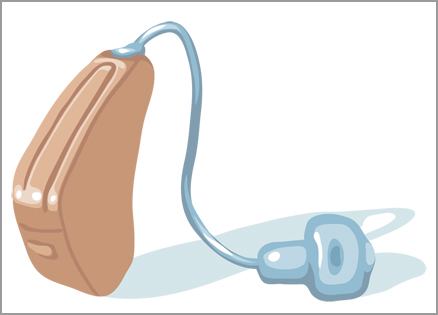
Hearing aids cost thousands, but they sure are tiny. I didn’t even realize mine was missing until a phone conversation with my sister in California. I found myself switching the phone from one ear to the other, struggling to hear. How annoying.

“Love ya, but I must go find my hearing aid, okay?” I told my sister. I hadn’t even bought insurance on it!

Faithful Paws and Purrs In Article Ad

Around the toilet, under the pillows, inside every nook and cranny, along every single cabinet. That creamy-colored, almond-shaped thing was definitely not in the house.

Mentally, I retraced my steps around town. Exercise class. Women’s meeting at my friend Mary’s house. The post office. The Performing Arts Center. I didn’t recall having trouble hearing at any of those places, so I didn’t bother with calling.

What else to do but pray? Oh, how I prayed. A favorite Bible verse came to mind. “I cried to the Lord and he heard and answered my prayer,” I said. I said it out loud, to the cat, to the house, to the heavens above.

I woke the next morning to a clear voice in my head: Call Mary. I didn’t need my hearing aid to hear it. I had to give it a try.

“I’d be glad to look around,” Mary said. Ten minutes later, she called me back. “It was right by my front door, but I never would have noticed it if you hadn’t called.”

God heard my prayer to find my hearing aid, and angels made sure I heard his answer loud and clear.


Download your FREE ebook, Rediscover the Power of Positive Thinking, with Norman Vincent Peale.

Healing Prayer Brought a Miracle

My room at University Hospital in Birmingham, Alabama, was crowded. I gazed at the faces of our pastor, William Cox, and deacons from our church, including my husband, Brooks, gathered around my bed.

For more than a year I had been fighting a losing battle against a strange liver ailment, recently lingering in a hepatic coma for three days before coming around.

Pray a Day Vol 2 In Article Ad

It seemed I had been on the critical list more often than not. But that day I felt relatively good, if weak, and my mind, thankfully, was clear. I caught Brooks’s eye and he smiled reassuringly.

Brooks and I attend First Baptist Church in Warrior, our hometown, where I am a music teacher. All in all we’re a pretty mainstream congregation, and though we certainly believe in prayers for healing, we had never gone in for laying on of hands or anointing with oil. We left that to other churches.

But since I had come out of my coma a verse from the Book of James kept storming into my head: “Is any sick among you? Let him call for the elders of the church; and let them pray over him, anointing him with oil in the name of the Lord.”

I had begun having trouble in 1984 and a year later was diagnosed with a rare autoimmune disorder that caused my body to attack its own liver cells. In a terrible way the biological process that was supposed to keep me well was making me sick, deathly sick.

By 1986 doctors had all but given up on saving my liver. I had been put at the top of a transplant list at the University of Pittsburgh Medical Center–a pioneer hospital in liver transplants–but no one was sure if a new liver would reverse the disease.

I had heard so many medical opinions that I chose to keep one in the front of my mind at all times, something internist Dr. Roy Roddam had told me: “Never forget, Virginia, that God is bigger than any disease.” You know your condition is serious when your doctor starts reminding you to pray.

My hospital stays had become more frequent and complicated. I suffered weight loss, headaches, extreme fatigue, confusion, jaundice and, especially dangerous, bleeding in my esophagus that sometimes wouldn’t stop. My liver functions were deteriorating rapidly.

During those three days when I was in a coma, Brooks had stayed by my bedside reading psalms to me, and our church kept up an unceasing prayer vigil.

I came out of it, but in the absence of a miracle I was probably going to die, sooner rather than later, leaving Brooks to raise our three young children without their mother.

With the verse from James echoing in my mind, I had Brooks ask Pastor Cox if he would be willing to try something different–laying on hands and anointing with oil. “Tell Virginia I don’t see why not,” he had sent word back, “especially since it’s scriptural.”

And that was why they were gathered in my hospital room on a cloudy fall day in 1986.

I looked at the wreath of faces above me–neighbors, friends, pastor, husband. There was a physical sensation of love pouring from them as they leaned over me–warm, comforting, serene. They had prepared themselves through prayer and fasting, as the Bible instructs.

Pastor Cox stood at the head of the bed, Brooks at my right, the others completing the circle. The pastor read aloud. Gently, he anointed my forehead with oil.

They laid hands on me, tentatively at first. I felt the slight press of fingers and a rippling warmth. I can’t say I experienced anything out of the ordinary, save for a subtle yet pervasive sensation of peace that trickled through my entire being.

They finished quickly, since I could not have visitors for long. Holding Brooks’s hand, I fell into a long, deep sleep.

The next morning my liver specialist, Dr. Colin Helman, performed yet another grueling endoscopic exam of my esophagus and stomach, looking through a long fiber-optic tube to locate blood vessels in danger of rupturing.

I was quite surprised to see a pleased but puzzled expression on his face when he finished, and nearly dumbfounded when he said I showed an amazing amount of improvement in the short time since the last endoscopy. He said it as if he had trouble believing it himself.

“Virginia,” he remarked, “all I can say is that I am very relieved.” I was stunned to hear good news when all I had been told of late was to expect the worst.

Later, blood work confirmed the unexpected turn in my condition. Doctors and nurses beamed when they came into my room. People again spoke louder than a whisper. Within days I was removed from the top of the list in Pittsburgh for an urgent liver transplant and put toward the end of the line.

When I was released from the hospital I had an odd, insistent feeling it was for good. Strength returned; I could eat again; there were no more major-bleeding episodes. Over the months my liver-function tests improved steadily.

I felt better than I had in a long time. There was no clear medical explanation for my sudden transformation.

One Sunday about a year later we celebrated the baptism of my youngest son, Hop, then 6 years old. Pastor Cox led the ceremony and I played piano. Halfway through, a parishioner raced up to me with the message that I had an urgent phone call. I knew what it probably was and quickly followed her to the church office. As I thought, it was the transplant coordinator at the University of Pittsburgh Medical Center. They had a liver for me.

Not long before, I wouldn’t have hesitated. Like many transplant candidates, I would have had a bag packed, ready to go at a moment’s notice. Now I paused.

I had already turned down two earlier transplant opportunities, not yet ready to face the overwhelming ordeal of surgery. This was probably my final opportunity.

But if my liver was slowly healing, as it surely appeared to be, might someone else need a transplant more urgently than I? Should I step aside and trust the Lord?

I told the hospital I would call back in 10 minutes and sent the parishioner for Brooks, Pastor Cox and Dr. Oliver Harper, our family physician, who was attending Hop’s baptism. “What do I do?” I asked them, not so much afraid as anxious to make a decision.

Brooks covered my hand with his and all at once an almost physical memory of that day in my hospital room came rushing back. I could see the faces above me and feel the faint warmth of fingertips through the thin, crisp sheet.

In an instant I knew I wanted to remove myself from the transplant list. My healing was well under way. Why interfere? “What would you advise if I were your wife?” I asked Dr. Harper.

“I’d tell you not to have it.”

That was all I needed to hear. I called the hospital and told them I wouldn’t be having the surgery. Then I returned to my son’s baptism and took my seat at the piano as the service resumed.

Today I am 49, the mother of three children, ages 22, 19 and 16. As I’ve said, I come from a fairly traditional church background. I don’t use the word “miracle” lightly. Yet what else can I call it?

I was in and out of a coma, my life hanging by a thread. I was told my liver was beyond saving, and even with a new one I would be fighting heavy odds.

So how do I explain that 11 years later, after six inexperienced members of my church stood in a circle, laid their hands on me and asked the Lord for a healing, my liver functions better than doctors ever dreamed it would and that I enjoy good health again?

No, I don’t use the word “miracle” lightly. Yet when I look back on my experience I find no other word that fits, no other concept that makes sense. The Lord’s grace shone on me and for a reason I am not yet meant to understand fully, I was allowed to live. God showed that he is bigger than any disease.

Download your FREE ebook, A Prayer for Every Need, by Dr. Norman Vincent Peale

Healing Prayer for a Boy with Leukemia on Hanukkah

I awoke thinking that I was at my parents’ house.

I could almost smell Mom’s potato pancakes in the air, hear the comforting sounds of her and my father, whom I call Aba, bustling about downstairs.

Faithful Paws and Purrs In Article Ad

But then my eyes finally adjusted to the fluorescent light. The pale green walls, the metal bed rails…I remembered where I was: the UC-Irvine Medical Center cancer ward. The last place on earth I wanted to be, especially the first night of Hanukkah.

I lay in the hospital bed, woozy from antibiotics. The drugs left me in a kind of haze, never quite certain what was real and what was imagined. I remembered Mom bringing me here several days ago, feverish and miser­able.

By now I had come to expect long hospital stays after chemotherapy treatments that left my immune system helpless against infection. But I had prayed—had believed—that this time would be different.

After months of fighting leukemia I wanted to be home for Hanukkah with my family, to light the menorah and hear the story of how when the temple was rededicated in Jerusalem there was only enough oil to light the menorah for one day.

But it continued burning until more oil could be made—for eight days!

I looked forward to my father, a rabbi, saying the traditional prayers, those words honoring a God of miracles. I needed to hear my father’s voice, to feel his unshakeable faith.

But that wouldn’t be happening. No way could a menorah be lit in a hospital room. A fire hazard, the hospital staff said.

I sank back into the pillow. God, I prayed, you knew how much I needed this. Couldn’t you have granted me this much?

I didn’t want to think about the alternative. Perhaps God was answer­ing me. Maybe this was his way of telling me that the cancer had finally won.

This isn’t how my life was supposed to turn out, I thought. I was going to be a rabbi, walking in my father’s footsteps, one of God’s servants. I’d just finished my second year of rabbinical school that July when I came down with what I thought was a bad case of the flu.

Then I got the diagnosis: leukemia, an extremely aggressive form. Even with the most powerful chemotherapy available, my chances for survival were slim.

Slowly I sat up. I was still alive, if you could call it that. I’d survived longer than doctors expected, months longer. But what was the point if I couldn’t celebrate my faith? Why now, when I needed God most, did it feel as if he had abandoned me? Why hadn’t he just let me die in July?

“Have faith,” my father always counseled at times like this. “Remember God’s teachings.”

Aba had been the one who had assured me that I would celebrate Hanukkah. Even in the hospital. “We’ll get it done,” he had said with total conviction. I’d believed him, until I’d overheard the conversations outside my room.

“An open flame?” a voice had said. “In the hospital? You’ve got to be kidding.” I’d heard nothing more about it from Aba. I’d never known him to fail. It must have crushed him.

In just a few hours—a half hour after sunset—menorahs would be lit along the West Coast.

I thought of everything that would be happening at home, Mom making foods fried in oil like potato pancakes to remind us of the first Hanukkah. Aba arranging the menorahs around the dining room table, one for each family member. All of us lighting them after Aba said the prayers.

Except for me. Would Aba even put out my menorah? What would be the point?

The hospital was oddly silent, as if everyone had left me. I felt myself fading, getting weaker. My eyes closed.

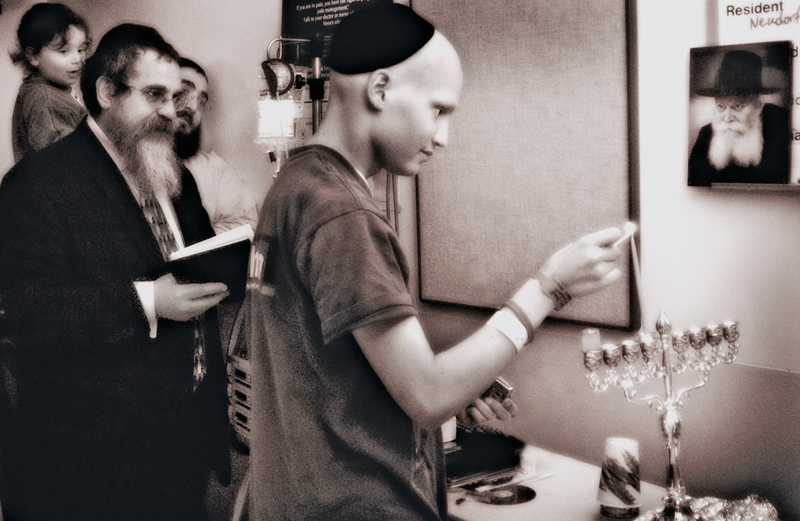
I awoke to what seemed like a dream. There gathered in my room were my parents, my grandmother, my brother-in-law, my sister and her baby. Four generations. And someone I didn’t recognize, a man in a blue uniform.

“I’m from the hospital maintenance department,” he explained. “The fire department asked me to be here.”

My mother held out a new silver-plated, oil-burning menorah. “Happy Hanukkah,” she said, setting the menorah on a table by my bed. “You know your father. He can be very persuasive.”

“This is your Hanukkah, Yosef,” my father said with a smile. “They would permit only the one menorah. So we would like you to light it and then say the prayers.”

“But, Aba, you’re the rabbi,” I weakly protested.

“So I get to decide,” he responded.

Slowly I swung my legs onto the floor and stood, leaning on my father. The maintenance man stepped forward. My hand shook slightly as I lit the oil. The flame enveloped the wick and I could feel its warmth, first on my hand and then through my body.

Then I heard myself praying the words I’d longed to hear. “Blessed are you, Lord our God, King of the universe, who performed miracles for our forefathers in those days, at this time.”

“Beautiful,” my father said when the prayers were finished. “You didn’t need to hear me pray. You needed to say the words yourself.”

It was true. This was my twenty-first Hanukkah, but it was as if I were hearing those words for the very first time. God, creator of miracles, from the beginning, hemmed in by a few hospital rules?

I had been the one who had put limitations on what he could do. To him, even my leukemia wasn’t an obstacle.

That Hanukkah in the hospital was the first of many miracles that God performed in my life. Ultimately he connected me with an Israeli bone-marrow donor whose gift left me cancer-free. I finished school and was later ordained as a rabbi.

The first night of Hanukkah this year, I’ll sit down at my parents’ table, laden with Mom’s good cooking, and listen to my father say the prayers. Then I will light my silver menorah, the flame of my faith burning brighter and stronger than ever.

Download your FREE ebook, A Prayer for Every Need, by Dr. Norman Vincent Peale