

Embrace God's truth with our new book, The Lies that Bind

Willow’s Vegan Green Bean Casserole

Ingredients

1 lb. fresh green beans
1 ½ tsp. salt, plus more to taste
¼ c. finely chopped yellow onion
4 garlic cloves, minced
½ tsp. dried thyme
2 Tbsp. vegan butter or olive oil
1 c. cup finely chopped baby portobello mushrooms
2 Tbsp. all-purpose flour
¾ c. vegetable broth
1 c. unsweetened plain almond milk
1 ½ c. French’s Crispy Fried Onions
Coarsely ground black pepper to taste

Preparation

1. Preheat oven to 400°F. Rinse and snap ends off green beans; cut beans in half. Add beans to large pot in which 3 quarts water and 1 ½ teaspoon are salt are boiling; cook for 5 minutes.

2. Drain beans, then plunge in cold water to stop cooking. Drain beans and set aside.

Community Newsletter

Get More Inspiration Delivered to Your Inbox

Notice: JavaScript is required for this content.

/* FORM STYLES */

#nf-form-5-cont {
background-color:#ffffff;
border-radius:35px;
-webkit-border-radius:35px; }

/* FIELDS STYLES */

.nf-form-content .nf-field-container #nf-field-27-wrap {
margin:0;
border-radius: 25px;
-webkit-border-radius: 25px; }
.nf-form-content .nf-field-container #nf-field-27-wrap .nf-field-element .ninja-forms-field {
background-color:#ffffff;
border-color:#ffffff;
margin-bottom:0;
border-radius: 25px;
-webkit-border-radius: 25px; }
.nf-form-content .nf-field-container #nf-field-28-wrap {
width:120px;
}
.nf-form-content .nf-field-container #nf-field-28-wrap .nf-field-element .ninja-forms-field {
background-color:#00ab84;
width:120px;
}
.nf-form-content .nf-field-container #nf-field-28-wrap .nf-field-element .ninja-forms-field:hover {
background-color:#00ab84;
}


var formDisplay=1;var nfForms=nfForms||[];var form=[];form.id=’5′;form.settings={“objectType”:”Form Setting”,”editActive”:true,”title”:”Sign up for Newsletter”,”show_title”:0,”allow_public_link”:0,”embed_form”:””,”clear_complete”:0,”hide_complete”:0,”default_label_pos”:”above”,”wrapper_class”:”master-signup-form-wrap”,”element_class”:”master-signup-form”,”key”:””,”add_submit”:0,”currency”:””,”unique_field_error”:”A form with this value has already been submitted.”,”logged_in”:false,”not_logged_in_msg”:””,”sub_limit_msg”:”The form has reached its submission limit.”,”calculations”:[],”container_styles_show_advanced_css”:1,”title_styles_show_advanced_css”:0,”row_styles_show_advanced_css”:0,”row-odd_styles_show_advanced_css”:0,”success-msg_styles_show_advanced_css”:0,”error_msg_styles_show_advanced_css”:0,”formContentData”:[{“order”:1,”cells”:[{“order”:0,”fields”:[“master_signup_email”],”width”:66},{“order”:1,”fields”:[“subscribe_now_1660636976556″],”width”:34}]}],”changeEmailErrorMsg”:”Please enter a valid email address!”,”changeDateErrorMsg”:”Please enter a valid date!”,”confirmFieldErrorMsg”:”These fields must match!”,”fieldNumberNumMinError”:”Number Min Error”,”fieldNumberNumMaxError”:”Number Max Error”,”fieldNumberIncrementBy”:”Please increment by “,”formErrorsCorrectErrors”:”Please correct errors before submitting this form.”,”validateRequiredField”:”This is a required field.”,”honeypotHoneypotError”:”Honeypot Error”,”fieldsMarkedRequired”:”Fields marked with an * are required”,”container_styles_background-color”:”#ffffff”,”container_styles_border”:””,”container_styles_height”:””,”container_styles_margin”:””,”container_styles_padding”:””,”container_styles_float”:””,”container_styles_advanced”:”border-radius:35px;n-webkit-border-radius:35px;”,”title_styles_border”:””,”title_styles_height”:””,”title_styles_width”:””,”title_styles_font-size”:””,”title_styles_margin”:””,”title_styles_padding”:””,”title_styles_float”:””,”row_styles_border”:””,”row_styles_width”:””,”row_styles_font-size”:””,”row_styles_margin”:””,”row_styles_padding”:””,”row-odd_styles_border”:””,”row-odd_styles_height”:””,”row-odd_styles_width”:””,”row-odd_styles_font-size”:””,”row-odd_styles_margin”:””,”row-odd_styles_padding”:””,”success-msg_styles_border”:””,”success-msg_styles_height”:””,”success-msg_styles_width”:””,”success-msg_styles_font-size”:””,”success-msg_styles_margin”:””,”success-msg_styles_padding”:””,”error_msg_styles_border”:””,”error_msg_styles_width”:””,”error_msg_styles_font-size”:””,”error_msg_styles_margin”:””,”error_msg_styles_padding”:””,”drawerDisabled”:false,”export_settings”:[],”form_title_heading_level”:”3″,”ninjaForms”:”Ninja Forms”,”fieldTextareaRTEInsertLink”:”Insert Link”,”fieldTextareaRTEInsertMedia”:”Insert Media”,”fieldTextareaRTESelectAFile”:”Select a file”,”formHoneypot”:”If you are a human seeing this field, please leave it empty.”,”fileUploadOldCodeFileUploadInProgress”:”File Upload in Progress.”,”fileUploadOldCodeFileUpload”:”FILE UPLOAD”,”currencySymbol”:”$”,”thousands_sep”:”,”,”decimal_point”:”.”,”siteLocale”:”en_US”,”dateFormat”:”m/d/Y”,”startOfWeek”:”1″,”of”:”of”,”previousMonth”:”Previous Month”,”nextMonth”:”Next Month”,”months”:[“January”,”February”,”March”,”April”,”May”,”June”,”July”,”August”,”September”,”October”,”November”,”December”],”monthsShort”:[“Jan”,”Feb”,”Mar”,”Apr”,”May”,”Jun”,”Jul”,”Aug”,”Sep”,”Oct”,”Nov”,”Dec”],”weekdays”:[“Sunday”,”Monday”,”Tuesday”,”Wednesday”,”Thursday”,”Friday”,”Saturday”],”weekdaysShort”:[“Sun”,”Mon”,”Tue”,”Wed”,”Thu”,”Fri”,”Sat”],”weekdaysMin”:[“Su”,”Mo”,”Tu”,”We”,”Th”,”Fr”,”Sa”],”recaptchaConsentMissing”:”reCaptcha validation couldn't load.”,”recaptchaMissingCookie”:”reCaptcha v3 validation couldn't load the cookie needed to submit the form.”,”recaptchaConsentEvent”:”Accept reCaptcha cookies before sending the form.”,”currency_symbol”:””,”beforeForm”:””,”beforeFields”:””,”afterFields”:””,”afterForm”:””};form.fields=[{“objectType”:”Field”,”objectDomain”:”fields”,”editActive”:false,”order”:1,”idAttribute”:”id”,”label”:”Email”,”type”:”email”,”key”:”master_signup_email”,”label_pos”:”hidden”,”required”:1,”default”:””,”placeholder”:”@Your email”,”container_class”:”master-email-wrap”,”element_class”:””,”admin_label”:”master_signup_email”,”help_text”:””,”custom_name_attribute”:”email”,”personally_identifiable”:1,”wrap_styles_border”:””,”wrap_styles_width”:””,”wrap_styles_margin”:0,”wrap_styles_padding”:0,”wrap_styles_float”:””,”wrap_styles_show_advanced_css”:1,”label_styles_border”:””,”label_styles_width”:””,”label_styles_font-size”:””,”label_styles_margin”:0,”label_styles_padding”:0,”label_styles_float”:””,”label_styles_show_advanced_css”:0,”element_styles_border”:””,”element_styles_width”:””,”element_styles_font-size”:””,”element_styles_margin”:0,”element_styles_padding”:0,”element_styles_float”:””,”element_styles_show_advanced_css”:1,”cellcid”:”c4722″,”value”:””,”drawerDisabled”:false,”wrap_styles_advanced”:”margin:0;nborder-radius: 25px;n-webkit-border-radius: 25px;”,”element_styles_background-color”:”#ffffff”,”element_styles_border-color”:”#ffffff”,”element_styles_advanced”:”margin-bottom:0;nborder-radius: 25px;n-webkit-border-radius: 25px;”,”manual_key”:true,”id”:27,”beforeField”:””,”afterField”:””,”parentType”:”email”,”element_templates”:[“email”,”input”],”old_classname”:””,”wrap_template”:”wrap”},{“objectType”:”Field”,”objectDomain”:”fields”,”editActive”:false,”order”:2,”idAttribute”:”id”,”label”:”Subscribe Now”,”type”:”submit”,”cellcid”:”c4725″,”processing_label”:”Processing”,”container_class”:””,”element_class”:””,”key”:”subscribe_now_1660636976556″,”wrap_styles_border”:””,”wrap_styles_width”:120,”wrap_styles_margin”:0,”wrap_styles_padding”:0,”wrap_styles_float”:””,”wrap_styles_show_advanced_css”:1,”element_styles_border”:””,”element_styles_width”:120,”element_styles_font-size”:””,”element_styles_margin”:0,”element_styles_padding”:0,”element_styles_float”:””,”element_styles_show_advanced_css”:0,”submit_element_hover_styles_border”:””,”submit_element_hover_styles_width”:””,”submit_element_hover_styles_font-size”:””,”submit_element_hover_styles_margin”:””,”submit_element_hover_styles_padding”:””,”submit_element_hover_styles_float”:””,”submit_element_hover_styles_show_advanced_css”:0,”wrap_styles_advanced”:””,”element_styles_background-color”:”#00ab84″,”submit_element_hover_styles_background-color”:”#00ab84″,”drawerDisabled”:false,”id”:28,”beforeField”:””,”afterField”:””,”value”:””,”label_pos”:”above”,”parentType”:”textbox”,”element_templates”:[“submit”,”button”,”input”],”old_classname”:””,”wrap_template”:”wrap-no-label”}];nfForms.push(form);

3. In large skillet over medium heat, sauté onion, garlic and thyme in vegan butter or olive oil. Cook for 2 to 3 minutes, stirring frequently, then add chopped mushrooms and cook for 3 to 4 minutes more, stirring frequently, until lightly browned.

4. Season with salt and pepper, and sprinkle in flour. Cook for 1 min-ute to toast the flour, stirring to coat the veg-gies and break down any lumps of flour.

5. Remove sauce from heat, and add cooked green beans and ½ cup fried onions.

6. Slowly add vegetable broth, whisking to in-corporate. Add almond milk while continuing to whisk until smooth. Bring sauce to a simmer, then reduce heat to low. Cook 5 minutes longer, stirring frequently, un-til sauce is creamy and thick. Taste and adjust seasonings.

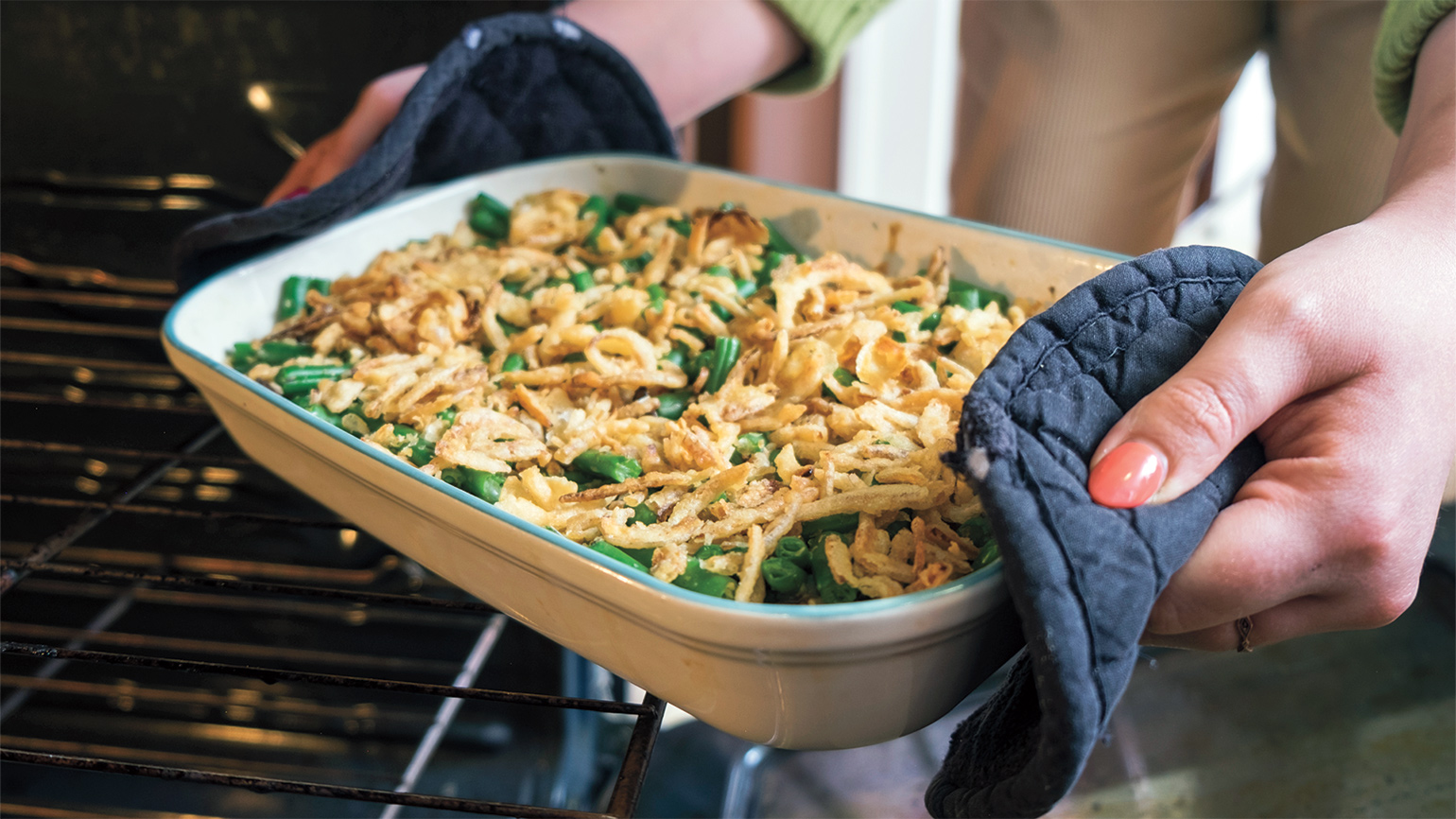
7. Toss well to combine, and transfer to oven-safe casserole dish. Top with remaining fried on-ions. Bake in preheated oven for 15 minutes, until beans are heated through, sauce is bub-bling and onions are golden brown. Serve immediately.

Read Jessica Reed’s inspiring story from the October-November 2022 issue of Guideposts!

For more inspiring stories, subscribe to Guideposts magazine.

Why Winter Is the Most Positive Season

There’s a Japanese proverb that says, “One kind word can warm three winter months.” To me, this means that when the cold wind howls, the snow flies and the night comes on all too soon, a little love, a little kindness and a little warmth go a long way.

Because the cold and darkness of winter encourages us to value the warm and comforting things in our lives, I believe that winter is the most positive season.

Winter brings us inside, and it brings us closer to those we love. Walking a positive path through winter means embracing this opportunity, savoring low lights, flickering candles, quiet conversation, crackling fires and cozy activities from movie-watching to jigsaw-puzzling.

In winter, we might also find ourselves alone more than in other seasons. Enjoying our own company is a healthy habit to cultivate, and the peaceful solitude of a snowy evening can provide welcome space to daydream, brainstorm, journal…or play some festive music and warm up with a solo dance party.

Those of us who are gardeners look forward to the colorful garden catalogs that come in the winter mail. All things are possible when the ground is frozen solid and the growing season is months away. Let your imagination expand and plan to cultivate a garden that bursts with color and flavor. For that matter, you can use that same technique to brighten your outlook on your whole life!

Perhaps easiest of all, try sharing one kind word with someone you meet today. A smile, a greeting or an encouraging comment could warm winter months for that person—and for yourself in the process.

And if winter is less-than-positive for you right now, either because of the physical or emotional challenges of the season, you can always turn to the inspiring words of the poet Percy Bysshe Shelley: “If Winter comes, can Spring be far behind?”

What do you think is the most positive season?

Why We Can Say “Happy Ash Wednesday”

“Happy Ash Wednesday!” Sounds like an unlikely greeting. What’s so happy about this reminder of our own mortality, not to mention a reminder of the struggles Jesus went through, culminating in the Crucifixion?

Celebrating Ash Wednesday

On Ash Wednesday in the morning, I will glimpse someone at the office or walking past me on the sidewalk with a smudge on their forehead. Before I remember what day it is, I’m ready to offer some Kleenex. “Here, if you want to wipe that off.”

No, in fact, it’s not meant to be wiped off. Those ashes, whether you’ve gone to church that morning or not, are a reminder of our shared humanity. In a way, they’re always there. As the old hymn goes, “Change and decay in all around I see…” Not a particularly happy line.

But then the verse concludes with, “Oh, thou, who changest not, abide with me.”

In the worship service the ashes are administered with the sacred words, “Remember that you are dust, and to dust you shall return.” The mark of the cross. A holy sign if there ever was one. It might make us not want to use the phrase “Happy Ash Wednesday!” But remembering what this season is about might help us.

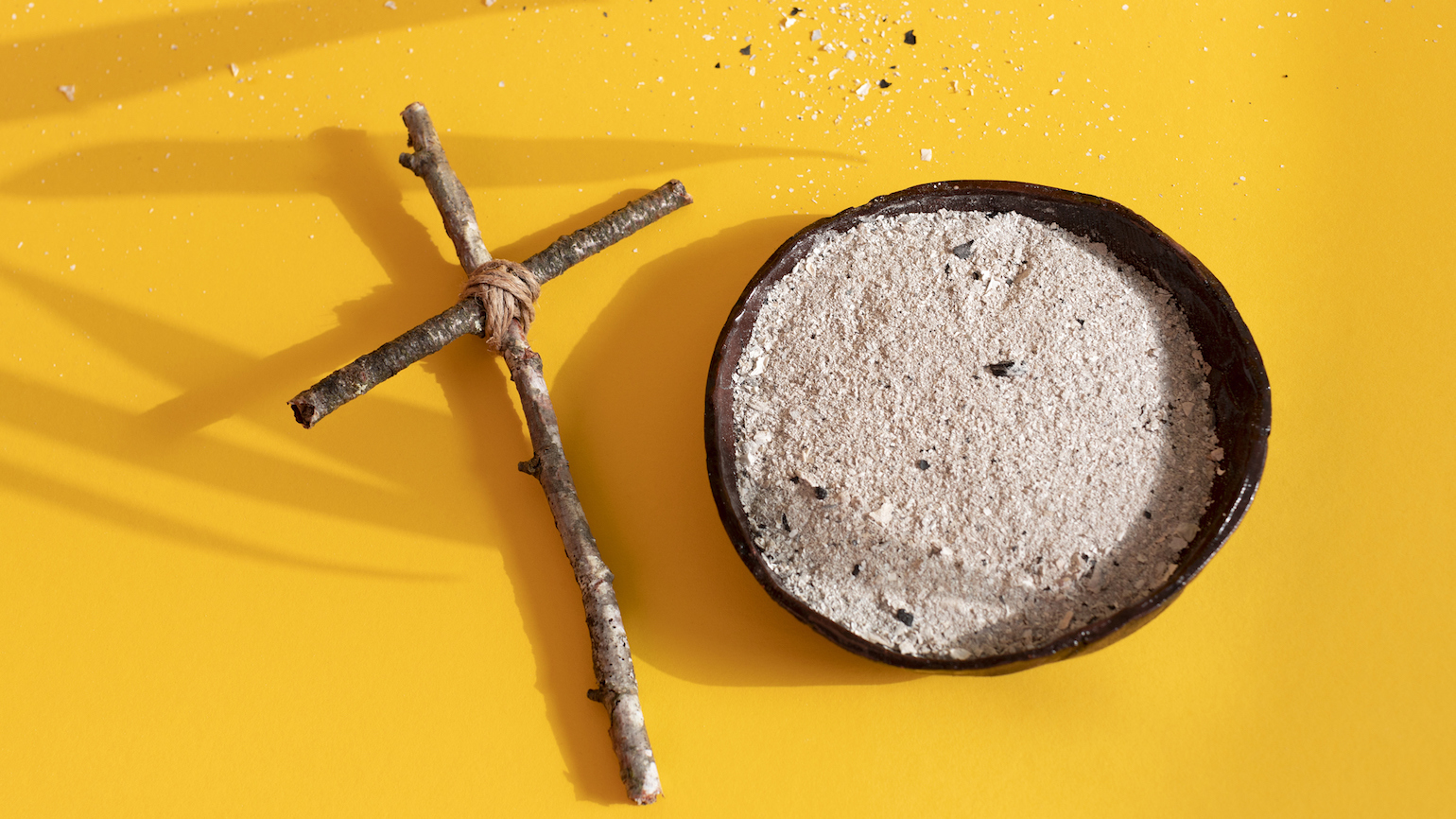
A wooden cross wrapped in purple ribbon with lent symbols like ashes and palm to show a happy ash wednesday

Ash Wednesday and Lent

Lent has begun. For 40 days, plus Sundays, we honor that period that Jesus spent in the wilderness, facing one temptation after another. It was all part of what the Lord needed to do before beginning His ministry. Growing in strength and resilience.

For those of us in more recent times who have had to endure the various constrictions, closures and fears of the pandemic, we, too, have often had to ask ourselves: What’s most important in our lives? What do we treasure? What is our calling? How can we make sure we don’t feel abandoned?

In Lent we often practice fasting ourselves, just as the Lord did for those 40 days. I’ve tried giving up different things for Lent, but you know what was the best? Giving up my cell phone. Could giving it up make my Lent season better and give myself an actually happy Ash Wednesday?

No, no, I didn’t give it up altogether for Lent, but I gave myself breaks from it and its insistent calls on my life with texts and emails and news screaming out for me to pay attention.

Lent serves as a reminder that one of the greatest trials Jesus faced in those 40 days was being in the wilderness, away from His friends and family. Going for a couple hours without the phone is a sort of modern wilderness experience. A chance to honor the precious gift and calling of silence.

READ MORE: Is Lent in the Bible?

Woman in a church group saying happy ash wednesday to her friend

Why It’s OK To Say “Happy Ash Wednesday”

Remember, without the Crucifixion there wouldn’t be the Resurrection. Without the sad fact and reality of death, we wouldn’t have the joyous message of eternal life with God.

Ashes to ashes, dust to dust, whether you wear a cross of ashes on your forehead or not, we all wear the mark of our Saviour’s death. And carry the promise of new life. Happy Ash Wednesday.

A Happy Ash Wednesday reflection: Don’t forget the good news that will come at the end of this Lenten season. It’s not all just trials. Soon enough we’ll be saying, “The Lord is risen, the Lord is risen indeed.” Whatever our suffering now, we, too, can celebrate that promise.

READ MORE ABOUT ASH WEDNESDAY:

Why Sundays Don’t Count During Lent

I don’t believe in actually telling people what I give up for Lent because that might sound like bragging, and the whole point of any spiritual discipline is to do it in secret and not lord it about to impress people. As Jesus said, “Beware of practicing your piety before men in order to be seen by them…” So you’ll have to forgive me for being oblique in this little story. It’s about a moment I was faced with the question: do Sundays count during Lent?

One Sunday in Lent we were dining with friends and the thing I gave up eating/drinking/thinking about was served. I looked with despair at my plate/bowl/glass and only took comfort in knowing that a friend at the table had given up the same thing.

But then she dug in and ate/drank the foresworn thing. “Wait, didn’t you give that up too?” I exclaimed, blowing her cover as well as mine.

“It’s Sunday,” she said. “During Lent, Sundays don’t count.”

Do Sundays Count During Lent?

It’s true. Sundays don’t count for any Lenten discipline. Sunday is the Sabbath. Sunday is a feast day. Sunday is the day we celebrate the Resurrection no matter what season. You can take Sundays off.

Why Don’t Sundays Count During Lent?

Some of this is just a matter of arithmetic. At Lent we honor the 40 days Jesus spent in the wilderness, praying and fasting, and if you count 40 from Ash Wednesday to Easter you have to skip the Sundays. They are not included.

A woman eating chocolate in bed after learning if sundays count during lent

A Deeper Look at Lent Sundays

But those are just numbers. Here’s a better way to look at it. A Lenten discipline is not like a New Year’s resolution. It’s not some sort of good habit that you expect to stick to for the rest of your life. You might want to, you might wish to, but that’s not the point.

READ MORE: 15 Inspiring Bible Verses for Fasting

A Lenten discipline is just a wilderness moment you’re giving yourself. After all, Jesus did not continue fasting after his 40 days. He broke bread and ate with his disciples. He changed water into wine. He was not a dour locusts-and-honey guy.

During your Lent journey, every time you reach for that thing you gave up, you can remind yourself that you want to follow in Jesus’s footsteps.

The way I look at it, renunciation is something we do for only a season. We can learn a lot from it. It has its spiritual benefits and gifts. During your Lenten journey, every time you reach for that thing you gave up, you can remind yourself that you want to follow in Jesus’s footsteps. You want to be just a little bit more like Him. You want to walk in the wilderness like he did. You want to face up to your temptations.

But renunciation is only for a season, even during Lent. It’s only six days a week. Then celebrate on the seventh, on Sunday. The Lord is risen, the Lord is risen indeed. Even if Easter is not here and the sky is still gray and the lilies haven’t bloomed yet, we are meant to celebrate. You get a free pass on Lent Sundays. Take it.

READ MORE ANSWERS TO YOUR LENT QUESTIONS:

Why Summer Is the Most Positive Season

“Ugh, a dead bird.” Sitting on the front steps of my home, I pulled the laces tight on my walking shoes, then gestured toward a carcass in the driveway. The bird’s black feathers glistened, iridescent in the sunshine.

“It’s just a crow.” My husband, Dave, touched it with the toe of his shoe while waiting for me to join him on a walk around the neighborhood. It was a bright May morning and the new leaves on the maple tree in the driveway trembled in a gentle breeze. Spring was well established in the Pacific Northwest, and normally I would have felt expectant, knowing God had good things in store—no matter what my immediate challenges. Instead, a feeling of dread threatened to smother me, along with the last shred of my faith.

“I’ll deal with the bird when we get back,” Dave said. “We need a walk.”

That was an understatement. Our life together was hanging by a thread. We were in financial straits, made dire by my ongoing treatments for ovarian cancer, treatments our insurance didn’t cover and that left me working temp jobs in accounting while my ambition to become a certified public accountant was put on hold. Some days it was a chore to function, and my marriage suffered under the stress of it all.

As Dave and I walked in silence I tried to dredge up the gratitude I knew I should feel just to be alive. Even if a crow lay dead in the middle of my driveway like a bad omen. For some reason I couldn’t shake the image from my mind.

When we returned from our walk, the carcass had mysteriously disappeared, not a feather in sight. “At least that’s taken care of,” Dave said, and went inside to shower.

I sat down at the kitchen table with my laptop and punched “crow sightings” into Google. Scrolling through pages of information, I discovered that various cultures believed various things about the birds, and much was left to personal interpretation.

“Seeing a crow is a reminder that where there is dark, there is also light,” one article suggested. That was certainly true of the crow in the driveway, its feathers a deep purple black that revealed gemstone colors in the bright sunlight. I reread the line, reminded of the darkness in my own life. God, I desperately need to find your light again, I prayed. I needed the comfort that came from knowing he was there for me no matter what.

In the coming weeks I felt his presence less and less. But crows were a different story. I noticed them everywhere—flying low over my windshield on the freeway, chattering in the trees when I walked by, clustering in my backyard. Like they were following me. For my current temp job, I rode the bus into downtown Seattle and walked 15 minutes to the office. I enjoyed the wind on my face and the birds overhead. Even if they were mostly crows.

One day a neighbor walked by while I stood on the front lawn, mesmerized by yet another crow visitor. “Did you know that crows are so intelligent they recognize human faces?” my neighbor said. “A study was done at the University of Washington. I read about it in The New York Times.”

“What an amazing creature,” I said, and just then remembered a story I’d learned as a child, a Bible story involving some very crow-like birds. Elijah, a great Old Testament prophet, was hiding out in the wilderness, scared for his life. He would have died if God hadn’t sent ravens to feed him daily. It struck me, even as a girl, that in this instance God had chosen the black-feathered bird as his angelic messenger. Not a dove, but a raven. It had made a lasting impression.

That night in bed, I reread the story. I closed my Bible and stared up at the ceiling while Dave slept beside me. Was God trying to tell me something with all these black-feathered crows? They always seemed near. Though I would never have dared to tell anyone, as spring turned to summer I had begun to believe they recognized me. The more depressed I felt, the more crows clustered into my environment. Just watching them glide on a breezy current, or at rest on a city bench, gave me an odd relief. The crows never lacked anything, even though a major city was far from their natural habitat.

One fall morning after Dave and I had said a chilly goodbye, I stopped under a stand of oak trees on my way in to work. God, where are you? I shouted in my mind.

I was sick of short-term jobs that barely paid the bills, sick of cancer treatments even if they were working, sick of worrying about my marriage, of grasping for hope that things would ever get better.

Dry leaves crackled underfoot as downtown traffic maintained a steady din in the background. A rustle overhead grabbed my attention and a chunk of bread dropped directly in front of me. I looked up into the tangled tree branches. The dark, intelligent eyes of a crow peered back at me. I stared down at what looked like a piece of bagel. To feed me? Like Elijah…

The crow cawed, then flew off. I almost waved at the feathered friend who had restored my faith. I walked on to my job, a temporary job until I found something full-time and could continue to strive for my CPA. Meanwhile I would take long walks with my husband, believing God had good things in store, for my marriage and my health and even my finances. It was time for me to trust in the hand of God, the one whose provisions come in unusual ways, whether that’s in the wilderness in biblical times or in downtown Seattle today.

Did you enjoy this story? Subscribe to Angels on Earth magazine.

10 Reasons Why Spring Is the Most Positive Season

“The day the Lord created hope was probably the same day He created Spring,” said the British moral philosopher Sir Bernard Williams. In my view, it is this hope that makes spring the most positive season of the year.

The world wakes up in springtime. Having been grey, cold, and still through the winter months, suddenly there are sights, sounds, smells, and flavors bursting from the natural world—and inviting action, inspiration, and commitments to fresh starts in each of us.

Here are some of my favorite ways to embrace the positive, hopeful nature of spring:

Child holding a dandelion

1)  Lean Into Hope

It’s so easy to connect the feeling of a spring day to the positive attribute of hope. Each seed we tuck into the dirt gets a whispered hopeful wish that it germinates, roots, and grows. Each bulb we planted last fall gets sought out and celebrated when it pokes through the thawing dirt. And each time we step outside to the songs of chirping birds, we hear the hope they have brought back from their winter sojourn and into the warm months ahead. Call hope by its name as you welcome spring.

Woman washing her windows for spring

2)  Clean Out

Give your home a thorough spring cleaning. Get rid of things that no longer bring you joy. Donate old clothes and kitchen items, or shred unnecessary papers. It will leave you feeling clear, clean, and ready for whatever is next in your life. Give your spring cleaning an eco-friendly or an even deeper sense of accomplishment and purpose.

Woman opening her window and breath fresh air of spring

3)  Open Up

Open the windows. Visualize the fresh air swirling through your home and through your lungs. Imagine it swishing away the dusty stillness of the cozy winter season. If spring allergies make an open window a less-than-positive idea, seek out other ways to freshen your space and breathe more deeply. Give your bedding a deep clean. Wipe down air vents in your home to make sure you’re breathing fresh, new air.

Family biking and celebrating spring as the most positive season

4)  Get Moving

Take a walk in the woods—or around the block. Breathe deeply and luxuriate in the invigorating feeling the spring air brings. You might like to seize the warming weather as a chance to kick your fitness up a notch. Amp up your walks or take to the pickleball court with friends. Even if you’re just strolling around the neighborhood or parking at the far end of the grocery store parking lot, enjoy the springtime renewal of your energy and strength.

Mother and daughter looking at flowers

5)  Look Closely

Go “searching for spring” in your yard or a local park. Notice crocuses, tulips and daffodils emerging, or leaf buds plumping up on the trees above. Silently thank each for signaling the return of warmth—and of hope.

Fresh spring vegetables

6)  Freshen Your Plate

After a long winter of warming, comforting foods, it’s a joy to welcome spring by celebrating the season’s flavors. Try crisp, spicy radishes earthy, verdant asparagus, or fresh-but-fleeting produce like pea shoots or fiddlehead ferns.

Watching the sun set

7)  Watch the Sun Set

As evenings warm up in springtime, step outside to watch the sun sink into the horizon,  relishing the slowly-but-steadily lengthening of each day and letting each sunset beckon you toward the languid warmth of the summer that lies ahead.

Woman and children preparing a garden

8)  Plan (and Plant) Your Garden

Crack into the soil in your backyard garden or potted containers to sow early-season crops like lettuces, radishes, and peas—or stay cozy under a blanket inside and spend wet spring afternoons planning the garden you hope to grow this season. As the poet Alexander Pope famously said, “Hope springs eternal.” So does your garden.

Friends skipping in the rain

9)  Splash in the Rain

Each time a nourishing spring rain shower taps on our windows, spring’s positivity washes over us, elevating our outlook and mood. Take this opportunity literally by stepping into your rain boots (or going barefoot) and heading outside to drink in the beautiful renewal of a fresh spring rain.

Bluebird perched on a branch

10) Listen to the Birds

Not only is birdsong a relaxing, delightful sound—so much so that it’s featured on many meditation and white noise apps—it is also a reminder that sometimes in life, beautiful things recede from view, but return again. Listen for new birds that are chirping their post-winter joy, and know that the world joins you in emerging into a bright, beautiful spring.

Why Fall Is the Most Positive Season

The romantic poet William Cullen Bryant called autumn “the year’s last, loveliest smile.” And on one of the many perfectly crisp, cool, brilliant fall days most of us are lucky enough to enjoy, with leaves crunching underfoot and cinnamon smells wafting from our ovens, the fall is just that—lovely.

There’s wistfulness in the mention of “last” in Bryant’s quote, an acknowledgement that the lush natural beauty that sprouted in springtime and burst into fruition in the summer is quieting down, headed toward the chill of the winter ahead.

But there’s also a sense of peace in the ending that autumn represents. Because the fall is such an elegant transition, such a colorful and beautiful ending that reminds us to marvel at the cycles of the natural world, I consider it to be the most positive season.

The natural changes of autumn—the spectacular show of changing leaves on display in deep forests and neighborhoods alike—mirror changes we experience in our own lives. Our routines change in the fall, whether you’re in a “back to school” season of life, easing back into a work routine after your summer vacations, or preparing to snowbird to warmer climes.

Navigating change is a challenge, but in the fall, our senses are flooded with cues to remind us that change can also be beautiful, worth pausing to savor, filled with pleasing moments that can sustain us through whatever the coming winter has in store.

The joys of fall truly saturate every sense. Our eyes take in the vibrant reds, oranges, yellows and waning greens of the trees. Our noses inhale the clean, fresh air mixed with the scents of newly-lit fireplaces and warming foods. Our bodies feel the soft comfort of longer pants, tops, loose scarves and shoes. The flavors of fall both excite and soothe our taste buds. And in addition to the much-anticipated sound of crunching leaves, our ears take in the voices of friends and family members who are back from summer adventures and ready to reconnect and reunite.

So autumn may be the “last” of the sunny seasons, but it is indeed something to smile about—something quite lovely.

For more inspiring stories, subscribe to Guideposts magazine.

Related Video

When Love Is On the Line

Mom and I turned off University Avenue and pulled into the potholed parking lot outside a large, rustic building. The neon sign blazed out the name Wild E. Coyote. It was September 1992, and line dancing was the big thing in Cedar Falls, Iowa. Mom had been after me to go with her for weeks. “It’ll do you good to get out. A lot of your friends will be there,” she said. “Some folks from church. And who knows, maybe you’ll even meet someone.”

Yeah, right. It was fine by me if I never dated another man in my life. I was done with love. Still, I liked to dance and Mom wouldn’t quit asking, so I agreed to go. The place was packed with people in their Wranglers and cowboy boots, and country music was blaring. I’m not ready for this, I thought. But the more I twirled and stomped along with everyone else, the more I got into it. I had to admit, line dancing was the most fun I’d had in a long time. So I went back to the Wild E. Coyote. Mom and Dad were more than happy to watch Zak and Jesse.

One night in October I noticed this tall guy with feathered-back hair. He looked young, despite his scruffy attempt at a beard. He had on a plain button-down shirt with baggy jeans and sneakers. Whenever I saw him at the Wild E. I found myself watching him. He was always at the center of a group of friends. A few times I caught him glancing back at me. Then one night there was a barn dance. You took your partner and danced in a big circle, switching partners every eight beats or so. Right when the song ended, I was standing in front of the guy. “Want to keep dancing?” he asked.

“Sure.” He wasn’t a bad dancer.

He told me his name was Kurt Warner. We danced together till closing time. He walked me out to my car. I could tell he wasn’t ready to say good night.

I didn’t want to hurt his feelings, but better his now than mine later. “I want you to know I’m a divorced mother of two,” I said. “So if I never see you again, I’ll understand.”

Kurt was quiet for a second, then shrugged and said, “Hey, thanks for the dances.”

I got into my car thinking, That’s the end of that. Fine. I don’t need more heartache. I’d already had my share, and then some. I’d had to take a hardship discharge from the Marines to take care of my son, Zachary, after he was brain-damaged in an accident. Then my husband told me there was another woman. The divorce went through just a month after I gave birth to our second child, our daughter, Jesse. The kids and I moved back to my folks’ house. Men? Forget about it. My parents and the Good Lord, they were the only ones I could count on, or needed to. It’s just you and me now, Lord, I’d say in my prayers. And I trust you.

The next morning there was a knock at the door. I answered it with Jesse in my arms. Kurt stood there with a rose in his hand, smiling sheepishly. I was still in my bathrobe and hadn’t put on any makeup. “How did you find me?” I demanded.

He mentioned a mutual friend who’d told him where I lived. “I’d like to meet your kids,” he said.

A thousand things ran through my head, but what came out of my mouth was, “Okay, come on in.”

Kurt walked into the living room. Right away Zachary crawled over and grabbed his hand. Kurt barely paid attention to me. Instead he got down on his knees and tickled Zak. Soon the two of them were wrestling around and giggling. Zak looked sad when Kurt finally left a couple of hours later, with a quick “See you line dancing” to me.

I realized I’d never gotten to tell him what was wrong with Zak. In fact, it seemed like it didn’t matter to him. He was as happy playing with Zak as he had been at Wild E. Coyote surrounded by his friends. What was with this guy?

Kurt played football at the University of Northern Iowa. I had less than no interest in sports, but I did like spending time with him. People started teasing me about how I danced only with Kurt, and I reluctantly admitted that we were dating. At first I wondered why all our outings were at the Wild E. But then I realized neither of us had any money. He was just a college student and I was in nursing school. “Why don’t you come over to my parents’ house?” I asked one night. “We can microwave some popcorn and watch a movie with the kids.”

“Sounds great,” Kurt said.

That’s how we really got to know each other, all those movie nights in my parents’ living room. After I put the kids to bed Kurt and I would stay up and talk. If he had a game coming up, he’d get all excited and ramble on about plays and stuff. “You know I don’t care about sports,” I’d say. “I’ll pray you play your best, and I’ll even come to the game, but don’t expect me to understand what’s going on on that field.”

We talked a lot about faith. That and family. I found out Kurt’s parents got divorced when he was four. Late one movie night Kurt glanced at the floor, where some of Zak’s toys were strewn. “You’ve got great kids, you know. Think they miss having a daddy?”

“I can take care of them just fine, thanks,” I told him, maybe a little defensively. Zak and Jesse liked Kurt an awful lot. My mom liked Kurt too. So did I. But that’s all. He was just a real nice guy.

We had been seeing each other for about a year when I walked into the living room one day and found Kurt sitting on the floor playing with Zak. Watching them, I felt a surge of warmth. I caught myself thinking, Kurt’s so good with the kids. I bet he would be a great father someday. He had Zak’s magnetic writing board on his lap. Zak was just learning to walk. He picked up the board and tottered over to me. I took it and saw Kurt had written “I love Momma” for Zak. Underneath that he’d added, “I do too.”

Strange that the word love would make me feel such panic. I erased the board quickly and wrote, “I love my momma too.” There, that would keep things from going too far. I just wasn’t ready. I doubted I ever would be.

Kurt graduated in 1994 and went to the Green Bay Packers as a free agent. He didn’t make the cut. He came back to Cedar Falls with nowhere to live. So he moved into my parents’ basement. He got a job as a stock boy at the Hy-Vee grocery, making minimum wage. It was a tough time for him, for us both, but Kurt wasn’t about to give up.

About a year later he was picked up by the Iowa Barnstormers, an arena football team in Des Moines. It wasn’t the NFL, but it was pro football. I thought I would be okay with his leaving. I was tough; I’d been in the Marines after all. But one day when I went to visit Kurt, I found myself thinking, He loves me so much, Lord. I wish I could love him like that. Where had that thought come from?

Later that year my dad retired and my parents moved to Arkansas. I’d finished nursing school, passed my boards and gotten a job so the kids and I could afford our own place. Finally, I was making it on my own.

On Sunday night, April 14, 1996, my sister called. “I can’t talk long,” I told her. “You know Mom calls me every week, right after the Sunday night movie’s done.”

“Brenda—” There was a long pause. “Mom and Dad were killed tonight.”

I grabbed for something to hold onto and tried to absorb my sister’s words. Mom and Dad were killed tonight. A freak tornado had struck their house.

All I wanted to do was yell at God. I’d believed in him, trusted him. People said things like, “God needed your parents in heaven,” and I’d think, I needed them here!

No one really understood what I was going through. I would rant, “Why did you have to take them? Why did this happen after everything else that’s gone on in my life? It’s not fair! I can’t even trust you now, God!” Kurt just held my hand and listened. It was the only thing that helped.

I should have known from the moment he showed up at my front door, but I’d resisted. The kids fell for him. So did my parents. I guess I did too. I just couldn’t let myself trust that feeling—until after one of my tirades, when Kurt pulled me into his arms and held me for the longest time. I drew back and looked him in the eye. No one else on earth would stand by me like this. It was then I finally felt sure. Lord, you sent this man. You want me to trust you by trusting him. I’d loved Kurt for a long time. Now, at last, I was ready to accept it, to accept the man the Lord had brought to me.

On September 18 we closed on a new house in Des Moines. Kurt was doing well with the team, and he took the kids and me out to celebrate. He went whole hog: a limo, appetizers and dessert. He’s going to pop the question, I thought.

Kurt didn’t say much on the way over to the new place. I was the one who opened the front door. The floor was strewn with rose petals. I followed the path of petals out back to the dark patio. Kurt was right behind me. He stooped and turned on some music, then popped up with a rose in his hand, just like that morning he’d turned up on my doorstep. Strings of lights on the back fence flickered. Kurt reached into the rose and pulled out a ring. He got down on one knee and said the words that the lights on the fence spelled out: “Will you marry me?”

“Yes,” I said to Kurt. And to the love God gives, which I can trust in no matter what. Jesse and Zachary cheered. Then Kurt took me in his arms, and we danced out there under the stars.

When Failure Is a Good Thing

Most people view failure as something that should be avoided at all costs. As humans, we tend to connect failure with a bad experience we had as a child. It may have been an “F” we received on a paper or the high expectations our parents placed upon our shoulders that stopped us from trying.

Award-winning psychologist and author, Ron Friedman, tells the story of how Sara Blakely, founder of Spanx, revolutionized the women’s underwear industry and became a billionaire in his book, The Best Place To Work: The Art and Science of Creating an Extraordinary Workplace.

Early on, Sara overcame a series of obstacles: zero experience in the hosiery industry, lack of a an education in business and only $5,000 to invest. When asked where she found the courage, she gave all credit to her dad. While most parents ask their kids, “How was your day?” when sitting down for dinner, Sara’s parents asked her and her brother, “What did you fail at today?” each and every night.

When interviewed by CNN’s Anderson Cooper, Sara said, “Instead of failure being the outcome, failure became not trying. It forced me at a young age to want to push myself so much further out of my comfort zone.” In reality, Sara’s father had re-defined failure; it became more about learning and less about a personal weakness.

If we view failure as weakness, we avoid stepping out of our comfort zone. Instead we must remind ourselves that failure is an action, it does not define us, but instead matures us. I’m sure that there are many risks we would all take in our personal, professional and spiritual lives if we could get past a fear of failure.

What has been the greatest lesson you have learned when taking a chance? Please share with us.

Lord, give me the courage and faith to step out of my comfort zone; help me to overcome my fears and grow from my failures.

When Daddy Decided to Splurge

A friend was going to look after my dog, Muffin, while I went into the hospital for some surgery. On the way to her house I stopped to see my mom and dad, Muffin trotting in after me as though she were a regular member of the family. A Benji look-alike, she’d been my soul mate for seven years. From the first time I’d spotted the wiry-haired stray hiding in the briers by a chain-link fence, we’d been inseparable. I’d always tried to give her the best life I could.

“Muffin will be just fine while you’re gone,” Mom assured me.

“I can’t believe you’re not putting that mongrel up at the Hilton,” Dad commented. “The way you spoil her! Giving her that fancy-dancy stocking full of dog biscuits at Christmastime and taking her everywhere.”

I steeled myself against his words. That I spent too much money on Muffin was an old issue. That I should be saving for a rainy day was an even older argument.

“I’ve always told myself,” Dad went on, “that I’d be better off if I were Roberta’s dog.”

I just hugged Muffin a little harder and tried to ignore Dad’s remarks. But even after I left, they stung. I dropped Muffin off at my friend’s and drove on to the hospital, still thinking of what Dad had said. Why did his criticism hurt so much? I was a grown woman with a successful career as a nurse. Why did his approval matter? It was as though I were a little girl again, trying to make my daddy proud.

A child of the Depression, Dad had had to be careful with money. He’d worked as a telegraph operator on the railroad and supplemented his earnings selling old pocket watches at flea markets. A horse trader, people called him. When I was barely out of diapers, I picked up his jargon. He loved to tell about the time he tugged on my pigtails and asked if I’d take a five-dollar bill for my Tiny Tears doll. I took a long look at her pink bottle and packet of tissues and shot back, “I want more, this here’s a rare one!”

By the time I was 10 years old, I was doing odd jobs in the neighborhood, hoping to match Dad’s industry. I hosed off porch furniture, waxed floors and starched the curtains in a neighbor’s guest bedroom.

With the first dollar I earned, I put aside 10 percent for church, but the next 10 cents I took straight to Broughton’s Dairy. There I bought a double-dip cone of lime sherbet, Daddy’s favorite, and climbed the steep iron stairs of the telegraph tower where he worked.

I tapped on the screen door and hollered, “Surprise!” I just knew he’d be pleased. “I bought this for you with the money I’ve been making.” Lime-green sherbet dripped down my fingers as Daddy tapped out a Morse code message.

Finally he looked up and smiled. But as he took a lick of soupy sherbet, he cautioned, “Don’t be squandering all your hard-earned money on ice cream now. You should be putting something away for the future.”

All the way home I fought back tears. Wasn’t there anything I could do to make him happy? When I was a little older I took up the violin so I could join in when he pulled out his fiddle. Then I studied piano. My first recital, I knew how proud he’d be of the way I played “The Londonderry Air.” But at the last minute Daddy couldn’t come. He had to work overtime. We needed the money. For a rainy day.

After I studied nursing and pursued my RN career, I became something of a horse trader myself, going to flea markets, collecting antiques. No matter what I bought, Dad was able to take the wind out of my sails when I told him the deal I’d made or how much I’d managed to save.

With Muffin, though, I never cut corners. She deserved the very best. In the hospital after my surgery, I kept thinking of how happy I’d be to see her again.

It was then that I received word Muffin had jumped the fence in my friend’s backyard and raced off. No one could find her. Lying in my hospital bed, I prayed that whatever happened, she would be safe. Still, when no news came, I was frantic.

The morning my mother drove me home from the hospital, all I saw were dogs. Dogs playing, dogs barking, dogs running to greet their masters. But no wagging tail awaited me when I got home.

“I’m so sorry, Roberta,” Mom said, tucking a blanket around me on the sofa. “Your father is worried too.”

Yeah, right, I thought, scrunching miserably into the pillow. Later, I got up to make a cup of tea, and the phone rang. The caller said she’d seen the ad about Muffin and wanted me to know she’d just lost her little pooch and knew exactly how I felt.

The ad? I wondered groggily before stumbling back to rest.

The next night I got more calls. One man who worked at the Waffle House asked for a better description of Muffin. Before hanging up he added, “Your dad must think the world of you to go to all this trouble.” Why did he say that? Another caller said, “The dog your father described to me is here, I’m sure of it.” What were they talking about?

The following day a coworker drove me around to check on the leads I’d received. None of the shaggy mutts people had found were Muffin. One was 100 miles away, but I knew how Muffin loved to jump into any open car door, so I felt compelled to investigate. Alas, the “female dog with matted hair” turned out to be a male cat. “I felt so bad for you I guess I got carried away,” the stranger admitted.

Then my sister called. “I found Muffin at the pound!” I was beside myself with relief as I went with her to investigate. But I knew at once when I approached the cage that the thin, mangy dog wasn’t my Muffin.

“Just call her name,” my sister urged. “Maybe she’s lost weight.”

“Muffin!” I cried. And from the saddest corridor in the animal world, 56 dogs of every description howled in unison.

With that my heart just broke. All those animals longing for a home expressed my own longing for my dog. It was as though my loneliness had found a voice.

That night another stranger called. She wanted me to know she was praying for me. “I don’t know why this had to happen to you, honey,” she said, “but God knows how you feel. Trust him with your sadness.”

By then I had given up, but when one more person called, absolutely certain he had my dog, I allowed myself to hope one more time. A friend drove me to the end of a muddy hollow, where a man stood with a yelping, stubby-tailed orange dog much bigger than Muffin. “She just has to be yours,” he insisted as the huge dog pawed my skirt.

“I don’t think so,” I said sadly.

The man looked at me woefully. “Lady,” he said, “I’ve already promised my grandkids a trip to Disney World with all that reward money your father’s giving.”

I was stunned. “Reward?” From the man who always accused me of squandering money on Muffin? The thrifty father who wanted me to save for a rainy day?

“I got the ad right here.” He pulled out the beat-up newspaper he had jammed in his back pocket. “See, this one.” He held out the want ads and pointed to an item he’d circled.

I took the paper, read it once, then twice, blinking hard to clear the tears that blurred my vision. The ad was clear and to the point. “Please help me find my baby girl’s lost dog,” it said. “$1,000 reward.”

“Thank you anyway,” I said in a wobbly voice. “Do you mind if I keep this newspaper?”

Mom and Dad visited me that night. “Daddy,” I said, “you and I have some things to talk about.”

That’s when Mom spilled the beans: “He’s been looking everywhere for Muffin. He gets in the car and drives all over, calling out the window. And he’s been telling people to call and to pray for you.”

I couldn’t believe my ears. Now I had to ask him about the biggest surprise of all. “Daddy,” I said, “what about the reward money?”

He shuffled his feet. “Well,” he said, “I figured it was the only way that dog could be found.”

“But a thousand dollars? Daddy, that’s so much money! You’ve never splurged like that. What about always saving for a rainy day?”

Daddy fixed his eyes on a crack in his brown leather shoe. “Sweetheart,” he said, “the day you lost your little Muffin I felt the biggest downpour of my life. You were so sad, I would have given anything to get your dog back for you. I’m sorry she hasn’t come home.”

I thought of all the scrimping and saving Dad must have done to put away a thousand dollars and how quick he was now to give it up for me. The years suddenly faded, and I was once more the girl who had learned bargaining from the best horse trader in the business. You can’t put a dollar figure on love, but Dad had come up with “a rare one” of his own. Nothing was too much for my happiness.

“Thank you, Dad,” I said, my voice breaking.

This story has a bittersweet ending. Muffin never turned up, but my prayers that she was okay did a lot to comfort me. Eventually, Dad took me back to the pound, and I brought home one of those howling mutts that was yearning for a home. It wasn’t a replacement for my lost dog—nothing could take the place of Muffin—but this was a new dog to spoil to my heart’s content. I named her Cleo, and we had many happy years together. And from that point on, Dad and I had an understanding. He can complain all he wants about the money I spend, and I can spoil my dog as much as I want.

Love can express itself in many different ways. I realize that when I was young, Daddy worked hard to be a good provider, saving for a rainy day. Then, as now, he was sheltering his baby girl, and giving me love the best way he knew how.

What Stands Between You and God?

Make sure nothing’s standing between you and the power of God.

When our boys were young, we began having an issue with the electricity in our home. Periodically, the lights would dim and flicker, seemingly for no reason at all. We’d be going along fine with our routine and then bam, the electricity slowed or stopped flowing altogether. This seemed to happen more often when the electric load in the house was higher.

My husband’s degree is in electrical engineering and discovering the source of this issue became a point of pride. But no matter what he tried, nothing work. We were at a loss.

Finally, we stumbled onto the problem. We had planned a weekend upgrade to our middle son’s room, complete with new furniture and paint. We hauled out all the old stuff and began prepping the walls. This involved taking off outlet and switch covers.

I worked my way around the empty room and began unscrewing the outlet cover on the wall where his bed had been. There was the problem. At one point, our curious son, had poked a penny into the socket. My husband immediately cut the power to that outlet and removed the scorched penny. That had been the source of our problem all these long months.

As I stared at that small penny it struck me that sometimes I do the same thing in my spiritual life. I let something into my life that comes between me and God. Then, when I need His Spirit to flow freely through me, He’s inhibited.

I had to remove a lot of pennies while our son was deployed. I needed every ounce of strength from God that I could get. So no matter where you are, I encourage you to make sure there’s nothing coming between you and the power that only God can provide.

What’s in a Name?

Every time I am at an event signing my children’s books, I am always amazed at the different names I encounter: Selah, Ryker, Hadley, Presleigh, Beckley, Dason, Apple, Jamoira, Dulce and more.

I often have to ask the parents to spell their child’s name so that I won’t mess up on my inscription. And, if the name is extremely unique, I simply have to ask if there is a story behind it.

Often, there is.

Books about the names of God.When we choose names for our children, sometimes we choose the first name of a beloved relative or a sound biblical name such as Matthew, Paul, Mary or Mark.

Other times, we select a name that flows well with our last name, which is what we did when we chose “Abby” and “Allyson” for our daughters’ names. “Abby Adams” and “Ally Adams” just rolled off the tongue beautifully.

Still, other parents name their children after favorite sports figures or celebrities or even seasons. When my sister had her youngest daughter on the last day of autumn, she decided to name her “Autumn” to signify that special day for all eternity.

Though names are important in today’s world, they don’t hold the same significance as they did in the Bible. You see, names in those times were often chosen to reveal something specific about that person.

Remember when God changed Abram’s name to Abraham because it meant, “Father of Many Nations?” That name was given to Abraham to remind him and everyone who called him “Abraham” that he would one day be the father of many nations.

It meant something.

When Moses asked God, “What is your name?” in Exodus 3, Moses didn’t just want to know how to address God, he wanted a revelation of God’s character.

That’s exactly what he received when God answered, “Say to the children of Israel: ‘The Lord God of your fathers, the God of Abraham, the God of Isaac, and the God of Jacob, has sent me to you. This is My name forever, and this is My memorial to all generations.’” (Exodus 3:15)

One of the most meaningful ways that God reveals Himself to us is through His names. From Elohim, which means God’s total power and complete creativity, to Jehovah Elohay, which means MY God, the God who is able to deliver me–each of His names give us a better understanding of the Father.

Unfortunately, many Christians today don’t know all of God’s names or their significance. I must confess, I didn’t either since I went to journalism school, not seminary.

However, I have found several books about the names of God, and I have been enjoying getting to know my God in a more intimate way by studying His names and their meanings.

So, I thought I would give you the Top 15 to get you started as you ponder His wonderful names.

1. Jehovah Jireh: The Changeless One Who Meets My Needs

2. Abba Father: Daddy God

3. Jehovah: My Intimate, Personal God

4. Elohim: God Almighty, The God Who Makes Covenants

5. Jehovah Nissi: My Banner, Miracle and Victory!

6. El Shaddai: The God Who is More Than Enough

7. Jehovah Shalom: The God of Peace, Nothing Missing, Nothing Broken

8. Jehovah Rophe: Jehovah, My Healer

9. Jehovah Shammah: The God Who Is There

10. Jehovah Elohay: The God Who Delivers You

11. Jehovah Tsebaoth: The God Who Dispatches His Angels

12. Jehovah Ropheka: The God Who Restores My Soul

13. Jehovah Gmolah: The Lord of Recompenses

14. Elohay Yishi: God of My Salvation

15. Jehovah Rohi: Jehovah, My Shepherd

Pray this with me:

Father, thank You for revealing Who You are through Your many names. You are Jehovah Jireh who meets my needs and Jehovah Elohay who delivers me! You are all of those things and so much more, and I am so grateful. In the Mighty Name of Your Son, Jesus, Amen.”