

Embrace God's truth with our new book, The Lies that Bind

Wounded Soldiers Learn to Rock On

I walked into the hospital with one thought continually racing through my mind: What would I say to them?

I’d gotten a call just a few weeks before from a representative for the USO (United Service Organizations). “We’ve heard about your inspiring story,” the man said. “We’d like you to come to Walter Reed Hospital and visit with some of the soldiers who’ve been injured in combat. Maybe you could help them get through it.”

My “inspiring story” hadn’t felt so inspiring back in 1984 when I’d made headlines: DEF LEPPARD DRUMMER LOSES ARM IN AUTOMOBILE CRASH.

I hadn’t lost my arm in any act of bravery. I’d been driving too fast on a winding road, thinking—like most 21-year-olds—that I was invincible. I’d eventually learned to drum again with only one arm, and our band had gone on to even greater success than before the accident.

And while a lot of fans and critics had thought my continuing to “rock on” in spite of missing an arm had been cool, I’d never met a war hero before. They were so out of my league—they’d risked their lives for their country. Maybe these guys who’d been injured in combat would resent my coming in and telling them everything would be OK. After all, who did I think I was?

My first few minutes at the hospital weren’t as tough as I’d expected. The soldiers seemed to get a kick out of meeting a rock star. I signed autographs and took pictures. Some of the guys in hospital beds told me about their favorite Def Leppard songs, mimed beating a drum while they imitated the sound of crashing cymbals.

“I can’t wait to tell my buddies I met you.” one said; “Wait until I show this picture to my wife!” another shouted, shaking my hand. Then the hospital administrator said, “We’d like you to meet Harris*. He lost an arm in combat.” I took a deep breath, and my wife Lauren and I followed him to Harris’s room.

Harris’s injury wasn’t the first thing I noticed about him. It was that big, black cloud that hung over him that got my attention. I looked at Lauren. She didn’t say a word but her eyes urged me forward.

“Hi, I’m Rick Allen,” I said to Harris. He nodded, never looking up. Now what?

I sat down by his bed. A few minutes went by in complete silence. It was so awkward, it felt like hours. Eventually, Harris looked at me—and I realized that words weren’t necessary. There was a knowing, a camaraderie. A tear ran down Harris’s cheek. “I know, man,” I said. “I know.”

Harris and I talked for a long time about the loss, the fear, the helplessness. I told him how humiliated I’d felt when I first lost my arm, how my older brother Rob had become my babysitter—feeding me, bathing me, brushing my teeth, everything—until I could do simple everyday tasks.

“You’ll learn new ways to do things,” I promised Harris. “And I’m going to help you.”

I’d made a promise to Harris, and I intended to keep it. Only problem was, I didn’t know how. Lauren and I talked about it that night. “What brought you back was the drumming,” she reminded me.

It was true. I had lain there helpless until I’d found myself drumming out rhythms with my feet. Rob had brought in a stereo, and I’d pounded out rhythms on a piece of foam at the foot of the hospital bed. Then an engineer friend designed a special drum kit for me that allowed me to play with one arm and my legs. Learning to drum that way had required intense focus and concentration and had taken me away from focusing on what I couldn’t do anymore. Maybe Harris and the other veterans could do the same thing.

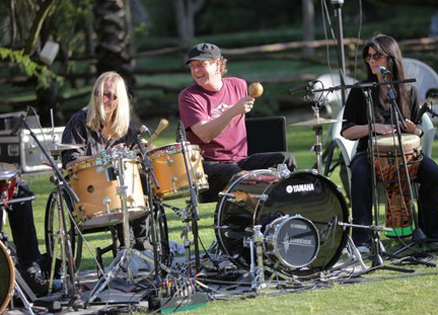
The next day, I called the USO. They directed me to something called the Wounded Warrior Project, a group dedicated to helping injured veterans heal both physically and mentally. Soon, Lauren and I started leading drum circles for the Project.

Drum circles are a rhythm-based group therapy using meditation and guided imagery. They’re not like what we rockers call “jamming.” In a drum circle, we introduce rhythms with the intention of releasing pain. With each rhythm, the vets are guided in how to breathe and how to experience their bodies in a certain way. Then we have both silent and sharing times. Therapists are on hand to help the soldiers talk through their frustrations. You’d be surprised how many of them are finally able to open up after experiencing the drum circles. It’s like they’re finally able to grab on to something that pulls them out of their isolation and grief.

From my own experience, I’ve learned that the human spirit needs only a spark to be reignited after a loss. Helping to find that spark for these soldiers has been one of the greatest honors of my life.

Harris participated in a couple of our drum circles and introduced me to other Wounded Warriors that have since come to The Raven Drum Circles to experience healing. We’d talk about how we’d swear the elbow itched on our missing arm (the docs call that “phantom limb syndrome”). We’d even make jokes: With my left arm and Harris’s right arm missing, we’d stand side-by-side and tell the group we were bookends. That always got a laugh. Over time, the black cloud over his head became a little grayer until it eventually faded away.

I ran into Harris not too long ago at a get-together in Los Angeles. You wouldn’t recognize him from the guy he was in the hospital that day. He was the picture of health and about to participate in a 130 mile bike ride down the coast to San Diego. The only thing that hadn’t changed was that his missing arm still isn’t the first thing you’d notice about him. His broad smile and enthusiasm for life stand out far more.

The USO had asked me to inspire the soldiers, but working with the Wounded Warrior Project inspired me beyond anything I could ever have imagined. It’s not some photo opp for me, some new ROCK STAR VISITS VETERANS headline. Instead, it’s this fantastic two-way street. I’ve learned so much about what the men and women of the armed forces do. I didn’t realize before that some of the amputees actually go back to active duty. That, to me, is off the chart! How can anyone not admire that level of dedication? The Wounded Warrior Project has given me a chance to do something to help the people who protect all of us, and I’ve gotten to meet all these heroes I wouldn’t otherwise have met.

And for me, meeting a soldier is like…well, I guess you might say it’s like meeting a rock star.

Download your FREE ebook, True Inspirational Stories: 9 Real Life Stories of Hope & Faith

Would Her Husband’s New Job Cause Him to Relapse?

Morning light filled the house. I wandered distractedly to the kitchen for more coffee. It was Sunday. My husband, Dave, had already left for church, taking the kids with him. For once, I only had to get myself out the door.

I took my time with the coffee. I read my book. I lingered in the shower. I brushed my teeth extra carefully. My reflection in the bathroom mirror stared back at me: You’re stalling.

I hated to admit it, but I didn’t want to go to church. Not because I didn’t love our congregation of about 100 in the heart of town. Everyone there was compassionate, generous and kind.

I didn’t want to go this morning because, three months earlier, Dave had become the associate pastor there. We’d been attending Restore Church for a long time before that, and Dave was an elder when the pastor, Jim Walter, asked him to come on staff. It was a dream position for Dave. You’d think I’d want to be there to support him. Certainly it would look terrible if the pastor’s wife didn’t show up.

The problem was, this wasn’t Dave’s first job in the clergy. Six years earlier, he’d been fired from his last ministry position—director at a nearby Christian camp—when camp leaders discovered he’d been using the company credit card to buy prescription pain pills. By that point, Dave had been addicted to opioids for 15 years.

Losing that job was Dave’s wake-up call. He confessed everything, quit using drugs and committed himself to recovery. He’d been sober ever since.

Gradually we rebuilt our life together. Dave found work outside the church. I stopped being a stay-at-home mom (my dream job) and found outside work. We went from being in debt and relying on food stamps to owning a house and saving money.

The job offer at Restore was an incredible act of grace. Jim had been our pastor when everything fell apart. He’d known Dave at his worst. In the years since then, he’d given Dave opportunities to lead recovery groups at Restore and invited him to become an elder. He saw the good in Dave, and the two of them shared a vision of the church as a beacon of hope for marginalized people.

I saw the good in Dave too. But was he ready for an opportunity like this? Was I?

I remembered the day Dave told me about the job offer. He’d come home from having coffee with Jim, bursting with excitement. Dave lives for ministry and for six years had thought that part of his life was over. This was a second chance to do what he loved most.

I couldn’t help feeling happy for my husband. But there was dread too. What if the stress of ministry had been a major factor in Dave’s addiction? What if he relapsed? His job at a debt counseling agency had been just a regular job. He might have to take a leave of absence to deal with a drug problem, but he probably wouldn’t get fired. Becoming a pastor again meant a whole different level of scrutiny.

In the past six years, I’d worked to attain a sense of security that was not dependent on Dave. The writing job at a Christian nonprofit marketing agency I’d taken to dig us out of debt had become a source of personal pride and professional satisfaction. The job was my shield against the panic I’d felt when we were broke.

I could keep my job if Dave started working at Restore. But not my life as a regular person. I’d be a pastor’s wife again. Church would become the dominant factor in our family’s life. Dave would bring the job home with him as all pastors do. A spotlight would be on us. I worried that the stress of ministery would become too much.

Both Dave and I had worked through 12-step programs as part of his recovery. The main lesson for spouses is: You can’t control the addiction, so it’s best to detach with love. I’d buffered myself against the worst effects of Dave’s illness by finding a job and building a financial cushion. So why was I consumed by fear? Every day, I searched Dave’s face for signs of stress when he came home from pastoring. My prayers were dominated by one request: Please don’t let Dave relapse.

At last I got dressed and drove to church. I was so distracted, I missed my freeway exit. The opening praise songs were over by the time I arrived, and there was no way to slip in unnoticed. “You’re just in time,” the usher said with a smile. It sure didn’t feel that way.

Months went by. My anxiety got worse, not better. Dave thrived at work, but I kept waiting for the bottom to drop out. I couldn’t stop dwelling on how our lives had changed.

I was more guarded at church, reluctant to share family problems for fear of what people might think. I stopped writing a blog I’d begun about our family’s recovery journey. The public vulnerability felt too risky.

Why couldn’t I snap out of this? I confided in my friend Kit, who is older and wiser. “Have you ever tried the Ignatian Exercises?” she asked.

She meant the Spiritual Exercises of Saint Ignatius, a program of prayer and contemplation developed by Saint Ignatius of Loyola. The program was designed to deepen a person’s relationship with Jesus through close spiritual self-examination and prayerful listening for God’s direction.

“That sounds like exactly what I need,” I said. Kit gave me the book she used in church. The program felt familiar, sort of like the 12 steps. I dove in and, weeks later, came to a section on acknowledging fears. The exercise involved listing all my fears, going back as far as I could remember and being as specific as possible.

My list started with pretty standard childhood stuff: fear of the dark, fear of drowning, fear of getting into trouble.

Then the fears turned more grownup: fear of being wrong, fear of not having enough, fear of being deceived, fear of my kids getting hurt, fear of losing my job, fear of being overlooked. Once I started, I couldn’t stop. It turned out, there was a whole world of fear inside me. All of it poured out.

I came to the last fears: Dave relapsing. Our family broke and adrift. Our lives devastated again.

I stared at the list. So long. So daunting. I noticed a pattern. Everything I feared was something I couldn’t control. Some of those things were comparatively small, such as my kids learning to drive. Others felt impossibly huge. Like Dave’s sobriety.

There was no way around it. To get over my fears, I had to give up control.

I looked back over the years since Dave had entered recovery. Working the 12 steps, I had wrestled with Step Three: “We made a decision to turn our will and our lives over to the care of God as we understood him.” I thought I’d done that.

In fact, I had been working to achieve more control in my life. Work gave me financial control. So did a savings account. I knew Dave felt burned out by his job at the debt counseling agency. But the work was steady and more predictable than ministry.

After years of chaos, I clung to security and control. But was that control an illusion?

I remembered a favorite Bible verse: “Perfect love casts out fear.” The opposite of fear wasn’t control. It was trusting a God who loves so perfectly, we have difficulty comprehending that love.

I wrote out a prayer: “Cast out my fears, God. Every one of them. Shine your light into the dark corners of my mind and heart. Encourage me. I give control to you.”

My fears did not vanish right away. But that prayer was a turning point. I asked friends to pray for me. I sought out a therapist. She was not a faith-based counselor, but when I told her I didn’t want to go to church, she encouraged me to attend anyway.

“Community will heal you,” she said.

I looked at our church with new eyes. The congregation had supported us through the dark days of Dave’s addiction. They knew our faults. Would they really abandon us at the first sign of trouble? Probably not.

Last of all, I began to let go of my fear that Dave would relapse. Loved ones of recovering addicts never stop worrying completely. But there’s worry— and then there’s fear that controls you. I (mostly) stopped searching Dave’s face for signs of stress. I celebrated his successes. I allowed myself to trust that God would be with us, no matter what happened.

Another one of my favorite quotes comes from C.S. Lewis’s book The Four Loves: “Love anything, and your heart will…be wrung and possibly be broken.”

Risk shadows every relationship. But the alternative is not to love at all. And of course, God takes just as big a risk in loving us.

It’s been six years since Dave started pastoring at Restore Church. I take our life together—and Dave’s sobriety— one day at a time. Like anyone in recovery, I walk a path of faith, step by trustful step.

For more inspiring stories, subscribe to Guideposts magazine.

Working with Passion Every Day

When we work with passion, it makes a huge difference. The dictionary defines passion as “strong or powerful emotion; boundless enthusiasm.” Having enthusiasm when taking on responsibilities is what separates us from others in our fields. Passion enhances the skills we bring to our workplace, ministry and community. It fuels our purpose in life.

The Italian Renaissance artist Michelangelo had a passion for sculpting. Before his 30th birthday he had completed two of his masterpieces: the Pietà and the David.

In his early 30s he was summoned by Pope Julius II to sculpt a magnificent papal tomb but was then asked to work on a painting project. At first, Michelangelo wanted to refuse, having no desire to paint a dozen figures in a small chapel in the Vatican. When the Pope pressed him, he reluctantly agreed to do the work.

Once he accepted the assignment, Michelangelo was fully committed. He expanded the project from the depiction of the Twelve Apostles to more than 400 figures and nine scenes from the Book of Genesis.

For four grueling years the artist laid on his back on a scaffolding, painting the ceiling of the Sistine Chapel. He paid a great price. His friends didn’t even recognize him from all the physical effects of the grueling work. When asked why he was working so diligently on a dark corner of the Sistine Chapel that no one would ever see, Michelangelo replied, “God will see.”

Everyone is called to do their part and use their gifts to make our world a better place. We need bridge builders, advocates for justice, messengers of love, artists and much more. It takes a multitude of people using their talents for the betterment of humanity.

And when we do our part in the world with passion, even when others may not recognize or see it, we know that God will see it. What are you passionate about? How are you doing your part? Please share with us.

Lord, help me to do my part in building a better world with great passion.

Words to Grow On

Let’s go back 70 years or so and I’ll show you what it was like being a “girl reporter.”

My father, a famous criminal lawyer, is far ahead of his time in believing girls must be able to earn a living. We are sitting in his study looking into my future and he asks me about my all too vivid imagination. “Is this the mark of a writer?”

A writer! Oh, yes, I say to myself.

“You know,” he continues, “Dickens started out as a reporter, and Kipling went to India for a newspaper.”

I interrupt sadly, “Oh, Papa, girls can’t work on newspapers.”

“A few do,” he says. “More will. Women are a gold mine of talent.”

His friend, publisher William Randolph Hearst, agrees, and there I am, barely 18, in the all-male city room of the Los Angeles Herald. Where city editor J. B. T. Campbell regards a newspaperwoman as a contradiction in terms.

The pace he sets for me—chasing fire engines, riding ambulances, viewing corpses, covering murders—makes me long for Grandma’s kitchen. The newspapermen are betting on how long I’ll last.

Nobody’s on my team and I’m scared all the time—of deadlines, of having to write so fast. I want to be a reporter, I believe I can grow into a writer, I pray to God that I can be both—but Campbell has almost won.

Then, I interview the sister of the Wright brothers who have invented the airplane. And Katherine tells of the heartbreaking years when they were ridiculed in their hometown of Dayton, Ohio.

Simple bicycle mechanics, these “boys” over 30 spent their days messing with kites, gliders, an engine all smoke and noise. College professors had proved positively that men would never fly, yet Wilbur and Orville kept revising and retesting this “flying machine” that couldn’t work. Their sister says to me simply, “And then, one day, it flew.”

Those words went back to the city room with me. They kept me from quitting then—or ever. Eventually came my first scoop, my first by-line, my first short story, my first book.

In each pioneer endeavor I met challenges. We all do, whether aiming at the moon, or building a better mousetrap, or attempting a difficult recipe or dress pattern. I’ve had disappointments. Stories rejected, souffles that fell flat.

But with each failure I’ve been able to chuckle a little, knowing that eventually, with patience and prayer, I could look back and say, “And then, one day, it flew!”

A Burden to Share

I grabbed the railing and hoisted myself up three steps to the community hall. Gasping for breath, I lumbered into a room where a dozen people sat in folding chairs. One was empty, but I figured it would collapse under my weight.

“Have a seat here,” said a large woman on the sofa along the wall. People moved over to make room for me. Plenty of room.

I was 45 years old, five foot six—and weighed 396 pounds. The only clothes that fit me were size 60 blouses and voluminous elastic-waist pants. My shoes all had Velcro straps; I couldn’t reach my feet to tie laces.

I had recently bought a new full-size car because it was the only one whose steering wheel I could fit behind. I was miserable. Yet I couldn’t admit it to anyone. I couldn’t even talk about it.

The meeting started right on time. People introduced themselves and told why they were there, how many pounds they’d lost and what they’d eaten that week. Then it was my turn. I forced out the words.

“I’m Sylvia,” I said. “This is my first time at a support group. I don’t really have anything else to say.”

My name wasn’t Sylvia, but I was too ashamed to let anyone know who I really was. Besides, I was used to keeping secrets. I was always telling people that I was trying to lose weight.

“It’s not my fault that nothing works,” I declared. What I wouldn’t admit was that my life was devoted to eating on the sly.

As far back as I can remember I loved to sneak. Mom made big batches of chocolate-chip cookies for our family of six and stored them in bags in the freezer. I’d take a bunch and hide them in my room.

Whatever was bothering me, however happy or sad or bored I felt, gorging myself always helped, as if I could fill up a sense of emptiness inside. Even when I was a child my eating was dishonest.

Later in college, studying for exams, I’d devour my way through rolls of raw cookie dough. Or polish off a bag of chips and then start in on the candy bars I’d stashed in the back of my desk drawer. I hid food like an alcoholic hides booze.

Marriage didn’t help me cope any better with my problem. When I went through a painful divorce, my weight crept up … 200, 250, 300 pounds. Only food could fill the void.

I taught middle-school English and social studies, and I hated overhearing kids mutter “fatso” and “whale” behind my back. I slipped deeper into depression, which was worsened by failed diets and bouts of overeating. Finally, I started counseling sessions with a therapist in the spring of 1999.

“Do you watch what you eat?” my counselor asked in our first session. “Yes,” I said. Actually, I was watching it go into my mouth. I would stop in a restaurant for a meal, then drive to the other side of town and have another meal—then head home and have a third.

That way, I convinced myself, nobody would know just how much food I was really consuming. “You need to talk to some people who struggle with overeating,” my counselor suggested. “There’s a group that meets every Saturday downtown.”

“I’m not a joiner,” I said. “I can change by myself.”

But the truth was, I refused to imagine my life any other way. I left the counselor and headed for a drive-thru where I picked up several value meals plus extra orders of fries. “For my coworkers,” I lied to the boy who handed me the three bulging bags.

The next week my counselor laid it on the line. “I’m not going to see you anymore,” she said, “unless you attend a group. And you’ve got to go to at least twelve meetings.”

That’s why I was sitting on the sofa at the support group, feeling more uncomfortable by the minute. “I’ve had some bad moments this week,” the woman next to me announced, “but with God’s help I managed to keep track of my calories and eat three sensible meals a day.”

God’s help? I was sure God couldn’t help me. “I was feeling down,” a man said, “but I realized overeating wouldn’t change anything, not really. So I called a friend to go to a movie instead.” But food did change things for me. It was my friend.

I clapped along with everyone else, but deep down inside I had a terrible feeling. Not me. These other people might be helped by all this “sharing.” Maybe they were even losing weight. But me? I was a hopeless case.

As soon as people realized my secret, they would turn away. Even these folks. Especially these folks, who certainly didn’t need a loser like me dragging them down. And all this talk of God. What would God want with someone like me?

I left the meeting and drove straight to the grocery store. On the way home I wedged a pint of Ben & Jerry’s between my knees so I could eat as I drove.

“I went to the meeting,” I told my counselor.

“Did you talk?” she asked.

“Sure,” I said. I wasn’t exactly lying, but I wasn’t being honest either. All I’d promised was to attend 12 meetings. The weeks went by, and the most I ever said to the group on Saturday morning was “My name is Sylvia” and “I don’t feel like talking today.”

The eleventh Saturday approached. I was nearly home free. That Friday in school I had lunch with the other teachers and made a production of having only half a turkey hero.

“I’ll eat the rest for lunch tomorrow,” I announced, thrusting it back in its brown bag. Easier to finish it off between classes in my room when no one was looking.

I headed down the hall for class, moving slowly through the student throng. “Moooo …” came the taunt of some boys behind me. The sound seemed to echo in the hall. I pretended I hadn’t heard.

An image stormed through my mind of me sharing this ugly humiliation with my support group. I blotted it out. I could never talk about something like this, never bare my soul. I thought of the sandwich in my bag and how soon I could get to it.

Saturday morning the leader said, “Today we’ll talk about hope.” Hope? Vaguely I heard the others talking. Round the circle they went. Then it was my turn. Waves of despair I’d been suppressing for years surged up and nearly took my breath away. In a flash it all came pouring out.

“I don’t have any hope,” I began. “I can’t even remember what hope feels like.” I blinked frantically to keep back tears. Go on, a voice inside me said. Go on. Somehow I knew I needed to do this, to accept, acknowledge and feel the pain.

I grabbed a tissue and continued. “I have no hope of ever being a normal size again. I have no hope at all. …” I was shaking. I started to sob so hard I couldn’t say another word. I motioned for the next person to go ahead and take her turn.

The meeting ended. I dodged the hugs and headed to my car. I drove out in a spray of gravel. I’m never going back. I’ve made a fool of myself. There is no hope for me. God, even if you are listening, you’re wasting your time.

On the way to the grocery store I stopped at the post office to pick up my mail, a little surprised that anything would get between me and a meal. Among the bills and catalogs was a thick envelope from a friend I’d taught with but hadn’t heard from in months.

Inside was a pretty card on which my friend had written: “Here’s something for you to hold on to.”

I pulled the tape off the small package she’d enclosed. A flat polished rock of white-and-purple marble dropped into my hand. Engraved on it was a single word: HOPE. I gripped it tightly in my hand.

I drove home and put the rock in the center of my dining room table. I didn’t want to eat at all, as if that tiny stone were a great rock that stood between me and my compulsion. It was Day One of my recovery.

The following Saturday I went back to the meeting. Number 12. I wasn’t ashamed to speak. I couldn’t afford to be ashamed. “I’m determined to lose this weight,” I said. “With God’s help and your encouragement I know I can do it.”

I had already begun planning. I would set up what worked for me. Only three meals a day, no snacking in between, yogurt instead of ice cream, hold the cheese and mayo and consume half the portion, maybe less.

I couldn’t exercise yet—I could barely even move—but foresaw the day when I would get up every morning for a brisk walk. “I can do it,” I announced. “I’m not alone.”

I took a deep breath. What I’d said was scary, but I’d made my commitment out loud, and I wasn’t backing down. “I have something else to tell you,” I said. “My name’s not Sylvia. My name is Jan. And I’m really glad to be here.”

Download your FREE ebook, Paths to Happiness: 7 Real Life Stories of Personal Growth, Self-Improvement and Positive Change.

With Reason and Faith

"If you don’t want to plant a crop on that field down the road, y’all might want to think about planting trees on it.” My brother-in-law, Alton, tossed that out casually and grabbed another of the buttermilk biscuits his sister–my wife, Rose Lane–had made.

Little did I know that his remark would change my life.

The three of us were sitting at their late grandmother’s old pine table having breakfast. Miss Julia had left the family homeplace, a nineteenth-century farmhouse and roughly 1,100 acres in middle Georgia, to Rose Lane.

We lived a few miles away, in Macon, but we’d been staying at the farm to look after things while we grieved for Miss Julia and took stock of our situation.

And really, to try to figure out what we were supposed to do with all this land. Mostly cattle and row crops had been raised on it since Rose Lane’s grandparents bought it. But I wasn’t a farmer. I was a rock musician.

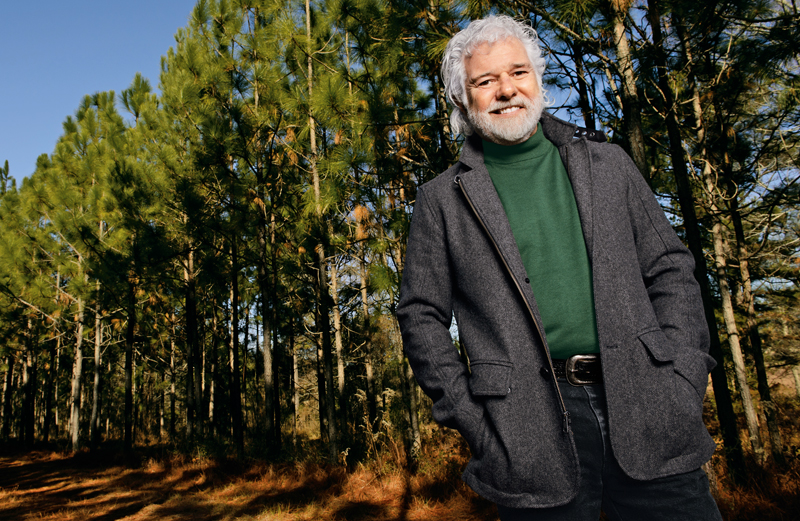
For four years I was the keyboardist for the Allman Brothers Band, who maybe more than any other group shaped the southern rock sound (that’s me you hear on the piano on “Ramblin’ Man” and “Jessica”).

When the Brothers temporarily disbanded in 1976, a couple of the guys and I started our own group, Sea Level. We toured extensively and made five albums, but in 1981 we broke up too.

Now I was between jobs, wondering what my next gig would be. A musician’s life is an uncertain one, but the Good Lord had always provided for me. I fell in love with music at the age of six. I’d listen to my mom pick out a melody on our piano, then play it back for her by ear.

She taught me that more important than the notes being played are the feelings being expressed. “What would it sound like if you were upset?” she’d ask. And I’d rumble something on the low keys. It gave me the shivers in the best way, like hearing everyone sing at church.

I discovered another love around that same time. My family lived in the country outside Montgomery, Alabama, and I felt a close connection to the land. There were woods to explore, horses to ride, a creek to wade in.

I started my first band, the Misfitz, at 13 after my family moved to Tuscaloosa. We practiced in my parents’ living room and played the YMCA every Friday night. At 17, I took off for Macon, Georgia, the birthplace of southern rock.

Capricorn Records was then an up-and-coming label, so that’s where I went. Behind the desk was the most beautiful girl I’d ever seen, with an equally beautiful name, Rose Lane White. I couldn’t stop thinking about her and her sparkling hazel eyes.

But would you believe it took me two years to muster up the courage to ask her out? Lucky for me, she accepted. After dating a few months and getting serious, I asked her to tell me about her family.

“We’re country folk,” she said. “My granddaddy was in the timber business. He and my grandmother also farmed, and my parents, my brother and I–we’ve all worked the land.”

Six months after our first date, Rose Lane and I were married. Two years later, our first child, Amy, was born. When we weren’t on tour with the Allman Brothers–we carried Amy from gig to gig–we were making memories with Rose Lane’s family on their land.

Spending our free time there was one thing. But now Miss Julia’s 1,100 acres were our responsibility, and we wanted to do right by her and by the land. So here we were at breakfast, Alton, Rose Lane and I, shooting around ideas.

“Trees?” I asked Alton. “You mean peach trees, or pecans?”

“Orchards need a lot of attention,” he said. “And you’re on the road so much. I mean trees that you grow for long-term forestry–for pulp production, saw timber and other products. Something you wouldn’t have to tend day to day like corn or cotton or cows.”

He looked at Rose Lane. “It would be kind of like reviving some family history.”

That got me thinking. And studying. I read everything I could get my hands on about trees, forestry and land management. I went to seminars. I sought advice from conservation experts.

I studied how to plant, grow, manage and harvest timber in ways that are beneficial for people, wildlife and the environment. The more I learned, the more I saw that one big reason we are here on God’s green earth is to be good stewards of the land.

One day, maybe a month or so into my research, I was playing my grand piano when I looked–really looked–at the instrument that had given me so much joy, as well as a great career. Its unique shape. The contrast of the black and white keys.

I thought about the thousands of hours I’d logged sitting at it, learning all I could. Then it hit me: This wondrous instrument came from that precious, natural and renewable resource–wood.

Of course I knew that. I’d just never given it much thought. The maple case, the spruce in the soundboard, the wooden keys and levers…now I could imagine all the work and care that went into growing those trees, harvesting the timber and crafting the wood.

My beloved piano wouldn’t be here without trees. I wouldn’t be living this wonderful life of mine without trees.

Tree farming? I had to try to make a go of it. Rose Lane and I agreed to make her grandmother’s house our permanent home. And like Alton suggested, we would grow trees on the land.

They would purify the air, filter our streams and rivers, and provide shelter for wildlife. Our trees would be used to make everything from paper to telephone poles.

Rose Lane’s hazel eyes were shining. “I think Miss Julia and Granddaddy would be very proud.” That very day the Rolling Stones called. They were looking for a keyboardist. As I said, the Good Lord provides.

Before I knew it, I was back on tour… with the world’s greatest rock-and-roll band. On breaks, I came home to Rose Lane and our girls (by then we had a second daughter, Ashley) and our tree farm. We named our place Charlane Plantation, a combination of Charles and Rose Lane.

I loved learning about trees, and that love deepened as I nurtured them and watched them grow. In the 32 years since we started Charlane Plantation, we’ve planted more than a half million trees.

I cofounded Mother Nature Network, the most visited independent environmental website in the world. And I’m still touring with the Stones and releasing my own albums.

My friends say I am a tree farmer in my heart and a musician in my soul. They’re right. As passionate as I am about music, sometimes I need a respite from the craziness of rock and roll.

I’ll go for a long walk among my trees. I breathe the air they’ve freshened, listen to the play of the breeze in their leaves and give thanks. As Ralph Waldo Emerson wrote, “In the woods, we return to reason and faith.”

Download your FREE ebook, Paths to Happiness: 7 Real Life Stories of Personal Growth, Self-Improvement and Positive Change

William Styron on Depression

William Styron, the Pulitzer Prize-winning novelist, was struck with depression in 1985. Five years later, at age 65, he wrote about overcoming this “catastrophic soul disease” in his powerful book Darkness Visible: A Memoir of Madness (Random House). We recently spoke to Styron about his experience with depression:

I never thought for a moment it would hit me. I didn’t even know what depression was. It can strike like lightning. The figures show that on average twice as many women are afflicted, but it can hit anyone.

People around the person who suffers from this illness must realize that the patient is going to be incapacitated through a great part of each day. The suffering is so intense that most people who are going through it feel that it’s going to go on forever.

Depression varies from person to person, but it does seem to run in cycles. For many, the worst horror comes in the morning. It prevents one from getting out of bed. Usually it lets up during the latter part of the day.

If people see the pattern they can be far more responsive, patient and protective of the depressed person’s needs.

The illness is treatable, and it is very important to find a professional whom you can talk to. The sufferer almost always has a failure of a sense of future. You cannot conceive of a day in which this pain begins to go away.

It requires an enormous amount of faith in oneself and in the capacity to get well to avoid the worst resolution. Only a small percentage of people–and I have to be blunt about this–kill themselves. That leaves a large majority who are going to get well.

The paradox is that they don’t believe it. They have to be told over and over again. It is essential for anyone who is in the position to deal with the sufferer to constantly assure the person day in and day out that he or she is going to get well.

My wife, Rose, was able to see something horrible was happening to me and was endlessly patient in helping me try to feel better. And I also found help reading chapters from the Bible, like Job. I read the Book of Job a great deal.

I’ve been a writer for a long time and I’ve always had response to my work, but nothing approaching the thousands of letters I’ve received from people all over the world after the publication of Darkness Visible.

Although I wrote the book to get my own experience off my chest, it’s gratifying to learn that it has been of such help to others.

Download your free eBook, Let These Bible Verses Help You: 12 Psalms and Bible Passages to Deepen Your Joy, Happiness, Hope and Faith.

Why You Should Use Your Imagination When You Pray

I prayed for you today.

I probably don’t know you, but as I started writing this blog post I imagined you clicking on the link. In my mind’s eye I saw the light from your device’s screen illuminate your face as you began to read these lines. The muscles in your face relaxed, little by little, as you scanned the text. You closed your eyes on finishing and began using your imagination to pray for someone or something in your own life.

The imagination is a powerful prayer tool, one that we too often neglect. Eugene Peterson, in his book Reversed Thunder: The Revelation of John and the Praying Imagination, refers to “the workings of the imagination as a means of grace,” and says that “an exercised imagination is essential to a full-bodied and full-souled life in Christ.” I agree wholeheartedly and am learning to incorporate imagination more and more into my prayers.

I pray for my two young grandchildren who cope daily with cystic fibrosis. I picture them as teenagers, playing baseball or dancing in a meadow. I see them breathing deeply, their lungs filling with the afternoon air. Their bodies are strong, their every function unimpaired. It’s my prayer for them, as my praying imagination envisions for them a long, vibrant future filled with health and vitality.

I pray for a friend who has endured more than a year of rehabilitation from an operation, gathering strength, yes, but so very slowly. I picture Jesus coming to her in her home, reaching out and touching her. I visualize warmth, light and strength coursing through her body.

Another friend’s life has been shattered by suspicion, accusation and betrayal. I close my eyes and imagine Jesus washing his feet, while so many layers of hurt flake off from his heart and mind, float into the air and disappear.

I hold in my mind the lovely face of my wife, who recently lost her father and was unable to attend his funeral. I sketch a mental picture of Jesus enfolding her in His arms while she weeps. I see her shoulders relax and her burden lift. Eventually, her back straightens, she exhales. She smiles. Nods. He smiles back.

These sorts of prayers heighten and deepen my prayer life. They are truly a means of grace. They make me eager to pray and excite me with the promise of God’s willing answers. I pray, even now as I write this, for you to enjoy a similar experience as the workings of your imagination shape and energize your own prayers.

Why You Should Stop Trying to Be So Productive

Excerpted from The Radical Pursuit of Rest: Escaping the Productivity Trap by John Koessler

As I write this, my attention is divided. I am listening for the chime that tells me I have a new email waiting. When I am at a loss for words, I find it hard to reflect at length about what I should say next. It is so much easier to click away from the screen and log onto Facebook. Or else I scan my favorite newsfeed and check out the latest headlines. To be honest, it’s not news. Not really. It’s gossip mostly. Headlines about actors, musicians and late night talk show hosts. I am not especially interested in their stories. But I keep scrolling, cycling past stories I have read more than once. Hoping all the while that something new and interesting will appear. I am not addicted. I am distracted.

Computer technology has not destroyed my ability to concentrate. But it has made it harder. It has also made rest harder to find. Digital technology has turned our world into one where we are never alone and are always on the job. Most of us don’t think it has any effect on our social and emotional well-being. But the digital world is altering the way we view time and schedule our activities. We use our cellphones to track one another. Wherever we go we are accompanied by the constant murmur of distant friends. Even when we turn off the phone some part of us wonders what we have missed.

Digital culture has also broken down the natural boundaries that used to exist between work and rest. Dr. Kimberly Fisher, a research associate at the Center for Time Use Research at Oxford University, observes, “People don’t have as much mental space to relax in a work-free environment. Even if something’s not urgent, you’re expected to be available to sort it out.” The last thing I do before I go to bed at night is check my email. If I have a new message, it’s usually about my job. If I wake up in the middle of the night, my first instinct is to lean over the nightstand to check for new messages.

The answer to this problem is obvious. All I need to do in order to pursue rest is to disconnect from the digital world. Not permanently but perhaps for a time. It is simple. But it is not easy. The prospect of being unplugged from the grid makes me nervous. This is more than the fear of losing access to information. It is a sense of being detached. I am not a digital native, yet even I feel uncomfortable when I turn off the technology. I feel isolated, cut off not only from the technology but from the relationships it represents.

The technology is new but the fear is an old one. It is solitude I dread. And digital culture makes solitude easier to avoid. When Jesus saw that the people planned to make him a king by force, he “withdrew again to a mountain by himself” (Jn 6:15). This was not the first time Jesus did this. Solitude was his regular practice. But I do not quit the crowd so easily. Not only do smartphones, texting and social media enable others to intrude on me at any time and in every location, they greatly increase the likelihood that I will invite such interruptions. I can withdraw to the mountain like Jesus, but I am never really alone. Digital culture is the new background noise. It is the multitude I carry in my pocket. Its incessant chirping intrudes on my most intimate moments and serves as a constant reminder of the waiting crowd. Rest is harder to find in a digital culture because technology has dissolved the two fundamental boundaries that are essential to rest: solitude and silence.

Solitude and Silence

Interruptions were a problem before there was digital technology. Jesus was interrupted too. The crowd intruded on his privacy on more than one occasion. The difference between his experience and ours is that the crowd had to make a serious effort in order to interrupt him. Today they can stay where they are and click their way into our presence. Like Jesus we occasionally need to withdraw from the crowd—especially the virtual crowd. One solution is to turn to habits the church practiced long before the computer age was ever envisioned: the ancient disciplines of solitude and silence.

Solitude is a critical component to our overall spiritual health. Dallas Willard describes the benefit of solitude this way: “The normal course of day-to-day human interactions locks us into patterns of feeling, thought, and action that are geared to a world set against God. Nothing but solitude can allow the development of a freedom from the ingrained behaviors that hinder our integration into God’s order.”

The biblical metaphor for solitude is the wilderness. Moses, David, the prophets, Paul, the disciples and of course Jesus himself all spent time in the wilderness. On the surface, the wilderness seems an unlikely location for rest. After all, the wilderness is not a resort. It is a place of deprivation. While we are in the wilderness we do not have access to our usual conveniences. The wilderness is also a place of disruption. Work must cease and we cannot maintain our ordinary relationships. It is impossible to follow our normal routine there.

This sheds an important light on the experience of rest. We are tempted to think of rest as a kind of indulgence. But in reality the practice of rest often involves a measure of self-denial. Rest requires that we cease our ordinary activities and break away from our daily relationships. When we are at rest we are often unavailable.

When God’s people observed the Sabbath in the wilderness, they could not gather manna. Instead the Lord preserved the extra food they had gathered on the previous day. God’s people were also forbidden from engaging in their ordinary work and were restricted in their movements. But deprivation is not the ultimate goal of rest. The intention was not for the Israelites to go hungry but to recognize that they were being fed by God. They abstained from their normal occupations in order to occupy themselves with something better. Likewise, when we rest in this way we do not cease from all activity; we abstain from one kind of activity in order to engage in another. We deprive ourselves of our ordinary work for a time in order to engage in a higher calling with a better reward. The benefit we receive by leaving our other pursuits behind is that we are refreshed. The ancient command to observe the Sabbath was both a sign and an invitation to enter into the experience of God, who refreshed himself on the seventh day of creation. The pursuit of rest is really the pursuit of God.

—Taken from The Radical Pursuit of Rest by John Koessler. Copyright (c) 2016 by John Koessler. Used by permission of InterVarsity Press, P.O. Box 1400, Downers Grove, IL 60515-1426. www.ivpress.com

The book cover of John Koessler's The Radical Pursuit of RestJohn Koessler (DMin, Trinity International University) is chair and professor of pastoral studies at the Moody Bible Institute in Chicago, Illinois, where he has served for over 20 years. He is the author of several books, including The Surprising Grace of Disappointment, True Discipleship, God Our Father and A Stranger in the House of God.



Why You Should Make New Friends as an Adult

While I had many friends growing up, one stood out. His name was Philip and his nickname was Junior. His family lived above our third floor apartment in Manhattan’s Lower East Side. Junior was the only boy of five children. On many occasions his parents took us boys to Coney Island beach where we enjoyed swimming and playing in the sand. When home, we loved wrestling on the living room floor and eating peanut butter and jelly sandwiches.

When I was having a bad day, he was always there. Although Junior and I don’t see each other as often as we used to, we remain friends. Our relationship reminds me of a quote from author Ally Condie, “Growing apart doesn’t change the fact that for a long time we grew side by side; our roots will always be tangled. I’m glad for that.”

Many of us have childhood friends who will be forever in our lives, but as we age we must continue to make new friends. As adults we may be more fearful of rejection or of a relationship turning bad, but we must seek out new friendships at work, church, the senior center or other places we spend time. Sometimes it means taking a risk and starting a conversation with a stranger, but we must make the most of opportunities to meet new people.

In life, we all face inevitable changes whether it’s in our health, career, housing or family. That’s when we tend to turn to our friends, family and God. These relationships play important roles in determining how we face obstacles. When life gets hard, we need others to lean on. Start building that support today.

Why Worry When You Can Pray?

Do you struggle with worry? Many people battle it on a daily basis. Worry means “to torment oneself with or suffer from disturbing thoughts.” By definition we bring worry upon ourselves.

Worrying takes its toll on both mind and body, cutting off natural energy and effectiveness. The physical and emotional impact varies from person to person. Worrying can lead to restlessness, mood swings and even illness. It has the potential to squeeze the life out of a person and rob them of joy, peace and happiness.

The other morning my daughter called to tell me how she responded to a late night text message from her boss. It became a long discussion with both being at different ends of how to resolve a business matter. The text message turned into a telephone conversation that ultimately led to a worry-filled, sleepless night.

Dr. Norman Vincent Peale offers this wisdom in dealing with worry, “Say to yourself, why worry when you can pray?” In Psalm 34:4, the psalmist writes, “I prayed to the Lord, and he answered me. He freed me from all my fears.”

READ MORE: THINK POSITIVELY THROUGH FAITH

When worry occupies our mind, it is best to seek the Lord in prayer. I find that the more I open up to God about my fears, and talk with Him about my worries and concerns, the more calm I become. His presence gives me peace, as He reassures me that things are going to be alright. Through prayer the burden of worry is lifted.

When we worry, we live with stress. Sleepless nights, eating disorders and physical illness, along with a host of other ailments, become the norm. However, praying to the Lord about our concerns leads to peace, calmness, a clear mind and sound health.

Why worry when we can pray? Instead of letting disturbing and worrisome thoughts occupy our minds, why not talk to God about them? Share how prayer has helped you get through difficult times without anxiety and worry.

Lord, teach us to release our worries to you through prayer. Move us from fearful thoughts to faith in You and Your sovereignty.

Why Water Is So Calming

As children, my sister and I always noticed our mom getting a contented, faraway look as she gazed at the ocean on vacation. We called it “the Enya Effect,” named for the dreamy music of the Irish singer she loved.

But the marine biologist Wallace J. Nichols would call what we’d noticed “Blue Mind,” a phenomenon where being close to water inspires positive emotional states including calm, relaxation, creative thought and more restful sleep.

Community Newsletter

Get More Inspiration Delivered to Your Inbox


In his 2015 book by that same name, Nichols presents the science behind Blue Mind, citing studies such as this one, which linked natural or constructed water features with mood improvement and a sense of inner restoration.

Brain chemistry changes around water as well. According to Nichols, water can impact neurotransmitters known to impact mood in a similar way to how they change during meditation. “The best way to handle stress,” he told Psychology Today, “may be to get to the closest beach.”

A river, lake, stream or pond will have the same effect. And if you can’t get away, a soak in the tub can tap into water’s calming properties—or a white noise machine featuring waves, rain or babbling brook. Even an internet search for aquatic photography can steer your mind toward peace and contentment.

And if you really want to enhance your aquatic joy, put on some Enya—I especially recommend “Caribbean Blue.”