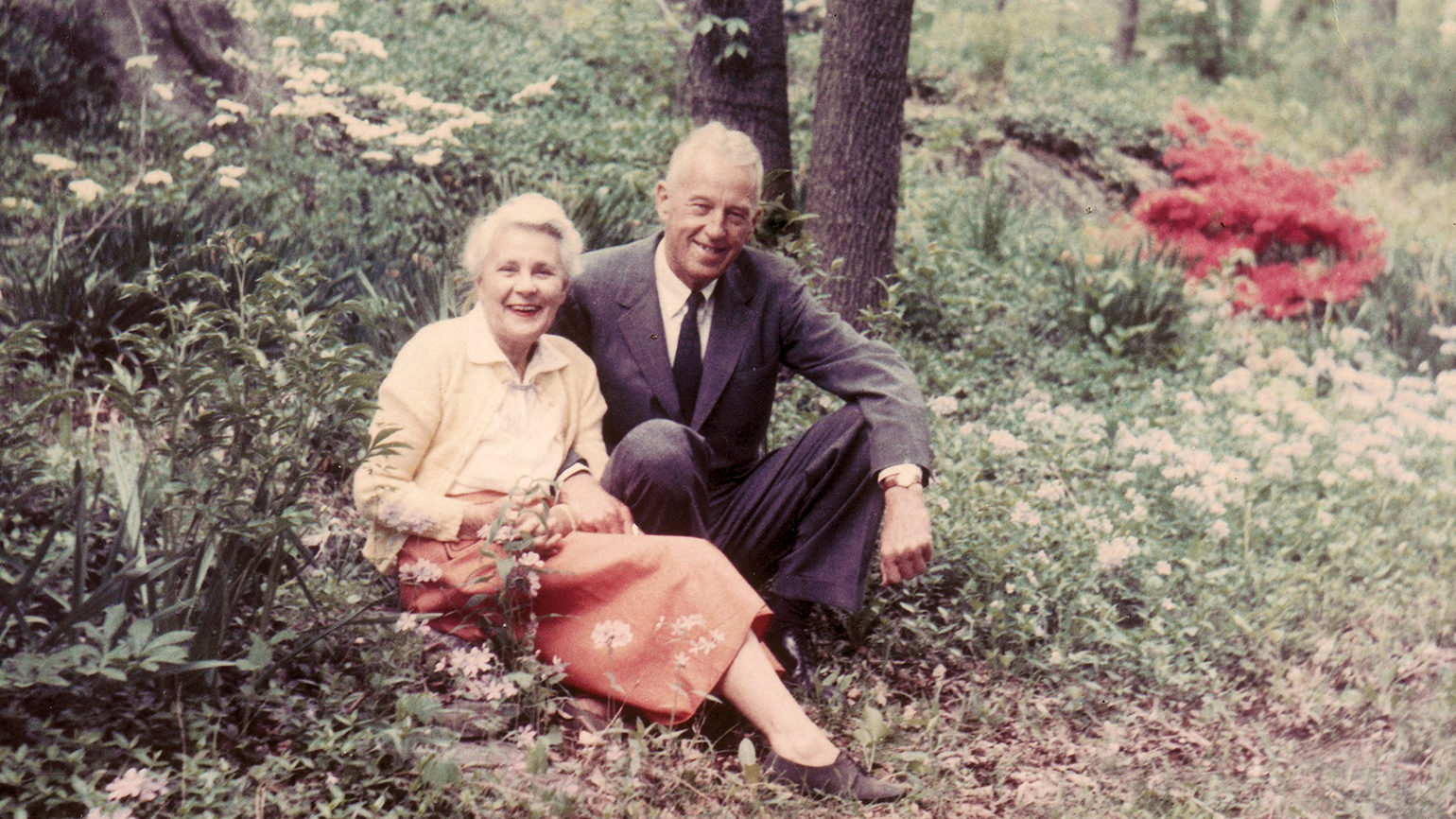
Bill & Lois Wilson, Copyright Stepping Stones Foundation. Property of the archive of Stepping Stones–Historic Home of Bill & Lois Wilson, Katonah, NY. Permission required for further use. http://www.steppingstones.org
I nudged my car up a narrow drive through trees. Sunlight on the leaves made a riot of shadows. It was beautiful, but I was impatient. I didn’t want to be there. I wanted to be at home, working on a new screenplay I was writing. Instead, my wife, Bernadette, had dragged me to a picnic at her friend Lois Wilson’s house. Lois was the widow of Bill Wilson, cofounder of Alcoholics Anonymous.
I knew about AA—I had started my career in newspapers and met plenty of hard-drinking reporters whose lives were saved by the organization and its 12-step program of recovery. And, ever since Bernadette had met Lois through some mutual friends, she had been telling me what a kind and fascinating woman she was. But not even learning that Lois had founded Al-Anon, the 12-step support group for loved ones of alcoholics, could make me glad to give up a precious weekend day. My business partners and I had recently produced the 1973 hit movie “Serpico,” starring Al Pacino. We were working feverishly on a follow-up, chasing screenplays, talent and money. There was little time for anything else. What am I doing here? We’ll just shake hands and leave early, I thought.
The picnic was at Stepping Stones, Bill and Lois’s cedar-shingle house on an eight-acre plot of woodland in New York’s Westchester County. Lois held the picnic every year, an open invitation for recovering alcoholics and their families to spend a day relaxing in the warm June sun. When Bernadette and I reached the top of Lois’s drive, we saw a wide lawn barely dotted with people spreading blankets. We were early. More time squandered.
We got out, and I breathed the rich, dusky smell of lilacs. A stream meandered past and disappeared into trees. Bernadette led me across the lawn to a screened porch at the back of the house. There, surrounded by a few friends, sat an elderly lady in slacks and a silk blouse. When she saw Bernadette, she rose and embraced her.
“Lois, this is my husband, Bill.”
Lois, who, at age 82, was no more than five feet tall, looked up at me with glistening, grayish-blue eyes and gripped my hand firmly. “It’s wonderful to meet you,” she said in a lively, crackling voice. I stammered out a reply, suddenly feeling very foolish. She was so open, so welcoming. She told me how pleased she was that I had come, then invited me to go with a friend of hers named Penny on a tour of the house. In moments I was mounting a creaky spiral staircase and entering a long, high-ceilinged room crammed with photographs, plaques, an old Moviola machine and a desk where, Penny told me, Lois had laid the groundwork for Al-Anon by sending letters to the wives of alcoholics in her husband’s support groups.
As I made my way through the room, poring over photographs of Bill and Lois, and reading letters from luminaries around the world thanking them for their work, my eyes widened in surprise. I clicked on the Moviola and felt my own movie gears whir. The founding of AA—what a film that would make! And all the material is right here at my fingertips. I wonder if Lois will give me permission?
When Penny and I returned to the porch, the lawn outside was packed with families eating, laughing and forming a line around the house to spend a few moments with Lois. I watched her greet each person as if he or she were her only guest. They kissed her cheeks, gave her gifts and told her stories of recovery and redemption. “I’m so glad you could come,” she replied. “And it’s wonderful to hear what AA did for you.”
Bernadette and I stayed most of the afternoon. When we left, I asked Lois if I could meet with her again to talk about my movie idea.
“Of course,” she said.
The following Thursday afternoon, Lois and I sat in her living room, drinking tea. I turned on a tape recorder, and she began to tell the story of herself and Bill. They had married just before he shipped off to fight in World War I. She still had a picture of him in his second lieutenant’s uniform, and I could see why she spoke of him so reverently. He was handsome, with a penetrating look, and she said that even at that young age, she believed he would do great things. When he returned from the war, he’d made a great deal of money working in finance on Wall Street, and he had rented an elegant apartment in Brooklyn Heights, just across the East River from Manhattan’s thrusting skyline.
He’d also, however, begun drinking. Not enough, at first, to affect his work. But enough to eventually snowball into a powerful addiction. Soon, he was arriving at the office hung over, insulting clients and cutting out early to drink. He would disappear for days into underground speakeasies, surfacing only when he ran out of money. Lois, frantic, would be left to nurse him back to health. After the stock market crash of 1929, he lost his job and the apartment, and he and Lois crammed their belongings into her father’s house on Brooklyn’s Clinton Street. Only when Bill’s drinking landed him in the hospital for the fourth time did he reach out to a God he had never believed in and realize that faith and fellowship were his only hope.
“He founded AA after meeting a fellow alcoholic named Dr. Bob Smith, on a trip to Akron,” Lois told me. “When he got back to New York, he began a support group at our house. Though, if you had seen it back then, you wouldn’t have called it that. It was mostly just Bill going to the Bowery and pulling drunks out of the gutter to pray with them and talk about their addiction. They weren’t exactly a welcome sight. But all I could think was, they were keeping Bill sober. So I didn’t complain that he wasn’t working, and that they weren’t paying him anything for his help. I got a job at Macy’s and did the cooking and cleaning at night.”
It was a precarious life, made more so when Lois’s dad died, leaving Lois and Bill to pay the mortgage on the house. Bill’s AA group was growing, but Lois’s job wasn’t enough to make payments. One day, a foreclosure-warning letter arrived from the bank. Lois showed it to Bill as he got dressed for a meeting downstairs.
“We need to talk about this,” she said.
“Not now, sweetheart,” Bill answered.
“But, Bill, we’re going to lose the house!” she said.
“Well, these men are waiting for me,” Bill said. And he dashed downstairs.
“At that moment, I realized something that sounds very strange,” Lois told me. “Bill’s AA groups were working wonders. But they were becoming like his drinking—consuming him. Not even sobriety could curb the effects of alcoholism! I felt so helpless, so trapped by this spiral of addiction, that I stomped out to the front porch to get some air. I was all set to yell at the trees when I happened to notice a long row of cars parked in front of the house. I peered through the car windows and saw that, sitting in each car, was the wife of one of the men at Bill’s meeting. They had driven their husbands there and parked outside to make sure they stayed. They were that desperate.”
“That’s who I need to talk to, I thought. They’ll understand. And I ran to the street and asked the women into the kitchen for coffee. As soon as I told them how mad I was at Bill, even though he was sober, they all cried out that they were mad at their husbands! Well, I knew right then that we wives, and anyone else related to an alcoholic, were sick and needed our own support group. And soon after that, Al-Anon began.”
Lois and I had many more conversations like that—several years’ worth, in fact. She told me much about her and Bill’s life, but mostly I paid attention to the parts about Bill. That information was what I needed for the television movie My Name is Bill W., which premiered in 1989, starring James Woods as Bill and JoBeth Williams as Lois. The movie was a hit, garnering seven Emmy Award nominations.
But Lois didn’t live to see it. She died in 1988 at age 97. I moved onto other projects and stowed the tapes of our interviews deep in a box.
More than a decade later, Bernadette and I moved to South Carolina. I was unpacking my office when I came across a stack of tapes buried beneath some papers. I took one out. It was wrapped in a green band, which I had used to mark Lois’s interviews.
A strange feeling came over me. I inserted the tape into a stereo I keep in the office and pressed play. Lois’s vivid, crackling laughter filled the room.
Then her voice came in, in that no-nonsense New England twang. “If your husband or wife gets cancer or some other terrible illness, do you walk out on them? Of course not. Well, alcoholism is a disease, and I couldn’t walk out on it.”
Bernadette came in. “Is that Lois?” she asked me.
“Yes,” I said, putting a hand to my face.
“How wonderful that you still have those tapes,” Bernadette said. “We should listen to them again.”
Yes, I thought. Listen. Did I ever really listen to Lois? I remembered not even wanting to meet her, driving grudgingly to her house under a warm June sun. What if I had never pulled up that narrow drive? Never stepped onto that screened porch and seen her welcoming eyes? I would never have made my movie. But, more important, I would never have met the woman who changed the way we think about alcoholism.
Lois had made me promise to preserve her anonymity in Al-Anon. But now that she had died, I realized that the world needed to know just how profound her insight and contribution had been. That afternoon on her porch, seeing those wives lined up in their cars, Lois didn’t just find a support group. She learned the true, terrible reach of alcoholism. The way it affects whole families, anyone connected to an alcoholic. Without her support of Bill, there would have been no Alcoholics Anonymous. But without her recognition of her own need for healing, millions would still be battling a disease they didn’t even know had hurt them.
I looked at Bernadette. “I think I need to write a book about Lois,” I said.
Bernadette grew quiet. “I think that’s a wonderful idea,” she said. “When will you start?”
I looked at the tapes. “Right away,” I said. “I’ve got everything I need.”
In fact, I had been led here years before, not knowing that that day when I first visited Stepping Stones, a plan had already been set in motion.
This story first appeared in the January 2007 issue of Guideposts magazine.
UPDATE: William Borchert wrote the script for his film My Name is Bill W., based on the true story of Alcoholics Anonymous founder Bill Wilson. He also published the book about Bill Wilson’s wife, Lois, called The Lois Wilson Story: When Love is Not Enough.
Photo courtesy of Stepping Stones–Historic Home of Bill & Lois Wilson, Katonah, NY, http://www.steppingstones.org







 John Koessler (DMin, Trinity International University) is chair and professor of pastoral studies at the Moody Bible Institute in Chicago, Illinois, where he has served for over 20 years. He is the author of several books, including The Surprising Grace of Disappointment, True Discipleship, God Our Father and A Stranger in the House of God.