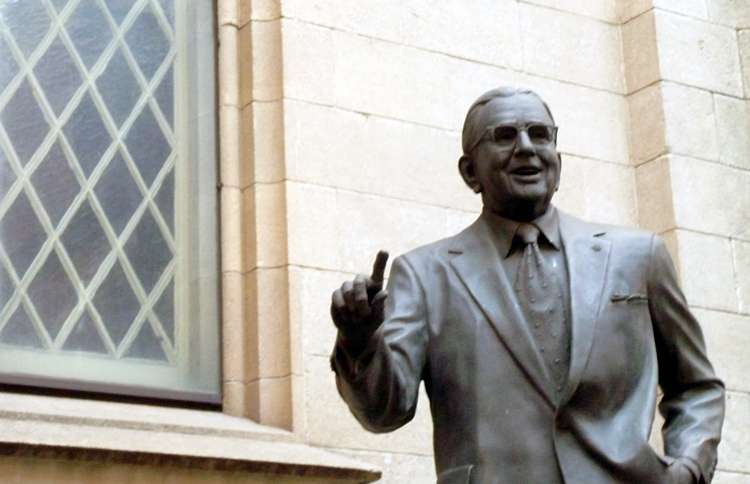
Fifth Avenue, lined with churches, museums and skyscrapers, runs down the spine of Manhattan. Marking the way are some historic statues, from a bronze William Seward in Madison Square Park to General Sherman astride his golden horse at 59 Street. To add to this impressive lineup, we celebrated the hundredth anniversary of Norman Vincent Peale’s birth on May 31, 1998, by erecting a statue of him outside the Fifth Avenue church where he pastored for 52 years.
When he first came to Marble Collegiate in 1932, the city was in the throes of the Great Depression, and the sanctuary was never full. Dr. Peale brought a vision of hope to the city and church, and soon the sidewalk was crowded with people waiting to get inside. Later he became minister to millions on radio and TV, but he never lost that empathy for the people, rich and poor, who came to hear him. I remember him telling me, “Everybody who walks through that door is broken by some sort of pain or sorrow. It is for me to remind them of God’s gifts.”
For 18 years I worked with Dr. Peale on the staff at the church. I enjoyed watching him treat the big city as though it were an Ohio boy’s hometown. He loved taking taxis (cab drivers were often the sources of his best anecdotes) and I don’t think he ever missed a Rotary meeting at the old Roosevelt Hotel when he was in town. He relished being in the ecumenical hub of things, rubbing shoulders with business, political and religious leaders. In 1969, when he invited Bishop Fulton Sheen to speak from Marble’s pulpit, I think it was the first time he had ever spoken at a Protestant church.
“When we meet our Maker,” Peale often used to say, “I think we’re going to have to answer one big question: ‘What did you do with what you were given?’”
Without a doubt, Dr. Peale did the utmost with his gifts, both large and small. I was always touched by his sensitivity to people. Once he apologized to me four times in a day—four separate telephone calls—for a hurt that had been entirely unintentional. When a group of ministers asked him what the most important thing a pastor could do for his congregation was, he stated unequivocably, “Love them, love them, love them.”
That, I think, was the key to his success. He learned to love all the people he dealt with. And so, unlike General Sherman on his horse or William Seward on his bronze pedestal, the statue of Dr. Peale is at street level, on equal footing with the crowds that pass by on Fifth Avenue. There he will stand for the ages, the humblest of men, preaching the Good News.
I sat on the bed in my old room in my parents’ house in Fort Worth, looking at the pictures on the walls, the trophies lining the shelves. Football. It had always been about football. In high school, in college at Baylor, where I’d been a star wide receiver, dreaming of making it big in the NFL. Now those plaques and trophies seemed to taunt me: “You’re a failure. You’re a loser.”
As seen in the August 2019 issue
of Guideposts magazine
I didn’t get picked in the NFL draft. So I’d started out as an undrafted free agent with the Indianapolis Colts. They were fresh off a Super Bowl title—this was 2007. I figured I’d be there to help them get another ring. Peyton Manning and I would be making big plays all over the field. Big plays.
In training camp, I turned heads, balling out. I’m gonna make this team, I told myself. Yet the Colts didn’t play me. “They’re just trying to hide you,” veteran players said. “Keep other teams from signing you.” The Colts cut me instead. I was re-signed to the practice squad, then got cut from that.
That was the first time I holed up in my bedroom. I didn’t want to talk to anybody. I felt humiliated. Since I was a kid, I’d talked about being a star in the NFL. What was I going to say now?
A week later, the Colts called me back to the practice squad. A second chance! Coach Tony Dungy talked about putting me in a Monday night game. Then something went wrong with my knee. I tried to suck it up and play through it. Coach saw me limping and told me there was no way I could be activated if I wasn’t able to go full speed. That was it with the Colts. The next season, the Seattle Seahawks invited me to minicamp. They cut me at the end of the preseason. A week later, they called and said they wanted me to come back. I packed my stuff, rushed to the airport, all ready to board the plane. My phone rang. Seattle again. They’d changed their minds. Another receiver had become available, someone who “fit into their plans” better. Someone better than me.
I got another shot, with the Washington Redskins. I ran my fastest time in the 40-yard dash: 4.3 seconds. Elite speed. The Redskins signed me to the practice squad, but I never played a game. By November, I was—you guessed it—cut.
I still wasn’t ready to face the truth. I tried Arena Football—where the smaller fields of turf laid over concrete were brutal on my body. Then I signed up to play for the United Football League, right before it went belly-up. I went into a spiral: smoking, drinking, partying. I got a woman pregnant. I might have been the son of a preacher, but I wasn’t acting like it.
Around that time, my college roommate Anthony Arline took his life. A Baylor football star like me, he’d also had a short-lived NFL career. Like me, he’d gone into a tailspin when his football dreams ran up against reality.
Was that my fate? Retreating to my old bedroom this time felt like the bitter end of everything. I turned away from the photos of me snagging a touchdown, all the trophies and plaques. They held no positive meaning for me anymore. Only reminders of failure. How was I going to move forward? How was I going to support my son? What kind of role model was I going to be?
I sat and wept bitter tears. God, who am I now without football? Why did you give me this dream just to take it away? I prayed harder than I had ever prayed before. Then it came to me: rehab time. Athletes rehab from all sorts of injuries and setbacks. Wasn’t I also struggling with a setback? A big setback.
I started out by hitting the gym with a dude from church. We’d go there in the middle of the night, when the place was empty. Pumping iron, pounding on the treadmill, holding each other accountable. I needed my friend to watch out for me as I watched out for him. I had to remake myself inside and out. I pored over the Bible. I drove to the mall and hung out at Barnes & Noble, sitting at one of the tables, reading every self-help book and inspirational book that I could get my hands on.
I’d get glimpses of what I needed to do, but you can’t remake yourself all at once. You need to take it in stages. I had to face up to the truth of who I was, not who I imagined myself to be. I made short videos of what I’d learned and posted them online, passing on the advice. RehabTime, I called it.
One of my new rules for living was to thank God at the beginning of each day, before even getting out of bed. Thank God for the life I was given. Thank God for my parents, my son. Set things right.
I was just a former football player, not a preacher, author or media star, but I got a call out of the blue. A guy I knew from Baylor asked me to speak at his church. “Who am I supposed to speak to?” I asked. A bunch of teenagers, he said. How many of them would be there? “Five thousand,” he said. Five thousand for my first speaking engagement! How long was I supposed to talk?
“Five minutes,” he said. Five minutes? It might as well have been five hours. I tried not to freak out. I wrote down all the things I should say. I rehearsed them over and over in my head. But the minute I stepped on stage, my mind went blank. I had no idea how to help these teens. All I could talk about was what I’d been through. I took a deep breath, opened my mouth and spoke from the heart. No notes, no filter. Just me straight up.
Those kids peppered me with questions afterward, hungry for more. I got a huge ovation, bigger than I ever got on the football field. That’s when it hit me: You don’t have to be perfect to help people. All you have to be is real.
My life was coming together. I was working at being a good dad, a good son, a good friend. Without even planning it, I had a whole new calling. I began posting to YouTube every day. The videos took off, getting thousands of views, hundreds of thousands—millions. It was both humbling and awe-inspiring. The comments and questions came pouring in, people asking for advice, help I’d never be able to offer if I were playing on Sunday. Help that came from my own struggles.
One day, I picked up the Bible my mother had given me way back in high school. On the cover was a football with the initials NFL. I’d always thought it was a reference to my football dreams, but then I noticed that the letters also stood for something else: New Found Life. On the first page, Mom had quoted Jeremiah 29:11: “‘For I know the plans I have for you,’ declares the Lord, ‘plans to prosper you and not to harm you, plans to give you hope and a future.’” This was my newfound life.
Trent with his wife, Maria, and their
children, Tristan and Maya
Today I’m happily married with two kids and another on the way. I do a lot of speaking engagements, and every day I post a video and respond to all those questions from people, always trying to be honest, speaking from the heart. Admittedly, trying to keep up with 10 million Facebook followers and 1.6 million on Instagram can be tough. One morning, I woke up and checked my phone before I even got out of bed. Ding, ding, ding, ding. I was being bombarded. How would I ever keep up? I started typing answers. Something on Twitter caught my eye, and I went to retweet it.
Then I stopped myself. What was I doing? Hadn’t I told people that the best way to start the day is with gratitude? Didn’t I believe in doing that myself? No wonder I was so stressed. Physician, heal yourself! Trent, it’s RehabTime.
I put down the phone and went for a hike. There are some great trails near our house. Great for exercise and fresh air. Best of all, my phone doesn’t even work out there. No signal. Nothing to take me away from where I am. I have a new way to start the day now, to protect my peace and to connect with God. I go for a hike first thing. For 45 minutes, nothing else matters. It’s just God and me.
So you see I’m still a work in progress. We all are. There are so many ways to grow; there’s so much to learn and pass along. So much to discover.
Not long ago I was back at that Barnes & Noble, where I used to sit for hours, studying book after book, learning from people who seemed so wise, so full of faith. This time I was sitting in front of a huge stack of books, signing copies. Because this book was my own, The Greatest You, by Trent Shelton. Me, a published author. Who could have ever known? When God says he’ll give you back better than what you lost, believe him.
For more inspiring stories, subscribe to Guidepostsmagazine.
A few years ago, I came across an article about the top five regrets of the dying, based on observations by Australian hospice nurse Bronnie Ware. I emailed the article to my dad. He thanked me for sending it, told me how much he loved it. I didn’t think anything of it–my dad always seems to like my emails.
It was only later that I found out that the article had really struck a chord with him, specifically item number two on Bonnie’s list: “I wish I didn’t work so hard.” It actually convinced him to retire. Something I never thought would happen until he was maybe 92!
Well, it’s been three years and my former workaholic dad absolutely loves retirement. I guess you never really know how God will use you to set a plan into motion, even if it’s for someone else. An email, a kind word, a seemingly insignificant encounter. They can all lead to pretty big things.
Here’s the rest of Bronnie Ware’s list, adapted from her book, The Top Five Regrets of the Dying–A Life Transformed by the Dearly Departing. Which item most resonates with you?
1) I wish I’d had the courage to live a life true to myself, not the life others expected of me.
This was the most common regret of all. When people realize that their life is almost over and look back clearly on it, it is easy to see how many dreams have gone unfulfilled. Most people had not honored even a half of their dreams and had to die knowing that it was due to choices they had made, or not made.
It is very important to try and honor at least some of your dreams along the way. From the moment that you lose your health, it is too late. Health brings a freedom very few realize, until they no longer have it.
2) I wish I didn’t work so hard.
This came from every male patient that I nursed. They missed their children’s youth and their partner’s companionship. Women also spoke of this regret. But as most were from an older generation, many of the female patients had not been breadwinners. All of the men I nursed deeply regretted spending so much of their lives on the treadmill of a work existence.
By simplifying your lifestyle and making conscious choices along the way, it is possible to not need the income that you think you do. And by creating more space in your life, you become happier and more open to new opportunities, ones more suited to your new lifestyle.
3) I wish I’d had the courage to express my feelings.
Many people suppressed their feelings in order to keep peace with others. As a result, they settled for a mediocre existence and never became who they were truly capable of becoming. Many developed illnesses relating to the bitterness and resentment they carried as a result.
We cannot control the reactions of others. However, although people may initially react when you change the way you are by speaking honestly, in the end it raises the relationship to a whole new and healthier level. Either that or it releases the unhealthy relationship from your life. Either way, you win.
4) I wish I had stayed in touch with my friends.
Often they would not truly realise the full benefits of old friends until their dying weeks and it was not always possible to track them down. Many had become so caught up in their own lives that they had let golden friendships slip by over the years. There were many deep regrets about not giving friendships the time and effort that they deserved. Everyone misses their friends when they are dying.
It is common for anyone in a busy lifestyle to let friendships slip. But when you are faced with your approaching death, the physical details of life fall away. People do want to get their financial affairs in order if possible. But it is not money or status that holds the true importance for them. They want to get things in order more for the benefit of those they love. Usually though, they are too ill and weary to ever manage this task. It all comes down to love and relationships in the end. That is all that remains in the final weeks, love and relationships.
5) I wish that I had let myself be happier.
This is a surprisingly common one. Many did not realise until the end that happiness is a choice. They had stayed stuck in old patterns and habits. The so-called ‘comfort’ of familiarity overflowed into their emotions, as well as their physical lives. Fear of change had them pretending to others, and to their selves, that they were content. When deep within, they longed to laugh properly and have silliness in their life again.
When you are on your deathbed, what others think of you is a long way from your mind. How wonderful to be able to let go and smile again, long before you are dying.
Life is a choice. It is YOUR life. Choose consciously, choose wisely, choose honestly. Choose happiness.
Karen Diefendorf always knew she wanted to be a pastor. “I’m told from about the time I was four years old I would say: ‘I want to be a preacher when I grow up.’ Everybody would pat me on the head and laugh—my church didn’t generally ordain women,” she said. “They’d say, ‘Well, she’ll get over that.’ But I never did. I felt a strong sense of calling very early in my life.”
Still, Diefendorf couldn’t have anticipated where her long and varied career would take her. During a 24-year career as an army chaplain, she served all around the world, including a stint at the Pentagon, made history as the army’s first female chaplain paratrooper and racked up some impressive honors, before ultimately being named Director of Training and Development at the U.S. Army Chaplain Center.
Today, instead of settling into retirement, Diefendorf serves as Director of Chaplain Services for Tyson Foods. “God keeps presenting these opportunities to me,” she says. Diefendorf talks to us about her life, career and how she finds gratitude each and every day.
GP: After growing up in your small Indiana town you headed directly to seminary?
KD: Yes. I went to Lincoln Christian College and Seminary (now Lincoln Christian University) in Lincoln, Illinois. My father really wanted me to go to Indiana University to do prelaw, but I knew within the first three days of being on campus that this was exactly where I was supposed to be.
GP: What happened after seminary?
KD: I ended up at a local United Methodist Church. I started as a part-time youth minister and ended up staying more than ten years before moving to another small church as their pastor. It was a great opportunity to get to preach full-time.
GP: When you entered active-duty army life in 1986, you were married with two young daughters. Did your family move around with you?
KD: Yes. A lot of people didn’t know what to do with a male army spouse at that point. Walt [her husband] was a trailblazer. He had to take care of our kids and figure it out. I give him a lot of credit.
GP: Where were you stationed throughout your career—and did you have a favorite place?
KD: Let’s see, we were in Fort Benning in Georgia; four years in Hawaii—our son was born there, then New Jersey. I spent a year at Yale University getting a Masters in Ethics, there was four years in Korea and two years at the Pentagon. A couple others, too. A favorite? No. It’s about the people you serve with. There was something unique about every single place we lived.
GP: How did the paratrooper gig come about?
KD: I was assigned to be chaplain at airborne school at Fort Benning. My ministry would have been a lot less effective if I wasn’t jump qualified.
GP: Were you scared?
KD: I think if you aren’t afraid you are going to get yourself hurt. The adrenaline certainly goes up every time that door opens on the aircraft. But you learn to trust the training. You always knew Chapel on Sunday was going to be packed before the first jump on Monday afternoon.
Tyson Foods Director of
Chaplain Services, Karen
Diefendorf
GP: After the army you worked as a hospice chaplain before heading to Tyson?
KD: Yes, my husband and I had decided to settle in South Carolina. There is a small Tyson plant there and I provided chaplain support six to 15 hours a week. Then, the director position in Arkansas opened up. But my husband had just built his 3-car man cave garage—and I thought, why would he ever leave. But he said, “let’s go.” That’s why I knew God had his hand in this. I felt very clearly that God was asking me to take on this responsibility.
GP: Now you oversee about 100 chaplains in 25 states. Tell us about the scope of the job.
KD: There are a few chaplains in the corporate headquarters, but the majority are at our 140 or so plants, seeing people one on one. Our team members rely on their chaplains to help them cope with life. I’ve taught our chaplains to ask two questions. One: tell me how your beliefs help you cope with what you are going through. That gives an insight into how people think. I also ask them: tell me how your beliefs are not helping you right now. One thing I’ve learned is that when crises happen there is often a crisis of faith.
GP: Has counseling during Covid been a challenge?
KD: Oh yes, but I’m so impressed with our chaplains. Those in the plants, have had to wrestle their own fears to the ground and say: “my people need me…” They’ve done an awesome job of helping our team members have confidence; I’m really grateful.
GP: How do you maintain gratitude during tough times?
KD: Gratitude is a pillar of my faith. But it always begins with the fact that I trust that whatever comes, God is a redeemer. If I believe that whatever comes to me—as cruddy as it may be—that God can make it work for my good, then there is a joyful component. There is a deep sense of confidence in me that this too shall pass.
God has a way of making things work for our good. My job is to open my eyes and watch him do it. When I walk into worship—whether that is on a Zoom platform or in person in a sanctuary somewhere—I have something to be worshipful about. I’ve gotten to see what God has done. To me, that’s a humbling experience.
That Saturday morning last April I had butterflies, waiting for some special guests to arrive.
A month earlier I’d found out that I won the New Year, New You contest. Even though the people at Guideposts said I’d been chosen because I showed the most promise of all the entrants, I couldn’t quite believe it.
Community Newsletter
Get More Inspiration Delivered to Your Inbox
My self-esteem was at an all-time low, my weight was at an all-time high and I certainly didn’t feel like a winner.
Any minute now the Guideposts Dream Team of lifestyle change coaches would be knocking at my door.
I’d seen their photos in my January 2009 issue, and I could picture the four of them charging into my house, ready for their mission, which, as the contest announcement put it, was “to develop a personalized healthy living plan” for me. Lord knows, I prayed for it and needed it!
It wasn’t that I wasn’t grateful for the many blessings in my life. My marriage to my high school sweetheart, Greg, still going strong after 25 years; our two wonderful sons, K.C. and Chris; the dream house we were building; my hard-earned college degree (I’d gone back to school at 36 and graduated at 40); my job as a sixth-grade teacher; my extended family, numerous friends and a terrific church family.
But I had plenty of problems too. My weight had been an issue since childhood, and it was a major factor in my health problems—foot and back pain (exacerbated by being on my feet all day teaching), pre-hypertension and pre-diabetes.
I was only 42, much too young to be having so many physical issues. I knew I needed to get healthier, but where would I even start? After all, I’d tried nearly every diet out there.
Physical fitness—or lack thereof—was another issue. Before the contest, I’d tried once again to get into shape by walking. I could barely walk a mile at first.
I’d reared two athletic sons, soccer players who ran up and down the field, and I yearned to be able to run with them.
But after a long day at school and helping out with activities like the children’s group at church, I was done. I had to decline when my coworker Dianne invited me to work out with her after school.
Yet the problem I struggled with most was my negative thinking. It was at the root of all my other issues. Even with so many blessings in my life, I often felt like the world was crashing down on me.
It was as if all the insults that had been leveled at me about my weight over the years had eaten away at my soul. I doubted my willpower, even doubted my faith was strong enough to make the changes in my life I knew I had to make.
At last a car pulled into the drive. I flung open the door. The Dream Team was here! There was a flurry of hugs and introductions.
I recognized them all—Theresa Rowe, fitness expert; Kevin Carroll, motivational speaker; Rebecca Katz, chef and nutritionist; Julie Hadden, my favorite contestant from The Biggest Loser.
Someone—I think it was Kevin—said, “Tammie, are you ready to change your life?”
“I’m ready!” Time for the Dream Team to get to work.
Rebecca took on a huge challenge: teaching me how to buy and cook healthy food. She almost fainted when she looked in my pantry. I don’t think she’d ever seen so many boxes of Hamburger Helper outside of a grocery store.
She showed me how to read food labels, so I’d know the nutritional content and the stuff to stay away from, like high-fructose corn syrup and partially hydrogenated oils.
Cut out processed and fried foods, she said, and ramp up the fruits and vegetables. But what would I feed Greg and the boys? They weren’t big on vegetables.
“I’m just trying to cook what they like,” I explained. Rebecca wasn’t having it.
“If you want to change, you can’t fall back on what you’ve always done. You need to make conscious choices,” she said. “It won’t kill your family to get off the fried stuff. Eating healthier will help all of you live longer. That’s what you want for those you love, right?”
Of course! I just hadn’t thought of it like that.
Kevin’s known as Mr. Positivity, and I could see why. He exudes positive energy.
“It’s great that you want to make lifestyle changes. You’ve gotta aim high,” Kevin said. “The way to reach a big goal is to set smaller goals leading up to it. Achieve one goal, then go for the next. When you reach a goal, reward yourself. But not with food.”
He suggested going to a movie with Greg or taking a break from housework and spending some quiet time with God. What really got me was that Kevin said when I reach a goal. Not if, when.
I was intimidated by Theresa at first. She’s in fantastic shape and serious about fitness. I thought she would be like those scary, in-your-face trainers I’d seen on TV, but she turned out to be deeply spiritual—a soul trainer.
When I admitted I hated to exercise, Theresa wasn’t fazed. “Don’t think of it as a chore. Think of it as a time to be with the Lord and to praise him,” she said. “Say you’re power walking. Look around at all the Lord has created and give thanks.” Exercise as a form of prayer? Now that I could relate to!
I felt like I knew Julie already from watching The Biggest Loser and reading her cover story in Guideposts last January. In person, she’s even more inspiring.
She gave me lots of tips, like keeping a journal to record every calorie I put in my mouth as well as every calorie I burned. And asking myself why I’m reaching for food: “Am I really hungry? Or am I bored? Upset? Stressed?”
The most important lesson Julie taught me had nothing to do with eating or exercise, and everything to do with my emotional and spiritual well-being.
That afternoon a photographer came to take pictures of me in front of our azaleas. “I hope you have your wide-angle lens,” I joked.
Julie pounced on me like a dog on a June bug. “Do you realize what you do to your mindset when you say things like that, Tammie? You’ve got to cut that out. Now I want you to say, ‘I am worthy of this opportunity.’”
I opened my mouth but I couldn’t get the words out. Tears sprang to my eyes. I hadn’t felt worthy of anything for so long. In fact, I’d lived my life feeling just the opposite. “Say it, Tammie.”
It took me a few tries but I finally got it out: “I am worthy.” Whoa. I could feel myself standing taller, facing the world with more confidence. Who knew three simple words could be so powerful?
It was an intense weekend. Sunday evening my Dream Team coaches went home. They’d be in touch regularly, but now it was up to me to put all the good information they’d given me into practice.
First, I found a workout partner. Like Theresa advised, I chose someone who liked to exercise every day, so her commitment would strengthen mine: Dianne.
I joined the gym and met her there every day after school. I set my first small goal: running a mile. Dianne cheered me on from the next treadmill, “Just one more minute, Tammie. You can do anything for a minute!” The day I ran my first mile, I don’t know who cried harder, Dianne or me.
Next challenge: eating healthy. It certainly took a lot longer to shop when I read the labels. But choosing fruits, vegetables and lean protein was worth it. I’m worth it, I reminded myself.
My men were taken aback when I declared our kitchen a no-fry zone, but they got into it once they realized food that’s good for them could still taste good.
Regular exercise worked wonders. I had the energy to keep up with the kids at church even after a long day at school. I increased the distance I ran to three miles. Then I set another goal: running a 5K.
Chris decided he’d do the race with me, so we trained together over the summer. He ran figure eights around me, that smart aleck, but what a joy it was to be working out with my son!
Of course, obstacles cropped up—the pizza party for my mom’s birthday, trips out of town, those five weeks when I hit a plateau and didn’t lose an ounce. But I drew on the support of the Dream Team, my family and friends, and powered through.
Most of all, I drew on my faith. It struck me that all those excuses I used to make—I’m just meant to be big, I’m too tired to exercise, my guys won’t go for vegetables—were a form of negative thinking. A way of telling myself “I can’t” when God was trying to show me I can.
As Dianne pointed out when I got down on myself, “You graduated college with a 4.0 GPA while working full-time. You accomplished that; you can accomplish anything you set your mind to.”
Like that 5K. I ran all the way to the finish line. When I told my class, one of the kids, bless his heart, said, “Awesome! Mrs. Temple, you should try out to be a Dallas Cowboy cheerleader!” That’s not my next goal, but I sure like that line of thinking.
It reminds me of one of my favorite Scriptures, from Hebrews: “Let us lay aside every weight…and let us run with endurance the race set before us looking unto Jesus, the author and finisher of our faith.”
A year ago I never would’ve dreamed I’d be able to get healthy, lose more than 60 pounds or run five miles (that’s what I’m up to now). Just goes to show what’s possible when you set aside the weight of your negative thinking and see the potential God sees in you!
The dictionary definition of a “habit” describes a behavior that’s routine, settled, and often done subconsciously. You might not even notice it in your everyday life.
Psychology tells us that new routines take a long time to adopt—and possibly even longer to break. Two months of consistent investment in new behavior is just the starting place to ensure a sustainable, fully integrated habit.
This is a time of year to get excited about launching new behaviors, breaking old ones, and giving our lives a general refresh. But knowing what’s involved with making changes, it’s smart and healthy to pause and review what we’re currently doing on a daily basis.
If habits are mostly subconscious, after all, who’s to say we won’t be reinventing the wheel by committing to new ones? Here’s how to start an inventory.
Give Yourself a Few Days
Plan on 2-4 days that are examples of your typical routine, and grab a notebook or open an electronic document to track your habits. A single thought-scan of your day isn’t enough to identify repeat behaviors, or notice the subtleties of habits that aren’t obvious at first glance.
Wake-up, mealtimes, work routines, evening patterns, and bedtime are spaces we move through each and every day. Start there. Note behaviors you notice, like whether you get up from your desk every hour to re-fill your water bottle or grab a snack. Don’t judge or evaluate your habits, just list them.
Look at your habits. Do they have something in common? Do you see categories of behavior, like responses to stressors, or managing energy fluctuations, or keeping track of complex schedules? Reflect on your behaviors with an eye toward what is serving your positive, inspired life—and what you want and need to release or replace.
This exercise will give you solid ground from which to launch new healthy habits in this new season. After all, when you have a clear vision of where you are, you can more easily step toward the place you want to be.
How clear a picture do you think you have of your current habits?
After 47 years working in healthcare administration, and 15 years of being retired, Dr. Judy Ryan has had ample opportunity to reflect on the ways retirement changed her life.
If you’re getting ready to retire, Judy has seven questions to help you prepare.
1. What concept guides your life?
Turning to scripture helped Judy, a former president and CEO of The Evangelical Lutheran Good Samaritan Society, reflect on what it means to make life-changing decisions. The word “kavod” helped her wrestle with the impact of leaving her career.
“Kavod means something like wisdom, but heavy — the capacity to think about this world and the next, and to make life decisions based on that process of moving from this world to the next,” Judy says. “It is closely related to the idea of a discerning heart. It is both noun and verb, a dialogue with God.”
2. Do you have time to be creative?
For Judy, work in medical policy and advocacy kept her from artistic endeavors. During retirement in Key West, Florida, she began to paint.
3. Have you found a vibrant retirement community?
Think about home maintenance and medical care. But also look for a place that offers things like group activities, outings, and a spiritual community that inspires you.
4. Have you found services for older adults in your community?
Judy and her husband, Rocky, planned financially for retirement, but not everyone has that luxury. If you don’t feel financially secure, look into free and low-cost services in your area. Meals on Wheels and Senior Companions are two programs that can enhance your well-being on a budget.
5. Are you compassionate with others?
This could mean visiting residents in a nursing home, or spending time listening to people with views that differ from yours.
6. Do you have a spiritual focus in your life?
“Having some concept of God absolutely directs the way I live my life,” Judy says. “Find your own faith experience that allows you to experience that.”
7. How can you remain involved in things you’re passionate about?
Themes of advocacy, care and education all came up over and over throughout Judy’s life, so she felt called to keep working on those areas of her life in retirement.
For you, personal interests and skills might lead you to volunteer in a career field that was important to you, serve as a mentor or pass along life stories to your family members.
No matter how you spend your time, Judy’s got one bit of healthcare advice for you:
“Don’t take yourself so seriously,” she says. “Laughter is good medicine. It just plain is.”
Most people are just starting adult life in their twenties. I feel as if I have lived a lifetime already.
I took my first drink when I was 14. I was an alcoholic before I graduated high school. I was kicked out of one college and dropped out of another. Along the way, I got arrested for public intoxication and driving under the influence. Four months after the DUI, I was fired from my job at a fast-food restaurant. I was close to broke. My parents had run out of ideas for trying to help me.
I was 21. Alcohol had crippled my life before I was old enough to drink legally.
How did I sink so low so fast? How did I climb back up?
I hear those questions a lot in my current job as an administrator at a sober living facility in Austin, Texas, called Alpha 180, which specializes in people like me: young adults whose lives were being wrecked by drugs or alcohol.
The residents of Alpha 180 come from many backgrounds. We all have one thing in common: We once thought of drugs and alcohol as harmless rites of passage for teens and young adults.
We found out the hard way that, for people prone to addiction, the real rite of passage is learning to live an adult life without the crutch of intoxication. It’s a lesson I wish I’d learned a long time ago. I’m grateful that in my new life and my work, helping people like me, I’m getting to grow up at last.
There’s no obvious reason why I became an alcoholic. I grew up in a stable, happy family with loving parents. Dad was an accountant. Mom stayed home with me and my younger sister, Sara. Church was a big part of our lives. I went to a small Christian private school.
Despite all those good things, I somehow became convinced that drinking was a sign of grown-up sophistication. In middle school, I had a vague sense that somewhere out there all the cool kids were drinking and having a great time. I wanted in on that.
One day, I reached into my parents’ liquor cabinet and pulled out a bottle of vodka. My parents hardly ever drank. Mostly the small cabinet in the living room stayed shut.
I uncapped the vodka bottle and took a sip. Disgusting! I choked and nearly spit it out.
And yet, at the same time, I tasted liberation in that vodka. Freedom from my 14-year-old insecurities. Access to that cool grown-up life I’d envisioned. I took another drink and another until I was buzzed. That feeling I liked a lot. I hit the liquor cabinet more times before discovering there really were cool (to me) kids at school who drank. Soon I was partying with them. A few kids’ parents didn’t seem to care what we did, so we drank at their house.
My own parents were clueless. Once, they caught me coming home with alcohol on my breath, but I swore it was my first time and promised it would never happen again. They grounded me, but that was all. I kept up with school and other activities, so no one suspected anything.
My problem with alcohol worsened during college. Dramatically. Unsupervised, I drank whenever I wanted. That grown-up life I’d envisioned, surrounded by all the cool people with drinks in their hands? The reality was me sitting alone in my dorm every day, getting wasted and sending drunk text messages to my friends. Really cool, right?
One of those texts got me kicked out of school. I texted something nasty and threatening about a professor, and the text wound up with campus police.
A few hours later, officers were pounding on my door. I was arrested for threatening a faculty member. I couldn’t even remember what I’d written. Administrators told me I could leave the school or face charges. I left.
My parents were stunned but tried to be supportive. They let me live at home while I applied to a new college, Texas A&M. I kept things together until I started school. Then it was back to daily drinking.
I lasted less than a year at Texas A&M. Late one night, I came reeling out of a bar and got arrested for public intoxication. Ten months later, while driving drunk to meet some friends, I blasted through a small town at highway speed and got pulled over. I failed a sobriety test and went to jail.
My parents found an outpatient rehab program. I attended halfheartedly for a week before relapsing. Part of the problem was that most of the other people in the program were older than I was. I convinced myself they were the real alcoholics. I was just a college kid who liked to party.
I can handle this, I told myself. I’d snap out of it after growing up a little—graduating, getting married, landing a great job.
The job I got? Behind the counter at Chik-fil-A.
By this point, I was desperate to stop drinking. I knew I was headed off a cliff.
The cliff came four months later, when Chik-fil-A fired me for coming to work drunk with a bottle of liquor in my pocket.
Why did I do it? Especially when I knew alcohol was wrecking my future? I drank for the same reason all alcoholics drink. Because I was physically addicted and thought drinking would help me cope with the shame of living an alcoholic life. That’s what people in recovery call alcohol-brain. It culminates in shame-based drinking.
I went back to La Hacienda, the rehab facility I’d dropped out of.
“I’m wondering if you take people back,” I asked the woman at the intake desk. I braced myself for a curt no.
“Of course we do,” she said. “It’s great to see you, Ross. Welcome back.”
I was floored. Standing there at the desk I told her everything—how I’d returned to drinking a week into the program, then gotten fired from my job. My voice was heavy with defeat.
Matter-of-factly, the woman told me about La Hacienda’s four-week residential program in a small town about 200 miles from Texas A&M (not far by Texas standards). I decided right there that’s what I wanted.
“We’ve been praying so hard for you,” Mom said when I told her I was going to a treatment center.
Part of me wanted to say, “God doesn’t seem to be answering those prayers.” But that didn’t seem like the right attitude to start recovery.
La Hacienda combines the Alcoholics Anonymous 12-step program with lots of support from treatment professionals—doctors, therapists, nurses—and other participants.
Determined to succeed, I blazed through AA’s steps one and two, admitting I was powerless over alcohol and that only a power greater than me could stop my drinking.
Then came step three: “We made a decision to turn our will and our lives over to the care of God as we understood him.”
What did that mean? I’d grown up in church. Hadn’t I already done that? If praying to God could stop alcoholism, I’d have been sober a long time ago.
“I don’t get this one,” I confided to a therapist.
“It’s not complicated,” he said. “You just have to be willing to do things you know are good for you even if you don’t really want to do them. Trust God to know what’s best and follow his lead.”
Do things you know are good for you even if you don’t really want to do them.
From the moment I took that first drink from my parents’ liquor cabinet, I’d been running away from this simple definition of growing up. I crawled inside a bottle and hid from the complicated emotions and difficult responsibilities of transitioning to adulthood.
“I’m tired of doing this alone,” I said to God. “Help me. I’ll do what it takes, no matter how hard.”
I graduated from La Hacienda, sober but still ashamed and unsure of how to live an actual adult life.
Together with two La Hacienda friends, I moved into a sober living house in Austin. While there I happened to attend an AA meeting at another sober living facility called Alpha 180.
It was a revelation. Everyone in the room was my age. Their stories were my story—underage partying leads to solo drinking leads to train wreck.
“I’m so ashamed,” one person after another said. “I feel like I let everyone in my life down. I want a different future.”
I didn’t know what my own future held, but I felt certain these meetings would help me figure it out. I spent so much time at Alpha 180, the director eventually invited me to apply to become a house manager, overseeing the living quarters and assisting with programming.
Alpha 180 helps residents become responsible adults by mixing service and accountability with opportunities to blow off steam. The house is deliberately located close to the University of Texas campus, in a part of Austin known for drunken parties.
The mission is to be a beacon of sobriety in a place dominated by the idea I once believed—that drinking and drugs are a shortcut to adulthood. We have fun—paintball fights, outings to movies and concerts. But we’re also collectively responsible for running the house, and we’re not afraid to be honest and vulnerable with one another.
I’m still growing up. I recently reenrolled in school, and I’m taking on new responsibilities at Alpha 180, writing for the house’s website and mentoring younger residents.
I’m excited about the future and no longer ashamed. I don’t have to drink to feel grown-up. I’ve been through a rite of passage requiring more change and growth than alcohol’s false promise.
I gave in and let God lead. I accepted the challenge of doing what’s right, even when I don’t want to. I encourage every young addict to embrace those life-giving marks of true sobriety. Of true adulthood.
One of the joys of hiking is spotting the wildlife around you. Do you know how to keep yourself safe while also respecting wild animals and their habitats? “For all wildlife,” says Leslie T. Sharpe, author of The Quarry Fox: And Other Critters of the Wild Catskills, “the first line of protection is to not startle or surprise them. It’s best to always watch ahead, and make some kind of noise so that they can hear you coming.” Here’s what to do if you encounter these animals out on the trail.
Black Bears
If you see a black bear ahead, keep your distance. This will allow the animal to carry on with its routine. If the bear spots you, don’t look it in the eye, Sharpe warns. “This is interpreted as a challenge.” Jessica Williams of Seattle, who hikes with her dachshunds, says it’s best to remain calm. “Unlike with a grizzly, avoid making yourself look threatening to a black bear. Instead, slowly back away. Don’t run, and never turn your back to the bear.”
If you’re worried bears might be nearby, keep them at bay by singing, clapping and banging sticks. Bear bells, whistles and alarms may also work. Carry bear spray and make sure you’re trained in how to use it.
Grizzly Bears
Grizzlies are a different story. They will try to intimidate you by false charging, Sharpe says. “Stand your ground, spread your jacket over your head and make yourself as big and tall as possible. If attacked, try to punch the bear in the nose. If it knocks you down, lie on your tummy, cover the back of your neck with your hands and don’t move. Hopefully, it won’t be hungry.”
Snakes
Even nonvenomous snakes can bite, so it’s best to give them a wide berth and wear leather boots to protect your feet. If you meet a rattlesnake, stay still and give it time to calm down, then back away.
If you’re planning to hike with dogs in rattlesnake territory, Amy Burkert of the travel website Go Pet Friendly recommends rattlesnake aversion training for the dogs, typically a six-week class to learn scent identification and an escape response.
Coyotes and Cougars
Never run or act like prey if you come across a coyote or a cougar. “Yell, wave your arms and maintain eye contact,” says avid hiker Kristine Tonks of Edmonton, Canada. If the animal is aggressive, throw your backpack in its direction.
Moose
Spot a moose? Don’t panic. These herbivores aren’t interested in you as prey. But if they begin to charge, run and hide. They can seriously maim with their powerful hooves.
Mountain Goats
Williams notes that encounters with aggressive mountain goats have prompted the closure of certain trails in Washington State. “Stay at least 50 yards away from a mountain goat,” she advises. “If a goat looks threatening, back away and yell to scare it.”
Alligators
Be alert for alligators when hiking along a waterway. Pamela Webster of Ithaca, New York, travels by sailboat with her husband and golden retriever. Her advice: “Never wade, or allow your dog to wade, in fresh or brackish water where alligators are likely to appear.” Especially at dawn and dusk, when gators are most active.
Being prepared and knowing how to react in these situations is key. Understanding how to protect wildlife while you’re in their territory is important too.
While you may be eager to snap a picture, do not encroach on an animal’s space. Your presence could jeopardize its ability to remain safe from a predator.
Consider keeping your dog on a leash. According to Parks Canada, off-leash dogs may chase wild animals or cause them to feel threatened, and are one of the leading causes of wild animal attacks.
Never come between a wild animal and its young. Parental instinct will kick in and prompt an attack.
Never feed wild animals, no matter how cute they look. Nonnative food may harm them, and feeding them might lead to frequent encounters, which could be dangerous.
Did you enjoy this story? Subscribe to All Creatures magazine.
We all have self-talk affirmations that help us stay uplifted and positive. From “I am beautiful” to “I am good at what I do” to “I matter to the people in my life,” these mantra-like phrases are a helpful part of the routine of positive emotional hygiene.
However, positive self-talk isn’t always enough to sustain an upbeat outlook, particularly during a challenging time in life. Particularly for people who suffer from low self-esteem, depression or anxiety, telling yourself everything is going to be ok can feel hollow and inadequate.
According to Melody Wilding, a social worker who has researched happiness and human behavior, positive affirmations work at the level of your consciousness that’s closest to the surface. As she writes in Forbes, these statements “do nothing to contend with the subconscious mind where limiting beliefs really live.”
The first step toward sustainable positivity, Wilding says, is to give yourself permission to feel your feelings—all of them. That includes acknowledging that a stressful interaction at work left you feeling angry, a medical test triggered feelings of worry or a calendar slip-up has you feeling disappointed in yourself.
Wilding recommends a technique called “re-framing” to shift how your mind reacts to those negative feelings. She writes, “You might re-work your self-talk to sound more like, ‘I am a work in progress, and that’s okay.’ It’s pointing you in the direction of positive growth and is both realistic and achievable.”
This advice came to me at just the right time. I am having one of those days where I feel like I am doing too many things—and doing too few of them well. So I put Wilding’s technique to the test, first acknowledging, “I am feeling overwhelmed and unfocused.” Then I created a re-frame: “I am proud that I have accomplished some things today. I am doing my best, and my best is enough.”
Can you re-frame negative self-talk to have a more positive outlook today?
Life is more complex than any family drama from the golden age of television may have had us believe. When mom, dad and the kids faced a sticky problem, they generally had it neatly resolved within the running time of that week’s episode—and pass the mashed potatoes.
Actual family dynamics tend to make problem-solving far dicier. When the real-life issue is an older parent who needs care, it can be especially difficult to reach a consensus of all involved. Maybe the bulk of the caregiving has fallen to the oldest daughter who has very specific ideas on the way forward but can’t seem to bring her siblings on board. The middle child always seems to be too busy with kids and a job to pitch in or come up with solutions. The “golden child” just talked to Dad, who said everything was fine and not to worry. Resentments are starting to boil over and any possible plan seems to have stalled at idle. Someone reluctantly proposes a family meeting. Now what?
Unwelcome as they may be, family meetings can be an invaluable method of working through problems and reaching good solutions. The process allows every family member to air thoughts and concerns and in doing so, to hear one another out. Holding a focused conversation in the service of a parent who needs attention can do much to clear up misinformation, and to prepare the best possible way forward. Here are some tips to plan for and carry out successful family meetings:
Preparing for the meeting
Planning ahead for a family meeting is as important as the actual meeting. First consider why it is you’re meeting. The logistics of bringing everyone together means coordinating schedules, but if the reason for the discussion is especially pressing—for example, your father is declining and your mother needs immediate assistance—then coordinating schedules, while challenging, is necessary.
If you do have to arrange a family meeting to discuss the care of a parent, it can be helpful to:
Keep to one or two topics. Decide on the most pressing issue(s) so that everyone has a clear focus for the conversation. It’s a good idea to include these topics in the meeting invitation you send to your family members.
Time and place. Zoom, Microsoft Teams and other platforms can make it easier to gather individuals who live far apart. Choose a date and time that works for most of the participants.
Decide beforehand which family members will be asked to provide input and which of them will have a deciding voice. (For example, you might want all adult children and their significant others to participate in the meeting, but only the adults in the nuclear family to have a part in decision-making).
Encourage participants to come armed with relevant information. Examples might include physician visit summaries, observations and financial documents.
The meeting itself
Before the meeting begins, you may want to establish some ground rules like letting participants finish talking without interruption and refraining from side discussions. If a participant introduces a topic that wasn’t on the agenda, gently remind everyone what the meeting is about. It may also help to complete discussion of the first topic before going on to the second topic.
Hold to facts rather than feelings. Your parent may want to remain in his or her own home, but safety factors, ongoing oversight or worsening physical and emotional conditions may be deemed more weighty. It’s important to have as much information as possible on your parent’s condition or illness, as well as on how to access relevant community resources. Don’t shy away from discussing how to pay for necessary services and possible resources at your disposal, like IRAs, stocks, additional assets, etc.
Remember who this meeting is about. Respect your parent’s beliefs and values when making any decisions. If at all possible, involve your parent in the discussion and decision-making process. It is easier to exclude a person rather than asking them to leave if the topic becomes upsetting. Rely on documents such as Power of Attorney for Healthcare, Power of Attorney for Financial and Living Wills that have the wishes of your loved one already in place.
Moving forward
After everyone has aired their thoughts and concerns, work on a plan to move forward. Try to be specific about the steps you need to take and, if it’s feasible, draw up a timeline to complete them. Rather than assigning tasks, invite family members to offer to help in the ways they choose. Keep each person’s talents and strengths in mind:
“Caroline, you’re good at gathering information. Could you please reach out to the four health care agencies we discussed to find out what our first steps should be?”
“James, you do a great job maintaining your house, Could you please do an outside inspection of Dad’s home and figure out what we need to work on to get it into shape?”
All families have their own unique issues, which impact how each individual relates to the others. This, of course, includes lifelong relationships with their parents. Remind everyone that the purpose of this meeting is to protect the well-being of your parent. It’s not about repairing old disagreements or perceived injustices. At the same time, it does provide the opportunity to redirect expectations and outcomes as a team. Communicate with “I” statements (I feel…, I need…). Even when you’re not all on the same page, look for the one truth you can agree upon.
You may also want to involve a moderator in the family meeting to maintain the focus, solicit feedback from all the family members and assist in determining how to move forward. Social workers, ministers and Care Consultants are all good options. Often, family meetings arise out of a crisis and arriving at your next steps can be of the essence. A moderator can help you figure out what you need to do right away, as well as offer ideas on further steps you might not have considered. This person may also have valuable experience to share about how to access community programs and other resources.
The nitty-gritty comes after the meeting, as each person begins to take constructive steps. The moderator can be a great asset, guiding you to work through any obstacles that arise, providing positive reinforcement and serving as a touchstone for the entire team. The good news is that once you’ve established a spirit of cooperation and collaboration, the next family meetings should be far less daunting.
Navigating the passage to adulthood with health and sobriety can feel like a challenge for teens and their families. Many people assume alcohol and drugs are a harmless, or at least universal, rite of passage.
In fact, research shows that alcohol and drugs can seriously damage young people’s brains. Chemicals in alcohol and drugs alter brain development and increase the likelihood of developing a substance use disorder. People who start drinking before age 15 are four times more likely to develop a substance use disorder.
Teens often assume everyone in their peer group or school uses drugs or alcohol. Research shows the opposite. Fewer than 30 percent of all American teens report drinking alcohol even once a month. Substance use seems widespread because it gets a lot of attention in popular culture and on social media. Most kids, though, don’t drink or take drugs.
The best way to prevent teen substance abuse is to maintain strong family bonds, set clear expectations and educate kids about the harmful effects of drugs and alcohol.
Signs of a possible substance use problem include sudden changes in a teen’s friends, grades, activities or attitude. Parents who suspect a problem should not assume they can handle things themselves. Seek advice from school counselors, treatment professionals or trusted online sources. Established treatment organizations such as Caron feature a range of educational materials on their websites.
The transition to college and the freedoms it allows can be challenging for young adults. Some students, especially those who were already using in high school, may find that their substance use increases and so do the consequences.
Behaviors such as drinking to the point of blackout or memory loss, drinking heavily on a regular basis, or drinking or using drugs while alone are red flags for college students and their families.
As with teens, college students can help themselves stay sober by surrounding themselves with sober friends, staying focused on schoolwork and getting involved in campus or community organizations.
Research shows that it’s neither normal nor healthy for teens or young adults to drink or use drugs. Sobriety is an important—and eminently achievable—part of the transition to adulthood.
Christine Storm
Regional Director of Education,
Caron Treatment Centers