Embrace God's truth with our new book, The Lies that Bind

When Plans Fail

Have you ever had a plan that didn’t pan out the way you expected? Over the holidays my wife and I helped my son move to Michigan for a new job. I planned to get a good night’s rest so that I could drive the first five hours, and he could drive the last.

I got to bed on time but woke up at three in the morning and couldn’t get back to sleep. I eventually decided to stay up and begin our drive. I had every intention of completing my shift. My plan was simple and feasible–at least I thought so. 

Light for Life NASB Study Bible in Article

Shortly into the trip my eyelids grew heavy, and I realized that my plan wouldn’t hold up. I gave the wheel to my son who took control and got us safely to our destination.

Read More: Join Us for the ‘Power to Overcome’ Day of Prayer

This reminds me how often my plans take a back seat to God’s purpose for my life. It is not to say that I don’t plan, but things don’t always pan out the way I expected.

For example, this week I celebrate 14 years at Guideposts. When I started here, my plan was to stay for two years and then proceed to be a pastor in New York City. God had other plans.

Two years ago my son Paul purchased an apartment in a very trendy neighborhood with the thought of staying there for several years. But God had a different plan for him too. 

There is a proverb that says, “You can make many plans, but the Lord’s purpose will prevail.” Another translation states, “We humans keep brainstorming plans, but God’s purpose prevails.”

It’s only natural to make plans and set goals for the New Year. This is my practice as well. But my plans and God’s purpose for me don’t always align, and I’m glad they don’t. God’s purpose is always better.

As you make your plans for the New Year, keep an open heart to God’s purpose. We don’t always know how, why and when it will unfold, but God’s purpose always prevails. Why are God’s plans always better than our own? Please share with us.  

Lord, in the New Year let Your purpose prevail in our lives. 

When Life Gets Tough

Are there times when you are troubled on the inside, but appear fine on the outside? Recently, while attending an event, a US Army chaplain shared her story about returning home from her second deployment in Iraq. Shortly after returning to her military base in Germany, she realized that her family wasn’t there to greet her. She understood it was an expensive and long trip, but it still hurt.

When home, it hit hard, and she began to cry. This was the beginning of a dark time for her. She had never felt so alone. On the outside she looked perfectly normal, but inside she was faced with loneliness and sorrow.

Witnessing Heaven In Article Ad 827x123

Everyday people are faced with troubles but must continue to work, care for loved ones and fulfill their life obligations without showing external signs of their inner struggles. At such times, people ask them why can’t they get it together or why are they still holding onto their struggles?

When life seems to be working against us, how can we get through these difficult times? When asked to lead the funeral service for her uncle, a World War II veteran, one chaplain unexpectedly began her path to healing. As she brought comfort to others and lead a service for someone she had loved, she herself began to feel whole again.

We don’t know how and when we will get though our dark and troubled times, but there are things we must continue to do:

  • Maintain our trust in the source of hope…God.
     
  • Pray through our challenges.
     
  • Keep the Word of God close to our hearts. Remember His promise, “I will never forsake you.”
     
  • Express our feelings, especially to trusted friends.
     
  • Celebrate small moments and good days.

One of my favorite texts is from the book of Lamentations, “The thought of my pain, my homelessness, is bitter poison. I think of it constantly, and my spirit is depressed. Yet hope returns when I remember this one thing: The Lord’s unfailing love and mercy still continue, fresh as the morning, as sure as the sunrise.”

I also think of the Rev. Robert H. Schuler’s words, “Tough times never last, but tough people do.”

When life gets tough, let us remember God’s faithfulness, love and mercy.

How have you overcome life’s toughest problems? What keeps you going when life gets rough? Please share with us.

When It Pays to Wait

It had been a long business trip. I was tired and ready to get home. We’d already had multiple flight delays, so I was relieved when we finally boarded the plane. The flight attendants shut the door, settled the passengers, and soon after, I heard the beautiful sound of the engines firing.

As is typical in Atlanta, we waited a bit on the tarmac for our turn on the runway. And then finally, we started moving. Slowly. We did that for about 10-15 minutes, and then the plane stopped and an announcement came over the speakers with words to the effect that we’d had a delay, and we’d be in a holding pattern for a little while.

Light for Life NASB Study Bible in Article

That “little while” turned into 90 minutes. Sitting on the tarmac in those extra tight seats on small planes and with almost no air conditioning on a day that had hit 105 degrees, it seemed like forever! 

Just for the record, “holding patterns” are not my spiritual gift. Waiting is not something that comes easily to me. I’m more like the sports car with the engine rumbling at the traffic stop while it waits for the light to turn green.

But now with the benefit of lessons learned as I’ve reached my (ahem) advanced age, I’ve realized something: When God asks me to stay in a holding pattern, I’d be wise to accept that with grace and a good attitude.

Here are a few things He’s shown me:

His timing is perfect. Why would I want to move ahead with something before God says, “I’m ready”? 

His plan is always what’s best for me—and far better than any of my plans.

Sometimes those holding patterns are for my benefit. To teach me something. To connect me with someone. Or to wait while He finishes putting pieces in place.

Sometimes that waiting seems like forever, just like it did on that hot airplane. But it’s always a wise decision for me to trust the One who pilots my life and to wait until He says, “It’s time to move now.” 

When God Sends You in an Unexpected Direction

I walked along the sidewalk that borders the west side of Central Park this morning marveling at its geometry: hexagonal paving stones underneath my feet were bordered by parquet-like brickwork, with a tidy stone wall running alongside. Just past the wall lay the park itself, where delicate branches of leafless trees laced the blue sky, and an erratic chatter of house sparrows emerged from sprawling yews.

The contrast between the straight-lined, orderly, man-made sidewalk and the intricate, swirling exuberance of nature just beyond its border set me to thinking about the differences between God’s creation and man’s.

A Journey of Faith In Article Ad - Avail Now

The world holds innumerable examples of circles made by God: the moon, belly buttons, grapes, drops of water and the center of flowers. Triangles are readily evident, too. There are kitty cat noses and ears, conifers, mountain peaks, agave leaves and river deltas. 

But what about that most-common shape in the man-made world, the rectangle? I searched my brain for natural counterparts, and though I thought and thought I came up with only two: teeth and salt crystals. That surprised me. Do we prefer rectangles simply because it’s easier to plan and build with blocks and straight lines? Or does it have something to do with how humans tend to assume life is supposed to be linear? I don’t know.

There is a saying that God writes straight with crooked lines. As I look at the beauty of a tree in winter, with its boughs and branches and twigs reaching skyward in a seemingly jumbled but obviously planned pattern, I can grasp something of what that means. 

God’s plan isn’t always tidy and predictable in the way that I want it to be. There are twists and turns in my life that I can’t foresee or predict. That doesn’t mean branching off in unexpected directions is bad or wrong. All it means is that in each new place I find myself, I need to continue growing, reaching upward, living for and with the Lord.

When God Makes Appointments for Us

Did you know that all of us have appointments from God? I was reminded of that recently when I took my granddaughters out for a special day.

Anna, Ava and Eden love to play dress-up. They often walk into the room with a regal air while wearing their princess dresses, tiaras and fancy heels that belong to their mothers. I had three sons so it’s a real treat for me to enjoy these moments and watch their vivid imaginations at play.

The Daily Bible Large Print relaunch with digital free gift in article ad

Last week, I took them out for a special princess day, and we went to get pedicures. Or as four-year-old Ava called them, “pedicurds.” The girls were so excited!

Since we went in the daytime and his daddy was at work and couldn’t keep him, three-year-old Ethan had to go with us. He wanted to know where the pets were. Yeah, he heard the word as “peticures.”

Michelle's grandchildren at their appointment.The girls were adorable as they picked out their polish—with sparkles of course. The salon has child-sized pedicure chairs with backs that look like pink bears. I don’t know who had more fun, the girls as they were pampered, or me as I watched their sweet faces and listened to their giggles. It was a day of making memories.

But something happened on the way to the salon that really stuck in my heart. Five-year-old Anna rode with me. She talked excitedly about the pedicures and then she wanted to know how long it would take to get to the salon. I told her it would be about ten minutes and then she said, “Grandmama, how do they know we’re coming?”

I said, “I called earlier this week and made an appointment for all of us.” And then God whispered, “I’ve made appointments for you as well.” I’ve thought a lot about the special appointments God’s made for us, and I wanted to share them with you:

1)  We have an appointment to be born.
In Ecclesiastes 3:2 it says, “a time to be born.” Before time began, the God of the universe made an appointment for the day when we would take our first breath of air. And He had a purpose and a plan for each of us.

2)  We have a divine appointment to meet Him.
In Acts 16:31 it says, “Believe on the Lord Jesus Christ, and you will be saved…” so make sure you don’t miss the most important appointment of your life.

3)  We have an appointment to bear fruit.
In John 15:16 it says, “You did not choose me, but I chose you and appointed you that you should go and bear fruit.” God wants us to tell others about Him, to be extensions of His love.

4)  We have an appointment to die.
Hebrews 9:27 says, “And as it is appointed unto men once to die.” Only God knows how many years are between our appointment to be born and our appointment to die. It’s important to have our hearts ready for whenever that final appointment occurs. I so want to make Him happy with how I live during the years in between. How about you?

Just like I made that pedicure appointment for my sweet girls because I love them, our loving Father has a plan and a purpose—appointments—for each of us. And you know what? Just like I enjoyed watching my little princesses, I suspect He also enjoys watching us as we live for Him.

When God Knows Your Fears

“Mother, ask them to let you come to the operating room with me and hold my hand. That’s all I need…just till I go to sleep.”

“I don’t think they’ll let me, Julie,” I said sadly. “Rules are rules.”

Whistle Stop Cafe In Article Ad May 2023

I knew, from the two previous minor surgeries Julie had experienced during the past several years, that she would put on a brave front, smile and go to surgery without any complaints. But down in the operating room, as she waited to be put to sleep (there was always the wait), she’d shake. Not tremble mildly, but shake so violently that she’d be sore from the shaking.

This operation to remove wisdom teeth was not serious, but Julie had a horror of this trembling that was beyond her control. “Mother, I dread the shaking more than the surgery or the pain. I’m eighteen years old, engaged to be married, and I shake so hard I rattle the bars on the bed. I’m shaking already!” And she was.

“I have an idea,” I told her. From my purse I pulled out a small card. The day before, when I’d been searching through my desk drawer for a stamp, the smiling face of a little girl on the card had seemed to look up right at me. She had red hair like Julie and was saying, “Hi, I just wanted to tell you that….” The rest of her message had been on the inside of the greeting card. I tore off the printed message and added my own so that the adorable little girl seemed to be whispering, “I need someone to hold my hand while I’m waiting to be put to sleep. I won’t shake if you’ll hold my hand. Thanks. Julie.”

I read the note to her and added, “If you’ll let me, I’ll tape this note to your sheet. Someone in the operating room will see it. I even remembered tape.”

“They’ll think I’m a baby,” Julie said softly.

Just then an attendant came to take Julie to surgery. I helped her tuck Julie’s long hair under the small green cap, and watched forlornly as she was placed on the wheeled cart. At the door I read Julie’s lips, “I love you.” I kissed her on the forehead and waved goodbye.

Twenty-five minutes later the doctor phoned me to say that Julie was in recovery and would be back in the room in a short while. He said surgery had gone beautifully. When they brought Julie back, her eyes were open and she was smiling as best she could with the gauze pads sticking out of her mouth and the ice pack tied around her head. She winked and made an “okay sign” by putting her thumb and forefinger together in a circle.

Then she began waving her hand around to get my attention. She couldn’t talk and wanted to write. I handed her a pad and a pen. Still groggy, she scribbled, “I have to see the nice black lady who came to get me. She read your note and stayed with me and held my hand. She never left me. She kept me from shaking. Even wrapped me in warm sheets. Please find her.”

When I promised I would, Julie went immediately to sleep.

Later in the day, I asked one of the aides if the woman from the operating room could stop by Julie’s room.

“Oh, that’s Ernestine. I’ll ask her to stop by.”

Ernestine came in flashing a warm smile. I showed her the note from Julie. Even with the gauze pads in her mouth, Julie managed to say, “Thank you.” Ernestine brushed off my attempts at gratitude and talked instead about Julie’s pretty red hair.

When the doctor came by that evening, he asked right away, “Did you put that note on Julie?”

Not sure of what be was going to say, I admitted that I had.

His stern face broke into an enormous grin. “Well, that was about the neatest thing we’ve seen in the operating room. We want to help people. Often we just don’t know what their fear is. Ernestine stayed right with Julie. I wish more people would tell us about their fear, so we’d know how to help them. Thanks for the note.”

After the doctor left I sat down and looked out the window. I could see people moving in the busy street below, some walking, going into shops, riding in cars. I wondered how many of those people harbored unspoken fears. And pondered how much better it would be for all of us to admit out weaknesses, ask for help, confess when we’re afraid.

Watching Julie sleep, my heart was filled with gratitude. She’d had the courage to admit to strangers her desperate need…please hold my hand…and the Lord had provided Ernestine.

Download your FREE positive thinking ebook!

When Distance Complicates Family Caregiving Roles

I went out to my car in my parents’ driveway early that morning last February and tossed my bag inside. Then I turned to my mother. Her freezer was filled with dinners I’d made. I’d picked up her prescriptions and run a few last errands. I’d warned her to watch out for scam artists calling after they saw the obituary. It was time for me to go home to Kansas City, go back to work. But it was hard to leave, knowing Mom would be living all alone now after almost 60 years of marriage.

We’d buried my dad just a few days earlier in a military service. He was a Korean War veteran, a hard-working man who’d driven an 18-wheeler for Caterpillar for four decades. I was worried about Mom. She had worn herself out taking care of Dad for the past two years, ever since he’d been diagnosed with Alzheimer’s.

NIVFLB Inarticle ad

I reached out to hug her goodbye. She felt small and frail in my arms. “Please take better care of yourself,” I said softly. “I don’t want to have to come back in two months and do this again.” I didn’t want to lose her too.

Get practical spiritual advice for everyday challenges in Spiritual Remedies​

I glanced past her, to the house. In the 35 years since I’d left our small Illinois town, I’d been back no more than a couple dozen times. My relationship with Mom was strained for many of those years. I wanted her to see me as my own person rather than an extension of her own desires. It didn’t help that we were both introverts who didn’t handle conflict well and got prickly when challenged.

Mom had hoped that I would marry, live nearby and start a family, as she had done in the 1950s. She’d married at 18. Marriage wasn’t a priority for me. A career as a writer—that was my goal. I left home at 21 and moved to Kansas City, Missouri, to pursue it.

Dad was 48 then, a familiar sight tending the yard on his riding lawn mower, wearing his Caterpillar hat. Mom had returned to school and was just starting a nursing career at 42.

I built a life as a writer in Kansas City. In her own way, Mom was as independent as I was. She taught herself to paint in her 50s and, on my annual Christmas visits, would show me her artwork and the ribbons she’d won in local competitions.

One time she handed me a photo of herself in purple leggings and white running shoes. “I’ve started running,” she said. Living 400 miles away, I didn’t know about new interests she’d taken up any more than she knew about mine, and the realization made me a little sad.

With each visit, I’d notice another change. Mom needed glasses. Dad got a knee replacement. His hair turned white.

Eventually I made peace with the fact that my mom would never be who I wanted her to be. She seemed to do the same with me. I took more interest in her art and sewing projects. When I bought a house, Mom weighed in on paint and fabric swatches and sprang for a new sink for my kitchen. We settled into an easier relationship. “I’m glad we get along better,” Mom told me. “I don’t have to walk on eggshells now.”

In 2014, at age 82, Dad was diagnosed with Alzheimer’s. He declined quickly. The stress of being his caregiver took a toll on Mom. She had chronic kidney disease, and her kidney function numbers slipped. She was depressed. I told her to get some in-home assistance, but she refused, independent as always. My brother Rick lived a mile from them, and my other brother, Steve, lived an hour away. They helped out and didn’t share all of my concerns.

“You worry too much, Deb,” Rick said, noting that I was welcome to move back to Illinois to lend a hand.

It weighed on me—the thought that one day I might not have a choice. I prayed often, asking God to be there for my parents when I couldn’t. I saw them more often, delivering bags of frozen chicken and veggies I’d prepared so Mom could throw them in her slow cooker. I made grocery and pharmacy runs and suggested ways she could simplify her life, like getting dinners delivered by Meals on Wheels. “We don’t need that,” Mom would say to nearly everything. She didn’t like the idea of having strangers in the house.

Then in July 2015, Mom and Dad both ended up in the hospital. Dad had a bleeding ulcer. Mom’s kidney numbers were at dialysis level. I stayed with them while they were recovering. Before I went back to Kansas City, I made Mom promise to hire a housecleaner.

She found someone on Craigslist. A woman named Amber. “She does a good job,” Mom reported after Amber’s first visit.

Just knowing Mom wouldn’t be doing everything herself, that there would be one more person checking in on my parents, was a huge relief.

When Rick’s name flashed on my phone one morning the following January, the usual list of fears ran through my head. Had Mom fallen? Had Dad wandered off in the cold? The news was worse: Dad had died in his sleep.

I stayed for a few days after the funeral, not wanting to leave Mom alone. But now I had to. I stood in the driveway and hugged her for a long time. Please comfort Mom and keep her safe, I prayed as I drove away. At least she had Amber.

Back in Kansas City, I called Mom several times a week, telling her she should volunteer at the hospital or take an aquatics class at the rec center. Something to stay active. She told me she was plenty busy writing thank-you cards and catching up with friends.

Every time we talked, she had something new to tell me about Amber. “She’s always interested in what I’m doing,” Mom said. Amber opened up to Mom, confiding that she’d been just a teen when her mother died. Amber’s life was still a struggle, raising two sons as a single mom.

Mom said she’d printed flyers for Amber’s business. “Amber helped me rearrange the living room,” Mom mentioned during another call. “And she stayed for dinner. I cooked one of those frozen dinners you made.”

Another time, Amber showed up in tears because she owed a large sum on her income taxes. “I helped her figure it out,” Mom said with an air of confidence.

She missed Dad, but without the stress and isolation of caring for him, Mom was actually thriving. She hadn’t felt like going to church. Now she went every Sunday. She was going out, renewing old friendships. And with Amber, she even seemed to have made a new friend. Maybe my brothers were right. I should relax. Trust that God was looking out for Mom.

One day on the phone, Mom mentioned that two of her rings were missing from her dresser drawer.

“Has anyone been in the house?” I asked her.

“No. Nobody but Amber.” “Don’t worry,” I said. “I’m sure they’ll turn up.” Still, it seemed odd. Mom wasn’t the type to mislay things.

Two weeks later, she still hadn’t found them. I tried to think what could have happened. “Do you think Amber could have taken them?”

“She’d never do that!” Mom said. “Just the other day, she was asking about my rings. She’s got enough to worry about, poor thing. I loaned her $200 so she could keep her electricity on.”

The hair on the back of my neck stood up. I pressed Mom a bit further, but that only upset her. I couldn’t get a hold of Rick.

Something wasn’t right. Part of me wanted to hop in my car, drive straight to Illinois and confront Amber. But what would that accomplish? I didn’t have any proof. I kicked myself for not having visited Mom since the funeral. Maybe I would have noticed something.

How could she have let this woman get so close to—

I stopped and thought of all the conversations I’d had with Mom. Most of them consisted of me giving her advice, pushing her, telling her how she needed to take care of herself…when what she’d needed most was someone to listen. Like Amber did.

A week later Amber called my mom and said she’d met a guy who had what she thought might be Mom’s rings and was trying to sell them.

“He wants $1,500,” Amber told Mom. “Can you get the money? I’ll come pick it up.” Mom played along.

When Amber arrived, Mom challenged her story until Amber finally turned over both rings.

“I was your friend,” Mom said. “Why would you steal from me?”

“I needed the money,” Amber replied.

Mom fired her then and there. “I told her I forgave her,” Mom said when she called to tell me what had happened. “I feel bad for her. She must have really been desperate.”

“You did the right thing,” I said. I didn’t admonish her to be more careful or criticize Amber. I just listened.

Mom refused to file a police report. I wasn’t as forgiving. Searching the Illinois courts database online, I discovered Amber’s felony for retail theft. I called Amber and left a message on her voice mail: “Don’t ever call my mother again. My brothers and I are involved in Mom’s life, and we’ll be paying attention.”

That was the last we heard of Amber. I’m grateful for the experience. It gave me a new understanding for Mom and for how God cares for us. I visit Mom every two months, and I don’t lecture her on estate planning, veterans benefits or exercise. I listen. I love hearing stories of her childhood or life with Dad. She’s taken up drawing and likes to share her latest pieces with me.

On my most recent visit, I didn’t hurry back to Kansas City as usual. Mom and I lingered over coffee.

Finally I hugged her goodbye. “I can’t wait to come back in two months,” I said, “and do this again.”

7 Ways to Protect Your Senior from Fraud

For more inspiring stories, subscribe to Guideposts magazine.

When Bluebirds of Happiness Came to Stay

Mother’s Day was crowded at my mother-in-law’s house. She was surrounded by her nine children and many grandchildren. It made our own house feel all the more empty when my husband and I got home.

My own mother had died years before. My eldest daughter was giving birth to a grandchild a thousand miles away. Most of all I missed my son, Jason, who’d died of leukemia when he was just a boy. I’d felt that loss every Mother’s Day since.

Go For It In Article Ad

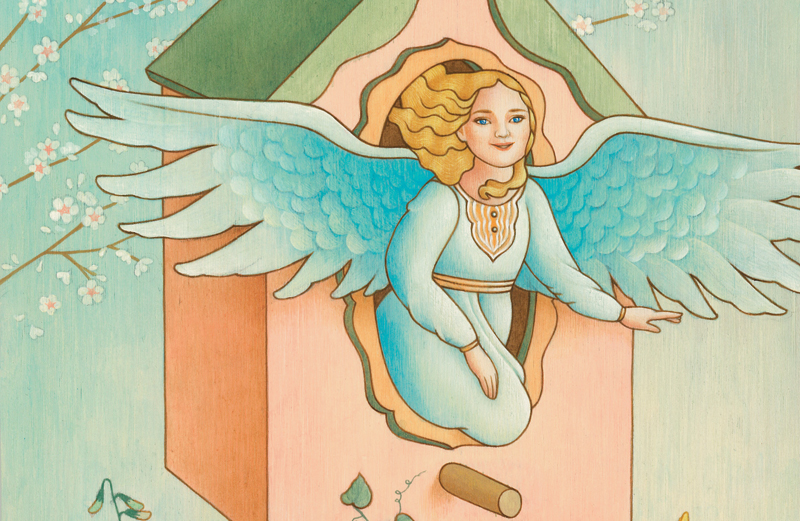
I made myself a cup of tea and sat at the kitchen table. My eye went to the framed needlepoint hanging on the wall: four bluebirds sitting on a wire with an inscription underneath. Their feathers were blue as the bright May sky, their breasts the color of ripe peaches.

It wasn’t the colors that had drawn me to the picture all those years ago. I bought the needlepoint kit when Jason was spending more and more time in the hospital. I needed something to do with my hands while he had his chemotherapy treatments, so I went to the craft store for crochet supplies.

I spotted the needlepoint kit on the rack. Three of the birds were facing me. The other faced into the distance, like he was getting ready to fly.

Looking at the pattern, I felt like I was seeing my own family. The little group of three birds together were my daughters. The fourth bird—the one getting ready to fly off—was my son. We knew even then that he would one day soon leave us to fly up to heaven.

I straightened the picture on the kitchen wall. Now all my birds had flown the nest. No mother can keep her children close forever, I told myself. Eventually you have to let them go. My daughters were grown up into amazing young women with lives and families of their own.

Usually I was proud and happy with the women they had become. But on days like today I wished I could hold them all close again. I wished that things didn’t have to change.

I turned from the picture to look out the window. The backyard was quiet. The birdhouse I’d bought at an auction months earlier hung from a pole on the deck. Beyond it the sandbox and swing set sat empty—more reminders of the past.

I was about to turn away when a bird flew up and perched on the deck railing, not six feet from the window. At such close range I could see its wings clearly. They were the exact shade of blue as the birds in my needlepoint. And the bird’s breast was the same warm peach.

“Come look at this!” I called to my husband.

“I’ve never seen a bird quite like that,” Ed said when he came to the window. The little bird hopped up and down the railing, then jumped to the birdhouse. It disappeared inside. “Maybe he’s found a home.”

We watched the bird until it flew off again. Its feathers were so bright, and such a perfect match to my needlepoint, I had trouble believing the bird was real.

“Time to do some research,” I said. I got on the computer and searched pictures of bluebirds. It turned out this was a real bird, of course, but one extremely rare for our area.

“The Eastern Bluebird,” I read off the screen. “It says here The North American Bluebird Society is trying to increase their numbers.”

My husband looked over my shoulder at the pictures. I pointed out our visitor, a male of the species. “And look at the birdhouse—just like ours.” It was made by the Bluebird Society, designed specifically for the Eastern Bluebird. We had bought it without even knowing.

I couldn’t have asked for a better Mother’s Day present. The next morning, while I was having my coffee, the bluebird returned. He went in and out of the birdhouse several times before settling on top to sing. I listened as his soft warble drifted through the open window.

“He has a mate,” I said. The female bluebird’s feathers were more of a blue-gray than a bright blue, but her breast was the same peach color. She went in and out of the birdhouse as the male watched, puffing out his chest as if proud of the home he had found for them.

For the next few days the two birds worked diligently to put things in order. They carried grass and pine needles to the house, slowly building their nest. One day a sparrow tried to claim it for himself, but together they chased him off.

According to my computer, bluebirds aren’t bothered by humans, so one afternoon I lifted the roof of the house to take a peek inside. I found a teacup-sized nest made of soft grass with four little blue eggs inside. Just like my family, I thought. And just like my needlepoint.

All that summer I watched my bluebird family. The mother sat on the eggs while the father brought food. Eventually when I lifted the roof of the birdhouse I found four little orange beaks at the end of four skinny necks. I got so attached to my bluebird family they felt like my chicks.

One afternoon while I was looking in the birdhouse I saw my husband on his way to the car. “Pick up some mealworms when you’re out,” I said.

“Huh?”

“Bluebirds like mealworms,” I said. “You can get them at the pet store.” The mother and father bird worked so hard to feed their family, I couldn’t resist lending a hand.

A few weeks later a little head popped out of the hole in the birdhouse. The first and bravest of the chicks had come out to explore the world. Soon they’ll all come out, I thought, watching from the window. Then they’ll all fly away.

The sadness I’d felt on Mother’s Day returned. But I knew there was nothing I could do. Being a mother meant letting go. I’d known that ever since Jason had died. Maybe that’s what God wanted to remind me of with these bluebirds, I thought.

I looked at the needlepoint on my wall. The inscription read: “To love and be loved is the greatest joy on earth.” I was grateful for the love I had in my life, even if it didn’t last forever.

One by one the little birds learned to fly. They left the birdhouse. Their parents did too. By fall it stood empty. I tried to embrace the letting go.

Time went on, through winter and into spring. One morning in May— right around Mother’s Day—I saw a flash of blue out the kitchen window. An Eastern Bluebird alighted on the birdhouse. Was it the same bird from last year? Or one of the children?

I wasn’t sure. But I knew that soon my birdhouse would be full again.

For 16 years the bluebirds have returned to our backyard birdhouse. I love it when Mother’s Day in our house is as full as the birdhouse full of chicks outside. My children and grandchildren take delight in their visits, and I cherish our time together.

But no matter whether my house is empty or full, I know love is always there. The ones we love may leave us, but we will be reunited among the angels in heaven. With God, letting go doesn’t mean forever.


Download your FREE ebook, True Inspirational Stories: 9 Real Life Stories of Hope & Faith

When a Childhood Dream Comes Together

Rhonda dipped a chip into the guacamole we were sharing, her eyes never leaving mine. This was only our second date, definitely still in the getting-to-know-each-other phase, yet already I sensed a connection between us. She was super cute. Easy to talk to. But could I really trust my feelings?

I mean, look what happened the last time I thought everything was going great. I was married then, with four kids—three daughters and a son. My star was rising career-wise.

God's Constant Presence In Article Ad

Customer service and sales came naturally to me, and at just 29, I was the manager of a Target department store in the greater Houston area. I had a strong work ethic, instilled in me by my parents. I put in long hours, proud that I could provide well for my family.

READ MORE: A BAKERY BUILT ON HARD WORK FAITH

Then came a total shocker: My wife said she wanted a divorce. “You’re not married to me, you’re married to your job,” she said. “And our kids…they need you to be there for them. They need a father.”

I didn’t get it. The kids knew they could count on me, didn’t they? I did things with them. I tried to show them what was important in life. Sometimes I even took them to work with me. Monica, our second child, turned out to be a lot like me, a natural salesperson. Once I’d found her telling a woman shopping in the shoe department that the sandals she was looking at would go perfectly with her outfit.

My wife and I split up. Some guys like the bachelor lifestyle. I was miserable. I’d get off work, come home to my bare-bones apartment, nuke something for dinner, then halfheartedly play guitar and stare at the empty walls until it was time to go to sleep.

I threw myself into my job even more and got promoted to regional manager. That meant moving an hour and a half away from Houston. A couple of years of that, and I couldn’t take it anymore. I had to be closer to my kids.

I left retail and landed a job in Houston doing maintenance for an oil company. I had zero experience in the industry, but the hiring manager liked my attitude, energy and people skills.

Now, five years after the divorce, I felt stuck, like my get-up-and-go got up and went. All I’d done was trade one grind for another. I was on call 24 hours a day, seven days a week for my new job. I barely saw my kids—every other weekend at best. My oldest, Sunset, was a junior in high school. Soon she’d be off to college and I would lose any chance of building a meaningful relationship with her.

READ MORE: BERRIED IN CHOCOLATE

Actually I worried that I’d blown it with her, with all my kids. Even when I did have time off, they didn’t seem very excited about spending it with me. What was I supposed to be doing with my life? I’d started going to church for the first time in ages, searching for direction. I liked the minister, the people, but I hadn’t found the answer I was looking for.

Instead I had found myself daydreaming about what I loved to do as a kid. The summer I was eight, my mother gave my younger brother Albert and me a handheld ice shaver—a Gilchrist No. 78. “Your dad and I can’t afford to give you an allowance,” she said. “But I thought you could make money selling snow cones, like I did when I was your age.”

She took us to the store and bought a giant block of ice for ten dollars and three kinds of syrup—banana, cherry and grape. Albert and I set up a table outside our house and taped a sign to it: Snow Cones, 75 Cents. Scraping the Gilchrist against the ice with all my strength, I could fill a cup with ice shavings—the kind that melt in your mouth—in about two minutes.

At first our only customers were a couple of our friends. By the next week, though, word had spread, and there were kids coming from all over the neighborhood, lining up for shaved ice. It was hard work—our arms ached from all the scraping—but worth it. Everyone, even the cool teenagers, hung out on our front steps, laughing, cutting up, sticking out their syrup-stained tongues.

I loved that feeling of connecting with people, of being part of something bigger than myself.

“God gave you a gift for making folks happy,” Mom told me. “I’m proud of you for working for your own money. But money isn’t everything. In the end, what matters is your family.”

READ MORE: THE CAKE BOSS’ PROMISE TO HIS DAD

Of course. But what struck me was that to make it in this world you need money. And to make money, you need to work hard, harder than the next guy. By my teens, I was selling shaved ice after school and on weekends. I’d pull in as much as a hundred dollars on a summer Saturday. Still that wasn’t enough. When I was 15, my parents asked me to get a job with a steady paycheck. They needed my help with our family’s bills.

So I put away the Gilchrist No. 78 and got hired as a cashier at a Popeyes chicken restaurant. I worked there through high school graduation, learning a lot about the food-service business. Then I moved into retail. I married at 22, started a family and worked my way up through the ranks at Target.

But where had that gotten me? By the summer of 2011, I was at a dead end. Marriage over. Disconnected from my kids. Working crazy hours at an unfulfilling job. The one positive thing to come out of it was meeting Rhonda. She was an executive assistant at the oil company, divorced, with a teenage daughter. They’d moved from Washington, D.C., to Houston hoping to make a fresh start.

Now I looked into Rhonda’s eyes, feeling warmed by her gaze. Maybe that’s why we clicked. I didn’t have to struggle to explain what I was going through. She understood.

She leaned across the table. “If you could do anything, Alexx, what would it be?”

The words just popped out of my mouth. “Shaved ice. I’d love to have my own shaved-ice stand again.”

I’d been thinking about that a lot lately, but I hadn’t told a soul. I mean, the idea was off the wall, right?

Rhonda probably thought so. Her mouth was half-open, as if she was about to laugh but caught herself.

READ MORE: CARLA HALL FINDS HER HAPPY

I was trying to find a way to change the subject when she spoke. “So why don’t you do it?” she said. “I’ll help. We’ll do it together.”

We? I blinked. Was this woman for real?

“There’s a lot to consider,” I said. “It’s not something to rush into.”

“Then let’s start planning.”

I’d been researching the idea, looking on the internet for advice, business plans. But no matter how I ran the numbers, it never penciled out. I had to support my kids. I was afraid of the risk.

“The first thing is location,” I said. “We’d have to set up shop someplace where there’s a lot of foot traffic.”

“Why be stuck in one spot? Why not go where people are?” Rhonda said, her hands fluttering excitedly. “School carnivals, soccer tournaments, community festivals. You could have four or five trailers, different teams.”

I’d never thought of that. I’d need employees, supplies, trailers. But if there were more customers and no rent to pay on a store…. I asked Rhonda for a pen and did some calculations on a napkin. “It just might work!” I said.

Rhonda and I got serious after that. Not about wedding plans but about our business plan. Our dates were at street fairs and rodeos, where we checked out the competition. Walking hand in hand with her, sharing a shaved ice and talking about how we could make the flavor fresher, I fell hard for Rhonda.

I wasn’t the only one. suddenly my kids wanted to spend more weekends with me and Rhonda, helping with our market research. They hit it off with Rhonda’s daughter, Alexandra, too.

All of us would hang out at my apartment, tossing around ideas. We decided on a name: Just Chill Out. Sunset designed a logo on her iPad. Monica came up with the uniform—T-shirts in a bright, cheerful lime green. My 11-yearold, Brandon, helped me test different types of ice.

The winner? Round cocktail cubes. We voted on which syrups and ice shaver to buy. Our choice was the Snowie 3000, capable of making a cone every three seconds. A big upgrade from the old Gilchrist No. 78.

“This is fun, Dad,” my 13-year-old, Alison, said one night. “Like we’re a family again.” I felt it too. A sense of connection I hadn’t felt in years, of being part of something bigger than myself. And it went beyond family.

Now I could see how the pieces were all coming together. My parents’ work ethic. My mom’s gift of the Gilchrist No. 78. My years in food service and retail teaching me how to create the ideal customer experience. Meeting Rhonda, whose ideas and enthusiasm fired me up again. Creating a business that my kids could be a part of. God had seen to every detail.

READ MORE: WHAT GUY FIERI LEARNED FROM  HIS FATHER

That’s why before our very first gig— a community festival one Saturday in the summer of 2014—I asked everyone, including Albert, his son, my brother Michael and my sister Virginia, who were all pitching in, to gather in the driveway. We held hands and bowed our heads. “Thank you, Lord, for everything you’ve given us,” I said. “For bringing our families together in this business. For showing us that through you, all things are possible.”

We came in for a giant group hug. I kissed Rhonda. “Thank you for believing in me,” I said. “With your brains and my energy, we make a great team.”

We had a blast at that festival. The kids worked every shift, greeting customers, making shaved ice, running the cash register. They did me proud, as proud as my mom must have felt watching Albert and me with our snow-cone stand.

Within three months we had enough bookings that I left the oil company to run Just Chill Out full-time. We bought more trailers and ice shavers. Now we have five teams, with our daughters as crew leaders. Rhonda and I finally made wedding plans and got married. Last year we welcomed the newest member of our crew, little Emily Elizabeth. See what I mean about everything—and everyone—coming together?

Did you enjoy this story? Subscribe to Guideposts magazine.

What Your Dreams Say About You

You walk into a room and there they are—your doctor, your best friend and your boss, all talking about how to make your life better. Sound like a dream? It is. It’s what happens nearly every time you go to sleep. Dreams are like your personal team of advisors. Processing the day’s events. Sorting through issues and worries. Preparing you for the unexpected. Sending you subconscious messages that can change your life for the better. All you have to do is pay attention.

“Since ancient times people have realized dreams contain special information that can help guide their lives,” says psychologist Patricia Garfield, Ph.D., author of nine books on dreams. Sumerians recorded dreams on stone tablets as early as 3100 B.C. Ancient Egyptians would sleep in a temple and have their dreams interpreted by a priest the next day. And the Bible contains hundreds of references to dreams as sources of divine revelation, such as the one in which Joseph was told that Mary would bear Jesus.

A Journey of Faith In Article Ad - Avail Now

Today, many scientists agree our ancestors were on to something: Dreams have significance and we can use them to improve our waking lives. “The brain communicates in dreams by combining images much the same way that when you’re awake you communicate by combining words,” says Robert Hoss, executive officer of the International Association for the Study of Dreams and author of Dream Language. “Everything you see in a dream is some aspect of yourself or some emotional memory.”

Each night about 90 minutes after you fall asleep, you enter a REM (rapid eye movement) period. REM sleep is when most dreams occur. It lasts about 10 minutes during your first sleep cycle, lengthening to 30 minutes or more as the night goes on and you complete more cycles. Major muscles are temporarily paralyzed during REM sleep, so you can’t act out your dreams.

Most of the cortex, or outer layer of the brain, is shut off during dreams, including the control centers for our motor and sensory functions and our sense of logic and time. That’s why dreams often seem bizarre to our waking minds. What kicks into high gear while we dream are the more primitive parts of our brains, like the limbic system, which deals with emotions. “Dreams link up related conflicts from the past with the present,” says psychologist Alan Siegel, Ph.D., an assistant clinical professor at the University of California, Berkeley, and author of Dream Wisdom. “It’s a little like a Google search. Your mind puts in ‘relationship problems’ and up pops your first boyfriend who rejected you. You can find symbols in your dreams for what you’re facing in life.”

With a little effort, you can turn your dreams into tools for enlightenment.

Increase Self-Awareness
Sometimes it’s clear what a dream means. But more often than not, dreams are metaphors and require interpretation. The best way to start making sense of your dreams is to write them down in a journal. You’ll remember them better and notice certain signs and patterns. Pay special attention to recurring scenarios. “We tend to have more vivid dreams and often more nightmares when getting married or starting a new job or moving somewhere,” says Siegel. “Dreams help you navigate through life passages by showing you inner feelings you’re having a hard time dealing with.”

Siegel recalls a graduate student who had started her own business. She prided herself on being a laid-back, well-liked boss. But while keeping a journal for Siegel’s class, she had six dreams of getting angry at her employees or them getting angry at her. “It was an incredible eye-opener. She realized she was letting her employees walk all over her and not asserting herself enough.”

 The same dream might signify something different for someone else. One meaning doesn’t fit all. The only way to figure out what a dream is saying to you is by doing dreamwork on it. Many experts, like Siegel, advise using free association. Write down as much as you can of your dream, then note any and all connections you can think of for each image. How did you feel in the dream—scared, frustrated, hopeful? Concentrate on the dreams that evoke the strongest feelings, even if they seem the most convoluted. Try coming up with a title for your dream, like “Playing Frisbee with the Rolling Stones at the Laundromat.” How might the various symbols relate to your current life?

Gain Insight into Relationships
Why does your high school crush or a relative you haven’t talked to in ages suddenly appear in a dream? “Many women get upset when they dream of being in a loving situation with an old boyfriend,” says Garfield. “They wake up and are married with kids and wonder if the dream means they don’t love their husband or should have married that other guy.” Garfield’s advice: Think about the chief characteristics of the person in your dream. A dream about an ex who was artistic or spiritual, for instance, may be expressing a longing to get in touch with those sides of yourself.

Often in dreams, roles in relationships are reversed or one person represents another. Hoss recalls a woman in a troubled marriage who had a recurring dream of storming away from her husband. After she mentally rehearsed a new ending in which she turned to confront him, she dreamed the same scenario and turned to her husband—only to find he had her father’s face. She saw then she had been projecting her unresolved anger toward her father onto her spouse.

To help people figure out what a dream means, Hoss uses a technique called image activation dreamwork. Here’s how to do it: Pick out the primary symbol (or two) in your dream and think about its function. Better yet, put yourself in its place and think about what it would say. Hoss counseled a man who wasn’t getting along with a female boss. One night he dreamed of being in a sweet potato patch with his boss on the other side of a barbed-wire fence. “I asked him, ‘If you were a sweet potato, what would you say?’ And he said, ‘Butter me up and I’ll be good!’ Right there was what he really wanted to say to his boss—he wanted to be appreciated.” Try this with your own dreams. It could lead you to some unexpected insights.

Solve Problems
We tend to dream about what’s on our minds. It’s not unusual for a runner to find herself jogging in a dream, or an actor to speak his lines. Some experts believe dreams are like a rehearsal for waking life. They may also play a role in memory, since we dream more when we’re learning new skills.

Great breakthroughs have famously come in dreams. Dmitri Mendeleev saw the complete Periodic Table of Elements. Golfer Jack Nicklaus says a dream showed him a new way to grip his club that boosted his career. Paul McCartney woke up one morning having dreamed the melody to “Yesterday.”

Want to nudge your dreams into sparking creative solutions? Try incubation: Set a conscious intention to dream about a particular problem. “For some people it helps to visualize something to do with the problem or put pictures or objects near the bed that symbolize a dilemma,” says Deirdre Barrett, Ph.D., assistant professor of psychology at Harvard Medical School and author of The Committee of Sleep. Others prefer to write down a question, put it under their pillow and literally “sleep on it.” Tell yourself what you want to dream about throughout the day and especially as you feel yourself falling asleep.

Barrett did a study with college students in which she asked them to incubate a problem for one week. Within the week, 50 percent reported having a dream dealing with the problem and 25 percent said they dreamed a solution.

Heal Physically and Emotionally
Even disturbing dreams can turn out to have a positive impact on your life. Barrett and other experts say dreams sometimes serve as a kind of early warning system for physical illness. The dreaming mind may pick up on subtle clues from the body because it’s not distracted by waking thoughts and sensory input. While most dreams about illness and dying are metaphors for an emotional issue, if you sense something physically wrong in your dreams, it never hurts to get it checked out.

Some people try to encourage healing through the practice of lucid dreaming, or becoming aware you’re dreaming while it’s happening. Patricia Keelin, who has participated in research for the Lucidity Institute in Palo Alto, California, has long used lucid dreaming for spiritual exploration and healing. She describes how a friend used the technique on his badly injured ankle. In his dream, “he rubbed his hands together and imagined that they emitted healing energy…a brilliant blue radiating light. He imagined as vividly as possible that the light was magically repairing all the torn tissues. He later went on to do marathons!” So far there’s no hard proof that lucid dreams heal, but Keelin says at the very least, they make you feel calmer in difficult or painful situations.

Don’t forget your nightmares, either. Though your first instinct may be to flee your nighttime demons, research shows facing them can be powerful. One woman reports that for years her sleep was haunted by the image of the man who’d abused her as a child. Finally she decided to confront him in her dreams. “I reached out and tore away at his face. It fell apart like wet clay and behind it was nothing. He still appears in my dreams sometimes but I’m not afraid of him anymore.”

Work, health, relationships, self…you can apply your dreams to improve practically every area of your waking life. And once you tap into the hidden power of your dreams, you’ll never again look at sleep as wasted time. Instead, you’ll look forward to the movies your subconscious screens for you. So, how’s your personal dream team going to help you tonight?

Download your FREE positive thinking ebook!

What You Need to Know about Your Blood Pressure

May is National Blood Pressure Awareness month. Blood pressure is the pressure through which blood is pumped through your circulatory system – one of the most important functions in your body. 

Elizabeth Kaback, M.D., a cardiologist at Scripps Health Center in California, spoke with Guideposts.org to help clear up some common misunderstandings about blood pressure. She offered her tips for recognizing the signs of high blood pressure, preventing it, and, if you’re suffering with high blood pressure, how you can manage it.

The Daily Bible Large Print relaunch with digital free gift in article ad

GUIDEPOSTS: How do we make sense of those blood pressure numbers?

DR. ELIZABETH KABACK: The upper number, the systolic number, is the number we get when the blood comes shooting out of the heart into the rest of the blood vessels it’s feeding into and the bottom number, is the relaxation part. How your vessels respond to a big push of blood out of the heart and how do they relax?

GUIDEPOSTS: What’s the ideal blood pressure?

EK: It depends on your age. The bottom number tends to be higher when you’re younger and you have high blood pressure and as you age, they both tend to get higher. Part of that is because the vascular system tends to get less elastic, but in general, if you are less than 40, your blood pressure should be less than 130/90. If you’re 50 or older, you should probably be less than 140/90.

GUIDEPOSTS: How would a person know if they had high blood pressure without a reading?

EK: Blood pressure’s referred to as the silent killer because people can walk around for years with high blood pressure and they only present with stroke or a heart attack. If you’re healthy and you’re going to your doctor and you find that your blood pressure is a little higher than it should be, you might want to do things to get that down.

If you’re someone who doesn’t go to the doctor though, you may find you go into the drugstore and you try one of those machines and you find out your blood pressure is very high. The numbers we get really worried about for a stroke and heart attack are upwards of 180/100.

But over the years, what gets people into trouble is that they don’t run quite that high but they run greater than 140/90 for most of the time and they get into a situation that spikes their blood pressure over 180/100.

GUIDEPOSTS: So there are no symptoms?

EK: People can have no symptoms at all or they can have chest discomfort or present with symptoms of a stroke. There’s a wide range of presentations but in between that, a lot of people wake up with morning headaches. Naturally, your blood pressure is supposed to drop when you sleep but when you develop high blood pressure, it tends to be higher at night when you’re sleeping than when you’re up and walking around. Some people will wake up with morning headaches or they’ll find they get short of breath easier when they’re exercising because it becomes harder for the heart to pump against a higher pressure and then the heart can’t fill because it’s trying to squeeze against a higher pressure head. It may be that you get flushed or shaky. People that have secondary hypertension, that’s when you have hormones that cause hypertension, will have a feeling of their heart racing and it’ll make the person get hot and flushed.

GUIDEPOSTS: What can people do to prevent high blood pressure?

EK: Cut out high salt content food and highly processed foods: white sugar, white salt, white bread, things that have high salt contents. Americans’ tastes and palates are used to having very salty diets which is why Americans tend to eat beyond 3 grams of salt a day. Really, the recommendation is to eat no more than 1.5 grams.

Some people are more salt sensitive than others but that’s certainly a way to help your body naturally. Exercising regularly, maintaining a normal body weight, eating fresh fruits and vegetables, mainly more veggies than fruits because they have antioxidants and anti inflammatories that help to reset the scale.

GUIDEPOSTS: What about exercise? How does that affect your numbers?

EK: The more you move the better. I personally don’t think 30 minutes is enough. I like to go by steps per day. Bottom line you should be taking at least 10,000 steps a day. That doesn’t mean you do it in an isolated workout period, it means in your day, from when you get out of bed in the morning to when you go to bed at night, the activity you partake in is covering that many steps throughout the day. Sitting is the new smoking. We’re attached to our computers and cell phones and we’re not moving as much as we should.

GUIDEPOSTS: One thing we always hear with blood pressure is it’s correlation to stress. What’s the relationship between blood pressure and stress?

EK: When you’re in a stressful situation you produce hormones that spike your blood pressure. We have this flight or fight mechanism. In the old days, you were facing a saber tooth tiger, your adrenaline would spike and you’d run away from the tiger and that adrenaline would get burned off because you ran and your hormones would rebalance. Today, we have chronic stress because we’re bombarded by things in our life that cause it – the TV’s on, your cell phone rings, you’re trying to make it to a meeting, and you’re driving the kids all over the place. We have to understand that part of your well being is monitoring and managing your stress.

GUIDEPOSTS: So many people have a fear of going to the doctor. Many don’t get regular checkups. Why is it important to be on top of your health?

EK: The best thing is to know that the doctor is there to help you and you’re being proactive. It’s better to know than not know because then you can take action. If you take action, you’re empowering yourself and if you’re empowering yourself, it makes it less scary, going to the doctor.

What to Know About Wandering in People with Dementia

This article is based on information provided by Home Instead Senior Care.

Every morning, Owen put on his white coat and did his usual rounds, from patient to patient. He spoke carefully to each one, asking questions, taking their pulse and listening to their heartbeats with his stethoscope. 

NIVFLB Inarticle ad

Actually, though, Owen is an 86-year-old retired M.D. and his “patients” are the family members with whom he lives. Owen has Alzheimer’s, a brain disease that can take those who have it back to earlier days and surroundings.

Wandering is one of the potential symptoms of Alzheimer’s disease and other dementias. According to a leading authority on the issue, people who wander often are attempting to return to a familiar destination, such as a place they used to work, with a specific purpose in mind.

“A person may want to go back to a former job he or she had, even though it may no longer exist,” said Monica Moreno, director of Early-Stage Initiatives for the Alzheimer’s Association. “Someone may have a personal need that must be met. For example, that individual may be looking for the bathroom, but be unable to find it. So he or she goes searching and gets lost. There’s always a purpose and intent. It’s just a matter of identifying the triggers.”

Common triggers can range from what is known as “sundowning”, or tiredness and confusion at the end of the day, to an altered routine, such as a relocation from home to an assisted living facility.

How frequently someone wanders typically varies depending on what stage of Alzheimer’s the person is in. “I work with many individuals living in the early stage of the disease,” Moreno said. “Typically the challenge during this stage of the disease isn’t wandering, it’s getting lost. Perhaps it can be an individual who starts out to an appointment on a familiar route to see a long-time physician, and suddenly cannot remember how to get there. Early-stage Alzheimer’s disease tends to involve more disorientation, while the later stage may involve wandering to find where they want to go.”

Although reasons for the behavior vary, people who wander often are trying to find safety and reassurance because they may feel lost, abandoned or disoriented. If your loved one says he or she wants to “go home” or “go to work,” try responding in ways that focus on exploration and validation, rather than correcting the person. You might say, “We are staying here tonight. We are safe and I’ll be with you. We can go home in the morning after a good night’s rest.”

Alzheimer’s disease affects everyone differently, which makes wandering unpredictable and complicated, noted Moreno. Because of that unpredictability, it’s important for families to get an early diagnosis and put plans in place to help keep individuals safe and independent for as long as possible.

For more information, go to “10 Ways to Balance Independence and Safety When Caring for Someone who Might Wander.”