Embrace God's truth with our new book, The Lies that Bind

The Soul Survivors

Welcome, U.S. Army 4th Battalion, 9th Infantry, 25th Division. I stared at the sign outside the reception. For 40 years I’d avoided these Vietnam vets’ reunions. I didn’t want to talk about the battle that haunted my nightmares, or how I’d survived.

The Battle of Mole City, December 22, 1968. We were a unit of 500 American soldiers, stationed in deep bunkers along one of the North Vietnamese Army’s busiest supply routes. I was 20. Fit, strong, tough.

My three months in ’Nam hadn’t been much different than working on our family farm. I spent most days in the hot sun, digging the trenches the base was named for.

There was a holiday truce. After dinner, we opened packages from home with cards, cookies and miniature trees. It almost felt like Christmas. At 10:00 p.m. we received our orders for the night: patrol, L.P. (the listening post), or perimeter. I was assigned to defend the perimeter.

All was quiet till midnight. The L.P. reported some NVA movement. The four of us in our bunker took our positions. Suddenly the night sky lit up. Flares. Mortar fire. A surprise attack!

We returned fire. There was a tremendous explosion. An anguished scream from the soldier next to me. I looked over. He was dead. I was struck too, in my right leg. Another grunt dove out the back of the bunker. I crawled after him.

We squeezed into the next bunker, filled with GIs. Something thudded into the mud. Another grenade! I threw myself as far from it as I could.

Boom! Blood ran from my ears. A third grenade rolled in. Shrapnel ripped into my belly. My rifle was clogged with mud. My injured leg was useless. We were overrun. Guys were falling, crying out for their mothers.

One brave sergeant climbed out of the bunker, firing his M16. His silhouette crumpled; his body rolled down past me. All I could do was lie there and wait for death.

I wouldn’t have called myself religious, even though I wore a miraculous medal with my dog tags. Still, I shouted above the gunfire, “God, help me!”

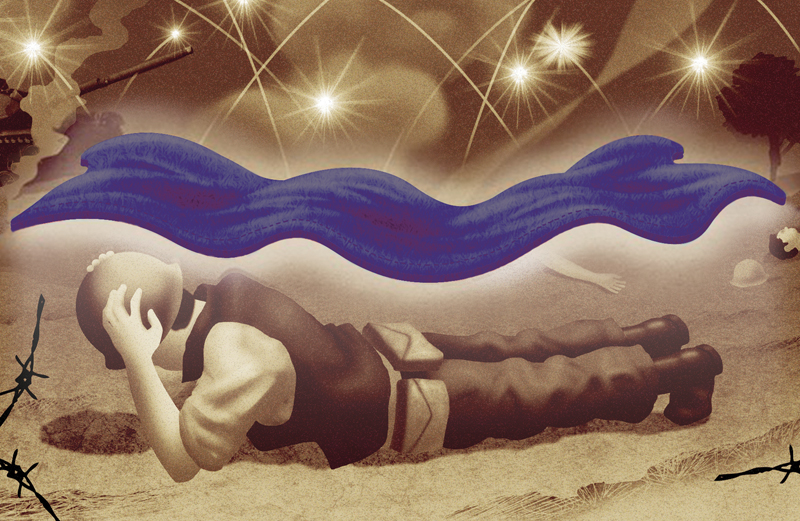
Everything went silent. No explosions. No screams. Like I’d gone deaf. At the same time, I felt something hover over me. It fell softly upon my shoulders, warm, comforting, like I was a child being tucked into bed. Before I could figure out what it was, I blacked out.

When I came to, it was daylight. I moved to uncover myself, but nothing was there. Feet shuffled outside the bunker. Who had won? The NVA? Would I be taken prisoner? I pulled away a sandbag blocking my view. It thumped to the ground.

A helmeted head poked in. A U.S. Army sergeant. “It’s okay, soldier,” he said.

I was the only one found alive in that bunker. The Army sent me home. The physical wounds healed. My other wounds didn’t. Counselors told me that the nightmares were my mind trying to piece together what had happened in Mole City.

Even after I learned that we’d been stormed by 1,500 NVA, outnumbered three to one, the survivor’s guilt remained. Why had I been wrapped in that cocoon of safety, while others died?

For 40 years, that guilt kept me away from reunions. I wasn’t sure why I’d come now. But I took a deep breath and entered the reception hall. I put on my name tag and scanned the room.

A man came up, saw my name tag. “You’re the guy I’ve been looking for.” “I’m sorry,” I said. “Who are you?”

“Bob Chavous.” He shook my hand. “I heard you were in the perimeter bunker near where I was supposed to be. I survived, the other guys didn’t. It’s not easy to talk about.”

I understood all too well. Bob said he’d been assigned to the L.P. that night, one of the men who called in the warning about the enemy soldiers.

“Before we could withdraw, the sky lit up with a hundred mortars. We were pinned down in a rice paddy,” Bob said. “I made my peace with God, and prayed he’d let my family know that I loved them.”

He paused for a moment, searching for the right words. “Then it was like…a blanket settled over me and put me to sleep until the fighting was over.”

A blanket of protection. I’d never know why it had covered me. But I hadn’t been the only one. How many others at this reunion had felt the same thing? Been touched by the same inexplicable warmth that we told ourselves couldn’t possibly be real?

I was ready to talk then. Ready to tell everything I’d held inside. I wasn’t alone. Bob needed to know he wasn’t either.

Read Bob Chavous’ account of the Battle of Mole City!

Download your FREE ebook, Mysterious Ways: 9 Inspiring Stories that Show Evidence of God’s Love and God’s Grace.

The Soul of an Artist: A Teacher Inspires a Lawyer to Pursue His Passion

From the outside, things looked okay. I had a nice apartment, good friends, a longstanding job as a lawyer with New York City’s Department of Finance. But inside I felt empty. Day after day, I tracked down corporate scofflaws, calling them up and confronting them about the thousands of dollars they owed the city. It was necessary work—somebody had to do it—but over the years, steeling myself, I found I had become so callous. Life was drained of its colors.

I used to drop in at a tavern in Greenwich Village after work and unload on a bartender there, Angelo. The place had these big paintings on the walls, brilliant acrylic portraits. One showed folks sitting around a card table playing bridge with all the details beautifully painted, even the cards. It was not what you’d expect to see in a bar—nothing generic about it—and one day I asked someone who the artist was. “Angelo,” he said.

I was flummoxed. Angelo, the bartender? In his free time, he created beauty with paints and a brush. He nurtured his artistic side. A side I had myself but had somehow let languish. How long had it been since I’d even tried to draw? What would Miss Wiener think?

Growing up, I was studious, quiet and curious. I wanted to see—really see—everything in the world outside our Brooklyn apartment. I was one of three kids, and I’d sit for hours at our kitchen table, copying pictures out of TV Guide or Life magazines. I remember studying Jackie Kennedy’s bouffant hair in a picture—the same way our teachers at school were starting to wear their hair. I wondered how it worked, so I copied it carefully, penciling each strand of hair in her bangs. Drawing was an incredible way of understanding things.

I once drew a picture of LBJ when he was elected vice president. His big floppy ears and the bags under his eyes fascinated me. I must have captured something about him because, when I brought in the picture and showed it to my teachers, they put it up in the hallway. That was where Miss Wiener saw it.

Miss Wiener was brand-new that year at P.S. 113. Only 21 years old, she was given all the jobs the other teachers disliked, like taking care of the hamsters, the goldfish and the turtles. During recess, instead of going outside to play stickball—which I wasn’t very good at—I used to stop in and study the animals. I’d sketch the geometric patterns on the turtles’ backs.

“You drew that picture of the vice president,” Miss Wiener said one day.

I nodded.

“You’re a good artist, Ronald,” she said. “Do you have any more pictures to show me?”

It was like a light went on. An adult was really interested in what interested me. Mom was loving and nurturing, but she had her hands full just getting us to church. It was altogether different to have a teacher express her enthusiasm, one who seemed to know a lot about art. Miss Wiener brought in books she got at the library of famous painters like Gauguin, Renoir and Rembrandt. I especially liked Rembrandt. His portraits looked so real, I could imagine the people stepping right out of them and talking to me.

I had never actually painted, but I loved studying the colors and seeing how an artist could show things with just a few deft touches, the light on a hand, the shadow or shade on a face.

“Let me take you to a museum,” Miss Wiener said one day. She had a tiny car, a Renault Dauphine, about the size of a VW Bug, and she drove me into Manhattan on a Saturday. We trooped around the city, visiting the Museum of Modern Art, walking up the ramps that sloped around the walls of the Guggenheim, seeing some real Rembrandts at the Metropolitan.

Miss Wiener looked as if she could have been painted by one of the artists we saw, Modigliani. She was slender with pale skin and red hair, and I could imagine how he’d depict her features, her direct gaze and that quick smile. She opened the door to a whole new world for me. She even signed me up for art classes at the Modern and drove me to them.

Other kids were good at sports. I drew. It’s what I did, and Miss Wiener showed me the many different ways an artist could express himself. Thanks to her encouragement and support, I got into a good middle school. In seventh grade, I ran for student body president. I drew multiple self-portraits for my campaign and my face was plastered all over school. I won.

Neither of my parents had gone to college. My mom would have loved becoming a teacher like her sisters back in Virginia, but she worked too hard to support the family. And Dad…well, Dad had his demons.

It’s not hard to see why I felt called to be the super-responsible one, the middle child, the one getting awards at graduation. College was an obvious choice for me. I loved the academic challenges and was a motivated student. Law school seemed a logical next step for a history major like me. I wanted to be able to get a good job and make everybody proud.

The artistic side of me got lost. I might blame the art teacher in college. He did everything he could to make his classes unappealing, scheduling them at an ungodly early hour and then criticizing his students’ work with undisguised disdain. He was no Miss Wiener. Later came the demands of school and the law and chasing down scofflaws… until I seemed a stranger to myself and found myself wondering why my life felt drained of color. I had to make a move before it was too late!

The first thing I did was take myself back to church. I found a congregation I liked, with people who could talk about God and prayer in one sentence and then tell you about a great new restaurant in the next. Faith and community become one in my life.

And then there came that moment in the bar. What if i tried to paint like Angelo? What if I asked him for help? I bought some supplies and christened a corner of my apartment “my studio.” I immersed myself in painting. I’d tackle a big canvas, hearing Miss Wiener’s voice in the back of my head, then I’d ask Angelo if he could give me some advice. We even worked together on weekends. Angelo taught me how to mix colors, how a complementary color could be used to make something darker. If you put green next to red, you’d get a vivid shadow and shading. He’d get out his brush and rework what I’d done, showing me how to do it.

I took out some family albums and worked from old photos, making portraits of relatives, most of whom were long since gone: Aunt Delilah, Aunt Nannie, Aunt Luella. Their features would come alive with a few flicks of my paintbrush. One day I found an old picture of my father, who had died from alcoholism when he was only 54 years old. In the photograph, he was still a young man—thoughtful, studious yet already prematurely old. What was he thinking? What made him tick? Why had he made the choices he had?

Copying the picture in a painting was like meeting him for the first time. Like I said, art had always been a way of understanding things. Not that I would ever fully understand my father, but I saw him differently after that. Painting was a way of forgiving, like saying the Lord’s Prayer with a brush.

IRon reunites with his favorite teacher, Mrs. Weiner’d long ago lost touch with Miss Wiener, but as the portraits accrued in my studio and my sense of self returned or at least a new sense developed—the lawyer who was also an artist—I was blown away to get a call out of the blue from one of her grown sons.

She was Mrs. Wiener now—she’d married a man with the same last name—and had moved to the suburbs, where she was the headmistress of a small school. Her son told me that she’d been suffering from cancer and wanted to see me again.

She came into the city, and we met at a restaurant on the Upper West Side, not far from my new church. She still looked like a Modigliani portrait, only she now had gray in her hair. There was something else I had never noticed as a kid—she had a very strong Brooklyn accent. But we were both very different people now. “I’ve taken up painting,” I told her. “I do portraits of people I love.”

I wished I had been able to take Mrs. Wiener to my studio in Brooklyn, where I could show off my work, but she didn’t live long enough to be able to make that trip. All too soon, I was visiting her grave. If only I’d been able to tell her how she had changed my life. Let it never be forgotten how one person’s interest in you, their willingness to encourage you, their ability to draw out your gifts can make a difference. A life difference.

It’s never too late to begin doing all the things you know they would love you to do. Never too late to discover what passion animates your spirit.

I am now retired from the law and paint full-time. I paint images that I see on Facebook or capture the faces of friends from church. Each blank canvas is a new challenge, an opportunity to see and to show. Each painting is a new expression of myself, filling me with joy. Each painting is another step in a new life.

For more inspiring stories, subscribe to Guideposts magazine.

The Song I Had to Give Away

As a songwriter I’m naturally pleased when people recognize my authorship. When Goldie Hawn recorded my tune “The House Song” in the mid-1970s, it was as big a thrill to me as when “I Dig Rock and Roll Music,” which I had a hand in writing, went Top 10 in the 1960s. But to this day the song I get the most credit for is one I didn’t really write.

Music has been part of my life since I was eight years old. In high school I was encouraged to start my own rhythm-and-blues group, but when I moved to New York City in 1959, I had no entertainment career plans.

I was a 20-year-old college dropout from Michigan State University who, because of a passing interest in photography, landed a job at a photographic chemicals company in Manhattan.

Evenings after work my colleagues and I would head for a Greenwich Village coffeehouse to play chess. One night I noticed a stage being constructed in a corner; the manager told me auditions for entertainment would be held later in the week. By that weekend, relying on nothing more than the songs I had created in my high-school and college days, I was in show business.

I gave up my day job and became a singer, comedian and master of ceremonies at the Gaslight Cafe. Increasingly I was drawn to the simple, yet profound, legacy of folk music. And each night between shows, I went to hear as many other performers as possible.

After my set one night, Albert Grossman, a well-regarded folk music impresario, asked me to join him at his table. I was hoping the meeting might lead to a solo record contract and a tour. Then he asked, “Have you ever considered performing in a group?” I was crushed.

As taken aback as I was by his question, I found myself a few months later joined by Mary Travers and Peter Yarrow in my Lower East Side apartment searching for vocal ranges and harmonies. Our voices blended well. We had an appreciation of one another’s talents. After a year of preparation (and Albert’s guidance) our group—Peter, Paul and Mary—was on the road, on the radio, and on the record charts with songs like “Lemon Tree,” “If I Had a Hammer” and “Puff (The Magic Dragon).”

Those were heady times. A sense of change was sweeping the country. There was a young president in the White House, hope on the wing and a new day dawning.

And then: despair. The impact of the assassinations of President John F. Kennedy, Martin Luther King, Jr., and Robert Kennedy was devastating. The arts became more and more expressive of the dark mood of the country. Gone were the dreams of a better tomorrow. The only choices left seemed to be cynicism or escape.

Or so it felt to me. At the age of 30 I found success increasingly meaningless. The more popular Peter, Paul and Mary became, the emptier I felt. I began to recognize a barrier between my working lifestyle and my family, the people I cared for most.

I was performing 150 nights a year and devoting the remaining days to photo shoots, interviews, recordings and television appearances. I was losing touch with the very ethic I defended in song.

Backstage at peace rallies, I watched in dismay as arguments and manipulation replaced mutual concern. I asked myself: Is life nothing more than some great scramble for advantage? What is it all for? If there is some order in life, how does one go about finding it? Is “order” what some call God?

During this searching time of my life I visited a friend in Woodstock who was recovering from a serious motorcycle accident. He provided the advice: “Read the Bible.”

I took the suggestion seriously. I started at Genesis and read the Bible whenever I could. I was fascinated, but it seemed like distant history. Then, after a concert in Abilene, Texas, a fan introduced me to the promises of Christ. He prayed with me. I knelt praying to a creator I had only hoped was there.

Suddenly I felt a sure, comforting answer.

After that, I began to pray constantly. I would ask God the smallest questions, such as “Shall I take this elevator?” “Shall I sit next to this person?” “What would You have me say here?”

I discovered a wonderful closeness. God was with me in every situation. He was a best friend.

And so it was only natural that I would turn to him when, during the trio’s tour in the fall of 1969, Peter asked if I would sing a song to bless his wedding. Though I immediately answered, “Of course,” I didn’t tell Peter that it wasn’t going to be me who would bless his wedding.

One of my first days home I retreated to the small basement studio in our house. After tuning up my 12-string guitar, I sat in silence for a moment.

Lord, I prayed, nothing would bless this wedding ceremony more than Your presence. How would You manifest Yourself?

And the lyrics came:

I am now to be among you
at the calling of your hearts,

Rest assured this troubador

is acting on My part.

The union of your spirits here

has caused Me to remain,

For whenever two or more of you

are gathered in My name

There am I, there is love…

For the next hour I strung the lyrics together into the format of a song. The last section paraphrased a sentiment that had been voiced by another songwriting friend of mine, Jim Mason. He’d asked, “Do you believe in something that you’ve never seen before?” The song provided the answer, “There is love.”

Just one hour before the wedding ceremony, I sang it to my wife, Betty. “It’s beautiful,” she said. “But they won’t understand ‘I am now to be among you.’ They’re going to think you’re presuming to be God.”

I thought about what she said, and changed the words.

The song was sung at the ceremony: “He is now to be among you…” The blessing had been asked for and given. It would never be sung again, I thought. It was for Peter.

Several weeks later I was waiting backstage before my solo portion of a Peter, Paul and Mary concert when Peter asked, “Why don’t you sing the song you sang at my wedding?”

“I couldn’t do that,” I said. “It was just for your wedding.”

He looked at me thoughtfully. “My bride is out there,” he said. “Would you sing it for her?”

So I sang it that night, and the following nights. Each time it was well received, and each time I was amazed that something so particular had such a broad appeal. Is this what you wanted, Lord? I asked. Did you mean the song for everyone?

Less than a year after Peter’s wedding, the trio took a leave of absence from performing and we each created solo albums. By then I knew that “Wedding Song” would be included on mine, but now I had a dilemma on my hands. How could I honestly copyright the song in my name? Yet if I didn’t claim the song for someone, the record company would pocket the royalties.

In the end I set up a foundation to oversee the publishing rights and to receive all my income as composer. Any money the song earned could then be distributed to worthy causes.

To my amazement, shortly after the album’s debut, “Wedding Song” was released as a single and almost immediately went into the Top 30.

In the meantime I had chosen to spend more time with my family. I wanted to live a simpler life, away from the demands and pressures of performing. I half expected to hang up my guitar and stop playing professionally.

Then one afternoon as my family, some friends and I were sitting together in our backyard I received an excited phone call from the record company. The Tonight Show had called to ask me to perform “Wedding Song” on network TV. “This could be the beginning of a solo career!” the record company representative exclaimed.

Once I had wanted nothing more. Now I knew better. “No, thanks,” I said.

It’s been 22 years since the Public Domain Foundation was created to receive the royalties from “Wedding Song.” Two million dollars has been distributed to charitable organizations all over the United States—from soup kitchens for the homeless to research into computer interaction for hospitalized kids.

Every year, too, I turn down requests to sing “Wedding Song” at services around the country. “It’s not my song,” I can honestly say. It belongs to every bride and groom who ever had a good friend strum a guitar and sing at their wedding.

God gave me a song. It was mine to give away.

The Sister-in-Law Diet

“Do you maybe have anything spiffier?” I asked the salesman at the medical-supply store. I was staring at a motorized scooter in a color so dismal I didn’t know what to call it…greige?

He showed me one in a cheery cherry red. Better. If I had to spend the rest of my life in a chair, it might as well match my nails and pocketbook.

“Your scooter will arrive in a month,” he said, writing up my order. “Right at your doorstep.”

Great. That meant I’d have it in time for Thanksgiving. In time for everyone to see, especially my sister-in-law, Ellen. I sighed, limping out of the store. What choice did I have? I was only 56 years old, but this scooter had been a long time coming. So this is it, Lord. More of a complaint than a prayer.

I had been battling health problems since I was teenager, when I was diagnosed with a condition that caused benign tumors to grow on my nerves. There were tumors in my brain, in my mouth, even on my spine and legs, which made it excruciatingly difficult to walk. I had undergone 32 surgeries over the years.

As if that wasn’t enough, the antiseizure medications I’d been prescribed contributed to weight gain. I’m not going to lie, though. I had a sweet tooth, big time. I weighed nearly 300 pounds by the time I was 40. Nowadays, I could barely complete my rounds as a nurse without panting, then collapsing into a chair in the patient waiting room.

“The best thing you can do, Roberta, is lose some of that weight,” my longtime physician, Dr. Brownfield, had told me at my last appointment. “Might even keep you out of a scooter.”

It was a nice idea in theory. I’d tried every diet there was, from Atkins to Weight Watchers, and never lost more than five pounds. My health problems had taken so much from me already. Now they were about to take my freedom.

To add insult to injury, Thanksgiving came and the scooter never arrived. There was some kind of mix-up. Typical. They probably ran out of red. At least I saved face in front of my family when we all gathered for dinner.

Ellen eyed me when I arrived. I always felt as though Ellen—and everyone, really—judged me because of my weight. In the 40-plus years she’d been married to my brother, the two of us had never really connected.

She’d always been good to my brother, and we had a polite relationship. But we were hardly close. What did we have to talk about? Ellen was a math teacher and athlete, the kind of person who exercised regularly and cut the fat out of everything. She was six years older than I was, but had the energy of a high school cheerleading squad.

Meanwhile, I was easily 100 pounds overweight and about to be relegated to a motorized scooter, a fact I left out when she asked how I was doing. I don’t think she would have been impressed that the scooter came in red.

Ellen had cooked up an elaborate feast. She sent me home with a dozen different containers of leftovers. I phoned her the week after to thank her. Despite ingredients like broccoli and low-fat sour cream, her dishes had been surprisingly tasty.

“What in the world do you do to that food?” I asked. I’d actually lost a pound from eating her meals all week.

“Just a few cuts here and there,” she said, then paused. “You know, Roberta, if you want to lose weight…I mean, if you really want to try, I could coach you.”

Ellen? Coach me? How would that work, exactly? We could barely make small talk. How was I going to discuss something as personal as my diet with her? Just the thought of disclosing my candy-bar-a-day habit made me cringe. And did she think I hadn’t tried during all my other futile dieting attempts? That I was some kind of diet slacker?

I almost told her no on the spot. But Dr. Brownfield’s words popped into my head. “Maybe we could keep you out of that scooter….” I had a choice. It was a long shot, but anything was better than a future on wheels. Even if that meant opening up to my perfect sister-in-law.

“You can think about it,” Ellen said.

“I don’t have to think about it,” I said. “I’m up for it.”

I had no idea what i was getting myself into. To get started, Ellen asked me to keep a food journal. I tried to be completely honest, even about my sweet tooth. She called and I read her my entries for the week. She didn’t say anything.

“That bad?” I muttered.

“You don’t really eat that much, Roberta, but your meals come too late in the day,” she said. “That’s the first thing we can change. Easy. No more eating after six p.m.”

Easy for Ellen, maybe. Who wants to eat celery and boiled carrots no matter what time of day it is? Still, I was in no position to argue. So I followed her instructions and began eating dinner before six p.m. A real challenge with my hectic nursing schedule.

When I made my rounds, I’d stare longingly at the vending machine, desperate for just a little snack. Two long, torturous weeks later, I stepped on the scale at work and couldn’t believe the number staring back at me—I’d lost two pounds!

My feeling of victory was short-lived. When I got back to the nurses’ station, one of the other nurses talked about a diet she’d lost five pounds on in the first week. I called Ellen, ready to quit.

“Wait a minute, let’s look at the math here,” Ellen said in that matter-of-fact teacher’s voice of hers. “If you dropped a pound a week for the rest of the year, that’s about fifty pounds all together. That’s a big deal, Roberta.”

Hmm. Fifty pounds was at least five dress sizes. That’d mean I could fit into the jeans at a store like Chico’s, where I’d always dreamed of shopping. I longed for Chico’s jeans!

Once I was back on board, Ellen was ready to move me to phase two of her master plan—more seemingly insignificant changes. Substituting water for regular soda and cutting out the bread in my dinner. She insisted I would see results.

So I resisted the urge to reach for a can of soda in the afternoon and had my grilled chicken sandwiches with one slice of bread instead of two. By the end of one week, I’d lost a pound.

Then another. And another. My blood pressure dropped by 20 points and I was down a dress size by the end of the month. My joints weren’t so sore. Best of all, I could make my rounds without taking so many breaks. Coworkers took notice. The hospital cafeteria even named a special low-calorie, low-carb sandwich after me.

I called Ellen faithfully every Monday with a status update on my weight. And to get a pep talk. Her calm, scientific way of thinking was strangely comforting. Sooner or later, she said, the weight would come off, because I was consuming fewer calories, eating the right things and moving around more. It was simple science.

One morning, we got to talking about some new recipes, and before I knew it, we’d been on the phone for half an hour!

“You’re going to need new clothes,” Ellen said. “I saw some lovely things at the mall the other day.”

I went shopping after work and stopped by Ellen’s house with my finds. She had me model every outfit. Ellen wasn’t really into girly activities, but we still had a blast. We barely talked about calories or carbs. When I left, she hugged me goodbye. Like friends. Sisters, even.

After that, I didn’t wait until Mondays to call Ellen. She was the first person I called when I needed advice buying a new car. We even prayed about my decision together.

The weight came off too, just as she promised. Every month, another three or four pounds. I lost 45 pounds that first year. And Ellen wasn’t finished with me. She introduced a new goal every month, taught me how to make smart choices when eating out.

I started to crave vegetables. Whenever I slipped, she was there to pick me up. “This diet isn’t about just one day,” she told me. “It’s about a lifetime. Hour after hour of making the right choices.”

Thanks to Ellen’s coaching, I lost 94 pounds over two years and have kept the weight off. My health problems haven’t disappeared, but I no longer search for the nearest chair when entering a room.

And the red scooter? I never bothered straightening out the mix-up. I booked my first vacation in over a decade, confident I’d be able to walk long distances without pain.

I even buy my jeans at Chico’s. The saleswoman has gotten to know me.

“Losing weight slowly is the way to go,” she said recently. “Your sister had the right idea.”

I smiled at her use of the word sister to describe Ellen, but didn’t bother correcting her. I couldn’t have said it better myself.

Download your FREE ebook, Paths to Happiness: 7 Real Life Stories of Personal Growth, Self-Improvement and Positive Change.

The Sign We Couldn’t Miss

My husband, Gil, and I had finally reached Perry, Georgia, a quaint little town west of Savannah. We’d been RVing for weeks, touring the South and exploring the cities and towns tucked along the way. Gil guided us through the tree-lined streets, dotted with boutiques and charming restaurants. There was so much to see! I looked over and shot Gil a smile. But he was grimacing. “Gil, what’s wrong?” I asked.

“Nothing,” he said, flatly. “I’m fine.”

I could tell by his clenched jaw and stiff grip on the wheel that he was in pain. “Gil, what’s the matter?” I pressed.

“Well…I don’t want to ruin our trip, but my arthritis has been flaring up for the past few hours. I should probably get to a doctor,” he admitted.

A doctor! I knew he had to be in severe pain to mention that. Gil was always so strong. Where would we find help out here though? We’d never been to Perry, and the nearest hospital or clinic could be miles away. I kept my eyes peeled while Gil steered us down the main road in town.

We passed a hardware store, an ice-cream shop, a library…everything but a clinic or hospital. It had been almost an hour and now we were in the neighboring town of Warner Robins. Every second that passed, my worry grew. “The pain is getting worse,” said Gil. Lord, please send us a sign to let us know you’re with us, I prayed aloud.

Just then, we drove by a church. A sign with large, bold letters stood out front, almost as if it were calling out to us. Gill and I saw it at the same time. “Are you looking for a sign from God? Well here it is.” Gil let out a loud, hearty laugh, and so did I. I felt my worry disappear. I could tell Gil was less tense too.

Just down the street, there stood another sign. One for a walk-in clinic.

These Volunteer Retirees Are Ready to Save Lives

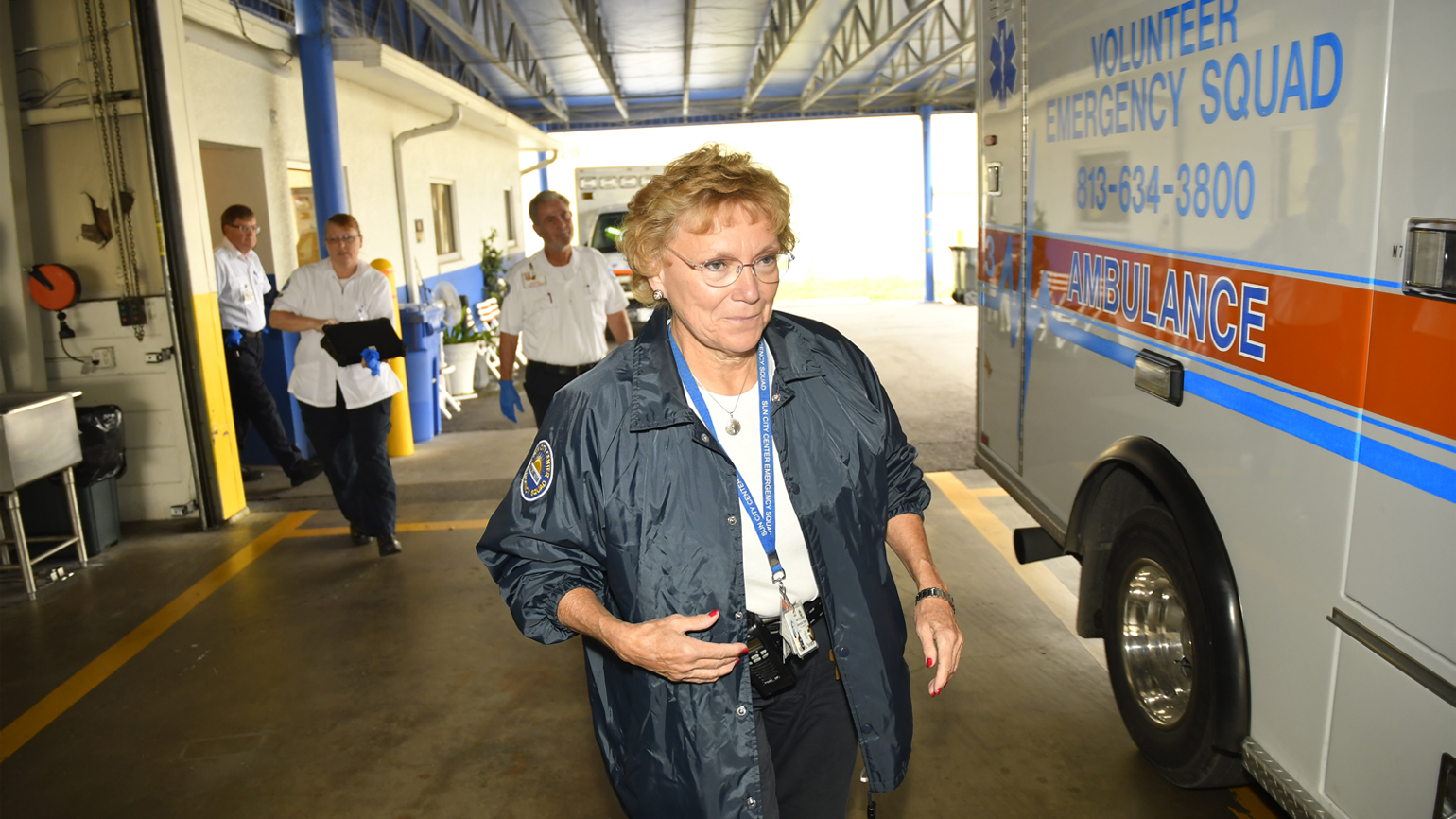
The Sun City Center Emergency Squad is a volunteer organization that provides the Sun City Center, Florida senior living community with Basic Life Support (BLS) services and ambulance transportation – as well as wheelchair, crutch, and cane lending. Guideposts spent the day with one of their teams, while members answered phone calls, practiced CPR and more.

The Self-Love Diet: A Healthy, Hearty and Happy Approach to Weight Loss

“Let’s get your weight first,” the nurse said at my six-month cardiology checkup. I slipped off my shoes, stepped on the scale, listened to the metallic counterweights sliding back and forth. No need to look. I already knew what I weighed—too much. For several years, my cholesterol had been borderline, but I was already on two blood pressure medications and didn’t want to add another pill for cholesterol. So I convinced myself I could get my numbers down with diet and exercise. Whenever I would lose some pounds, for a class reunion or a beach trip—usually with some quick-fix fad diet—the weight always came back.

My cardiologist sat down in front of me, flipping through my chart. “Well, you’re the only patient today who has lost weight. Three pounds,” he said. “It’s a start.”

Right. Losing 10 times that amount still wouldn’t put me at my “ideal weight,” the dreaded number that had stared at me accusingly from charts in waiting rooms for years.

I couldn’t remember the first time I went on a diet. I had always been chubby. “Pleasingly plump,” my grandma would say. I was aware, even at a young age, that other girls were smaller than I was. I noticed it in pictures, when my middle was wider than my friends’. I noticed it when we dressed for gym and my thighs were not sleek beneath my shorts.

“Do you think you could lose five more pounds?” my cardiologist asked. “Most people don’t realize what an impact extra weight has on their overall health.”

Though my husband, Gary, loved me just the way I was, I already knew those extra pounds were hard on my body. My hip had been giving me trouble. I couldn’t walk in sand anymore, which ended my beloved beach walks along the shores of Lake Michigan. Climbing the bleachers at my grandson’s basketball games had become almost impossible. Even lying on my hip in bed at night was painful. I’d tried physical therapy. Pain pills. But it wasn’t enough. My orthopedist had advised hip replacement surgery. Then my left knee had started acting up and I had to be fitted for a brace right before a dream trip to Italy. I’d needed a cane to navigate the stairs at the Basilica of St. Francis in Assisi. Much as I loved traveling, I couldn’t imagine doing more of it when my body was slowly but surely breaking down.

“Sure,” I told my cardiologist. “Five pounds.”

He closed my chart with a satisfied slap. “Great. See you in six months, five pounds lighter.”

I drove home, mentally flipping through my repertoire of diets. Which one this time? High-protein? Low-fat? South Beach? Scarsdale? I had tried pretty much everything: Eat this—don’t eat that. Eat these foods together. Weigh your food. Count points for your food. Exercise like crazy to burn off extra calories.

My family had what I called fat genes. Almost everyone in my family was overweight. And dieting was something we didn’t discuss when we got together, which was almost always to share a big, home-cooked meal. What we did talk about was food.

Old recipes. Grandma’s famous dumplings. An aunt’s delicious chocolate pie. Momma’s melt-in-your-mouth biscuits, topped with the sweetest pear preserves in Indiana. How could those things be so harmful? Food was how we celebrated and how we consoled each other. “Eat something—you’ll feel better,” I’d heard dozens of times as a child. So I ate. And, it was true, I almost always felt better. Until, of course, I didn’t. Those eating habits had given me a lifetime of weight problems.

Eventually, I convinced myself that my body was the weight it wanted to be. It must be how God wants me, I told myself. I learned how to dress to camouflage my weight issues: lovely flowing clothes, lots of layers, dramatic jewelry and saucy hats. But I couldn’t camouflage the strain the extra weight was putting on my health or the limitations it was adding to my lifestyle. And really, did God want me to be so unhealthy?

This time, things had to be different. My motivation was different, and my strategies would need to be too. I went straight from the doctor’s office to the grocery. Instead of the fat-free and low-calorie foods I would normally buy to start a diet, I shopped in the “fresh” aisles. Lots of fruits and veggies. I skipped the cereal aisle. Ditto with the low-fat chips and cookies, the frozen meals and nutrition bars. Those foods were more like a punishment than good nutrition. This effort had to be more about taking care of the body God gave me than about just losing weight.

I spent more time in the kitchen. I pushed my can opener to the back of the counter and prepared fresh green beans. Shucked corn. Sliced tomatoes. I made thin cornbread, crunchy and hot from a black skillet. And I made salads—lots and lots of salads, topped with pickled beets and black beans and chunks of cheese. I cut out fried foods. I discovered that organic steel-cut oats cooked all night in the slow cooker were nothing like those packets I used to open and dump in hot water. I bought local honey to use as sweetener. Gary and I ate out less often. He seemed to be enjoying the meals I was creating. I trolled the Internet for muffin recipes, tweaking ones I liked to make them hearty and healthy. I started making my own tea bags, filled with black tea and cardamom pods and cinnamon. I even gave myself permission to drink it with half-and-half—something I never would have done in my rigid dieting days. I began to look forward to these new foods. It had been three months since my cardiologist visit, and I was already down 15 pounds. Yet this didn’t feel like a diet. In fact, it felt as if I was eating better than I ever had.

I decided to buy a new fancy digital scale. I brought it home and set it up in the bathroom.

I had prayed about losing weight before—weighing myself several times a day, obsessing over every pound, ashamed to say I was hungry because I thought people would think I shouldn’t be eating. I didn’t want to go back there. I took a deep breath, tapped my toe on the edge of the scale, gazed down at the glowing zeros. I heard a voice encourage me. This is your chance—not just to look good but to feel good. I will help you with this.

I stepped up on the scale and waited for the results. I hope I’m still in the ballpark of 15 pounds.…

I was down 20 pounds! But it wasn’t the pounds that mattered so much. Twenty was just a number. That number didn’t define me. What mattered was I’d finally gotten it right. I’d learned to take care of my body, not starve it.

Soon, it was time for my six-month checkup. I’d promised my cardiologist five pounds. He was in for a surprise.

“Twenty pounds!” the doctor said. “This is fantastic!”

It was. The pain in my knee was better. My hip issues weren’t as debilitating. Even my feet complained less when I took long walks.

Now, a year after the three-pound loss, I’m down 50. I dropped from size 16 jeans to size 8. My hip pain is completely gone. My knee discomfort has diminished to an occasional twinge. My orthopedist is no longer talking hip replacement. My knee brace and cane are buried in a dark corner of the spare closet. I have discontinued one of my blood pressure meds and was able to cut the dosage of the other one in half. My cholesterol numbers are all in normal range—something I haven’t seen in 30 years!

“The more time you spend in the kitchen, the skinnier you get,” Gary teases me. This new lifestyle has been good for both of us—even he is down 15 pounds.

All my life, I wanted to be thin. God wanted me to be healthy and whole. His, of course, was the better idea. One that allows me to do what I love—travel with friends, walk the shores of Lake Michigan with my husband, climb the bleachers at my grandson’s basketball games. And live the way I was meant to live.

Try Mary Lou’s Hearty Banana Muffins at home!

For more inspiring stories, subscribe to Guideposts magazine.

The Secret of Spiritual Contentment

Contentment is the opposite of self-pity. If our hearts are content because we trust in God as our loving provider, then we’ll tend to keep our eyes off our troubles. But if we dwell on our wants or our difficulties (great or small), we will lose sight of the provisions God is granting us.

The Old Testament character Job learned this secret of contentment. Amazingly, after losing everything–his home, his wealth, his family, even his health–he was able to say, “Naked I came from my mother’s womb, and naked I will depart. The Lord gave and the Lord has taken away; may the name of the Lord be praised” (Job 1:21).

In all of his sorrows, Job continued to believe in God’s goodness. He refused to charge God with wrongdoing, even when his complaining wife urged him, “Curse God and die!” (Job 2:9).

Job resisted the temptation to be angry with God. He knew his peace and security came not from having a multitude of things, but from knowing beyond a shadow of a doubt that God was faithful.

Our church in North Dallas helps with a wonderful ministry called Voice of Hope that provides an after-school program in a Christian environment for underprivileged kids.

Several years ago my family, along with others, agreed to help deliver holiday turkey dinners to some of the families that were being served by Voice of Hope. Our simple task was to deliver the dinners to the people’s homes and sing a few Christmas carols.

At virtually every house, we were greeted by wonderfully warm and grateful people. Each visit went the same way: we presented the dinners, sang our songs (even though none of us could carry a tune), then said our goodbyes.

To my surprise, almost every household asked if they could offer a prayer before we left. Their prayers typically went something like this:

Dear Lord, you have given us so very much. We do not deserve your rich blessings! Thank you, Lord Jesus. Thank you for your loving-kindness, your forgiveness, and your mercy. Thank you most of all for your son, Jesus, in whom we have abundant life.

Thank you also for these kind people who have brought us a bountiful turkey dinner. We are so grateful! In your wonderful son’s name we pray. Amen.

These were contented people! They had very little in the way of possessions, but they were rich with peace and joyfulness.

My family and the other volunteers learned an incredible lesson that day as we got back in our SUVs and returned to overindulgent, discontented North Dallas. We learned that contentment is not based on what you have; it is based on how you choose to view life. It is an issue of the heart.

Paul’s Potential Pity Party
Consider the apostle Paul for a moment. Now, here was a man who deserved a pity party! He was thrown into a Roman prison not for committing a terrible crime, but for sharing the gospel of Jesus throughout Asia Minor.

Certainly he could have whined, shaken his fist at God, and cried, “It’s not fair!” We wouldn’t have blamed him, would we? Haven’t we all said those words at some time in our lives?

Many situations in life are not fair, especially for mothers. We work hard serving our families and the needs of our households, and we don’t get enough appreciation for all we do. It’s not fair!

Paul could have said the same thing. “I’ve given my all to tell others about Jesus, and what has it gotten me? A jail cell!” Paul could have grumbled and complained and given up on the mission God had called him to. But he didn’t.

Instead, Paul faced this challenging situation by choosing to look up and not down. He did not focus on how bad the circumstances were but on what God could do through the circumstances.

And what did God do? For one, he opened up many opportunities for Paul to minister to the prison guards, the officials who tried him, and the visitors who came to see him each day. Second, he made sure Paul had some ink and some papyrus and prompted him to begin writing.

Today we can open our New Testaments and refer to the letters Paul wrote to the early churches from his prison cell. We can see–and benefit from–the awesome work that God did through Paul in prison.

Paul was able to write these words during his time in jail: “I have learned to be content whatever the circumstances” (Philippians 4:11). Now if Paul could say this from his prison cell, I wonder if we could say it from our laundry rooms? The good news is that Paul did not leave any confusion as to how he was able to be content.

In the next two verses he gives us the key that unlocks the prison door of self-pity: “I know what it is to be in need, and I know what it is to have plenty. I have learned the secret of being content in any and every situation, whether well fed or hungry, whether living in plenty or in want. I can do everything through him who gives me strength” (verses 12–13).

Perhaps you have heard that last phrase before. You may have even memorized it in another translation: “I can do all things through Christ who strengthens me” (NKJV). It is truly a wonderful–but often misused–verse.

Did you realize that Paul was talking about contentment when he wrote it? He was giving us the key to unlocking our prison of self-pity: believing that with God’s strength, we can get through whatever life brings.

Can we still be content if our child doesn’t get the best teacher in the first grade? If our friend disappoints us? If our husband is not always sensitive to our needs?

Through all the stressful and challenging situations of life, we can still find contentment when we fix our eyes on and place our hope in God–the only one who can give us strength to make it through.

Heading Off Bitterness and Anger
When we forget that key to contentment, we can spend all of our time dwelling on the negative in situations–and that’s dangerous. When we continue to rehearse our discontented thoughts and attitudes over and over, anger and bitterness set in, threatening and sometimes destroying the relationships we hold most dear.

Recently our family took a cruise to the Caribbean. We enjoyed visiting many wonderful tropical islands and seeing the sights as our large ship sailed from port to port.

Standing on the deck one afternoon, we watched in awe as smoke billowed out of a mountain on the nearby island of Montserrat. We realized we were looking at an active volcano. What an impressive sight!

That volcano comes to mind as I think about the danger of anger in relationships. As it rumbles within us and heats up over time, anger can erupt and overflow.

And just as the hot lava of a volcano destroys everything in its path, so our outbursts of anger, rooted in resentment, bitterness, and self-pity, can destroy the people around us.

I think about Suzette, who married a wonderful man but was discontent from the moment she returned from the honeymoon.

She didn’t feel that her husband’s job provided her with the income she desired. The home he could afford wasn’t in the “right” neighborhood. He never seemed to help out enough around the house and with the kids. And he certainly wasn’t sensitive to her feelings!

Over time, the bitterness and anger festered and grew inside of her. What began as a spirit of discontent led Suzette to begin looking for greener grass–and eventually to an affair with her husband’s best friend, Rick.

The devastation and heartache caused to both families has been incalculable. If only Suzette’s discontent had been checked at the door of her heart before she began each day, perhaps this picture would have turned out differently!

How do you keep anger from overtaking your heart? You cut it off at the pass! Here are three simple steps you can follow daily:

1. Recognize the roots of bitterness and anger.
The first step toward fighting an enemy is recognizing it. If you are developing a bitter attitude toward someone or something, then you need to identify it. You may even want to write down or journal what is simmering inside you and why you feel the way you do.

If you find yourself grumbling, complaining, or rehearsing a pity party, it is time to recognize it and determine to move in a new direction.

2. Change your perspective.
Determine to stop focusing on what is wrong. Quit playing the “I am hurt” tape in your brain. For that matter, quit trying to make sure the other person knows how much they hurt you.

Do not play the blame game of pointing the finger and saying it is all his or her fault. This is negative, unproductive thinking and will only keep you in a pity party prison.

Choose to change your focus on what is good. Focus on the hope in each person and every situation. God has not left you. He can bring hope out of seemingly hopeless situations. It is your choice what you will dwell on.

3. Ask God to give you strength and direction.
Seek God’s help in forgiving others and moving forward. The Bible reminds us that we must forgive others, because we have been forgiven of everything (Colossians 3:13). Dear friend, as we look to him, we begin to see a loving God who is able to help us forgive and move forward.

Moment by moment, ask God for direction, strength, and help to move past the anger and toward a whole new attitude. Ask him to replace your hate with love and your anger with forgiveness. He is able to weed out the roots of bitterness in your life as you seek his help.

The Science Behind the Benefits of ‘Spiritual Thinking’

In the 1990s, when I first worked as a religion reporter, a new category of believer was emerging in America. Some of my colleagues called this SBNR: Spiritual, But Not Religious. More recently, journalists responded to demographic data suggesting that as many as twenty percent of the American public identify as “nones,” or having no religious home.

Both “SBNRs” and “nones” are less likely to belong to religious communities or identify overtly with a faith tradition. But in both cases, social science research consistently identified a simple truth—any sense of spirituality, any level of “spiritual thinking” in a person’s life benefits their mental health, their happiness and their resilience.

Lisa Miller, a clinical psychologist and director of the Spirituality Mind Body Institute at Teachers College, Columbia University, has written a new book—The Awakened Brain: The New Science of Spirituality and Our Quest for an Inspired Life—about the brain science behind the mental health benefits of spiritual thinking, regardless of whether or not a person’s spirituality is attached to a religion.

“Spirituality is innate,” Miller recently told The Wall Street Journal, “We can all cultivate this natural capacity and build our spiritual muscle.”

When we do, Miller said, our mental health is more likely to strengthen and be resilient against life’s challenges. “A strong spiritual awareness protects against the most prevalent forms of inner suffering, the diseases of despair: addiction, depression and even suicidality,” she said, referencing multiple studies. These studies are based on brain scans that showed spiritual thoughts to activate parts of the brain associated with greater blood flow, lower stress hormones and emotional responses like bonding with others.

Protection from mental illness is not the only benefit of spiritual thinking, she continued. “Character strengths and virtues such as optimism, grit, commitment and forgiveness go hand-in-hand with strong spiritual awareness. It helps us be more creative. It also leads to more gratitude and more resilience. There is a sense that things will work out.”

“Spiritual thinking,” according to Miller, includes intentional practices to quiet the mind, elevate feelings of awe and gratitude and think generously and altruistically about others.

Meditation, prayer, community fellowship, text study and simple kindness are all ways to cultivate and practice spiritual thinking. For some, those might be connected to a religious congregation or set of teachings. For others, they might have simply evolved over a lifetime of learning, self-reflection and growth.

What does “spiritual thinking” look like in your life? How do you use it to strengthen your emotional health?

The Safe Haven of God’s Love

I lace up my running shoes and head outside. The autumn night air is so crisp it feels like you could break a piece of it off. The leaves on our block crunch under my feet.

I remind myself for the thousandth time: Christi, you had to make that phone call. It was a matter of survival. You did the right thing. But did I?

I start my run. Running always clears my mind, especially through this familiar territory. I’m so happy to be back home with my family in the small Ohio town where I grew up.

A harvest moon rises above the branches like a giant pumpkin; moonlight shimmers on the shingles. I know every turn in this road, every crosswalk, every hedge. My roots run deep here. But where am I going? Am I running away from something or running to something?

My breathing focuses me. I think of Justin and our failed marriage. I come from a solid churchgoing family that has been there for me, all my life. My grandmother, Gram, helped take care of me as a child.

Like her, I sang in the church choir. She and my parents came to all my performances in the school plays. All I knew from them was love, not fear. But my relationship with Justin had become about fear.

I remember the first time I saw him blow up. We were working together as TV news anchors and he exploded in a rage in the newsroom. We were having a little disagreement, but his face turned red, the angry words spewing out like venom.

We all just watched him, no one more bewildered than I. This wasn’t the Justin we knew.

It was our first job in TV, a tiny station in West Virginia. Justin seemed so confident, handsome and charismatic. I saw in him what I wanted to be, self-assured. I fell in love.

In a matter of months we were engaged and I was going to follow him to his next job at a bigger station out West. Wasn’t that what a wife was supposed to do? Stand by her man and support him in every way possible?

Sure, I told myself, he has a temper. I could help him with that. I didn’t think he was abusive. I made excuses for him, even when we had our first big argument just before the wedding.

I had gotten an unexpected job offer of my own, working as an anchor in Cleveland, not far from my family. It would be a huge step up, great experience in a good market. Maybe we could work something out, change our plans.

“You can’t do that, Christi!” Justin screamed. “We’ve already decided. You can’t back out now.” That same anger was in his voice, and a veiled threat. If I loved him, truly loved him, I should go with him, not him with me. Otherwise, it was over.

My running shoes pound the sidewalk, the trees tremble in a cool breeze. I remember driving through these same streets on my way to the wedding, heading to church. It should have been the happiest day of my life. Instead, one uncomfortable scene after another haunts my memory.

Justin stomping away from the altar when the photographer wants to take more photos of me; Justin rolling his eyes when the DJ asks us to dance together again. I know now I was in denial. I told myself things would be better after the honeymoon, when we were on our own.

Only a few weeks into our marriage, he went out with some of the guys after work. He came back to our apartment rip-roaring drunk and in a foul temper. His words were toxic and felt like a punch in my gut. “You whore,” he shouted. “You’re a liar! You don’t really love me.”

“Justin, please calm down. I don’t know what you’re talking about,” I said. Who was this stranger screaming at me? Not my husband.

“I never want to see you again,” he snarled. “This marriage is over.” Then he threw his wedding ring at me.

“Justin, wait…”

The next thing I heard was the sound of splintering wood. Boom! Two fist-sized holes in the bedroom door.

When he finally passed out, I curled up on the bathroom floor, scared to breathe. I knew I couldn’t let him treat me like this. But I also knew I married this man. I couldn’t walk away.

Maybe he’d suffered some terrible trauma. Maybe Justin just needed to know that he was loved unconditionally. I couldn’t abandon him when he was clearly hurting. Wasn’t that what marriage was about? For better, for worse. Love could heal all.

Why did I think I could stop the violence just by being a devoted wife? His demons were much too big for me to deal with alone. And yet I was too ashamed to tell anyone that I needed help. Ashamed to admit how he treated me, ashamed that I would be seen as a bad wife.

Justin and I moved ahead in our broadcasting careers and had some good times together. We’d go out with friends, see movies. But then some argument would rise up about nothing, usually after Justin had a few too many, and he would lash out at me again.

His rage chipped away at everything I knew about myself. One day I looked in the mirror and had no idea who the woman staring back at me was.

If only I could be kinder, more loving. Maybe that would change things. Maybe that would help. At least he doesn’t hit me, I told myself. But once he held my arms so tight I got bruises. Another time his fists flew so close to my ears that I could feel the wind rush by. The threat was unmistakable.

“We’ve got to go to therapy,” I pleaded. We went. Justin promised to stop drinking and that lasted for a while. But then we stopped seeing the counselor. “I don’t need some guy to tell me how to run my marriage,” he said. I was too exhausted to object. And too afraid.

Only when I was home in Ohio, home with people who loved me, could I begin to see through the fog that was my marriage. Only when I stopped saying it was all my fault. Only when I dared to believe I wasn’t the awful things he said I was.

I had to leave Justin. But how could I end my marriage when I believed that marriage was forever? I would be letting down God.

I prayed for God to give me wisdom and strength, and made that call from Mom and Dad’s house. I couldn’t have this conversation with Justin face to face. I had to be in a safe place. Still, it was the hardest thing I had ever done.

At first Justin was quiet, almost eerily so. Then he started shouting. “I can’t believe you’re doing this, Christi! Don’t think you’re getting out of this easy.”

“I’m sorry,” I said. “I hope you can understand.”

“Tell that to my lawyer,” he hissed.

I hung up the phone and waited for the tears, but they didn’t come. Only relief. But the following night the guilt found me again. So I ran.

Running lifts me. Running makes me feel closer to God again, as if it’s just him and me, one-on-one, leaving the cares of the world behind. Not running from something but to something.

I dash by the high school, by the track around the football field, by the auditorium where I’d sung in the musicals. I head back toward home along the street where Gram lives, the same house where I used to drop by and play her old Melodian. Her light is on. I stop and push open the door. “Gram!”

She comes, ready to listen, ready to help. As always. We sit in the living room, she on the old couch, me on the Melodian bench. I notice the hymnal open to a favorite hymn.

“I have to tell you, Gram,” I say. “I called Justin and told him I’m not coming back to him. I can’t stay married anymore.” The guilt still burns, the fear that I am wrong. That it is still somehow my fault.

“Oh, honey,” she says. “I’ve been praying for you.” She stands and comes to my side. “God doesn’t want you to be where you aren’t safe. Not where there’s violence. That’s not love.” She pauses. “I know.”

I scan her sweet, lined face and know in an instant what she is talking about. She too had been in love; she’d had a very happy marriage.

But when my grandfather came back from World War II, she said, he wasn’t the same man. He drank and turned “mean.” Though she never elaborated, I know we have something else in common now.

“I prayed and prayed then,” she says, “and asked God what was the right thing to do. For years I waited. Then one day I knew I had to leave him. God has never let me down. God won’t let you down.”

“I love you,” I say and hug her, and in that hug is all the reassurance I need. This is what I had to do. Love with violence isn’t love, and God is only on the side of love. As guilty as I felt about leaving, I could see that love isn’t abuse. Nobody is born for this.

I have to be honest. I had a lot more work to do on my own, separating the excuses from the truth, learning how to ask for help and not be too proud or ashamed.

I found an incredibly supportive therapist and in session after session I looked at who I had become. I needed to let go of the victim and reclaim the strong, capable woman God had made me. I had to forgive in order to heal. Fear is the opposite of love, and where fear reigns, love can’t.

What I dared to believe brought me where I am today, happily remarried to an extraordinary man. We have three beautiful girls. They’re a big part of the reason I needed to tell my story. I want them to know, the way Gram let me know.

Love doesn’t make excuses. Love doesn’t intimidate or lie. Love speaks the truth even when it’s painful but not in a painful way. It is the way I was loved by my family. It is how we are all loved by God.

For more inspiring stories, subscribe to Guideposts magazine.

The Role of Faith in Coping with Chronic Pain

Hi, Guideposts. I’m Jonathan Merritt, author of Learning to Speak God From Scratch, and I’m excited to talk with you today. My experience with chronic pain changed the way that I encountered God in at least two ways—in fact, two very, very different ways.

Initially, it sort of short-circuited my relationship with God. I think a lot of people who experience any kind of tragedy in their lives—either it’s a personal experience or it’s an experience where they have to watch some kind of confusing evil or pain or injustice in the world—they have a short-circuiting of their faith.

They wonder, “Where is God in all of this? Why would God allow this?” You almost experience a severing from your own spirituality as a result of pain. And I felt very far away from God, particularly in the first year or two of this journey. There were things that I said to God that you couldn’t say in a PG-13 movie.

But I noticed, over time, as I began to hold my relationship with God a little more loosely, to allow God to define what that relationship would look like rather than placing expectations on God about the way that our relationship should function, it began to change because I started to realize that God’s role in the midst of pain is not at all what I thought it would be.

God doesn’t just offer us a parachute out of pain, but God offers us divine presence in the midst of pain. And once I could receive that presence, rather than to constantly be frustrated with this divine exit strategy that never seemed to come, it gave me the sense that I was no longer alone in this struggle, that there was always someone with me who promised to never leave me and to never forsake me so long as my pain persisted.

When I first started struggling with chronic pain, I could never have predicted the way that that experience would affect my prayer life. You know, in the Western world, particularly those of us who are Christian, when we want to pray, we make noise. We say something. We have to come up with the right words.

But what kind of words do you say when you’ve run out of all the right words, when you’re drowning in the midst of frustration and confusion, and you can’t find any words to say? What I realized is there’s a whole other side of prayer. There are other traditions of prayer where you’re not as focused so much on speaking the right words as you are with not speaking words at all.

So I began to practice a kind of meditation known as mindfulness meditation, a kind of Christian contemplative practice. Instead of constantly speaking to God, giving God my grocery list of things that I was waiting for God to do—on my timetable, of course—I instead learned to, as the Psalmist said, be still and know that God is God, to merely sit in God’s presence and to wait on God to say what I needed to hear in that moment. It was a long time coming.

You know, when you ask people with chronic pain what gives them hope, typically you get some list of platitudes, maybe with Jesus wallpaper on it. But what I realized is the thing that helped me the most was really practical. It was the spiritual practice of observation, the spiritual practice of noticing, to begin to notice the influences in my life that changed the state of my health for good or for ill, to begin to notice the triggers in my life that I had never noticed before that made things better or worse.

I began to realize that when I ate certain things or when I avoided eating certain things, it could change my health. I began to realize the ways in which my travel schedule, just getting on an airplane, the stress of going through airport security, the way that affected my pain. I began to realize that sleep, for me, was a big trigger. That if I didn’t sleep well, I wouldn’t feel well.

I began to accept my own limitations. No longer could I work from 8:00 a.m. until midnight every day. I began to have to accept those limitations and then to proactively accept a schedule that was more healthy for me.

And so it was a long process of realizing, noticing my triggers, and then proactively managing those triggers. Each time, I began to see just a little bit of improvement. That little bit of improvement was the spark that would give me the hope to keep going day after day after day.

What to Give Up for Lent: 15 Meaningful Suggestions

Every year when Lent rolls around I go ahead and launch into giving up something for 40 days. No, I won’t tell you what I’m going to try to give up because that would be bragging about being humble, which seems to go against the whole meaning of Lent. Suffice it to say, I’ll try.

Why Give Something Up for Lent?

The practice of giving something up for Lent originated in the Biblical story of Jesus going into the wilderness for 40 days and resisting temptation. This period of time was necessary for Jesus before He could begin his ministry.

I know people who use Lent to give up bad mental habits. One year my wife, Carol, declared that she’d give up worrying for 40 days. (Our friend said that would be like Fred Astaire giving up his tap shoes.) I’d be all for getting rid of fear and sloth and self-absorption for six and a half weeks. That would be some accomplishment. But then I’m always trying to tackle those demons.

I actually believe in giving up something material. It’s not about health, although I suppose there might be some health benefits to what I do. It’s about remembering that I am All Too Human and that I don’t really have to be a slave to the cookies at lunch or the chocolate bar in my desk drawer.

READ MORE: 5 Spiritual Benefits of Fasting

The Meaning of Giving Something Up for Lent

The reason we give something up for the 40 days of Lent is because it is a spiritual discipline. It’s a way of saying to God, “I know I’m a physical being with natural wants and desires but you’ve also made me a spiritual being with wants and desires that you are ready to satisfy.” When that urge for the thing I’ve given up for Lent comes—as it surely will—I remind myself of what’s most important in my life.

Woman writing down what she's giving up for lent in her journal

How to Give Something Up for Lent

It can be tough to stick with your Lent fast. Giving something up for 40 days (not including Sundays) is no small task. You might find yourself slipping without even realizing it. You committed to not doomscrolling, but here you are reaching for your phone. You said you wouldn’t complain, but soon you find yourself venting about your day to your friend. Stumbling during the Lent season is normal, but there are steps we can take to stay committed to giving up what we said we would. Here are a few suggestions:

  • Add your Lent plans into your daily planner or calendar. Make it an active part of your day. Right before bed, cross out your Lent practice on your to-do list to mark a job well done.
  • When you feel the urge to do whatever you gave up, pray or meditate instead. Focusing on your body and breathing or reaching out to God for strength can help these moments go by faster.
  • Journal during Lent to keep track of how you are doing. Be honest. If you slip up, write it down and think about why you gave into old habits. If you are successful for a whole week, write about how this practice helped you or taught you something about yourself.
  • Do Lent as a family or reach out to others who are participating in Lent. Share what you are giving up (if you want) and figure out ways you can support each other through the 40 days.

15 Things to Give Up for Lent:

Woman complaining on the phone to give up for Lent

1. Complaining

While venting about a problem you have is a great way to blow off some steam, we can sometimes fall into the habit of constantly complaining. We can start to only focus on the negative things that happen to us instead of recognizing the things in our life we can feel grateful for. Instead of focusing on the bad traffic during the morning commute or the spam calls that keep blowing up your phone, think about what great audio book you could start listening to in the morning, or friends you want to reach out to for a quick catch-up call. Try to commit to kicking the complaining habit this Lent season.

Man sitting at his desk late at night to give something up for lent

2. Staying Up Late

After a long day of work or running errands, it can be tempting to stretch out your evenings to put off the next day’s tasks. This can lead many people to stay up later than they should, spending their time watching TV or scrolling on their phone instead of getting some much-needed rest. Try giving up staying up late this Lent. Start to wind down earlier in the evening by turning off your screens and making a cup of tea. Commit to a bedtime so you are getting that necessary 8 hours of sleep. It may take some time to get used to the new schedule, but 40 days might be just what you need to keep up this positive habit all year long.

woman looking in mirror to give up self criticism for lent

3. Self-Criticism

Self-reflection is an important part of being a positive, well-rounded person. How can I be doing better for my family and friends? What internal biases do I have and how can I stop them? However, it’s important not to be too critical of ourselves, especially about aspects we have no control over.

This Lent give up the bad habit of being too self-critical. When you look in the mirror, instead of focusing on the parts of yourself that you don’t like, list everything you love about yourself. When you make a mistake in life, take the steps to apologize and take steps to forgive yourself.

Man at his desk trying to give up procrastination for lent

4. Procrastination

Everyone falls into the habit of putting off tasks that need to be done. I’ll do the dishes after one more episode. I’ll start my exercise routine later today instead. Use this Lent to give up procrastination. Do a task as soon as you decide it needs to be done. Make a habit of getting up to tackle it without a second thought. If you have a few things that need to be done during the day, do them all back-to-back so you don’t lose that productivity momentum. You’ll be surprised how gratified you feel after doing away with procrastination this Lent and beyond.

Woman sitting on the couch giving up binge watching tv for Lent

5. Binge-Watching

With easy access to Netflix, Hulu, HBO Max and more, it’s simpler than ever to fall into the habit of binge-watching. It’s how we unwind after a stressful day or how we prefer to spend a rainy weekend. However, like our parents always said, too much TV isn’t good for you. You spend too much time staring at a screen and not enough time being social or active. Think about giving up those TV marathons this Lent. Instead try limiting yourself to one episode a night or skip TV time altogether and do something else with your time instead—relax after work by going for a walk or spend your rainy weekend listening to music and doing a jigsaw puzzle.

Happy couple going on a hike to give up staying inside for lent

6. Staying Indoors

Because more people than ever work from home, with no commutes to get them outside, it can be easy to fall into the habit of staying indoors all the time. Or you might walk straight from the car into the house, or you might be a stay-at-home parent with no errands to run that day. No matter your situation, try to give up staying indoors this Lent and commit to some outside time. Go for a walk after your workday, spend your Saturday at a local park, or plan a hiking daytrip with the whole family. Soak up some sunshine (and vitamin D) and breathe in the fresh air. Just don’t forget the sunscreen.

Woman with her eyes closed meditating to give up something for lent

7. Skipping Prayer or Meditation

How many times have you been stressed about something and didn’t take the time to slow down and breathe? How many times have you been faced with a dilemma and just tried to figure it out on your own without asking for help? You might have pushed through the stress and felt burned out at the end of the day, or you tried to fix everything alone and ended up disappointed.

Use this Lent to stop skipping those steps that can help you in these situations: prayer or meditation. Commit to praying more this season by turning to God with your problems or simply checking in with Him throughout the day. Make meditation a regular practice by finding a quiet spot and using a guided meditation app.

READ MORE: 10 Inspiring Prayers for Lent and Fasting

Woman looking at her phone to give up doomscrolling for lent

8. Doomscrolling

Doomscrolling is the act of scrolling on your phone and reading only troubling headlines and bad news. Because of how much we are used to scrolling on our phones for information, we can fall into a habit of doing this every day for several minutes or even hours. Doomscrolling can disrupt your sleep and even heighten your anxiety. Here are some ways to commit to giving up doomscrolling this Lent:

  • Set a timer on your apps. Most phones come with a function to limit the amount of time you can spend on an app. Set it for twenty minutes so your scrolling has a definitive end time.
  • Use your phone for positive things. Follow pages or accounts with inspiring stories or messages. Read about people helping people or stories of hope. Let these pages fill your feed so your scrolling makes you feel uplifted and hopeful about the world.
  • Don’t use your phone in bed. A prime time for doomscrolling is in bed at the end of the day before we click off the lights. Commit to not using your phone during this time. Instead read a book, listen to calming music, pray or meditate.
A group of friends holding up colorful cellphones to give up social media for lent

9. Social Media

Social media apps like Facebook, Instagram, Snapchat, and TikTok can be the places where the most doomscrolling happens. Take a social media break during Lent by deleting the apps from your phone for the full 40 days. There are plenty of other ways to check in with your loved ones. Instead of liking their post about a job promotion, send them a personalized text message telling them congratulations. Instead of scrolling through an old friend’s profile, give them a call to catch up. Instead of using social media to be social, plan an in-person get together with your friends.

Woman recycling at home to give up being wasteful for lent

10. Being Wasteful

The Lenten season is a popular time for spring cleaning and downsizing the clutter in our homes. This means lots of trash headed to the garbage cans. Use this as a chance to give up being wasteful and focus on going green this Lent. Here are a few suggestions to get you started:

  • Take the time to recycle.
  • Take up composting to lessen your waste even more.
  • Instead of throwing unused clothes away, see if friends or family want them.
  • Put your unneeded furniture on a local Facebook page and you might find a neighbor who could use it.
  • Plan your meals ahead during the week so you don’t have a bunch of spoiled leftovers in the fridge that will inevitably end up in a landfill.
woman staring at chocolate cake trying to give up sweets for lent

11. Sweets

For many people, Lent is a time to give up a kind of food. Whether you are interested in the spiritual benefits of fasting or simply looking to cut out an unhealthy habit, resisting the temptation to eat a favorite food shows true sacrifice and discipline. For example, you can give up sweets for Lent, whether that’s chocolate, sugary drinks, ice cream, or dessert. While the human body does need sugar to function, too much sugar can be unhealthy and even lead to a sugar addiction.

Guideposts contributor Jeanette Levellie wrestled with a sugar addiction and found comfort through prayer and distractions. “Whenever I felt powerless or overwhelmed by my urges,” she said, “I learned to shift my focus. I’d walk around the neighborhood and revel in the wonders of nature, work a jigsaw puzzle with [my husband,] Kevin, or get lost in a novel.” Let Lent be the time to commit to cutting back and you might even find yourself continuing even after the 40 days are up.

Two men looking at a home to give up gossiping for lent

12. Gossiping

Diplomat and former-First Lady Eleanor Roosevelt once said, “Great minds discuss ideas, average minds discuss events, small minds discuss people.” Talking about other people behind their back may be a tempting practice, particularly if it’s someone you don’t get along with. However, doing so can leave us feeling more bitter than before. Use this Lent as a time to give up on gossiping. If you find yourself wanting to talk about others in a negative way, stop yourself and think of something nice or constructive to say instead. Try including friends in this Lent practice so you all can hold each other accountable for making the group a gossip free space.

Woman sitting isolated by the window thinking of what to give up for lent

13. Isolating

How many times has a friend asked how you are doing, and you responded “fine” even if you weren’t? When we are going through difficult times, we may feel the urge to avoid others and never ask for help. What I’m going through is not a big deal. I can handle it myself. I don’t want to bother others with it. Yet asking for help is a vital step in bringing ourselves to a better place, no matter what we are going through.

This Lent, stop the bad habit of isolating yourself and commit to being more open with your loved ones. You can also use Lent as a time to help your loved ones who are feeling isolated. Reach out to a friend when they are going through a rough time. If they respond they are “fine” give them the space to share more with you so they can ask for help if they need it.

woman sitting in a cafe with her friend talking about giving up sarcasm for lent

14. Sarcasm

After Laura Boggs’ daughter told her that Laura’s sarcastic comments were getting hurtful, she took it as a chance to give sarcasm up completely for Lent. It was harder than she thought. Would it be hard for you as well? If you are the type to throw a sarcastic joke into a conversation, try giving it up this Lent. Instead of automatically making fun, take a minute to think about the thing you are cracking a joke about. Could making this joke hurt others? Is it worth putting a negative comment out there? And why do you turn to sarcasm so quickly?

For Laura, giving up sarcasm for Lent helped her see the ways that her demeaning comments were really her way of putting herself down. “Humor isn’t a bad thing,” she said. “In fact, it’s a great thing. But not when you hide behind it, afraid to really reveal yourself, flaws and all.”

Man outside eating a salad to give up unhealthy things for lent

15. Ignoring Your Body

How many times have you walked away from your work desk with tense shoulders and an aching back? Have you gone for a glass of water and gulped it down, not realizing how dehydrated you are? Are you so busy during the day that you accidentally skip a meal? All of these are moments in our day to day when we don’t listen to our body and what it needs.

Use this Lent as a time to give up ignoring your body. Pay attention to it throughout the day and give it what it needs to be healthy and comfortable. If your muscles start to hurt during the day, try a simple stretching exercise to loosen them up. Keep a bottle of water with you so you can always hydrate when your body needs it. Set a timer so you don’t skip meals and be sure to pick healthy foods that your body will thank you for.

READ MORE ABOUT LENT: