
She Followed God’s Voice to Battle Addiction

The opera stage is crowded with outsized characters, and in my long career as a leading soprano I’ve played most of them. Wagner’s Brünnhilde, Strauss’s Salome, Puccini’s Tosca. I’ve sung these and countless other roles around the world, sharing the stage with the likes of Luciano Pavarotti and Plácido Domingo. But there was one role I never came close to mastering—though I played her every day. That role was myself.
Onstage, gathering audiences into the soaring sweep of my voice, I was beloved as one of the opera world’s most passionate, most versatile singers. Offstage, my life was a wreck. I was an alcoholic. A binge eater. Cycling through relationships with abusive men. From childhood I’d felt called by God to sing.

But you would never know that, watching me in my hotel room after a performance, drinking until I passed out, waking up covered in bruises, scrolling through the text messages on my phone to try and figure out what I’d done. I lived by my voice. But it took years, decades, my whole life, really, before I finally accepted that only one Voice could save me from myself.
I’m serious when I say I felt called by God to sing. It happened when I was 14 years old. I was lying in bed early one morning, watching sunlight filter through a gap in my curtains. Suddenly a voice—at once loud and soft, warm and fierce, real and otherworldly—spoke to me with utter clarity. You are here to sing.
That was all. Yet I knew those words came from God, and were meant for me, because I’d been singing, and loving to sing, for almost as long as I could talk. As a toddler I begged my grandmother to put on her vinyl record album of My Fair Lady. I learned all the songs by heart and belted them out in Grandma’s living room, outfitted in her apron and one of her pillbox hats.
I sang at church, at school, in Christmas pageants, wherever I could. I knew there was something special about my voice. I could tell by people’s faces when I sang. Their eyes widened. They smiled, leaned forward. Oh, how I lived for those moments of connection! At one with an audience, I felt at one with myself.
But such moments were fewer than I wanted because my parents, strict Southern Baptists, made it clear that singing for any other reason than to please God was prideful and wrong.
“Who do you think you are?” my dad asked once when he caught me playing the piano and singing show tunes in the living room. He loomed up beside me, his face a mix of awe and fear, as if my voice were a powerful, uncontrollable force. I shut my mouth and slunk away.
There was a reason my parents were so strict, why Dad sometimes spanked me for no reason or washed my mouth out with soap, making sure the washcloth got all the way back to my molars. Theirs was a shotgun wedding.
Mom was just a teenager when I was born. And by the time I was three, I could tell Mom and Dad fought a lot, more than most couples—sometimes over other women at our church. My parents were young and didn’t know how to raise kids. Mom was a curvaceous woman, and Dad, I guess wanting to spare his daughter a lifetime of weight struggles, monitored everything I ate. That backfired. I became obsessed with food, using it to calm my fears that Dad would up and leave us, or that he’d suddenly get mad and spank me.
By the time I heard God so distinctly affirm my teenage singing aspirations, my own feelings about singing—about my life, really—were a tangle. I got praised for singing at church, but punished for it at home. My body produced the voice I lived for. But I was ashamed of my body, which already was bigger than other girls’, and only growing bigger as I binged on food to soothe my anxieties. I feared God didn’t approve of how I used his gift. I stopped listening for more affirmation. I figured I didn’t deserve it.
You’d be amazed how far an artist can go without an ounce of self-esteem. I won major singing competitions in college. Soon I was working as an understudy at famous opera houses, then drawing rave reviews for my own starring roles. I toured the world, singing at Covent Garden in London, La Scala in Milan, the Metropolitan Opera in New York. “One of the most important American singers to come along in years,” The New York Times called me.
If only they knew what my real life was like! I married a man I met in high school. He didn’t love me and cheated on me. After we divorced I took up with a marijuana grower—yes, seriously—who turned me on to hard drinking. He had a terrible temper and once kicked me in the head during an argument.
My weight soared to nearly 300 pounds, so heavy even the critics who loved my voice took notice, and I was passed over for roles because I couldn’t fit costumes and directors said I couldn’t portray romantic heroines. (Which deeply bothers me, this idea that only skinny women deserve love lives—but that’s a different story.)
I tried fad diets and weight-loss drugs, even had a balloon inflated in my stomach. At last I found relief from food cravings through gastric bypass surgery. But even as the pounds started falling off and I could actually buy outfits in regular sizes, my addictions blossomed.
All those feelings of fear and shame I’d carried since childhood—they didn’t go away just because I was thinner or famous. Actually, being famous made them worse. I felt like a fraud. Like a beautiful voice hiding an ugly mess. Even my family was a mess. Mom and Dad had divorced and gotten remarried to other people. They hardly spoke to each other.
Finally, the mess got too ugly even for my voice to hide. I had taken up with yet another damaging man—a member of the Metropolitan Opera chorus who already had a girlfriend when we started dating. No surprise, he refused to commit, and every time he retreated I went on a bender. I was frightened of myself—but not too frightened to drink more.
During a singing trip to China in 2013, I sat in my hotel room drinking all day and passing out by evening, surrounded by empty bottles. I woke up one night in a Chinese hospital room with an IV drip in my arm. “Put her on suicide watch,” a doctor said.
A few weeks later I checked into a rehab center in Miami. I didn’t have high hopes. I’d gone to Alcoholics Anonymous before and never stuck with it. Why would this time be different? The rehab felt like a prison. I didn’t get along with my roommate, Betty, who—like most addicts, I’ve come to learn, including me—was very self-centered.
She always grabbed the same spot on the couch for group therapy sessions, no matter who else wanted to sit there. One day we inmates (what I called the patients) were asked to do a trust exercise: lead one another around the center blindfolded. I got partnered with Betty. She put a blindfold on me and began guiding me through the halls. “I’m right here, Debbie. Follow me. Follow my voice.”
The exercise ended in a courtyard. I took the blindfold off and turned to Betty. Somehow, following her like that had softened my feelings toward her. But she’d already raced off to claim her favorite spot on the couch. For a moment I stood there feeling abandoned. Story of my life, I thought.
But almost as soon as those words entered my mind they vanished. My attention was yanked back to what Betty had said as she led me through the halls: “Follow me. I’m right here, Debbie. Follow my voice.”
My voice. Long ago, I had heard a voice in my childhood bedroom. The voice had told me to sing. And I had spent my life singing. But had I truly followed that voice?
If I had, I wouldn’t have ended up on suicide watch. I wouldn’t be in rehab wondering if it was possible for me to stay sober. I wouldn’t have binged on food and alcohol and men all my life in a frantic effort to numb my gnawing fears. I wouldn’t have felt those fears in the first place because I would have known that, no matter what happened in my childhood, no matter what size I wore, I was loved by God. God loved my voice and wanted me to use it for his glory.
But I had been using my voice to drown out the one Voice that could save me. I looked around the courtyard. Everyone was going in for group therapy and I was there alone, in the stillness and soft tropical air. I breathed in—that breath, so necessary for singing. Only now, I felt God there, deep inside my body, where my voice originated.
You are here to sing.Yes, and it was God who gave me singing, and blessed it, and said it was good. I went inside to group therapy. For the first time I had reason to hope that this time my efforts to stay sober would turn out differently.
And so far they have, although, as we say in AA, it’s one day at a time. My days are happier and more peaceful than they’ve ever been. I still sing leading opera roles, but I’m branching out too, into other kinds of music. And I’ve begun mentoring up-and-coming singers.
“You have to take care of yourself,” I tell my protégés. “Don’t let the work consume you. Your voice is a gift. Use it wisely.”
I wish someone had told me that when I was young. Actually, Someone did. What it took me years to learn was how to listen. I’m right here. Follow me.Those words are the sweetest aria I will ever hear.
This story appeared in the February 2015 issue of Guideposts magazine.
She Donated a Kidney to the Cop Who Arrested Her
I flopped onto my bed, exhausted. It was late, so late my teenagers were asleep. I’d put in extra hours working for a friend’s online gift shop. Thanksgiving was a few weeks away, and holiday orders were already piling up for the 2019 season.
I was a single mother working two other jobs—maintenance at a community college, house cleaner—to support my family and launch my own addiction recovery program for women. All my hard work would pay off in the end, I was sure, but…Lord, I am tired.

I clicked open the Facebook app on my cell phone, hoping to scroll through smiling pictures of friends and family for a quick pick-me-up. But the first thing that popped up was a post—“My dad needs a new kidney”—from April Potter Holleman, the sister of my good high school friend Misti, who had died in 2011. Their father, Terrell Potter, now retired, had been an officer in our town’s police department.

issue of Guideposts
Before I could finish reading the post, a fully formed sentence appeared in my mind. You have this man’s kidney.
I shot bolt upright. “God,” I said, trying not to let my voice break, “I don’t have time for this.”
Holy Spirit, have mercy! I was pushing 40 with two teenagers to raise. I was caring for 92 women in addiction recovery, up to my neck in good works. I didn’t have the energy to add another person to my roster.
Besides, who would want a kidney from a recovering addict, someone who’d abused her body the way I had? Certainly not an upstanding man of God like Mr. Potter. I didn’t know him well, but I remembered from hanging out with his daughter that he lived a Christ-centered life.
The kind of life I was striving for.
I got hooked on prescription opioids in 2007. I had a nice house then and a good job as an electrician at a mobile home plant. Though he and I were divorced, the kids’ father was in their lives, and I was grateful for that after growing up without a dad. Then I had six operations to remove cancerous cells from my ovaries. A doctor wrote scrips for my postsurgical pain. The cancerous cells kept returning. Finally I had to have a hysterectomy.
That surgery left me reeling. My hope of having more children someday was gone. I’d lost something so foundational to my sense of worth and womanhood. I felt like damaged goods. When the doctor stopped writing scrips, I bought pills from people at work, then from dealers on the street. The next thing I knew, I was shooting OxyContin—a faster, more intense high than taking pills.
I spiraled fast. I lost my job, my car, my friends. Were my kids fed? Did they get to day care or school? I didn’t care. About them. About anything. Except getting high.
During the years that followed, the one constant, if you could call it that, was the town police department. I was arrested for the first time in 2007 for possession of a controlled substance, then another 15 times over the next five years.
“You’re trying to ruin my life,” I’d scream when an officer booked me. “You want to get me in trouble.”
In 2009, I was arrested for possession of stolen property and fraudulent credit card use. I recognized the officer. Terrell Potter. I’d been to his house, eaten at his table, laughed with his daughter. It didn’t matter. At that moment, I hated him.
“You’re a bunch of pigs,” I snarled, getting cuffed against the cruiser. “I’m not hurting anyone!”
“Watch your head,” he replied quietly, ducking me into the back seat. “We’re just doing our job, Jocelynn.”
I was a repeat offender, a junkie. Most cops spoke to me with contempt, treated me as if I were worthless. Not Terrell Potter, even after arresting me several times. He always treated me with respect. He would ask about my mom and my children. Even through the haze of addiction, I could see something different in his eyes—different not only from the other officers but also from how most people looked at me.
There was kindness. Compassion. Hope. Hope that I didn’t have. As if he was somehow able to look past the unkempt hair and dirty clothes, the physical wreck of the addict, to the suffering human being inside. Someone who could still be saved.
By November 2012, I’d lost my house and moved in with my ex-husband. We were watching the local news one night when my face popped up with “Alabama’s Most Wanted” in big letters underneath. I’d made the paper plenty of times, but somehow seeing myself on TV jolted me.
“Is that for your speeding tickets, Mama?” my daughter asked.
That’s it, I thought, I’m done living like this. I don’t want to lie to my kids anymore.
I turned myself in the next morning. The children were better off with my ex and my mom. I hadn’t been much of a mother.
I thought I would be sent straight to rehab. Instead I was sentenced to serve six long months in Franklin County Jail. What a place to detox.
Sometimes a woman from the jail ministry, Miss Cooper, would come talk to the female inmates. “Our bodies are a temple of the Holy Spirit,” she’d say. “Corinthians reminds us to glorify God with our bodies and treat them with care.”
Though I didn’t join the prayer circle, I would listen from my bunk. I heard Miss Cooper love on those women, not judge them, despite the crimes they’d committed. That got me wondering if maybe there was a force for good in the universe. I started reading the Bible.
I went from jail to rehab. Addiction stalked me like a ravenous beast. All I wanted was a pill. Just one little pill. I can’t do this, I thought. I can’t stay clean. It felt as if I had reached a breaking point, given a stark choice between life and death.
“I give up,” I told my client rep at rehab one day in April 2013. “I’ve tried to beat this my way, and I can’t. I’m ready to do whatever it is God wants.”
The words just spilled out of me. I was desperate, reaching blindly for something beyond myself, but suddenly I felt lighter. Clear-headed for the first time in years.
“And what do you think God wants you to do?”
I thought about Miss Cooper, preaching about treating our bodies with care. “Stay clean,” I said.
I graduated rehab that August and moved in with my mom. I had nothing. No license, no car, no job. It didn’t matter. God had delivered me from my addiction. I was committed to learning how to take care of myself and be the mother my children deserved. I had no illusions. It would be a hard road back, as hard as the road that had gotten me here. But now I had God.
I also found a new passion for helping other women get clean. By October, Mom and I were driving around, reaching out to addicts. “Look at me,” I’d say. “I was just like you 11 months ago. Let’s get you to rehab.”
One day at a time over the next several years, I forged a relationship with my kids. I worked with judges and the district attorney. On Sundays and every Christmas, I ministered to women in the Franklin County Jail. My phone rang day and night. I took on second, third, sometimes fourth jobs to help put 803 women and 146 men through rehab. I filed paperwork to start a nonprofit called The Place of Grace Center, a recovery program for women.
Now the Holy Spirit was telling me I had Terrell Potter’s kidney. A part of me wanted to lash out and fight the way I had in the old days. I was already stretched so thin. And wasn’t I damaged goods anyway?
I spent the rest of the week fasting and praying, waiting for a sign that God was serious. Friday morning, my eyes landed on the Gospel of Matthew. Thou shalt love thy neighbor as thyself.
I called April Potter Holleman. “It’s Jocelynn James. I was friends with your sister in high school.”
April was surprised to hear from me—we hadn’t been in touch in years—and even more so when I blurted out, “I’ve got your dad’s kidney. Let me know what I need to do.”
After April and her family got over the shock, she sent me to get tested at Vanderbilt University Medical Center in Nashville. I got a call from the transplant coordinator on December 5. “Great news,” she said. “You and your dad are a match.”
“He’s not my daddy,” I said. “I’m not even kin to him.”
She could hardly believe it, she said. The match was so perfect.
Terrell and his wife invited me to their home. “If you’d asked me to write down a hundred folks who might give me a kidney, I wouldn’t have thought to put your name on the list,” he said.
The Potters were so godly that I felt bad about donating a piece of me. My body isn’t exactly pristine, I thought. Weren’t they worried?
“We’ve been praying so hard for the perfect match,” Terrell said. “You’ve blessed us, Jocelynn. Thank you.”
I was stunned into silence. After so many years of drug abuse, it was still hard for me to believe my body was precious, capable of providing a perfect kidney. That I was precious, worthy of saving someone else’s life.
Terrell’s gaze met mine. His eyes held the same kindness and compassion I’d seen when he’d arrested me in the depths of my addiction. Only now I truly understood what he’d been trying to tell me. You are a beloved child of God. You too can be saved.
On July 21, 2020, Terrell and I were prepped for surgery at Vanderbilt, surrounded by our loved ones. His family and mine, board members from The Place of Grace, bosses from all my jobs. I couldn’t have imagined so many folks caring about my well-being in those days when Terrell was picking me up off the streets.
Six hours later, my kidney was Terrell’s. “Your kidney broke national records,” the surgeon said. “Most urine produced after a transplant surgery!”
The Potters and I are family now. We’ve got a group text going, and I talk to Terrell every day. I don’t even knock when I walk in his front door. “Is that you, Jocelynn?” Terrell asks when he hears me rummaging through the fridge.
“Just getting a Diet Coke.” For someone who grew up without a daddy, having Terrell in my life means the world. I know God loves me, but I’m grateful that my earthly father figure does too.
I’m humbled when I think about how God renewed me from the inside out, restoring a body that I’d abused, making it possible for me to help Terrell. And restoring my soul. When I reach out to people struggling with addiction, I try to show them what Terrell showed me. That they are children of God, worthy of care, worthy of love.
For more inspiring stories, subscribe to Guideposts magazine.
She Conquered Her Addiction with Persistent Prayer
As the cell door clanged shut behind me, I slumped onto a dirty cot and stared at my surroundings. Planks formed the flooring, and a row of windows ran along the top of the wall—too high for me to see out. But I hadn’t been able to see a way out of my life for years.
I had spent half my 45 years drinking. Now I had been arrested for public drunkenness. I had no money. A prostitute sitting across the cell from me offered me a cigarette and, with a ragged smile, invited me to join her trade. The other occupant of the cell, a frail homeless woman, fell into a fit of coughing. They had locked her up to save her life. Who will save mine? I wondered.

Alcohol had become a serious problem with me. Bernie, my husband, had given me my first drink long before we were married, and after our marriage we made a habit of drinking and partying. Alcohol seemed to give me confidence and a feeling of acceptance. During the day I worked as a bookkeeper; Bernie worked as a policeman. Still, we were deeply in debt.
Then Bernie started seeing other women. He also became abusive toward me. Once, he knocked me out the door onto a concrete slab, breaking my shoulder.
The only bright spot in my life was our daughter, Mary. I made sure I always took her to church. Though I had accepted Jesus as my Savior when I was eight years old, I had fallen away. Even though I got drunk on Saturdays, I was sober by Sunday morning so Mary and I could go to church.
One night I took Mary to a small church. There, while sitting at the end of a pew, I looked up and was amazed to see Jesus walking down the aisle, placing his hand on each person’s shoulder. When he came to me, he laid his hand on my shoulder too. I actually felt the pressure of his touch. And I wondered, After all I have done, could Jesus still have his hand on me?
I tried leaving Bernie several times, but he had me followed, then abused me. He threatened, “If you leave, I’ll frame you and take Mary away. You’ll never see her again.”
But when he took Mary with him to his rendezvous with a woman, I couldn’t stand it anymore. I followed him to the motel and knocked on the door. There he was, naked—and Mary with him and the woman! I couldn’t let that happen again. So a few days later I signed papers to commit Mary to the Barium Springs Home for Children, then grabbed Bernie’s gun and told him, “Sign these papers, or one day I’ll use this to kill you.”
Mary was nine years old and didn’t understand why a mother would commit her child to a home for children. She said she hated me. I hated myself. A week later I left Bernie for good. But I continued drinking.
One weekend I joined a group of drinkers, and we went barhopping until the police arrested us. That’s how I ended up in the jail cell. Outside, clouds had darkened the sky, and a thunderstorm brought rain pounding on the jail’s tin roof. I shuddered. A single bare bulb glared from the ceiling. As I sat there wanting to die, that light seemed to shine right into my heart, illuminating all the bad things I had ever done. I saw myself as I really was—a drunk—and Bernie wasn’t even in the picture for me to blame anymore. I was doing this to myself!
Right then I knelt on the hard wooden floor beside that filthy cot and prayed, “God, I’m not asking you to get me out of this, but please, just give me the strength to endure what I must go through.” Then I promised him, “Lord, if I get out of this cell, I will get into a recovery program, and I will stay in it the rest of my life.”
I prayed through the night, and by morning peace had flooded through me. The next day a friend bailed me out, and the charges were dropped. I enrolled in a recovery program and got a job as a bookkeeper and office manager. With several members of the recovery group, I began going to bars to pick up anyone who wanted to join our program. Eventually we established Hope Haven, Inc., a halfway house for women.
I have gone more than 30 years now without a drink. God has brought my daughter back, has blessed me with a wonderful grandson, and has given me a new husband, Jack. God has also helped me to forgive Bernie. And I am so thankful for that light from a jail cell that showed me the way out of my old life and enabled me to turn to God, who, no matter how bleak life may seem, is always there, always waiting to help us.
This story first appeared in the November 1996 issue of Guideposts magazine.
She Asked God for Help with Her Husband’s Addiction
A secret is a powerful thing. It can protect or it can destroy. And the energy it takes to hide that secret will starve a marriage of the openness it needs to grow or even survive. I know. For a long time I hid what I thought was a terrible secret, and it nearly cost my husband, Dan, and me everything.
If you live in a small town, as I have my whole life, you know how hard it is to keep anything quiet. The girls working at the mini-mart are your kids’ classmates. You go to the same church as your parents and in-laws. Everybody knows everybody else’s business. I’m a private person by nature. Growing up, it felt like any little thing I did was fodder for the local gossip mill. It’s never been easy for me to confide in people. That’s why I never talked about my husband’s problem. Even when my friend Debbie would gush, “You and Dan have the perfect marriage!” I would hold my tongue.

So you can imagine how my whole world exploded with the ringing of the telephone that crisp autumn evening back in 1997. I was racing around the house in a good mood, catching up on a few chores while our two younger kids, Christy and Matthew, did their homework at the kitchen table. I grabbed the receiver. It was my cousin. “Wanda? Do you know what’s going on?”
I dropped the stack of towels I’d just folded. “No,” I said. “What?” Please, God, I thought, don’t let it be what I think it is.
“Dan just got pulled over by the cops,” he said. “Right in front of the mini-mart. He was pretty unsteady. One of the girls there said she saw him get handcuffed. Then they hauled him off in the police car.”
I hung up and paced the kitchen floor. Panic pulsed through me. Then anger. Real anger. He told me he was going to a sale after work; but he’d lied before about going out drinking. The phone rang again and my heart jumped. This time it was the state police. Yes, they’d picked Dan up for a DUI and they’d taken him to the hospital for a blood test. I could come get him.
I’m not sure what came over me. Maybe it was the pressure of years of trying to hide Dan’s drinking, even from the kids. Now, in one furious burst, I told them what had happened, and regretted it instantly. They had been taught that good Christians—people like us—just don’t drink. Now what would they think? What would people think? Now everyone would know. I threw on a jacket and grabbed my keys, my stunned children’s eyes fixed on me as I charged out the door. Deep inside, I always wondered if it would come to this.
Dan and I grew up on neighboring farms. We went to Sunday school together. Naturally, we couldn’t stand each other. Just as naturally, that changed in our teens. I suddenly took note of the kindness in Dan’s pale eyes, and I couldn’t resist his offbeat sense of humor. He was easy to be with. But I knew that despite his solid upbringing, he had a bit of a wild streak. And I admit, I liked that a little bit too. It would give me something to work on. He certainly knew what beer tasted like. That was true of most of the young guys around here. I wrote it off as youthful indiscretion. By the time our courtship began in earnest, I was certain that, for Dan, drinking was a passing thing. We dated for more than a year and got married in that same church we’d gone to all our lives. That’s how things have been done around here forever.
Supporting a growing family put a lot of pressure on Dan. At least that’s what he told me. He started to hit the bar with a few buddies on Friday nights. He knew how I felt about it—not good, to say the least—but he said it gave him an outlet. He’d recently launched his own construction business, and I knew the stress and working so many long hours was getting to him. But he’d rather start off the weekend at some bar than with me? That hurt.
“It’s not like I drink every day,” he would tell me. No one would ever peg him for a drunk. He wasn’t falling down, slurring his speech. He could go for days on sheer willpower, without touching the stuff, toughing it out on his own. In all other ways, Dan was a devoted, loving husband and a great dad. But as soon as the stress kicked in, he was back on a barstool. And I would go back to making excuses for him.
I laid down the law. No alcohol was ever to enter our house, and the kids would never know of any of this. For my part, I went to work on God. Every day I prayed for a miracle. Did I take any other action? I couldn’t. That would mean talking about it, and that wasn’t going to happen. I felt like I could only trust God with my family’s secret. Sometimes, in my desperation, I wanted to talk to someone. Anyone who might understand. But I couldn’t.
It must have been in the early eighties when Dan crashed into a tree and totaled our truck, driving drunk. He didn’t get caught, but it was time for an ultimatum. His drinking had progressed beyond just Friday nights. “I want you to know one thing,” I yelled. “I will put up with this until our kids are grown, and then I’m done.” I wiped the tears from my eyes. “I won’t live my whole life like this.”
“I’ll stop,” he said, averting his eyes. “I’m strong.” I didn’t believe him anymore, not after all the broken promises. There was Dan my best friend, whom I’d loved and believed in since we were teenagers. Yes, there was Dan the remorseful husband determined to reform. But then there was Dan the drinker, who I feared might never change, no matter what I did. So I decided to just hunker down and make sure no one ever found out.
Dan’s drunk-driving arrest changed all that. Now everyone would know. There was no point in going on with this charade.
Dan was standing outside the emergency room when I pulled into the hospital parking lot. Shoulders slumped. Chin pressed to his chest. He looked so tired. My angry heart started to soften, even though I didn’t want it to. Not this time. “I’m sorry, Wanda,” he said. “I’m going to quit drinking. I don’t expect you to believe that, but this time I know I need help. I’m not strong enough. I can’t do this alone.”
Alone. That single word almost knocked me down. Alone. That’s just how I felt. Terribly alone. Something clicked.
The next few weeks were tough. I worried that the kids thought Dan and I were going to get a divorce—like “drinking,” we’d always told them that “divorce” was something people like us didn’t do. Now it seemed to them that anything was possible. “Your dad’s been struggling with alcohol for a long time, and we’ve tried to keep that from you,” I explained one night, after I’d dropped Dan off at his counseling session. “But nothing is more important to us than our family,” I told them. I wanted them to know that no matter what happened, their father and I had made a commitment—to each other, and to them. Teenage kids can’t always express their feelings openly to adults, but I believe they were relieved.
Later I picked Dan up from counseling. He eased himself into the passenger seat and took my hand. “Wanda, this battle is bigger than me,” he said. “I can’t make any promises to you. I can’t say that I’ll never pick up a bottle again. I can only live one day at a time. But with God’s help, I believe I can be whole again. We can be whole.”
And again something clicked. With God’s help. Had I really asked him to do anything more than help me keep my husband’s drinking a secret? Had I truly sought his help, surrendered my problem to him? I was no more in control of Dan’s drinking than he was. Keeping that secret had isolated me, even from God. No wonder I felt so alone. I thought back to the vows we had exchanged so many years ago. For better or for worse. In sickness and in health. Despite any ultimatums I’d made, I still believed in those vows. Restoring the trust in our marriage would take work. I would have to trust God more, and be more open about my husband’s alcohol addiction and my own part in covering it up. Not that I had to tell the world about it. But if I were to heal, I needed to be as open as Dan was trying to be. Maybe sharing the secret could help someone else as much as it would help me. I started with my friend Debbie. What a relief it was to tell her the truth—to tell her everything, how frightened and isolated I’d felt because of Dan’s drinking. How draining it was mentally, physically and spiritually to keep that secret.
“Wanda, I had no idea,” she said. “But knowing that you and Dan went through some difficult times makes me admire your marriage all the more. It’s obvious how much you two love each other.”
That was one thing I knew for certain. I’d always loved Dan, ever since we were in Sunday school together. Ever since that day I first noticed the kindness in his eyes. We worked through our problems because we knew we had something very special. Every marriage has problems, but working through them is what allows love to blossom and to grow.
On July 1, 2003, we celebrated our twenty-fifth anniversary. Dan hasn’t touched a drink since his arrest. Our relationship has matured and deepened with the passing years. We now have two beautiful grandchildren. God has been faithful to our family even when we weren’t always faithful to him.
What about my secret? It isn’t a secret anymore. I’ve learned that a secret can only hold power over me when it’s hidden. A secret revealed and brought into the light of God’s love has a hold on me no longer. Besides, there are no secrets from God. He is always faithful. He always hears us. He is always ready to help us. All we have to do is ask.
Shaka Senghor: The Healing Power of Forgiveness

Today, Shaka Senghor is a motivational speaker, a mentor, an MIT Media Fellow alum, one of Oprah Winfrey’s Super Soul Sunday guests and the New York Times best-selling author of Writing My Wrongs: Life Death and Redemption in an American Prison. Seven years ago, however, Senghor was still an inmate serving a 40-year sentence for second-degree murder.
The Detroit native was just 19 years old on the night that changed his and another young man’s life forever. Paranoid after being the victim of a shooting himself, Senghor believed the young man (whose real name he keeps private out of respect for the victim’s family) was a threat to his life. In reality, Senghor was the threat, and, in a drug deal gone bad, he shot and killed his victim after an argument.

In his memoir, Senghor shared that he was often physically assaulted by his mother for small infractions. Those  beatings caused him to feel rejected and unloved by her. At 11 years old, his parents split, and though he remained in good relationship with his father, his anger and feelings of abandonment by his parents only grew. His honor roll grades began to drop. After his mother threatened to kick him out of the house for bad behavior, he decided to leave on his own and eventually got involved in selling drugs at 14 years old.
“Day by day, we were all being stripped of our morals,” he wrote of the impact of the harsh environment he’d become a part of as a drug dealer, as compared to the respectful way his family had raised him. Due to his mother’s rejection and the life of a criminal he was leading, Senghor began to wrestle with feelings of worthlessness, and even planned his own suicide. The thought of his 2-year-old nephew who lived with him finding his lifeless body was the only thing that stopped him. But his pain didn’t go away.
By the time he was 19, confronting an unhappy customer with the gun he’d carried ever since he had been shot two years earlier, Senghor was so full of anger, sadness and hurt that he took another man’s life without thinking twice. It would be 5 years before he began to accept the full weight of what he’d done that night.
While in prison, Senghor received a letter from his victim’s godmother, asking him why he’d killed her godson. Riddled with guilt, Senghor began to use writing as a way to deal with his emotions. “Saying I am sorry for robbing you and your family of your life seems too small a gesture,” Senghor wrote in a letter to his victim five years into his sentence. “I wish I could restore your life.”
He also wrote back to the godmother, apologizing for what he’d done. Senghor first learned of the healing power of forgiveness two weeks later when she responded to him, telling him that she forgave him and that he should seek God’s forgiveness, as well.
“I took her words to heart,” he said. But “it would be five [more] years before I reached the point when I could truly forgive myself.”
The godmother’s forgiveness opened up for Senghor a healing he had never known. As he explains in Writing My Wrongs, he was able to examine the failings of people in his childhood–the physical and emotional abuse, and rejection that led to his deep-seated sense of anger and abandonment and his suicide plans. Through years of processing his emotions about what people had done to harm him and the harm he had done to others, he was finally able to let it all go.
He began to turn his life around while still incarcerated, becoming a mentor to other inmates and encouraging them in their journeys to change their lives for the better. In 2010, after nearly two decades in prison and several years in solitary confinement, Senghor was released from prison and ever since has been on a mission to mentor other young men to avoid the traps that ensnared him. He also works to end mass incarceration in America through his non-profit organization, Beyond Prisons. Through his organization and speaking engagements around the country, he shares his path to healing and forgiveness.
In a conversation with Guideposts.org, Senghor shares how he learned to forgive others and himself.
GUIDEPOSTS: What’s your process for forgiveness?
SHAKA SENGHOR: The first stage is acknowledgement of what is causing the hurt. This is the most important stage. The second stage is apologizing to yourself or others if you’ve caused the hurt. The last [stage] is just recognizing there’s a certain grace you’re extending someone when you forgive them and also when you’re accepting forgiveness. It’s really being conscious that you’re forgiving with no expectations of the person’s behavior being anything other than what it was when you were injured in the first place. That’s when you know you’re ready to let those things go.
READ MORE: FINDING OUR WAY TO FORGIVENESS
GUIDEPOSTS: Does ‘letting go’ or forgiveness also mean remaining in contact or community with those who may have injured you or who you may have injured?
SS: Forgiveness doesn’t necessarily mean that you have to continue to interact with the person. It means that you’re freeing yourself from the negative energy that holds you hostage. But If you choose to, it’s making a choice knowing that that person may not change and in fact may become more harmful. But because you recognize whatever it was that you needed to forgive them for, it makes it just a little bit easier to move on and not allow that toxic energy to infiltrate your sense of peace and happiness.
GUIDEPOSTS: When you’re feeling upset or feeling toxic energy, how do you reset yourself and regain your peace?
SS: I meditate; I tend to do an assessment of what my days are like, what brings me happiness and fulfillment. Whenever I feel things that may trigger a sense of discomfort, I acknowledge them. But meditation is a big part of that. Prayer is a big part of that.
Those two practices alone typically get me where I need to be in terms of my own sense of peace. I also believe in connecting with other human beings around issues and things that we care about that tend to bring me a sense of peace. Of course, having my son, his smile is a great source of peace for me.
GUIDEPOSTS: How do you make sure that your self-forgiveness sticks and years later you’re not back to beating yourself up for something you thought you’d already forgiven?
SS: Self-forgiveness is a part of my regular self-care. What I learned through meditation and through studying is that typically what we hold ourselves hostage to are things which no longer exist except in our mind. Most of our hurts have already happened. We tend to replay them like a movie. I intend to stop playing that movie. Once you take that Blu-ray out, you can no longer be entertained by that movie. It’s the same with old, past hurts and we tend to reinjure ourselves by playing it over and over in your head. Even if someone else tries to play that movie, for me it’s a matter of recognizing that that reality no longer exists for me and I’ve moved on.
[I tell myself:] “something is trying to emerge that’s unhealthy. This has already happened in your life. You can’t do anything about it. Why give it space to fester or grow?” Whether it’s my writing, whether it’s reading, being a father–I tend to shift that energy to things I have some control over.
Shaka Senghor’s memoir, Writing My Wrongs: Life, Death, and Redemption in an American Prison is available in paperback 1/31/2017.
Setting a Course for Happiness
Early last week I had a moment to go through our 11-year-old daughter Eloise’s school papers (why I didn’t do this each school day as schoolwork came home is another story!). I so enjoyed coming across her writings and math and science work.
One piece was a sheet of paper with “Current Events” typed at the top with lines below to be filled in. Eloise had chosen to write a current events article entitled, “Smile, It Is the International Day of Happiness.”
I didn’t know this day existed! From Eloise’s paper, I learned that the International Day of Happiness is March 20. Recognition of this day began in 2012 (good thing I haven’t missed out on too many!) and was proposed by the country of Bhutan.
The purpose of this day is to do the things that make you smile, make you happy and content. My daughter wrote, “Sometimes all you have to do is start smiling, make yourself some hot cocoa, and snuggle up inside a blanket and read a good book.” Just the thought of these things envelops me with contentment.
Sounds so simple, doesn’t it? Happiness is an emotional state that means something slightly different to all people: The things that make each individual happy vary, but the actual emotion can feel unique as well.
We are all adversely affected, to some degree or another, by outside factors–bad weather, traffic jams, stressful situations, difficult people–but it is empowering to think that each of us has the ability to set our course of happiness every day despite seemingly negative influences. Not always easy, for sure, but possible (and at least worth a try).
Norman Vincent Peale, my grandfather, wrote, “Our happiness depends on the habit of mind we cultivate. So practice happy thinking every day. Cultivate the merry heart, develop the happiness habit, and life will become a continual feast.”
Grandpa Peale shares with us in this quotation that happiness can be ours with effort, practice and a sense of purpose. Grandpa understood the hurdles, the outside influences, that can challenge happy thinking, but he was a believer in every individual’s gift of strength and power to reach a place of contentment in his or her life.
Some days, some moments, are harder than others, but happiness is ours for the taking if we set our minds to it and make it a priority.
I know that what Guideposts Foundation offers through its outreach programs has the power to bring happiness to others.
I have read grateful emails from people who felt like their prayers were heard through OurPrayer and learned that Guideposts inspirational booklets have been absorbed by our military members while serving overseas, far from the things back home that bring them happiness.
Thank you for your support of these outreach programs. Giving and knowing that others will be lifted by your generosity–now that’s a sure path to happiness.
Self-Care: What Is It and Why Should You Practice It?

Do you take care of yourself?
It seems like a simple question with an automatic answer. Many of us would say, “Yes, of course.” But what if the follow-up question was, “How? What do you to make sure your needs are being met?”

At its core, that’s what self-care is.
You’ve probably come across the word while reading your favorite glossy lifestyle mag or browsing a popular healthy living blog but for so many people, defining self-care, and actually practicing it, are difficult things to do. Maybe that’s because society has taught us that success is synonymous with happiness, maybe that’s because you were raised to think of others before yourself. Whatever the reason, self-care is something that’s fallen by the wayside for many of us. Fortunately, we’re finally cluing into the positive benefits of looking after ourselves.
What Is Self-Care?
It might be easier to first define what self-care is not. Self-care is not selfishness.
“Many women confuse self-care with being selfish — that somehow taking care of ourselves is self-involvement or a selfish act instead of a self-respectful act,” Helen L. Coons, a clinical health psychologist at the University of Colorado School of Medicine in Aurora, Colorado tells Good Housekeeping. “Self-care is one’s action is around our physical, emotional, relational, perhaps professional, educational, and, for some people, spiritual well-being that reflects the way that we take care of ourselves on the most fundamental levels.”
Self-care is, simply, looking out for your own needs. It’s tuning into the important things in your life, trying to focus on what makes you happy, what brings you stress and adjusting your habits accordingly. Practicing self-care enables you to live a more fully-realized life, to appreciate the gifts you’ve been given, to make room for others. In a sense, self-care is inherently unselfish. By identifying your values, your abilities, and your limitations, you become better equipped to support others.
Why Is Self-Care So Important?
Self-care isn’t just a perk we wish we could afford, it has proven scientific benefits. Being described as a “hard worker” is often thought of as a compliment, but science has proven that overworking yourself leads to all kinds of health problems including exhaustion, anxiety, depression and heart disease. Stretching yourself too thin, forgetting to address your own needs, often leads to a downtick in your emotional well-being which can affect your relationships, and interferes with your moods and your thought patterns.
“The reality is, without taking some time to engage in self-care, you’re burning the candle at both ends. The research is clear: the human brain and body cannot stay focused, productive and effective without taking breaks to recharge,” Clinical psychologist Dr. Chris Friesen tells NBC News.
People who allow themselves breaks throughout the day to recharge, who carve out time to spend by themselves, who dedicate even 15 minutes to doing something they want to do solely for their benefit, are better able to think, communicate, and perform in multiple areas of their lives. The bottom line: self-care makes you a more well-rounded, healthy individual.
How Do You Practice Self-Care?
This is often where the confusion comes in. Self-care is just that, it’s specific to oneself. What makes one person relaxed or happy might not be the same for another. The best way to practice self-care is to identify what brings you joy and set aside time for pursuing it. For some, that means a relaxing massage, an appointment at the salon, a day at the beach, an hour reading your favorite book, a midday nap. For others, it might be a fishing trip, a yoga class, a meditation time, a bike ride in the park. Big or small, whatever activity brings a sense of peace to your hectic day is worth doing and doing often.
Of course, there are plenty of self-care habits that apply to all of us. Eating healthy is a form of self-care. You’re signaling to yourself that, despite lack of time and a busy schedule, you’re invested in nourishing your body. Getting plenty of sleep is another universal form of self-care. According to the American Psychological Association, most Americans would be happier, healthier, and safer if they were to sleep an extra 60 to 90 minutes per night. Gifting your body time to recharge, and your mind to renew itself is one of the easier self-care steps we can all take.
But whatever kind of self-care speaks to you remember, it’s an active decision. You must make time for yourself and to do that, you must fight past obstacles that might stand in your way. For many, that’s guilt. We’ve simply not been taught to think of ourselves first, but by doing so, we’re ultimately better prepared to serve others. Another hurdle is time. We live in a fast-paced world that demands we keep up, but life is also meant to be enjoyed. That’s what self-care can truly teach us. How to enjoy each moment and make the most of it.
Seize the Moment with Positive Thinking

The best seize the moment because they don’t allow their fear of failure to define them.
They know this fear exists, and they overcome it. Their faith is greater than any score, performance, or outcome. Even if they lose, they are still on the path to greatness. And even if they fail, they are one step closer to the perfection they seek.

Ironically, even though the best have a dream and a vision within their sights, it is the journey, not the destination, that matters most to them. The moment is more important than any success or failure. The moment is the success. The moment is the reward.
When the best are in the midst of their performance, they are not thinking “What if I win?” or “What if I lose?” They are not thinking “What if I make a mistake or miss the shot?” They are not interested in what the moment produces but are only concerned with what they produce in the moment. When all eyes are watching, they know that this is the moment they have been preparing and waiting for.
Rather than hiding from pressure, they rise to the occasion. As a result, the best define the moment rather than letting the moment define them. To seize the moment, don’t let your failure define you; let it fuel you. Don’t run from fear; face it and embrace it. Don’t let fear rob you of your love and joy for the game; let it push you into the moment and beyond yourself. Let it inspire you to live and work each day as though it was your last.
Don’t let the moment define you. You define the moment. Define it by knowing that your practice and preparation have prepared you well. Define it with your mental strength, faith and confidence. Define it by knowing that regardless of the outcome, you have given your very best.
Everyone talks about destiny. Everyone searches for it, not realizing that each and every moment is your destiny. Make every moment of your life count.
Don’t focus on the past, and don’t look to the future. Focus on the now. Success, rewards, accolades, fame, and fortune are merely byproducts for those who are able to seize the moment—not those who look beyond it. Ironically, to enjoy success you must not focus on it. Rather, you must focus on the process that produces success.
You are more than your successes. You are more than your failures. You are who you are in the moment. Enjoy it. Live it. Make the most of it. Make it yours.
Reprinted with permission from Training Camp ©2009 by Jon Gordon
Download your FREE positive thinking ebook!
Seeker of Faith, Painter of Light
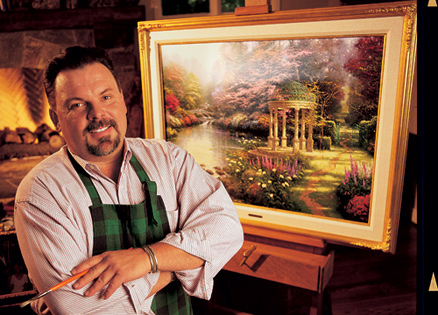
One afternoon, early in my career, I attended a showing of my work in a small gallery in northern California.
Among the people who stopped by to see my paintings, there was a man who wandered in off the street, saw the brightly lit artwork (as well as the complimentary hors d'oeuvres!) and decided to stroll around the show. After making his rounds, he pulled up beside me.

"So," he said, "why does this Kinkade guy have all the lights on in his paintings?"
"I couldn't tell you," I confessed.
"Well, if you see him," said the man, "ask him for me."
In a sense, I have spent my career trying to answer that question.
When I was a child, I would come home after school and our house would often stand empty, dark and cold. I'd hope, as I approached, that the lights would come on suddenly—that someone would swing open the door and wave and smile as I quickened my step.
I could hope, but I knew that no one would be home. My father had left us when I was little, so my mother worked late as a secretary to support the family. My brother and sisters frequently got home from school after I did.
I would scuff my heels along the sidewalks beside shadowy hedges and sycamore trees. I would stop and study a bird's nest or some wildflowers or perhaps the way wood smoke curled out of chimneys on cool days, but mostly I'd look at all the other houses I passed, the lights on in their windows, the brightness so inviting I wanted to dash up and ring the bell and wait to be offered some cookies and warm cinnamon milk.
When I finally reached my house, I was hesitant to open the door and go in. It was more than just being afraid of the dark. The lights within other houses on our street filled me with longing. I wished the whole world could be lit up like those houses. Even as a latchkey kid, I was a bit of a romantic.
By no means would I describe my childhood as a miserable one. Nothing could be further from the truth: In the foothills of the California Sierras, in the small town of Placerville, we Kinkade children—I, my older sisters and younger brother—enjoyed a blessed upbringing.
My brother and I made a tree house in our backyard and rolled go-carts down our drive. We would attend services at a country church down the lane from our house, the Kinkade clan taking up the length of a pew.
I would sit mesmerized not by the voice from the pulpit, but by the blue glass windows overhead and flickering yellow lights of the candles at the altar.
The Placerville of 35 years ago was an innocent place and time, the kind of town where we could ride our bikes to Main Street for a haircut and a bag of dime-store popcorn without our mother worrying, where a boy could deliver the local paper to the door of a pretty girl who would one day become his wife.
And it was a place where a boy could have his dream of becoming a painter nourished, his ever-supportive mother framing his drawings on the living room wall, right next to inexpensive prints by his heroes, Norman Rockwell and Rembrandt.
After high school, I took all my romantic aspirations and small-town innocence with me to the University of California at Berkeley. I wanted to become an artist of the people, a communicator with paint, the next Norman Rockwell.
I had a desire to touch people's lives with my paintings, and I believed that if I could be true to myself, if I could express my feelings and paint from my heart, my work would speak to people. Why else would I want to paint but to share the joy and light I felt inside with others?
Talk about culture shock! My homespun values were about to clash with twentieth-century intellectualism. No one at Berkeley seemed to find much merit in my idealistic approach. People were creating art around dark or pessimistic themes, exploring tortured inner feelings, childhood pain and personal insecurities.
My fellow students urged me to get in touch with inner demons. My paintings were deemed clichéd and sentimental and outdated.
I suppose I should be grateful for that period of my life, for the way my beliefs were tested. But at the time, each class hour felt like a blow to the stomach, my professors all fighting to tear down my idealism. To them, artwork was supposed to shock and disturb the viewer, not provide comfort and joy.
In my dorm room at night, I would lie awake, plagued by doubts. I worried that my professors had it right, that my vision was naive and simplistic. The light began to fade from my dream.
By the end of the year, I gave up on the art program altogether and switched to the College of Liberal Arts, studying literature and humanities. With each spare hour I had, I painted alone in a basement studio and did illustrations for a local newspaper, but every day was a struggle to discover how I could ever become the painter I'd vowed to be.
I'd pray for counsel, but didn't have any answer besides quietly painting and drawing and keeping my creative flame alive through work and hope. Then one day a friend asked me to a revival meeting and, to my surprise, I said yes.
I was 22 years old and I'd not gone to church regularly since I'd left home. I remembered the lights and glass and burning candles of my hometown chapel. Maybe the smell of a church would lift my spirits.
But the auditorium was dark and uninviting, part of an abandoned college, and I wondered what good could come out of a place as dreary as this. With its faded drapes and dusty windows, I couldn't see the slightest promise of light in the place.
As the enthusiastic young preacher's voice rose and his words, like a long-lost lifeblood, reached my heart, I felt something good within me stir. It was like the feeling I once got looking at a house all ablaze with the warmth of light, as if I at last had found home.
"God's in the room," the preacher was saying. "He's waiting to touch your life, to meet your every need, to fill your life with light. He's here. If you want to know him, come down to the altar. Come down to the altar now."
Without consciously willing it, I was suddenly rising and making my way down the aisle to the preacher, his words entering me like light enters glass. At the front of the auditorium, I found myself kneeling.
Open the doors, I was praying. Open the doors you want me to go through, God. I commit whatever talents I have to you. If there is any way you want to use me, please show me the direction clearly, dear God.
I felt myself filled with what I'd always wanted to fill my canvases with, felt lifted out of the dark morass of confusion. I sensed a freedom I'd never known before, freedom to paint as I had always wanted to. And from that day, it has been my life's mission to fulfill that dream of light and bring it to people.
I finished out Berkeley and went on to the Art Center College of Design in Pasadena, where some of my teachers did encourage my traditional approach. Along the way I seemed to be living out the cliché of the starving artist—working late into each evening and scrimping for art materials and tuition.
I tell you, those years were lean, but things were also falling into place for me.
A fellow artist, James Gurney, and I ended up traveling across America after two years at Art Center. We were, as the newspapers called us, two young "hobo artists."
In the process of working and traveling, we came up with the idea for a sketcher's handbook and hit New York with a book proposal in hand. The Artist's Guide to Sketching came to life and became an art instruction success by the time I was 24 years old.
In 1982, I married my childhood sweetheart, Nanette, and we returned home to Placerville, not far from where I'd first seen her on my paper route. My paintings soon started to sell. In fact, I couldn't keep up with the demand.
To reach more people, Nanette and I experimented with ways my work could be reproduced, including a process in which the print's inked image can be bonded with artist's canvas. With a few touches by trained artisans, the reproduced work on canvas had all of the appearance and texture and warmth of an original oil painting.
To convey hope and joy to others, the scenes I paint are alive with light. Each canvas is infused with brightness, because I believe this is how the world can be and sometimes is. A lighted window says home to me. It says all is well with the world, someone's waiting, someone cares.
Most of all, light exists in the dimension of the spirit. It was what God first created and is probably the most consistent metaphor in all of Scripture. Truth is represented as light, and in one bible passage, Christ affirms that each of us should "Let your light so shine before men, that they may see your good works, and glorify your Father which is in heaven."
But light is something you can't hold. You can't touch or taste or pin down its subtle, constantly changing effects. As a painter, light is the essence of what I try to capture on canvas—a light that dispels darkness, that chases away confusion and despair.
However, for me, the brightest light burns inwardly. With this supernatural, inspiring light, God illuminates our spiritual path and leads us to heaven through the love of his son. And heaven, at least in my artistic imagination, is a place where the windows always glow.
Download your FREE ebook, Creativity and Personal Growth: 7 Inspiring Stories On How Crafts Can Change Your Life
“See It and Believe It”
A few years after my dad went to be with the Lord and I stepped up to pastor our church, I was struck with the desire to write a book. Now, this was pretty far out. I’d never written anything besides sermons, and even they could be a challenge. Would I ever be able to write a whole book?
Of course, it wasn’t as if I’d ever expected to be a pastor either. I liked my job filming the services, and talking in front of people made me nervous. Then one Sunday I had an urge to say a few words to the congregation. Next thing I knew, I was leading worship!

I was sure God wouldn’t have put the desire to write a book in my heart if he wasn’t going to help me fulfill it someday, in his time. Until then, for motivation, I set two copies of my dad’s most popular book where I would see them every day–on a shelf by my bedroom closet.
One copy was in English, the other in Spanish. My dream was that my book too, when I wrote it, would be translated into Spanish.
A year went by. No book. Two years, three years, four. It would have been easy to let my dream die. But I had Daddy’s books strategically placed on that shelf. I had to walk by them every single day.
Even when I wasn’t consciously thinking about writing my own book, my subconscious mind and my spirit were moving closer to it. Something inside me was affirming, “Yes, one day I’m going to write a book.”
Studies show that we move toward what we consistently see. Keep something in front of you to remind you of what you’re aiming for.
A businessman I met had a dream of building a new office for his company. He bought a brick, the same type of brick he planned to use for his building. He kept that brick on his desk. Every time he laid eyes on it, his belief in his dream was renewed.
If you’re not reaching your highest potential, it might not be for lack of talent or determination, but because you’re not keeping the right things in front of you. All over your house, you should have pictures, Scripture verses, mementoes that inspire you to make your dream come true.
Say you’re single and you want to get married. Put an empty photo album on your coffee table. Why? That’s where you’re going to put your wedding photos. Consider it a tangible article of faith, a way of declaring, “Lord, I believe that you will lead me to the right partner and that one day I will be married.”
Or maybe you’re hoping to buy your dream house. Add a new key to your key ring. If somebody asks, “What’s this extra key for?” tell them, “It’s for the house that’s on the way.” See it and you’ll believe it!
My brother-in-law Kevin is a twin. He dreamed of having twins himself. He and my sister Lisa tried to have a baby for a long time. They attempted every fertility treatment available. Lisa had several surgeries. Nothing worked.
They were beyond discouraged. They were devastated. One day Kevin found a small package in the mailbox. There were two diapers inside, promotional samples from Huggies.
Kevin could have thrown them away, thinking, We don’t need these, and it looks like we never will. But something came alive in him. Those two diapers had to be a sign. He ran into the house and showed Lisa. “Look, honey, we just got the first diapers for our babies!”
He wrote the date on them and put them on his bedside table. Month after month, they were the first thing he saw when he opened his eyes, and the last thing he saw before he fell asleep.
Several years later, Kevin and Lisa got a phone call out of the blue asking if they would be interested in adopting a baby. “Yes!” they said. The caller asked, “Would you consider adopting two? These are twin girls about to be born, and they need a good home.” Talk about a dream come true!
Proverbs says, “where there is no vision, the people perish.” With no vision your dream will die, and part of you will die with it. Is there something you see every day that reminds you of what your dream is, something that inspires you and ignites your faith?
If your dream is to go to a particular college, buy a T-shirt with the school name and wear it confidently. Every time you see that T-shirt, say, “Thank you, Lord, for bringing my dreams to pass. For helping me become everything you created me to be.”
I learned this visualization technique from my father. He and my mother started Lakewood Church in 1959 in an old feed store. There were 90 people in the congregation. You know what Daddy called the church?
He set up a sign outside that declared in big blue letters: Lakewood International Outreach Center. The sign probably cost more than the building.
Of course it wasn’t an international outreach center. Not yet. It was a little old neighborhood church. But every time my father drove up and saw the sign, he was moving toward his vision.
Do you know what Lakewood is today? An outreach center that touches people all over the world. One year we had a conference and people came from 150 countries! It looked like the United Nations.
You’re not inconveniencing God by having big dreams. In fact, it’s just the opposite. If you can achieve your dreams with just your own strength, abilities and resources, your dreams are too small. Believe big! So big that you have no choice but to call on God.
Remember that book I dreamed about writing? In 2004 I wrote Your Best Life Now. When the publishers read the manuscript they decided to publish it in English and Spanish at the same time. What I’d kept visualizing finally came to be.
It had seemed far out, but God took my dream even further. My book was also translated into French, German, Russian, Swahili, Portuguese–more than 20 languages.
Don’t stop believing. Every dream, every goal God puts in your heart, he will bring to pass. And sometimes, he might even supersize it!
Download your FREE ebook, Rediscover the Power of Positive Thinking, with Norman Vincent Peale.
Secret Meaning of Beans

I was a single mother raising three teenagers when I met John, who had two young children of his own. After a two-year, long-distance relationship, we decided to get married, and John and I agreed that my kids and I would move halfway across the country to Kansas from our home in Seattle.
I loved John, but I was anxious about the move. Nevertheless, we packed our things and began a new life in the plains. It wasn’t easy. The kids didn’t make new friends as quickly as I had promised them they would. And I missed my old house, friends, job and the familiar surroundings of the Pacific Northwest.

Even God seemed far away. One dark, rainy day I poured my heart out to him: “Lord, please give me the fruits of the spirit, especially joy and peace.”
It was then, as I prayed, that I thought about making bean soup. I wondered if I had any beans on hand. Mentally I went through my pantry and remembered a jar with layers of different colored beans that a friend had given me before I left Seattle.
From the back of my cupboard I took out the jar, feeling another pang of homesickness. A hand-printed recipe hung from the lid on a piece of red yarn. I read it and dumped the beans into a pot to wash them. Then I saw something on the back of the card. My friend had matched the types of beans with eight virtues. “My family has used this recipe for generations,” she explained. As I read the list I recognized the fruits of the Spirit from Galatians:
Pearl Barley—Love
Split Peas—Joy
Black Beans—Peace
Red Beans—Patience
Pinto Beans—Kindness
Navy Beans—Goodness
Lentils—Gentleness
Black-eyed Peas—Self-control
When my family gathered around the table in front of piping hot bowls, I told them about our Fruits of the Spirit soup. “God will help us make it here,” I said. And indeed we did. Soon enough the kids made new friends, and I found peace in my new home. But most important, I found that with faith you never move away from God, only closer. A nearly forgotten jar of beans reminded me of that.