Embrace God's truth with our new book, The Lies that Bind

Her Mother With Alzheimer’s Sang ‘Silent Night’

In my mother’s room at the mem­ory care center, I dug through the clothes piled on the floor looking for a sweater and scarf. Her clos­et had plenty of hangers, but Mom, who’d always been tidy, no longer re­membered to use them.

“What’s happening, dear?” she asked, fuzzy on my name.

A Journey of Faith In Article Ad - Avail Now

“It’s Christmas Eve,” I reminded her. “We’re going to church. One of your favorite places.”

“We always go to such fun places,” Mom said, smiling vacantly. It was unclear what, if anything, she had understood.

I glanced at my watch. “We need to hurry.” My dad, husband and three kids were meeting us at church for the afternoon service. Even though I wanted to get Mom settled in a pew early, everything, even the simplest tasks, took longer now.

When I was making the 700-mile trip from my home in New Jersey to southern Indiana, where my parents lived, getting Mom to church had felt like my top priority. This would be Mom’s first Christmas at church since she’d gone into memory care. The Christmas Eve candlelight service was one of our traditions, and I’d want­ed her to have something familiar to hold on to.

But now I wondered. Mom’s Alzheimer’s disease had advanced. She’d barely left the facility in months. The church would be packed, and crowds sometimes overwhelmed her. Did Christmas have any meaning for Mom anymore?

As a long-distance caregiver, I’d had to let go of so much over the past 10 years, so much of the relationship I’d cherished between Mom and me. I’d even struggled to admit that Alzheimer’s could be the cause of her slipping memory, as if denial would somehow keep the de­mon at bay.

We’d talked on the phone every day back then. “I’m forgetting things,” she’d said during one call. “I think some­thing is wrong with me. I’m going to see the doctor.”

“Mom, you’re just doing too much,” I’d insisted. She was only 69, a retired teacher with a sharp mind. “You’re so busy gardening and volunteering. All your activities at church.”

Faith. That was one of the big differences between us. Mom rarely missed Sunday services or Bible study. She prayed often. When I was growing up, it was a given on Sunday mornings that Mom and I would be in a pew at our Methodist church in Jefferson­ville, sitting beside her moth­er, whom we called MeMe. (My much older brother had already flown the nest when I was little, or he would’ve been there too. )

“Your faith will always be some­thing you can rely on,” Mom told me. “You need to know God will be there to catch you when you fall.” For MeMe, church was a social event, but for Mom it was about feeling close to God, basking in his loving spirit. Even as a girl, I could see that.

I loved listening to Mom sing the old hymns in church, her voice soar­ing. The song coming from her lips was so joyful, as if she were one with the music. It was amazing.

Even so, after I left Jeffersonville to follow my dream of becoming a writer in New York City, I left church behind me too. I was focused on building my career, getting married, having kids.

Mom hated that her own children lived so far away; my brother had moved to Texas. I came home as of­ten as I could. Mom and I even took a girls’ trip to England, Wales and Ire­land. Mostly I stayed close through our daily calls.

MeMe had developed Alzheimer’s, and Mom had cared for her until the end. Mom was terrified that she too would fall victim to it. She didn’t want to be a burden to my father, my brother and me. I knew I couldn’t be the caregiver she had been. Not from New Jersey, where life was filled with respon­sibilities, a mortgage, young children.

“You don’t have dementia,” I’d told Mom over the phone. Was I trying to reassure her or myself?

Days later, while driving to nearby Louisville, Kentucky, to a doctor’s appointment, Mom got totally lost. She’d had to call Dad; he drove to her so she could follow him home.

“I don’t know what’s happening to me,” she said. “I’m scared, Kristen.”

The doctor’s diagnosis was incon­clusive, but I grew more anxious with each passing month and with each troubling call with Mom. I was no lon­ger in denial about her condition. I’d slipped into a kind of depression at the thought of losing Mom bit by bit to a disease that steals who we are. And of not being able to be there for her when she needed me most.

One Sunday morning, I decided to go to church alone. I picked a mega-church I’d often walked by. I remem­bered how loud and joyful the music had sounded, even from the street. The parishioners seemed happy and animated as they streamed outside after services. I wanted to feel what they were feeling.

I took a seat in a crowded pew. “We all suffer physical and mental health crises,” the pastor said. “Believe in God, and he will produce miracles.”

What kind of miracle could I hope for? I wondered. There’s no cure for Alzheimer’s, after all.

Still, when the service was over, the people around me greeted me with such genuine warmth and caring. I went back the next Sunday and the one after that.

I kept going. I learned the words to the praise songs. I started reading my Bible and praying, devoting time each day to nourishing my long-neglected spiritual side.

Mom declined slowly yet inexo­rably. Dad hid her car keys. Not be­ing able to go out by herself devas­tated her. I pushed to get Mom into a memory care facility. I called facilities across southern Indiana. But Dad and my brother felt it was too soon.

I poured out all my frustrations, my fears, my grief to God. My pastor spoke often about how faith could take the place of worry. Letting go, living in the moment and trusting the future to God. The more I grew spiritually, the more I wanted to learn. I started prac­ticing yoga, then eventually trained to become a yoga teacher, exploring even more deeply how to stay present.

My daily conversations with Mom were becoming more one-sided. I would tell her in detail about my fam­ily, the kids’ sports, my writing assign­ments, the TV shows we were into, what we ate for dinner, the songs I sang at church. It wasn’t always clear how much she registered, but Mom and I were connecting. That’s what I told myself, anyway.

One day, while I was at the yoga studio where I taught, Dad’s number popped up on my cell phone. Some­thing’s happened to Mom! I thought. But it was Dad who needed help. He’d gone to the VA hospital with chest pain. The doctor had ordered emer­gency quadruple bypass surgery for the next day.

Dad was scared for himself and even more worried about Mom. Could I come home? I raced to my house. My husband booked me a ticket for the next flight out.

I stayed in Indiana for two weeks. My brother also came to help. Mom was confused and upset by everything that was happening. I called eight agencies and found a home health care aide who could put in a full day with Mom and Dad after I’d gone back to New Jersey. She was a sweet wom­an older than my parents, who were in their late seventies by then.

Mean­while, I put Mom on a waiting list at a memory care center. I didn’t want to upset Dad by talking to him about it, but there was no doubt in my mind that Mom needed 24/7 care.

A room became available in January 2018, just as Dad arrived at the same conclusion on his own, surely an ex­ample of God at work. I went back to Indiana to help with the move. We packed Mom’s clothes, family photos and favorite coloring books. It was hard for everyone, but Mom was safe, which was the best I could hope for.

I couldn’t call her every day; a conver­sation didn’t hold her attention for long. Instead, I took to calling Dad every evening. In a way, it felt like honoring Mom. She’d been devoted to him for their 60-year marriage.

Through it all, I held fast to my faith, to the support and friendship I’d found at church. One Sunday, I stood to the strains of a praise song I’d come to love, “The Great I Am.” I raised my arms high, my body moving to the music, letting the words wash over me. “I want to be near, near to your heart. Loving the world, hating the dark.”

The voices around me lifted, joyous. It reminded me so much of childhood Sundays in Indiana, sitting beside Mom in church, listening to her sing out her love for the Lord. In draw­ing me back into his house, closer to him, God had given me a way to draw closer to my mother, a connection that went beyond words.

The faith that had sustained her had finally taken hold in me, and I couldn’t help but think this was what she would have wanted. Though we were separated by the miles between us, by her loss of memory, here in church, basking in the light of God’s love, I felt so close to my mom. This was my miracle.

That Christmas Eve in Indiana, af­ter Mom had gone into memory care, I got her dressed and drove us to church just before the candlelight service. Our family filed in. “Take our seats,” a young couple with a baby said. They were in the back row. Mom could sit near the end of the pew between Dad and me. Perfect.

We got settled, and the music—all the familiar carols—began: “The First Noel,” “Joy to the World,” “Angels We Have Heard on High.” Mom hummed and even sang some of the lyrics. She held Dad’s hand and mine. Then she closed her eyes and bowed her head.

“What is she doing?” Dad whispered to me.

“She’s praying,” I said. Dad had tears in his eyes.

Did Christmas still have meaning for Mom? I didn’t have to wonder anymore.

At the end of the service, as the sanctuary went dark and the congre­gation began singing “Silent Night,” I lit her candle. Mom’s eyes never left the flame as she mouthed the words. After the final verse, she puckered her lips and blew out her candle.

“Thank you,” she said. “That was beautiful.”

For more inspiring stories, subscribe to Guideposts magazine.
Her Mom With Alzheimer’s Still Inspires Her

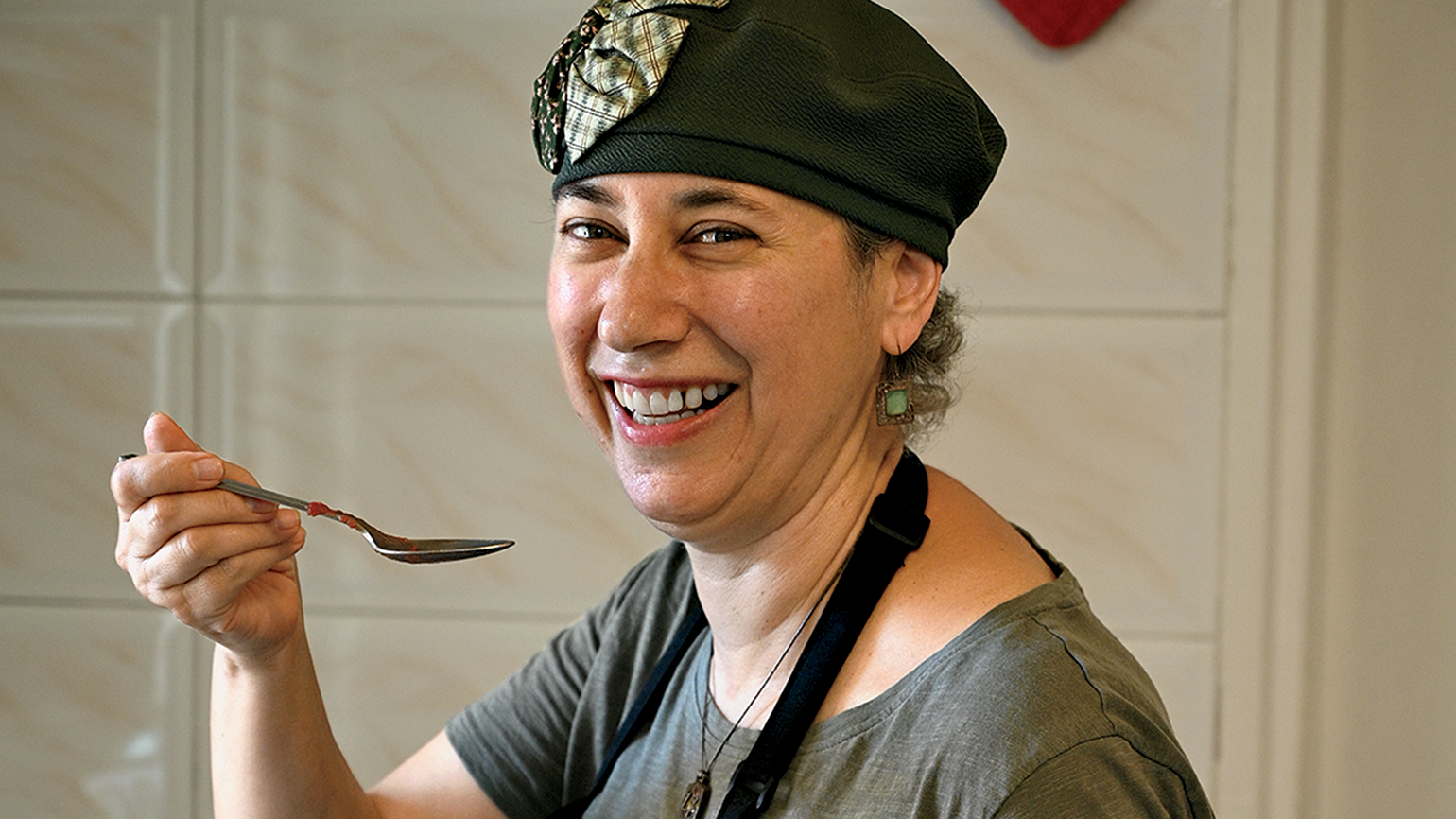
If there was a way to capture the essence of my mom, Naomi, it was through her cooking. My childhood was filled with bountiful family dinners, especially on Friday nights, when we celebrated Shabbat, and mouthwatering holiday feasts. The kitchen was Mom’s domain, the same way the lab was my scientist dad’s.

Both had grown up in the rough East End of London. My dad, Jack, had been as skinny as a rake. Mom’s cooking soon fattened him up.

Rejoice in All Things in article ad

My brother and I were born in England. We were toddlers when our family moved to the U.S. for Daddy’s career. We had a typical American childhood in Bethesda, Maryland. We went to the local synagogue, where Mom eventually became executive director. In our house, the kitchen was the best place to be. We each had our assigned seats around the butcher block table in the breakfast nook. I would sit for hours in my heavy oak chair, reading all manner of books. The radio was tuned to rock or classical, depending on who got to it first. And Mom was always there by the counter, cutting, chopping, stirring.

Mom’s chicken soup was her expression of love for our family. She cooked this dish with only fresh herbs (don’t even think of using dried herbs!) and vegetables cut into big chunks. We delighted in the clear golden broth, the tender strands of chicken, the soft celery and aromatic dill. It was the highlight of every Shabbat dinner.

I moved to Israel with my husband in 1991. Jeff and I made our home in Beer Sheva, in the Negev desert. My parents soon moved to Israel as well, to the Mediterranean resort city of Netanya. Jeff and I traveled with our kids to Netanya to share Shabbat with my parents. We’d walk together along the beach, then feast on one of Mom’s amazing Shabbat dinners—roasted meat and eggplant, hummus, challah, plum pie and, of course, chicken soup. The kids always asked for seconds, sometimes even thirds, of the fragrant dish.

In 2010, at the age of 69, Mom was diagnosed with Alzheimer’s. She remained bubbly, talkative and good-natured. She could make jokes and sing along to her favorite songs. But she could no longer manage cooking those tremendous meals. A huge part of her identity—the nurturing mother and wife who gave love through her cooking—was lost.

For the first time in his life, Daddy started cooking. We joked that he had found his true passion. He brought his scientific expertise into the kitchen.

Every Tuesday, I’d make the two-and-a-half-hour trip to Netanya. Mom and I would roam the bustling streets, window shopping and telling jokes. We’d drink coffee at a café with a view of the sea. I tried to keep our outings stress-free. If that meant bending the truth to fit Mom’s reality, that’s what I did. Sometimes she informed me she was 46, which made me older than she was. I’d just go along with it.

I knew the longer I could keep Mom active and involved, the longer we would have her around with us. I took her grocery shopping and had her help me choose ingredients, even if she mixed up tomatoes and red peppers. When we made soup, I’d help Mom cut vegetables so she could still take part in cooking.

Sometimes she wanted to be held. The first time she came into my arms, I felt awkward. I comforted her, but I knew that what I wanted—to remain her child—could not last. Even the Jewish grace after meals became problematic. Sitting at my parents’ table, I recited, “God of compassion, bless my father and my mother, my teachers, hosts of this household.” I felt sad saying the words. Mom had taught me many things over the years, some practical (how to check eggs before you buy a carton), others intangible (that children thrive when you love them unconditionally). Was she still my teacher?

As a way to cope, I stationed myself in my kitchen and focused on cooking, incorporating recipes from Mom and borrowing from the cultures around me. Mom gave me all her cookbooks, and I studied the notes she’d made in them. I found her handwritten recipe for sesame green beans taped inside Florence Greenberg’s Jewish Cookery Book and added it to my repertoire.

My kitchen experiments brought back memories that turned out to hold new significance—for instance, my favorite cake Mom used to make when my brother and I were kids. Failure cakes, we called them. I don’t recall why she let us eat the first one. Had she left out an ingredient? Misjudged the baking time? The batter rose to a rich, wine-sweetened cake with a hint of nutmeg. Delicious! We begged Mom to make more. She did, just for us. The flaw turned out to be what made the cake special. Failure cakes are an apt metaphor for Alzheimer’s. I try to find a success within the limitations the disease has put on her life. Take my Tuesdays with Mom—it didn’t matter how many times we drank coffee in the same café or window-shopped at the same stores. What mattered was that we were together. Each visit was new for her, and I loved those moments of joy and laughter as much as she did.

Then there were the meals that Mom used to patch together from leftovers—they were legendary in our house. She’d bring to the table a pan brimming with chicken or beef cut into small pieces and sautéed with as many vegetables as would fit. Onions, peppers, maybe green beans and cauliflower. She’d add soy sauce, tomato paste or leftover gravy to create a delectable sauce. I can’t say there hasn’t been grumbling from my kids when dinner appears on the table as a reinvented version of yesterday’s fare. But as when I was growing up, every time we make Mom’s Leftovers Supreme, it turns out different and delicious. It’s all in the quality of what you’ve got to put in it. And the amount of love you add. Sort of like our lives. Even as Alzheimer’s claims more of her abilities, Mom is still teaching me.

For more inspiring stories, subscribe to Guideposts magazine.

Her Loving Grandpa Saved Her From Addiction

Something brushed my hand and I stirred awake. There was my beloved grandpa Kegg beside me. He was holding my hand. “Honey, wake up,” he said. I glanced around. I was in a hospital bed. What was happening? I felt panic until I looked at my grandfather’s face. He always made me feel better, no matter what.

Family meant everything to me. I learned that growing up in Johnstown, Pa. I had love and support from my parents, my three brothers, and especially my grandfather. I believed Grandpa Kegg knew everything, and he didn’t mind a bit that I thought so. He lived right next door, so we kids were often at his house. Grandpa took a morning walk and sometimes we’d trail along. He had a favorite hat—a red plaid hunting cap—and he wore it year in, year out. “Guess what’s in my pocket?” he’d ask. He might have had gum or a shiny nickel or a stone he’d rubbed till it shone. If one of us was worried about homework or trouble with a friend, he’d make silly noises to get us laughing. “Quack, quack!” he said once when I was feeling low. My mood brightened instantly. Whatever was wrong, Grandpa had that effect on me.

Still, I had trouble with my moods. My teenage years weren’t easy. I was changing from a girl into a woman, and I didn’t understand what I was feeling. Happy one minute, sad the next. Excited to be growing up and afraid of it at the same time. I was confused and somehow uncomfortable in my own skin. What was happening to me? Was I normal? In some ways my family all felt like strangers to me. I could talk with Grandpa Kegg about almost anything. But these feelings were something I couldn’t express—to anyone. I kept everything bottled up. Kids at school made fun of me because I was withdrawn. I felt different, and I thought it was all my fault. I didn’t know the word for it back then, but I was depressed most of the time.

“Something wrong with my little girl?” Grandpa Kegg asked one day. “No, I’m okay,” I said, and turned away. Grandpa put his hands on my shoulders and pivoted me back around. He could see that I was too old for silly duck quacks to cheer me up, and that my troubles these days were more serious than a tiff with a friend. “Oh, honey,” he said, and hugged me tight. God and his angels could see me from heaven, but more than anyone on earth my grandpa understood me. I felt close to heaven in his arms.

As soon as I graduated from high school I decided to strike out on my own. “I think I’ll go live in Florida,” I said to my parents. “Just for a while.” They thought maybe a change of scenery would do me some good.

I flew to Tampa, found a job and a room to rent. I liked the Gulf Coast and the warm, tropical air. One morning I walked along the bay, thinking of Grandpa in his red plaid cap. Life seemed very different here in Florida. Maybe I can be different here too, I thought. More like the little girl who used to laugh at Grandpa’s silly duck quacks.

But I hadn’t left my depression back home. Being on my own only made it worse. I looked for friends to fill my time between working. “Let’s party!” a girl said to me in a bar one night. Turned out she was as troubled as I was, but she knew how to escape—alcohol and drugs. “Come on,” she said. “Try it.” I did. What would Grandpa Kegg think of his little girl now? I wondered. Before I knew it, I was “partying” every night. Instead of an escape from depression, my new lifestyle became another kind of trap.

By this time I’d become an expert at covering things up. I learned to hide my drinking just as I’d hidden my depression. No one knew the real me. I found a new job whenever I lost one, and got through my twenties. But I couldn’t hide from myself. I missed Grandpa. I missed my family. Finally I went back to Johnstown. But all the old insecurities waited for me there. Moving to Florida hadn’t cured my depression, and it looked like moving back home wasn’t going to cure my drug and alcohol addiction. Grandpa could see I was in more trouble than ever. I was grown up now, but the little girl in me still struggled for help.

One night I drank myself to the lowest point I’d ever known. I didn’t want to go on with my life. I stumbled into the bathroom and opened the medicine chest. A full bottle of pills stared back at me. I filled a glass of water and swallowed every last one. I lay down on my bed. “Please, God, I can’t fight anymore. Let me go to sleep and never wake up.” I hoped the people I loved would forgive me.

Now, with Grandpa Kegg there beside me I wondered how I’d wound up in this hospital bed. Grandpa was wearing his red plaid cap. He’s out for his morning walk, I thought. But why am I here?

Grandpa looked very sad, and kept patting my hand. “Honey, you have to wake up,” he said. “Your life isn’t over yet.” Then I remembered what had happened. I was so embarrassed. Did Grandpa know what I’d done? I wanted to tell him everything. I knew he’d understand. I knew he’d still love me. And that—more than anything else—made me want to change my life. Looking into Grandpa’s loving face, I knew I could do it. I had so much to say to him, but I was so tired….

I must have drifted off to sleep. Mom was holding my hand when I woke up again. My whole family was there, everyone except my grandfather. “Where’s Grandpa?” I mumbled.

“You’ve been asleep for three days,” Mom said softly. “Your grandpa’s been so afraid you’d never wake up, he hasn’t left the house once.”

I didn’t argue. I knew in my heart that Grandpa had come to comfort me. As soon as I was discharged from the hospital I went to see him. He hugged me so tight he took my breath away. It was heaven to be in his arms again. “Your visit to the hospital changed me,” I said. “I’ll be the Kristine you’ve always known and loved. You’ll see.”

Grandpa looked at me with tears in his eyes. “But, Kristine, I didn’t go to the hospital,” he said. “I just couldn’t.”

“You must have gone during your daily walk. You wore your favorite cap.”

“You know I couldn’t have walked all the way to the hospital,” Grandpa said. He was quiet, trying to make sense of what might have happened.

“I know it was you, Grandpa. You told me to wake up and I did.”

Grandpa’s eyes twinkled, as if he’d found an answer to our riddle. “Heaven wasn’t ready for you,” he said. “I suppose God sent an angel to tell you so.”

Chills ran over me. My grandpa did know everything. And he knew that the heavenly angel who appeared to me in the hospital was meant to remind me of the earthly angel I’d loved and trusted all my life. And the angel was right. My life wasn’t over. In fact, every day feels like a brand-new beginning.

This story first appeared in the July 2008 issue of Angels on Earth magazine.

Her Husband Was Addicted to Meth. Could She Find the Strength to Leave?

Midnight on New Year’s Eve. I was in a rental car in Denver, Colorado. My 10-year-old son, Rylan, was sitting beside me. A flurry of fireworks exploded in the sky above us. Rylan gazed up with tired eyes. It was late, and we’d just gotten off a plane from Washington State, where we’d been visiting my parents.

My husband, Heath, should have been at the airport to pick us up. We lived 70 miles away in Estes Park, a small town at the foot of Rocky Mountain National Park.

extraordinary women of the bible

Heath was in jail. He’d been arrested for stealing copper from construction sites, where he worked as a heavy equipment operator. He sold the copper to pay for drugs. He’d called from jail while Rylan and I were on our way to the airport in Washington.

A meth addict. That’s what Heath was. Dropping Rylan and me off at the start of our trip, he’d given us big hugs and assured me he’d be fine. He couldn’t join us because he had to work. Or so he said.

I should have known better. Heath had been abusing drugs on and off since before I met him, though it took me—so naive!—a long time to figure that out. He’d spent most of our marriage promising to get clean, relapsing and promising again, begging me to believe him.

Now, heading out of Denver on the interstate, I knew I had a decision to make. Heath wanted me to bail him out. He expected to see me at the jail in the morning. He’d sounded frightened and confused on the phone. “I can explain everything,” he’d said. “This’ll never happen again, I swear.” I glanced over at Rylan, who was now asleep. Heath was his father. My husband. The thought of breaking up our family was unthinkable. Or it had been until now. We couldn’t keep going on like this.

What made it all even harder was that, when he was sober, Heath was a wonderful man. Funny. Charismatic. Loving. Devoted to his mother and grandmother. A great dad to Rylan—when he was around.

We’d met in our twenties, after I moved to Estes Park for an elementary school teaching job. I’m from Wisconsin. The beauty of Colorado took my breath away. I wanted to be outside all the time. Heath loved the outdoors too—hiking, fishing and hunting.


I liked him the second I saw him at a music club. He was cute, a funny dancer, but he didn’t seem to care what people thought. The two of us hit it off and started dating. Soon we were living together and I got pregnant. Heath was ecstatic.

I had a different reaction. I knew I should want to marry Heath. I loved him and could tell he loved me. We lived together. We were going to have a child together.

But something felt wrong, and I couldn’t bring myself to commit. Heath wasn’t the most reliable guy. I knew he worked in construction, and he always seemed to have steady income. But his hours were irregular. He never had pay stubs. Some nights he’d come home late, and the reasons he gave sounded implausible. Suspicious, even.

He’d done a lot of partying in high school and college, but he swore those days were behind him. Still, some part of me didn’t fully trust Heath. Though I loved him, I held something back. Not long after Rylan was born, I was doing laundry when I found something in one of Heath’s jacket pockets.

A small glass tube with a globe on one end. I had no idea what it was. I didn’t ask Heath; instead, I showed it to a friend the next day. She didn’t know either, but her teenage son did.

“That’s a meth pipe,” he said.

I confronted Heath. He was defensive but then broke down and admitted he smoked meth. He’d tried it in college and still did it sometimes.

“But I’m not an addict!” he protested. “I can stop. I will stop.”

I was so scared, I told Heath to move out anyway and took Rylan with me for a few months to Wisconsin, where my dad and stepmom lived. I told Heath we were done—and definitely not getting married—until he was clean.

I thought for sure his love for me and Rylan would motivate him to give up the drugs. But Heath seemed to get worse. Once we were back in Estes Park, he drifted in and out of our lives, sometimes sober, sometimes not. My parents kept telling me to let him go for good, but how could I do that to the father of my son? Plus, I’m a teacher. I look for the good in people. I was sure I could fix Heath. I mean, if I couldn’t, who could?

Heath insisted he could fix himself. He never entered a 12-step program— “I don’t need that, I can do it on my own”—yet eventually he managed a year of sobriety. I agreed to get married. Our wedding was three months after Rylan’s ninth birthday. Heath moved back in with us, and we started talking about having another baby.

Then, one day, I noticed a pair of skis missing from our storage shed.

“No idea,” Heath said when I asked where they went. “Maybe someone stole them?”

More things disappeared. Heath started coming home late again. I discovered thousands of dollars missing from our savings account. He fell back into the old cycle of drug use, promises to quit and relapse. Now that we were married and Rylan was old enough to want his dad in his life, I found it harder to leave. I did everything I could to get Heath to quit.

I covered up for him with bosses. Lied to my parents and friends. Filled out job applications for him.

The end result of all that? A New Year’s Eve phone call from jail. And now here I was, pulling up to our condo in the rental car. I woke Rylan, and we went inside. The condo was a disaster. Dishes and food everywhere. Our Christmas tree tilted over in the living room.

I tucked Rylan in and collapsed on the couch. I felt alone. Terrified. “God, help me,” I whispered even though I hadn’t been to church in ages. Then I went to bed.

I woke up the next morning with the same pit in my stomach. But something had shifted. I knew what I had to do.

“Erin, where are you?” Heath said when he called. “When are you coming to bail me out?”

“I’m not bailing you out, Heath,” I said. “I’m not staying in Estes Park. I’m taking Rylan, and we’re moving to Washington. When you’re clean, you can call me and we can talk. But I can’t take this anymore. I’m leaving you.”

Heath was angry, but I didn’t stay on the phone with him long enough to let him change my mind. I called my mom and told her everything. “About time!” she said.

I resigned my teaching job and started packing up the condo. Mom flew down to help out.

The day before my thirty-ninth birthday, I was unloading a rental truck into my mom and stepdad’s garage. It felt like the worst day of my life. My marriage was probably over. I had no job. No place to live. Rylan, desperate not to lose his father, was confused and angry, lashing out at my mom for encouraging us to move.

A few days later, I called Lynne, a friend and fellow teacher back in Colorado. Lynne’s son had struggled for years with addiction to opioids.

“I feel lost,” I told her. “I don’t even know if I did the right thing coming here. Rylan is furious. And I’m so depressed. I can barely get out of bed in the morning.”

“You were very brave,” Lynne said. “Maybe you should try going to Al-Anon. It’s really helped me.”

Lynne meant the 12-step program for loved ones of addicts based on the principles of Alcoholics Anonymous. I didn’t know much about it, but I was willing to give it a try.

I said nothing at the first meeting I attended, just listened to stories that sounded like mine. Exactly like mine. The feelings if not the facts.

At the second meeting, I heard a word I’d never heard before: enabling. It meant helping an addict in all the wrong ways—ways that hurt not only you but the addict too, even if you think you are helping.

Was that what I’d been doing with Heath? Enabling his addiction? But I wanted him to get sober!

The more Al-Anon meetings I attended, working the 12 steps, the more I realized I’d been making mistakes from the minute I discovered that meth pipe in Heath’s jacket pocket. Again and again I’d let hope triumph over reality. Rather than committing Heath to God’s care and protecting myself and Rylan from the damage of my husband’s addiction, I’d tried to fix Heath. At Al-Anon I learned the hard truth that you can’t fix an addict. Only the addict—invoking the help of their higher power—has the ability to do that.

Heath called every day. I kept those calls brief—Heath was still mad. Then gradually, I noticed, things changed. Heath was routed into a drug court program that required him to attend a 12-step meeting every day. He checked into a 30-day residential rehab program. He went to church.

I found a church too, headed by a wonderful pastor named Abby, who was my age. Pastor Abby invited me out to coffee and encouraged me to join the women’s group. I sang in the choir. Rylan started school, joined a soccer team and made friends.

Heath began working the 12 steps. He made amends to Rylan and me and told me getting arrested was the best thing that could have happened to him because it forced him to take inventory of his life and addiction.

“I was so mad at you when you said you wouldn’t bail me out,” he said. “But that’s what saved me.”

I found a job teaching fourth grade. Rylan and I moved into a small house overlooking the ocean, and I spent a lot of prayer time walking along the water, my footsteps in the sand.

Near the end of his drug court program, Heath got permission to serve the last few months of his probation in Washington. He moved in with Rylan and me, and a year later he’s still here. Still sober.

A foundational principle of 12-step programs is One day at a time. Neither Heath nor I take his sobriety for granted. Relapse is always a threat. Each day we do what I did the night Heath got arrested—ask God for help. Addiction is a disease you can never turn your back on.

I know it was God, and only God, who gave me the courage to leave Heath. Only God could fix Heath. Like Heath said, my decision saved his life.

It also saved our marriage—and our family too.

For more inspiring stories, subscribe to Guideposts magazine.
Her Husband Had a Stroke When He Was 30

Dave, my husband, was working crazy 18-hour days. I hardly saw him. But there was no reason to expect otherwise. He was a doctor in his third year of residency in orthopedic surgery at Rush University in Chicago. He had to work hard. He’d always worked hard. That’s who he was. Type A all the way. Focused, driven.

All the more reason we needed this vacation, a babymoon. I was five months pregnant with our first child, and we figured we’d give ourselves a trip to Hawaii before things got even more crazy. Just the two of us. Time together.

GP In Article Desktop

The last thing we did before leaving our apartment was say goodbye to our dog Penny. (A friend was going to pick her up later.) Penny wagged her tail and went around in circles. Dave gave her a hug. “We’ll be back soon. You’ll see us again, Penny.” That was Dave, the man I married. Affectionate and reassuring, seeing to the needs of the ones he loved. Even Penny.

We jumped in a taxi to O’Hare International Airport. As soon as our flight took off, Dave got out his laptop. Some medical article he had to read, I figured. “Don’t work too hard,” I said, squeezing his hand. “I’m taking a nap.”

The next thing I knew, he was giving me a nudge and asking me to look in his eyes, his right pupil so dilated, I couldn’t even see the iris. Fear rushed through me. “Are you having a stroke?” I asked.

“I think so,” Dave said. Then he lost consciousness.

I rushed to get help. There was a nurse in the row in front of us, soon joined by a doctor and an EMT also on the flight. They stretched out Dave’s unconscious six-foot, two-hundred-pound frame across a row of seats. “He needs to get to a hospital immediately,” the doctor said. We made an emergency landing in Fargo, North Dakota.

At the hospital, Dave was intubated but didn’t wake up. Family flew in. I looked to Dave’s dad—a neurologist—for some sign of hope. Surely he would know what to do. But the diagnosis was anything but reassuring: an ischemic midbrain stroke, one of the worst kinds. All I could do was pray and ask others to pray.

That night I had a dream that Jesus was with Dave in the hospital, telling him about all the prayers coming his way. “I’m on the case,” Jesus said, sounding just like a doctor. Like Dave.

After three days, my husband was transferred by air ambulance to Chicago, still unconscious. Best to get him back at Rush, close to home, with doctors and nurses who knew him. If only he’d wake up.

That first full day at Rush, I showed up in his room and was amazed to find him sitting up in bed, alert, smiling. I grabbed his hand. The nurse asked him who I was. “Alli,” he said. Who was she? “My wife.” How long had we been married? “Four years.”

I was overwhelmed with relief… briefly. Dave’s father took me aside and let me know just how complex Dave’s case was. The part of the brain damaged by Dave’s stroke, the thalamus, did not regulate his basic motor skills. Soon enough he would be moving around. He’d look normal, but his cognitive deficits were the most worrisome. The thalamus, my father-in-law explained, is like a microprocessor, coordinating everything the brain does, including thinking and personality.

“He might not be the same man, Allison,” my father-in-law said.

Every day, I was with Dave at the hospital and then at the rehab hospital, working with the doctors, the nurses, the therapists. Trying to be positive. Holding on to hope. But at night, home alone with Penny, I found it harder to keep the faith. Would I ever get my husband back? Would he ever be the same? His conversation was an incoherent babble so much of the time, this brilliant man who never used to stumble over a word.

Friends tried to reassure me: “It’s a marathon, not a sprint.” “Take it day by day.” “It will be a long road.” “Two steps forward, one step backward.” What they said might have been clichés, but there was a truth to them: It would be a long road; it would be a marathon. I had to accept that.

Yet not even the top neurosurgeons could say whether my Dave would emerge from his damaged brain. Control was an illusion that had shattered into a million pieces. What would happen when Dave came home? How would we manage when the baby arrived?

One day in speech therapy, Dave was asked to name as many fruits and vegetables as he could in one minute. He named three. He was supposed to come up with a woman’s name for each letter of the alphabet. He couldn’t get past the letter A. My name begins with A.

So much of our relationship had been based on unspoken signals. Dave was intuitive. He knew when I hurt, when I needed quiet, when I yearned for a hug, when it was time to laugh. Gone. Everything at home reminded me of how far removed our former life had become. The dishes we had received as wedding presents, photos of us on trips, notes we had written to each other and tucked in random places. Would my husband ever be the same man, or would he stay a stranger? The thought rattled me to the core.

I told myself I should be grateful that Dave was still alive. But this man, this stranger working so hard with therapist after therapist, was not the man I married. “I’m on the case,” Jesus had said in my dream. Was this as far as the case would come?

My friend Marya came from Washington, D.C., to help out. I was in my sixth month, the fatigue all-encompassing. Our unborn daughter. I could feel her kick and squirm. Would she ever know her father the way I had known him? What kind of parent could he be?

Marya came up with a plan to cheer us both up. She would bring Penny down to the rehab hospital, and I’d bring Dave outside to greet her. He hadn’t seen Penny since we left for our aborted vacation, weeks earlier. I could still picture her wagging her tail, turning in circles, as Dave knelt down to hug her. One of the last moments of our previous life.

The two of us went down to the street and stepped out of the hospital. There was Penny on her leash. Dave didn’t even recognize her. More shocking, Penny didn’t seem to know him. She cowered between my legs as though he were a complete stranger, a confirmation of all my deepest unspoken fears.

Dave came home. He transitioned to outpatient therapy. He slept for hours. I drove him back and forth as if he were a kid. Those clichés were proving all too true. A marathon, not a sprint. One step forward, one step back. Any day would see the birth of our daughter. We’d gone to classes; we’d done all the preparation. Dave would be my coach. But that was the other Dave; the old Dave, my partner.

His rehab doctor assured me that Dave would be able to participate in the birth of our daughter, but I wasn’t so sure. I just couldn’t see how Dave would be able to focus on everything happening at the hospital that day, much less the tasks of caring for a newborn. No matter how much I prayed, I worried. How were we going to manage?

On a Saturday in October, I went into labor. We hung out at home for as long as we could, then got a ride to the Northwestern Prentice Women’s Hospital, where I was admitted. At least it was a different hospital than the one where Dave had been.

The Chicago Cubs were playing that evening, hoping for a long-awaited chance to go to the World Series, the entire city in a postseason frenzy of red and blue. The game was on TV in the background, Dave turning to it in between contractions. Was he incapable of concentrating on my labor? More interested in a simple baseball game? No. No, I sensed, this was more like the old Dave—relaxed, confidently multitasking, monitoring my contractions, cheering me on, bringing me damp washcloths to swab the sweat from my face, squeezing my hand just when I needed it. Me squeezing back, just as I’d done on the plane right before the stroke.

Our baby made her entrance. Dave himself cut the umbilical cord. The moment he took our little girl in his arms, I could see the pure love in his soft green eyes. It was that part of him, his soul, divinely given, that still burned bright. That part of Dave—of all of us—that remains intact, no matter what.

There were still many more months of rehab to go, and none of it was any easier with a newborn around. The sleepless nights, the challenge of taking care of our daughter while also taking care of Dave and cheering him on at home and at rehab. Sometimes the fears got the better of me. But my faith had grown. I’d always thought that what you believed would shelter you from the worst. Now I knew: Faith was the companion that sustained you through the worst.

One year after the stroke, Dave returned to his residency. He is a doctor today, although not a surgeon—he works as a hospital consultant. He’s bright, committed, maybe a little less type A than he used to be. He has changed, but I have too. I think of a line I’ve circled and underlined in one of my favorite devotionals: “The truth is that self-sufficiency is a myth perpetuated by pride and temporary success. Health and wealth can disappear instantly, as can life itself. Rejoice in your insufficiency, knowing that God’s power is made perfect in weakness.” It is indeed.

For more inspiring stories, subscribe to Guideposts magazine.

Her Healing in Haiti

Mail lay scattered across the kitchen table. I couldn’t put off sorting through it any longer. I flipped through the envelopes, putting aside the ones addressed to my husband.

It had been over three years since Bob had died from complications after minor surgery. To friends and family it looked like I had moved past the worst of my grief. I took care of my house, socialized, kept up with church committees. On the outside everything appeared to be normal.

Mys of Blackberry Valley In Article Ad

But inside I was anything but. I worried I would never get better. Never be myself again. They say grief has no set time limit, but I was so tired of feeling empty and hopeless. My grief was sharp and fresh as ever. It was like a wall of pressure in my chest, crushing my heart.

I snatched up a piece of Bob’s mail and held it out to tear in half. Will this feeling ever go away? I thought–and stopped myself from ripping the envelope to shreds.

The letter was from an organization that funded a Haitian orphanage called My Father’s House. Its founder, Carol Hawthorne, had given a presentation at our church. Bob and I had donated, and Bob ended up on the mailing list to receive the newsletter with updates on the children.

I hadn’t read one since Bob died. But just three months before, in January 2010, the country had been hit by a terrible earthquake. In my depressed state, it hadn’t even occurred to me to wonder whether the orphanage had survived.

I opened the newsletter and was relieved to find out that My Father’s House was still standing. Of course now it was more crowded than ever. At the bottom of the page was an announcement about an upcoming mission trip to visit the orphanage in person. I should go.

The thought wouldn’t leave me. I contacted Carol Hawthorne. “What would I do if I go?” I asked. “Build houses?”

“The Haitian people there are eager to work and they know what they’re doing,” said Carol. “What they need are raw materials, and we provide them. We also visit with the children. We go to clinics and schools, pass out supplies. You’ll be very busy, I promise!”

I reserved a spot but didn’t mention it to any of my friends. Just a few weeks later, I was at JFK with seven strangers, waiting to board a plane to Port-au- Prince. Even after takeoff I wasn’t really sure of what I was doing.

In Haiti we were met by Pastor Ronald Lefranc, the director of My Father’s House. We piled into an old school bus and drove over bumpy roads full of potholes, gravel and mud.

We passed women wobbling under the weight of huge water buckets balanced on their heads. Piles of refuse littered the landscape, and the land was dotted with ragged tents and tin shanties.

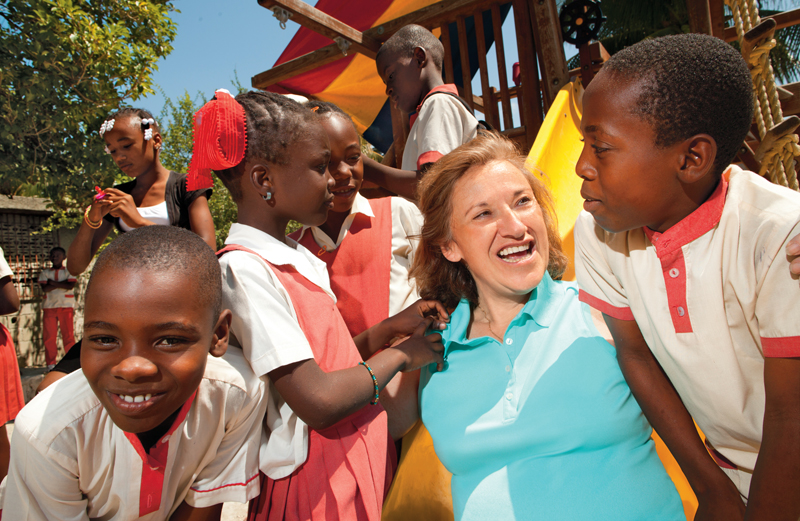
Finally we pulled up to the orphanage. A crowd of children–52 in all–rushed up to greet us. I couldn’t understand the words of the welcome song they sang in Creole, but with the smiles on their faces I didn’t need to. Each child planted a big kiss on my cheek.

Carol and Pastor Ronald led us into the main building. “What are those over there?” I asked, pointing to a collection of flimsy tents. “Is there not enough room in the building for all the children?”

“We have the room,” said Pastor Ronald. “But many of these children came here after the earthquake. They still don’t feel safe sleeping under a roof.”

There was no sign of fear in the playroom inside. I played dolls, patty-cake and beauty parlor. Children I’d just met presented me with pictures they’d drawn and letters written in Creole. They’d lost so much, yet were so joyful.

In the evening the children gathered in the dining room for devotions. They passed a Bible between them, taking turns reading aloud. One of the older children stood up to speak and then they all joined in song. The words were strange, but the tune sounded familiar. “‘Amazing Grace!’” I said.

Carol grinned. “I’ll bet you’ve never heard it sung in Creole!”

The children recited the Lord’s Prayer and settled down. In the silence, a quiet buzzing noise began. I looked around for its source. Had some tropical insects gotten into the place?

Then I realized the buzz came from the children themselves as they prayed, each one in a whispered, intense conversation with God.

As Carol had promised, it was a busy week. We drove up to villages in the mountains and visited medical clinics. We passed out toothpaste, soap and special buckets that filtered out bacteria from the water. There was so much to do I had no time to dwell on my own feelings.

But one afternoon toward the end of the week, sitting in the playroom of the orphanage, I felt like something was missing. It was as if something I’d carried for a long time was gone. What was it?

One of the girls handed me a note in Creole. A translator read it out to me: “Dear Michelle,” it said, “I am very happy that you came to Haiti. I think that you are very happy too.”

Tears sprang to my eyes. She was right. I was happy. The wall of pressure in my chest had disappeared.

My love for Bob was there, strong as ever. I still missed him and I knew I always would. But I was myself again. The children here did more than distract me from my grief. They taught me through example that I could feel joy in spite of it.

The next day the children sang us a farewell song. I kissed each of them good-bye. “Are you coming back?” one of the girls asked.

“Yes,” I said. And I would, as often as I could. Because My Father’s House was filled to overflowing with little angels who’d given me far more than I could give back in return.

Learn about relief organizations that are making a difference in Haiti!

Download your FREE ebook, Angel Sightings: 7 Inspirational Stories About Heavenly Angels and Everyday Angels on Earth

Her Fears Made Her Angry at Her Husband of 60 Years

I woke with a start one night last February when my husband, Bill, came into my room at midnight. He was leaning weakly against the doorway. “I need to go to the hospital,” he said.

“What’s wrong?” I asked. “What happened?” Bill had attended a piano concert with friends near our Seattle home that night. I’d stayed in and gone to bed before he got home.

The Daily Bible Large Print relaunch with digital free gift in article ad

“The last thing I remember is getting out of the car and Dean driving away,” Bill said, his face ashen. “Then I woke up lying on my bed, still dressed.” I called 911 and pulled on my clothes. I was worried sick. Why had Bill blacked out?

When we went outside to the ambulance, I saw Bill’s hat and glasses lying on the icy ground in front of our condo. I asked the EMT to pick them up. In the ER, they told us Bill had broken the mastoid section of the temporal bone by his ear and suffered a concussion. Because he couldn’t recall the accident, the doctors kept him overnight for tests, but all they found was an irregular heartbeat—something that could be controlled with medication. As far as any of us could figure out, Bill had just slipped on the ice and fallen, hitting his head on the ground.

What kind of person walks carelessly on icy pavement? I thought. I knew to step carefully, as if walking on eggshells. Why didn’t he? Especially at this stage of our lives—he and I were both 83—and with two daughters and five grandchildren who worried about us. But I didn’t say anything to him. What good would it do?

When Bill volunteered, “I should have been more careful,” I sat in stony silence. Even after his admission, I felt annoyed and resentful, but I pushed those feelings down. After all, we were each other’s caregivers. I have a minor congenital heart condition that could worsen, and in the past decade, Bill has battled both prostate and skin cancer. We stick close together for emotional—and actual—support.

One afternoon at the end of July, almost six months later, we were on a bus headed to Harborview Medical Center for Bill’s eye exam. As the bus started onto the Ship Canal Bridge, Bill stood up and walked the few steps to the front of the bus to pick up a new route schedule. Suddenly the driver braked. Bill, his arms flailing, vainly grabbed for the bars and straps, then fell hard backward.

I jumped up from my seat. “Are you all right?”

“Yes,” Bill said, from the floor, his voice feeble.

Two other passengers lifted Bill and helped him get to the nearest seat. I steadied myself and moved to sit beside him. “I think it’s my shoulder,” he said. “It hurts when I try to lift my arm.”

The driver found a place to pull over and came back to investigate. “Do you want us to call an ambulance?”

“No,” I said. “We were headed to Harborview anyway.”

Instead of the ophthalmologist’s office, we ended up in the ER. Again. What kind of person walks on a moving bus without holding on to something?

Once more, I said nothing to Bill, even when he said, “I should have held on to something.” This time, he’d broken his left humerus, the long bone in the upper arm that forms part of the shoulder. He was fitted with a sling. He didn’t have to stay overnight, thank goodness. In the weeks that followed, I found my resentment growing, building on the annoyance I’d felt when he’d fallen on the ice.

It wasn’t that Bill complained all the time; he didn’t. It wasn’t that he was a lot of trouble; he wasn’t. For a while, I had to do more driving, attend more medical appointments, do more of the jobs around the house that required two hands. Nothing major. Still. How on earth did Bill manage to get into these awful situations?

A few times, I asked God for help with those negative feelings, but this issue definitely wasn’t at the top of my prayer list. Given my husband’s repeated carelessness, I felt entitled to my attitude.

In the early fall, a couple months after Bill’s accident on the bus, I was finishing my daily breathing meditation—deep breath in, deep breath out—that I do after my prayers when I remembered something. An episode 60 years ago when I had also felt anger and resentment toward Bill. Funny, I hadn’t thought about it in years, and I didn’t know why I was thinking of it now. Things occasionally pop up during the breathing exercises after my prayers. Insights that turn out to be important. It’s as if, with those deep breaths, I’m clearing a space in my mind and heart that God’s wisdom might fill.

Bill and I had met during our junior year of college in Massachusetts. After graduation, he went back to Missoula, Montana, to start law school, and I got a job as a research and editorial assistant for a nonprofit in New York City. We wrote long letters. We missed each other terribly. I flew home to Crawfordsville, Indiana, for Christmas, and Bill drove there from Montana. He asked me to marry him, and I said yes. The following August, we were married in Crawfordsville. After the reception, Bill and I drove off across the country to Missoula in his old black Chevrolet.

Those first months in Montana were wrenching for me. I’d given up everything, everyone, every place I’d ever known to be with my new husband. We socialized occasionally with Bill’s law school friends and their wives, but still I was lonely. That spring, Bill spent several grueling weeks preparing for his final exams, weeks in which I tiptoed around the house, made sure he ate and rested, and put up with his bad moods. I couldn’t wait to celebrate with a nice dinner out when he was done with his exams.

On the Friday after finals were over, Bill announced he was taking off with classmates to play golf in a town a hundred miles away. “I’m not sure when I’ll be back,” he said.

I was too surprised and disappointed to say anything but “Okay.” So much for our celebration! But as soon as the door shut behind him, my anger boiled over. Clearly we had married too young. Bill wasn’t ready. All right then. We hadn’t been married long. The bonds between us were few and still loose. I would make my own plans. I had options! My New York roommates had both left the city, but maybe I could find an apartment there on my own. Even get my old job back. Or I could go home, back to Crawfordsville, and look for a job from there. That would show him.

When Bill walked in late the next afternoon, I greeted him and asked him how he was.

“Tired but fine,” he said.

“Well, I’m not fine,” I said. To my dismay, I broke down in tears. “How could you? I thought we were going to celebrate together!”

Bill looked sheepish. “We should have,” he said. “I’m sorry.”

“Instead, you ran off to party with your friends. I was so worried! You didn’t even call!”

“I should have,” Bill said. And he really did look sorry and confused, more by his own actions than by mine.

“I didn’t marry you to be left here by myself!”

“I wasn’t thinking straight,” he said. “It won’t happen again.”

And it didn’t. Although we’ve had our measure of challenges and disagreements, just like any other long-married couple, since that day Bill has always put our relationship first. So why was I remembering all of this now, 60 years later, when the circumstances were so different?

Then I realized that calm planning had not filled that long-ago weekend. What had filled it was fear. Fear of what could happen to a young man in a car with other young men, probably distracted and driving too fast. Fear of what would happen to me if Bill had not come back. I’d had no friends in Montana, no resources of my own. All I’d known and loved was far away. I’d felt abandoned.

The bonds between Bill and me may have been few and loose back then, but they certainly weren’t now. We were likely nearing the end of our long life together on earth. Every health scare, setback and accident reminded me of that fact. When Bill hurt himself as he had lately, when he blacked out… What if one day… I couldn’t bear to think about it.

By the time I finished my breathing exercises that day, I understood that what I’d been feeling that afternoon in 1959 and what I’d been feeling lately were the same thing. I had been afraid back then, and I was afraid right now.

What kind of person resents a loved one for getting hurt? A frightened one. The anger and resentment were my instinctive way of pushing down the deeper emotion of fear. In that moment, God gave me the clarity to make that important connection, and I felt closer to Bill. More empathetic. More tolerant. Had I ever come close to a bad fall? Too often. Usually I was the one with poor balance. Could I land in the ER soon? Absolutely.

Now whenever Bill says things like “I should have been more careful” or “It’s my own fault,” I take his hand in mine and remind him, “It could happen to anyone.”

And I feel grateful for each moment we have together.

Read More: 6 Ways to Cope with Caregiver Anger

For more inspiring stories, subscribe to Guideposts magazine.
Her Faith Was Restored by Mother Goose

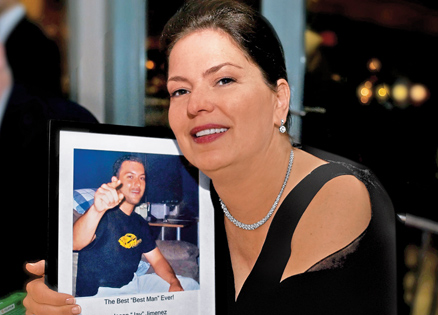
Easter Sunday had a powerful new meaning for me ever since my adult son Jason died in a car accident. I knew Jay was alive and happy in heaven, and that I would see him again one day. But as I looked at Jason’s picture carved into the headstone that Sunday, I wished for more.

For nearly 30 years I’d been his mother. I’d talked to him, listened to him, helped him, taken care of him. All the things mothers do. Now he was gone.

God's Constant Presence In Article Ad

I laid roses in front of the headstone. The plot was already covered in tributes: a heart wreath from Valentine’s Day, wind chimes I brought in the spring. I took good care of the grave, but it was a poor substitute. Show me how to be a mother now that my son is with you, Lord.

My son Eric helped me to my feet. “I’m going to plant some flowers here,” I said.

“I didn’t know you gardened, Mom.”

“I don’t. But I’m going to learn.” I had to care for something. That’s what mothers do.

Eric pointed down the row of headstones. “Look.” A pair of Canadian geese walked over the grass. It wasn’t unusual to see geese in this cemetery, but I’d never seen them come so close. “They were only a few feet away,” Eric said as we got back in the car. “They kept looking at us. I wonder what got them so interested.”

By the following weekend I’d forgotten all about the geese. My mind was on my gardening project. I planned to find a professional and ask for advice. First I stopped at the cemetery to take another good look at the grave site, maybe get some measurements so that I could describe it to the people at the nursery.

I hoped to have something planted by Jay’s thirtieth birthday, which this year fell the day before Mother’s Day. How will I ever get through it? I thought as I approached Jay’s grave.

Someone had beaten me to the spot! A Canadian goose stood in front of the tombstone gazing at Jay’s picture. What on earth is she doing? I stepped closer, careful not to scare her. That’s when I noticed the decorations from the grave all piled together in a heap. The goose was standing on top of them!

Had she moved them herself? What would a goose want with wind chimes and silk flowers? Why had she made such a mess?

The valentine’s wreath lay face up on the ground. Everything else—ribbons, trinkets, notes—was inside it, mixed in with grass and downy feathers. Even the wind chimes were tucked among the silk flowers. The wreath was buttressed on either side by the two angel statues I’d placed in front of the headstone.

At the top of the pile was the cross from Palm Sunday. The goose was standing on it, still as a statue. She didn’t move, even when I came even closer. She did, however, let out an eerie hiss.

The hiss was answered by a furious honking. The second goose—her mate—stalked across the grass, flapping his wings. The meaning was clear: Get away from her! He chased me back a safe distance.

That’s when I realized what I was seeing. The goose on Jay’s grave was making a nest. She was going to be a mother. A wave of emotion washed over me at the thought: wonder, excitement, sadness, envy.

I remembered preparing a room for my own children when I was pregnant. Jay’s crib might have had a musical mobile and stuffed animals instead of goose down and old petals, but the idea was the same. She was making a place to care for her children. And out of all the graves in the cemetery, she’d chosen my son’s.

Obviously there would be no planting today. I drove home and looked up all I could about Canadian geese. It looked like I wouldn’t get anywhere near Jay’s grave for weeks until the goslings hatched and they marched into the lake for their first swim.

To my surprise, I didn’t mind. I couldn’t wait to see Mother Goose and her nest again.

I returned to the cemetery the very next day. I found a spot far enough away that Father Goose didn’t attack, but close enough that I could see Mother Goose on her nest.

I know how you feel, I thought as I settled down in the grass. You’re nervous but excited too. Most of all, you want to keep your babies safe and happy. You want the best for them. That’s what mothers do.

Beyond the gravestone, Father Goose watched me. He clearly wasn’t so sure about having me so close. But I wasn’t going to let a goose keep me away from Jay’s grave. “You’re not the only one protective of your children,” I told Mother Goose. “I can be pretty fierce too when it comes to my babies.”

The goose gazed back at me in silence, but I felt she understood.

Over the coming weeks I spent more and more time at the cemetery, always keeping a safe distance from the expectant mother sitting on her clutch of eggs. I told her about my sons: Jay’s first day of kindergarten, Eric’s high school graduation.

Maybe Mother Goose didn’t understand the words I said, but I believe she knew something of the feelings underneath. Surely God understood. When I spent time with Mother Goose, I could feel him close. Him and Jay.

I e-mailed pictures of the goose family to my friends. Many came to see for themselves.

When the days I’d been dreading—that weekend in May that held Jay’s birthday and Mother’s Day—arrived, they brought all my old grief with them. How can I celebrate Mother’s Day without both my children? I thought when I opened my eyes that Sunday morning.

Then I thought of Mother Goose. She didn’t know about Mother’s Day. She wouldn’t open gifts with her children or send cards. She would sit in her nest and love her babies. What could be a better celebration?

“It’s her day too,” I said to Eric, when the two of us met at the cemetery. “I think God sent this goose family to bring me comfort. I will always love Jay. I will always be his mother. He will always be my son. Just because I can’t see him or talk with him like we used to doesn’t mean our love isn’t as alive as ever.”

Two weeks later I snapped pictures of four newborn goslings marching behind their father toward the lake. One day they would spread their wings and fly away, out of their mother’s sight, but never out of God’s. Wherever they went, she would go on loving them forever. That’s what mothers do.

Join the goose parade!

Download your FREE ebook, Angel Sightings: 7 Inspirational Stories About Heavenly Angels and Everyday Angels on Earth

Her Daughter’s Courage in Facing Cancer Bolstered Her Faith

It’s hard to believe that this past year, my beautiful daughter, Natalia, and I are again dealing with life-threatening challenges to her health. It doesn’t seem so long ago that our hopes and faith were tested the first time.

In 2007, Natalia walked her first runway at my sister’s college fashion show, not far from where we live in Harlem, New York. At 12 years old, my green-eyed girl was already five foot nine; she got her height from her father, from whom I was divorced. As I watched her sashay down the runway, I was stunned by how poised and confident she looked—she was a natural! “I’m going to be a model,” she announced after the show.

Whistle Stop Cafe In Article Ad May 2023

“We’ll see about that,” I told her. It’s good for a child to have a dream, but as the first college graduate in my family, I hadn’t gotten a doctorate in urban education and worked as a teacher so that my daughter could be a model. I relented a bit, however, and let my sister do a photo shoot with Natalia. They’d just begun putting together a portfolio in January 2008 when Natalia complained of pain in her right knee. It was so unusual for my happy-go-lucky daughter to complain about anything that I scheduled an appointment with an orthopedist.

The cherry blossoms were in full bloom that sunny April day I took Natalia to the orthopedist. After X-rays were done of her leg, the doctor placed them on a backlit white screen on the wall. He pointed to a spot about the size of a lime on the screen. “That lump you see on her thighbone is a tumor.”

I grabbed Natalia’s hand. “That can’t be right,” I said.

“Unfortunately, I’m 99 percent sure it’s malignant, a bone cancer called osteosarcoma. The good news is that it looks as if we caught it early. I’m referring you to Memorial Sloan Kettering.”

Natalia’s first and only question to the doctor was not “Will I live?” but “Will I be able to walk the runway again?” How could she ask such a foolish question? She didn’t shed a tear, but I broke down in sobs when we reached the parking lot. “Do you know something I don’t?” Natalia said. “Stop crying, Mommy. I’m not going to die!”

In the three days leading up to Natalia’s biopsy at Memorial Sloan Kettering, I prayed every waking moment. I sent out a mass e-mail to everyone we knew, asking them to join us in prayer for my daughter’s healing. My parents and sister came with us to the hospital. Her dad and other nana met us there. I peppered Dr. Morris, Natalia’s orthopedic surgical oncologist, with questions and suggestions. Natalia insisted on knowing everything, even the long-term survival rate for osteosarcoma, which was 70 to 75 percent if the cancer didn’t spread. Dr. Morris told Natalia she’d know she had cancer if she woke up with a bandage on her upper chest; that would mean they’d inserted a Mediport for chemotherapy. I didn’t let go of my daughter’s hand until the second she was wheeled into the operating room.

I walked down the hallway to the chapel and curled myself into a fetal position in a pew. “You know I always trust in you, Lord,” I prayed. “But the thought of Natalia being cut open, of losing her… I’ve never been so afraid! Please help me surrender this burden to you. Give me your peace.” I felt some small measure of release.

The nurse came into the chapel to bring me to Dr. Morris. When I saw the box of tissues on the table, I knew what was coming. “Natalia’s tumor is malignant,” Dr. Morris said. “We’ll start aggressive chemotherapy next week, then remove the tumor and reconstruct her leg three months from now.”

Anger and disappointment rose inside me, but I pushed my feelings down so Natalia would not see them on my face when she woke up in the recovery room. As soon as Natalia opened her eyes, she pulled away the sheets and looked down at the bandaged bump of the Mediport. I held my daughter in my arms, and all I could think was You can’t leave me. If you die, I will too.

Memorial Sloan Kettering became our battleground in the months that followed. Natalia’s chemotherapy regimen was brutal: three drug regimens to kill the tumor cells. Less than a month into Natalia’s treatment, her hair started falling out in clumps. I found her in the bathroom one morning, shaving her head into a baby Mohawk. It wasn’t long before even that little shock of hair fell out. To match my daughter’s look, I shaved off my own hair, and we held our newly shorn heads high all over town. Natalia named the leg with the tumor Will, telling everyone, “I will walk again!” She named the other leg Grace, for my favorite TV show, Will & Grace.

With each round of chemo, Natalia would say, “Let’s get this party started!” but by cycle 4, she was so weak that I had to carry her to the wheelchair to go to the hospital, and she slept as many as 38 hours at a stretch. I would lie next to her, pleading with God for a miracle as I listened to the melody of my daughter’s heartbeat. I felt helpless in the face of her intense pain, but after I set up a blog where we could post updates, I felt I was at least doing something useful. The blog became our bridge to friends and family. In mid-June, we shared the incredible news that Natalia’s scans were clear. The cancer wasn’t spreading.

In addition to removing the tumor and the affected parts of her femur and replacing it with an internal titanium prosthesis, the doctor would also need to do a knee replacement, she said. Will this ordeal ever end? I wondered. Yet Natalia remained as resilient as ever. On the day of her surgery, the rain poured furiously from the sky, just as it had the night Natalia was born. I took it as a sign that the operation would go well, which it did. Natalia finally came home after her string of surgeries, and before she was even out of her wheelchair, she insisted on taking my red stilettos with her to physical therapy. “My goal is to be able to walk in these heels,” she told the physical therapist. “Let’s get to work!”

Within five months, Natalia was back to dancing around the house. She ended up putting so much weight on the leg she called Will that it broke, along with her internal prosthesis. On January 12, 2009, nine months after her diagnosis, she finished the last of her agonizing 19 cycles of chemo. In mid- February, another reconstructive surgery was performed. She was left with an 18-inch scar.

The worst seemed to be behind us. Natalia had excellent health during her teenage years. I enrolled her in enrichment programs and continued to push her hard in the direction of academics, but she remained as obsessed with modeling as ever. At a parent-teacher conference her sophomore year, Natalia’s teacher told me she was distracted and not turning in her homework. When I got home that night, I found her practicing her runway walk down the length of our living room instead of doing schoolwork. “Listen,” I told her, “you’ve got to let go of this modeling idea. You’re going to need a good job with security and a stable future.”

Natalia looked me straight in the eye. “I understand that a regular job can give you security,” she said, “but what about joy? You know how much I love you, Mommy, but I’m not going to live a life half-lived, not even for you.”

It was as if we were from different worlds entirely. Oh, Lord, I asked, why did you give me such a strong-willed child? I put Natalia on a weekly contract to keep up with all her schoolwork; if she failed to do so, her privileges for the weekend, such as going out with friends, were revoked. Her academic performance dramatically improved, but she still insisted on modeling in school and community fashion shows.

Natalia made her official debut on the runway at a New York bridal show when she was 18. I watched as she glided down the catwalk in a sparkling long white dress. Not only was she breathtaking, but she radiated pure joy and comfort in her own skin.

Suddenly I understood: This beautiful dream was what had sustained her through all the grueling trials of her illness and recovery. I clapped my heart out for my daughter, bursting with pride that she had fought tooth and nail to reach her goal.

While attending college, Natalia did more fashion shows and photo shoots, although she didn’t sign with an agent until she was 23. That’s when her career really took off: She walked in several shows at New York Fashion Week and was featured in Elle and Vogue magazines. She appeared on Season 17 of Project Runway on Bravo TV. As a way to advocate for inclusion and body positivity in the fashion industry, she insisted that the scar on her leg never be airbrushed away in photographs.

Then in January 2019, we found ourselves back at Sloan Kettering. Natalia was diagnosed with renal medullary carcinoma, a rare cancer of the kidney. Her right kidney was removed, and in March she was declared cancer-free. We were ecstatic. But our happiness was short-lived. In mid-October, the doctors informed us that the cancer had returned, this time in her lungs. Natalia decided that after such a horribly draining experience 12 years ago, she would not undergo any chemotherapy. Instead she embarked on nontraditional treatments. She said, “This is what God is telling me, Mommy.”

In the years since Natalia became ill the first time, I’ve learned that God gives me peace in my heart when I’m making the right decision and anxiety when I’m not. Back then, I spent my days drowning in fear and anxiety, unable to fully surrender to the mystery of the unknown. But this time, as I fully support Natalia in her decisions, I am at peace. I can let go because God made my daughter so strong, so grounded in faith. Her spirit remains unbroken, and so does mine.

For more inspiring stories, subscribe to Guideposts magazine.

Her Blue Angel

Bluebirds were always a source of joy for my husband, Pete, and me. We loved to watch them in our yard, building their nests in the many bluebird boxes Pete had built to accommodate them.

But after Pete’s death from heart failure, I had no interest in bluebirds or anything else. I was all alone, and my loneliness consumed me.

Inspiration from the Garden in article ad

“Come look at this!” my daughter called from the kitchen a few days after the funeral. “Come see this silly bluebird!”

I stayed on the couch. The yard was full of birds in August. What could be so special about this one? Kristi came to me in the living room. “Mom, there’s just something about this bird you have to see.”

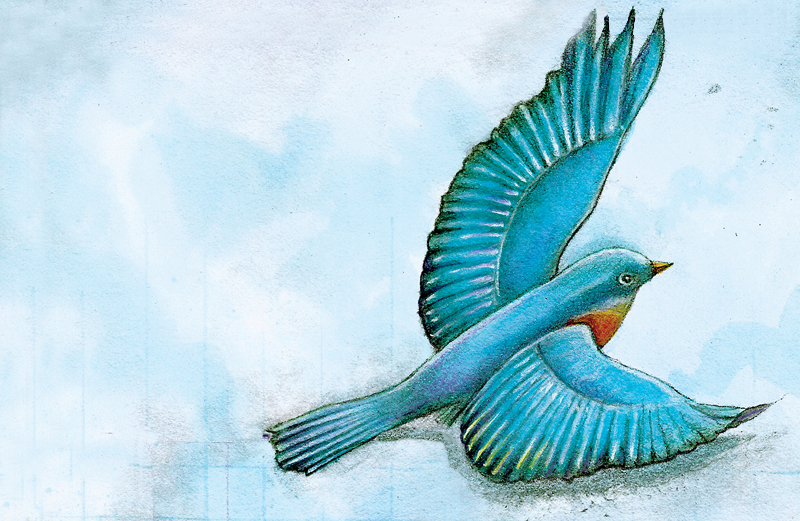
I followed her to the kitchen, expecting to see a bluebird perched on one of the boxes or maybe the bird bath. Instead I found him on the screen itself. He turned his bright blue head this way and that, peering into the house as if he was looking for somebody.

“Have you ever seen a bluebird do that?” Kristi said.

“I’ve never seen one this big,” I said. He wouldn’t even fit in a bluebird box. With his peach-colored chest puffed out proudly he reminded me of Pete himself.

The bird flew to the banister of the porch, then back to the screen door. One, two, three times. Then he flew up to the flagpole beside the birdbath and just sat.

Pete would have loved him, I thought. It was strange to be watching the bird without him. Pete and I had been inseparable since we got married in 1958. We spent even more time together after our retirement, sitting on the porch, cooking dinner, working on craft projects. Now, what did I have left?

Kristi fixed lunch but I couldn’t eat. I could hardly look at the kitchen table, the place where Pete and I had shared our morning prayer each day. I went back to the couch.

Before I knew it, Kristi was calling me again. “Now’s he’s out by the garage,” she said.

Her husband, Keith, had backed Pete’s pickup into the driveway while he swept out the garage. The bluebird perched on the truck’s open window, looking at the front seat as if seeing someone there. He flew inside to the backseat, then to the front, then flew to the window of Pete’s workshop.

“It’s like he’s visiting all the places that belonged to Dad,” Kristi said.

“Strange coincidence,” I said. Those places reminded me of my husband, but whatever the bird’s reasons for sitting in those places they had nothing to do with my husband.

By the time I went to sleep that night I’d forgotten all about the bird. So I had no idea what was banging on the screen the next morning until I was face-to-face with him. Once again he flew to the porch banister and back three times. Then he took his spot on the flagpole.

For the rest of the summer and well into the fall, the bird was a daily visitor. Every morning he greeted me at the screen door; every afternoon he sat on the flagpole. Somehow his presence made me feel less alone.

Maybe I still took my meals standing at the counter because I couldn’t face Pete’s empty chair at the table, but at least my bluebird was watching over me. He gave me something to look forward to every morning, and something happy to talk about with friends and family.

“What do you call him?” my niece asked me.

“I just call him my Blue Angel,” I said. God used a raven and a dove to speak to Noah. Why couldn’t he have sent a bluebird to comfort me?

One day in December I caught sight of myself in the mirror. Months of avoiding the kitchen table had left me thin and tired-looking. Even my hair looked scraggly. It was time for me to start taking care of myself. I made an appointment with my hairdresser, Retha.

It was a trek to the salon, but I’d been with her a long time. “I need a cut and a perm,” I told Retha when I sat down in her chair. Retha tied a smock around me and stopped. “What’s that?” She pointed out the door of the salon to the street.

Something round and blue was perched on Retha’s SUV outside. It was my bluebird! There was no mistaking him at that size. He stayed on the SUV throughout my entire appointment and was back home to greet me the next morning as usual.

As I got stronger, my bluebird took some time off. Sometimes he didn’t visit for a couple of days at a time. But he was there when I needed him. Like on Valentine’s Day when he surprised me at my bedroom window.

One challenge still remained: the breakfast table. I still hadn’t so much as pulled out a chair. Today’s the day, I thought as I got up one morning.

I made a cup of coffee and took a seat opposite Pete’s empty place. Instinctively I stretched my hand across the table, reaching for Pete’s hand to say the morning blessing.

All my months of progress vanished. I was alone again, and the pain overwhelmed me. “How could you take him from me?” I yelled to the empty kitchen. “Why isn’t Pete here with me?” I pounded the table and cried, barely aware of where I was and what I was doing. All I knew was how much I hurt.

Then something caught my attention. Something banging on the storm door. I opened my eyes to see my bluebird knocking just as he’d done that first day, his bright peach chest rising and falling as if he’d flown to me in a rush, his little heart beating under his feathers.

“I’m here!” he seemed to say. “You’re not alone. I’m here.”

I’m not alone, I thought. I had my Blue Angel. What was more, I had the God who’d sent him to me. I would not forget it again.

On May 17, 2011, my bluebird visited me for the last time. But his message remains safe in my heart: I am never alone.

Her Biscuits Gave This Widow a New Purpose in Life

I’ve been cooking my entire life, starting with helping my mother and grandmothers. I’ve loved watching my family, friends and my husband, George, enjoy good, home-cooked meals. Gathering around our wooden table—bonding, laughing and, of course, eating—was such a huge part of our relationship. But when George got sick, I stopped much of my cooking. Then he passed away just a month after our fiftieth anniversary. What does the Lord have in mind for me now? I wondered.

George and I had met in 1965 at a small Alabama college. I first saw him while looking out my dorm window. He was wearing a Hawaiian shirt and cutoffs. I thought he was just darling!

We married in 1968. I was so excited to cook my first meal as Mrs. George Gantt that I forgot to wash the dirt off the turnip greens. Those greens turned out so gritty, we had to pour them out. George just laughed. That was his way. If I put it on the table, he happily ate it.

The kitchen was the heart of our home. George and I and our son, Dallas, and daughter, Hannah, would join hands and take turns saying grace at meals. When a good song started playing on the radio, George would grab me and we’d dance around the kitchen. Our song was “Unchained Melody.” In their teens, our children would groan and say, “What are y’all doing?” Even as grandparents, we still danced in the kitchen.

George loved my biscuits and gravy. Naturally, when we organized a fund-raiser at our church, Bethany Baptist, biscuits were on the menu. I must have made 900 of them that night. “Miss Brenda,” people said, “these biscuits are amazing!” I was already famous for the chicken and dumplings I made for fellowship meals, but now everyone wanted to know my secret for biscuits.

What secret? I thought. I just used simple ingredients and an old can to cut the biscuits. Several young men offered to pay me to teach a cooking class for their wives. I was flattered but busy with my own family.

Busy worrying about George. He was 70 by then. Something was off. It got harder for him to work up lessons for the Sunday school class he’d taught for 30 years. Then he started asking me how to get to places we’d been to hundreds of times. Hannah and I took him to a clinic in Atlanta. George was diagnosed with vascular dementia. “Brenda, I want you to promise me some things,” George said. “I don’t want you to use the power saw or drive my tractor. Let someone else do that.”

“Okay.” I tried not to cry.

“And don’t ever take ice cream away from me.” Vanilla ice cream was his favorite treat.

“Darling, you’ll have ice cream,” I said. “I promise.”

George began having trouble swallowing, then walking. Soon he couldn’t do anything on his own. Taking care of him became my full-time job. I didn’t have the energy to even think about cooking, so I hired a lady to make our meals.

At the end, George had to go to a nursing home. I insisted on one thing. “I want him to have two of those cups of vanilla ice cream at lunch and two at supper,” I told the director. Within days, George couldn’t eat at all. One day, just 18 months after his diagnosis, we lay cheek to cheek, and as I sang “Amazing Grace” to him, his last breath left him.

Our church did a big meal for our family after the funeral. So many people expressed how they loved George. But when that was over, I was left with an aching emptiness.

Lord, I asked, will it ever stop hurting? The more I prayed, the more I came to accept that I would never stop missing George. But my grief was proportional to the great love he and I shared, a love that had been a gift from God.

One day, I thought about George faithfully teaching Sunday School for 30 years. It was part of his service to the Lord. Just as cooking was mine. And I knew that he’d want me to keep cooking and enjoying our family. I called Hannah: “I’ll see y’all here after worship for Sunday lunch.” Big Mama, as the grandkids called me, was back.

Cooking brought me comfort. In the spring of 2020, I decided it was time to share my biscuit recipe. Then the Covid pandemic sent everyone into quarantine, so I made a video. I used my phone to film myself. I cut the biscuits with my old Chef Boyardee can, the same one I’d been using since I first got married.

I shared the video on Facebook. That should make the church folks happy, I thought. The next day, a friend called. “Brenda, do you know how many people have seen your video?” I couldn’t believe it: Within days, my shaky video had reached more than a million people! They messaged me: “How do you cook butter beans?” and “How do you cook rice so it’s not sticky?”

My son-in-law, Walt, set up a Facebook page called Cooking With Brenda Gantt. Now every week, I’m showing how to cook something else. I published a cookbook this past November, and it sold out before it was even printed! “You’re a viral sensation, Big Mama,” my grandchildren tell me.

Lots of people say I’ve inspired them to start cooking again or that I remind them of good times with their grandmothers, something they sorely needed during the pandemic. I love helping folks learn to cook so they can enjoy meals with their families, and I love talking about Jesus while I’m cooking.

George would be so tickled. More than anyone, he’d understand how glad I am that the Lord gave me a new purpose so that I can wake up every day and say, “It’s going to be good, y’all.”

Try Brenda’s delicious Strawberry Cake at home!

Cover of Brenda Gantt's It's Gonna Be Good Y'All: A Collection of Family Recipes & Stories

Brenda Gantt is the author of It’s Gonna Be Good Y’all: A Collection of Family Recipes & Stories.

For more inspiring stories, subscribe to Guideposts magazine.
He Put His Dreams on Hold to Be a Caregiver, Then Found the Inspiration He Needed

Mom hooked her arm through mine. We walked slowly across the back porch, or at least as fast as Mom could go, taking in the autumnal colors. “What’s bothering you?” she asked, squeezing my arm. She knew something was wrong. She always knew.

“I guess I feel a bit…lost,” I said.

God's Constant Presence In Article Ad

The pine trees and butterfly bushes were beautiful. Yet they reminded me that just months earlier I’d been living in a cramped apartment in Harlem, chasing a dream that now seemed further away than ever.

I love to perform and have always wanted to live in New York City. I had studied chemistry and musical theater at Wheeling Jesuit University. Months before I graduated, my father passed away after a courageous battle with brain cancer.

Shortly after I graduated, my mother fell ill from septic shock. I decided to put my plans to move to NYC on hold to help care for her. That caregiving lasted 10 months until she recovered. Finally I was able to move to that apartment in Harlem.

I went to auditions and worked catering gigs to pay the rent. I met a lot of talented people. But I recognized a common thread in those I met: negativity. What I’d been through with Mom and Dad made me want to make my mark in a positive way. But how?

I created a blog called NYC Smile 4 Me, which focused on the question “What makes you smile?” I’d record people’s answers and post them online. Just that question alone made people smile—and God smiled on my efforts.

Soon I started receiving press passes for red carpet events. I interviewed stars like Jonah Hill, Helen Mirren and Bette Midler. Everyone had a different #SmileStory. “Getting asked that question makes me smile,” Chita Rivera said. “Children!” Steve Martin said. “My dog, Thunder Pup,” Kristin Chenoweth said. “A garden full of ivy and knots,” Molly Ringwald said. I was dubbed Boh the Smile Guy. People loved the videos I put up on my YouTube channel. I was making people smile!

I was working at the U.S. Open when my sister, Chesla, called. “They found something on Mom’s lung,” she said. I went home immediately, praying all the way.

For the next eight months, I split my time between New York and Wilkes-Barre Township. Ten days working—glamorous parties and celebrity interviews. Ten days sitting with Mom while she received chemotherapy.

All those three-hour car rides gave me plenty of time to think. What do I really want to do? Make people smile, of course. But it was too hard when I was worried about Mom.

“Mom, I need to move home full time,” I told her.

I waited for her to list all of the reasons I shouldn’t move back. Mom had always been my biggest supporter. She knew exactly how much I would be giving up, just when things were coming together.

“If that’s what you think you need to do,” she said, “then okay.”

I uploaded a video to my YouTube channel explaining why I was moving. “You’re making a terrible mistake,” one of my friends said. “Don’t throw everything away.”

Yes, but Mom was Mom. She came first, no matter what the sacrifice. On the eve of my three-year anniversary of living in New York City, I packed up my Harlem apartment.

I immediately threw myself into my caregiving responsibilities. Doctor’s appointments. Laundry. Serving meals. Playing shut-the-box. Putting together puzzles. Dispensing medications. With each passing day, my caregiving duties made my dreams seem more and more delayed. What did I have to show for myself now? I remembered when the Today show’s Natalie Morales interviewed me and said, “I appreciate you. There needs to be more people like you. I believe in you.” I didn’t regret being with Mom—not for a moment—but there was so much I wasn’t doing.

That day on the back porch, walking slowly with Mom—the only exercise she was up for—it took me a while before I could really answer her. What was wrong? “If I’m going to be here, my smile mission is going to be here too,” I said finally.

“People need smiles everywhere,” Mom said. “There’s a lot you can do for others right here. Go and see what resources the mayor’s office has for you.”

NYC Smile 4 Me in Wilkes-Barre Township? Mom was right. People everywhere need smiles. I checked to see when the next town council meeting would be. Mom and I kept talking and hatched an idea.

A week later, I entered the town hall, an imposing brick building. The council and mayor sat around a large round table. They spent an hour discussing town business, and then the mayor asked if there were any new agenda items. I stood up, took a deep breath, smiled and began to speak.

“I have a proposal,” I said. “Some of you know the work I do with my smile mission. And since moving back to care for my mom, I haven’t been able to find a way to bring it to my hometown. Well, I would like to put on an event here for our town—a Smile Festival.” I outlined what it might be like, a sort of fall festival, with free activities for everybody, and lots of food. Food definitely made folks smile.

The council took it under advisement. The next day the mayor called to ask me to meet with him in his office.

“Chris,” he said, “October 21 is officially Smile Day! You’re in charge.”

I hurried home to tell Mom the exciting news.

“Mom, guess what?” I said when I burst through the door. “We’re in charge of a community-wide fall festival on October 21!”

“October 21?” Mom glanced at the calendar. “Honey, that’s only four weeks away.”

Four weeks. How on earth were we going to pull this off? It wasn’t like going to some Manhattan opening where I just stood on the red carpet with my microphone. I had to make this red carpet out of whole cloth.

“Where do we start?”

“Let’s get to work. We’re going to have to be creative,” Mom said.

We cleared off the kitchen table. Mom took out a pad of paper and began making lists. Places to call: the fire department, the police department, the print shop. I put out a call on Facebook. “Smile Day is happening. My mom and I need your help. Send people and ideas our way, and we’ll do the rest!”

The responses poured in. A friend helped set up interviews with local radio shows to get the word out. A dentist donated prizes. A college fraternity offered to oversee the ring toss. A Girl Scout troop volunteered to run a face-painting booth. The police department offered a meet and greet with its K-9 unit. The fire department said they’d cook the pizza and hot dogs. The yogurt shop volunteered its penguin mascot for pictures.

I worried that all this planning was too tiring for Mom, but she waved off my concerns. “All of this excitement is a nice diversion from my numb hands,” she said. They were a side effect from her chemotherapy.

The morning of the festival was sunny and crisp. Mom and I arrived early to oversee a balloon delivery. Everybody had a million questions: Chris, when should we put out the cupcakes? Chris, when will we present the Dr. Stanley T. Bohinski Smile Day award? Chris, where should people park their cars? Chris, when do we give out the raffle prizes?

My big question to myself: What if nobody shows up? At 10 a.m., the doors opened. By 10:15, the fire hall was packed. The mayor pulled me aside. “Boh, this is the most attended town event in recent history!” I looked around the room. Senior citizens playing Bingo. An Elvis impersonator rockin’ and rollin’. Families dancing. Parents smiling. Kids winning prizes.

In that moment, I realized the power of a smile. And I knew I was exactly where I was supposed to be. My own dreams weren’t delayed; they were just coming true in a different way than I had ever envisioned.

I’ve been living at home for over a year now, and currently Mom’s health is on the upswing. I’m still a caregiver, making pancakes for Mom at 3 a.m., when her medication keeps her awake, celebrating milestones like the day she was able to drive again. But she also acts as my caregiver, slipping confetti-stuffed cards into my bag when I make the occasional foray into New York for some event, always welcoming me home as I pull into the driveway. I pray that her health continues to improve.

In the meantime, I make each moment count. With a smile.

For more inspiring stories, subscribe to Guideposts magazine.