Embrace God's truth with our new book, The Lies that Bind

The Gift of Grandchildren at Christmas

I think the only thing more special than having children at Christmas is having grandchildren. Don’t get me wrong. I have precious memories of the years when my sons were little guys, but this is a chance for a second set of cherished memories. And now, with the beauty of hindsight, I know how quickly those years zoom by so I’m squeezing the sweetness from every moment. My grandchildren are aged six years to 18-months, so Christmas is a time of great excitement.

I loved the moment when three-year-old Ethan walked into our family room and yelled back to his cousins and siblings, “Grandmama’s got presents under the tree!” Then everybody had to know which gifts were theirs. Such sweet faces as we looked at the packages.

I loved the look of wonder on little Nolan’s face as he looked at my lit-up Christmas village scene, his tiny fingers feeling the snow on the table.

While we had dinner, three-year-old Eden told her mama, “Grandmama told us about when we were bears.” After some puzzlement, I realized she was talking about the bear tree in our foyer. It’s decorated with the bears that belonged to my sons while they were growing up, bears we bought on family vacations, and bears to represent all the grandchildren.

A week or so earlier when the grandbabies were at the house, I’d shown them bears on the tree, telling them, “This one belonged to your daddy. Here’s the bear Uncle Tim got when he graduated from kindergarten….” I showed them their personal bears and then I pulled a special bear from the tree. This one is holding a Bible and tucked behind that tiny Bible is a folded piece of paper I put there many years ago, a prayer request asking God to send children to two of our sons and daughters-in-law who’d been told the odds weren’t good for them to be parents. I choked back tears as I hugged each grandchild, telling them, “You are the answers to those prayers.”

Carrying on a tradition that began with their daddies when they were young, everyone came to our house to bake cookies earlier this week. We made peanut blossoms—peanut butter cookies with a Hershey Kiss on top. The rolled balls of dough were misshapen and every size under the sun, but the little ones had a great time. Somehow, a lot more Hershey Kisses were consumed than what went on the cookies. I’ve laughed for a couple of days at the odd places I’ve found the wrappings from the candies.

But, oh my, how precious it is to make memories together, soaking in the sound of their laughter, surrounded by little ones perched on chairs and the kitchen island. I loved that 18-month-old Nolan was even into making the cookies. After watching the others help mix the dough, he wanted a turn. It melted my heart as he put his little hand on the top of the mixer to help me. And then he’d “roll” his piece of dough, throw it onto the cookie sheet and then clap his hands as if he’d accomplished a great task. Moments in time captured forever in my heart.

But today my favorite time to be with my children and grandchildren is almost here: Christmas Eve. It’s a night when we begin our family time by reading the Christmas story, using the nativity set, with each of the children moving the figures into the stable as the story is read.

And then before we open gifts, we all get on our knees and each person prays, thanking God for His amazing gift of a babe in a manger, and thanking Him for all He’s blessed us with this year. I’ll be honest, I usually peek during the prayer, soaking in the amazing blessing of a family who loves God. You see, my best gifts aren’t the packages under the tree, they’re the ones gathered around the tree.

So from the Cox household to yours, Merry Christmas. I hope that all of you have a wonderful Christmas celebrating the birth of a Savior.

The Feline That Restored Her Faith

Fat drops of rain spattered against my face. I ducked under an overhang and set down the heavy cat carrier. “Just a few more blocks, Junior, and we’ll be at the vet,” I said, peering in at the stray I’d taken in two months ago. He mewed pitifully.

“I know exactly how you feel,” I said.

Community Newsletter

Get More Inspiration Delivered to Your Inbox


So far my year had been dismal. Family disagreements. Reduced shifts at my bookstore job. A move to a dumpy, cheaper apartment, close enough to walk to work and to shops.

Now my boss told me that he would have to cut my hours even further, and word came from the corporate office that I would be losing my health insurance. What would I do if I got sick? I was barely making ends meet as it was. I didn’t think I could take one more blow.

Still, I couldn’t miss Junior’s vet appointment. He would be getting a microchip with my phone number and address injected between his shoulder blades so that people would know who he belonged to should he ever get lost.

I didn’t even want to think about what I would do without my cats, the one bright spot in my life.

A friend at work had told me about Junior. She knew that I had been looking for a buddy for Prince, a big gray cat that I had adopted from a shelter a few years back.

“I saw a new cat at the park,” she said. “He was hanging out with some feral cats I feed. But he’s friendly. I think he must have been abandoned. Would you consider…”

“I’ll take him,” I said.

I’d barely made introductions before Junior and Prince started grooming each other. Finally something was going right.

My cats gave me a reason to get up in the morning. They needed me. And I needed them. Their antics made me laugh. And they both cuddled next to me in bed at night, their gentle purring a reassurance.

Thank you, God, I prayed. We’ll get through this rough patch together, the cats and I.

But now I wondered, worried all over again about my job, my health, everything. I hefted the carrier and trudged on to the vet’s office, trying to ignore the pelting rain.

A vet tech ushered me into an exam room when I got there. I took Junior from his carrier and set him on the table.  “He’s a handsome fellow,” the vet tech said.

Not that I had anything to do with Junior’s looks, but I swelled with pride.

The vet tech explained how microchips worked. “With just a quick scan any veterinarian will know that your cat has an owner and will be able to find out how to reach you.”

She took a wand from the counter. “First let’s make sure that he doesn’t already have a chip,” she said. She scanned Junior’s body. “Yep. He has a microchip already.”

“That’s impossible,” I said. “He was abandoned.” “Maybe he got out by mistake,” she said. “Here’s the number for the microchip registry. They’ll be able to tell you who he belongs to.”

But I already know who he belongs to, I thought. Me!

I loaded Junior into the carrier and plodded home in the rain. It was all I could do not to flop down on some bench and have a big cry. But who would even notice? Or care? “Hey, God!” I wanted to shout. “Remember me?”

Prince met us at the door of my apartment. Freed from the carrier, Junior playfully swatted Prince’s tail. They belonged together. With me. How could Junior have another owner? I hadn’t seen any notices anywhere about a lost cat.

I stared at the phone, then took a deep breath and forced my fingers to punch in the number.

The guy at the microchip registry listened to my story. “Let’s see,” he said. “That cat was reported missing ten months ago. Looks like the owner lives in Ester, Alaska.”

“B-b-but,” I stammered, “I’m in Walnut Creek, California.” I looked in awe at Junior, imagining him crossing glaciers, fighting off hungry wolves. Incredible!

Then it hit me. His home was 3,000 miles away. I’d never see him again.

“Her name is Sappho,” he continued. “That can’t be right,” I said. “He’s a boy. The vet said so.”

“Well, that may be, but it’s definitely the same microchip. I’ll contact the owner.”

I hung up and grabbed Junior. “Sappho?” I said. The cat nuzzled my face. “Whoever you are, I sure don’t want to lose you.”

That evening the phone rang. I hesitated, letting it ring again before finally answering. It was the microchip guy. “I’m patching the cat’s owner through now,” he said. There was a click, then a woman’s voice. “You really have our cat?”

“Well, they say I do,” I said. “How did you lose him?” I hoped I didn’t sound too accusatory.

“It was my daughter, Aurora,” she said. “She was moving from Alaska to Arizona, and she stopped at a park there in Walnut Creek. That’s when Sappho got loose from her car. She hadn’t owned him that long so maybe that’s why.

“She put up posters and posted his picture on the web, but no one called. Finally, she had to leave. Let me give you her number. She’ll be so excited to hear from you.”

We said goodbye. My fingers hovered over the phone’s keypad. I felt bad. For Aurora and her mom. And me. Especially me. With each number I pushed, it seemed like Junior was slipping further away.

Aurora answered. “I think I might have your cat,” I said.

There was a pause, then a shriek of joy. My whole body sagged. I told her how I’d taken Junior in, how well he was doing.

“I can’t thank you enough for taking such good care of him,” she said. “Isn’t he a wonderful cat? You know he was raised with sled dogs. And he loves being sung to…”

I couldn’t deny it any longer. He was her cat. She loved him as much as I did. I’d been selfish to even think of keeping him. “I could rent a car and drive him down to you,” I heard myself say. “Or put him on a plane.”

“Let me figure it out and get back to you,” she said.

We hung up.

I sat there in my dumpy little apartment, but I felt calm, the stress that had weighed so heavily on me suddenly gone, like it was never even there. I had done the right thing. I had contributed something right to a world where so much seemed wrong.

I could handle this. Everything—my job, the bills, Prince and I—would turn out okay. Hadn’t God sent Junior to me? The perfect antidote to my fear and worries. God would be there for me even after Junior was gone. Junior was a demonstration of grace.

“God, thank you for taking care of me,” I prayed. “I believe you know what’s best for Junior just like you know what’s best for me. Be with him and his owner, wherever their journey might take them…”

The phone rang. I picked up. It was Aurora. Was she calling back with instructions already?

“Hi, Linda,” Aurora said. “I’ve been thinking. You’ve actually had Junior longer than I did. And he’s happy there. I think you should keep him.”

For a moment I couldn’t speak. “Thank you,” I finally said. “That’s incredibly sweet of you. I’ll send you pictures. I’ll even sing to him.”

I looked down at Junior, rubbing against my leg, purring, the very sound of grace. Maybe he hadn’t crossed a glacier or fought off hungry wolves, but the journey that had brought him to me seemed no less amazing.

Download your FREE ebook, Paths to Happiness: 7 Real Life Stories of Personal Growth, Self-Improvement and Positive Change

The Family That Prays Together…

My younger sister, Lauren, and her husband, Scott, pulled up to my house in their 18-year-old car, their belongings piled high in the backseat. I took a deep breath and walked to the door to greet them, trying to push aside the worries that had besieged me since I’d agreed to let them move in.

“Could we stay with you for a little while?” Lauren had asked. “Until we get back on our feet?”

Community Newsletter

Get More Inspiration Delivered to Your Inbox


I’d known the question was coming, but that didn’t make it any easier. A year earlier Scott had been laid off. He’d searched and searched for work but had come up empty. Although they didn’t have kids to support, they didn’t have much savings either. They could no longer afford the rent on their apartment.

It wasn’t like Lauren and I didn’t get along. We talked on the phone all the time. But we were opposites in terms of temperament. Lauren was chatty and outgoing. I was reserved. I was eight years older, the responsible big sister who got married and settled down.

Lauren was more of a free spirit. She had dreamed of becoming a singer and still performed sometimes. She filled up a room with her big personality.

I didn’t have room at my house for us each to retreat to our own personal space, especially with my son David having recently moved back in after splitting up with his wife and having trouble financially.

Could Lauren and I live under the same roof? We hadn’t since I had gotten married and moved out of our parents’ home…and that was almost 50 years ago.

I still lived in the two-bedroom house my husband, George, and I bought back when we were starting out. We’d raised three kids here. George had passed away 10 years earlier. I’d been lonely at first, but I’d come to accept being on my own, even like it. I led a quiet life, had a comfortable routine. I loved sitting with the paper and my coffee in the morning. I took my dog for walks, tended my rosebushes. I had art class on Tuesdays—oil painting. I helped edit a scuba diving magazine my oldest daughter and son-in-law publish. I also volunteered at a medical clinic.

I’d been careful financially and even though the recession hit hard here in California—you couldn’t turn on the news without hearing about the unemployment rate and foreclosures and businesses closing—I thought I would be okay.

Now hard times were knocking at my door anyway. And I had no choice but to open it. This was my sister, for heaven’s sake! I felt guilty for even hesitating.

“Lauren, Scott, come on in,” I said, throwing my front door wide. “Can I give you a hand with your things?”

They were partway up the walk, lugging two huge bundles of…tent fabric? What on earth?

“Thanks, we’ve got it,” Lauren said. “Can we put up these tents in your backyard? We can’t afford to rent a storage space for our stuff. Don’t worry, we’ll put down paving stones.”

I cringed. My lawn! “Well…okay,” I said. I didn’t want to start off on the wrong foot by saying no.

Scott and Lauren trooped back and forth carrying clothes, dishes, linens and books. They stuffed everything into the tents. It occurred to me that we had never set a time limit on their stay. Well, there was no going back now.

“David has the spare bedroom,” I said. “I set you guys up in the den. It’s got its own door so you can have some privacy.”

“You’re a lifesaver, hon,” Lauren said.

David watched the move-in with apprehension. “One bathroom” was all he’d said when I broke the news to him. I hoped he’d come around. I hoped I’d come around.

The next morning everyone made a beeline for the bathroom. There were awkward glances and impatient sighs. By the time it was my turn the hot water had run out. Scott left for a job interview.

I tried sitting down with the paper, but Lauren sat down too. She started telling me about every job Scott had applied for recently. I knew talking helped her cope. All I wanted was to read my paper before my shift at the clinic. I went to get a second cup of coffee. The pot was empty.

That evening I settled onto the sofa to watch American Idol, my favorite TV show. Lauren wandered in and launched into a recap of her day.

“Scott’s interview went pretty well…but lots of people applied, so who knows….” I looked around for David. He sometimes watched with me, but he’d made himself scarce apparently. I sighed. I hadn’t had a quiet moment all day.

“Naturally the car’s acting up again,” she went on. “Scott’s out there working on it right now…” I turned off the TV. Lauren paused, looking anxious. I mentioned volunteering at the clinic that day.

“Wow, it’s wonderful you do that,” she replied, seeming grateful to change the subject. “How did you get involved?” I felt strange talking about myself. I didn’t do much of that, living alone and all. But soon we were chatting away. I looked up at the clock. Bedtime already!

The next morning we discussed a bathroom schedule. There still wasn’t enough hot water, but at least no one quarreled.

We decided to handle our own meals for the most part. But I didn’t want it to feel like a boarding house, so two or three times a week one person would cook dinner for everyone and we’d eat together. David, surprisingly, liked that idea. He and Scott began commiserating about job hunting.

A couple of days later I curled up on the sofa to read. Lauren came in and plopped down beside me. I closed my book with another sigh. To my surprise she didn’t launch into a tale of car woes, though at that very moment Scott was out in the driveway with his head under the hood.

“Do you mind if we pray together?” she said. “I could really use someone to pray with right now.”

Lauren was usually so upbeat it was easy to forget how much stress she was under. I nodded, wondering, When was the last time I’d prayed with someone in this house? Since George died?

Lauren lit a candle on the coffee table and we held hands. “Thank you, Lord, for Mary Lou letting us stay here,” she said. “But Scott needs work. Please help him find a job.”

My turn. I looked at Lauren. Worry was etched on her face. Suddenly it struck me that even though she and Scott had a roof over their heads, technically they were homeless.

I thought of all my wincing and sighing, my irritation over hot water and missed TV shows. A wave of guilt crashed over me, followed by a new feeling. A door seemed to open inside me. Love for my sister came rushing in.

“Thank you, Lord,” I said, “for bringing Scott and Lauren into this house. Help them to feel welcome here. Help me to welcome them and ease their burdens.”

We sat quietly a moment, holding hands. At the same moment we both said, “Amen.”

A few nights later I came home to a heavenly aroma. Lauren and Scott were making tamales.

“Join us!” cried Lauren. “It’s easy. Watch.” She showed me how to stuff and fold the cornhusks. David came in and Lauren put him to work too. Soon we were all talking and laughing over a delicious tamale dinner.

The next morning I sat with my coffee and paper. Something was different. Where was Lauren? I glanced out the window and saw her weeding my rosebushes. “Hon, you don’t have to do that,” I called out to her.

“It’s okay, I love gardening,” she said. “We didn’t have a yard at our apartment. This is great!”

One evening all four of us crowded onto the sofa to watch the news. “A new trend in this recession,” said the newscaster. “Out-of-work families are moving in with relatives to save money or just to keep a roof over their heads.”

“Hey, that’s us!” cried Lauren. There was a pause as the reality of what we were going through sank in. Then everyone laughed.

“We are the news,” David said. I felt a warm glow knowing the roof that had sheltered George and me and the kids was sheltering my family still. The room felt warm too. Warm with love and togetherness.

Life went on like that for months until one afternoon I came home from art class to find Lauren bursting with excitement. “Scott found a job! We can get our own place again.”

“That’s…wonderful,” I said, setting down my keys.

A few weeks later Lauren and Scott found an apartment. They packed up their stuff and took down their tents. Lauren gave me a big hug.

“You’ve been such a blessing,” she whispered. “We couldn’t have made it without you.” David and I waved as they drove away. I tried not to cry. Thank you, Lord, I prayed, for opening my heart to my sister.

These last nine months had been a blessing. What started out seeming insurmountable—hard times and my own worries—ended up bringing my sister and me closer than ever. There was always room for more love.


Download your FREE ebook, The Power of Hope: 7 Inspirational Stories of People Rediscovering Faith, Hope and Love

The Family That Cooks Together

My daughter Rachel stood in the kitchen in a floral sundress, her brown hair up in a ponytail. I was overjoyed to see her. She’d just flown in from Texas, where she and her husband, Jared, lived. Our favorite thing to do on mother-daughter visits like this? Cook.

Rachel opened the refrigerator door and poked her head in.

The Lies That Bind In Article Ad

“Mom,” she said, turning toward me with confusion in her eyes. “I see lots of milk, yogurt and cheese.” She looked again. “And eggs.”

“I know you don’t eat meat now,” I said, “so I got a bunch of eggs and dairy for you.”

“Mom, Jared and I aren’t just vegetarian—we’re vegan. That means we don’t eat meat, dairy or eggs. No animal products at all.”

“Wow,” I said.

What will I feed them? I wondered. Rachel had told me how she and Jared listened to an audiobook about the health benefits of a vegan diet. More normalized blood glucose levels. A reduced risk of heart problems.

Our family history of hypertension and arrhythmia was a problem I figured I’d deal with later. Rachel was more proactive and decided to give veganism a try. Jared was on board too.

At the time, though, I thought it was just a temporary thing. A fad. Who ever heard of vegans in Texas?

“It’s great,” Rachel said. “We eat fruit and vegetables, whole grains, nuts and beans. When prepared right, vegan food is delicious. You’d be surprised, Mom.”

It didn’t sound great to me. What harm is there in the occasional cheeseburger or piece of fried chicken? Or a dollop of sour cream on your baked potato every once in a while? A person needed some variety.

Tonight, I’d planned on making a cheesy lasagna loaded with veggies—no meat in that. For dessert I thought we’d whip up my aunt Etta’s famous chocolate pie. But hearing that Rachel didn’t even eat dairy, I didn’t know what to do for dinner.

When Rachel and my other kids were young, I was a bit of an absent-minded cook, sometimes forgetting a crucial ingredient or burning the breakfast toast. But by the time she was a teenager I’d found my groove, and even worked as a caterer.

For her part, Rachel always loved the kitchen. By ninth grade, she packed her own healthy lunches for school. Then, when she got married, her interest in the kitchen—and in healthy eating—grew even stronger.

I remember once visiting Rachel and Jared in Texas before they became vegans. I sat down to a delicious meal: salad, garlic bread (not burned), and spaghetti topped with a rich and creamy pesto sauce. She had made everything from scratch.

Rachel and I bonded over cooking. I loved experimenting on my own, watching the Food Network in my spare time and serving elaborate meals to my husband and guests. I posted pictures of what I made on Facebook: casseroles, bourbon brown sugar pork loin, you name it. Rachel did the same.

Soon, we were blogging to share recipes. We’d call each other, testing the same meals and chatting as we cooked.

But now, Rachel had gone vegan, and I couldn’t help fearing that her new diet would destroy the fun of our bond, one that brought me such joy. I tried to squeeze a prayer between my panicky thoughts.

“Are we cooking today, or what?” Rachel asked, a playful gleam in her eye. I relaxed.

“Don’t we need a specialty supermarket for vegans?” I asked.

“Nope,” she said. “I’ll bet we can improvise a meal with whatever you have here.”

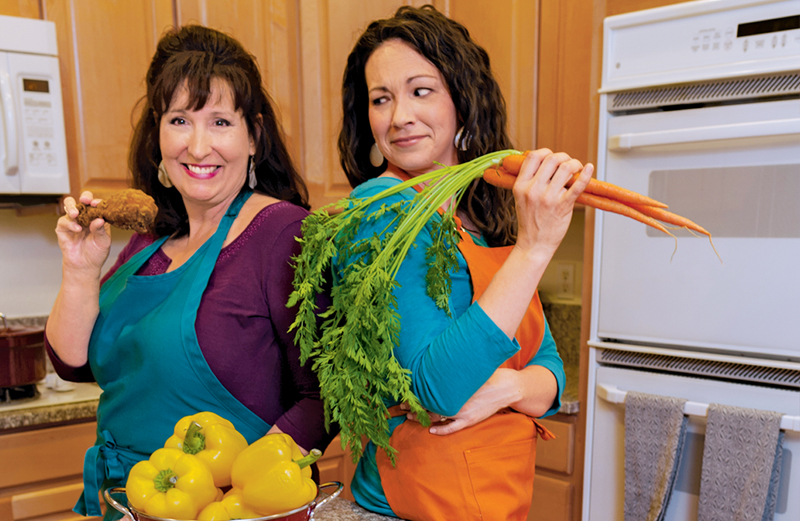
Rachel glided around the kitchen, the way she always did. It was almost a kind of ballet. She examined the bowl of sunny yellow peppers I had gotten for the vegetable lasagna.

“What about the yellow pepper soup you tried that one time?” she asked. “Let’s make that—vegan-style!”

I frowned. “But the recipe calls for chicken broth and cream, and I know you can’t eat those anymore.”

“Don’t worry,” Rachel said. “You just start chopping up the yellow peppers and I’ll see what else I can find in your kitchen.”

While I put the peppers on a cutting board and set to work, Rachel grabbed a sweet potato, a clove of garlic, an onion, nutmeg, and then, drifting to the pantry, she returned with a carton of vegetable broth. I’d forgotten I had that.

“Ta-da!” she said. “Here’s everything we need to make a vegan yellow pepper soup. The sweet potato will make it creamy.”

Soon, the soup was simmering on the stove, and Rachel and I were sitting at the table, catching up, swapping stories and laughing like we always did. I’d lost track of time when Rachel looked at her watch and said, “Let’s see if it’s done!”

With eyes closed, I brought a spoonful of soup to my lips. A complex, pleasant mix of flavors filled my mouth. I had to hand it to her: This soup was delicious.

Not that I was ready to go vegan just yet. But knowing how healthy the soup was made me enjoy it even more. Best of all, we were having fun. Rachel may have gone vegan, but that didn’t mean we had to change the way we cooked together. Joy was one ingredient we’d always share.

Try Becky and Rachel's Yellow Pepper Soup for yourself!

Download your FREE ebook, Rediscover the Power of Positive Thinking, with Norman Vincent Peale

The Dreams That Drew Her Closer to Her Adult Daughter

Wide awake, I sat up in bed before a hint of light entered the room. I’d had another dream about Jennifer, my middle child. She’s 38 now, a wife and a mother of three. Usually in my dreams she’s still a little girl—shy, freckle-faced and with a brightly colored headband holding back her shiny auburn hair. I loved her hair. I’d brush it into a ponytail and kiss the tiny hollow at the back of her neck before she left for school.

Jennifer was a mama’s girl. I never minded being called in the middle of the night to rescue her from a slumber party. “I have a stomachache, Mama,” she would complain, but we both knew she was homesick. I loved having her snuggle next to me as we drove home at 2 a.m. We fit together like pieces of a jigsaw puzzle.

New Every Morning Journal In Article Ad A

Jennifer had been five years old and her older sister, Julie, seven, when the twins were born. Everything changed. The boys demanded so much of my time and energy, I hardly had any left for their older sisters. I was constantly exhausted—and short-tempered. Writing became my only escape. In retrospect, I saw it so clearly. Sweet, quiet Jennifer, sandwiched between the others, required almost nothing from me.

One afternoon Jennifer made a chocolate cake for a school bake sale. She did it all by herself, carefully spreading the icing between the layers, covering the cake with chocolate frosting. I stood there admiring it, when somehow she bumped the plate and the cake fell to the floor. The layers slid apart, seemingly in slow motion. We both stared in shock. Then Jennifer sucked in her breath and said softly, “I’ll have to make another one—and there’s no more cocoa.”

I glanced at my watch. Was there any way I could possibly run to the store before I picked up the boys at school and dropped them at their various practices? I was on a tight deadline for an article that was due. Before I could come up with a solution, Jennifer did. “It’s okay, Mama. I know you’re busy,” she said matter-of- factly. “The top layer is fine. I’ll just take that to school.”

And I let her.

While she was in college, her father battled brain cancer. One day Jennifer and I stood outside his hospital room. “He’s not going to be here to give me away when I get married, is he?”

I shook my head sadly, absorbed in my own pain. A year later, her twin brothers walked her down the aisle. I couldn’t help wishing that she and I had spent more time together before she started life on her own.

Eventually Jennifer had three children of her own, two boys and a little girl who looked amazingly like her. They lived about an hour and a half away. Sometimes it seemed as though she were worlds away. I often dreamed about her—dreamed that we were close again, like we were when she was small. But this dream was different.

I got out of bed and went to the kitchen, going over the details. No wonder I’d been jolted awake. Unlike my usual dreams about Jennifer, in this one she was a grown woman and mixed in with a crowd some distance away. I stood on my tiptoes and waved and hollered, “Jennifer! Over here! I’m over here!” But she didn’t notice me.

Was it too early in the morning to call her now? I longed to hear my daughter’s voice. Often when I phoned, she wasn’t home and I ended up speaking to an answering machine. She was busy with the children or playing tennis or substitute teaching. When we did talk, our conversations floundered as if we were talking through a wall. That morning as the sky filled with light, I dialed her number. She answered on the second ring.

“Hey,” I said, trying to sound lighthearted. “I had a dream about you last night.”

“You did?”

I could picture her in her kitchen, her long hair darker than it was when she was a child but still lustrous and beautiful. I wished I could reach out and touch it.

Then Jennifer surprised me. “I dreamed about you too. But it was terrible. I won’t even tell you.”

“You can’t help what you dream, Jen. Go on, tell.”

Her words tumbled out. “We were walking to a wedding, and we took a shortcut through a vegetable garden. I was in the wedding, so I had to be on time, but a farmer hollered that I’d stepped on one of his tomatoes. I offered to pay for it. He said, ‘Okay, 43 cents.’

“That’s when I realized I didn’t have any money and asked you for a loan. You said no, and I started crying. Your purse was a black box with a lock on it. I somehow managed to pry it open. Inside you had lots of money. ‘Please, Mother,’ I begged. You said I had stepped on the tomato and so I would have to pay for it. I ran all the way home, got the money, ran back and paid the farmer. But by the time I got to the church, the wedding was over. I woke up in tears.”

The pain in her voice almost cut my breath off. My purse, a locked black box. Was I that far out of reach?

Jennifer attempted a laugh. “Wasn’t that ridiculous, Mother?”

Dry-mouthed, I replied, “No, not at all. There were so many things I should have done for you….”

“Well, you could have gotten up from your typewriter sometimes,” she said. “You were always writing.”

I couldn’t undo the past, but I loved that she was being honest and open. This was my chance.

“Jennifer, you’re right,” I said. “I overlooked you. You seemed so capable. I forgot you were just a child.”

There was silence on her end of the line. The communication seemed broken again. That was as far as we got. God, please bring Jennifer back to me.

I thought about her all morning. Finally I called an old friend. I told her about Jennifer’s dream and our awkward attempt to connect. “You know,” she said, “your relationship probably broke down over a lot of little things, like that cocoa you told me about. It’ll take little things to mend it.”

Little things, like the cocoa. Little things that stood for bigger things. Like the 43-cent tomato? I had read in the Bible how God spoke to people in dreams. Was my dream God’s way of prompting me to try again with Jen?

From my desk drawer, I pulled out a note card. “Dear Jen,” I wrote on it, “this is what I should have done in the dream.”

I found a small, golden mesh bag with a drawstring, something I’d been saving for years. I dropped 43 cents into it, then stuck the bag and the note into an envelope and addressed it to Jennifer. I barely made it to the post office before that day’s mail went out.

The next day, the phone rang while I was at my typewriter.

“Mama, I got the 43 cents!”

“That was quick!” I said. “I wish I could have been just as quick to reach out to you when you were growing up, Jen. Can I ever make it up to you?”

“Forty-three cents is a start,” she said.

We were talking. I was tremendously encouraged. “Bet you can’t guess what I’m doing,” I said.

“Bet I can.” Jen laughed.

“What?”

“Writing about 43 cents.” That was my Jen. She knew me like a book. We both laughed. We still had a way to go, but we’d begun. The whole thing started with a dream. Two dreams really. They had given Jen and me an opening, a lead to follow. So what if it meant doing something that seemed a little foolish—Jen telling me about her dream and me sending her some change. Nothing’s too foolish if it’s done out of love. And nothing is too foolish to restore love.

Enjoy more stories by Marion Bond West.

For more inspiring stories, subscribe to Guideposts magazine.

The Do’s and Don’ts of Decluttering as a Family

You’ve put it off for months, maybe years, but the dawn has arrived, and it’s time to thoroughly clean and declutter your house. Not alone, of course. Even better—with your family!

Whether you parent young kiddos to young adults, if your children live with you (or have recently moved back home) it’s time to declutter together. Get your husband or wife involved, too.

Pray a Day Vol 2 In Article Ad

You made the mess together, and decluttering is a family affair.

Set Communal Goals and Deadlines

You didn’t create the clutter in one day, and you likely won’t conquer it in a single day either. Clutter, especially the kind accumulated over a number of years, requires strategy. Sit down with your family and, together, decide what you want to accomplish by when. Set reasonable goals and deadlines that work with everyone’s schedule. 

Maybe agree to make the kitchen tidy by next week, but donating old clothes gets until the end of the month? Whatever you decide, establish deadlines so is working toward the same ends.

Schedule Special Decluttering Dates or Times

You’ll be surprised what you can clean in fifteen minutes! If the prospect of getting started with the whole house sets your family ablaze with arguments, create designated times to tidy. Think of these tidy times as sprints, not marathons.

Set your phone timer (or kitchen timer!) for fifteen to twenty minutes every other day. While the timer is counting down, declutter. All hands on deck! Scrub corners, do dishes, toss things in the trash. When the timer stops, you and your family stop. Even if the decluttering isn’t finished, make the rule and stick to it. You’re in it for the long haul.   

Organize New Storage Systems

Part of the problem might be storage—you don’t have enough! Baskets, shelves, and plastic tubs are your new best friends. Discuss with your family what they want the house to look like. A super clean Swedish flat? And old English manor with many shelves? Figuring out how exactly you want the house to look can help guide your storage decisions.

Getting things out of the house is the ultimate good, but if you truly can’t bear to part with something, a new storage system is a good compromise.

Apologize for Whatever Was Said in Anger

Remember to be gentle, with yourself and each other. Decluttering might feel overwhelming, even impossible. The fact that you and your family are working together to clear the house is cause for celebration. You’re doing your best. There may be disagreements, and it’s important to apologize, but you’re all in this together. Take pride in what you’ve accomplished.

The Door of Hope

Eight o’clock, Sunday morning. I pushed open the door to Scottsdale Bible Church and the familiar sounds of the orchestra rehearsing brought back a rush of sweet memories.

For years I had played the cello in that orchestra. I loved playing for the congregation every week—the fellowship, the praise music, even the rehearsals—everything about it. Back then I was happy and fulfilled. A wife and stay-at-home mom.

Light for Life NASB Study Bible in Article

Now, after living in California for two years, I was back here in Arizona. Divorced. My daughters were away at college. For the first time in my life I felt truly alone.

I slumped onto the empty back pew and reached for a tissue in my purse. Lately, I carried them everywhere. I never knew when the tears might start up again.

I wanted so badly to play in the orchestra again, to go back to something that had brought me so much joy, but I just couldn’t face anyone. What if they asked me how things were? What would I tell them? That my 29-year marriage was a failure? That my world had imploded? That I was alone?

If only Emily were here, I thought. She would understand.

Emily and I met my fifth year with the orchestra. We sat next to each other—she, the only violist and me, the only cellist among a sea of violinists. The first few weeks we made small talk and it seemed like the orchestra was all we had in common.

Emily, a single mom, was a busy accountant. I came to rehearsals in jeans and a T-shirt; Emily was usually decked out in a smart tailored suit, having come straight from her office or a meeting with clients.

But one day I noticed that her cheeks were wet with tears. What could make this beautiful, strong woman so sad? I wondered. Suddenly I felt the strangest urging in my heart.

“Do you want to go to breakfast tomorrow before work?” I asked, thinking she could use someone to talk to.

“I’d like that,” she said. The next day we met up at a café. We talked about the orchestra, our kids, nothing too deep. We really hit it off. Soon we were meeting at the café every week, sharing our lives over oatmeal and mugs of steaming coffee—black, no sugar, just the way we both liked it.

One day I got brave enough to get a little more personal. I finally asked Emily what had made her cry that day at practice. “A few years ago my husband left me and our four children,” she said. “Not long after that, he died.”

I was floored. All this time she had been carrying around a deep, private pain. I marveled again at how different her life was from mine. I couldn’t imagine being a single mom with such heavy responsibilities. “How do you do it all?” I asked her.

“At first, things were really, really hard, but there wasn’t time to stop and think about it all,” Emily said. “I just had to move forward. Tears became a fact of my life. I know someday they will stop, but in the meantime I always have a tissue handy.” Then she smiled in spite of herself.

Her honesty made me open up too. I told her how my husband had been out of work for several months. That the stress was taking a toll on our marriage and that we might have to move.

“Give your worries to God,” she said confidently. “He’s there to guide you.”

From there, we talked about our faith, shared Bible verses and prayer requests. We kept up with our weekly breakfasts and shared news of other things in our lives—her latest hikes, my volunteer work.

Then my husband found a job in California. Although we’d moved many times throughout our marriage, change was never easy for me. And with both of our daughters away in college, I wondered how I would fill my days without my good friend. I met Emily at our café to tell her the news.

“Don’t worry, Robin,” she said. “You’ll find new friends. And we’ll stay close. God will make a way for you and be with you every step. He always has been.”

In the midst of packing up to move, I worked on another project—a gift to leave with Emily.

I’d been reading through the Bible, from Genesis to Revelation, and I remembered one of my favorite verses, from Hosea 2:15: “Here I will give back her vineyards to her, and transform her valley of troubles into a door of hope. She will respond to me there, singing with joy…”

I found a photo of a door online and superimposed the verse over it, printed it and put it in a simple silver frame. At our last breakfast, I presented it to Emily.

“I hope this reminds you that although you have faced hard things in your life, you are going to walk through that door of hope one day. I just know it.” I hugged her tightly and said goodbye.

Once in California, I struggled to find a rhythm. My husband was consumed by his work and I spent most of my time alone. I planted flowers in our garden, joined a health club, eventually made some new friends. But there was a heaviness in my heart that I just couldn’t shake.

I e-mailed Emily about it. “I’m praying for you,” she wrote back. “You’re going to be just fine.”

But things only went from bad to worse. My brother-in-law died unexpectedly, my husband’s company was sold, leaving him unemployed once again, and the pressure built up in our marriage. I stopped writing to Emily or even talking much to anyone.

I thought marriage counseling would help. We gave it a try. A few months later, though, my husband announced that he would not continue the counseling—or the marriage. He would stay in California and I would return to Arizona. Alone.

Numbly, I began the arduous task of trying to move forward and start over.

Sitting in the back pew that Sunday morning clutching a tissue, I thought about the last two years. The heartache, the unknowns of my future, my constant tears. And I thought of Emily. I’d lost track of her. How ironic, I thought. Now I’m the one crying.

After the service, I mustered up my courage and went backstage. I saw a violinist I’d once played with. “Do you know where Emily is?” I asked.

“Oh, didn’t you hear?” she asked, looking surprised.

“Hear what?”

“Emily reconnected with her high school sweetheart sometime last year,” she said. “They got married and she moved to New Jersey. I’ve got her new e-mail. And, say, you should come back to the orchestra. We can always use another cello.”

I mumbled thanks, scribbled down Emily’s new address and hurried off before anyone could ask me any more questions.

Back home I typed out a short e-mail to Emily, congratulating her on her new life and wishing her every happiness. I told her that my life had also changed—but not for the better.

“Emily, when we first met, I wanted to encourage you,” I wrote. “Now, it seems that our circumstances have completely reversed. Any advice you might have for me would be so helpful. Love, Robin.” I ended the note and hit send.

The next day I checked my e-mail—there was a message from Emily!

“Robin, thank you for your note. I am sorry that there is so much pain in your life right now, but you will survive this and thrive in the end. I can’t say how you will do this, but I know you will. Please write when you can. I am always here for you.”

Instead of face-to-face breakfasts, Emily and I reconnected computer-to-computer.

Emily was right. I did make progress, slowly. I found part-time work, began volunteering at a hospital and rejoined the orchestra at church. My tears subsided just like Emily’s had. It was a happy milestone the day I realized that none of my pockets had any tissues in them.

One afternoon I came home from work and found a package leaning against my door, a New Jersey return address in the corner. There was a note tucked inside. “I’m still unpacking a few boxes and found this. I thought perhaps it might be your turn to have it. Love, Emily.”

I carefully unwrapped the layers of tissue paper and smiled at what was inside—a plain silver frame, showcasing a photo of a door, with a simple verse superimposed over it: “Here I will give back her vineyards to her, and transform her valley of troubles into a door of hope. She will respond to me there, singing with joy.”

I’d wanted those words to give hope to Emily in the days of her tears. Now they were here for me.

I still don’t know exactly what prompted me to ask Emily to meet for breakfast that long-ago day. Or maybe I do. An urging from the One who’s been guiding our steps along a path of dear friendship. Guiding our steps right through that door of hope.


Download your FREE ebook, True Inspirational Stories: 9 Real Life Stories of Hope & Faith

The Dog Who Opened His Heart

April 10, 1998. Tokyo. I sat on the bed in my tiny hotel room, getting ready to head off to practice for the Japan Open, with one thing on my mind.

For the last 10 years I’d competed all over the world on the professional tennis tour. I’d reached the semifinals at Wimbledon and been ranked as high as twelfth in the world. Tennis was my life.

Sweet Carolina Mysteries In Article Ad

I’m a praying guy, so you’d think I’d be asking God to help me get my serve right before my first match. But my mind was on something else. It was time to give up my dream. The dream I’d been holding on to for the past two years—one that had nothing to do with tennis.

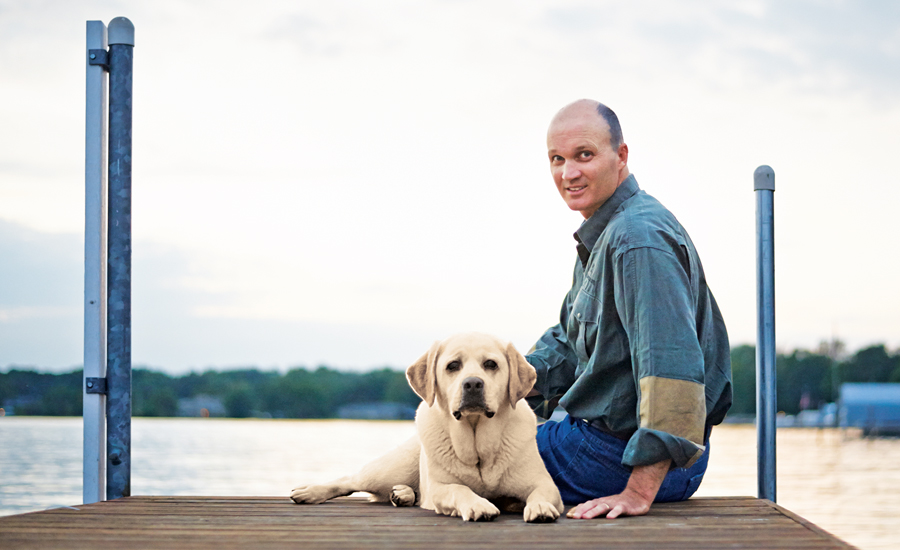
My dream was to get a dog. A yellow Lab, to be exact.

The life of a professional tennis player—nine months of the year on the road—was not a recipe for responsible dog ownership. But ever since my fitness coach took me pheasant hunting for the first time with his friends and their dogs, I’d been obsessed.

Like this story so far? Subscribe to All Creatures magazine!

I couldn’t stop thinking about how intelligent and well-trained the dogs were. How they were like teammates to their owners.

They reminded me of the dogs I’d grown up with on Lake Minnetonka in Minnesota. I was the youngest of four, nearly nine years behind my next oldest sibling. By the time I was in fourth grade, I was the only child at home.

My closest companions were our two Siberian huskies. They were outside dogs and loved running around in the cold. My parents gave me a wooden dog sled one Christmas, and many a winter day I’d hitch the huskies to the sled, jump on and take off across the frozen lake like I was in the Iditarod.

Maybe that’s why I was drawn to Labs. Not only were they excellent companions, they served a solid purpose. That was the odd part of my dream. Even though we lived on a lake famous for great fishing, my family wasn’t into fishing or hunting. We were sports-centered.

My mom’s father taught her and my older siblings to play tennis. So when I came along, it was no surprise that I picked up a racket when I was four. By nine I was playing at Nationals. Later, I received a tennis scholarship to Stanford and left after one year to turn pro. I’d been competing on the tour ever since.

After that outing with my fitness coach, I was set on finding a Lab to be a hunting companion.

There was a big stumbling block, though: Who would take care of my dog while I was away on tour? I was single and lived alone. My siblings had their own lives. My parents lived nearby, but they were nearing 70.

“David, we don’t want that kind of responsibility at our age,” Mom told me. “We have had enough dogs to know we have had enough of dogs!”

It was time to let go of my dream. I felt like a little kid who’d just found out the Christmas gift he’d prayed for all year wasn’t under the tree.

Then a paper slipped under the door of my hotel room. A fax, from Mom.

This wasn’t unusual. She often sent faxes with news and encouragement from home, with some tennis tips and Bible verses mixed in.

What was unusual was how she began: “I came across a beautiful yellow Lab on my morning walk through the neighborhood,” she wrote. “His owner lives a few blocks from us. But I’ve never seen his dog before.” That’s odd, I thought.

She described the dog’s beautiful coat, big brown eyes, cheerful personality. “If I ever got a dog,” she closed with, “I would get one just like that.”

If she ever got a dog? Was this really my mom? Hadn’t she told me that she was done with dogs? What had gotten into her?

The next day, there was another fax from Mom, this one even more bewildering. “I called the dog’s breeder to find out more about her dogs and breeding philosophy.”

The day after that, another fax arrived with this previously unimaginable statement: “I sent the breeder a down payment on a puppy today.”

What?! You could’ve knocked me over with a feather.

I wish I could say the news inspired me to swashbuckle my way through the Japan Open, but I lost in the early rounds and flew home.

We went to visit the litter of puppies. One of them, a male, looked straight out of a dog show. He had an athletic build, a beautiful buff-colored coat and almond-shaped brown eyes. He walked over to me and fell asleep with his little head resting on my shoe.

He was the one. I knew it. Dad was soon building a run outside their house in anticipation of his arrival.

It didn’t take long for me to see that Ben was no ordinary dog. His puppy misbehavior—chewed shoes, accidents, nipping—was minimal. He learned basic commands quickly. He was intelligent, gentle and thoughtful.

That dog run? Ben never spent a night in it. He just seemed to belong right with us, wherever we were. When I was on the road for tournaments, Mom and Dad were happy to dog-sit. I called home and got updates every day.

Soon I started Ben’s training. That turned our walks into an adventure. “Fetch it, Ben!” I’d shout, throwing his rubber retrieving dummy into the marsh that bordered a street in my neighborhood. He’d disappear into the cattails…then burst out with the dummy in his mouth and tail wagging.

“Atta boy,” I’d say, patting his head. Sometimes I would hide. He’d always find me too.

If I knocked a tennis ball over the fence while practicing, Ben would run into the trees to find it, sifting through the dozens of balls that had landed there. Minutes later, he’d trot out proudly with the exact ball that I had hit—never anyone else’s—in his mouth.

Everywhere I went, Ben went too. Now I knew why Jacob in the Bible named his son Benjamin, meaning “son of my right hand.” That’s what Ben was to me. I loved him dearly and deeply. Ben brought something to my life that I never knew a dog could.

The year Ben was three, 2001, was a time of change. I’d been dating Brodie, a girl I’d known for most of my life, but that year we broke up. I retired from the professional tennis tour.

I was in my early thirties, and injuries had taken their toll. I continued to play parttime in senior’s tournaments as I set out to discover the answer to the question What’s next after tennis?

One thing made the transition easier: Ben. God brought Ben to me at just the right time, I thought. So I’ve got to trust that he has new and good plans in store for me.

I was driving with my parents one day, listening to the radio, when out of the blue Mom posed a question that was more like an answer: “David, have you ever thought about getting into radio?”

I hadn’t. But a few weeks later I got an unlikely phone call from a radio station, asking if I’d like to host one of their programs. Soon I was producing and hosting The Christian Worldview every week…with Ben at my feet in the studio.

After recording, it was time for The David and Ben Show. We loved heading up to Lake Superior for fun. “Careful, boy!” I’d say, before tossing his dummy into the rough, freezing surf. No matter how high the waves were, Ben dove in with his signature resolve.

Soon after he turned eight, Ben got sick. At first I thought it might just be fatigue, but when he stopped eating I took him straight to the vet. The diagnosis was devastating: prostate cancer.

I was heartbroken. I cried out to God, “Why did you bring Ben into my life only to take him away so soon?”

Treatment failed. I couldn’t bear to see him suffer anymore. Mom and Dad couldn’t either. We called the vet, who came to the house. She assured us that we were making the right decision to put him down.

Ben was lying on the couch, nodding in and out of sleep. He’d lost a lot of weight, but his face still had that look of serenity and nobility. I put my arm around him and buried my head in his neck. “That’s my boy,” I whispered. “You’ll always be my boy.”

The vet found a vein in Ben’s rear leg and administered the injection. He turned his head to look, then rested it back on the couch and closed his eyes.

“His heart has stopped,” the vet said quietly. “He’s gone.”

I remained slumped over him, gently stroking his side.

It wasn’t until I watched the vet leave with my beloved Ben that a dam inside me broke. Mom and Dad wept for hours with me. “I’m so grateful to have had Ben,” I said. “I just don’t understand why he had to leave so soon.”

I remembered how Ben had come into my life right when I was about to give up my dream of getting a dog. And yet God moved to make my dream come true. He even changed my parents’ minds.

He knew Ben would teach me how to live more fully and love more deeply. In the midst of my grief, God expanded my understanding of his higher plans for us, and his grace.

Remember Brodie? We got back together and we’ve been married for five years. We have a son, Tommy, and—this probably won’t surprise you—not one but two Labs, Gracie and Billy.

All because my boy Ben opened my heart.

Download your FREE ebook, Paths to Happiness: 7 Real Life Stories of Personal Growth, Self-Improvement and Positive Change.


The Dog That Brought Them Together

I was introduced to my wife, Julee, by her dog, Rudy, a rather corpulent cocker spaniel. I was walking on West 72nd Street in Manhattan on a seemingly ordinary May evening when along came Rudy, trundling at a measured but determined pace, completely undeterred in his stately progress along the busy sidewalk by his fellow New Yorkers, who were using their two legs to try and get past him. On the other end of his leash was a dazzling blonde with massive green eyes. I could almost feel a breeze when she batted her lashes.

“That’s the fattest cocker spaniel I’ve ever seen,” I blurted out, thinking this might be a good way to strike up a conversation. I was met with an annoyed look for my efforts. Julee tried to keep moving, but Rudy suddenly became obstinate. He stopped, looked at me, woofed perfunctorily, and bulldozed his way over, dragging a scowling Julee behind him and nearly pulling her off her pumps. She was an actress and singer, I was soon to learn, rushing home from an audition to walk her dog.

God's Constant Presence In Article Ad

We walked around the block together while I tried to smooth-talk my way out of my opening conversational salvo.

“Rudy has the most magnificent ears I’ve ever seen,” I offered.

That got me another turn around the block and Rudy, in what I surmised to be an effort to impress me (or perhaps to help me impress his owner), tried to pick a fight with a much larger and younger dog, and I was able to help extricate him from the conflict. By the time I walked Julee and Rudy to their building, I felt I was coming close to redeeming myself. Julee showed lukewarm interest in my offer of Chinese food later that week, scribbled her phone number on a taxi receipt pulled from her purse almost as an afterthought, and disappeared into the elevator, Rudy giving me a final look over his shoulder as he slipped past the closing door. Upstairs on the twelfth floor, Julee let herself into her apartment, tossed Rudy a treat, and then dialed her mother in Iowa. “Mom,” she said, “I just met the man I’m going to marry.”

Me? I was just hoping to get to see her again. On the way home I ducked into a pet store. Usually you get the girl a gift. I got Rudy a little something, planning to drop it off with Julee’s doorman in the morning. An inner voice told me it would be a good idea.

Sometimes God shouts, sometimes he whispers, and sometimes he sends a woof.

The Dog of My Dreams

My 12-year-old dog Lucy was lying under the kitchen table, one of her favorite spots.

She looked up at me with those intelligent eyes of hers—one blue, one brown—but I knew when she didn’t get up to greet me that the day I’d been dreading had come. I called the veterinarian, who’d taken good care of Lucy ever since I’d adopted her, and asked her to come over one last time.

Community Newsletter

Get More Inspiration Delivered to Your Inbox


I sat down on the floor next to her to wait for the vet, stroking her fur and thinking back on everything we’d been through together. Lucy was part Australian shepherd, part Queensland heeler. A rescue, so you could say I saved her life. Really, though, she saved mine. That’s why I thought of her as my angel here on earth.

When I met Lucy at the Humane Society, I was living with my two children in an old farmhouse in Ojai, a laid-back California town with paths made for strolling, gorgeous sunsets and mountains all around. Although I worked in Hollywood, I didn’t want my kids to grow up there. I wanted my daughter and son to have an upbringing more like my own back in Arkansas.

The farmhouse had a curvy staircase and on Christmas morning, I insisted the kids come down it with their hands over their eyes. “Okay, everybody, open your eyes!” I’d say. I loved to see them take in the presents, the tree, the lights…the wonder of Christmas.

It didn’t take Lucy long to fit into our family. She decided her job was to watch over us, like any good herding dog. She claimed certain spots—a particular section of the sofa, under the kitchen table, outside by the lavender, places where she could keep an eye on things. She snapped at bees and occasionally got stung. She even took part in our rituals, like coming down the stairs with the kids on Christmas morning (though she didn’t put her paw over her eyes).

One day I got home from grocery shopping and Lucy trotted out to the driveway to greet me. I walked slowly on the gravel because I couldn’t quite see around the bags I was carrying. All of a sudden Lucy blocked my way. I moved to the right to go around her. She blocked me again.

“C’mon, these bags are heavy,” I said. But she wouldn’t let me pass. In fact, she started barking at me—which she never did—forcing me to back up. I lowered the bags. That’s when I saw it. Right where I was about to step was an angry coiled rattlesnake. “Good girl!” I told Lucy. We made our way around the rattler and into the house.

I gave Lucy a hug—and an extra-large helping of treats, of course. And I thanked God for giving her to me. Not only because she’d saved me from the rattler, but also because she was saving me from being overwhelmed by the tough stuff I was coping with.

My father, whom I adored, had recently passed away. And although the divorce I’d just been through had been amicable, I was still learning to adjust to life as a single mom. Lucy was there for my kids and me day in and day out, which made me feel incredibly protected and loved—and hopeful that things would work out.

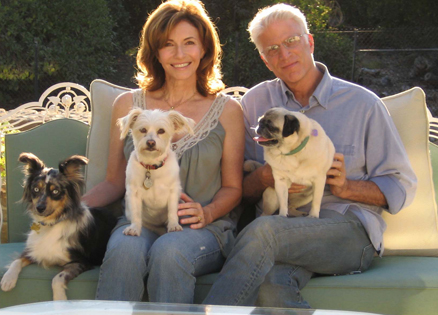
Eventually they did. When Lucy was middle-aged I got another amazing and unexpected gift from God. I fell in love with and married Ted Danson, who is my dream friend and husband. There’s never anything so wrong with me that he can’t make me laugh. Our family blended amazingly well, and his two girls and my kids are hilarious and adorable and the lights of our lives.

Ted and Lucy, of course, fell madly in love. The only time she put up a fuss was when he and I started dancing around the living room. Something must have triggered Lucy’s herding instincts (maybe we were moving like unruly sheep!) because she tried to tackle us and knock us over. Did I mention how she made us laugh?

Now I couldn’t hold back my tears. The vet was here. I stood to talk to her. Lucy slowly got up too and walked over to the doctor. Then she sat down and looked at me, her gaze steady and serene, guiding me through this moment as she had so many others. She was telling me, It’s time to say goodbye.

I knew she was right, but that didn’t make losing her any easier. Every day for weeks afterward, I’d glance at the sofa or under the kitchen table, expecting Lucy to be there. We still had a dog in the house—Roxy, the pug we’d given my son for his fourteenth birthday. She was funny and quirky and had quite the talent for hypnotizing us into thinking we hadn’t fed her. I loved her, but there wasn’t that soul-deep connection I’d had with Lucy.

Ted could tell how much I missed her. “Maybe we should get another dog,” he said. “I’m not ready,” I said. I didn’t know what I was waiting for. Some sign, maybe, that it was okay to move on.

Three months after Lucy died, Ted and I took a trip to Todos Santos, Mexico. One night the image of Lucy came to me in a dream, looking right at me. I got a message: You’ll meet your new dog tomorrow. As soon as I woke up the next morning, I told Ted, “Lucy’s going to help find us a dog today.”

He groaned. “How? And where? We’re supposed to be on vacation.”

“I don’t know,” I said. “But it’s going to happen.” I was sure of it. We saw dozens of dogs that day—napping in doorways, roaming the streets. Each time I wondered, Is this the one? But none gave me the certainty my dream had.

We ate at a restaurant and were driving back to the hotel when I saw a little white head pop up from a hole in a crumbling wall. A terrier mix. Her eyes locked on mine for a moment before she dropped out of sight.

“Stop!” I shouted. “That’s the dog!” We got out and tracked her down. She was with a pack of street dogs. She was scruffy, malnourished, covered with fleas and ticks—the most pitiful-looking dog I’d seen all day. Maybe ever. If it had been up to me, I wouldn’t have chosen her. I like bigger dogs. And she didn’t seem healthy. But the choice wasn’t mine. I was being guided. This dog needed me.

I approached her slowly, not wanting to scare her. When I got close, she sat down and gave me a look that said, I know you’ve come to get me. I’ve been waiting. She let me pick her up and put her in my beach bag. “You’re coming home with us,” I told her.

She lay absolutely still as if she understood. That’s how I was able to sneak her through the hotel into our room. We had a patio with an outdoor shower. It took me two hours to clean her up and get all the fleas and ticks off her. “We’re naming you Lulu,” I said, “after Lucy.”

The next day I took Lulu to a local vet. He was bewildered. Of all the strays to adopt, why this one? He said she wouldn’t have lasted another week, she was so weak from starvation.
To me, that was another sign that this little dog was meant for us. Lucy had come to me when I needed her most, and we’d come for Lulu when she needed us most. There was a wonderful spiritual symmetry to the whole thing.

We brought Lulu home to Ojai, and she hadn’t been with us long when I noticed something amazing. She was drawn to the exact places where Lucy used to hang out, places that our pug totally ignored. I’d find Lulu lying under the kitchen table, sleeping in that same spot on the sofa and outside by the lavender, snapping at the bees and sometimes getting stung.

Like her predecessor, Lulu is very smart and loyal and watches over our family, which now includes an Australian shepherd named Arthur. She charges ahead of him on our hikes, as if she’s blazing trail for him. She and Arthur walk down the stairs in front of our pug, who’s elderly now, guiding her so she doesn’t fall. She hasn’t had to rescue me from a rattler, but if anyone tried to hurt me, it would be Lulu who’d protect me.

She sets the tone for our other dogs and shows them how to behave. I like to think of her as an elegant Spanish lady. You have to take care not to offend her dignity. If she’s trying to jump onto our bed, I won’t lift her up. She’s perfectly capable and doesn’t like to be helped.

Yet Lulu always knows when I need help. If I’m feeling out of sorts, she’s there in a heartbeat, letting me know how deeply I am loved. Of all the gifts our four-legged angels bring us, I think that may be the greatest.

The Courage to Forgive a Friend

A friend loves at all times… (Proverbs 17:17, ESV)

I had just finished writing the last few heartfelt lines on the cute friendship card I’d purchased earlier that day, and as I was addressing the envelope, I heard that still small Voice speak to me.

Witnessing Heaven In Article Ad 827x123

Don’t send it.

I tried to ignore His Voice, but then as I headed to the Post Office to mail the card to a person who had been my best friend for many years but not since our falling out the year before, I heard Him again.

Don’t send it. She’s not ready. I’m working on it.

Though I wanted to mail the card and hope for the best, I knew my previous attempts to make things right with my friend had not turned out well. In fact, they’d been met with rejection, reopening the wounds in my heart that I thought were already healed.

READ MORE: DESTINED TO BE FRIENDS

So, I sat in the parking lot of the local post office and cried for a bit, ripping the card into several pieces so I wouldn’t be tempted to mail it later.

It was time to let God work. It was time for me to stop trying to “work it” on my own and truly give God all of my hurts, regrets, and hopeful expectations where she was concerned. You see, she was the one friend I felt I would grow old with; the one who was a sister to me; the one who supported me no matter what; and the one I’d missed every single day since we’d gone our separate ways.

I’d long forgiven her and hoped we could move past the fight that had separated our families, but that hasn’t yet happened. So, I continue to trust God. But, here’s what I’ve learned through this ordeal.

Just because you’ve forgiven someone doesn’t mean that person has or will ever forgive you, and that shouldn’t matter. You are only responsible for your heart, and by forgiving that person, you’ve chosen to live. There’s an old expression that says holding onto unforgiveness is like taking poison and wanting the other person to die. It doesn’t affect that person, but it will destroy you.

Bottom line: it doesn’t matter who was at fault or who said what—it only matters what God’s Word says, and it says to forgive. His Word says to believe the best in others. And, His Word says that a friend loves at all times.

All means all.

So if you’re on either side of this situation—hoping to be forgiven or needing to offer forgiveness—I hope you’ll push past the pain and enter into God’s overwhelming love and grace. Let Him heal your broken heart.

Don’t dwell on the “would’ves, could’ves or should’ves” but rather meditate on the goodness of God. And, remember, it’s all in God’s hands and in His timing. Forgiveness may come, but even if it doesn’t, keep your heart right and choose to love. And, ask God to help you forgive yourself.

He will.

The late Maya Angelou said it best: “You can’t forgive without loving. And I don’t mean sentimentality. I don’t mean mush. I mean having enough courage to stand up and say, ‘I forgive. I’m finished with it.’”

It’s time to forgive and choose to live.