Embrace God's truth with our new book, The Lies that Bind

Remembering Koko, the Beloved Gorilla Who Learned to Communicate via Sign Language

When the whole world grieves the passing of an animal, it’s clear it was a very special animal, indeed. Such was Koko the gorilla, who passed away in her sleep on June 19, 2018, at a preserve in California’s Santa Cruz mountains. Koko was 46.

A female western lowland gorilla, Koko touched us in so many ways, especially in her ability to learn hand signs—more than 1,000 signs in what her caregiver and instructor, animal psychologist Francine “Penny” Patterson, calls “Gorilla Sign Language” (GSL), a modified version of American Sign Language (ASL).

Patterson also spoke English to Koko from her earliest years and it’s estimated that Koko understood some 2,000 English words. As might be expected, Koko didn’t grasp or utilize grammar and syntax, but her facility with language, both spoken and signed, represented remarkable progress in the effort to bridge the communication gap bewtween human beings and animals.

“Koko touched the lives of millions as an ambassador for all gorillas and an icon for interspecies communication and empathy,” The Gorilla Foundation, which oversees the preserve where Koko lived for many years, posted in announcing the news of Koko’s passing on its website. “She was beloved and will be deeply missed.”

Born on July 4, 1971 at the San Francisco Zoo, Koko was given the name Hanabi-ko (Japanese for “Fireworks Child”); the following year, Patterson began her groundbreaking work with Koko.

Koko was featured in numerous documentaries and twice appeared on the cover of National Geographic magazine. Her first cover, on the October 1978 issue, was a precursor to today’s selfies: Koko took the photograph of herself in a mirror.

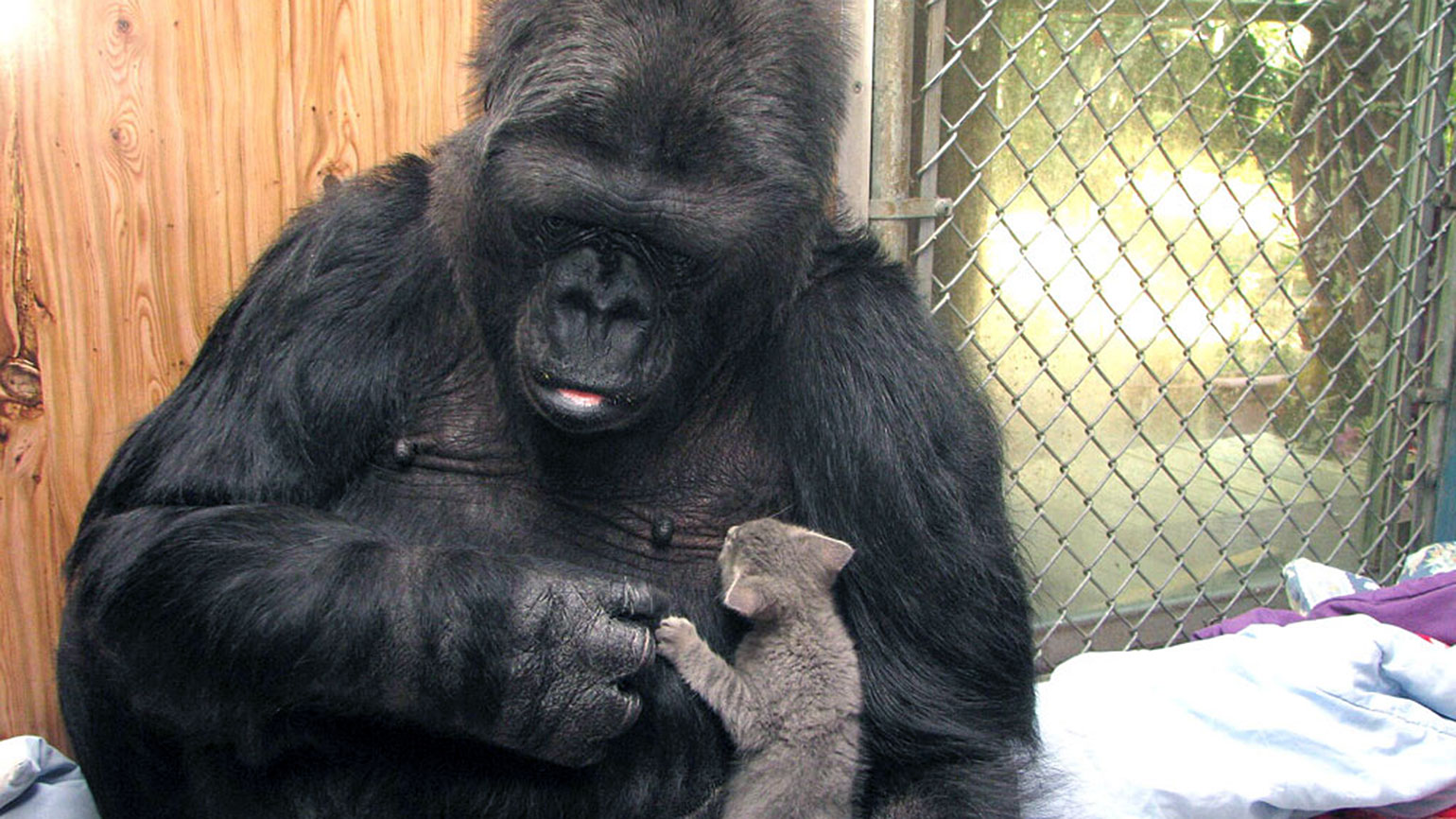
Koko enjoyed children’s books with kittens in them, and in December 1983, when asked what she’d like for Christmas, she said she wanted a kitten. When she was given a stuffed toy, she expressed her disappointment, so in July of ’84, for her birthday, she was allowed to choose her favorite from a litter of several kittens.

She chose a gray-and-white Manx and named it “All Ball.” Koko liked to rhyme when she signed and to her, the tiny kitten resembled a ball. She played with All Ball about an hour a day, in between the various other activities that filled her waking hours.

“They would play chase with each other and [Koko] would hold it and pet it,” biologist Ron Cohn told The Los Angeles Times in 1985. “The cat reacted to [Koko] as she would a human, but she was pretty independent and would bite Koko or wriggle loose when she got tired of being babied.”

In December 1984, All Ball got loose and made her way onto a highway near the preserve, where she was run over. When Koko learned the sad news, Cohn said, “she acted like she didn’t hear us for about 10 minutes. Then she started whimpering—a distinct hooting sound that gorillas make when they are sad. We all started crying together.” Animal lovers around the world mourned with Koko.

In the press release announcing Koko’s death, the Gorilla Foundation said, “The foundation will continue to honor Koko’s legacy and advance our mission with ongoing projects including conservation efforts in Africa, the great ape sanctuary on Maui, and a sign language application featuring Koko for the benefit of both gorillas and children.”

Recovery and Reconciliation

Father’s day cards from Grant–zero. Birthday cards from Grant–zero. The silence is deafening.” I didn’t even have to look at the postcard from my dad to tell my therapist what it said. The words were seared in my memory. Dad was always finding fault. Keeping score.

There was no change in my therapist’s calm expression. “If you could say anything to your father, what would it be?” he asked.

NIVFLB Inarticle ad

“I don’t know.” Whatever I said would only be found lacking.

“The key to sobriety is honesty,” he said. “Not just about your drinking. About your relationships.”

I sighed. My recovery sponsor had been telling me the same thing lately.

My therapist asked again. “If you were going to die tonight, Grant, what would you say to your dad?”

My father was a Navy fighter pilot. Pilots are notorious control freaks. Throw in a hefty dose of military discipline, and that made the man impossi ble to live with. Thank God he was often away on deployment when I was a kid.

Otherwise in our house, it was all “Yes sir” and “No sir.” He laid down strict rules and didn’t hesitate to enforce them. My sister coped, but I chafed at all the restrictions. A minor infraction like snacking between meals would get me sent to my room for the night.

The punishment increased exponentially for more serious offenses. As a teenager, I was grounded for months on end.

Much as I hated his rules, I hated his cold, distant demeanor more. Dad had exacting standards, and he was quick to point out how we didn’t meet them.

He was the hardest on Mom. He complained about her permissiveness, her spending, her housekeeping, even the kooky Lucille Ball sense of humor that made her so much fun to be around.

She had to be hospitalized for her nerves a number of times, and I was sure it was all Dad’s fault. As soon as I finished high school, I left home and didn’t look back.

Mom’s funeral was the last time I saw Dad. He knew nothing about me, and that’s the way I wanted it. He’d phone from San Diego once a month with military precision, always at 5:00 p.m. (1700 hours, he’d say) on a Sunday. It was the same stilted small talk every time–the weather, sports, the news.

I knew he only called me out of duty, not out of any real feeling. Certainly not out of love. That, I had always tried to convince myself, was not part of our equation.

I built a good life in Arlington, Virginia. I had a solid job, a beautiful family, a nice house. But inside I was miserable, and I didn’t know why.

I turned to the bottle to mask the pain. My drinking got out of control. I wrecked five cars. I flew into fits of rage. When I saw my kids pull away from me, fear in their eyes–the way I used to react to my dad–I knew I had to get help.

I joined a recovery program, faithfully went to meetings. Each day it became easier for me to say, “My name is Grant. I’m an alcoholic.” With my sponsor’s guidance, I worked the 12 steps.

I’d come a long way over the years. But lately I’d gotten stuck, on the eighth step: becoming willing to make amends to everyone I’d harmed with my drinking. I’d made a list and divided it into three categories: “Immediately,” “When the opportunity arises” and “When hell freezes over.”

Dad was the lone entry in the last category. My sponsor and my friends in recovery said that wasn’t how the program worked. I ignored them. They didn’t know my father!

What I couldn’t ignore were my feelings about Dad. I tried to pack them away and move on. I didn’t want them controlling my life the way he used to. I asked God to take away my anger and resentment, but I didn’t get an answer.

To me, that silence felt like rejection. First my earthly father, then my heavenly Father too. I had tried to love them both but they didn’t love me back.

“I can’t talk honestly with my dad,” I told my therapist. “He’ll shut me down.”

“Then write him a letter,” my therapist said. He handed me a notepad and pen. “Here, give it a try.”

I took a deep breath and picked up the pen. “Just as the silence was deafening to you…” I began. I described how hurt and rejected I’d felt growing up because he never hugged me, never noticed anything good that I did, never said he loved me. Before I knew it, I’d filled a page and a half.

The next day I mailed it. There. The truth was out. No more pretending. No more stilted phone calls.

And that’s what happened. Literally. Dad didn’t call that month. Or the next. Fine, I told myself. I don’t care.

Six months after I sent the letter, I finally got a call. From my sister. “Something’s wrong with Dad,” she said. “He’s sick.”

“What do you mean sick?” Dad had an iron constitution, unlike poor Mom.

“I think he’s depressed, really depressed. I’ve never seen him like this. I don’t know what’s wrong.”

But I did. I hung up, stunned. I’d pictured my dad being angry, disgusted, dismissive. I’d never imagined he would be hurt. If he’s hurt by what I wrote, he has to care about me…at least a little, I thought. It hit me that everything I’d condemned him for, I was guilty of myself.

I picked up the phone and for the first time in 15 years, I dialed my father’s number. “Dad?”

“Grant?” He sounded shocked.

“How are you?”

“Fine. How are you?”

The weather, the Redskins, the Chargers… we ran out of small talk.

My heartbeat quickened. My hand holding the phone shook. Then the words I knew I had to say as much for myself as for him flew out of my mouth. “I love you, Dad.”

Silence. So intense it took both hands to keep the phone to my ear. God, please don’t let him hang up!

I heard something strange. A stifled gasp. Ragged breathing. Then I realized Dad was crying.

“I love you too, son,” he said.

Never in my life had I heard him call me “son.” Or say “I love you.” Never, ever had I known him to cry. Not Dad. Not this man I thought I knew.

That call was a beginning. A tentative one. Three months later I flew out to San Diego to spend a week with my father.

Even though we’d been talking on the phone every week, it wasn’t until we went on a three-hour drive to see my sister that we really got honest with each other. I guess we both felt safer talking to the windshield than face-to-face.

“I need to tell you something,” I said. “I’m a recovering alcoholic. I’ve been sober six years now.”

Dad was silent for a minute. Was he going to criticize me for lacking self-control? I braced myself.

Then he spoke. “You know your mom was an alcoholic….”

No, I didn’t know. But the moment I heard it, I knew it was true. “All those times she was in the hospital for her nerves, she was actually drying out?”

“Yes. I’m sorry I didn’t tell you. At first I was trying to protect you. Then I assumed you’d figured out what was going on. I was afraid you blamed me.”

The more we talked, the more the pieces fell into place. Mom had seemed so fun and carefree to me as a kid. Now I recognized the kooky things she did as the risk-taking behavior of an alcoholic.

Carefree, when she was under the influence, devolved into carelessness–with money, housework, even parenting. All the times she left my sister and me to fend for ourselves, saying gaily that she was just going out for a little while.

“Why didn’t you divorce her?” I asked Dad.

“Back then they didn’t give custody to fathers,” he told me. “I figured that three months of sanity a year when I was home was better than none.”

I’d pegged my father as cold-hearted and cruel when all along, he’d been trying to do right by his children. He knew we needed structure and stability, so he combated the chaos the only way he knew–with military order and discipline.

He’d seen seeds of my mother’s disease in my teenage recklessness and tried to nip it in the bud. He hadn’t meant to hurt me. Everything he’d done, he’d done out of love.

We spent the rest of my visit making up for lost time. When we said goodbye, he pulled me into a long hug.

In that embrace, I felt not only my father’s love but also the love of the Father who had reconciled us and who would give us 17 more years together, 17 years filled with the closeness–and the amends– that we’d both longed for.


Download your FREE ebook, True Inspirational Stories: 9 Real Life Stories of Hope & Faith.

Reba McEntire’s Guide to Life

Sometimes people ask me for advice. “Reba, which song should I record?” “How do I get started in the music business?” “Do you think my teenager is ever going to lose that attitude?” (The answer to that last one, by the way, is yes, so hang in there.) If I could summarize my best advice in one word it would be: Listen.

My grandma, my mama’s mother, Reba Estelle Brassfield, taught me a lot about listening. I’m her namesake and I adored her. I remember her braiding her long hair every night before she went to bed.

Sweet Carolina Mysteries In Article Ad

After supper, we’d sit on the porch looking at the sunset and Grandma would take a gallon jar filled with fresh milk heavy with cream and churn it into butter. Next morning we’d slather it on her home-baked biscuits or let it melt on her blackberry cobbler.

Grandma would take us kids fishing at a pond behind her house. We’d drop our lines in the water and listen as she told Bible stories, waiting for the fish to bite. That’s where I learned about Noah and the Ark, Jonah and the whale, Joseph and his coat of many colors. And the songs she sang to me, like “Jesus Loves Me.”

But mostly she showed me how to talk to Jesus. You just said whatever was on your heart. I used to watch her get on her knees in her nightgown by her bed, braids trailing down her back. Afterward I asked her what she was doing. “Talking to Jesus. The Holy Spirit is talking to Jesus for me.”

“How do you know what he’s saying, Grandma?”

“I listen real hard. I listen to what God wants me to do. That’s the most important part of praying.”

Listening is a part of singing too, something I first discovered in church. I still have the little brown hymnbook I used as a child. Alice, Susie and I would go with Grandma and Grandpa Smith to worship at a one-room country church near our ranch in Chockie, Oklahoma.

There was a piano in the church, but most of the time, we didn’t have a piano player. Thank goodness Stella McGee could read music. Mrs. McGee would study the hymnal, call for silence, hum the pitch to the congregation and then we’d sing a cappella.

We had to hear the right note for everyone to start together and we had to keep listening to sing the song through together. Just like Grandma’s prayers, singing involved listening as much as anything else, and all great musicians have great ears.

First grade was the beginning of my performing career. I sang “Away in a Manger” for our school Christmas program, the first time I sang behind a microphone. I loved hearing my voice soaring in the gym. I felt bigger than I was, bolder.

I was the third of four kids so it wasn’t easy to get noticed. But when I sang, people paid attention. People listened.

I kept at it, getting one solo after another, “My Favorite Things” one year, “Red Wing” the next. At the 4-H talent show when I was in fifth grade I borrowed my teacher Mrs. Mackey’s daughter’s prom dress along with a rhinestone necklace and bracelet and sang “My Sweet Little Alice Blue Gown.”

I won the Junior Individual Act division, my first trophy ever. Still, I didn’t think my voice was anything special. Singing came so natural, I guess that’s why I thought I was meant to succeed at something else, something that didn’t come so natural. That turned out to be another lesson in listening.

I wanted to be a world champion barrel racer, a rodeo champion like my daddy. I grew up riding horses, all of us kids did. When we were five or six Daddy said, “Get on that horse, get in the brush and find some cattle.”

On a ranch, everyone has to pitch in. It’d be 4:00 A.M. when Daddy would get us up and we’d go catch and saddle the horses in a 40-acre pasture while he cooked breakfast. He’d fry bacon, then fry eggs in the grease. The eggs would float in bacon fat and slide off the platter.

We’d fill our bellies then get on our horses and chase cattle all day in brush so thick sometimes you couldn’t ride through it. Many times I had to get off my horse and pull his legs out of the briars.

One day while we were working cattle down at the corrals, I got real mad when they wouldn’t go into the chute. I reared back, cussing, and threw the hot shot— the cattle prod—at the fence. It busted into pieces and hit me in the forehead.

Mama and Daddy didn’t say a word about my cussing. I guess they thought getting my head cut was punishment enough.

I worked hard at being a barrel racer. You run the horse as fast as he can go, then stop him as fast as you can, turn around a barrel, accelerate and do the same thing with two more barrels, making a cloverleaf pattern. I started training at nine and by the time I was 11 I was competing, all 75 pounds of me on 1,500 pounds of horseflesh.

“Reba,” Daddy said, “you need to kick your horse more.”

“Daddy,” I said, “I’m kicking as hard as I can! My stirrups are sticking out like this.” I held up my hands as far apart as I could. Daddy just shook his head.

I loved the practice pen, or the roping pen as we called it. I practiced and practiced, entered one rodeo after another. I did okay, sometimes pretty good, but I got nervous and I’m sure the horse knew it!

Turns out, I was allergic to everything in the barn—the dust, the hay, the mold, the mildew. I’d start sneezing. My eyes itched and my throat got so constricted I wouldn’t have been able to sing if I tried. After one miserable showing, Daddy said, “Why do you want to do something you’re not that good at?”

“Well, what am I good at?”

“Singing. That’s your gift,” he said.

I’d like to say the rest was history, but sometimes the people you’re least likely to hear are your family, and I could be just as stubborn as Daddy. Finally I started focusing more on my music.

It started in junior high when Mama and my Oklahoma history/art teacher talked our superintendent Mr. Toaz into forming a country-western band at the school. We didn’t have a marching band or a choir. So that band was our country music 101 class.

Out of that class, my brother, Pake, my sister Susie and I formed a trio called the Singing McEntires, and performed at every place we could. In college, I got my first big break. Guess where? At a rodeo! I sang the national anthem at the 1974 National Finals Rodeo in Oklahoma City in front of 9,000 people each night for 10 performances.

Something happened there that was another good lesson in listening. “I sing the national anthem in the key of D,” I told the conductor.

“We play it in the key of A,” he said.

My gut told me that would never do. The key of A would be awful for me. I should have listened to my instincts. But I didn’t feel like I could argue with the conductor. We tried it at the rehearsal and, yes, I sounded awful.

Fortunately Clem McSpadden, the man who got me the job and one of the main men there at the NFR, spoke to the conductor. The next run-through we did it in D. But it was almost a disaster.

All this training in listening turned out to be invaluable in my career. Time and again I’d sit in the tour bus or on a plane, asking what was right for me. I’d try to listen. Sometimes I’d forget.

Once I auditioned for a part in a movie I really wanted. It seemed meant for me. I was sure I had it in the bag, then I found out that they’d cast another actress. I was crushed. Why didn’t I get the part? Why did they give it to someone else? If there had been a cattle prod handy I would have chucked it at the wall (probably with the same results too).

Finally I did what Grandma had taught me. I got myself quiet and listened for the answer. Listened real hard.

You didn’t get that part because you’re needed at home with the kids, came the message. My husband, Narvel, and I had his three kids, Shawna, Brandon and Chassidy, with us a lot, plus we had our own son, Shelby.

“Thanks for the answer, Lord,” I said. It was just what I needed to hear, and it made all the difference. I was more than glad to be there with my family.

By now Narvel, our kids and people who work with me know I don’t do a thing without praying first. “What are you doing next?” someone might ask.

“I don’t know,” I’ll say. “God hasn’t told me yet.” I honestly believe that.

Not long ago Shelby, age 22, announced he wanted to become a racecar driver. All I could think was what a dangerous occupation that was. I didn’t know anything about the racing business. Was it even more dangerous than rodeoing?

I could picture myself wearing a path in the dirt pacing, worrying, waiting to see that he’d finished a race safely.

I prayed hard. I finally realized God gave Shelby that passion and talent to race cars, so I had to trust God to take care of Shelby on the track, just like I trust him every minute of the day. “Shelby,” I finally told him, “I’m behind you a hundred percent.”

Shelby is racing now and he’s good at it. I’m talking to God more now too.

Sometimes when I close my eyes I can smell Grandma’s hot biscuits with butter fresh from the churn. It feels like she’s right there praying with me, her long gray braids running down her back, both of us opening our hearts and listening to what God has to say. Listening real hard.

Praying for a Pet

Got a stressed pet? Here are a few tips to comfort and calm them:

1. Recognize stress-induced behavior.
Don’t assume your pet’s negative behaviors are signs of disobedience. Situations that may trigger stress are socializing, moving, traveling, adoption, loud noises and being left alone. Signs of stress include scratching, panting, pacing, trembling, excessive licking, hiding, accidents in the house, barking or howling (dogs) and excessive vocalization (cats).

Mys of Blackberry Valley In Article Ad

2. Watch the timing of rewards.
Your pet craves your attention, and coddling him during stressful moments may be interpreted as a reward. For instance, making a big production out of saying goodbye when you leave the house can actually cause your pet to become anxious. Instead, say a few parting words and walk out the door as if leaving is no big deal. Save the petting session, extra cuddle time or treats for when you return.

3. Keep them occupied while you’re out.
Many pets experience separation anxiety. Have a pet food dispenser and puzzle toys available when they’re home alone. For cats, place a perch near a window. If possible, arrange for a visit from a pet sitter.

4. Try training.
A professional trainer can guide you in replacing your pet’s negative behaviors with positive ones. “Redirection” is often effective. If your pet focuses on something that causes anxiety—say he growls at another dog behind a fence while you’re out on a walk—divert his attention. Use a favorite toy or bits of food. This helps defuse an emotionally charged moment.

5. Soothe with scents.
Some pets respond to pheromones, airborne substances that mimic natural calming chemicals produced by animals. Pheromones come in sprays, plug-in diffusers, wipes and collars. Humans can’t smell them, but for many pets they do the trick.

6. Put on some mellow music.
Albums such as Through a Dog’s Ear and Through a Cat’s Ear are specifically created to relax your pet during times of stress. Bonus: You may also enjoy the classical music!

7. Tame travel terrors.
Many pets are anxious riding in cars. If your pet gets carsick, ask your vet about medication. Before the trip, withhold a meal (but always provide water), give her ample time to relieve herself and tire her out with a long walk or play. A safe place to ride is crucial. Keep your cat in a carrier. For dogs, use a crate or a seatbelt tether. Simply being away from home can cause stress. Bring along her favorite toys or blanket, especially if she’ll be staying somewhere without you, like a sitter’s home or a boarding facility.

8. Prepare for fireworks.
Fourth of July fun often isn’t fun for pets. If loud noises upset yours, stay home during fireworks. Play games or practice obedience commands to engage him. Provide a safe and secure retreat, but never shut your pet in a room. Turn up the TV or music (see no. 6) to muffle the fireworks. Use the same techniques during thunderstorms.

9. Swaddle them.
A calming coat, such as a Thunder- Shirt, uses straps with hook-and-loop fasteners to apply a constant, comfortable pressure (similar to swaddling an infant). These coats for dogs and cats come in a range of sizes and help during thunderstorms and fireworks or any time your pet is anxious or reactive.

10. Consider alternative remedies.
For severe cases, in which the fear is so intense that your pet is causing herself harm, your vet may prescribe a sedative. For milder cases, homeopathic or herbal remedies may work. Melatonin is often used for anxious pets, and Rescue Remedy is a popular herbal treatment. Discuss these options with your vet before giving them a try.

Being aware of when your pet’s anxiety arises and taking steps to relieve it will help make him feel safe and happy—just as your faithful friend does for you.

For inspiring animal-themed devotions, subscribe to All God’s Creatures magazine.

Prayers for Grown-Up Kids

What is it about praying for your kids that you swing from wildly ambitious hopes to woefully mundane fears, never sticking to one or the other? At least that’s what happens to me.

My two boys are great. Both in their 20s, they are following fabulously different paths, one in a creative business environment the other on a rich spiritual journey, and in my head I can see the two paths cross in an explosion of talent and wisdom.

Inspiration from the Garden in article ad

I’m flattered when they come to me, their old man, for any shred of advice. I also realize that being a dad of a 20-something means listening. Listening very carefully.

Here’s a prayer for the parent of a grown-up child: Please let me listen, Lord, and know when I should step in to help, and when I should let go and let you do the helping.

Alas, I want to micro-manage at all times. And in lieu of that, I do what I remember my father did when I was in my mid-20s. I send links to articles, clippings, little things I think maybe, possibly, they might want to read. The subtext: If you don’t want to listen to me, listen to this expert.

I waffle between trusting God and wishing to be God and making it all happen for them, with a wave of my wrist, a magic wand and a prayer, transform their lives.

Not long ago, I was thumbing my way through the Scriptures, looking for some model parents. I noticed in the book of Luke how Mary, at the prospect of this extraordinary child she would bear, burst forth in magnificent poetry: “My soul magnifies the Lord and my spirit rejoices at his presence…” 

Well, that’s Mary, I thought. She was, after all the mother of God. She could afford to have outrageous dreams and hopes.

But if you keep reading the gospel of Luke you quickly come to a moment when she sounds like any other anxious parent. Remember that story, how Jesus at age 12, lingers behind in Jerusalem and doesn’t join his earthly parents on the caravan back? 

Missing him, worried sick, they hurry back to Jerusalem, searching high and low, only to find him in the temple, “His Father’s house.”

It is a parent’s fate. You dream big dreams, pray big prayers, plummet back into worry–where are they?–then you let it go and trust God. They are, after all, in God’s hands.

Prayer for Pets

What has four legs (more or less) and needs prayers? Probably someone you know.

I’ve said it before—we’re a praying company. GUIDEPOSTS receives hundreds of thousands of prayer requests a year, each and every one prayed for by name and need by staff and by thousands of volunteers around the world. If you have a need, we’ll pray 24/7. That’s the deal.

God's Constant Presence In Article Ad

The prayer requests we get range from pleas for universal peace and harmony to help with a balky transmission in a 1961 Pontiac Bonneville that was headed for a classic car show. Usually people pray for their families, for their health and the health of loved ones, for finances and for freedom from fear and worry. If you want to know what’s important to people, find out what they pray for.

One constant that touches a place in my heart is prayers for pets and animals. As you know, Julee and I have Millie, our two-year-old golden retriever who shows up periodically in some of your favorite videos at Guideposts.com. Millie is family and we will pray for her as quick and naturally as we will pray for any human loved one.

I know you pray for your pets because I get the letters and emails and posts. You’ve asked for prayers for everything from parakeets to a whole herd of cattle.

Here’s what I’d like to propose: a special prayer page for your pets right here on our site. Send a picture along with your specific pet-related prayer request and we’ll post it on the page. You’ll also be able to see and pray for other people’s pets. Meanwhile, check out this video of Millie and me. I think you’ll like it. Millie does.

Edward Grinnan is Editor-in-Chief and Vice President of GUIDEPOSTS Publications.

Power Manger

My Nativity set is the first Christmas decoration I unpack and the last I put away. It’s been a cherished part of the holiday since I was a little girl.

My father would read from Matthew and I would reenact the night Jesus was born, walking each figure into the stable until they were all gathered around the baby in the manger. That’s how the Christmas story came alive for me.

Whistle Stop Cafe In Article Ad May 2023

I carried on this tradition with my children, and now that I’m a grandmother, it’s my grandchildren’s turn. Two years ago, I gave my grandsons—ages four and six—their own Nativity set. 

I read them the Christmas story from the Bible and let the boys play out each scene with the figures from the set just as I had as a child—the angel appearing to Mary, the wise men following the star, everyone coming to see the Christ child.

My grandsons seemed to get into it. They solemnly marched the wise men close to the manger. They even made sounds of amazement they thought the sheep and cows would make when they saw the baby.

You know how it is, though. You try your best to pass your faith on to your grandchildren, but when they’re that young, it’s hard to know if anything’s really sinking in.

One Sunday last December, my husband and I stopped after church to see the boys. “Grandma, look at the ’tivity!” the younger one said, tugging me by the hand while the older one ran ahead into the living room. I smiled. Maybe they remember the story I taught them!

There was the Nativity set on the coffee table, front and center. I was about to congratulate myself when I saw that all the figures were tipped over. I guess they didn’t understand, I thought, trying not to let my disappointment show.

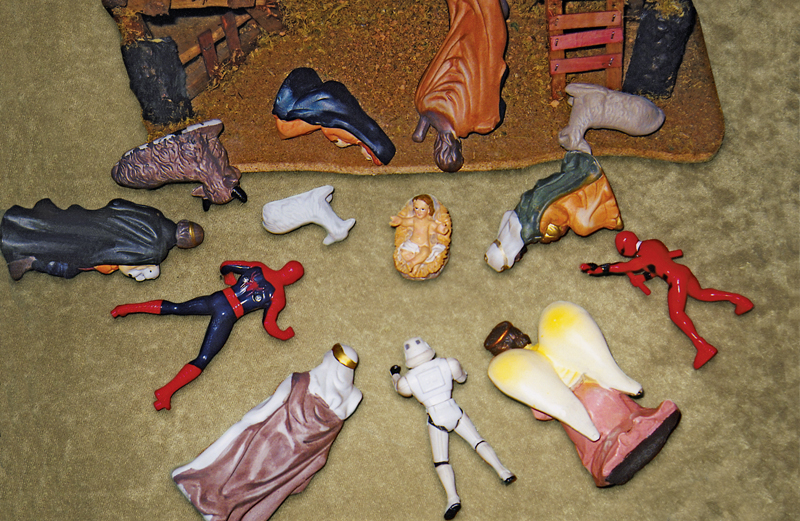
I stepped closer. That’s when I noticed that the figures were not lying carelessly, but arranged neatly in a circle around the baby in the manger, all facedown. The wise men, the shepherds, the angel, Joseph, Mary, the animals and…a Power Ranger, a Star Wars figure and Spider-Man. What was going on here?

My grandsons looked up at me, their expressions expectant, as if asking, Don’t you see, Grandma?

Then I did. Everyone was bowing down and worshipping Jesus, just as the wise men do in Matthew 2:11. Even those with superpowers recognized and honored the greatest power of all.

I pulled my grandsons close and kissed the tops of their heads. I didn’t have to worry. They understood the meaning of Christmas, maybe better than I did.

Download your FREE ebook, True Inspirational Stories: 9 Real Life Stories of Hope & Faith.

Please Pass the Black-Eyed Peas

Call me a typical guy but to me New Year’s Day means two things: football and food. As in watching college bowl games on TV—I save my loudest cheers for my Oklahoma Sooners, of course—and eating a big bowl of black-eyed peas. Both good old-fashioned American traditions, right?

Well, not for my wife, Stephanie. In the 10 years we’d been married I’d managed to change her mind about football. I didn’t quite convert her into an OU fan, but she did come around to understanding my love for the game and for the Sooners.

Pray a Day Vol 2 In Article Ad

Not bad for a woman who had less than no interest in football when we met.

But black-eyed peas? Forget it. Steph didn’t like beans of any kind.

“I won’t eat them, and I won’t cook them,” she declared. There was no swaying her.

Believe me, I tried. The first year we were married, I appealed to her sense of tradition. I told Steph that’s what my family ate every New Year’s when I was growing up in Poteau, Oklahoma.

My mom would lay out a spread of cornbread, fried potatoes and a steaming pot of black-eyed peas and we’d feast while we watched football. Dad liked to say that eating black-eyed peas on January first was supposed to bring good luck all year long.

“I don’t really buy into that,” I told Steph, “but it was fun just the same.”

“For you all, sure,” she said. “Not my kind of thing, though.”

I took another tack. “How about making some just because you love me?”

Steph laughed and shook her head. “Nice try.”

She did bring home a can of black-eyed peas from the grocery and present it to me on New Year’s, though.

I didn’t give up. Steph was into eating healthy. Her idea of a great meal was salad. Once we went to a steakhouse and she ordered a chopped salad. Not as a starter either. That was her whole dinner: a pile of lettuce and veggies with three little slices of sirloin on top.

She claimed everything tasted better on a bed of greens. Yeah, right.

Still, I thought I might be able to use Steph’s fondness for healthy food to help my case come New Year’s. I looked up nutritional information on black-eyed peas and fed it—the info, not the peas—to her.

Black-eyed peas are low in fat and sodium, and cholesterol free. They’re a good source of calcium, folate and vitamin A. And a half-cup, cooked, has as much protein as three ounces of red meat.

“They’re good for you,” I said. “Like your salads.”

Steph wouldn’t bite.

I resorted to opening a lone can of black-eyed peas at halftime that New Year’s Day and every one thereafter. That sufficed for tradition.

Until last year. Who says Steph has to make black-eyed peas? I thought. Why can’t I make them myself? I got on my laptop and Googled how to cook them. Guess what popped up? A recipe for black-eyed pea salad!

I printed out that recipe and another one, a slow-cooker version of what my mom used to make. I threw the ingredients in the Crock-Pot before we went to bed.

New Year’s Day I woke to a heavenly aroma. I checked the Crock-Pot. Bubbling along nicely.

The Sooners game started. During commercials, I washed spinach and cut up veggies for the salad. Steph took pity on me and made the dressing.

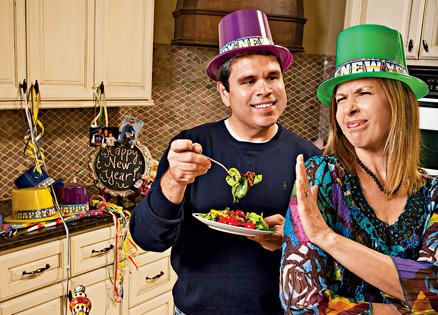
At halftime, we sat down together in front of the TV with our food on a tray. A big bowl of slow-cooked black-eyed peas for me. And a salad for her, topped with a scoop of those very same black-eyed peas.

I watched Steph take a bite. Then another. “You’ll eat anything if it’s on a bed of greens, won’t you?” I teased.

Steph just grinned and kept eating. She actually liked the black-eyed peas!

So much that she’s making them for us January first. The game, the food and the woman I love—this will be my best New Year’s ever. Especially when the Sooners win.

Try Michael’s New Year’s recipe for Black-Eyed Pea Salad.


Download your FREE ebook, Rediscover the Power of Positive Thinking, with Norman Vincent Peale.

Planting Hope in Winter

I’m not much of a gardener. I love having beautiful flowers—but I don’t have a good track record when it comes to making them grow. During our son’s first deployment, life conspired to change that. 

A few months after our son left for the Middle East, my friend gifted me with a box of tulip bulbs. My face immediately betrayed my confusion and dismay. She laughed at my expression, but wasn’t the least bit disconcerted. Instead she walked me through the process of planting them. 

Sugarcreek Amish Mysteries In-Article Ad 2023

She explained that these bulbs were put into the ground in the fall and lay dormant all winter. They had all the nutrients they needed inside the bulb and would come out in the spring. “When you see the leaves of the tiny flowers pushing toward the sun, you’ll know that it’s almost time for your son to come home. They’ll give you hope when you need it the most.”

I thanked her—trying to show my gratitude for her gift—and then left the carton in my garage, intending to ignore it. The last thing I needed was a spring without hope. But every time I ventured out there, my eye fell on the box. I admit that I didn’t really want to go to the trouble to plant them and fail in making them come up in the spring, but their presence rebuked me. So I gave in and ventured into my garden for a session of bulb planting.

It was a long winter—cold and dark. I endured both the weather and the loneliness and fear I felt with our son away. Dead leaves, frost and finally a sprinkling of snow covered the area where I’d planted those flowers, and I soon forgot they were there.

Finally the weather began to warm. One day, as I walked down our front steps, I noticed an area of green. I bent down to inspect the situation more clearly and saw that those tulips had begun to grow, their tiny leaves forcing their way to the sun.

Day after day I noted the flowers’ progress. And day after day, the time approached when our son would finally be home. It was as if those flowers were a physical representation of the hope I’d been afraid to let bloom during the dark winter months. Now with spring just around the corner, nothing could keep either of us from straining toward the light

Almost all of those bulbs bloomed. And with each brightly colored flower, I marked off one day closer to getting to hold my son in my arms again.

So often we don’t know when our hope is growing. God works things together deep inside our hearts and souls. He brings joy out into the open only after the growth has occurred. It’s a lesson I’ll never forget.

Pets as Caregiving Companions

Edwina Perkins and Beethoven
Hello Guideposts. My name is Edwina Perkins, and this is Beethoven.

My mother-in-law came to live with our family because she had been diagnosed with Alzheimer’s and had finally reached a point when she could no longer live by herself.

Beethoven was 11 months old and I noticed that right after she moved in, he began protecting her by following her around.

Oh, I so believe that Beethoven at this point was destined to be in our family. The children were young. We had a puppy, and then all of a sudden, we had a person in our house with Alzheimer’s. I didn’t know how I was going to do it and I felt like all the responsibility was going to fall on me. But this little guy came through, and he shared the responsibility with me by keeping an eye on my mother-in-law.

He was her guardian angel. I just know it, because had he not whimpered under our bedroom door, she could have walked down the stairs and out the door, and I would have never known it. But in the middle of the night, whenever he would whimper, I would get up and I would find her in the hallway. He helped take care of her in so many ways.

Once my mother-in-law had to leave, he would sit at the top of the stairs outside of her bedroom door and just wait, because every night we would tuck her in and he would wait while we did so. Right after she left, he stayed at the top of the stairs for about three days until he realized she was gone.

Just watching her pet him, absent-mindedly, I knew he loved her, and I knew she loved him. And it was what we needed because having her move in was a huge adjustment. I think Beethoven made it easier for all of us.


Donna Winningham and Sherlock
Hello Guidepost friends. I’m Donna Winningham, and this is my friend, my African gray parrot, Sherlock. I’ve had him for about five years. I decided I wanted to get a bird that was really smart, and Sherlock fits the bill.

My mom came to live with us after my dad died. Kind of felt like she was taking care of Sherlock, if I was at work or my husband was gone. She would feed him; she liked to feed him. She would call us if he flew off the roost and let us know that he needed help. Sometimes she would even walk over in her walker and pick him up and put him back on his roost.

That was really special. I think it was a good little companion for her. Although we never really planned it that way, but in the long run, looking back, after she died, looking back, I think, yeah, that was really good for her. It gave her a sense of purpose.

The TV would be on. They’d be watching Dr. Phil or the news or whatever, and he would make the sound of the ringtone of the phone and then say “Hello,” and he pops the of a can every now and then and goes, “Oh boy!”, like he’s just had a drink of something really good. Just all kinds of crazy, little amusing things that a parrot will do.

I’d say he misses her. She was here for about 15 months, I guess before she went to live in a different facility. I feel like he served a purpose. I think it was probably providential. At the time, I may not have thought that, but looking back, you kind of see things differently. We have some great memories with her here, and Sherlock’s part of that


Monica Morris and Punkin
Hi Guideposts. My name is Monica Morris, and I’m here to tell the story about the relationship—the unlikely relationship—between my dad and our cat, Punkin. My dad found Punkin in the barn when he was out doing chores. Punkin had been abandoned. He was just a little kitten, and we assume his mom had abandoned him. And Dad just kind of took him under his wing, and fed him and took care of him, and Punkin became his lifelong companion.

He would follow my dad out to the barn every day, and when Dad took off on the tractor or in the truck, my Punkin would just go out to the porch and wait for Dad to come home. And later on in life, when he became an indoor kitty, and he would sit on my dad’s lap or my mom’s lap and keep them company. He was always there for them.

We were all worried about Punkin after Dad died, because he was grieving and he wasn’t eating. And we really—Punkin in our minds kind of represented that my dad was still with us, and we were afraid of losing him, too.

Punkin would wait for my dad to come home. He would sit on my dad’s kitchen chair and wait for him, or he’d sit up on the table and stare at the chair. And once he became accustomed to the idea that my dad wasn’t coming back, he would sit with my mom again like he used to.