Embrace God's truth with our new book, The Lies that Bind

A Perfect Place to Pray: The Dentist’s Chair

Have a dentist appointment coming up? Have you ever prayed in the dentist’s chair?

I don’t mean “Lord, get me out of here” prayers—or maybe I do. Those are totally valid prayers. But they’re not the only kind that make the dentist a great place to pray.

On a recent visit to the dentist, I faced the prospect of a few hours in the chair. With my mouth open. Sometimes painfully propped open. And while the people there play soothing music over the sound system, I wasn’t looking forward to such a long stretch of time in which I couldn’t read, write or even listen to an audiobook. (Perhaps it’s important to hear the person with the drill saying, “hold still” or “turn your head”).

Then I had a revelation: the dentist’s chair is a great place to pray. And prayer can occupy my mind with better, higher thoughts than, I hope that wasn’t an “uh-oh” I just heard.

So, I tried it. I started by praying (silently, of course, as my mouth was otherwise occupied) for myself—my teeth, gums and so on. Next, I prayed for the dentist and her assistant and for the dental hygienist as well as the office staff. But I didn’t stop there. After all, I had plenty of time at my disposal.

I prayed for my family, one by one. I prayed for my church family, then for my neighbors. I prayed for relatives and friends who are struggling with illness or physical issues. And more.

By the time my dental appointment was over, I had interceded for more people and needs than I had in a long time. I even progressed to giving long and specific thanks and praise to God for…well, so much.

My dental prayer session didn’t make me love being at the dentist or look forward happily to the next time. But the focus on prayer not only assuaged both boredom and pain; it also helped the time to pass much more quickly. And it gave me a stress-relieving, God-saturated plan for all of my future visits.

Need a Lift? Try Our Gratitude Challenge

Learn More About Our Thanksgiving Day of Prayer

A New Way to Pray the Apostles’ Creed

I was touring Egypt some years ago, when my guide, a Coptic Christian, referred to the importance of a specific prayer in his tradition, comparing it to the Apostles’ Creed in the churches of the Western world.

Until that time, though I had often recited the creed in private and public worship, I hadn’t considered it to be a prayer—though it always ended with “amen.”

The Apostles’ Creed is an ancient statement of Christian belief, dating to at least the 4th century A.D. and possibly much earlier. Its exact wording differs in various churches and denominations, but it’s always something like the following:

I believe in God, the Father Almighty,
creator of heaven and earth.
I believe in Jesus Christ, His only Son, our Lord.
He was conceived by the power of the Holy Spirit
and born of the Virgin Mary.
He suffered under Pontius Pilate,
was crucified, died and was buried.
He descended to the dead.
On the third day he rose again.
He ascended into heaven,
and is seated at the right hand of the Father.
He will come again to judge the living and the dead.
I believe in the Holy Spirit,
the holy catholic Church,
the communion of the saints,
the forgiveness of sins,
the resurrection of the body,
and the life everlasting. Amen.

I suppose I didn’t relate to it as a prayer because it’s not addressed to God; it refers to each member of the Trinity, but in the third person. However, though I’ve continued to recite it regularly in the course of my prayers, since that conversation with my Coptic friend, I’ve also occasionally turned it slightly to enhance my private worship. Like this:

I believe in You, God, my Father.
You are almighty,
creator of heaven and earth.
I believe in You, Jesus Christ, the Father’s only Son, our Lord.
I believe You were conceived by the power of the Holy Spirit
and born of the Virgin Mary.
You suffered under Pontius Pilate,
were crucified, died, and were buried.
You descended to the dead.
On the third day You rose again.
You ascended into heaven,
and are seated at the right hand of the Father.
You will come again to judge the living and the dead.
I believe in You, Holy Spirit,
and in the holy catholic Church,
the communion of the saints,
the forgiveness of sins,
the resurrection of the body,
and the life everlasting. Amen.

It’s a slight change, but one that has made the creed even more precious to me. I hope it will do the same for you.

A New Way to Pray for God’s Will

I’m pretty sure I’ve prayed the Lord’s Prayer since preschool, and I’ve prayed it daily for many years. So, I figure I’ve prayed “Thy will be done” thousands of times. Sometimes, when I’m feeling most submissive and surrendered, I even pray, “not my will, but Thine be done,” as Jesus prayed in the Garden of Gethsemane.

For all my experience, however, it’s not easy to pray it sincerely. I want to mean it. I hope I mean it. And maybe, of the thousands of times I’ve prayed it, I’ve really meant it a hundred times. And that may be a tad optimistic.

But I’ve learned another way to pray for God’s will that helps me do so a lot more honestly and sincerely. It doesn’t feel as spiritual as “Thy will be done,” or as abandoned as “not my will, but Thine.” But it sure has been a help.

Much of the time, when I pray, I pretty much know what I want. I even think I know what God wants. (After all, in the Bible He says a lot about the things He wants: love, grace, mercy, justice, life and so on.) For example, if I pray for someone to come to an experience of new life through faith in Jesus Christ, praying “Thy will be done” can feel redundant. The Bible already says that God is “not willing that any should perish, but that all should come to repentance” (2 Peter 3:9, KJV). Similarly, when I pray to become more like Jesus, I know that “this is the will of God, even [my] sanctification” (1 Thessalonians 4:3, KJV). And so it goes.

But “Thy will be done” isn’t always so clear. I know that God’s thoughts are not my thoughts, and His ways are not my ways, as Isaiah 55:8 makes clear. His timing is hardly ever my timing, and His tactics and strategies are often inscrutable to me. At such moments, my new way of praying for God’s will comes in handy. In this case, I’ll pray according to my (admittedly limited) wisdom and then add, “unless you have a better idea.”

Of course, God’s ideas are always better than mine, and I’ll often say so when I pray that way. His will is a “good, pleasing and perfect will” (Romans 12:2, NIV), always. That’s the context of my prayer, “unless you have a better idea.”

It’s not fancy. And maybe it won’t feel right to you, but it helps me remember that God’s in charge. He’s much smarter than I am, and I want everything I ask of Him to be granted only if and when it’s His idea too.

A Good Time to Pray? When You Can’t Sleep

According to the National Center for Sleep Disorders Research, up to 40 percent of the population experiences signs of insomnia every year. There are many triggers for insomnia including health problems, stress, medications, substance abuse, anxiety and aging. While some people don’t battle insomnia, occasionally they may wake up in the middle of the night and be unable to get back to sleep. When younger, if I couldn’t sleep I tried a variety of things: counting backwards, watching television and reading. Sometimes it worked, but typically not. I would think about all the things that needed to get done the following day or unresolved issues.

The inability to fall back asleep used to frustrate me, but not anymore. Now I see it as an opportunity to pray; to be still in the presence of God. I have come to realize that talking with God is the best use of this time. In these quiet times, I unload my worries and concerns, and seek His guidance. This is also a great time to pray for others who are battling their own issues. Nothing releases me of my worries more than praying for others.

Some of my best conversations with God have taken place before the sun has risen. Everything around me is quiet, dark, still and motionless. There are no distractions. His presence gives me peace and eventually I can fall back asleep even if it’s only for a short time. No longer do I see this time as wasted.  When you can’t sleep, talk with God and remember Psalm 46:10, “Be still and know that I am God.” When do you find it best to talk with God? Please share.

Lord, in our sleepless nights, You are there for us. Hear our prayers. 

Having trouble getting a good night’s sleep? Download Abide for Christian sleep meditations that use calming techniques and Scripture verses framed in calming stories to lull you into a peaceful slumber.

A Farewell Prayer

Ever wonder if you should go to a funeral or not? Go. You’re meant to be there.

That’s how I thought of Carmen’s funeral. A long-time member of our church, she died last Saturday at age 87 – at least that’s how old the program said she was. She seemed ageless to me.

Was I her best friend? Goodness no. Did I feel loved by her? Goodness yes. Did she know how to spread love to many? Yes, indeed, that was her gift.

She might have had few words, but she had a dazzling smile and the warmest handshake. At church she was the first to notice when anyone new showed up; at coffee hour she would be the first to grab their hand and lead them to someone she was sure they should meet.

I’ve been to church committee meetings where people have strategized about how to make sure visitors feel welcome. Carmen was a committee of one in that department.

For many years she and her elderly mother came to church and I could tell that her mother worried about what would happen to Carmen when she was gone.

She shouldn’t have. Carmen took care of the church; the church would look after Carmen.

People visited her at her care facility. Her name would pop up on the prayer list. When the latest photo directory was compiled, there was Carmen, older and frailer, but still with the dazzling smile.

Over 30 years ago Carol and I got married at this same church. We decided on a small ceremony, just family and a few close friends.

“But you know,” Carol said, as though explaining a little known rule of etiquette, “anyone from the church community is allowed to come. That’s just how it works.”

Most of our church friends were too polite to show up uninvited. Not Carmen. She dispensed with all such formalities. She came in a new dress and a shiny pair of Mary Janes. Hers is the widest smile in all the photographs.

We prayed for Carmen at the funeral. “A sheep of your fold, a lamb of your own flock,” said the minister. “Receive her into the arms of your mercy, into the blessed rest of everlasting peace, and into the glorious company of the saints in light.”

Here on earth she had let that light shine.

8 Ways to Pray With Your Body

I first encountered the Jewish practice of shucklen—a Yiddish word which means to shake or rock) at the Western Wall (or Kotel) in Jerusalem. Many of the worshipers who lined the ancient wall that once supported the Temple rocked back and forth as they prayed—some slowly, some frenetically.

No one knows for sure how this practice began. But one midrash suggests why it became a common practice:

A person is required to sway during prayer, as it is written: “all my bones shall proclaim: O God, who is like You!” (Psalms 35:10). . . . And this is the custom of the Rabbis of France and her pious ones.

I have heard others explain, similarly, that shucklen constitutes literal obedience to the command to “Love the Lord your God with all your heart and with all your soul and with all your strength” (Deuteronomy 6:5, NIV)—that is, with your “bodily” strength.

That is just one way to put your physical strength into your prayers. Others include:

1) Standing
Standing to pray was the most common posture for prayer in Jesus’ day. He referred to the Pharisees standing in the synagogues and on street corners to pray, condemning not their posture but their pride. He told His own disciples, “When you stand praying, if you hold anything against anyone, forgive them, so that your Father in heaven may forgive you your sins” (Mark 11:25, NIV).

2) Lifting Up Hands
Psalm 134:2 says, “Lift up your hands in the sanctuary and praise the Lord” (NIV). Lifting our hands—palms to the sky—is a physical way of reaching out to God and asking for His help. Paul urged, “In every place of worship, I want men to pray with holy hands lifted up to God” (1 Timothy 2:8, NLT).

3) Bowing
Orthodox and Roman Catholic worshipers often bow in worship (for example, bowing is the proper response to the “Gloria Patri” in liturgy); others, however, do so less often (if ever). But bowing is a great posture for worship and prayer. I tend to bow (slightly) when singing a worship song that extols God’s holiness or mentions His kingship or His throne. “Come, let us bow down in worship,” sang the psalmist (Psalm 95:6a, NIV).

4) Kneeling
Kneeling at one’s bedside or at a church altar is less common than it once was, but kneeling is a helpful posture in prayer. It reminds the person who is praying that he or she is a supplicant and a needy beggar asking for favor. “Let us kneel before the Lord our maker,” the psalmist sang, “for He is our God” (Psalm 95:6b-7a, NIV).

Ask the OurPrayer team to pray for you!

5) Lying prostrate
The Bible says that “Abram fell facedown” while talking to God (Genesis 17:3). No posture better embodies humility than lying prostrate before God, and (for me, at least) no posture better concentrates the mind and spirit. While it may more often be done in private rather than public worship, I have done both.

6) Lying supine
Those who are sick or bedridden often pray while lying on their backs. Even if that is not the only posture available to you, praying in a supine position can be beneficial. One of my favorite prayer practices is lying on my back on a hilltop or in a meadow on a fair day, with my eyes open, praying as I watch the clouds roll by.

7) Sitting
In my evening prayers, I almost always sit and journal my prayers in a notebook on my lap. You might place an empty chair next to your favorite place to sit and carry on your conversation with Jesus as if he were seated next to you. You might even pour Him a cup of coffee and start your prayers, “Good morning, Lord.”

8) Pacing
I have often found that pacing—particularly when my prayers seem urgent or numerous—helps to focus my thoughts and words a little better. The 20th century pastor, Oswald J. Smith, said his prayer practice was to clear the furniture from the center of the room and pace back and forth while praying.

Of course, God is more concerned with the position of our hearts in prayer than of our bodies. But our posture can often reflect our hearts and focus our minds, and thus lead us more quickly—and perhaps deeply—into the place where God wants to meet us.

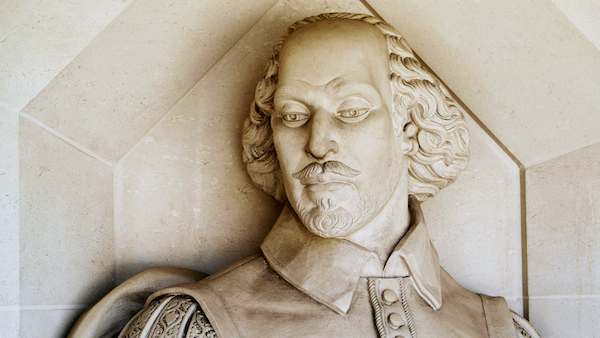
7 Ways to Pray with Shakespeare

I am something of a Shakespeare nut. I have read—and seen performed—all of his plays, most of them many times. I can sit in a performance of Hamlet or Much Ado About Nothing and laugh like a madman or cry like a baby at the beauty of his thoughts and words.

Of course, many people start to nod off as soon as his name is mentioned. They recall droning lectures and 9th grade readings of Romeo and Juliet.

But even people who think Shakespeare is oh-so-boring, have been enriched, even shaped, by his words—from “To be or not to be” to “Neither a borrower nor a lender be” and “The quality of mercy is not strained.”

The Bard and the Bible by Bob HostetlerSuch thoughts and words have long shaped my life and my writing (so much so that I wrote The Bard and the Bible (A Shakespeare Devotional), a book of daily readings that pairs a quote from Shakespeare, a verse from the King James Bible (created in the same period and the same city as Shakespeare’s works), and a short reflection that compares or contrasts the two.

In recent years, Shakespeare’s words have even shaped my praying, as I have often echoed the Bard’s words in my prayers:

1) A Morning Prayer
Some days it feels as though I am heading out to do battle, as Henry V did before the battle of Agincourt. So I will sometimes make his short prayer of trust and abandonment my own:

How thou pleasest, God, dispose the day!

(Henry V, IV, 3)

2) A Prayer of Confession
Though I’ve never killed my brother (or married his wife!), I have occasionally adapted the confession of Claudius in Hamlet to begin my own prayers of confession, remembering that “All may be well” when we confess our sins and experience God’s pardon:

O wretched state! O bosom black as death!

O limed soul, that struggling to be free

Art more engag’d. Help, angels! Make assay,

Bow, stubborn knees, and heart, with strings of steel,

Be soft as sinews of the newborn babe.

All may be well.

(Hamlet, III, 3)

3) A Prayer of Petition
In As You Like It, Orlando’s encounter with the exiled duke starts off badly. But he apologizes, explaining that he hopes his gentleness from that moment on will make up for his previous conduct. He says,

Let gentleness my strong enforcement be.

(As You Like It, II, 7)

I have made Orlando’s prayer my own on numerous occasions when I regretted my actions and, after swallowing my pride, tried to make a new start . . . with gentleness.

Ask Guideposts’ OurPrayer team to pray for you!

4) A Prayer for Gratitude
Among the first words Henry VI speaks in one of three history plays that tell the story of his reign are these:

O Lord, who lends me life,

lend me a heart replete with thankfulness.

(Henry VI, Part II, I, 1)

He applies the words to his gratitude for his wife, but I have applied those words to a multitude of settings.

5) A Prayer of Praise
I also frequently “repurpose” Florizel’s words, which he spoke in The Winter’s Tale to praise his sweetheart, Perdita:

What you do

Still betters what is done.

(The Winter’s Tale, IV, 4)

I make those lines a prayer of praise to God. When I see an amazing sunset, hear a moving song,or glimpse a blooming flower, I pray, “What you do still betters what is done.”

6) A Wedding Prayer
In the last act of Henry V, Queen Isabel of France prays the following for her daughter as she is given in marriage to the victorious King of England after the battle of Agincourt:

God, the best maker of all marriages,

Combine your hearts in one.

(Henry V, V, 2)

Though the participants rarely recognize it as a quote from Shakespeare, I will occasionally pronounce the above prayer in a wedding ceremony or pen them in a wedding card.

7) A Prayer of Trust
Shakespeare’s last recorded prayer may be contained in the first line of his last will and testament, dated January 25, 1616, just three months before he died:

I commend my soul into the hands of God my Creator, believing through the merits of Jesus Christ, my Savior, to be made a partaker of life everlasting.

It resembles the prayer of Jesus on the cross, recorded in Luke 23:46: “Father, into thy hands I commend my spirit,” which was in Shakespeare’s day a part of the funeral service in the Anglican Book of Common Prayer.

These are not the only prayers found in Shakespeare, but they are the seven I recall and repeat most often. If they turn out to be helpful to you in putting a little more poetry into your prayers, I will say, “Amen, amen” (Coriolanus, III, 3).

7 Ways to Pray Without Ceasing

Every time I hear that phrase from Paul, “pray without ceasing” or “pray continually” as the Common English Bible puts it, I think he’s asking the impossible. Really now. It might be one thing for a monk in a cloistered cell, but what about me? What about you? We’re too busy for that!

Unless…unless. Unless I’m thinking too narrowly about prayer. Why do I think that keeping connected to God can only be done with my eyes closed and my head bowed? Aren’t there other ways? Sure there are. Here’s a list:

1. Get a song in your head.
There’s a slew of them in my memory and a half-dozen new selections get logged into my larynx every Sunday. Got a song can get stuck on the hard disk of your brain? Might as well be a holy one. Let it do the praying on your behalf.

2. Wear a prayer.
A couple years ago my wife, Carol, was wearing this beaded bracelet that didn’t seem like her style at all. “What’s that?” I asked. She explained it had made by a friend who was in the hospital, part of her therapy. “Every time I see it,” Carol said, “it’s a reminder to pray for her.”

Read More: Bible Verses That Will Transform Your Life

3. Have a Bible verse handy.
The one I’ve tried recently is that commandment Jesus repeated, “Love the Lord your God with all your heart, and with all your soul, and with all your strength and with all your mind.” I’ll just tell myself: heart, soul, strength, mind. That’s enough.

4. Put a prayer on your phone.
If you’re like me, you’re checking your phone all the time–for messages, emails, news, Facebook updates. Might as well put a prayer there too. There are some great prayer apps. OurPrayer has an easy one to use. It’s free too! NOTE TO SELF: Read the prayer app before getting sucked into the latest news.

5. Look at a tree.
Okay, I know this sounds silly, but when was the last time you really looked at a tree? Notice how the branches spread out, look at the color of the bark on the trunk. Any buds pushing through, any leaves popping out? See God in a blade of grass, a leaf, a flower, a tree.

6. Flash a prayer.
As you listen to someone at work, as you talk so someone on the phone, as you read a friend’s text, as you respond to a family member’s email, flash them a prayer. Think of how much you love them. Zap that thought through cyberspace. It’ll be God at work in both your lives.

7. Write down three things you’re thankful for.
Scribble them on a Post-It note. Scrawl them on the back of an envelope. Send yourself an email. Every moment of thankfulness is a reminder of God’s blessings, a prayer without ceasing.

Rick will be hosting a live chat “How To Pray When Busy” on Facebook on Wednesday, April 5 at 3pm EST.

7 Ways to Pray with Beads

Many people these days associate the use of beads in prayer as a strictly Roman Catholic practice, the Holy Rosary. The rosary is a cycle of prayers that focus on the mysteries of the faith, the Apostles’ Creed, “Our Father,” “Gloria” and “Hail Mary.”

But you don’t have to be Catholic to pray with beads. Many Orthodox Christians use a prayer rope, a wool or silk loop with 100, 50, 33 or 10 knots and beads in it. A cross usually begins and ends the loop. The prayer rope is used to keep track of the number of times a person prays the Jesus Prayer or other prayers.

Community Newsletter

Get More Inspiration Delivered to Your Inbox

Notice: JavaScript is required for this content.

/* FORM STYLES */

#nf-form-5-cont {
background-color:#ffffff;
border-radius:35px;
-webkit-border-radius:35px; }

/* FIELDS STYLES */

.nf-form-content .nf-field-container #nf-field-27-wrap {
margin:0;
border-radius: 25px;
-webkit-border-radius: 25px; }
.nf-form-content .nf-field-container #nf-field-27-wrap .nf-field-element .ninja-forms-field {
background-color:#ffffff;
border-color:#ffffff;
margin-bottom:0;
border-radius: 25px;
-webkit-border-radius: 25px; }
.nf-form-content .nf-field-container #nf-field-28-wrap {
width:120px;
}
.nf-form-content .nf-field-container #nf-field-28-wrap .nf-field-element .ninja-forms-field {
background-color:#00ab84;
width:120px;
}
.nf-form-content .nf-field-container #nf-field-28-wrap .nf-field-element .ninja-forms-field:hover {
background-color:#00ab84;
}


var formDisplay=1;var nfForms=nfForms||[];var form=[];form.id=’5′;form.settings={“objectType”:”Form Setting”,”editActive”:true,”title”:”Sign up for Newsletter”,”show_title”:0,”allow_public_link”:0,”embed_form”:””,”clear_complete”:0,”hide_complete”:0,”default_label_pos”:”above”,”wrapper_class”:”master-signup-form-wrap”,”element_class”:”master-signup-form”,”key”:””,”add_submit”:0,”currency”:””,”unique_field_error”:”A form with this value has already been submitted.”,”logged_in”:false,”not_logged_in_msg”:””,”sub_limit_msg”:”The form has reached its submission limit.”,”calculations”:[],”container_styles_show_advanced_css”:1,”title_styles_show_advanced_css”:0,”row_styles_show_advanced_css”:0,”row-odd_styles_show_advanced_css”:0,”success-msg_styles_show_advanced_css”:0,”error_msg_styles_show_advanced_css”:0,”formContentData”:[{“order”:1,”cells”:[{“order”:0,”fields”:[“master_signup_email”],”width”:66},{“order”:1,”fields”:[“subscribe_now_1660636976556″],”width”:34}]}],”changeEmailErrorMsg”:”Please enter a valid email address!”,”changeDateErrorMsg”:”Please enter a valid date!”,”confirmFieldErrorMsg”:”These fields must match!”,”fieldNumberNumMinError”:”Number Min Error”,”fieldNumberNumMaxError”:”Number Max Error”,”fieldNumberIncrementBy”:”Please increment by “,”formErrorsCorrectErrors”:”Please correct errors before submitting this form.”,”validateRequiredField”:”This is a required field.”,”honeypotHoneypotError”:”Honeypot Error”,”fieldsMarkedRequired”:”Fields marked with an * are required”,”container_styles_background-color”:”#ffffff”,”container_styles_border”:””,”container_styles_height”:””,”container_styles_margin”:””,”container_styles_padding”:””,”container_styles_float”:””,”container_styles_advanced”:”border-radius:35px;n-webkit-border-radius:35px;”,”title_styles_border”:””,”title_styles_height”:””,”title_styles_width”:””,”title_styles_font-size”:””,”title_styles_margin”:””,”title_styles_padding”:””,”title_styles_float”:””,”row_styles_border”:””,”row_styles_width”:””,”row_styles_font-size”:””,”row_styles_margin”:””,”row_styles_padding”:””,”row-odd_styles_border”:””,”row-odd_styles_height”:””,”row-odd_styles_width”:””,”row-odd_styles_font-size”:””,”row-odd_styles_margin”:””,”row-odd_styles_padding”:””,”success-msg_styles_border”:””,”success-msg_styles_height”:””,”success-msg_styles_width”:””,”success-msg_styles_font-size”:””,”success-msg_styles_margin”:””,”success-msg_styles_padding”:””,”error_msg_styles_border”:””,”error_msg_styles_width”:””,”error_msg_styles_font-size”:””,”error_msg_styles_margin”:””,”error_msg_styles_padding”:””,”drawerDisabled”:false,”export_settings”:[],”form_title_heading_level”:”3″,”ninjaForms”:”Ninja Forms”,”fieldTextareaRTEInsertLink”:”Insert Link”,”fieldTextareaRTEInsertMedia”:”Insert Media”,”fieldTextareaRTESelectAFile”:”Select a file”,”formHoneypot”:”If you are a human seeing this field, please leave it empty.”,”fileUploadOldCodeFileUploadInProgress”:”File Upload in Progress.”,”fileUploadOldCodeFileUpload”:”FILE UPLOAD”,”currencySymbol”:”$”,”thousands_sep”:”,”,”decimal_point”:”.”,”siteLocale”:”en_US”,”dateFormat”:”m/d/Y”,”startOfWeek”:”1″,”of”:”of”,”previousMonth”:”Previous Month”,”nextMonth”:”Next Month”,”months”:[“January”,”February”,”March”,”April”,”May”,”June”,”July”,”August”,”September”,”October”,”November”,”December”],”monthsShort”:[“Jan”,”Feb”,”Mar”,”Apr”,”May”,”Jun”,”Jul”,”Aug”,”Sep”,”Oct”,”Nov”,”Dec”],”weekdays”:[“Sunday”,”Monday”,”Tuesday”,”Wednesday”,”Thursday”,”Friday”,”Saturday”],”weekdaysShort”:[“Sun”,”Mon”,”Tue”,”Wed”,”Thu”,”Fri”,”Sat”],”weekdaysMin”:[“Su”,”Mo”,”Tu”,”We”,”Th”,”Fr”,”Sa”],”recaptchaConsentMissing”:”reCaptcha validation couldn't load.”,”recaptchaMissingCookie”:”reCaptcha v3 validation couldn't load the cookie needed to submit the form.”,”recaptchaConsentEvent”:”Accept reCaptcha cookies before sending the form.”,”currency_symbol”:””,”beforeForm”:””,”beforeFields”:””,”afterFields”:””,”afterForm”:””};form.fields=[{“objectType”:”Field”,”objectDomain”:”fields”,”editActive”:false,”order”:1,”idAttribute”:”id”,”label”:”Email”,”type”:”email”,”key”:”master_signup_email”,”label_pos”:”hidden”,”required”:1,”default”:””,”placeholder”:”@Your email”,”container_class”:”master-email-wrap”,”element_class”:””,”admin_label”:”master_signup_email”,”help_text”:””,”custom_name_attribute”:”email”,”personally_identifiable”:1,”wrap_styles_border”:””,”wrap_styles_width”:””,”wrap_styles_margin”:0,”wrap_styles_padding”:0,”wrap_styles_float”:””,”wrap_styles_show_advanced_css”:1,”label_styles_border”:””,”label_styles_width”:””,”label_styles_font-size”:””,”label_styles_margin”:0,”label_styles_padding”:0,”label_styles_float”:””,”label_styles_show_advanced_css”:0,”element_styles_border”:””,”element_styles_width”:””,”element_styles_font-size”:””,”element_styles_margin”:0,”element_styles_padding”:0,”element_styles_float”:””,”element_styles_show_advanced_css”:1,”cellcid”:”c4722″,”value”:””,”drawerDisabled”:false,”wrap_styles_advanced”:”margin:0;nborder-radius: 25px;n-webkit-border-radius: 25px;”,”element_styles_background-color”:”#ffffff”,”element_styles_border-color”:”#ffffff”,”element_styles_advanced”:”margin-bottom:0;nborder-radius: 25px;n-webkit-border-radius: 25px;”,”manual_key”:true,”id”:27,”beforeField”:””,”afterField”:””,”parentType”:”email”,”element_templates”:[“email”,”input”],”old_classname”:””,”wrap_template”:”wrap”},{“objectType”:”Field”,”objectDomain”:”fields”,”editActive”:false,”order”:2,”idAttribute”:”id”,”label”:”Subscribe Now”,”type”:”submit”,”cellcid”:”c4725″,”processing_label”:”Processing”,”container_class”:””,”element_class”:””,”key”:”subscribe_now_1660636976556″,”wrap_styles_border”:””,”wrap_styles_width”:120,”wrap_styles_margin”:0,”wrap_styles_padding”:0,”wrap_styles_float”:””,”wrap_styles_show_advanced_css”:1,”element_styles_border”:””,”element_styles_width”:120,”element_styles_font-size”:””,”element_styles_margin”:0,”element_styles_padding”:0,”element_styles_float”:””,”element_styles_show_advanced_css”:0,”submit_element_hover_styles_border”:””,”submit_element_hover_styles_width”:””,”submit_element_hover_styles_font-size”:””,”submit_element_hover_styles_margin”:””,”submit_element_hover_styles_padding”:””,”submit_element_hover_styles_float”:””,”submit_element_hover_styles_show_advanced_css”:0,”wrap_styles_advanced”:””,”element_styles_background-color”:”#00ab84″,”submit_element_hover_styles_background-color”:”#00ab84″,”drawerDisabled”:false,”id”:28,”beforeField”:””,”afterField”:””,”value”:””,”label_pos”:”above”,”parentType”:”textbox”,”element_templates”:[“submit”,”button”,”input”],”old_classname”:””,”wrap_template”:”wrap-no-label”}];nfForms.push(form);


READ MORE: THE JESUS PRAYER

Whether you’re Catholic, Orthodox, or decidedly unorthodox in your practices of prayer, you might find praying with a beaded or knotted strand to be helpful. Here are seven ways of praying with beads you might try:

1) Try a book.
Use a book, such as Praying with Beads: Daily Prayers for the Christian Year by Nan Lewis Doerr and Virginia Stem Owens. It consists of a compelling and instructive introduction followed by morning, noon and evening prayers for use with a string of prayer beads. The prayers follow the Christian calendar throughout the liturgical year.

2) Get crafty.
Pray while creating a prayer rope. If you’re a knitter or crafty type, try making prayer ropes as you pray. (One book, Bead and a Prayer: A Beginner’s Guide to Protestant Prayer Beads by Kristen E. Vincent, offers instructions for making prayer ropes).

3) Intercede for others.
Intercede for your family members and friends, one by one, as you count off the knots or beads on a prayer rope (this might be easier with a ten-knot rope, which is often small enough to be worn as a bracelet).

4) Create your own cycle.
Develop your own, tailor-made “cycle” for praying. For example, you might use the four cycles of seven in a 33- or 34-knot prayer rope to rotate through a pattern of adoration, confession, listening, thanks, petition, intercession and praise.

5) Focus on one person.
Similarly, you might use the knots or beads in a prayer rope to focus on one person (or a few). While touching each knot or bead, you might pray for their health, marriage, children, job, finances,

6) Pray the fruits of the Spirit.
Use a 10-knot prayer rope to pray the fruits of the Spirit (love, joy, peace, forbearance, kindness, goodness, faithfulness, gentleness and self-control) for your loved ones, perhaps starting or ending with the Jesus Prayer or the Lord’s Prayer.

7) Save it for special seasons
You might not choose to use prayer beads or a prayer rope all the time; you may want to pull it out for special seasons, such as Advent or Lent or for people’s birthdays or when you want to focus your prayers on a specific need.

Try it. Praying with beads might do something new for your prayer life. And who doesn’t need that?

7 Ways to Pray When You’re Scared

Here are 7 of my favorite ways to pray when you feel overwhelmed with fear.

1) Gideon’s Greeting
When the angel of the Lord found Gideon cowering in fear from the Midianites, the angel said, “The Lord is with you, mighty warrior” (Judges 6:12 NIV). So say those words to yourself whenever you are afraid. Even when, like Gideon, you don’t feel anything like a warrior, say, “The Lord is with you, mighty warrior.”

2) David’s Prayer
The words of David when the Philistines held him prisoner in Gath was the first “memory verse” my wife and I taught our children: “When I am afraid, I put my trust in you” (Psalm 56:3 NIV).

3) Jeremiah’s Hope
The prophet Jeremiah felt thoroughly unqualified for what God called him to do. But God said, “Don’t be afraid of a soul. I’ll be right there, looking after you” (Jeremiah 1:7-8 The Message). Those are good words to repeat to yourself anytime you quake with fear.

4) Jesus’ Promise
Jesus made this promise to His followers: “Peace I leave with you; My peace I give you. I do not give to you as the world gives. Do not let your hearts be troubled and do not be afraid” (John 14:27 NIV). It is easily turned into a prayer of affirmation: “You give me peace, Jesus; Your peace, not the kind of peace the world gives. I will not let my heart be troubled; I will not be afraid.”

5) Isaiah’s Song
The prince of the prophets sang, “Behold, God is my salvation; I will trust, and will not be afraid; for the Lord God is my strength and my song, and He has become my salvation” (Isaiah 12:2 ESV). These are good words to memorize in order to pray them anytime fear or anxiety comes upon you.

6) Paul’s Affirmation
Paul, the great first-century church planter, wrote: “I am sure that neither death nor life, nor angels nor rulers, nor things present nor things to come, nor powers, nor height nor depth, nor anything else in all creation, will be able to separate us from the love of God in Christ Jesus our Lord” (Romans 8:38-39 ESV). Feel free to add “ghoulies and ghosties and long-leggedy beasties” to that list.

7) David’s Testimony
Fearing for his life among the Philistines, David once pretended to be insane until they let him go. Psalm 34 is thought by some to include his testimony upon escaping: “I sought the Lord, and He answered me; He delivered me from all my fears” (Psalm 34:4 NIV). When you are afraid, it is good to remember those occasions in the past when God has heard and answered your prayers and delivered you from your fears.

These are just a few suggestions. But they have often worked for me, and I hope at least a few of them will become your “go-to” for praying the fear out of you.

7 Ways to Pray When You’re Not in the Mood

Don’t always feel like praying? Join the crowd.

I don’t think I know anyone who is always in the mood. After all, prayer can be hard. It can be boring. And there often seems to be so many other things—easier things—to do. Like watching television or listening to a podcast.

But God never said to “pray when you feel like it.” The Bible contains no commands to “pray when you’re in the mood.” Often prayer is most beneficial and most necessary when we feel the least like it. So the question isn’t should we pray when we don’t want to—it’s how. As a partial and imperfect answer, I suggest seven ways to try:

1)  Pray Bible prayers.
Having a few prayers from the Bible committed to memory or marked in your Bible helps tremendously when you don’t feel like praying. I recommend especially Ephesians 3:14-21, Psalm 8, as well as any of these.

2)  Pray “breath prayers.”
Breath prayers are short and simple prayers that take no more than a single breath to pray, such as, “Lord, hear my heart” or “Have mercy.” Check out this post for 10 suggestions.

3)  Count your blessings.
There’s a precious song in the movie, White Christmas, in which Bing Crosby tells Rosemary Clooney that he chases away sleeplessness not by counting sheep but by “counting my blessings.” That’s also a great way to pray when you don’t feel like it. Start by counting your blessings. If it doesn’t send you off to a relaxed state, it’s at least likely to lift your spirits.

4)  Pray the prayers of others.
I keep a few books near my “prayer chair” that I turn to often, especially when words fail me: John Baillie’s A Diary of Private PrayerThe Private Prayers of Lancelot Andrewes and Presence Prayers for Busy People. I’m often amazed at how a quick turn of the page leads me to the perfect prayer for my “don’t feel like praying” heart.

5)  Pray one-word prayers.
As it is sometimes with a close friend or spouse, it can take only a word to express yourself to God. I’ll occasionally pray one word repeatedly or adopt a one-word prayer for the day as a way of keeping the lines of communication open between me and God, even when I don’t feel like praying.

6)  Pray a hymn or spiritual song.
My small stack of books by my prayer chair also includes a favorite hymnal, which I turn to often to find a hymn to sing—or speak—that expresses more than I can put into words. Other times, I pray in song without looking up the words, as “Great is Thy Faithfulness” or “My Jesus, I Love Thee” spring easily to mind.

7)  Call on the Holy Spirit to pray on your behalf.
The Bible says, “the Spirit helps us in our weakness. We do not know what we ought to pray for, but the Spirit Himself intercedes for us through wordless groans. And He who searches our hearts knows the mind of the Spirit, because the Spirit intercedes for God’s people in accordance with the will of God” (Romans 8:26-27 NIV). I rely on that promise often, simply asking the Spirit to say what I can’t pray—or don’t feel like praying—at the time.

In my experience, turning to one or more of these measures not only helps me to pray when I don’t feel like it, but sometimes even ushers me into a spirit of prayer that I hadn’t expected, reviving my passion and renewing my soul.

7 Ways to Pray When You Can’t Pray

How to pray when you can’t pray? A couple of us editors were discussing this problem when someone brazenly said, “You know, I think if you’re trying to pray it is praying. To try to pray is to pray. You can’t fail.”

Perhaps prayer is the only human endeavor where trying to do it is doing it. I mean, if God is God, he’s got to hear us no matter what, even if we don’t feel like we’re praying when we are. We don’t feel all peaceful and in touch with something beyond ourselves.

I know what that’s like. You bow your head, close your eyes, you mutter something and your mind is flying in a thousand directions. You’re worried about your health, your family, your work, your lack of work. You’re thinking about the grocery list and the checkbook and the laundry when you want to be praying. Can’t pray? Here are some things I do. Try ’em.

  1. Go ahead and say it to God anyway. Say whatever is on your mind. Say the worst. It can’t be any worse than anything he’s heard. He’s God, after all.
  2. Breathe. Take some deep breaths. A friend of mind uses the phrase “God is love” as he breathes. In and out. “God is love.”
  3. Too disgruntled to pray? Start thinking of what you’re grateful for. Make a mental list. Write it down if you want. As Joel Osteen writes in his latest book, “Seeds of discouragement can’t take root in a grateful heart.”
  4. Pray for someone else. Pray for lots of other people. Log onto OurPrayer.org and read through some prayer requests. Praying for others always helps focus me. My problems always fall into perspective.
  5. Say the Lord’s Prayer or the 23rd Psalm. I once met a businesswoman who would say the Lord’s Prayer to herself whenever she became angry. It was one surefire way to calm herself down.
  6. Sing. Sing to yourself. It could be a hymn, a praise song, but it could also be some rock number that always makes you feel up and inspired. Music always works on the spirit. The psalms, after all, were meant to be sung.
  7. Go for a walk. Go for a run. Look at a tree. Look at a flower. Climb a mountain. Sit in a chair absolutely silent.

Remember, to try to pray is to pray. You can’t do it wrong. There are probably as many different ways of praying as there are people on this earth. Each one of us has our way of communicating. Each one works.