Embrace God's truth with our new book, The Lies that Bind

What the Bible Says About Getting Along with Others

“Love one another. As I have loved you, so you must love one another” (John 13:34). It sounds so simple, but it’s the biggest challenge we face. Not everyone is easy to love. A friend complained the other day, “My boss should have been a porcupine. She prickles at every little thing!” But every encounter we have with another member of God’s creation gives us new opportunities to draw closer to Him.

My friend doesn’t have to be fond of her “porcupine” to love her. Biblical love is about compassion, about what we do and how we treat others. “If you love me, you will obey what I command,” Jesus tells us (John 14:15). “Whoever has my commands and obeys them, he is the one who loves me” (John 14:21). Fortunately, God understands that loving others isn’t always easy. He stands right behind us, giving us all the support we need. When we don’t know how to love, He who is love can teach us how to win against fear, anger and hate.

Prickly people like my friend’s boss bring out a lot of surprising feelings in us. Anger, frustration, envy and resentment are just a few of the things that get in the way of living out our faith. Experts tell us not to ignore these feelings, or our neglected emotions will fester in a dark corner of our hearts. We need to acknowledge how we feel—and then let go of our feelings and move on.

No matter how difficult others may be, we’re responsible for how we act and react. Jesus tells us to pluck the plank from our own eye before we focus on the sawdust elsewhere (Matthew 7:3). But what if all we can see is sawdust? How can we see the plank? My quick ‘vision test’ of what’s in my heart is to turn to 1 Corinthians 13:

  1. Have I been patient? Really patient? Patient the way Jesus would be?
  2. Was I kind?
  3. Do I envy this person? If so, why?
  4. Am I boasting in any way, even silently in my heart? Do I look down on this person?
  5. Is my pride getting in the way of loving this person?
  6. Was I rude, or did I speak sharply?
  7. Am I seeking the best for this person, or is there an element of self-seeking in my heart?
  8. Do I find myself easily angered by this person? Why?
  9. Do I keep a record of the person’s wrongs?
  10. Do I secretly delight when evil happens to her?
  11. Do I continue to trust and hope that God’s will for this person will prevail?

None of us wants to see our own faults…especially when we think 99 percent of the blame lies with someone else. But that’s what Christ asks of us. Humility is the first step we have to take if we’re going to love others as Christ loved us.

READ MORE: SCRIPTURE FOR BETTER RELATIONSHIPS

What Jesus Left Behind to Come Here

Jesus’ leaving heaven is like a painter becoming a brushstroke on his painting, or a playwright becoming a character in his own play. For some people, it is easier to imagine putting all the oceans in a teacup or trapping the atmosphere in a bottle than it is to understand that God would take on human form and walk this planet.

Jesus left behind many things to visit this world. First, he left the glory of heaven. We know very little about what heaven looks like. We know it is inhabited by God, his angels, and believers who have died. Revelation describes it as a beautiful place (21:1–22:7). Trying to describe it properly is beyond human language.

By coming to earth as a human, Jesus took on certain limitations and weaknesses. For example, the timeless One became bound by time, by the passing of day and night. Formerly, he was above time, unaffected by its passing. On earth, time ticked by for him as it does for all of us.

God is described as being omnipresent—present everywhere at all times (Psalm 139:7–12). There is no place in heaven or on earth a person can go where God is not. During his earthly ministry, Jesus was bound by our three spatial dimensions.

READ MORE: HAVE ENORMOUS FAITH IN JESUS

He also took on basic human needs for food, rest, warmth, shelter, and more. In heaven he had no such needs, but on earth he felt hunger and thirst, weariness, and emotional and physical pain.

Take It to Heart
“Christ uncrowned himself,” William Dyer wrote, “to crown us, and put off his robes to put on our rags.” Jesus made great sacrifices for us. He left behind glorious things so he could take us in. There is much to admire about our planet; there is much to look forward to in heaven.

Check Your Understanding
When we think of Jesus’ sacrifices we usually think of the cross, but he made many others. What do those sacrifices teach us?
His sacrifices show the length of his love for humanity. The highest sacrifice is the cross, but we shouldn’t overlook all that he left behind.

If someone said, “Love isn’t defined by what we give, but by what we give up,” would you agree?
There is certainly some truth in that. Love is expressed in giving of ourselves, but it is also demonstrated by what we’re willing to give up for someone else.

Think of yourselves the way Christ Jesus thought of himself. He had equal status with God but didn’t think so much of himself that he had to cling to the advantages of that status no matter what. Not at all. When the time came, he set aside the privileges of deity and took on the status of a slave, became human! Having become human, he stayed human. It was an incredibly humbling process. He didn’t claim special privileges. Instead, he lived a selfless, obedient life and then died a selfless, obedient death—and the worst kind of death at that—a crucifixion. (Philippians 2:5-8 MSG)

What Does ‘Salt of the Earth’ Mean?

It was while preaching the Sermon on the Mount that Jesus proclaimed, “You are the salt of the earth” (Matthew 5:13). On the simplest level, Christ’s words are about salt as a flavor enhancer. He is telling us that as Christians we are to bring out the flavor of God in the world.

When we are true to being the people God created us to be, when we are true to His calling, we bring out the essence of His goodness and make it more evident to ourselves and to others. When I am the salt of the earth “my soul glorifies the Lord” (Luke 1:46), magnifying His presence so that others can sing, “How sweet are your words to my taste, sweeter than honey to my mouth!” (Psalm 119:103).

Yet this requires purity on our part. We cannot be the salt of the earth unless we “draw near to God with a sincere heart and with the full assurance that faith brings” (Hebrews 10:22). We must rid ourselves of all that interferes with our love of God, and follow the command, “Do not love the world or anything in the world” (1 John 2:15).

We must separate out our worldly desires to keep from losing our flavor: The only time salt loses its flavor is when other minerals are mixed in with the sodium chloride. Thus the first step we can take toward being “one who has clean hands and a pure heart, who does not trust in an idol or swear by a false god” (Psalm 24:4) is to examine the elements mixed in with the salt in our lives.

Cultivating these three traits will help make your life a little “saltier.”

1. Transparent.
The person who is truly salty is one through whom the light of Christ can shine easily and about whom Jesus would say, “Here truly is an Israelite in whom there is no deceit” (John 1:47). We can pray, Lord, help me rid my heart of all guile.

2. Trustworthy.
The person worth his salt is one who has followed the command to “rid yourselves of all malice and all deceit, hypocrisy, envy, and slander of every kind” (1 Peter 2:1). We can pray, Christ, open my eyes to the envy and hypocrisy of my heart, and keep my lips from unkind words.

3. Encouraging to others.
To be the salt of the earth means to see in others what Christ sees in them. “Strive for full restoration, encourage one another, be of one mind, live in peace” (2 Corinthians 13:11). We can pray, Jesus, help me be an example of all that you want us all to be, in word and deed.

Why not begin this very day to live a life full of the flavor of God, so that through us others can “Taste and see that the Lord is good” (Psalm 34:8)?

Walking the Path of Holiness

Some Bible verses seem more demanding, more challenging than others. Perhaps none more so than 1 Peter 1:15-16: “But just as he who called you is holy, so be holy in all you do; for it is written: ‘Be holy, because I am holy.’”

How can we mere humans be holy? Seems an impossible feat, yet that is what we are called to be. In Hebrews 12:14, Paul writes that we must “Make every effort to live in peace with everyone and to be holy; without holiness no one will see the Lord.” It sounds like a deal breaker, doesn’t it?”

Isaiah gives us a particularly helpful perspective on holiness. “A highway will be there; it will be called the Way of Holiness; it will be for those who walk on that Way” (Isaiah 35:8).

Turns out holiness isn’t about how you appear to others, but rather where you are headed. There is a path to holiness, and it is up to us to walk that path. Every day!

To make sure you are progressing on the Way of Holiness—and not simply marching in place—look for these “road markers” in your life.

1. You are moving toward being more fully centered on God’s will.
You yearn to serve Him in all things, at all times, to “live and move and have [your] being in Him” (Acts 17:28).

2. You are increasingly aware of what keeps you from Him.

3. You grow more “eager to serve” (1 Peter 5:2).
You pray more, help the poor and needy more and accept more readily the crosses God has given you.

Godspeed as you walk this holy highway!

Waiting on the Lord: The Power of Silent Prayer

God is always with us, but in our busyness, we don’t often allow ourselves to experience His presence. One way—a challenging but very rewarding way—to become more aware of God’s presence in our lives is to wait on the Lord.

By just being still and focusing your thoughts on God, you can make a space for contemplation in the midst of your obligations and duties. Martha and Mary provide the perfect examples of how we’re often unaware of the presence of the Lord and how to wait for Him. When Jesus visited the sisters at their Bethany home, Martha began to try to get everything ready to pro- vide hospitality to Jesus. She had wonderful intentions—she was ready to “wait on the Lord”in the sense of serving Him. Luke tells us that Martha had a sister named Mary, who sat at the Lord’s feet and listened to what he was saying.

But Martha was distracted by her many tasks; so she came to him and asked, “Lord, do you not care that my sister has left me to do all the work by myself? Tell her then to help me.” But the Lord answered her, “Martha, Martha, you are worried and distracted by many things; there is need of only one thing. Mary has chosen the better part, which will not be taken away from her.” —Luke 10:39–42

Poor Martha! Was she wrong to try to serve Jesus? Of course not. But Martha was so intent on serving the man that she failed to recognize the Messiah.

On one day each week, I say no verbal prayers except for the prayers my husband and I start and end our day with. Recognizing my tendency to be like Martha—busy and distracted—I use my once-a-week silence to be quiet in the presence of the Lord.

For me, that silence requires trust. Like Martha, I’m not one to wait—my prayers are often a barrage of pleas and praise—and so by making myself wait on the Lord in stillness, I’m expressing my faith in the most challenging way I can: in silence and patience. My day of silence, my prayer Sabbath, restores my sense of unity with the Lord. The day before my day of silent prayer, I pray like this:

Dear Lord, Tomorrow let me pray to You without words and images. Let my prayer to You be the living of my life in the knowledge and awareness of Your constant presence, love, forgiveness, mercy, healing. And by so living, let my life itself become a prayer to You, without the need for words or images.

If you’d like to prepare for a weekly prayer Sabbath, take comfort from Jesus’ assurances about waiting on and trusting the Lord

Use Your God-Given Power

We use words rather loosely because we repeat them so frequently. One such word is “power.” I decided to consult the dictionary on the subject.

The Latin word from which “power” derives is the equivalent of the Greek word dynamis, a word used all through the New Testament. And from dynamis is derived the English word dynamite.

The Bible is filled with the most powerful ideas in this world. By substituting the word “dynamite” for the word “power,” you can begin to understand the greatness of it.

Take this verse, for instance. “When Jesus had called the Twelve together, he gave them power (dynamite) and authority to drive out all demons and to cure diseases” (Luke 9:1). And, in praying for his followers, Jesus asks, “Holy Father, protect them by the power of your name” (John 17:11).

Imagine how powerful God’s name is!

When you are up against a tough situation, the first essential is to stand up to it. Face it, think about it, study it, pray about it; then hit it and keep after it. You have within you enough force, put there by Almighty God, to overcome situations that seem overwhelming.

Acts 1:8 promises, “The Holy Spirit will come upon you and give you power.” When the Holy Spirit comes upon you, you will experience an explosion that will change your whole life and, through you, help to change the world. It’s really tremendous.

If you practice faith constantly, if you keep in His spirit, if you stay in tune with Him, you can bring the necessary power into play against all difficulties. Don’t ever think you’re weak. Don’t ever say you’re weak. Don’t ever believe you’re weak. You’re not weak.

“For the Spirit God gave us does not make us timid, but gives us power, love and self-discipline” (2 Timothy 1:7). You are filled with a God-given power that you can bring into play against difficulties and overcome them. And that’s a dynamite truth!

Two Very Special Bible Verses for Advent

Advent’s coming. The very word means “coming.” No sooner have we finished off the turkey leftovers and stuffing than we celebrate this miraculous coming.

In my childhood we had an Advent calendar and opened a window every day until we came to the last BIG window which showed Mary and Joseph and the baby in the manger.

With each window there was a Bible verse, 24 of them in all. This year for Advent I’ve decided to hold just two very special verses in my heart and head.

1) You should love the Lord your God with all your heart, and with all your soul, and with all your mind, and with all your strength (Mark 12:30). Don’t you love how Jesus breaks it down into four special arenas of love. I’m almost tempted to gesture to each of them.

My heart. He’s not just talking about that vital organ that circulates my blood and keeps me alive with every beat. It’s also the symbolic home of my affections, passions, cares, concerns, values, everything that makes me wake up in morning, ready to start my day.

My soul. How do you gesture to the soul? It seems even bigger than the body or any part of it. It’s that part of us that existed before we were born and outlasts us. Beyond time. To love God with my soul means embracing the God and the God I see in everyone else.

My mind. Yes, our minds. Our intellect, our knowledge, our cognitive abilities. To love God, we don’t leave our minds at the door. We use them. We expand them. We celebrate them. We read, we go to Bible studies, we listen, we learn, we grow. Constantly.

My strength. Faith can seem like it’s just an airy, heady thing. Not at all. Jesus reminds us that we have strength inside and out. I go to the gym. I lift weights. I go for a jog. And I turn to God to keep strong in my commitments and loyalties. The sole source of strength.

2) You shall love your neighbor as yourself (Mark 12:31). The “as yourself” is the part that’s easy to forget. Thinking about others is great for the mindless muddle of self-absorption. Not just caring but doing. I get into trouble though when I’m so busy doing, turning myself into a sacrificial lamb—with an element of self-congratulation—that I forget to do for myself.

Advent offers us opportunities for both. We shop for others. We buy gifts. We think of that perfect thing they’d never think of for themselves. We decorate the house. We set up a crèche. We put out the figures around it. We listen to carols and sing them.

And we remember the love that sets all of this in motion. The love of God that enables us to love ourselves and others. See what’s coming and has come. Welcome it yourself. Happy Advent.

Turn to the Bible for Prayers About Peace

Among the many prayers in the Bible are numerous prayers for peace. One example are the verses ascribed to King David, probably written around 3,000 years ago:

Pray for the peace of Jerusalem:
“May those who love you be secure.
May there be peace within your walls
and security within your citadels.”
For the sake of my family and friends,
I will say, “Peace be within you” (Psalm 122:6-8 NIV).

I regularly pray those words, just as they are recorded in our Bibles, praying for peace in Jerusalem (the very name of which includes the Hebrew word for peace: “shalom”). But I also apply those lines more broadly, adapting and applying them to contemporary situations, along with numerous other biblical prayers and admonitions to promote peace. Here are seven prayers for peace, drawn from the Bible:

1)  Prayer for perfect peace in your heart and soul
Lord, the prophet Isaiah said to You, “You will keep in perfect peace those whose minds are steadfast, because they trust in You” (Isaiah 26:3 NIV). And Jesus, You said, “Peace I leave with you; my peace I give you. I do not give to you as the world gives. Do not let your hearts be troubled and do not be afraid” (John 14:27 NIV). So, I pray for that perfect peace of Christ (Colossians 3:15) to rule in my heart and soul.

2)  Prayer for peaceful sleep
Heavenly Father, as the psalmist sang, “In peace I will lie down and sleep, for You alone, Lord, make me dwell in safety” (Psalm 4:8 NIV).

3)  Prayer for peace in the church 
God, Your word says, “The Lord gives strength to His people; the Lord blesses His people with peace” (Psalm 29:11 NIV). Help me and Your whole church to “Make every effort to keep the unity of the Spirit through the bond of peace” (Ephesians 4:3 NIV).

4)  Prayer to be a peacemaker
Jesus, You said, “Blessed are the peacemakers, for they will be called children of God” (Matthew 5:9 NIV). I want to be blessed; I choose to be a peacemaker, knowing that “Peacemakers who sow in peace reap a harvest of righteousness” (James 3:18 NIV).

5)  Prayer for the peace that passes understanding
Prince of Peace, I ask for You to fulfill in me the promise of Your word that “the peace of God, which transcends all understanding, will guard your hearts and your minds in Christ Jesus” (Philippians 4:7 NIV).

6)  Prayer to live in peace with all
God, since Your word says, “If it is possible, as far as it depends on you, live at peace with everyone” (Romans 12:18 NIV), I ask You to help me “make every effort to do what leads to peace” (Romans 14:19 NIV), that I and those around me “may live peaceful and quiet lives in all godliness and holiness” (1 Timothy 2:2 NIV).

7)  Prayer for the peace of a city, region or home
God, I pray for the peace of __________:
“May those who love you be secure.
May there be peace within your walls
and security within your boundaries.
For the sake of everyone within,
I will say, ‘Peace be within you’”(based on Psalm 122:6-8 NIV).

That last prayer, from Psalm 122, is a great one to pray while on a walk around your neighborhood or city. It can also work as a house blessing for any home you enter. And all of those prayers above can help to cultivate and spread the “shalom” of God, a fruit of His Spirit (see Galatians 5:22).

Tired? Tap into Divine Energy

How we think we feel has a definite effect on how we actually feel physically. If your mind tells you that you are tired, the body mechanism, the nerves and the muscles accept that fact. But if your mind is intensely interested, you can keep on at an activity indefinitely.

The Bible tells us that everything we are—our ability to think and reason and act—come to us as a gift from God. “In Him we live and move and have our being” (Acts 17:28). God is not only the source of our life, He is also the source of the energy we need to live that life.

Religion functions through our thoughts; in fact, it is a system of thought discipline. By supplying attitudes of faith to the mind, religion can actually increase your energy.

“I can do all things through Christ who strengthens me” (Philippians 4:13). Your belief in God helps you accomplish all you need to do (and more!) by communicating to your body that you have ample support and resources of power.

The supreme overall word of the Bible is life, and life means vitality—to be filled with energy. Jesus said, “I am come that they might have life, and that they might have it more abundantly” (John 10:10).

This doesn’t mean your life will be free of pain or suffering or difficulty. But it does mean that if you practice abiding in God and listening to his voice, you can live with power and energy. Every day. “Never will I leave you; never will I forsake you” (Hebrews 13:5).

God is the source of all energy in the universe—atomic energy, electrical energy and spiritual energy. When we are in spiritual contact with God, the Divine energy flows through our personality, automatically renewing both our minds and bodies.

So the next time you’re feeling tired and overwhelmed, don’t reach for an energy drink. Instead, sit quietly. Open your Bible to the Psalms. Meditate on the power and presence of God in your life. Be energized!

Three Things the Bible Says About Prayer

I’ve been reading Biblical scholar T.J. Wray’s new book, What the Bible Really Tells Us. She has a gift for taking in a lot of information and summarizing it in a helpful way, especially when talking about prayer. In my prayer life I can get lost in the details. She helps me see the big picture. Here’s her take on what the Bible says about prayer:

1. We should pray a lot.
Three times a day is the amount often mentioned in the Hebrew Scriptures. “Evening and morning and at noon I utter my complaint and moan,” says the Psalmist. But even that’s not enough. “I will bless the Lord at all times; his praise shall continually be in my mouth.” Then there is Paul’s oft-quoted injunction to “pray without ceasing.” I’ve always felt that was a real challenge. Am I supposed to stop everything to pray all the time? Then I look at Paul’s busy life. He was always writing, traveling, preaching, getting out of tight spots like prison and a shipwreck. Obviously he prayed while he did.

2. Prayer comes in many different shapes.
Like most people, I’m prone to pray when I want something. I ask God for health, wellbeing, peace, patience and freedom from worry, and not just for myself. This is called “petition,” and there are plenty of examples of it. Just start with the Lord’s Prayer. But I often forget the other opportunities for prayer. Like praise: “Praise the Lord, all you nations! Extol him, all you peoples!” Or thanksgiving: “O give thanks to the Lord for he is good, for his steadfast love endures forever.” Or just telling God I’m sorry: “Have mercy on me, O God, according to your steadfast love.”

3. We can ask God for anything.
People in the Bible ask God for healing from a physical illness, from emotional distress, for deliverance from their foes. King Solomon asked for wisdom, Christ asked for strength. It’s important to ask and trust. “Ask and it will be given to you; search and you will find; knock and the door will be open for you,” Jesus said. He also said, “So I tell you, whatever you ask for in prayer, believe that you have received it, and it will be yours.” Now, isn’t that comforting?

Hopefully, these tips will help you to learn how to pray more effectively.

The Ultimate Bible App

It was a German printer named Johannes Gutenberg who made the breakthrough. We call it innovation today.

For centuries the Bible had been laboriously hand-copied by scribes and monks in medieval towers. A king or queen might have an exquisite illuminated prayer book or collection of the Psalms, but few others did. Not many could read anyway.

Then, in 1455, Gutenberg, pioneering the use of movable type, printed a complete Latin Bible. A revolution had begun. God’s Word became more accessible, and people could experience a more personal relationship with God.

Martin Luther translated the Bible into everyday German; then William Tyndale did one in English, claiming, “Before very long I shall cause a ploughboy to know the Scriptures.” The monumental King James Version, produced in 1611, could soon be found in nearly every English-speaking home.

I’m not Gutenberg, I’m a pastor, but I am passionate about getting Scripture into people’s hands. Not long ago, my church came up with a way of doing that, something we believe can be as revolutionary as Gutenberg’s Bible.

Much like the early popularizers of the printed Bible, we struggled to get it right. In fact, I felt like the last person God would pick for this work. But that’s God for you.

Picture a college frat boy who had never been interested in the Bible. I wasn’t the wildest one by any means, but my sophomore year my fraternity was at risk of being kicked off campus. I thought, as sort of a PR move, we should show the fraternity council that we weren’t such bad guys.

“Let’s have a Bible study at the house,” I said. “Anybody can come.” We needed to let people know that our place wasn’t just for wild parties.

Even though some of my fraternity brothers laughed at the idea, we decided to do it. We handed out flyers all over campus, put up posters and called everybody we knew.

The day of the Bible study came and I was feeling pretty proud of myself. In the middle of class, it dawned on me that I didn’t own a Bible. It was too late to buy one, let alone read it. If there ever was a foxhole moment this was it. God, I need a Bible, I half-muttered. NOW.

When class was dismissed, I dashed outside, hoping one of my buddies might have an extra Bible lying around. I almost ran into an older gentleman in a coat and tie. His name tag said he was from Gideon International, whatever that was.

He was handing out small green books with faux-leather trim. Bibles. “Do you want one, young man?”

“Sure.” I took out my wallet. I would have given him a hundred bucks if I had it. “How much?”

“Nothing. They’re free.”

A God I wasn’t even sure I believed in had hand-delivered a Bible. I took it and thumbed through it on the way back to the fraternity: Matthew, Mark, Luke, John….

What I hadn’t realized was that he had given me a copy of the New Testament. So when we gathered in a circle in the den, the place still reeking of beer and cigarettes, I announced, “We’ll start at the beginning, Matthew.…”

“Mine says, ‘Genesis: In the beginning God created the heavens and the earth,’” one of my frat brothers said.

“Mine doesn’t,” I said. “Let’s start with Matthew.”

And we did. I was hooked. I whizzed through the Gospels and devoured Paul’s letters. One night, when I read about God’s grace in Ephesians, I became so desperate for a conversation with this savior I barely knew that I climbed out the window to escape the crowded frat house.

I wandered to the softball field, knelt on the damp grass, offered myself up to God, and stood up a different person.

To my surprise, a buddy from the fraternity made the same decision that night. “Let’s celebrate,” we said. We were so green in our faith that we did the only thing frat boys knew to do when something good happened. “Let’s get a beer.”

Eventually I found a Bible complete with Old and New Testament. I joined a church, went to seminary and became a pastor. That free Bible changed my life. I wanted to help other people connect to it.

I started a church which by the grace of God grew by leaps and bounds. Yet I was discouraged with how little people knew about Scripture. I could hardly blame them, given my past.

We held meetings to come up with ways to bring the Bible into people’s everyday lives. We brainstormed, tried different things. One day, Bobby Gruenewald, one of our pastors, was waiting in a slow security line at the airport, heading back to Oklahoma, staring at his new smart phone.

He wondered, What if we create a website where people can share Scripture and upload videos? By the time he reached his gate he had registered the domain name, YouVersion.com.

His concept seemed solid–so we ran with it. As excited as we were on launch week, our new idea didn’t catch on. Most of our users were staff members, and even they didn’t love using the site.

After a few months, I realized that if we couldn’t find a way to turn things around, attract more traffic and get our numbers up, we’d have to take the website down.

Knowing that Apple was about to launch the world’s first app store, Bobby had another idea. He asked, “What if we created a Bible app? We can modify what we’ve already built and offer different translations, Bible studies, reading plans.” Bingo. That was it.

Everyone thought we should charge for the app. Certainly 99 cents would be reasonable–a bargain, really. After all, it would help us cover the massive expense of developing the app.

Then I thought of that frat boy in a panic, desperate for a Bible. “No,” I said. “Someone once gave me a Bible for free. Let’s do the same.”

I knew it sounded nuts. How was our church going to afford an app that gives the Bible to people for free? And yet, it just felt right.

We worked around the clock, doing things by the seat of our pants. Our one dedicated YouVersion employee was a 19-year-old college kid. We reached out to Bible publishers to get the rights to offer their versions for free.

Even knowing this could potentially hurt their sales, publisher after publisher generously agreed. We sent out e-mails to our congregation and friends. Then we went live. We figured we’d be lucky if we got a few thousand downloads in the first month.

We had 81,000 downloads on the first weekend!

The numbers have continued to astound us. We’re up to 150 million downloads and over a billion hours of Bible reading. We offer 747 versions of the Bible in 476 languages.

We have hundreds of Bible studies from legendary pastors like Billy Graham and Joel and Victoria Osteen, and the numbers continue to climb. You can download it to your phone, tablet or computer; you can listen, you can watch videos. We’ve even launched a Bible app for kids.

I used to put tabs in my old Bible so I could find the different books. No need to on my phone. I just type in the book, chapter and verse and go right to it.

I’ve noticed too how our Bible study discussions have been enhanced. On YouVersion, you can stay on the same verse and switch to a dozen different translations. It’s also easy to bounce around to different parts; and it levels the playing field.

“Let’s read from the first chapter of First Thessalonians,” someone will say. It used to be only the well-versed Bible students who could immediately turn to the right page. Now everybody can do it.

Today we have a staff of 30 who work on YouVersion and hundreds of volunteers around the world. After English, Portuguese is the most popular language, followed by Korean and Spanish.

The project is entirely supported by our church, by donations and by the passion of people who want to share Scripture with virtually everyone on the planet.

Did Bobby have any idea what he happened upon in that airport security line? No way. He was just grasping for a new approach and wondering how technology could help.

The truth is, God uses our inventions, from the printing press to the Internet, to spread his Word, not the other way around. Talk about an Innovator.

Download your free eBook, Let These Bible Verses Help You: 12 Psalms and Bible Passages to Deepen Your Joy, Happiness, Hope and Faith..


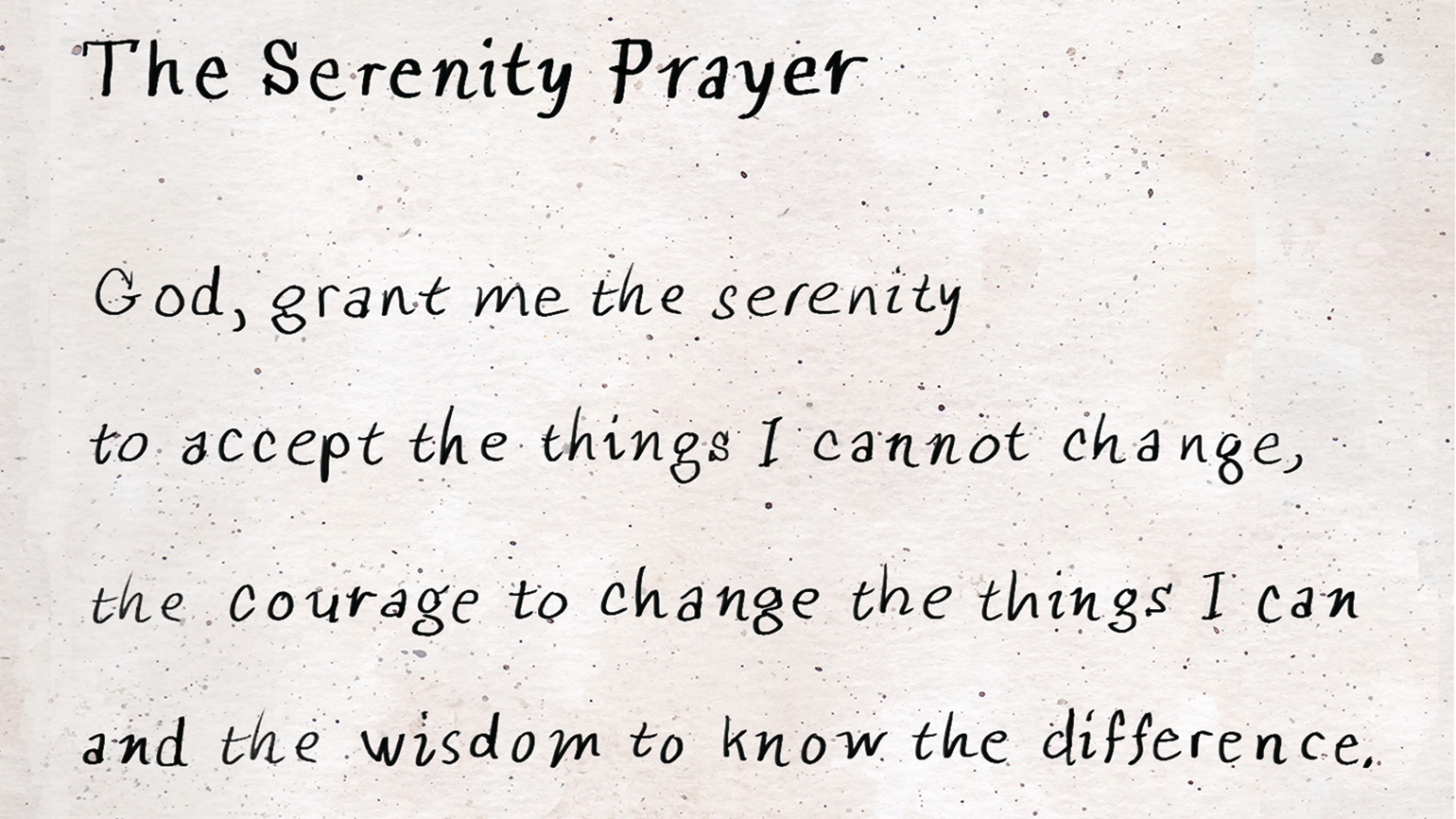
The Serenity Prayer Ignited His Spiritual Awakening

If only Carlene Schaaf’s dad had discovered the Serenity Prayer and the organization it is most closely associated with, Alcoholics Anonymous, whose members often recite it in unison at the end of meetings. I was one of the fortunate ones, though I didn’t know it at first. I wanted to stop drinking but wanted nothing to do with a God I didn’t care to believe in. That gave me a problem with the prayer.

“Then don’t say ‘God,’” my sponsor said dismissively. “He’s not going to be offended.” I took the advice and omitted his name when I stood at the conclusion of a meeting, grasping hands with the persons on either side of me. I didn’t let myself think too hard about whom I was beseeching for serenity, just so long as I didn’t give in to the G word. I even practiced outside the meetings so I wouldn’t slip up.

So why did this prayer seem to keep me out of trouble? It centered me in situations where I’d normally reach for a mood changer. I wondered if maybe it would work even better if I added “God.” I experimented, and that was the beginning of my spiritual awakening.

AA founder Bill Wilson said about the Serenity Prayer, “Never have we seen so much AA packed into so few words.” And I might add, never has so much God been packed into so few words.