

Embrace God's truth with our new book, The Lies that Bind

The Roads That Lead to God

For many of us, the beginning of a new year offers a time to think about the future, a time to plan for positive changes in our lives. But as you probably know, making New Year’s resolutions is a lot easier than carrying them out!

Even the great Apostle Paul confessed, “For the good that I will to do, I do not do; but the evil I will not to do, that I practice…. O wretched man that I am! Who will deliver me from this body of death?” (Romans 7:19, 24).

Community Newsletter

Get More Inspiration Delivered to Your Inbox

Notice: JavaScript is required for this content.

/* FORM STYLES */

#nf-form-5-cont {
background-color:#ffffff;
border-radius:35px;
-webkit-border-radius:35px; }

/* FIELDS STYLES */

.nf-form-content .nf-field-container #nf-field-27-wrap {
margin:0;
border-radius: 25px;
-webkit-border-radius: 25px; }
.nf-form-content .nf-field-container #nf-field-27-wrap .nf-field-element .ninja-forms-field {
background-color:#ffffff;
border-color:#ffffff;
margin-bottom:0;
border-radius: 25px;
-webkit-border-radius: 25px; }
.nf-form-content .nf-field-container #nf-field-28-wrap {
width:120px;
}
.nf-form-content .nf-field-container #nf-field-28-wrap .nf-field-element .ninja-forms-field {
background-color:#00ab84;
width:120px;
}
.nf-form-content .nf-field-container #nf-field-28-wrap .nf-field-element .ninja-forms-field:hover {
background-color:#00ab84;
}


var formDisplay=1;var nfForms=nfForms||[];var form=[];form.id=’5′;form.settings={“objectType”:”Form Setting”,”editActive”:true,”title”:”Sign up for Newsletter”,”show_title”:0,”allow_public_link”:0,”embed_form”:””,”clear_complete”:0,”hide_complete”:0,”default_label_pos”:”above”,”wrapper_class”:”master-signup-form-wrap”,”element_class”:”master-signup-form”,”key”:””,”add_submit”:0,”currency”:””,”unique_field_error”:”A form with this value has already been submitted.”,”logged_in”:false,”not_logged_in_msg”:””,”sub_limit_msg”:”The form has reached its submission limit.”,”calculations”:[],”container_styles_show_advanced_css”:1,”title_styles_show_advanced_css”:0,”row_styles_show_advanced_css”:0,”row-odd_styles_show_advanced_css”:0,”success-msg_styles_show_advanced_css”:0,”error_msg_styles_show_advanced_css”:0,”formContentData”:[{“order”:1,”cells”:[{“order”:0,”fields”:[“master_signup_email”],”width”:66},{“order”:1,”fields”:[“subscribe_now_1660636976556″],”width”:34}]}],”changeEmailErrorMsg”:”Please enter a valid email address!”,”changeDateErrorMsg”:”Please enter a valid date!”,”confirmFieldErrorMsg”:”These fields must match!”,”fieldNumberNumMinError”:”Number Min Error”,”fieldNumberNumMaxError”:”Number Max Error”,”fieldNumberIncrementBy”:”Please increment by “,”formErrorsCorrectErrors”:”Please correct errors before submitting this form.”,”validateRequiredField”:”This is a required field.”,”honeypotHoneypotError”:”Honeypot Error”,”fieldsMarkedRequired”:”Fields marked with an * are required”,”container_styles_background-color”:”#ffffff”,”container_styles_border”:””,”container_styles_height”:””,”container_styles_margin”:””,”container_styles_padding”:””,”container_styles_float”:””,”container_styles_advanced”:”border-radius:35px;n-webkit-border-radius:35px;”,”title_styles_border”:””,”title_styles_height”:””,”title_styles_width”:””,”title_styles_font-size”:””,”title_styles_margin”:””,”title_styles_padding”:””,”title_styles_float”:””,”row_styles_border”:””,”row_styles_width”:””,”row_styles_font-size”:””,”row_styles_margin”:””,”row_styles_padding”:””,”row-odd_styles_border”:””,”row-odd_styles_height”:””,”row-odd_styles_width”:””,”row-odd_styles_font-size”:””,”row-odd_styles_margin”:””,”row-odd_styles_padding”:””,”success-msg_styles_border”:””,”success-msg_styles_height”:””,”success-msg_styles_width”:””,”success-msg_styles_font-size”:””,”success-msg_styles_margin”:””,”success-msg_styles_padding”:””,”error_msg_styles_border”:””,”error_msg_styles_width”:””,”error_msg_styles_font-size”:””,”error_msg_styles_margin”:””,”error_msg_styles_padding”:””,”drawerDisabled”:false,”export_settings”:[],”form_title_heading_level”:”3″,”ninjaForms”:”Ninja Forms”,”fieldTextareaRTEInsertLink”:”Insert Link”,”fieldTextareaRTEInsertMedia”:”Insert Media”,”fieldTextareaRTESelectAFile”:”Select a file”,”formHoneypot”:”If you are a human seeing this field, please leave it empty.”,”fileUploadOldCodeFileUploadInProgress”:”File Upload in Progress.”,”fileUploadOldCodeFileUpload”:”FILE UPLOAD”,”currencySymbol”:”$”,”thousands_sep”:”,”,”decimal_point”:”.”,”siteLocale”:”en_US”,”dateFormat”:”m/d/Y”,”startOfWeek”:”1″,”of”:”of”,”previousMonth”:”Previous Month”,”nextMonth”:”Next Month”,”months”:[“January”,”February”,”March”,”April”,”May”,”June”,”July”,”August”,”September”,”October”,”November”,”December”],”monthsShort”:[“Jan”,”Feb”,”Mar”,”Apr”,”May”,”Jun”,”Jul”,”Aug”,”Sep”,”Oct”,”Nov”,”Dec”],”weekdays”:[“Sunday”,”Monday”,”Tuesday”,”Wednesday”,”Thursday”,”Friday”,”Saturday”],”weekdaysShort”:[“Sun”,”Mon”,”Tue”,”Wed”,”Thu”,”Fri”,”Sat”],”weekdaysMin”:[“Su”,”Mo”,”Tu”,”We”,”Th”,”Fr”,”Sa”],”recaptchaConsentMissing”:”reCaptcha validation couldn't load.”,”recaptchaMissingCookie”:”reCaptcha v3 validation couldn't load the cookie needed to submit the form.”,”recaptchaConsentEvent”:”Accept reCaptcha cookies before sending the form.”,”currency_symbol”:””,”beforeForm”:””,”beforeFields”:””,”afterFields”:””,”afterForm”:””};form.fields=[{“objectType”:”Field”,”objectDomain”:”fields”,”editActive”:false,”order”:1,”idAttribute”:”id”,”label”:”Email”,”type”:”email”,”key”:”master_signup_email”,”label_pos”:”hidden”,”required”:1,”default”:””,”placeholder”:”@Your email”,”container_class”:”master-email-wrap”,”element_class”:””,”admin_label”:”master_signup_email”,”help_text”:””,”custom_name_attribute”:”email”,”personally_identifiable”:1,”wrap_styles_border”:””,”wrap_styles_width”:””,”wrap_styles_margin”:0,”wrap_styles_padding”:0,”wrap_styles_float”:””,”wrap_styles_show_advanced_css”:1,”label_styles_border”:””,”label_styles_width”:””,”label_styles_font-size”:””,”label_styles_margin”:0,”label_styles_padding”:0,”label_styles_float”:””,”label_styles_show_advanced_css”:0,”element_styles_border”:””,”element_styles_width”:””,”element_styles_font-size”:””,”element_styles_margin”:0,”element_styles_padding”:0,”element_styles_float”:””,”element_styles_show_advanced_css”:1,”cellcid”:”c4722″,”value”:””,”drawerDisabled”:false,”wrap_styles_advanced”:”margin:0;nborder-radius: 25px;n-webkit-border-radius: 25px;”,”element_styles_background-color”:”#ffffff”,”element_styles_border-color”:”#ffffff”,”element_styles_advanced”:”margin-bottom:0;nborder-radius: 25px;n-webkit-border-radius: 25px;”,”manual_key”:true,”id”:27,”beforeField”:””,”afterField”:””,”parentType”:”email”,”element_templates”:[“email”,”input”],”old_classname”:””,”wrap_template”:”wrap”},{“objectType”:”Field”,”objectDomain”:”fields”,”editActive”:false,”order”:2,”idAttribute”:”id”,”label”:”Subscribe Now”,”type”:”submit”,”cellcid”:”c4725″,”processing_label”:”Processing”,”container_class”:””,”element_class”:””,”key”:”subscribe_now_1660636976556″,”wrap_styles_border”:””,”wrap_styles_width”:120,”wrap_styles_margin”:0,”wrap_styles_padding”:0,”wrap_styles_float”:””,”wrap_styles_show_advanced_css”:1,”element_styles_border”:””,”element_styles_width”:120,”element_styles_font-size”:””,”element_styles_margin”:0,”element_styles_padding”:0,”element_styles_float”:””,”element_styles_show_advanced_css”:0,”submit_element_hover_styles_border”:””,”submit_element_hover_styles_width”:””,”submit_element_hover_styles_font-size”:””,”submit_element_hover_styles_margin”:””,”submit_element_hover_styles_padding”:””,”submit_element_hover_styles_float”:””,”submit_element_hover_styles_show_advanced_css”:0,”wrap_styles_advanced”:””,”element_styles_background-color”:”#00ab84″,”submit_element_hover_styles_background-color”:”#00ab84″,”drawerDisabled”:false,”id”:28,”beforeField”:””,”afterField”:””,”value”:””,”label_pos”:”above”,”parentType”:”textbox”,”element_templates”:[“submit”,”button”,”input”],”old_classname”:””,”wrap_template”:”wrap-no-label”}];nfForms.push(form);

Fortunately, Paul found an answer to his question. In the next verses he writes, “I thank God–through Jesus Christ our Lord! For the law of the Spirit of life in Christ Jesus has made me free from the law of sin and death” (7:25, 8:2).

And at another time the Apostle wrote, “I can do all things through Christ who strengthens me” (Philippians 4:13).

God has given us the ability to change things, and ourselves, for the better. All through history, from Noah and Abraham to Edison and Lincoln and Billy Graham and my own parents, God has enabled men and women to do exciting, seemingly impossible things, proving that we can be “workers together with Him” (2 Corinthians 6:1).

How can we harness His divine power to transform ourselves–and our world–for the better? We only need travel the right roads.

1. Travel the road of total trust.
It is God’s will that we trust Him completely. Turn all your plans and panic and problems over to Him. Believe that God is in charge, that He has a plan and will work for your good in all things (Romans 8:28). When something terrible happens (as it does at times to all of us), trust God to bring good out of it.

2. Travel the road of positive affirmation.
Positive affirmations work! Every day feed your mind hopeful, positive statements. Begin with these:

But seek first the kingdom of God and His righteousness, and all these things [that you need] shall be added to you (Matthew 6:33).

In due season we shall reap if we do not lose heart (Galatians 6:9).

I can do all things through Christ who strengthens me (Philippians 4:13).

3. Travel the road of the forward look.
The Apostle Paul knew the importance of forward thinking. “But one thing I do, forgetting those things which are behind and reaching forward to those things which are ahead…” (Philippians 3:13). The important thing to do about the past is to extract whatever know-how or wisdom it may contain–then forget it.

Look ahead, never back. Make sure you have a clearly-defined goal. Hold it in the conscious mind until it sinks into the unconscious. Then you will be well on your way to the success you imagine.

May the roads you travel this year bring you closer to the Savior and to your own personal best.

The Relationship of Faith and Suffering

Suffering hurts. It isolates. It cripples. Yet the Bible makes it clear that suffering is part of the call to faith. “Take up your cross and follow me,” Jesus said (Mark 8:34). We’re not even supposed to be “surprised at the painful trial you are suffering, as though something strange were happening to you,” but are commanded to “rejoice that you participate in the sufferings of Christ, so that you may be overjoyed when his glory is revealed”(1 Peter 4:12-13).

How can this be? Suffering knocks us to our knees—but if we pray while we’re there, that’s a good thing. One of the hidden benefits of suffering is that it can draw us closer to God—if we are willing to move in that direction. We can reach for a deeper connection with God and learn things we’ve bypassed in times of comfort and pleasure. Suffering teaches us humility and opens our hearts. Jesus did not come to explain away suffering or remove it; He came to fill it with His Presence.

But how, exactly, do we get through our suffering? Often we begin by saying something as simple as, “Father, You have allowed this suffering to come to me, and I accept it in the name of Christ. I ask You to unite my suffering to His, so that through it I may become more like Him in every way.” And remember, we need to concentrate on what we are being asked to endure today (Matthew 6:34).

Of course, there’s nothing wrong with praying for relief from suffering, but we also need to prepare our hearts for whatever God’s will may be. My father used to advise people to put pain in God’s hands, and leave it to Him. “If it is His will that you are to bear it,” Dad said, “God will fortify you with sufficient understanding and strength to endure it.” He knew firsthand that prayer can remove suffering; he also knew that prayer was needed in order to “be joyful in hope, patient in affliction, faithful in prayer” (Romans 12:12).

When we do suffer, we are called to do so patiently. Why? “Because Christ suffered for you, leaving you an example, that you should follow His steps” (1 Peter 2:20-22). Keeping a positive attitude and concentrating on better days ahead is important to surviving our difficult times. We must resist the temptation to become bitter and, instead, join the Apostle Paul in saying, “I consider that our present sufferings are not worth comparing with the glory that will be revealed in us” (Romans 8:18).

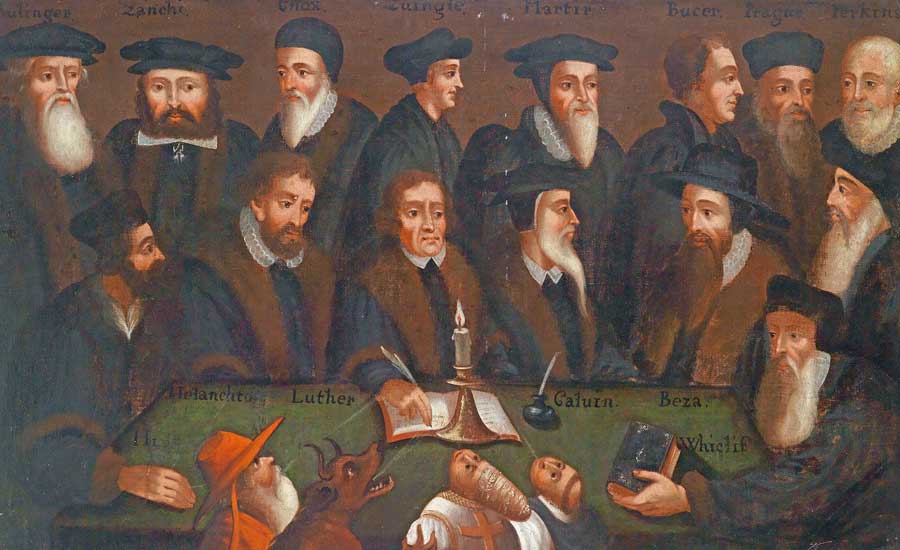
The Reformation: 5 Things You Should Know But Probably Don’t

Many people have heard about Henry VIII and his wives or Martin Luther nailing long lists on church doors. Others may have learned about a famous printer who printed Bibles or studied the battles that pitted Catholics versus Protestants in one of longest conflicts in European history.

These are just some of the facts about The Reformation, the religious movement that caused the schism in Western Christianity and created, to an extent, the Catholic and Protestant traditions of Christianity. Of course, there is more to the story. How much do you really know about the Reformation? Discover five things you need to know—a couple of them may surprise you.

1. There is no such thing as “The Reformation”

This is not as contradictory as it may seem. Many may think of “The Reformation” as a singular moment in history when really, it is a movement that involved many key players, several different regions and a spanned a few decades. The Reformation started in Europe but spread throughout the region and into Latin America, North America, Africa and Asia. And its key players were not just Martin Luther but Luther, John Calvin, Henry VIII, and others. Lastly Martin Luther’s 95 Theses, which was posted on October 31, 1517, was the beginning of a nearly 40 year process of reformation for the Christian church.

2. The printing press effect

In the 1450s, Johannes Gutenberg invented the printing press, making him the first European to use movable type printing. As the story goes, he was interested in turning a profit and discovered that printing the Bible—his Gutenberg Bible was one of the first big books in the West to use movable type—was a good way to do it. But, he also discovered that printing indulgences—the remission of the punishment due to sin—was also financially lucrative. How did this pertain to the Reformation?

The printing press allowed reformers such as Martin Luther to distribute his 95 Theses and aided in the spread of German Bibles. But, it was also a reminder of the issue of indulgences, which Luther was against. His anti-indulgence stance was the catalyst for the 95 Theses, which is also known as the “Disputation on the Power and Efficacy of Indulgences.”

3. The nail in the door

The verdict is still out on whether he literally nailed his 95 Theses to the door at Wittenberg on October 31, 1517. The 95 Theses, which outlined Luther’s dispute against clerical abuses is considered the initial catalyst for the Protestant Reformation. Popular accounts of history describe Luther aggressively nailing the theses to the door, which, of course, seems quite powerful. Yet it is arguable whether he actually did that since accounts are varied and some are from people, such as Phillip Melancthon, who wasn’t eyewitnesses to the event.

4. Women in the Reformation

It is often said that, “History is written by the victors,” and in the case of such writers on the Reformation, they usually leave women out of the story. Yet, women played a number of roles instrumental to the Reformation. They were nuns, wives of key players, royalty, scholars and much more. One such woman was Marie Dentiere who was part of an Augustinian monastery but soon left to join the reformers. Dentiere was a strong proponent of the reform in Geneva, often speaking out in public places and writing a pamphlet to the Genevans about God’s intentions for the city. Because of her work Geneva became a Protestant republic.

5. Wars and rumors of wars

One of the most significant battles waged as a result of the Reformation was the Thirty Years War, which is considered the longest and most destructive war in European history. The war started because of fragmenting of the Holy Roman Empire inherent in the new Protestant and Catholic structure, but it turned into a political feud concentrating on the France–Habsburg rivalry for European political pre-eminence.

The Power of Kindness

Who are the kindest people you know? Isn’t being in their presence like sitting in sunshine? Kind people make you glad to be alive; they help you see beyond the fog of worry or discontent. “Anxiety weighs down the heart, but a kind word cheers it up” (Proverbs 12:25).

Jesus’ commandment to us to “Love one another, as I have loved you” (John 13:34) was an instruction to be kind, always and to everyone. Our Lord exemplified kindness–healing the sick, pouring Himself out for the crowds who gathered to touch Him or hear Him. He was human; it must have been exhausting.

Yet, “Very early in the morning, while it was still dark, Jesus got up, left the house and went off to a solitary place, where he prayed” (Mark 1:35). He replenished His strength with prayer and solitude. We can do the same.

What does living a life of kindness mean? It means curbing our impulse to speak sharply. It means praying every day: “Let the words of my mouth and the meditation of my heart be acceptable in Your sight, O Lord, my strength and my Redeemer” (Psalm 19:14). If a harsh word escapes us in a moment of stress, kindness motivates us to make a sincere apology.

It means telling the hard but necessary truth in a way that builds the recipient up, rather than tears her down. (Jesus could call the Pharisees “brood of vipers” and “hypocrites” because He was God and had the Godlike right to judge, but we must not presume to have such power. We will often be totally wrong in our assessment.) We are to live our lives being “kindly affectionate to one another” (Romans 12:10).

Sometimes kindness means shading the stark truth: “You’re looking so much better” to a friend going through a hard time and showing it. “I believe in you completely” to someone you care about who is struggling to get his footing in life or on the job. In this way we help to “bear one another’s burdens, and so fulfill the law of Christ” (Galatians 6:2).

Kindness means refraining from complaining or gossiping, letting the other driver go first, putting your cart into the cart corral at the grocery store rather than leaving it in the next parking space. It means sending a note or card, making a hospital visit, bringing a meal to a shut-in.

It means giving to the needy a substantial part of what we are blessed to have. It means being patient with those who try that patience. And it means forgiving, with no strings attached. “Be kind and compassionate to one another, forgiving each other, just as in Christ God forgave you”(Ephesians 4:32).

True kindness means being gentle in our inner, private thoughts–catching ourselves forming critical, negative judgments and nipping them in the bud. A surefire way to do that is to turn a negative thought into a prayer for that person. The Apostle James encourages us, as Christian brothers and sisters, to “pray for one another” (James 5:16).

The best thing about kindness is that it comes with a double blessing. The person who offers a kindness gets as much or more out of the deed as the recipient. Proverbs tells us, “Those who are kind benefit themselves” (11:17).

So make a conscious effort today to be kind to everyone you meet. It will make them–and you–feel better!

The Power of God’s Love

Thinking and faith are closely intertwined when it comes to the Christian life. Actually, faith is thinking positively instead of negatively, hopefully instead of cynically and lovingly instead of suspiciously. Three of the most important elements in Christianity are faith, hope and love. The Bible tells us “the greatest of these is love” (I Corinthians 13:13).

God’s love is fatherly.
God is called “Father” in the Old Testament as well as the new; Psalms 68:5 and 89:26, Isaiah 9:06 and 64:8 and Malachi 2:10 are examples of this. And of course this is his name throughout the New Testament. Jesus taught his disciples to begin their prayers with, “Our Father in heaven…” (Matthew 6:9).

To realize what that name “father” means, look at what Jesus said in Matthew 7:9-11. “Which of you, if your son asks for bread, will give him a stone? Or if he asks for a fish, will give him a snake? If you, then, though you are evil, know how to give good gifts to your children, how much more will your Father in heaven give good gifts to those who ask him!”

God’s love is forgiving.
God forgives and forgets the sins we confess to him. How wonderful it is that he promises that when we turn to him, “I will forgive their iniquity, and their sin I will remember no more” (Jeremiah 31:34). And, “As far as the east is from the west, so far has he [God] removed our transgressions from us” (Psalm 103:12).

God’s love is unchanging.
Just as a child may not understand what his parent is doing, so we may not always be able to make sense of what’s happening in our own lives. Our loving Father in Heaven may have a purpose beyond our limited human comprehension when he permits family tragedies, health crises or financial setbacks to attack us. God promises, “I will be with you; I will never leave you nor forsake you” (Joshua 1:5) and “all things work together for good to them that love God” (Romans 8:28).

No wonder that John, in his letter to believers, tells us, “God is love” (I John 4:8)!

RELATED: KNOW THE GOD OF THE IMPOSSIBLE

The Power of Friendship

Remember when you were a child and could easily identify your best friend—or perhaps even your “bestest best friend” or “second best friend.” As we age and mature, we learn to accept and interact with a wide range of people. We have in-laws and colleagues and neighbors and acquaintances. But we still need friends. Proverbs 27:9 speaks of the “pleasantness of a friend.” In fact, I often think the older we get, the more important friends become to us. It takes a long time to make an old friend. And while you can’t usually pick your coworkers or fellow parishioners, you CAN pick your friends.

It is no small thing to call someone your friend. Jesus, speaking to his disciples, said “I have called you friends” (John 15:15). He knew it was the ultimate compliment. Exodus 33:11 tells us that, “The Lord would speak to Moses face to face, as one speaks to a friend.” Friendship is a big deal.

One of the most famous friendships in the Bible is that between Jonathan and David. Even though Jonathan’s father, King Saul, sought to kill David, Jonathan maintained his close friendship with David. 1 Samuel, chapter 20 tells the story of how Jonathan came to warn David that he must flee for his life—a fact that brought both of these strong men to tears (verse 41). Jonathan’s parting words to David were, “Go in peace, for we have sworn friendship with each other in the name of the Lord” (verse 42).

This God-based friendship would survive war and even death, with David showing kindness to Jonathan’s crippled son after his father is killed in battle. “’Don’t be afraid,’ David said to him, ‘for I will surely show you kindness for the sake of your father Jonathan. I will restore to you all the land that belonged to your grandfather Saul, and you will always eat at my table’” (2 Samuel 9:7).

Friendship is a God-ordained and blessed relationship. Proverbs 12:26 tells us that, “The righteous choose their friends carefully.” God will use these carefully-chosen friends to help you grow in your faith while at the same time providing you with opportunities to help them grow, too. You will be following the Apostle Paul’s advice to “encourage one another and build each other up” (1 Thessalonians 5:11).

In Isaiah 43:19, God says, “See, I am doing a new thing!” God wants us to be open to new experiences, in our spiritual life and in our daily life, too. Friends can help you do that. So take time to cultivate those friendships God has blessed you with. And pledge to make a few new friends! “A man who has friends must himself be friendly” (Proverbs 18:24).

The Perfect Scripture for Spiritual Growth

God has wonderful plans to accomplish through each of us. In John 15, Jesus says, “I am the vine; you are the branches” (verse 5). A vine should bear fruit, and Jesus lists several variations on this theme: no fruit; some fruit; more fruit; and much fruit (verses 2, 8). Of these four possibilities, how would you rate yourself spiritually?

It’s important to remember that spiritual growth is not something you can do on your own. “Without me,” Jesus cautions, “you can do nothing” (John 15:5). In that same verse, He urges His followers to, “Abide in me.” Jesus wants you to live in His presence, to think of Him often, to pray to Him, to sing His praises, to talk and work with other Christians, who are really His body (Ephesians 5:30). You abide in Christ when you read His words in the Bible (often!), meditate on them and do what He says.

In John 15:7, Jesus gives us an amazing promise: “If you remain in me and my words remain in you, ask whatever you wish, and it will be done for you.” When you truly abide in Christ, you can ask for whatever you desire—for your longings will have become those of Christ Himself.

Why not take time this week to read the entire 15th chapter of John? Underline (or memorize) verses that challenge or inspire you. Abide…and bear fruit!

The Meaning of Christmas

When I was a boy, Christmas at our home was a beautiful thing, yet there weren’t many presents. My father was a preacher and received a yearly salary of $1,000. One year my brother and I wanted a bicycle. We told our parents about it for months on end and wrote letters to Santa Claus. We got the bicycle, all right–a secondhand one. But I can remember still the thrill of riding it up and down Gilman Avenue that day.

The gifts you receive–modest or elaborate–are important only to the degree they help you experience something of what Christmas really is. Which is what? It is a spiritual observance of the birth of Jesus Christ into the stream of history and into the soul of man. “The Word became flesh and made his dwelling among us. We have seen his glory, the glory of the one and only Son, who came from the Father, full of grace and truth” (John 1:14). That, in a nutshell, is Christmas.

The first thing Christmas means, of course, is that God is with us. Isaiah prophesied of Jesus that He would be called Immanuel, meaning “God with us.” In Jesus, God incarnate in human form walked the earth as a man.

Strange are the ways of God! Born in a little out-of-the-way country into a family of poor people, Jesus was first seen as an infant lying in a manger. And when He curled his fingers around the rough old hands of the shepherds, He began to win His way into the human heart. The Wise Men, looking for wisdom greater than their own, were led to Him and bowed before Him, a little baby.

When they looked into the eyes of this baby, they knew that here was wisdom incarnate. How did they know it? How do you know the deeper truths? By argument? By reasoning? By philosophy? No, by perception, insight, intuition, understanding. After a while Jesus came to the end of His human life; He ascended into heaven, but He left the Holy Spirit with us. He said, “I am with you always, even unto the end of the world” (Matthew 28:20).

God is in this world. God wants to be in your heart. Until we have a conscious experience of God we never really live. And until you know He is here you are a long way from the true Christmas.

How can we have a conscious experience of God? I can give you a suggestion: Go out in a spirit of love and do something for somebody who is in need. Jesus said, “Whatever you do for the least of these, you do for me” (Matthew 25:40). Where human need is you have the best chance of finding Him. So long as you are thinking only about yourself you won’t find Him. But if you love other people and engage in sacrificial service you will find Him… and you will have a very merry Christmas indeed.

The Lens of Devotion

I was reading Psalm 34 recently and came to verse 3:

Oh, magnify the LORD with me, and let us exalt his name together!

My mind zoomed in on “magnify.” How are we supposed to make God bigger? I wondered, slightly taken aback. Then I remembered teaching a class on ladybugs to preschoolers last summer. I’d given each child a magnifying glass before realizing they didn’t know how to use one. So I had the kids look through my big magnifier as I moved the glass closer and further away from my hand. My fingers grew and shrunk. The kids gasped with delight. And they immediately realized what I’d forgotten: a magnifier changes how we see something, not the object itself.

Light dawned. I’m supposed to be a lens through which others can see God more clearly.

More light dawned. That’s not easy.

Here’s the rub: If I’m going to magnify the Lord, I need transparent faith. I can’t have sin scratching up the lens, and my ego can’t block the view. For others to see God through me, my life has to be focused on him. And though I sigh to admit it, magnifying God means my devotion has to be bigger than “me and Jesus” time first thing in the morning. I have to love God so fully that even when others don’t know I’m a Christian, they know more about him by knowing me.

That’s a high calling. But soon we will celebrate the birth of Christ, and part of the way others will see the “reason for the season” is through us.

Oh, magnify the LORD with me, and let us exalt his name together!

What will you do so that others can see him more clearly through you this month?

5 Joyful Easter Devotions

Looking for a new way to celebrate Easter? Between busy schedules of egg hunts and baskets filled with candy, it can be hard to find the time to sit with God and feel gratitude for this holy season. Here are five Easter devotions to help you reflect on what this day is all about. Read them on your own before you say your Easter prayers, or gather the whole family to read them together before your Easter celebrations.

READ MORE: The Easter Story in 14 Bible Passages

1. An Easter Devotion: The Joy That Invades Our Hearts

by Elizabeth Sherrill

He is not here; for he has risen…—Matthew 28:6

Only a week had passed since that triumphant Palm Sunday entrance into Jerusalem—but what a difference in the little procession that set out now! No cheering crowds, no waving branches. Just a few silent women setting out in the gray dawn to perform the last sad rites at the tomb.

The day that changed human history was not a public occasion but a private one. The day when everlasting life broke into earthly time began not with celebration but with tears.

This is still the way Easter breaks into our lives—when we least expect it, when all seems lost. That’s when the stone rolls away and the angel speaks and “death is swallowed up in victory” (1 Corinthians 15:54)

If it seems too good to be true, this joy that invades our hearts, it seemed so on the first Easter morning too. Mary Magdalene could not believe what her eyes were telling her; she took Jesus to be a gardener at work early among the graves. Preoccupied with her loss, she barely glanced at the figure standing before her on the path. She had a mournful task to fulfill and—

“Mary.”

There in the first light of dawn, Mary stood still. That voice…that tone of loving involvement. This was the moment, the moment when Jesus called her by name, that Easter broke like the sunrise into her heart. It is how we recognize Him still. The risen Jesus calls us so personally, comes into our lives to individually, that with Mary Magdalene, we cry out in glad recognition.

READ MORE: 10 Easter Eggs from Around the World

And then we do what the women did on that first Easter Sunday. Dropping their spices and ointments, the burdens of their sad errand, they rushed to tell the others. They set the pattern, these women who were first at the empty tomb, the two-fold pattern of the Christian faith newborn that Easter morning. They met the living Jesus. And they brought the good news to those who grieved.

That’s always our role, when it’s Easter in our lives; to tell someone else that He is risen.

2. An Inspiring Easter Surprise

by Penney Schwab

For the gift bestowed upon us by the means of many persons thanks may be given. —2 Corinthians 1:11

It was a wonderful Easter. Morning worship at our son Patrick’s church in Texas featured an excellent choir and inspiring sermon. Our daughter-in-law Patricia prepared a veritable feast for dinner. After our traditional family egg hunt, my husband Don said, “We need to head home, so we can stop in Amarillo and get Penney’s Easter surprise.”

Read this inspirational family devotion for Easter and see what Penney’s husband had in store for their surprise. 

3. Easter Always Comes

by Marci Alborghetti

Trust in him at all times; ye people, pour out your heart before him. —Psalm 62:8

“I saw a robin!” My mother’s voice on the phone had the singsong quality of smug victory. She might as well have added, “Na-na-na-na-na!” She likes to win this game.

Mom and I have an annual competition to see who can spot the year’s first robin. It means that the winter will, indeed, end, even when we’re convinced it’s going to go on forever. For both of us, it’s always been a long, gray crawl from Christmas to Easter. So the first robin is an important signpost, and even more so this year.

Read this heartwarming Easter devotion and learn how the sighting of a robin taught Marci an important Easter lesson. 

4. A Devotion About the Easter Miracle Deep Within

by Elizabeth Sherill

He is not here; he has risen! —Luke 24:6

“He is not here,” the angels told the little group of grieving women who came to the tomb that first Easter morning. “He has risen!” This is what angels, in their myriad shapes, tell us still, not only on this Easter, but every day.

For me, one of those angels is a handsome conifer, the only large tree in our yard. My husband John and I were new homeowners, not sure of how to care for the lawn and shrubs. But whatever our failures, the tree towered above them, drawing the eye away from weeds and bare spots. That’s why we were distressed when that fall some brown patches appeared among the dark green needles.

Read the rest of this beautiful devotion during your Easter celebrations and see how a conifer tree became an important Easter symbol. 

5. A Devotion for Easter Monday

by John Sherrill

I am with you always… —Matthew 28:20

It’s Monday, the day after Easter.  Yesterday, when the children and grandchildren left, my wife, Tib, and I went through the usual post-holiday letdown. We coped with it as we always docleaning up. I collected left-behind jelly beans before they could be trod into the rug, picked up a ball of colored foil where someone had missed a wastebasket, found a half-eaten chocolate rabbit under one of the kids’ beds.

Tib gathered the wicker baskets and carried them up to the attic, then got out the vacuum cleaner and attacked the escaped Easter grass.  How did the shiny green strands get so far from the bedrooms where we had unpacked the baskets?

Read this unique Easter devotion and learn how a post-Easter clean-up became a sign of Hope for this couple. 

READ MORE ABOUT EASTER:

The Empowering Words of the Bible

Since childhood, the Bible has held a significant and impactful role in my life. I still have the Bible my parents gave me when in elementary school. Each night I would read Psalm 27. It begins with “The Lord is my light and my salvation—whom shall I fear? The Lord is the stronghold of my life—of whom shall I be afraid?” These words soothed my spirit and reassured me that God is always with me. I had nothing to be afraid of, not even when the lights were off in my bedroom—God was there to protect me.

When older, it was the words to Joshua when tasked with leading the people into the promised land, “Have I not commanded you? Be strong and courageous. Do not be afraid; do not be discouraged, for the Lord your God will be with you wherever you go.” I was empowered by these words of encouragement and support. The words jumped off the print and into my heart as if they were meant written for me. Whenever I find myself up against a difficult task or when conflicts arise, I hold on to this verse.

When unsure of what decision to make or what path to take, the counsel is found in Proverbs, “Trust in the Lord with all your heart and lean not on your own understanding; in all your ways submit to him, and he will make your paths straight.” This reminds me to lean on the source of all wisdom, not on my own experiences, knowledge and insights. This is not to say that I don’t take responsibility in making decisions, but it means to seek guidance from the one who sees and knows all things from all perspectives. Why not lean on God? It would be foolish not to.

Although at times the Bible can feel overwhelming, but it can help us and empower us in so many ways. One thing is for sure, the more we read and pay attention to the words of the Bible, the more we discover messages of hope and words fitting where we stand at the time. Do you have a favorite verse? If so, please share with us.

Lord, thank you for the power of Your Word that guides, empowers and transforms us.

The Easter Story in 14 Bible Passages

Connect to this season on an even deeper level by reading the Easter story in the Bible. Here are answers to some common questions, followed by the Biblical story told in 14 verses with stunning artwork.

READ MORE: 10 Acts of Kindness to do for Easter

What is the Easter Story?

The Easter story recounts Jesus’ resurrection three days after His crucifixion.

The Bible states how Jesus made a triumphal entry into Jerusalem. Shortly after, His apostle Judas agreed to betray Jesus and deliver Him to the chief priests for thirty silver pieces. After attending the last supper with His apostles and visiting the garden of Gethsemane to pray to God, Jesus was delivered to Pontius Pilate and sentenced to death. Jesus took His final steps walking through a crowd of angry people while carrying a cross. He was crucified, and with His last breath He committed himself to His father’s hands. Shortly after, Jesus’ body was returned to His followers, and He was buried in a tomb.

However, on the following Sunday, Jesus’ followers went to His tomb to find it open. Jesus’ body was not inside. They knew that Jesus had risen.

READ MORE: 10 Easter Eggs from Around the World

Is the word “Easter” in the Bible?

The word “Easter” is only found in the King James Bible version of the Old Testament, in Act 12:4, when King Herod captures Peter. The verse reads:

And when he had apprehended him, he put him in prison, and delivered him to four quaternions of soldiers to keep him; intending after Easter to bring him forth to the people.

The events of this verse took place well before Jesus’ crucifixion, so many biblical scholars, including the Armstrong Institute of Biblical Archeology, believe this translation to be misleading. In every other translation of this verse, the word “Easter” is translated to “Passover.”

While the word is not found anywhere in many Bibles, the Easter story itself is still one of the most powerful stories of the New Testament.

READ MORE: 40 Beautiful Easter Quotes to Share

Where is the Easter Story in the Bible?

The Easter story is in the Bible, specifically the Book of Matthew, the Book of John, and the Book of Luke. These gospels take us through the story from Jesus entering Jerusalem to His resurrection on Easter Sunday. Jesus’ resurrection is also mentioned throughout the New Testament, from Philippians to Romans to Corinthians.

Below is the Easter story told through 14 Bible verses, followed by seven Bible verses that mention Jesus’ resurrection for further reading and reflection.

The Easter Story in 14 Bible Verses

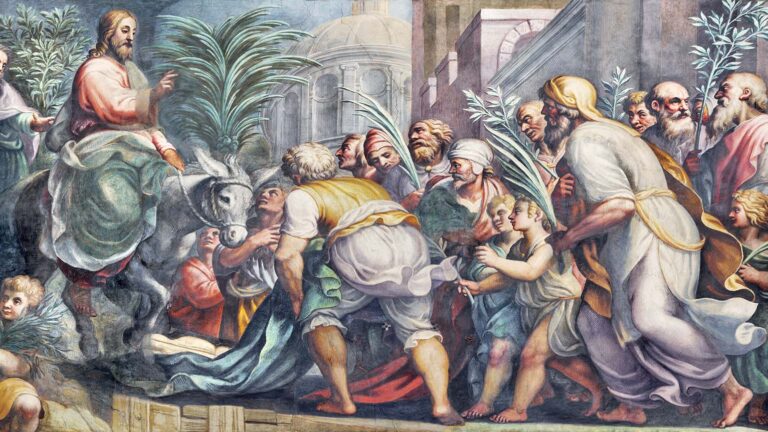
The fresco of Entry of Jesus in Jerusalem from the Easter story in Duomo by Lattanzio Gambara
The fresco of Entry of Jesus in Jerusalem by Lattanzio Gambara.

1. Matthew 21:7-9 — Jesus’ Triumphal Entry into Jerusalem

They brought the donkey and the colt and placed their cloaks on them for Jesus to sit on. A very large crowd spread their cloaks on the road, while others cut branches from the trees and spread them on the road. The crowds that went ahead of him and those that followed shouted…

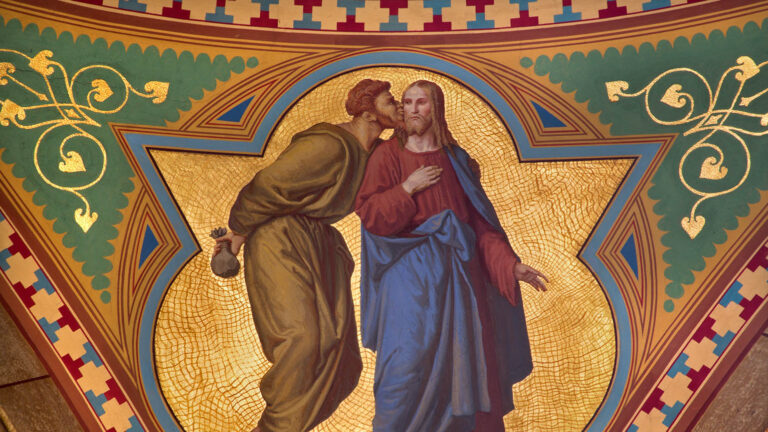
Mosaic of Judas kissing Jesus from the Easter story at Altlerchenfelder church in Vienna
Fresco of Judas betraying Jesus in Altlerchenfelder Church in Vienna.

2. Matthew 26:14-16 — Judas Agrees to Betray Jesus

Then one of the Twelve—the one called Judas Iscariot—went to the chief priests and asked, “What are you willing to give me if I deliver him over to you?” So they counted out for him thirty pieces of silver. From then on Judas watched for an opportunity to hand him over.

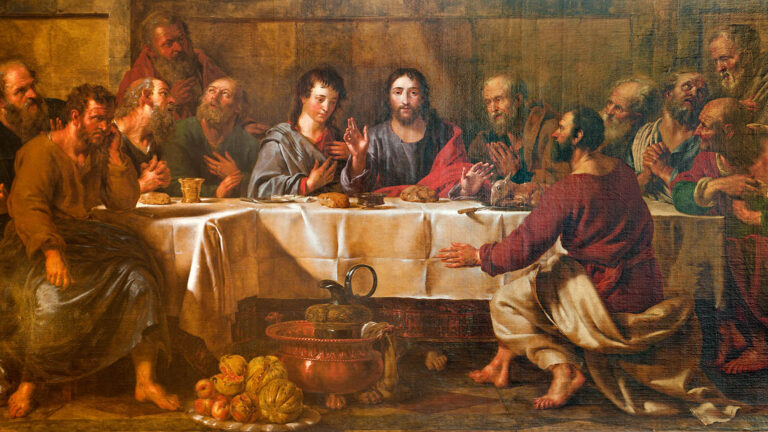
Painting of the Last Supper from the Easter story at St. Nicholas Church in Brussels
Painting of the Last Supper of Christ from St. Nicholas Church in Brussels.

3. Matthew 26:18 — The Last Supper

He replied, “Go into the city to a certain man and tell him, ‘The Teacher says: My appointed time is near. I am going to celebrate the Passover with my disciples at your house.’”

Garden of Gethsemane from the Easter story in the Bible
The Garden at Gethsemane where Jesus prayed in the Easter story in the Bible.

4. Matthew 26:36 — The Garden of Gethsemane

Then Jesus went with his disciples to a place called Gethsemane, and he said to them, “Sit here while I go over there and pray.”

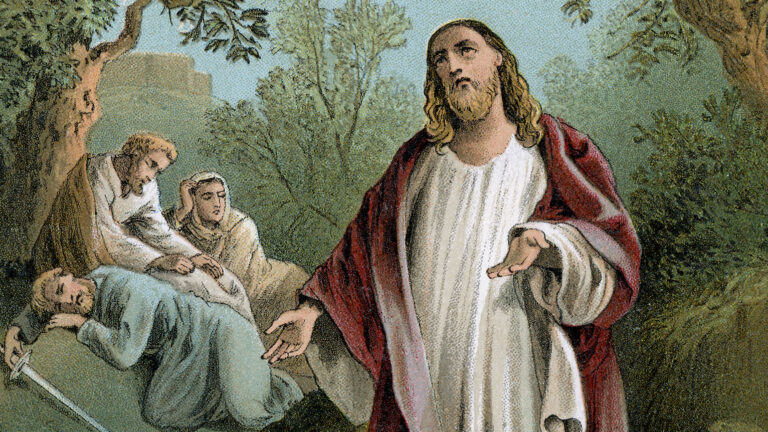
Vintage colour lithograph of Jesus praying in Gethsemane from the Easter story
Vintage color lithograph of Jesus in the Garden of Gethsemane (1882).

5. Matthew 26:39 — Jesus Prays in the Garden

Going a little farther, he fell with his face to the ground and prayed, “My Father, if it is possible, may this cup be taken from me. Yet not as I will, but as you will.”

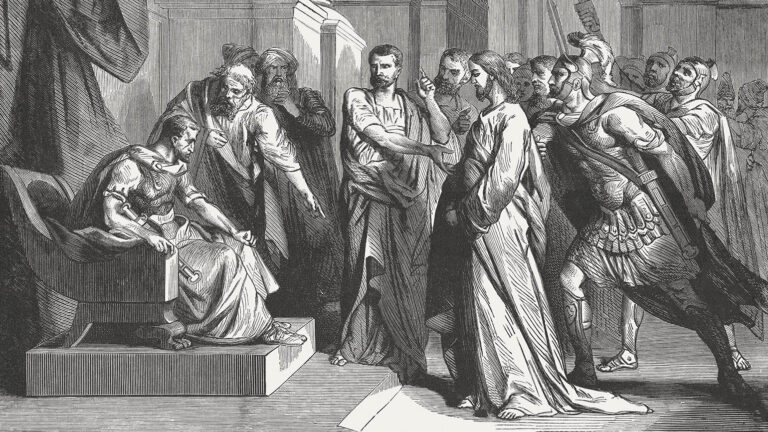
Wood engraving of Jesus before Pilate in the Easter story
Wood engraving of Christ before Pilate (1886).

6. Matthew 27:1-2 — Jesus Delivered to Pilate

Early in the morning, all the chief priests and the elders of the people made their plans how to have Jesus executed. So they bound him, led him away and handed him over to Pilate the governor.

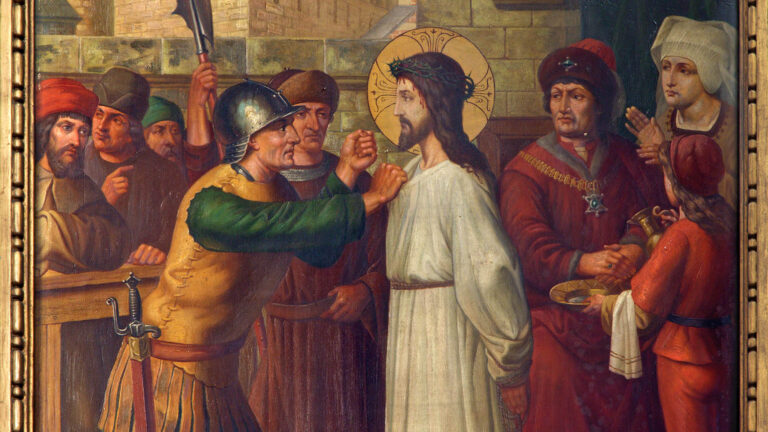
Painting of Jesus and Pilate from the Easter story in Our Lady church in Belgium
Jesus before Pilate from Our Lady Church in Mechelen, Belgium.

7. John 19:6 — The Trial of Jesus Before Pilate

As soon as the chief priests and their officials saw him, they shouted, “Crucify! Crucify!”

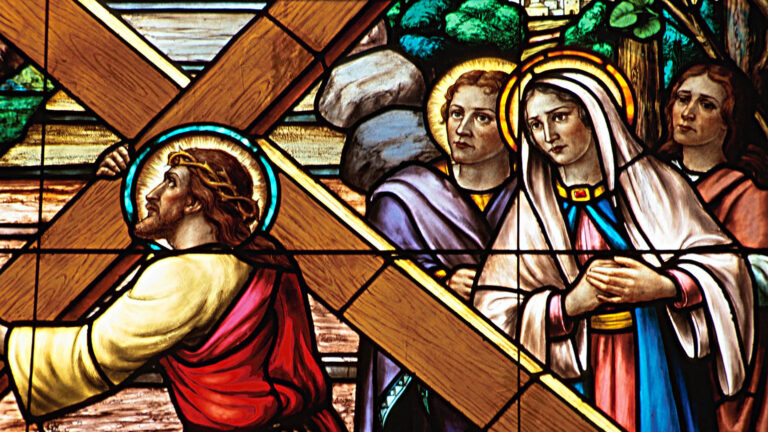
Stained glass of Jesus carrying the cross from the Easter story
Stained glass of Jesus carrying the cross from the Easter story.

8. Matthew 27:30-31 — Jesus’ Final Steps

They spit on him, and took the staff and struck him on the head again and again. After they had mocked him, they took off the robe and put his own clothes on him. Then they led him away to crucify him.

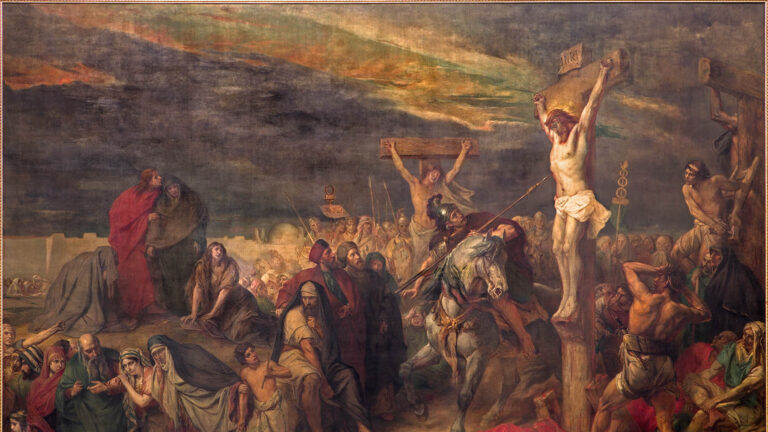
Jesus on the cross from the Easter story in St. Jacques Church in Brussels
The Crucifixion painting by Jean Francois Portaels (1886) in St. Jacques Church at the Palace of Coudenberg in Brussels.

9. Mark 15:33 — Darkness Comes

At noon, darkness came over the whole land until three in the afternoon.

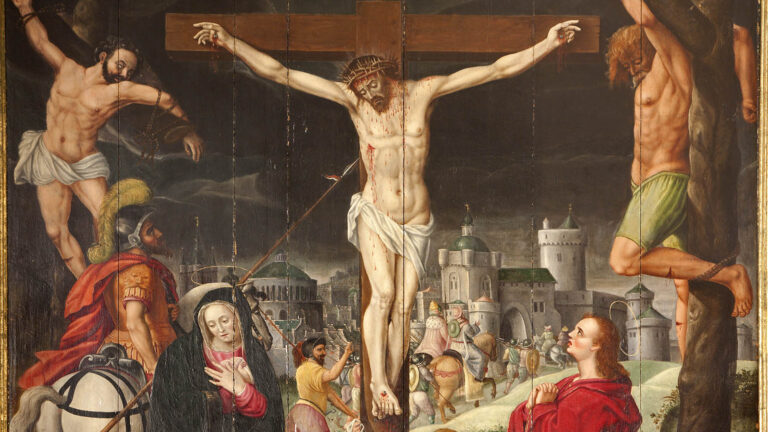
The Crucifixion of Jesus in the Easter story from St. Baaf's Cathedral in Belgium
Crucifixion painting on the wood from a side altar in the underground chapel of St. Baaf’s Cathedral in Gent, Belgium.

10. Luke 23:46 — The Death of Jesus

Jesus called out with a loud voice, “Father, into your hands I commit my spirit.” When he had said this, he breathed his last.

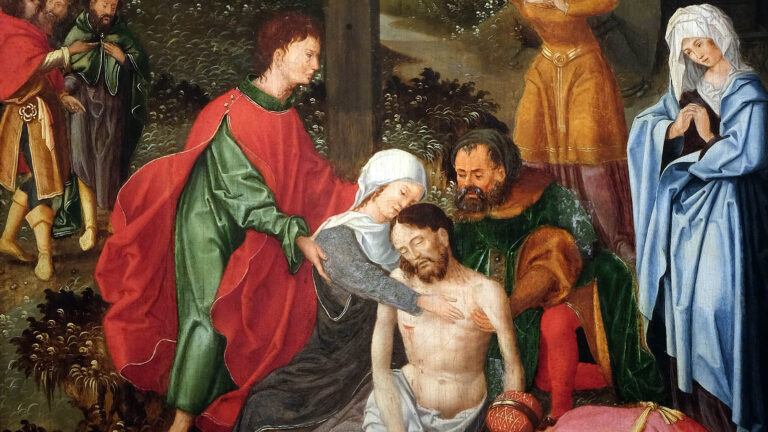
Descent from the cross in the Easter story from Mimara Museum in Croatia
Descent from the Cross by Joos van Cleve from Mimara Museum in Zagreb, Croatia.

11. Matthew 27:57-59 — Jesus’ Body

As evening approached, there came a rich man from Arimathea, named Joseph, who had himself become a disciple of Jesus. Going to Pilate, he asked for Jesus’ body, and Pilate ordered that it be given to him. Joseph took the body, wrapped it in a clean linen cloth…

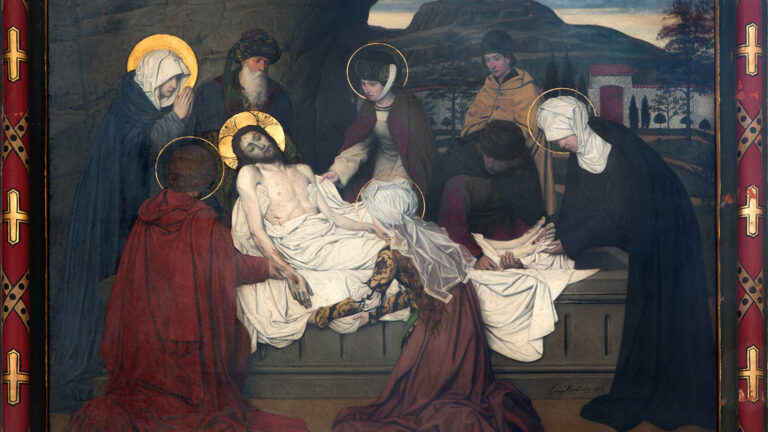
Jesus burial from the Easter story in Cathedral of Our Lady in Belgium
Burial of Jesus by Josef Janssens in the Cathedral of Our Lady in Antwerp, Belgium.

12. John 19:40-41 — Jesus is Buried

Taking Jesus’ body, the two of them wrapped it, with the spices, in strips of linen. This was in accordance with Jewish burial customs. At the place where Jesus was crucified, there was a garden, and in the garden a new tomb, in which no one had ever been laid.

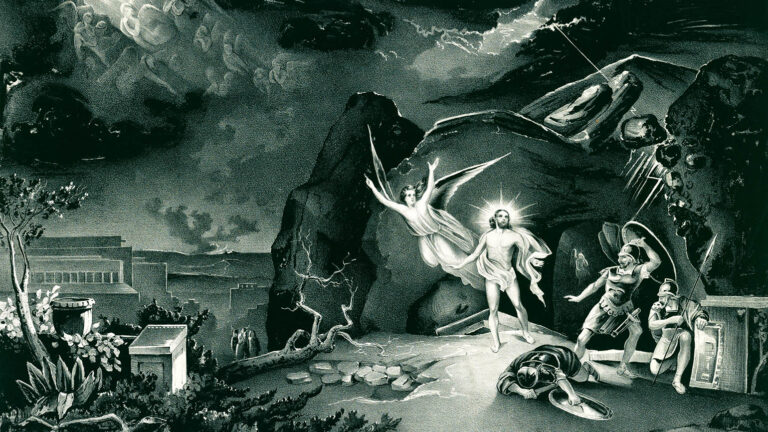
Lithograph of Jesus' Resurrection in the Easter story
Lithograph of the Resurrection by Nathan Currier (1849).

13. Luke 24:1-6 — The Resurrection

On the first day of the week, very early in the morning, the women took the spices they had prepared and went to the tomb. They found the stone rolled away from the tomb, but when they entered, they did not find the body of the Lord Jesus. While they were wondering about this, suddenly two men in clothes that gleamed like lightning stood beside them. In their fright the women bowed down with their faces to the ground, but the men said to them, “Why do you look for the living among the dead? He is not here; he has risen!

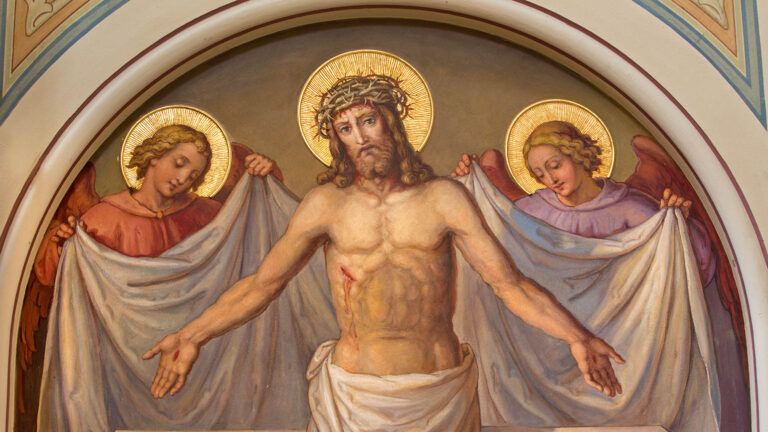
Fresco of Resurrected Christ from the Easter story in Carmelites church in Dobling
Fresco of Resurrected Christ by Josef Kastner in Carmelites Church in Vienna, Austria.

14. Matthew 28:8-10 — Jesus Appears

So the women hurried away from the tomb, afraid yet filled with joy, and ran to tell his disciples. Suddenly Jesus met them. “Greetings,” he said. They came to him, clasped his feet and worshiped him. Then Jesus said to them, “Do not be afraid. Go and tell my brothers to go to Galilee; there they will see me.”

More of the Easter Story in the Bible

Here are five more Bible verses to reflect on that focus on the Easter story, specifically Jesus’ crucifixion when He died for our sins, and His resurrection. Bring these verses into your Easter prayers as you let the word of God guide you through this holy season.

READ MORE ABOUT EASTER: