Embrace God's truth with our new book, The Lies that Bind

Martha of Bethany

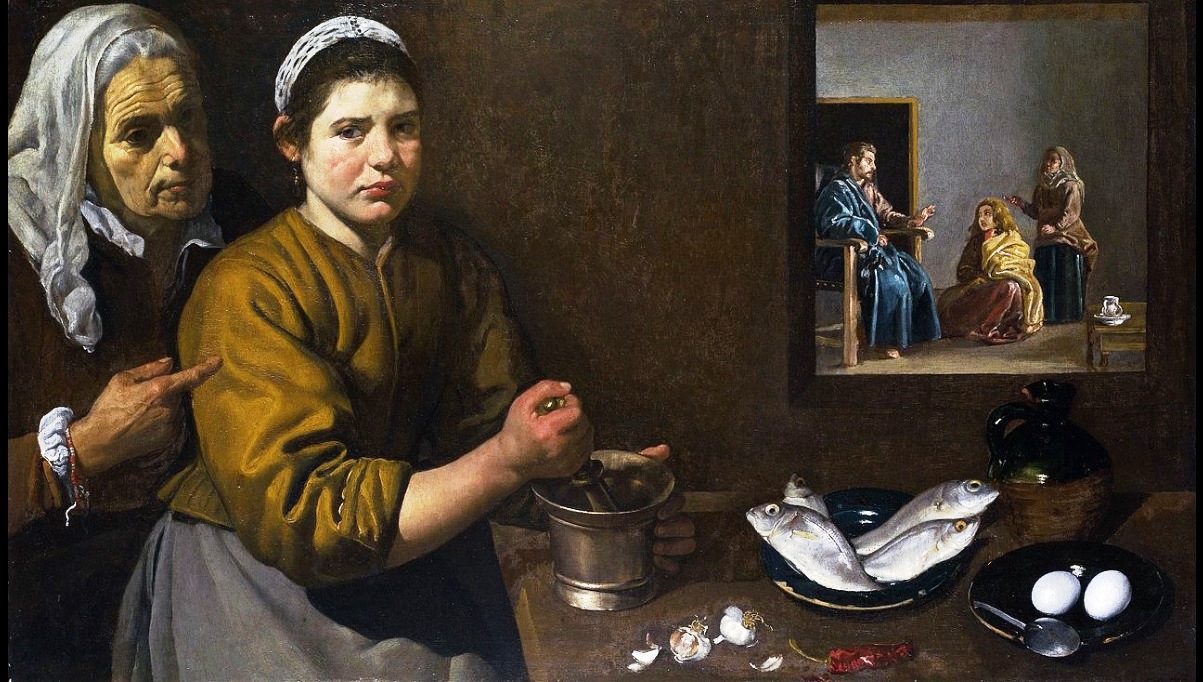
Martha and her sister Mary and brother Lazarus lived in Bethany when Jesus and Hs disciples stopped at their house.  During Jesus’ visit Mary stayed at His feet and  listened to Jesus speak while Martha was busy preparing and serving the meal for Jesus and the disciples. Frustrated,  Martha asked Jesus to order Mary to help her with the preparations. Jesus responded,  “Martha, Martha, you are worried and upset about many things, but few things are needed—or indeed only one. Mary has chosen what is better, and it will not be taken away from her.”

Later, in the Gospel according to John, Martha and Mary sent word letting Jesus know that their brother was sick. Jesus arrived too late as Lazarus had died four days earlier. Martha ran out to meet Him, while Mary remained inside. She and her sister Mary went with Jesus to their brother’s tomb. Martha had faith and watched as miraculously Jesus resurrected her brother Lazarus.

Sweet Carolina Mysteries In Article Ad

Here is Martha’s life story from the Bible:

• She lived with her sister Mary and her brother Lazarus in Bethany
 Now a man named Lazarus was sick. He was from Bethany, the village of Mary and her sister Martha. (John 11:1, NIV)

• She welcomed Jesus into their home
 As Jesus and his disciples were on their way, he came to a village where a woman named Martha opened her home to him. (Luke 10:38, NIV).

• Martha complained about Mary’s lack of help as she worked to prepare for a dinner 
She had a sister called Mary, who sat at the Lord’s feet listening to what he said. But Martha was distracted by all the preparations that had to be made. She came to him and asked, “Lord, don’t you care that my sister has left me to do the work by myself? Tell her to help me!”  “Martha, Martha,” the Lord answered, “you are worried and upset about many things, but few things are needed—or indeed only one. Mary has chosen what is better, and it will not be taken away from her.” (Luke 10:39-42).

• She showed great faith at the tomb of Lazarus
Lord,” Martha said to Jesus, “if you had been here, my brother would not have died. But I know that even now God will give you whatever you ask.”
Jesus said to her, “Your brother will rise again.” Martha answered, “I know he will rise again in the resurrection at the last day.” Jesus said to her, “I am the resurrection and the life. The one who believes in me will live, even though they die;  and whoever lives by believing in me will never die. Do you believe this?” “Yes, Lord,” she replied, “I believe that you are the Messiah, the Son of God, who is to come into the world.” (John 11:21-27, NIV).

• She served Jesus at a dinner in Bethany, where her sister Mary anointed Jesus with oil
Six days before the Passover, Jesus came to Bethany, where Lazarus lived, whom Jesus had raised from the dead. Here a dinner was given in Jesus’ honor. Martha served, while Lazarus was among those reclining at the table with him. (John 12:1-2, NIV)

For a devotion that focuses on lessons to be learned from Martha of Bethany read, Waiting on the Lord: The Power of Silent Prayer.

Read 10 Remarkable Women of the Bible.

Luke 23:34—A Closer Look at Forgiveness

Then Jesus said, “Father, forgive them; for they do not know what they are doing.” (Luke 23:34)

Forgiveness. It’s hugely important to our faith. And it can also be hugely difficult. Do we tell ourselves, “Why should I forgive that person who did something wrong in the first place?” “Don’t values count? Isn’t moralistic behavior most important?”

Go For It In Article Ad

But then we turn to Jesus and see how He asked His own killers, those who crucified Him and those who demanded His Crucifixion, to be forgiven. Making that prayer on the cross while He was dying. One of His last requests of God.

If Jesus could do that, at one of the worst and saddest moments of His life, aren’t we being asked to do the same?

Forgiveness. It’s hard, and it’s absolutely necessary to function as a compassionate, loving, caring human being.

Woman praying for forgiveness

A Crucial Passage in the Lord’s Prayer

Think about those times you’ve been felt called to forgiveness. You can’t really skip over it. After all, it’s a crucial passage of the prayer Jesus taught us, the Lord’s Prayer. “Forgive us our sins as we forgive those who sin against us.” Whether you use the word “debts” and “debtors” or “trespasses” and “trespass against us,” it’s part of our faith.

As that prayer makes clear, it’s quid pro quo. If we’re going to ask God’s forgiveness for what we have done wrong, then we’d better be willing to forgive others for how they have wronged us. Look again to Jesus’s example on the cross.

I know that I’m more prone to cast quick judgments on those who have wronged me. I want to shout it out. Make sure God noticed. “Look, God, what that jerk did to me?” “Can you believe, God, how awful that person has behaved?” “Have you seen how manipulative and darn-right evil that guy is, Lord. Isn’t it appalling?”

As if God hasn’t noticed. As if God didn’t see. As if God doesn’t care or isn’t concerned.

Couple hugging

Doing Due Diligence

But pointing out someone else’s errors, someone else’s flaws, can be a quick way of not confronting our own. I know that the person at church—yes, at church—who bothers me the most is actually a lot like me.

Rather than confront my flaws, I project and throw them all on him. Calling him out rather than doing due diligence on my spiritual self.

Every Sunday at church we say the Lord’s Prayer, together, and we also make a prayer of confession. It is essential to the functioning of our faith community. It is essential to our own spiritual growth. Perhaps it is the most essential thing.

Inevitably we have to turn to Jesus as a model.

The Narrative of the Crucifixion

Jesus is God among us in human form. And in that very form He suffered dreadfully. He came to earth to show us how to live. To give us a prayer like the Lord’s Prayer that can ground us in faith. One so short and succinct it takes less than a minute. And takes a lifetime to do.

When we look at the narrative of the Crucifixion, we can hear Jesus praying in the Garden of Gethsemane for this suffering to be taken from Him. He doesn’t want to undergo that terribly painful and humiliating torture of the Crucifixion. “Father,” He prays, “if you are willing, remove this cup from me…”

But then He follows it with sublime acceptance. “Yet, not my will, but Yours be done.”

He has to follow God even in this.


Hands clasped in forgiveness

Following God Means Forgiving

And following God means forgiving others, even His killers, because the message that Jesus brought to the world was one of love. Love for all. Love even for our enemies.

The world can be a bitterly conflicting places, full of strife and wrong-doing, but if we are ever to re-make it in God’s image, we need to bring love into all places. Not just those congenial settings like home with our loved ones, but the nightmarish settings, too. Like the Crucifixion.

“Father, forgive them for they know not what they do.” That transforming power is right there. Indeed, we sometimes don’t even know what wrongs we are committing.

Isn’t it freeing to realize that forgiveness is right at hand? Even then. Especially then.


Read More About Forgiveness

Live According to God’s Will

Part of being a Christian means working for the Lord; it is both a duty and privilege. In speaking to his followers, Christ urged them to “let your light so shine before men, that they may see your good works, and glorify your Father who is in Heaven” (Matthew 5:16).

Unfortunately, it’s very easy to take a task that the Lord has given us and make it our own. This is because deep down we yearn to do things right for the wrong reasons. We want to feel in control or to be accepted by others. We want to be perfect moms or admirable dads. We want to be thought well of and treated with respect. These entirely human desires rest on a secret perfectionism. We want to be perfect according to our own definition, not our Heavenly Father’s.

Sweet Carolina Mysteries In Article Ad

So how can we check whether what we’re doing is for our own sake or God’s? Jesus gave us an important checklist in the Sermon on the Mount (Matthew 5:3-11):

  • Does this help me know my need of God?
  • What’s being glorified: my image or God’s name?
  • Am I hungering and thirsting for righteousness—or proving that I’m right?
  • Am I being an example of God’s mercy or showing others what a good person I am?
  • How pure is my heart?
  • Am I being a peacemaker or wanting peace for myself?
  • Would I do this for God’s sake, even if everyone thought poorly of me?

During the Sermon on the Mount, Jesus said, “Be perfect, therefore, as your heavenly Father is perfect” (Matthew 5:48). Fortunately this isn’t a command to attain the level of goodness that only God can have. The Greek word translated as perfect here also means complete. And read in context, it’s clear that in order to be complete we must do what Jesus just commanded:

“Love your enemies and pray for those who persecute you… [God] causes his sun to rise on the evil and the good, and sends rain on the righteous and the unrighteous. If you love those who love you, what reward will you get? Are not even the tax collectors doing that? And if you greet only your own people, what are you doing more than others? Do not even pagans do that?” (Matthew 5:44-47).

Now here is something we can do. We can pray for those who anger us, who disappoint us, who cause us fear. We can heap burning coals of kindness and mercy upon our enemies (Proverbs 25:21-22). We can do this daily and, in so doing, grow to be more like our Father in heaven. And the more we focus on doing His will, the less likely we’ll be distracted by our own. Which is a perfect way to live.

Listening to the Bible on Your Phone

I hope this doesn’t sound too dorky but I’ve taken to listening to my Bible on my morning jog. That’s right, listening to selections from the Psalms, the Hebrew Scriptures, the epistles and the Gospels while I run.

Months ago I downloaded an app that gives me Scripture readings and for a while I would read them on my phone. Then I discovered a feature – I’m slow on the uptake with these things – where I could press a little arrow and hear the Bible on my phone.

Witnessing Heaven In Article Ad 827x123

Think about it. That’s how the Bible was originally shared (okay, not exactly on a phone). The words were read aloud. The gospels, the Psalms, the stories of Jesus. When Paul was writing his epistles back in the 50 A.D. he assumed that most people were simply going to hear his words.

Few people could read back then. And the costs of writing and copying something were enormous. Not till the advent of printing over 500 years ago did people really start getting the Bible by reading it. Not simply listening to it.

History seems to be reversing itself. The good old days have come back. With a twist. I can click on my phone and hear a man’s voice repeating Scripture that is some 2000 years old.

But why on my jog?

I confess I get a little BORED running. And need a little encouragement. I seem to get slower by the day and although my route takes me through a park with beautiful views, when I have to run up a hill, I’m thinking, this is too hard!

Instead of complaining, I take out my phone, push that arrow and hold the speaker close as I huff and puff and trudge up the hill.

I probably could use ear phones, but I hate having something stuck in my ears, and the voice reading the Scriptures is completely audible–until a plane flies overhead or a bus passes me.

It’s my morning prayer time. I lift up my eyes to the hills. From whence does my help come? My help comes from the Lord.

Just the other day I was running out of the park and a group of college-age kids were running in. All at once I heard one of them say, “Hey man, are you listening to the Bible on your phone?”

Yikes. All along I’d convinced myself that no one else could really hear. “Yep,” I said.

“Cool,” the guy yelled back. See? It’s cool to listen to the Bible. Who knew? Probably the first time anybody under 30 has said I was doing something cool. What an honor. Be cool! Listen to the Word. 

Light Your New Year with Hope

I once saw hope save a woman’s life.

Emilie Batisse was 79 years old when she was struck by a hit-and-run driver, and nobody expected her to live. She insisted on staying in her musty, old clapboard house, and it was there that the nurse let me in about a week after the accident.

The Daily Bible Large Print relaunch with digital free gift in article ad

Mrs. Batisse lay wrapped in plaster from hips to heels, but her voice was firm. “Sit right down to a cup of tea, Norman Peale,” she said. “You’re cold.”

The little room was cluttered with the mementos of a lifetime: a paisley shawl, a child’s drawing of a horse (lavender), shelves of much-loved, much-thumbed books. Mrs. Batisse, I thought, was living in the past. Then, to my surprise, I noticed a row of about ten brand-new poetry books that looked as if they had never been opened. I asked Mrs. Batisse if she cared for poetry, and her answer was one of the greatest testimonies to hope that I have ever heard.

“I love poetry,” she said, “but I haven’t read those yet.” As she looked at them her whole face lit up. “I’m saving them for my old age.”

Start each day with encouragement for your soul. Order Mornings with Jesus 2019

She did, too. She lived to read those books many times. When she finally died at 91, she was planning a trip to Europe.

What is hope? Hope is wishing for a thing to come true; faith is believing that it will come true. Hope is wanting something so eagerly that—in spite of all the evidence that you’re not going to get it—you go right on wanting it. And the remarkable thing about it is that this very act of hoping produces a kind of strength of its own.

Every doctor is familiar with this strength-giving function of hope—so much so that Cornell University’s medical school once conducted an investigation into the effects of hope on the body. After completing the research, Dr. Harold G. Wolff wrote an article for Saturday Review in which he reported as a medical fact that when a man has hope, he is “capable of enduring incredible burdens and taking cruel punishment.”

One of Doctor Wolff’s studies involved the 25,000 American soldiers imprisoned by the Japanese during World War II. These men were subjected to long months of inhuman treatment, forced labor, insult, poor food, filth. Under those conditions, many died, and almost all were sick. But there were a few who, with identical treatment, showed only slight damage from those nightmare months in prison.

Now here is the important thing. Interviews with those men revealed no physical superiority, but simply a far-above-average ability to hope! In prison they drew pictures of the girls they would marry; they designed their future homes; in the middle of the jungle they organized seminars in business management.

Doctor Wolff believes it was hope that kept those boys well—indeed in some cases, kept them alive.

Learn to hope! It’s easy to say, but how do we do it? In the first place, I think we have to know what it is that we hope for.

If that sounds obvious, ask yourself right now what you want most out of life. For prisoners of war, the answer was easy: They wanted freedom. But for most of us, as long as we’re in reasonably good health and know where next month’s rent is coming from, desire has lost its sharp edge, and hope doesn’t work its magic in our lives.


So the first step is to find out what your one strongest desire is. Be honest with yourself and don’t be afraid to say “a larger house,” or “a prettier face and figure.” Then challenge yourself. Pretend that you’re 80 years old and looking back over a life in which your heart’s desire has been granted. Are you satisfied? Perhaps so; but if not, keep challenging yourself until you come up with your answer.

For the hope that you settle on must be your own, not one that you vaguely feel you should have, but one that in reality you do have. This is an area where people often fail in trying to learn the art of hoping. They think they ought to wish for, say, a better world. This is certainly admirable, but to be effective your hope must be fervent enough to govern everything you do. I frankly suspect that most of us would make a greater contribution to others by genuinely hoping for our emotional-physical health than by nobly pining for a better world.

And second, after you’ve defined your own hope, I think it’s important to give it a symbol—something concrete that you can center your thoughts around.

Do you remember the story of Jeremiah and the field of Anathoth? What a marvelous symbol of hope that was! Jerusalem was under seige; almost everyone agreed that the kingdom was doomed—everyone, that is, except the long-bearded old prophet, Jeremiah.

Just as the armies of Babylon reached the gates, Jeremiah taught his people a great lesson in hope. Calling together a large number of witnesses, and with a great show of attention to all the legalities, Jeremiah purchased a plot of land outside the city. For, said Jeremiah, we will be taken away, but we will come back. And during all the long years of captivity, the memory of the field that Jeremiah had purchased in faraway Judah was a symbol of the restoration to come.

In modern times, too, a symbol can give staying-power to hope.

I read once, in the Chicago Tribune, the amazing story of Leo Algimas. Among the thousands herded into concentration camps by the Nazis was Leo’s family. Like the others, they endured incredible hardships, but because they had a symbol for their hope they never slipped into the despair that engulfed so many.

What do you suppose this symbol was that gave them such courage? It was a tiny piece of paper torn from a box of chocolates made in Chicago. This particular candy company prints a little American flag on the bottom of all its boxes, and that was the scrap of paper that the Algimas family passed from hand to hand in their barbed-wire enclosure. They looked at it, held it and whispered, with eyes shining, about the army of liberation that was coming.

A symbol is not the same thing as positive proof. The Algimas family did not know that the Allies would win the war. In fact, the war news given to the prisoners was edited strongly in favor of the Germans. Hope seems to have little to do with proof. Emilie Batisse had no evidence that she would get well; it was difficult to see how the Hebrews would ever see Jerusalem again, yet they went on hoping. They were like the White Queen in Alice in Wonderland.

“One can’t believe impossible things,” said Alice to the Queen.

“I daresay you haven’t had much practice,” replied the Queen. “When I was your age, I always did it for half an hour a day. Why, sometimes I believed as many as six impossible things before breakfast.”

And symbols help us to fix our minds on the “impossible.” The greatest symbol that the world had ever known was also the hardest to believe. A tiny baby sleeping in the manger of a stable was supposed to signal the kingdom of God on earth.

For the hope of the world, what a wonderful symbol! Hope has nothing to do with the odds and logic of the situation. Few would have believed the baby of this humble Jewish couple would change the destiny of mankind. But we know today that that is the precise thing that happened.

And He can change your personal destiny, too. Define what it is that you hope for, ask for it in His name, and no matter how impossible it may seem, the coming year is the year for your hope to start coming true.

Learn to Let Go and Let God

The Bible is the perfect place to turn when you are going through rough times. “Cast your cares on the LORD and He will sustain you; He will never let the righteous be shaken” (Psalm 55:22). These are true promises, with the seeds of inner peace hidden in them.

But it’s easy to misread these passages to mean that God is a magic problem-solver, a genie whose main job is to make us happy today. It’s easy to assume that casting our troubles on God means He will take our troubles away. Sometimes, though, He doesn’t.

Faithful Paws and Purrs In Article Ad

I love the phrase “Let go and let God” because it sounds so simple. But there are times when we aren’t clear what it is we’re supposed to let go of. And there are other times we want to let go, we try to let go—and it just doesn’t happen. Why?

Strengthen Your Faith with Free ebooks on Prayer, Bible Study and More

Sometimes there’s a difference in what we want to give up and what we need to release. We might be holding tightly to something we think of as good, like better health for a loved one or changed behavior in a wayward child. And though it’s never wrong to desire good things, there are times when we have to let go of what we think is best.

Other times we grip tightly to assumptions about the way life “should” be. We think things ought to be easier or being a parent shouldn’t be so hard. We fight what we’re being asked to do—effectively resisting taking up our cross (Matthew 16:24) the way Jesus commanded. Sometimes what we must give up are our preconceived notions of how life is supposed to work.

But in every case, what “Let go and let God” comes down to is this: We need to let go of our own will. We must claim as our own the incredibly hard prayer that Jesus prayed: “Father, if you are willing, take this cup from me; yet not my will, but Yours be done” (Luke 22:42). We need to let go and let God do what God wills. This submission will lead to peace and joy, even when the way is difficult. “Father, I place my life in Your hands!” (Luke 23:46)

Know the God of the Impossible

The person who believes that seemingly impossible things can happen will develop an incredibly strong faith. In fact, you can measure your faith by your concept of the impossible. People who grow a great faith are those who believe that nothing is too good to be true.

Little minds see only little things and as a result only little things ever happen. But big minds see big things happening, for big faith brings big results. An upstate New York farmer told me once: “Think big, pray big, believe big, see God as big, and life will be big.”

God's Constant Presence In Article Ad

Never build a case against yourself. Never settle for that which is small. Only be willing to accept from life the big things that life has to give to those who have a large faith in a God of greatness. Practice letting your mind stretch itself. Deliberately think bigger and bigger thoughts of faith. Conceive of greater things occurring through your faith. Take a deep breath and venture out beyond your depth. Do not hug the shore; do not fear high places.

You can go as far as you think you can. Think high and wide and deep and far. You will never go any higher than your thoughts or your prayers or your faith. So practice stretching your faith. You can never stretch it higher than God. But you can stretch it to Him.

These Bible verses can help you believe in the impossible:

And this is the confidence that we have in him, that, if we ask any thing according to his will, he heareth us.  (I John 5:14)

And he said, The things which are impossible with men are possible with God. (Luke 18:27)

But Jesus… said unto them, With men this is impossible; but with God all things are possible. (Matthew 19:26)

Jesus said unto him, If thou canst believe, all things are possible to him that believeth. (Mark 9:23) Cast not away therefore your confidence, which hath great recompense of reward. (Hebrews 10:35)

Suggested reading:  Luke, Chapter 8, which tells of some of the great things Jesus does.

Julian’s Visions

May 13, 1373. A 30-year-old Englishwoman lies prostrate in bed, dying of some mysterious illness. She can’t move her body “from the middle downwards.” What is wrong with her? The dreaded Black Death?

Some 25 million people will perish that century in Europe from bubonic plague, nearly half the population. Victims usually succumb in two days, spitting up blood, in excruciating pain, abandoned by loved ones who fear getting sick themselves.

Pray A Word a Day - 2023 In article

A priest arrives to give her last rites and sets up a cross so she can gaze on it in her final hours. She can scarcely breathe now. She is more dead than alive, when all at once her pains leave her.

She enters another world–is it heaven?–where Jesus speaks to her in a series of visions, as do God and the Virgin Mary. They give her guidance. Sixteen “shewings,” as she will later call them, of God’s love.

She sees great drops of blood coming from Christ’s forehead beneath his crown of thorns, his “garland.” They are round as pellets and come fast, as she says, “like the drops of water that fall off the eaves after a great shower of rain.”

She notes the changing color of his face, first white and pale, then deathly blue, then a brownish blue. His dry, wounded skin is “rent in many pieces, as a cloth that were sagging.” Finally she sees his parched body “hanging up in the air, as men hang a cloth to dry.”

But after such horror, God speaks to her. “Behold and see! For by the same Might, Wisdom, and Goodness that I have done all this, by the same Might, Wisdom, and Goodness I shall make well all that is not well; and thou shalt see it.”

Those wonderfully reassuring words come to the woman several times in her visions, with variations, like a motif in a symphony. She asks Jesus, in her “folly,” as she puts it, if it wouldn’t have been better that God had never allowed sin to exist in the first place. If God is all powerful, why didn’t he stop sin? Couldn’t it have been abolished?

No, the Lord says, but she shouldn’t worry because “all shall be well, and all shall be well, and all manner of thing shall be well.”

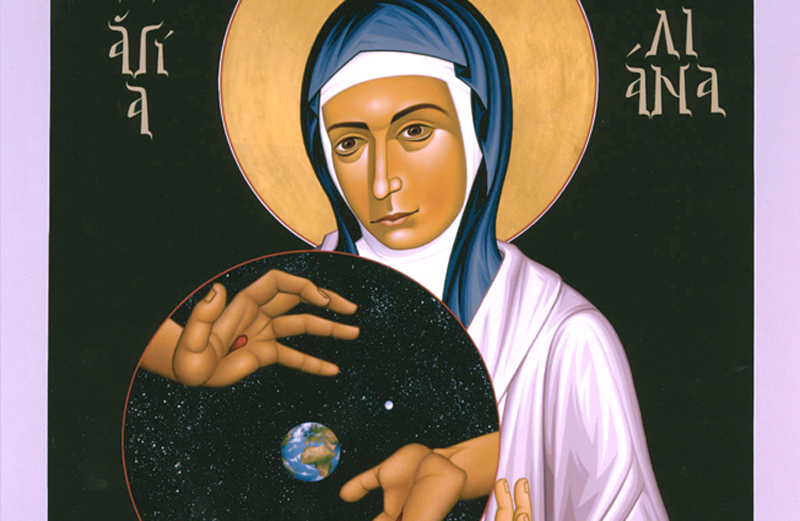
Despite the desperate misery around her, despite the baffling sinfulness of the world, everything circles back to God’s overwhelming love. In the first vision he holds out something round like a ball, like a hazelnut, and he puts it in the palm of her hand.

What is it? It’s the world, the universe, God tells her. He made it, keeps it and loves it.

The woman bubbles over with joy throughout her mystical journey. In heaven she sees the devil, “the Fiend,” scorned by God, and it makes her laugh. “I laughed mightily and that made them to laugh that were about me, and their laughing was a pleasure to me.”

Pleasure–a word she will use again and again to describe her visions, for in God’s workings in this world and the next there is much pleasure.

She has a dramatic vision of the soul. She sees a body lying on the ground, “heavy and horrible, without shape or form, like a swollen quag of stinking mire.” But then, out of this corpse “sprang a full fair creature, a little Child, fully shaped and formed, nimble and lively, whiter than a lily, which swiftly glided to heaven.”

Her last vision is the most frightening. She is still lying in bed and a handsome young man, “the Fiend,” comes to her side. His hair is red as rust, with full locks hanging on his temples, and his skin reminds her of ceramic tiles, with black spots like freckles.

But then his hands wrap around her neck, and become like paws holding her throat.

With that, she awakes. She sees the people who have been caring for her during her illness, mopping her damp forehead, praying, keeping vigil. Can they smell the stench of the Fiend? she thinks. She asks them. No, they seem oblivious to both the horror and the wonder.

She is cured, saved. All is well, all shall be well, all manner of thing shall be well.

The woman, known as Julian of Norwich, returned from the edge of death that day, and the visions she received consumed the rest of her life. She put them down in what is considered to be the first book in the English language written by a woman, Revelations of Divine Love.

Eighty-six chapters and about 63,500 words, a bold undertaking for someone who claimed to be “unlettered.” She became an anchorite, a religious hermit, living in a small room attached to a church. Through a window to the sanctuary, she could hear the services and Scriptures read.

Julian lived another 30 or even 40 years after her vision–it is not known for certain. Her book has survived her by hundreds of years and speaks across the ages with startling modernity.

She calls Jesus “Our heavenly Mother,” comparing his love to that of a mother who might allow a child to fall, perhaps to learn a lesson, but would never let her offspring endure endless peril.

I like to picture Julian making at the end the same journey she’d made when she was so ill. Her soul’s last flight, gliding up to heaven, where full understanding finally comes.

I see God reassuring her as he had on her first heavenly trip: “I may make all things well, I can make all things well, I will make all things well, and I shall make all things well; and thou shalt see thyself that all manner of thing shall be well.”

View our slideshow of Julian-inspired paintings!

Download your FREE ebook, Mysterious Ways: 9 Inspiring Stories that Show Evidence of God's Love and God's Grace.

Is That in the Bible?

An interesting press release hit my inbox this week, citing a recent survey by the Barna Research Group. As it turns out, many people don’t know that some of their favorite biblical quotes aren’t actually from the Bible. See how much you know—which of these famous phrases is found nowhere in scripture:

“To thine own self be true.”

The Lies That Bind In Article Ad

“God helps those who help themselves.”

“The truth will set you free.”

“God works in mysterious ways.”

As much as we at Mysterious Ways like that last one, the only phrase above that is in the good book is “the truth will set you free,” in the Gospel of John. According to Barna’s poll, only 24% of adults knew that.

However, that doesn’t make these other lines any less divinely inspired. Take the quote that inspired our magazine’s title. While it wasn’t written by God, the prophets, or the apostles, it does have divine origins.

In our inaugural issue of Mysterious Ways, contributing editor Rosie Schaap told the story behind these well-known words:

Late one stormy London night in 1763, a broken man was determined to end his life. He hired a coach to take him to the river. Only when he cast himself into the roiling Thames and drowned, he thought, would his agonizing trials finally end. He was unwavering in his resolve. He stepped down from the coach and walked through the fog toward the river’s edge. When he reached the quays, he noticed a strange man sitting there, staring at him, as if on guard. Moreover, despite the rainfall, the tides were low—too low to drown a man.

Returning home, the desperate man decided to poison himself with an overdose of laudanum, a potent drug derived from opium. But he couldn’t raise the bottle to his lips. He tried again and again. Each time, it was as if an invisible hand were pushing it away. Finally, he tried to hang himself. The rope snapped, and his housekeeper rushed in, responding to the noise. The man gave up. For reasons he could not conceive, the life that brought such despair and misery could not be ended…

That man was William Cowper, the famous English poet. It had not been the first time he had contemplated suicide, only to be held back by forces greater than himself. Four years after his dark evening in London, he sought a fresh start and moved to the village of Olney in Buckinghamshire. There, he met another man who had witnessed God’s grace at a moment of great desperation.

That man was John Newton, the celebrated Anglican preacher. Appointed to serve in Olney, Newton earned such a reputation for the power of his preaching and the depth of his convictions that people who desperately needed guidance and hope—like William Cowper—moved to town to benefit from his ministry.

Cowper took residence in a house adjoining Newton’s, and took a measure of peace in Newton’s friendship and care. Newton understood that for the fragile poet’s mind to find peace, writing would have to be part of the recovery. He encouraged Cowper to turn his creative talents to the composition of hymns, and the two collaborated on a collection of nearly 350 works known as the Olney Hymns.

In the centuries since, countless people have similarly found comfort and spiritual sustenance in the hymns written by these two men. Newton, of course, is best known for his most famous work, “Amazing Grace,” inspired by his miraculous rescue at sea. And Cowper? He composed a hymn titled “Light Shining Out of Darkness,” about the hidden workings of the world that had prevented his suicide and led him, against all odds, to where he was meant to be. It begins with a line we all know well: God moves in a mysterious way. . .

So don’t feel too bad if you’re one of those 76% who don’t know their Bible inside out. After all, the words in those pages aren’t the only ones God uses to reach us.

What’s your favorite biblical—or non-biblical—quote? Why does it have special meaning to you?

Is Lent in the Bible?


We observe Lent as the 40 days before Easter, starting with Ash Wednesday. If you want to take a moment to look at your calendar and count how many days there are between Ash Wednesday you’ll see—hmmmmm—there are more than 40 days. That’s because Sundays aren’t counted. We get Sundays off. Sundays are feast days, days of celebration. So where did this tradition come from? What is the meaning of Lent? Is the term Lent even in the Bible?

Is Lent in the Bible?

The short answer: No, Lent is not in the Bible. You won’t find that word there. But the practice of Lent comes from the Bible.

Pray a Day Vol 2 In Article Ad

Lent is that season of the year when we honor and remember a key moment in Jesus’s ministry. Before He could set out to do what He did, before He was going to preach and teach the Gospel, He went off into the wilderness for 40 days, fasting all the while.

4 Things the Bible Can Teach Us About Lent

Golden cross on a fence surrounded by spring flowers to show lent in the bible

1. The Promise of Easter

The word Lent comes from an Old English word that means springtime, or more specifically the lengthening of the days, as happens every Lent.

Isn’t that a nice reminder that this admittedly penitential season is quietly celebrating the arrival of spring, the arrival of more sunlight, the coming of the great Light and the promise of Easter?

As the Bible tells us “Jesus was led by the Spirit into the wilderness to be tempted by the devil” (Matthew 4:1). Take note of that. He didn’t simply wander into the desert because He wanted to. He was led by the Spirit. Let the Spirit lead you this Lent.

Family praying together on the couch with a bible opened to the lent story

2. Putting Jesus First

Jesus fasted for 40 days and 40 nights while there, and for that reason we often choose to give up something as we celebrate Lent. People give up chocolate or coffee or desserts or drinks. The purpose of such fasting? It’s a way of putting Jesus first in your mind and heart. Every time your stomach reminds you of how much you’re missing that bar of chocolate or that dish of ice cream, you’re reminded of Jesus.

It’s a way of putting Jesus first in your mind and heart.

(A minor technicality: since Sundays aren’t counted in the 40 days and since Sundays are days of honoring God anyway, many people skip their fast on the Sundays of Lent.)

woman hiking in the woods for lent in the bible with her puppy

3. Go into the Wilderness

The other thing worth considering is that Jesus was in the wilderness. Think of that as another way of honoring Lent. Go for a long walk in the woods. Go on a silent retreat. Go on a phone fast for a day (talk about something difficult to give up!). Let the Spirit speak to you.

READ MORE: 5 Fun, Easy and Faith-Filled Ideas for Lent

As we know from the Bible Jesus was tempted by the devil at the end of those 40 days. He was hungry. Probably tired and lonely, too. So, what do we do when we’re led astray by dark forces or just our own selfish, ego-centric natures? Look at what Jesus did.

When commanded to turn stones into bread, Jesus responded, “It is written, ‘Man shall not live by bread alone, but by every word that comes from the mouth of God’” (Matthew 4:4).

When the tempter took Jesus to the top of the temple and suggested Jesus throw himself off, Jesus countered by quoting Scripture again: “It is also written, ‘Do not put the Lord your God to the test’” (Matthew 4:7).

Couple reading about lent in the Bible together

4. Scripture is Our Best Ally

And the third time, led to a high mountain and shone all the kingdoms of the world that the devil would offer if only Jesus would worship him, Jesus banishes him for the last time, saying, “Away from me, Satan! For it is written: ‘Worship the Lord your God and serve him only’” (Matthew 4:10).

Scripture is Jesus’s best ally, as it is for us.

Whatever choices you make for Lent, whether you’re giving up sweets, going on a retreat or taking on a favorite charity, let Lenten Scripture be your companion. In that way you can find Lent in the Bible.

And know that the promise of Easter is just around the corner as the days grow longer and your faith expands. Happy Lent!

READ MORE ABOUT LENT:

Inspiring Verses That Involve the Number 22

For years, the number 22 haunted Ellen Gillette, whose youngest son, Adam, died on August 22, 2000. Whenever Ellen saw the number 22—whether it was on a restaurant bill or a sports jersey—she relived her son’s fatal car accident.

Until one evening, Ellen opened her Bible and something incredible happened. The words blurred and the numbers came into sharp focus. Chapter 22, verse 22… there were 22s everywhere. This time, the number didn’t scare Ellen. As she flipped through 22 after 22, verse after comforting verse eased her pain—a story Ellen told in the February/March 2017 issue of Mysterious Ways magazine.

Mys of Blackberry Valley In Article Ad

Click through our slideshow below to read some of Ellen’s favorite “22” Bible verses: