Embrace God's truth with our new book, The Lies that Bind

What Can You Let Go of This Fall?

“Some of us think holding on makes us strong,” wrote the poet and novelist Hermann Hesse, “but sometimes it is letting go.”

At this time of year, I think a lot about letting go, never more than when I watch brilliant yellow, red and orange leaves release their hold on tree branches and float to the ground. It’s a wistful sight, a signal that the lush greenery of spring and summer has run its course. But it’s also a reassuring reminder that letting go at just the right moment is a healthy, freeing action.

NIVFLB Inarticle ad

Trees that rest, leafless, through the winter are ready to sprout new growth in the spring. Turning that idea inward, what in your life can you let go of to prepare for a positive future?

Your answer might range from something really practical to something profound and emotional. Here are three categories of things most people can benefit from evaluating, asking if they are still serving your life or if you can let them go like an autumn leaf.

1)  Let Go of Stuff

Though the impulse might tend toward hibernating and nesting at this time of year, autumn is a great time to clear out summer clothes that did not bring you joy, fun and comfort this past season. As you pull old sweaters and jeans out of storage, ask yourself which can be passed along to a clothing drive or textile recycler. Same goes for books, kitchen gadgets, anything that you might be ready to release, in anticipation of the room you will have for more positive, useful possessions.

2)  Let Go of Caring What Others Think

When you feel judged by others, it’s easy to slip into a place where you question yourself at every turn. But as the inspiring writer Brene Brown puts it, “What’s the greater risk? Letting go of what people think, or letting go of how I feel, what I believe and who I am?” Releasing the opinions of others—especially those who really aren’t entitled to an opinion about your life—will leave you feeling more confident and grounded in your core values, decisions and attitude.

3)  Let Go of Unrealistic Goals

I’ve written before about doing a “resolution re-set” a few weeks into the new year. Looking back at priorities and intentions you set for yourself can reveal that they aren’t helpful, practical or accessible to you at this moment in your life. Being flexible to adjust course, say shifting from a daily workout to a three-times-a-week routine, gives you permission to release expectations you set for yourself that, it turns out, were unrealistic. Doing this isn’t giving up on self-improvement or personal growth—it’s pursuing those things in ways that set you up for success.

What would you like to let go of in your life?

What are the 4 Themes of Advent?

The Advent season is a time for reflection and anticipation—reflection on our spiritual lives, and anticipation for the arrival of Christmas. While Advent traditions vary based on religious denominations and cultures, one common practice includes focusing on four themes. These themes, or virtues, can be various things. The most common Advent themes are hope, peace, joy, and love.

Some traditions include lighting a different candle on a wreath each Sunday of Advent and reflecting a different theme. Here are the four themes of Advent, along with prayers, Bible verses, and practices to help you pray or meditate on their importance in your life.

Walking with Jesus L&E evergreen_in article ad

READ MORE: Advent Candles and Holders Perfect for the Advent Season

Advent Themes #1: Hope

A woman with her eyes closed outside in nature thinking about the four advent themesWhat is Hope?

Hope is an active anticipation in the ability to reach desired goals,” says Dr. Steven Sandage, a theologian and psychologist. “It requires a willingness to put energy toward those goals.”

Perhaps the most fascinating thing about hope is when we need it in our lives. Hope may not be necessary when we are faced with an easy task. It comes when we are faced with something that feels impossible. Hope requires belief. As Dr. Sandage says, “because without some belief in the possibility of getting toward a desired end, it’s hard to make progress in life.”

A Prayer for Hope

“Lord, You love me and by Your grace have given me eternal comfort and a wonderful hope. Now, comfort and strengthen me in every good thing I do and say.” —Bob Hostetler

Bible Verses about Hope

  • The light shines in the darkness, and the darkness has not overcome it. —John 1:5
  • May the God of hope fill you with all joy and peace in believing, so that you may abound in hope by the power of the Holy Spirit. —Romans 15:13
  • Now faith is being sure of what we hope for and certain of what we don’t see. —Hebrews 11:1

The Candle of Hope

As you light the candle of hope, think about all the things you are hoping to accomplish now and in the future. Dr. Lea Waters, a positive psychology expert, suggests making a list of things you’ve always wanted to do. “Suspend your reality for the moment and allow yourself to feel happy about this imagined future,” she says. “Later, you can focus on mundane realities like budget, but for now just let your brain dream.”

READ MORE: Join us on November 27, 2022, as we observe the 28 days of Advent.

Advent Themes #2: Peace

A man outside looking up and praying for the advent theme of peaceWhat is Peace?

The Merriam-Webster dictionary defines peace as “a state of tranquility or quiet: such as freedom from disquieting or oppressive thoughts or emotions.” However, inner peace can be a little more complicated than that. Peace in your heart is a yearning for wholeness, connection, and calm. This does not mean being at peace means you will feel it all the time.

This was very much the case for Carolyne Aarsen, who learned an important lesson about peace after the loss of her foster son with cerebral palsy. “I learned that peace is not the absence of pain,” she said in her Guideposts story, “peace is the presence of God.”

A Prayer for Peace

God grant me the serenity to accept the things I cannot change; courage to change the things I can; and wisdom to know the difference. Living one day at a time; enjoying one moment at a time; accepting hardships as the pathway to peace; taking, as He did, this sinful world as it is, not as I would have it; trusting that He will make all things right if I surrender to His Will; that I may be reasonably happy in this life and supremely happy with Him forever in the next. Amen. —The Serenity Prayer by Reinhold Niebuhr

Bible Verses about Peace

  • Peace I leave with you; my peace I give you. I do not give to you as the world gives. Do not let your hearts be troubled and do not be afraid. —John 14:27
  • Now may the Lord of peace himself give you peace at all times in every way. The Lord be with you all. —2 Thessalonians 3:16
  • The Lord turn his face toward you and give you peace. —Numbers 6:26

The Candle of Peace

As you light the candle of peace, take a moment to pray for this important Advent theme. You can pray for peace in the world, peace in your community, peace in your family, or peace within yourself. These prayers can bring you comfort and ease your worries.

READ MORE: 5 Advent Prayers for Peace, Joy, Hope, and Love

Advent Themes #3: Joy

A smiling woman in a yellow shirt feeling joyful about the advent themesWhat is Joy?

Some may view joy and happiness as the same thing. A feeling of being content and filled with pleasure. However, we should remember that joy is something much more spiritual and intentional. So, what is the difference between happiness and joy?

“Whereas happiness is shaped by external circumstances, joy is found deep within,” says Guideposts contributor Pablo Diaz. “Unless we are intentional in discovering the gift of joy in ordinary things, it will not happen.”

A Prayer for Joy

Our Heavenly Father, help us to think the kind of thoughts that give us joy and that transmit joy. Help us to get in our hearts the love of Christ, that we may love people, so that they find joy. —Norman Vincent Peale

Bible Verses about Joy

  • And Mary said “My soul glorifies the Lord and my spirit rejoices in God my Savior…” —Luke 1:46-48
  • I thank my God every time I remember you. In all my prayers for all of you, I always pray with joy. —Philippians 1:3-4
  • These things I have spoken unto you, that my joy might remain in you, and that your joy may be full. —John 15:11

The Candle of Joy

As you light the candle for this Advent theme, visualize the things that bring you joy. Whether that is an activity, a person, or a place, intentionally make whatever brings you joy a part of your day. Joy doesn’t just happen; it’s up to us to choose it daily.

READ MORE: 10 Interesting Advent Facts to Get You in the Holiday Spirit

Advent Themes #4: Love

Gloved hands making a heart symbol for the advent theme of loveWhat is Love?

Last, but certainly not least, the final Advent theme is love. It is one of the most powerful forces in the world. It can be uplifting, life-changing, and sometimes even devastating. But what exactly is love?

Love can be the love we feel for our families, or friends, or our significant others. It can be the love we feel for ourselves. But could love also be something deeper? Novelist Paulo Coelho said that loving others brings us closer to our spirituality. Understanding love better helps us understand God. “God and love are synonymous,” says minister Oswald Chambers. “Love is not an attribute of God, it is God; whatever God is, love is.”

Prayers for Love

Lord, help me feel Your love, that above all things I may know I am loved by You. —Pablo Diaz

Lord, thanks for the gift of love and for those who help us discover its meaning and power. —Pablo Diaz

Bible Verses about Love

  • For God so loved the world that he gave his one and only Son, that whoever believes in him shall not perish but have eternal life. —John 3:16
  • Love never gives up on people. It never stops trusting, never loses hope, and never quits. —1 Corinthians 13:7
  • My command is this: Love each other as I have loved you. Greater love has no one than this, that he lay down his life for his friends. —John 15:12-13

The Candle of Love

As you light the candle for love, focus on the love God feels for you. Remember that relationships may come and go, but God’s love for you is unending. Pray or meditate on the ways that God loves you and how you see His love in your daily life.

How do you plan to pray or meditate on the 4 themes of Advent this year?

READ MORE: Favorite Advent Carols That Keep Christ in Christmas

READ MORE: 10 Things You Might Not Know About Advent Calendars

Welcome to the Updated Guideposts Website

Have you noticed changes to Guideposts.org? We’ve just launched upgrades to the site to make it a better experience for you, our site visitors. All the stories, slideshows, videos, blogs and games that you love are still here. We’ve just changed the way they look. You’ll see bigger pictures and fonts—and we’ve made it easier to find the stories you like best.

The first changes you’ll probably notice are on the home page, Guideposts.org.  At the top of the page, we’ve got 3 articles in the top slots, so you have several good stories to choose from. As you scroll down the page, you’ll see several more big pictures associated with stories. It’s a new approach that allows us to showcase some of our newest content. There are several different sections on our new homepage, where we’ve grouped our content by themes, like Trending Topics or Better Living. On the right side of the home page, you”ll see the most popular stories from across our site, so you can easily see what other readers are enjoying.

Pause & Pray In Article Ad

As you click on the links in the navigation bar at the top of the page, you’ll see that these topic pages, like “Health and Wellness,” follow a pattern somewhat simliar to the homepage, except there’s one big picture for a story featured at the top of the page. As you scroll down, you’ll see stories pulled from throughout that particular section of the site. On the right side of the page, you’ll see the Most Popular stories in that topic area, so you can now easily find our readers’ favorite content in that section. 

As you click around the site, you’ll also notice changes to the designs for the article, slideshow, video and blog pages. 

Here’s what you’ll see. When you visit an article like, “10 Weight Loss Tips that Work,” you’ll see Related Articles on the right side of the page, and right below the article too!  You’ll be able to find more stories in the subject area that you’re interested in easily. When you scroll down the page and finish reading one story, a new story will load automatically. You won’t have to search the site to find another one. 

You’ll still have an opportunity to sign up for our newsletters and comment on the articles too, just like you could on our old site.

We’ve also updated our slideshows, which our visitors have told us are some of their favorite pieces of content. When you visit a slideshow like, “Bible Verses for Depression,” you’ll see the pictures are bigger. To the right of the slideshow, you’ll find a list of the most popular slideshows and if you scroll down you’ll see other slideshows to explore. 

Finally, if you want to search the site, click on what looks like a little magnifying glass at the top of the page. That will open up a search field for you.

We’re excited about these changes, and we’d love to hear from you. Let us know what you think of the new design at digitaleditors@guideposts.org.

Finally, you may remember that back in December, we re-organized our site. This was most visible in the categories that you see at the top of this page. Those structural updates remain in place, but just in case you need a reminder, we’ve collected a few links you might need here.

Blogs

Games

Customer Service

Submit a Prayer Request

(Note: If you’re an OurPrayer volunteer who needs to log in to the site, you will find the log in link at the bottom of the page, under Our Organization or just click here.) 

Thank you for visiting our site!  We appreciate each of our readers and we will continue to work to improve the site for you.

Walking with Jesus

One of my favorite things about writing devotions for Mornings with Jesus was sitting down and thinking about my own encounters with Jesus—really taking that time to reflect on my relationship with Him. I began writing or thinking about each devotion by asking myself, “What Scriptures have really impacted my life?” I would write out the Scripture verse, and then jot down experiences I’ve had that are related to that verse. It was a wonderful time of reflection for me as I looked back at the moments in my life and realized how God’s Word has brought understanding and strength to my life, and pushed me to change.

Some of the devotions came to me through that reflection process. Others were borne out of my own personal quiet time. As I met Jesus in the morning and read His Word, special Scriptures would stand out. I knew God had a plan for me to include those, too.

Sweet Carolina Mysteries In Article Ad

Since I’m a novelist, I like lots of description…it was hard to keep myself to the shorter word count of a devotion. And I’ve noticed that this devotional writing has impacted my blog (www.triciagoyer.blogspot.com) because it seems that every time I sit down with God’s Word I have something I want to share now! Writing for Mornings with Jesus has also reminded me to pause as I read God’s Word and think about what one message God’s speaking to me at that moment.

The biggest lesson I learned as I was writing was thankfulness. As I wrote about the Scriptures that meant the most to me—and about the numerous ways Jesus met me in everyday moments—my heart was flooded with gratitude. I realized even more that Jesus has given us the amazing gift of salvation but He didn’t stop there. He gave us Himself to walk beside our every step. My life and my devotional stories are proof of that.

My prayer for every Mornings with Jesus reader is that these devotions stir their hearts to open to our amazing Savior, and that the devotions give them a hunger to build a deeper, personal relationship with Him.

Download your FREE ebook, Daily Devotionals: 7 Days of Bible Devotions to Strengthen Your Faith.

Veterans Day: A Time for Gratitude

This year, my husband Rob and I celebrated two anniversaries. One was our 20th wedding anniversary in late October. The other, on Veterans Day, is 15 years since he returned home from a yearlong deployment to the Middle East with his Army Reserve unit.

Every Veterans Day is a day of special gratitude in our house. We give thanks to those who serve our country with courage and commitment, and to the families and communities that sustain their service members with pride, hope and everything in between.

Inspiration from the Garden in article ad

But at milestone years—5, 10, and now 15 years since Rob’s deployment—we especially reflect on how grateful we are to be here, together.

It was a coincidental confluence of our personal history and the U.S. Army’s deployment calendar that Rob returned home in time to celebrate a milestone wedding anniversary, 5 years, in 2004.

But there are ways in which it feels like more than a coincidence. After all, both marriage and military service require steadfast commitment, the active decision to continue doing something each person has promised to work toward. Also, in both marriage and service, no one is alone—collaboration and teamwork are crucial to success and safety. And finally, both marriage and the military ask different things of us at different points in time.

Rob is no longer in the Army, but our marriage, happily, continues. The lessons we both learned through his service have remained with us, strengthening us, challenging us and helping us grow.

And so it is with particular emotion that I will thank Rob for his service on this Veterans Day. Fifteen years is a long time, and we’ve made a wonderful life in that decade and a half. Today more than most, I’m grateful he served with such courage—and then came home to me.

How do you thank the veterans in your life?

Truckstop Ministries

Swing by the T/A truck stop off I-75 in Jackson, Georgia, and you’ll see a food court, gas pumps and rows of big rigs in the parking lot.

But then a peaceful song catches your ear and you follow it to a bright neon cross and a tractor trailer with “Truckers Chapel” in big letters across the side. Open the door and you see a dozen or so truckers from all over the country, filling the air with hymns.

Pray A Word a Day - 2023 In article

A church at a truck stop? Actually, it’s more common than you might think. But only because I ran into trouble back when I was a trucker myself.

I’d been driving a big rig for three years, and I could make runs from my hometown of Dublin, Georgia, to just about anywhere without a map. But inside, I felt lost. Those long days and nights on the road were lonely. Sometimes I could barely keep my eyes open.

One night a fellow trucker offered me some pills to stay awake. I didn’t say no. The pills put me on edge. I worked even longer hours, grew distant from my wife, Jan, and our young son.

One night I blacked out at the wheel. The truck ran off the road, tipped onto its side and skidded into a ditch. The load spilled out of the trailer. Amazingly, I wasn’t hurt. But I was suspended for two weeks.

It was a wakeup call. As soon as I returned home from my first run after the accident, I went to a local Baptist church for the first time in years. I thought someone told the pastor I was coming because every word of his sermon hit home. I had been neglecting my family, my friends, even my own health. Finally, the pastor came down from the pulpit. “I’m meeting you halfway,” he said. “Will you travel the rest?” I stood up and met him at the altar.

From then on, I would find a church on the road and go to a Bible study at home. Praying with others gave me a bigger boost than any pills ever could. The hardest thing was finding a church in a strange city. And there was rarely room to park my big rig.

After I quit running over the road and started running more locally, I got the idea to start a Bible study at a big truck stop in Atlanta. My wife loved the idea. I called the manager of the T/A stop in Atlanta, expecting him to laugh, but he offered up some space.

That first meeting, about a dozen people showed up. One guy didn’t say a single word until the very end, when he came up to me. “I was running low, Chaplain Joe,” he said. “You filled up my tank.”

“How ’bout Texas?” “Got anything out in California?” The requests for chapels at more truck stops kept coming in. I called truck stops and found local ministers to lead the services, and I bought Bibles by the case and gave them out to drivers.

Two trucking companies even offered to pay my salary—to quit trucking and serve as the president of Truckstop Ministries. In many of the locations, we set up converted tractor trailers so that drivers will have a place to worship together whenever they stop by.

Today, Truckstop Ministries has 500 workers in 77 locations nationwide. Our rigs aren’t the only things that need refueling. Our spirits do too.

This YouTuber Developed Spiritual Readiness

If you’d told me when I was in my thirties that I would now run a popular YouTube cooking channel called Mary’s Nest, with my hus­band helping behind the scenes with filming and editing, I wouldn’t have believed it—not for a minute. For one thing, YouTube didn’t exist then, and for another, I was convinced I’d be a high-powered lawyer with no time for marriage and children. Yet here I am today, a wife and mom, teaching all the things my mother taught me—the gen­tle domestic arts, as she called them— to more than a million subscribers! Isn’t that just like the Lord, to surprise us in the most amazing ways?

I was raised in the prepper lifestyle long before the term became popu­lar. Mom had lived through the Great De­pression and World War II, and she want­ed to make sure that I, her only child, was prepared for every eventuality. “Hard times can hit with­out warning,” she’d say. She drilled into me that processed foods were bad eco­nomically and nutri­tionally, and that the best buttress against uncertainty was a garden, a well-stocked pantry and a no-waste kitchen. That’s a big reason my YouTube channel is all about how to become a modern pioneer through traditional cooking skills such as culturing dairy, baking with ancient grains, canning and preserving.

Daily Strength for Women in Article ad

What I didn’t realize is that on this incredible journey, the Lord was also teaching me about spiritual prepared­ness, lessons that would serve me well when my little family of three—my husband, Ted; our son, Ben; and I—faced a crisis a few years ago. Let me show you what I mean.

LESSON 1: Lay the Foundation

Before I met Ted, my life was on a very different track—a fast one. I grew up in the 1960s and ’70s in suburban Bedford, New York. Much as I loved the home­making skills my mom taught me, I couldn’t wait to go to college and join the workforce like my dad, a corporate tax executive. My own office! My own copy of The Wall Street Journal, with my name on the address label!

By my late twenties, I was working in finance in Washington, D.C., and going to law school at night. I was de­termined to do everything that both my parents had done. When I wasn’t at work or school, I was tending my kitchen garden, making bone broth and sewing my own curtains. I pushed myself every second.

Finally, I finished law school and was preparing for the bar exam. One rainy December night just before Christmas, I worked really late at the office. On my way home, a teenager ran a stop sign and plowed into my car. I’d thought I was so in control of my life, but as my car spun across the wet road and into a tree, all I could do was call out to God. It had been an aw­fully long time since I’d talked to him. Though I had been raised Catholic by devout parents, I’d put faith on the back burner in pursuit of my career.

Fortunately, the other driver and I were unhurt. Sitting on the curb in the rain as I waited for the police, I thought, Is this how I want to live? All I do is work and study. I don’t have a social life, a prayer life. Something has to change.

I was due to spend Christmas in Tex­as, where my parents had moved for my dad’s job. As soon as the police fin­ished the accident report, I hopped on a red-eye flight. Mom and Dad picked me up at the airport.

“Is everything all right?” Dad asked.

I told them about the accident. “I’ve had an epiphany,” I said. “I want to live a slower, more intentional life.”

I got off the fast track and moved to Austin, Texas, to be closer to my parents. I started my own law prac­tice, helping small-business owners. I set my own hours and made time for friends, family and faith. Going to church every week and praying daily made me feel as if I was becoming a better version of myself, the person the Lord wanted me to be. I started to understand why my mom kept Psalm 118:24, “This is the day the Lord has made, let us rejoice and be glad in it,” on our kitchen chalkboard.

Doing the day-to-day work—prayer, devotions, Bible reading—gives you a solid spiritual grounding and prepares you for life’s inevitable challenges, such as when our son was diagnosed with a brain tumor during college in 2021. I’m convinced that seeking the Lord’s direction in prayer, which was already a years-long habit of mine by then, enabled me to stay calm and be strong for Ben when he needed me the most.

LESSON 2: Don’t Put Your Plan Ahead of God’s Plan

That rainy-night car accident made me rethink a lot of things. Why was I working 24/7 if I didn’t feel fulfilled? Had I put my plan ahead of God’s plan? I was a total type A then, and I had a hard time letting go. But when you release the illusion of control and put your life in God’s hands, you’ll dis­cover his plans are much better than any you might have.

Take what happened to me when I was close to 40 and had all but given up on having a family. I’d calculated how much time I had to meet the right person, build a relationship, get mar­ried and start a family before I would be too old to bear children. “The math wasn’t mathing,” as I’ve heard Ben and his friends say. No way could there be enough time. Okay, if God called me to be single, I would accept it.

That’s when I met Ted Shrader. My parents and I and Ted and his mother were flying on the same airplane and really hit it off. Ted was a software de­veloper. We exchanged business cards. I thought he was handsome and so nice, but I didn’t expect anything to come of it because he was in his twen­ties, 10 years younger than me.

A couple weeks later, I arrived at my little country church early for Saturday night Mass. The lights weren’t on yet. I sat in a pew in the dark and prayed, “Father, why do I keep thinking about that guy from the airport? I don’t know what your plan is here, but I’ll go with it. Guide me, and I will follow.”

Ted emailed and invited me to meet at a local bookstore café to catch up. Was his interest in me friendly or ro­mantic? “I think I’m a bit older than you,” I said as I sipped a café au lait and Ted enjoyed an iced tea.

“I know,” Ted said. “You have wrinkles around your eyes.” Then he stopped, realizing how that sounded, and added, “They’re the most beauti­ful wrinkles I’ve ever seen!”

We had a good laugh over that. In fact, we had such a wonderful time together that, by our third date, we were already discussing marriage. Ted was like no one I’d ever met. Whenever an ambulance or fire truck with sirens on passed us, he would pause to pray: “Father, please keep the emergency responders safe, and, Jesus, please put your healing hand on whomever they are going to rescue.” Soon we were praying together, growing closer to God and each other.

I discovered that the same evening I’d been sitting in that dark church, Ted had been at Mass, where a visiting priest asked people to write down their prayer requests and put them in a bas­ket. Ted wrote, “If it’s your will, Lord, bring me someone to marry.”

Ted proposed on our seventh date. We married a month later, and Ben was born nine months after that. I still laugh at myself for thinking that God could be limited by my math!

Surrendering control to God brings far better blessings than anything we can make happen on our own. It was accepting God’s plan over mine that led me to Mary’s Nest. When Ben came along, I threw myself into moth­erhood. Then we found out Ben had severe dyslexia and other learning disabilities, and it became clear that I’d never go back to practicing law. In­stead, I homeschooled Ben. I formed a group with other homeschooling moms. I was in my forties, and they were in their twenties. They wanted to know about good nutrition for grow­ing brains and asked me to teach them the traditional cooking methods I’d learned from my mom. I hosted classes in my kitchen. Word spread, and the next thing I knew, I was teaching in homes all around town. Ted and Ben suggested I post videos of my classes on YouTube. Before he left for col­lege, Ben cheered us on as Ted and I learned how to film, edit, produce and build our audience. If I’d done things according to my own plans, Mary’s Nest and the fulfilling life I have now wouldn’t exist.

LESSON 3: Make Time to Be Still and Just Be With God

Back when I was working full-time, going to law school and still making meals from scratch, a friend suggested a shortcut: “Why don’t you just buy a rotisserie chicken?” I blurted, “That’s against my religion!” I mean, it almost felt that way.

What most people don’t understand is that cooking the slow way doesn’t necessarily mean it’s the most labor-intensive way. You do 15 minutes of prep, but the oven does all the work roasting the chicken after that. And the result will taste better than any­thing you can buy precooked.

Much of the work in traditional food preparation is simply done by time. Dough needs time to rise; stock needs time to simmer; vegetables need time to pickle. I think there’s a spiritual les­son in that. It goes along with surren­dering control to God. Sometimes the hardest thing to do is wait. But it’s in the waiting, the taking time to listen, that we hear God most clearly.

Ben’s brain tumor was found during the early days of Covid, when lock­downs were in full force. He’d been having trouble hearing in his right ear. An MRI showed an acoustic neu­roma, a noncancerous tumor, pressing against his brain stem. Because of its location, doctors wanted to operate right away. Then Ben tested positive for Covid despite being symptom-free.

We learned we could either wait 20 days for the virus to clear, or we could go ahead with the surgery under quar­antine restrictions, which would entail bulky gear worn over the surgeons’ hands. Given the delicate nature of the surgery, we wanted the surgeons to be as unencumbered as possible. Of course, we wanted the tumor gone as quickly as practicable, but waiting seemed like the wiser choice.

I tried to break the news to my moth­er gently that her only grandchild had a brain tumor. She was in her nineties, and I wondered if she’d be too frail to handle the shock. I needn’t have wor­ried. “How gracious of the Lord to give us the next 20 days to pray,” Mom said. “Ben is strong, but praise our God that he gives us even greater strength to lean on.”

Just as my mother had foreseen, the delay in Ben’s surgery turned out to be a blessing. Those 20 days gave us the time to process what was happening and prepare ourselves for what lay ahead. Ben made peace with having major brain surgery. Ted and I meditat­ed on the words of Jesus, who taught us that tomorrow will worry about it­self, and that if God takes care of the sparrow, he will surely take care of us. We prayed fervently and turned over all our worries to the Lord.

The surgery left Ben with no hearing on his right side. None of the inner-ear parts could be saved because the tu­mor had wrapped itself around them. I waited by his bedside in the surgical ICU for him to wake from the sedation. When he opened his eyes and saw me, he broke into a sleepy version of his joy-giving smile. “Hi, Mom,” he said. It was the sweetest “Hi, Mom” I’ve ever heard.

I think of it this way: For dough to rise, it needs to rest in a warm place, away from drafts. It’s similar to how our souls need to bask in the light of the Lord, away from earthly distrac­tions. If we can learn to prepare spiri­tually for what life brings, to just be still and trust in God’s presence, he will work things out for our good and in a way far better than we could have planned for ourselves.

For more inspiring stories, subscribe to Guideposts magazine.

This Is Pure Love

Motivational speaker and author Zig Ziglar passed away on November 28, 2012, at the age of 86. We pay tribute to his inspirational life and career by sharing this story he wrote for Guideposts in 1978.

I love to play golf. Nothing makes me happier than just rarin’ back and bustin’ that ball as hard as I can from the tee. Then, if I can find it, I like to bust it again.

Go For It In Article Ad

Well, not long ago I bought a set of clubs for my 12-year-old son Tom. He was a bit hesitant at first, but then the golf bug bit him and he suddenly started to play—and pretty well for a beginner.

Our golf club has three courses, two for regular golfers, one for old folks and beginners. We were playing the easy course.

On one of the par fours, Tom hit a beautiful wood shot right down the middle, then took his five iron and put the ball right on the green about 40 feet from the pin. That meant he had a chance for a birdie.

To you non-golfers, that simply means that if he could sink this long putt he would score one stroke under par for the hole. I showed him how to line it up, and the ball went straight as a string—boom!—right into the cup!

I tell you, the expression on Tom’s face was the most beautiful thing I’d ever seen. I grabbed him and hugged him and we did a war dance for about two minutes.

Then I realized I had a problem. I was also on the green in two, about 12 feet from the cup. I was afraid that if I missed that putt, Tom would figure I had missed it on purpose so that he could win—a cheap victory worth nothing. So I stroked it firmly, and in it went.

I think you know what it would have meant to my boy if I had honestly missed that putt. He would have won a hole from his dad, something he’d never done, something he dearly wanted to do. But he just smiled and said quietly, “Great putt, Dad. I was pulling for you all the way.”

Now in my book, that’s love. Pure love. That’s what we need more of in every city, town and village in America.

I truly believe that regardless of who you are, you can get everything you want in life if you help enough other people get what they want.

When teachers pull for students, managers pull for employees, parents pull for children, husbands and wives pull for each other, then that helps each person realize his worth even more. It helps them to do better.

This also applies to our relationship with God. When we remember that Jesus is “pulling” for us, it’s the most comforting thing in the world.

The Therapy of Thankfulness

Every year when Thanksgiving comes around, I remember gratefully a bit of wisdom handed to me when I was a young man. Having some stubborn difficulties in my life, I took them to an older and respected friend. “Why is it,” I complained, “that I can’t seem to cope with these problems?”

I remember his long, thoughtful glance. “Maybe,” he said, “it’s because you aren’t grateful enough.”

Pray a Day Vol 2 In Article Ad

“Grateful?” I was astonished. “What are you talking about?”

“I’m talking,” he said, “about a law of living that you will discover someday. Focus on adversities, as you’re doing, and you’ll attract more of them. Be grateful for the privilege of living, and your life will grow increasingly bright. My advice to you is to be less of a complainer and more of a thanksgiver. Your troubles will become a lot more manageable, I promise you.”

Half a century of observing life and people has left me convinced that what my friend said that day is profoundly true: In some unfathomable way, the acknowledgment of past blessings seems to be the activator of blessings.

Over and over again I have seen the attitude of gratitude bring about extraordinary changes in people’s lives. I once knew a man—William Stidger—who suffered a shattering emotional breakdown. For months he was profoundly depressed, unable to work. No doctors seemed to be able to help him, but one day a friend challenged him to try what he called the therapy of thankfulness. “Many people have helped you in your life,” the friend said. “Pick any one of them—I dare you—and simply thank him.”

Pondering this, Bill Stidger recalled a schoolteacher, long retired, who years before had awakened in him an appreciation of poetry. He made himself write a short note, telling her what that act had meant to him. Soon a reply came back in the tremulous handwriting of an old lady. “When I read your letter,” it said, “my eyes were blinded with tears. Yours is the first letter of thanks I ever received from one of my students. I shall cherish it always.”

Bill Stidger wrote a note of appreciation to another person, and then another, until he had written over 500 such letters. By then, fully recovered, he was back at work. But he kept copies of those letters and the replies and in later years, whenever depression threatened him, he would reread some of them and let the therapy of thankfulness do its work.

Why is gratitude strengthening? Because it recharges the soul. Anyone who is grateful is focusing on what is good, and ultimately all good things come from God. This means that the thankful person is aligning himself with the most powerful force in the universe and is drawing strength from it.

Feeling thankful connects a person with a great spiritual dynamo, but before the power can begin to flow a second step must be taken: The gratitude you feel must be expressed. In a vivid scene in the New Testament, St. Luke tells how Christ once healed ten lepers. Of the ten, only one came back to express thanks. “But where are the nine?” asked Jesus. No one answered, but in that echoing silence every person present must have known that something was wrong, something was missing, some deep circuit was incomplete.

And so if at any time you feel a blast of appreciation or a sudden surge of gratitude, translate it into action. Write that note, make that phone call, send that small gift or flower. Act as if the impulse to act were a divine command.

When a group of people feel and express gratitude together, enormous power can come crashing through. A number of years ago Nikita Khrushchev, the formidable premier of the Soviet Union, visited this country. The mayor of New York gave a luncheon for him, and I was invited to attend. At Khrushchev’s entrance, the Soviet national anthem was played, and we all stood respectfully. We continued to stand as the orchestra played “The Star-Spangled Banner.” A bar or two went by; then somewhere in the vast crowd a little man started to sing the words. He had a thin, quavering voice, he sounded lonely and a bit foolish, but he continued to sing. Then another voice picked it up, and another, until suddenly with a great roar of sound everyone was singing. All the love, all the pride, all the gratitude we felt for this wonderful land came pouring through.

It is this healing power that we Americans seek and sense on Thanksgiving Day, something so beneficent that it’s like the touch of a great kindly hand on the fevered brow of the nation. You can’t measure or analyze it. It’s simply there, invisible, intangible, a glow of gratitude, an aura of thankfulness that strengthens us all, and strengthens our nation, too, because when you focus on the best in something, you want to preserve and defend it.

How can we maintain this attitude not just on Thanksgiving but on every other day? One way is to try to be more aware of the mystery and magic of life.

A simple device that I often use to heighten my sense of appreciation is one that I call my last-time technique. “Suppose,” I say to myself when I’m doing something particularly enjoyable or worthwhile, “suppose this were the last time you could see a sunset, or hear great music, or smell lilac or honeysuckle, or touch a loved one’s hand.” Just a mental trick, of course. But it seems to work.

It’s a step that each of us needs to take, because it completes a circle based on a profound yet simple spiritual law, the law that my wise old friend tried to teach me so many years ago, the law that says you will find what you look for.

In this life, if you steadfastly affirm goodness, goodness will be there. If you affirm love, you will find it. And if you affirm thankfulness, blessings will flow.

Read more stories about positive thinking.

Download your FREE positive thinking ebook!

The Sweet Scent of Nostalgia

Today’s guest blogger is assistant editor Daniel Kessel.

Have you ever noticed how certain smells bring up vivid memories from the past?

God's Constant Presence In Article Ad

It’s a widely studied topic. According to Brown University neuroscientist Rachel Herz, the same part of the brain that forms new memories is also responsible for registering smell–that’s why the link between scents, emotions and memories is so strong.  But as I recently learned, there may be more to this phenomenon than science alone can explain.

Lady the cat plays with word game tilesLast Tuesday after work, I pushed my way into a crowded subway car, tired from the busy day. I’d left the office around 6 PM, and with my 30-minute commute home ahead of me, I couldn’t wait to get back to my apartment and relax. I put my headphones in and held on as the train moved forward.
Within moments, a strangely familiar smell filled the subway car–a blend of wood, paint and flowers. At first, I couldn’t put my finger on why I recognized it. I looked around, expecting to find the source.

Someone holding a can of paint? A bouquet of roses? Both at the same time? But I saw nothing out of the ordinary. As I took the scent in, though, something clicked–and I felt overwhelmed with the memory of a place I used to live.

It was my first apartment after college, a three-bedroom, second-floor walkup in Sunset Park, Brooklyn. I shared the apartment with my friends Amanda and Joe, plus Joe’s cat, Lady.

The four of us became like a family–Amanda and I both had our first jobs, and Joe was finishing his final year of school. (Lady held down the fort.) We were all “words” people, so almost every weeknight we’d meet back at home, listen to music probably a little too loud and play word games.

That whiff on the subway brought me back. I closed my eyes and remembered the day we first moved into the apartment, when the walls were bare with a fresh coat of white paint and the hardwood floors were clear of furniture.

The aroma in the subway smelled just like our brand-new apartment–wood, paint, and a hint of something floral. We had to give the apartment up once our year-long lease ended, but I still missed living there with Amanda, Joe and of course, Lady.

The next day at work, during my lunch break, I logged into my Facebook account…and was surprised to read the first item on my news feed. “HELLO I MISS YOU JOE,” Amanda had written on Joe’s wall.

She linked to one of the songs Joe used to blast from our apartment’s speakers. Like me, they both missed our place and the good times we’d had there. I quickly “liked” the whole thread and started pitching into the nostalgia with some comments of my own.

I lingered over the post for a moment, reading our comment thread one more time. That’s when I noticed it—the timestamp of Amanda and Joe’s initial conversation: Tuesday at 6:24 PM. The same time I’d been down in the subway, overcome by a smell that reminded me of our Sunset Park home.

How about you? Has a mysterious scent ever jump-started your memory? Or do you have any recollections about a perfect home you’ve lived in? Share your stories with us!

The Surprising History of Santa Claus


Anyone who celebrates Christmas knows about the large jolly man dressed in red who flies on a sleigh and brings presents down a chimney. But why is he a part of our Christmas celebrations? What is the history of Santa Claus?

A Victorian stained glass window depicting Saint Nicholas in the history of Santa Claus

The Origin of Santa Claus: Saint Nicholas, a Man of Faith 

The lovable Christmas figure Santa Claus is based on a real person: Saint Nicholas.  

Pause & Pray In Article Ad

Nicholas of Myra was born sometime in the 4th century (his birthday is unknown) in present day Turkey, according to Britannica. After his parents were killed by illness, Nicholas donated all his wealth to the needy and dedicated his life to serving God. He was appointed bishop of Myra when he was still young because of his devotion to God and following the word of Jesus.  

Bishop Nicholas was a man of deep faith. At one point he took a pilgrimage to the Holy Land to walk in the steps of Jesus and better understand Him. During his life, he was prosecuted as a Christian and even imprisoned. Yet he did not let his belief waver. Despite his difficult life, he was known for his acts of generosity and performing miracles for people in need.  

Nicholas died on December 6th 343 AD, states Britannica. After he was beatified as a saint, this date was chosen as his Saint’s Day. While most reports state he was buried at his church in Myra, there are some conflicting accounts of this. Historians believe his remains were removed at one point and taken to Bari, Italy. According to some legends, part of his remains were taken to Ireland by two soldiers who fought in the Crusades. In Newtown Jerpoint, Ireland, there is a grave slab that depicts Saint Nicholas with two soldiers.  

READ MORE: 5 More Things to Know About the Saint Behind Santa Claus 

Saint Nicholas’ Miracles 

Nicholas performed various miracles throughout his life. Some of these miracles were confirmed by the church and used as proof for his beatification. Because of these divine deeds, Saint Nicholas is the patron saint of children and sailors. Here are some of the major miracles of Saint Nicholas, during his life and even after his death: 

  • Healing a woman’s hand 
  • Making dowry money appear for three poor sisters in the socks they hung drying above their fireplace (this is where the history of Christmas stockings originated) 
  • Resurrecting three boys who were murdered 
  • Calming a storm at sea and saving the ship he was on 
  • Saving a young boy who was kidnapped by pirates 
  • Appearing on ships that were in danger and providing aid 

READ MORE: 10 True Christmas Miracles to Comfort Us 

An ullustration of Santa Claus by Thomas Nast 1881 showing the history of Santa Claus

The History of the Modern-Day Santa Claus 

As time went on and the Protestant faith grew, devotion for Saint Nicholas subsided. He remained popular in Holland, where he was known as Sinterklaas. But how did we get to the Santa Claus we know today?  

READ MORE: Santa Claus Around the World

For that we can thank American writer Washington Irving, best known for writing the classic Halloween short story “Sleepy Hollow.” He had a hand in not just making Saint Nicholas popular again, but also popularizing the idea of celebrating Christmas in America. His goal was to make Christmas a time of giving and community. In 1819, he wrote in one of his many books, “Christmas is a season for kindling the fire for hospitality in the hall, the genial flame of charity in the heart.” 

Because of Irving’s writing, other writers and artists felt inspired by the selflessness of Saint Nicholas and included him in their own writing and art. 

In 1822, poet Clement Clarke Moore wrote a poem for his three children titled “An Account of a Visit from St. Nicolas,” though it is more commonly known by its first line, “‘Twas the Night Before Christmas.” This poem, now one of the most popular ever written, depicts many of the Santa Claus characteristics we know today. A joyous man with a round belly, a sack of toys, a sleigh pulled by reindeer, and that famous final line, “Happy Christmas to all, and to all a good night!” 

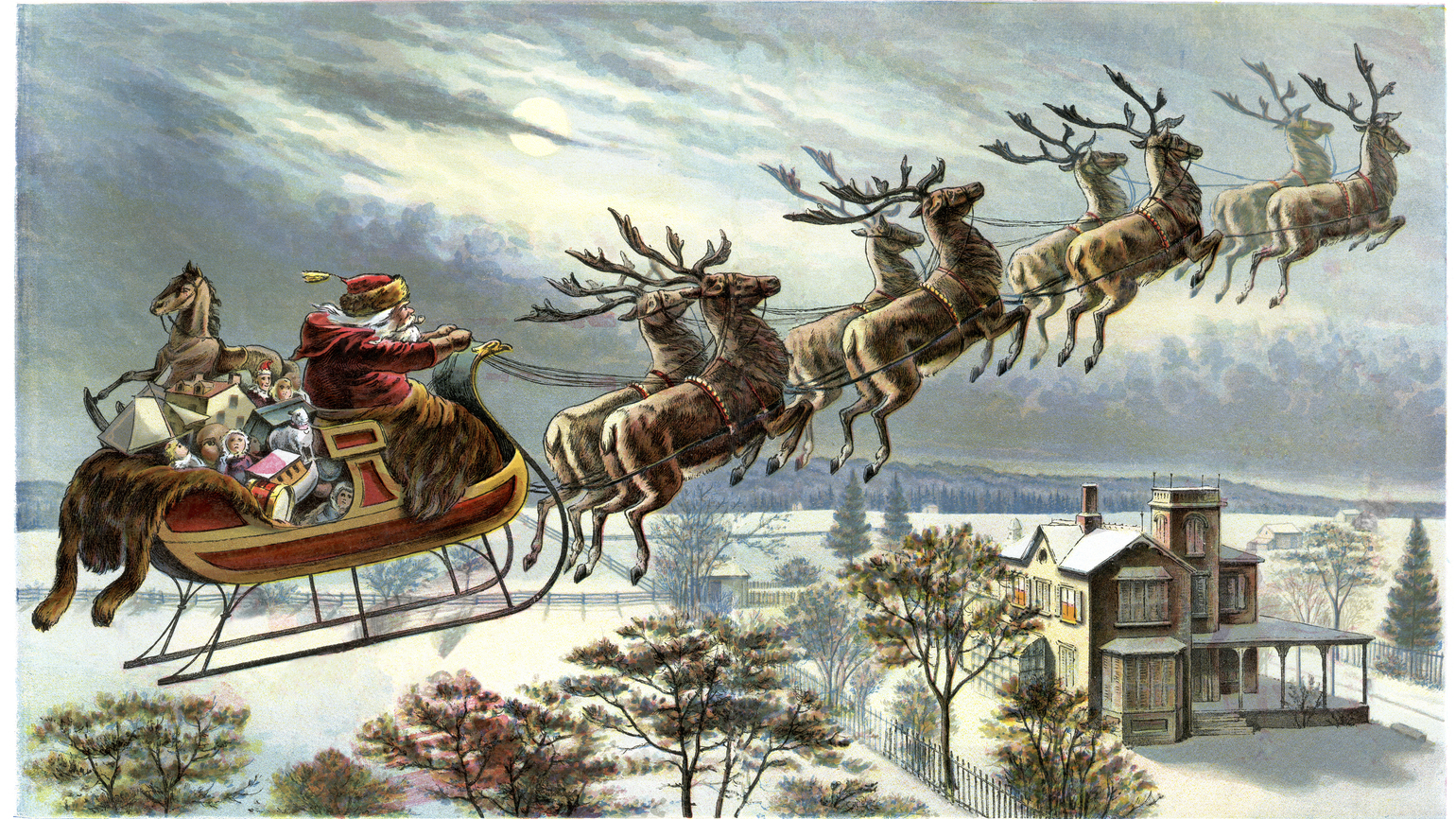
In 1863, this Santa Claus finally had an image to go along with it. Cartoonist Thomas Nast published his drawing of Santa Claus on the cover of Harper’s Weekly. L Frank Baum, the author of The Wizard of Oz, added his own spin on Santa Claus in 1902 with his book, “The Life and Adventures of Santa Claus.” 

READ MORE: 8 Classic Christmas TV Specials We Love

Then in 1931, according to their website, the Coca-Cola company hired artist Haddon Sundblum to paint a picture of Santa Claus for a Christmas advertisement. This smiling Santa Claus, with his red suit, rosy cheeks and a white beard, became so popular, it is the Santa most of us picture today.  

Portrait of Santa Claus in front of a Christmas tree wondering does Santa Claus belong in Christmas

Does Santa Claus Belong in Christmas? 

But if our modern idea of Santa Claus is partially based on a soda advertisement, does he really belong in Christmas celebrations? Despite the commercialization of this figure, he is still based on Saint Nicholas, a real man of faith and generosity.  

“Gift-giving, stockings hung by the chimney with care, Santa coming down the chimney, the joy of seeing your kids and grandkids unwrap a toy under that well-lit tree,” said Guideposts contributor Rick Hamlin. “They all feel connected to Christ’s eternal message of love.” 

READ MORE: Why Santa Belongs in Christmas

‘The Streetlight Effect’ and Our Search for Truth

One dark night, a police officer came upon a man who was frantically searching for something under a streetlight. “What have you lost?” the officer asked the man. “My keys. I dropped them somewhere across the street,” responded the man as he crawled around and examined every inch. “So why are you searching here?” asked the police officer. “Well, this is where the light is,” came the man’s reply.

This story—or joke, depending on how it’s told—has taken many forms over many decades, dating back to the 1920s. In most versions, the searching man has had a bit to drink, which only highlights the folly of his searching for keys in a place they can’t possibly be. Today, “the streetlight effect” is often cited in science circles, when researchers are cautioned not to pursue their inquiries only in clear, visible areas of study, but to look to hidden, unexplored places for the truth.

A Journey of Faith In Article Ad - Avail Now

In other words, if we are serious about finding the true solution to any problem, we need to be prepared to look for it wherever it may be hiding.

This requires faith, an inherent belief that the keys—either literal keys as the story says, or the “keys” to our happiness or positive lifestyle—are there to be found, if only we’d look in the right spot.

It requires patience, the willingness to tolerate failure as we fumble in the dark in search of that familiar metallic jingle.

And it requires a positive outlook to fuel both your inner faith and abiding patience as you pursue your keys, your truth, your answers.

What are you searching for in your life? Are you sure you’re looking for it in the right place?