Embrace God's truth with our new book, The Lies that Bind

Positive Thinking at the Grocery Store

It’s been one of those minute-to-minute weeks–work and deadlines, the kicking-in of spring sports and activities for the kids (which means fine-tuned scheduling and toing and froing), last-minute inquiries and to-do’s. You know the drill. This week I have struggled to lift my head and look around.

One of my current least-favorite tasks is grocery shopping for our family of five. Maybe it’s the monotony of it, or that it’s yet one more thing on the to-do list.

The Daily Bible Large Print relaunch with digital free gift in article ad

Two days ago, I had a 45-minute window to tackle the grocery shopping and drive the 15 minutes back to our town to pick up our kids. Before I walked into the store, I chuckled to myself about my recent aversion to grocery shopping. I mean, how painful is it really?

Then in the store, I ran into four women, all of whom were in our lives when our two girls were in nursery and elementary school in our former town.

Each one sweetly inquired about our children and our lives. Each offered kindnesses. One mentioned that she was buying ingredients for a church supper she and her husband would be preparing that night. “We are too blessed not to give back,” she said.

My unexpected encounter with these old friends reminded me of the value of connections to others, of  positive thinking and of making a mark on the world.

My grandfather, Norman Vincent Peale, spoke often of how we have a choice in how we feel, how we conduct our lives, how we make our mark on the world.

READ MORE: POSITIVE THOUGHTS FROM NORMAN VINCENT PEALE

Some people have a big platform, as my grandfather and the late Dr. Robert Schuller did by preaching and speaking about positive thinking and self-belief. Some donate to organizations, like the Guideposts Foundation, in order to help others through outreach efforts. And some, simply yet powerfully, share their kindness, thoughtfulness and gratitude in their daily interactions.

Every day we all have the choiceor I should say, the opportunityto positively impact the lives of others though our interactions and contributions to our world, big or small or both.

When I left the grocery store that day, it wasn’t only my cart that was full. I felt fulfilled. Now I’ll remember to lift my head, to look around, to take in and appreciate what’s around me (and who) despite the busyness of my schedule and length of my to-do list.

That will put me in a better place and in a better position to positively impact a life or two along the way.

Positive Thinking at Christmas

My memories of Christmas around the turn of the century in the town of Lynchburg, Ohio, are still crystal clear. My father used to boost me up so I could crank my grandmother’s doorbell, and everybody inside came running. I can smell the warm tallow of lighted candles on the tree and the aroma of homemade candy bubbling in a pot on the wood stove. It was a thrill to wake up and find an orange in my stocking, and I’ll never forget how excited I was the year I got a banana! We were a country preacher’s family, and we were poor. But we had a mighty good time.

One year my brother Bob and I dreamed of getting a bicycle. For months we haunted the stores looking at wheels and argued long about the color. At last we agreed: It had to be red.

Faithful Paws and Purrs In Article Ad

Christmas morning we crept downstairs. There were small gifts under the tree—but no bicycle. Then Mother said to us, “Let’s go down to the railroad station. Maybe Santa Claus forgot something, and perhaps it will come on the morning train.”

So down we went to the old B&O station to meet the train. The door of the baggage car rolled open, and there it was—a bicycle with a light on the front. It was secondhand, and we boys had to share it, but it was ours and it was red! Later I learned that Mother had made her threadbare coat last yet another season so we might have our dreamed-of bicycle.

When I was seven or so, we lived in Cincinnati, close to the tracks where the streetcars screeched around corners. A special car came along to grease the rails, and we children, I’m sorry to say, made fun of the grimy old guy who ran it. “Greasy Dick,” we shouted when he came by. “Hey, Greasy Dick!”

One day right before Christmas my father asked me to come along on one of his hospital calls. “Someone you will recognize isn’t feeling well,” he said. Propped up in a bed was Greasy Dick! My father introduced him by his real name, just as he would the finest gentleman, and when he shook my hand, it didn’t feel greasy at all. “I hope you grow up to be a fine man like your father,” he exclaimed. My father gave a prayer and patted his shoulder. When we left, my father said, “Remember, Norman, he’s not Greasy Dick; he’s a friend of ours. And he’s a child of God.”

As I grew up, I came to appreciate what a precious gift Dad had given to me. He’d taught me to look for the good in people, always. It was a Christmas present that affected my whole life, and one I’ve always prayed I might pass on to others.

When I became a pastor myself, I started out as the minister of a small church in Brooklyn; and since I was single, the ladies were always feeding me. One Christmas Eve I went to the home of some church members for dinner. On the door of the house across the street were a pair of wreaths—a traditional Christmas wreath and a somber funeral wreath. I had a feeling I should see if I could help, but I didn’t want to go anywhere if I wasn’t wanted, so I hesitated before deciding what to do. Finally I went and knocked, and when a man came to the door, I explained who I was. The man had tears in his eyes. “Come in,” he said.

Inside the front room was a casket containing the body of a girl who couldn’t have been older than four. “My wife is upstairs with our son,” the man said. “Please go and talk to her.” I went with trepidation. What could I do? What could I say? I was just a new, young minister and hadn’t had much experience with family tragedies.

Upstairs I found a lovely woman and a boy. As I fumbled around for what to say the woman spoke up. “God gave us our little girl,” she said, “and then took her home.”

She went on to tell me that God understood her grief because he had lost his son. We prayed together, and later on, that family became members of my church. I’d gone in anxious and unsure about how to comfort them, and they’d ended up comforting me. Ever since, I’ve been amazed by the ways in which we interact to help and heal one another.

Once, a young lady from Switzerland, Ursula, lived with our family in New York City. As Christmas approached she wondered what she could give us in gratitude.

She went to a children’s shop, bought a beautiful baby dress and had it gift wrapped. Then she approached one of the Salvation Army people on a corner. “Sir,” she said, “I have a dress for a poor baby. Do you know of one?”

“More than one, I am afraid,” he said.

Together they hailed a cab and the Salvation Army man gave an address uptown. When the taxi pulled up in front of a rundown tenement, the Salvation Army officer took in the package. “Say it is from someone who has been blessed and wants to pass those blessings on,” Ursula told him.

When the cab driver finally delivered Ursula back to our home, he told her there was no charge. “Don’t worry,” he said. “I’ve been more than paid for this.” Ursula told us about her present on Christmas morning. It was one of the nicest we ever got.

Start each day with encouragement for your soul. Order Mornings with Jesus 2019

After our three children grew up and had families of their own, there came a time when my wife, Ruth, and I found ourselves in London for the holidays. We were determined to have a Charles Dickens adventure. On Christmas Eve we had a hearty dinner and then went walking, our footsteps echoing in the deserted streets. It was gloomy going, and just about the time it seemed our Christmas spirits might never get off the ground, we heard singing from far away.

As we walked along, the sound of trumpeting brass and the chorus of jubilant voices got louder and louder. “O Come, All Ye Faithful!” “It Came Upon the Midnight Clear!” We heard them all. As we neared Trafalgar Square, we could see it was packed with thousands of people. A Salvation Army band was playing on a platform. It was bitter cold, but those people were having the time of their lives, singing “Joy to the World” at the top of their lungs.

There we were, so many miles from home, and yet right at home because of the spirit that surrounded us. We felt the same way years later when we took all our children and grandchildren on a trip to Africa, and sat outside our tent under glittering stars as we read the story of the nativity from the Bible.

There’s a story that appeared in Guideposts magazine that’s always meant a lot to Ruth and me. The story was about an African boy who gave his missionary teacher an unusually beautiful seashell as a Christmas gift. The boy had walked a great distance, over rough terrain, to the only place on the coast where these particular shells could be found.

The teacher was touched. “You’ve traveled so far to bring me such a wonderful present,” she said. The boy looked puzzled, then his eyes widened with excitement. “Oh, teacher,” he explained, “long walk part of gift.”

Sure, there have been plenty of times over the years when all the pre-holiday shopping and sermon writing and schedule arranging seemed to be too much, and my wife, Ruth, and I have been tempted to throw up our hands and say, “It’s just not worth the effort!” But then we’ve looked at each other and said, “Long walk part of gift.” And we’ve laughed and gotten back to work.

These stories are part of a golden thread that weaves us all together, strengthening us for the years ahead. Christmas is the ongoing affirmation of the greatest ideals and truth that anybody ever came up with. People feel reborn, invigorated, whole. Over and over, through the ages it goes.

Backward glances don’t make me nostalgic and sad—not at all. They give me a burst of excitement for going forward. And they add to the richness of celebrating Christmas now.

Read more stories about positive thinking!

Positive Thinker, Lifelong Learner

Update: Ochs went back to Fort Hays State University and completed a master’s degree in liberal studies.

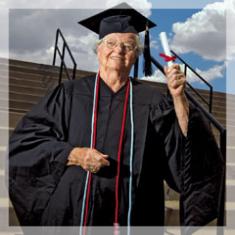
Talk about continuing education. Kansas great-grandmother Nola Ochs, the world’s oldest college graduate at age 95, is now pursuing a master’s degree.

GP In Article Desktop

Marriage and raising four boys on a farm kept her busy until the 1970s, when her husband, Vernon, passed away, and her youngest left the nest. “I wanted to get off the farm and do something for pleasure,” says Nola. So she took tennis lessons. Then a series of agribusiness marketing courses because, she says, “My boys were running the farm but we didn’t know how to market.” Her appetite for learning whetted, she signed up for whatever courses sounded interesting—including geography, genealogy, composition. “They will judge my generation by what we write, so I wanted to write well,” Nola reasons.

She discovered a real passion for history, a zeal enjoyed by her professors and fellow students at Fort Hays State University, who got to hear Nola’s firsthand experiences of events they’d only read about. She told the story of her family riding their team of horses into town. Nola, then just a young girl, was sure her father was going to leave for World War I (he didn’t) and wondered how her mother would be able to get the wagon back home. She told the class about cattle drives, the storms of the Dust Bowl in the 1930s, the radio announcement of the attack on Pearl Harbor, about how her father’s farmer status kept him out of World War II as well.

To cut down on travel to and from class, Nola moved off the farm and got an apartment on campus, furnishing it with a computer. Not one to shy away from new technology, she took a class, of course, on how to use it.

“My oldest son was skeptical, but when he saw how many friends I had he didn’t worry for long,” says Nola. Faculty and students were friendly and welcoming. Among her closest study buddies? Her 21-year-old granddaughter Alexandra, who graduated with her last May.

Life for the senior citizen college grad has been anything but mellow: a celebratory cruise, responding to well-wishers from all over the world, an appearance on The Tonight Show.

“Overall my enthusiasm comes from believing that what I do is helping the college and helping our state,” says Nola. “Just knowing that I am encouraging people, that’s what gives me all my energy.”

Nola’s Tips
Set a date to begin. We talk about things but we don’t do them.

Let people help you. They really do want to help!

Search your inner being for what you like to do. Everyone has something that they didn’t think there was time for. But it’s possible if you begin.

Positive Thinker: Jeremy Lin, Professional Basketball Player

One detail about you that people would find surprising I’m not nearly as humble as other people have portrayed me to be. I’ve always tried to cut away at this image of me as being a super humble guy. In reality, I am fighting pride a lot, every day, all the time.

Favorite Bible verse Joshua 1:9 has helped me in tough times: “Have I not commanded you? Be strong and courageous. Do not be afraid; do not be discouraged, for the Lord your God will be with you wherever you go.”

Rejoice in All Things in article ad

Best advice you’ve ever gotten From my mom: “Do your best and trust God with the rest.” I can be anxious and want to control things.

One thing you do for your spiritual well-being I sabbath once a week. For 24 hours a week, I don’t do any work to rest myself emotionally and physically. I also try to be intentional about blocking off time with God at least once a day.

Real-life hero My older brother, Josh. In many ways, he taught me, modeled for me and challenged me on how to be a man—not in the way that society defines it—but to love God, to love others, to be humble and selfless and to serve even when you’re in leadership.

Go-to place to pray Usually somewhere quiet or outdoors. I really like going into my backyard or going into the garage, somewhere no one else is.

Occupation you would pursue if not your current one Some type of philanthropy. Philanthropy and giving back have always been near and dear to my heart.

The hardest thing you’ve ever done Trying to go through fame and “Linsanity” and all these changes with the people I love. One of the things I’m proud of is continuing to stand by the people I love the most.

Early riser or night owl? I am definitely a night owl.

Favorite comfort food Burgers or ice cream or pizza!

Song at the top of your playlist Right now it’s “Way Maker” by Nigerian gospel singer Sinach.

You were an undrafted player whom the New York Knicks played sparingly. In 2012, they promoted you to the starting lineup and you led the team to a seven-game winning streak, one night scoring 38 points on Kobe Bryant and the Los Angeles Lakers, which started a cultural phenomenon known as “Linsanity.” After looking at the documentary 38 at the Garden, which features this period in your life, what do you hope viewers take away from it? I hope viewers take away a sense of self-reflection about where we are as a society and ask ourselves how we can do more to make a better world for the next generation.

Do you have a favorite moment in 38 at the Garden? All the interviews are great, but I especially love the interviews with Hasan Minhaj, Ronnie Chieng and Jenny Yang. They did an amazing job being insightful and funny. I loved how Hasan described the Toronto game and the wave-off. [Editor’s note: This was the game on February 14, 2012, when Jeremy, waves off his own teammate and the expected pick-and-roll play to take the final three-point shot and win the game himself.] He described it so eloquently.

What went through your mind as you were watching 38 at the Garden? A sense of appreciation and gratitude. I was really proud of having been a part of the “Linsanity” experience and to be in a place where I can retell it and people still care about it. I almost break down in tears thinking about the last part of the movie. It was a roller coaster of emotions between nostalgia, tremendous joy, laughter and sadness.

For more inspiring stories, subscribe to Guideposts magazine.

Positive Thinker: Dr. Willie Jolley, Motivational Speaker, Radio Host, Author

The hardest thing you’ve ever done Eulogize my mother; my brother, who was my only sibling; and my father-in-law, who was my personal pastor and mentor, all within 30 days in 2003. My mom died on April 11, and my brother and father-in-law died on the same day, May 6. I had to funeralize and eulogize them all. Without question, the hardest thing I have had to do.

Best advice you’ve ever gotten Advice from my mother: “When you don’t know what to do and are a crossroad, pray for wisdom!” I have learned that she was absolutely right. Godly wisdom is the power you are blessed with to get the right answer as to what you should do when you do not know what to do.

You Got This In Article Ad

Real-life hero Wow! I have so many real-life heroes that it is hard to pick just one person. My greatest hero is easy: He is a carpenter from Galilee who changed the world by his mission and message. His name is Jesus. Another hero would be Dr. Martin Luther King Jr., who lived out the principles of Jesus, to turn the other cheek and to share the power of love even when he knew it could cost him his life. Few people are really willing turn the other cheek and love people who are hateful to them.

In terms of the living, I have been blessed for almost two decades to have some of the greatest people on the planet on my SiriusXM show. Coach Tony Dungy, Bill Marriott, CBS sportscaster James Brown, T. D. Jakes, Gladys Knight, Bishop Marvin Winans, John Maxwell, Les Brown, Pastor Wintley Phipps, Wally “Famous” Amos, radio host Delilah.

All my guests share intimate details of the struggles they had and the great obstacles they had to overcome in order to achieve their goals. If I had pick one living real-life hero, I would have to say Les Brown, because of his willingness to give to others without expecting anything in return. I have seen him give and give and give—and have been the recipient of his giving spirit, by all the times he has talked about me in his speeches.

Song at the top of your playlist “Because He Lives.” I love that song! It was the song I sang at The Crystal Cathedral the first time I spoke there because it always blesses me. Another is “Lord, You’re Holy,” by Christian Sonic at the Family Worship Center, which was sent to me by a prayer partner, and I listen to it daily and praise Him each and every time!

Favorite Bible verse Psalm 34. “I will bless the Lord at all times: his praise shall continually be in my mouth….”

Occupation you would pursue if not your current one No such thing! I am doing what I love to do and what I was made to do. I believe “when you live your making, you will make a living and make a difference!” I cannot imagine doing anything but what I am doing or have done in preparation for what I am doing.

One thing you do daily for your spiritual well-being Ride my bicycle! And one of my greatest joys is to ride to Rock Creek Park in Washington, D.C., and sit by the water and read my favorite Scriptures! Awesome!!!

One question you wish an interviewer would ask “What was your biggest mistake?” And the answer is not listening to my mother as a teenager and thinking I knew more than she knew. Big mistake!

Go-to place to pray As stated earlier, Rock Creek Park by the water.

Early riser or night owl? I used to be a night owl when I was in the entertainment business, but once I decided to pursue the goal of becoming a positive messenger via speaking, writing and media, I changed my life and started going to bed earlier and waking up earlier.

Favorite comfort food Asian food—Chinese, Japanese (sushi) and Thai.

One detail about you that people would find surprising Around the house, I am very quiet. People ask my son, “What is it like when you are at home with your dad? Your dad must be talking to you all the time, huh?” And his response is, “Nope! Around the house he is very quiet.” His mom is the big talker around the house!

For more inspiring stories, subscribe to Guideposts magazine.

Positive Reading List: ‘Rethinking Positive Thinking’

If you’re reading this post in a blog called “A Positive Path,” you are probably persuaded by the idea that positive thinking benefits us in ways ranging from physical health to relationship and career success. But if you’re like me, you endeavor to do your positive thinking in the real world—the world that often confronts us with obstacles and challenges.

I recently read Rethinking Positive Thinking: Inside the New Science of Motivation, the 2014 book by the psychologist Gabriele Oettingen, and her research points toward a truth that makes perfect sense to me. Positive fantasies—imagining and visualizing the outcomes we want to achieve in life—are important, and they feel good. But it’s only when we pair those fantasies with reality-based assessment of the obstacles we face that we become motivated to take action and, ultimately, achieve our goals.

You Got This In Article Ad

In experiment after experiment over decades at New York University and the University of Hamburg, Oettingen’s research shows that those who indulge in positive fantasy alone don’t actually get much done. Neither to those who dwell on the possible negative outcomes they could encounter. Those who are the most motivated, successful and happy are those who travel a middle road that at times veers toward the positive, and at times considers life’s obstacles.

Rethinking Positive Thinking chronicles Oettingen’s research, and offers a practical technique readers can use to apply her findings to their lives. Technically, it’s called “mental contrasting,” but its far more fun name is WOOP, which stands for Wish, Outcome, Obstacle and Plan. Here’s a brief description of how to do WOOP on paper:

“On a blank sheet of paper, name the wish in three to six words. Identify the best outcome (also in three to six words) and write it down. Now let your thoughts lead your pen, taking as much paper as you need. Then name your obstacle, again letting your thoughts wander and lead your writing. To create a plan, first write down one specific action you can take to overcome the obstacle. Write down the time and place when you believe the obstacle will arise. Then write down the if-then plan: ‘If obstacle x occurs (when and where), then I will perform behavior y.’” Repeat it once to yourself out loud.”

Can WOOP help your life? How do you balance positive thinking with realistic consideration of your challenges? 

Positive Quotes for Positive Thinking

Inspirational quotes. I love them, don’t you? They’re a quick hit of positivity, a perfect pick-me-up on a busy day … which is every day, now that the holidays are here.

When I don’t have time to sit down and savor a full-length inspiring story, I turn to the quote of the day on our homepage or to The Up Side in Guideposts magazine, where we feature current quotes from positive thinkers.

You Got This In Article Ad

I love handmade things too, and while I was searching for gifts for the people on my holiday list, I came across some inspired interpretations of inspirational quotes by artists and crafters. I really like the idea of putting a favorite quote someplace where you can see it—and be inspired by it—on a daily basis.

Check ’em out. It’s probably too late to get these in time for Christmas or Hanukkah, but they would make a lovely gift for a friend (or for yourself) in the new year.

“Yours is the earth and everything in it.” This verse from Psalm 89 is the inspiration behind Yours is the Earth, a new line of products by artists and foodies Allie Peach and Jamie Wyckoff. The calligraphy and the plummy color in this print are just delicious.


“Be not afraid of going slowly, be afraid only of standing still.” From the Etsy shop Of the Fountain, whose owner, Brandy, makes hand-stamped leather tags. The quotes she uses are travel-related (since the tags are meant for bags), but they apply to spiritual journeys too. Wouldn’t this be an excellent reminder to stick with a New Year’s resolution? (Might have to get this tag for my gym bag.)


“You are loved.” A simple yet powerful message. Artist and optimist (how great that she calls herself that!) Shanna Murray’s illustrated decals are just what she says: “happiness for your walls.”

Happiness to you and yours this Christmas! See you in 2012.

Positive Playlist: What a Wonderful World

The glorious spring weather this week has had me humming “What a Wonderful World” on my walks to and from work. The aging Louis Armstrong made the song famous, singing in his gravelly voice, “I see skies of blue … clouds of white … the bright blessed day … the dark sacred night …”

Music is one of the best mood-lifters around, an extremely effective way to restore or reinforce a positive attitude. And “What a Wonderful World” is one of those songs I always find uplifting, even the slightly melancholy versions that have been released recently. To me, it’s the lyrics—they’re down to earth yet they’re also sentimental and spiritual, touching on a world greater than our individual selves, a future brighter for our children and grandchildren.

The Daily Bible Large Print relaunch with digital free gift in article ad

I did a little online research today and discovered that the idealistic, optimistic message was very much the intent of songwriters Bob Thiele and George David Weiss. The song was released in the fall of 1968, a year that saw America torn by racial and political conflict. A presidential election with bitter campaign fights. The height of protests against the war in Vietnam. The assassinations of two leaders committed to civil rights, Martin Luther King and Robert F. Kennedy. Riots that erupted in more than 100 cities after the killing of Dr. King.

Thiele and Weiss hoped that their song, performed by the grandfatherly 66-year-old Armstrong, whose popularity transcended race, would help heal a divided nation and remind the American people of what they had in common.

Forty-four years later, our country has changed for the better. But there are still bitter political divisions. A long and costly war. Racially charged tension after a tragic and senseless shooting. You might ask, have we changed enough? Is this such a wonderful world?

I think Louis Armstrong put it well in his intro to a performance in 1970 (check out the first video below), “Some of you young folks been saying to me, ‘Hey Pops, what you mean a wonderful world? How about all them wars all over the place? You call them wonderful? And how about hunger and pollution? … Well, how about listening to old Pops for a minute? Seems to me, it ain’t the world that’s so bad but what we’re doing to it. And all I’m saying is, see what a wonderful world it would be if only we’d give it a chance. Love, baby, love. That’s the secret, yeah. If lots more of us loved each other, we’d solve lots more problems.”

I’ll leave you with a few different takes on Louis Armstrong’s optimistic classic. Here’s to the wonderful world Pops was celebrating in words and song.

Louis Armstrong: Here’s the 1970 version with the spoken intro I mentioned.

Positive Change: A Sense of Direction

It was the mother of all hills, a steep grade slathered in slick mud.

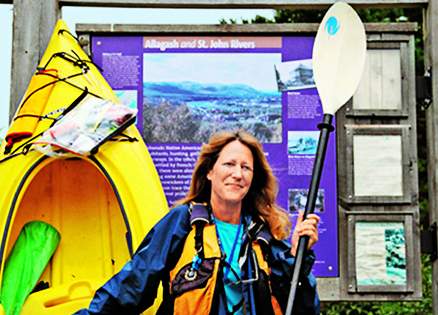
I couldn’t see any way around it—just the rocky river to the left of me and the thick forest to the right. One big obstacle before the next campsite at the Sheldon Springs Dam. “We can do this, Sparky,” I said to my lone companion, the 35-pound, nine-foot yellow plastic kayak I wheeled in front of me.

Witnessing Heaven In Article Ad 827x123

For 23 days, I’d been traveling the Northern Forest Canoe Trail—a winding 740-mile expedition over rivers, streams, lakes, ponds and portages first navigated by Native Americans and early settlers. I had more than 500 miles to go, and I wasn’t going to let a hill stop me.

I set Sparky down, tightened the straps on my backpack and began to climb. My feet slipped from under me. “Whoa!” I shouted. Slap! Face first in the mud. I pulled myself up and slipped and slid my way to the top.

I put down my backpack full of freeze-dried food and my bag of cooking supplies and skidded downhill. My tent and sleeping bag were next. I got them all the way to the top too. Now it was time for Sparky. I got behind the kayak and pushed. The wheels inched up the hill. Then… “Whoa!” Slap! Another face plant in the muck. Sparky tumbled down, nearly running over me. I tried a second time. And a third. But my shoes were too caked with mud. Sparky was stuck, and so was I. God, I thought, how can I do this alone?

That was a question I’d asked myself often over the past year. Up until then, my life had been like this trail. I’d hit some rapids and the occasional storm, but always moved forward. Then approaching my 50th birthday, I got stuck. First, both my children left the nest. Then my husband and I divorced after almost 30 years of marriage. But the biggest wallop came when the learning center where I’d worked for 10 years announced layoffs. I lost my job as a graphic designer and photography instructor. Wife, mother, artist, teacher—everything I’d defined myself by, gone all at once. I’d never felt so lost.

This trip was my sister Beth’s idea. She knew I was feeling down, and she called me one afternoon. “I read this article,” she said. “This guy, Mike, from New Jersey paddled the Northern Forest Canoe Trail all by himself. No woman’s ever done that. You could be the first.”

Sure, Beth and I had learned to swim and paddle in the reservoir behind our house when we were kids. I’d logged many hours with my paddling buddies running rapids. But paddle from New York to Maine, solo? Was Beth crazy? Then again, I needed to prove to myself that I could make it living on my own. Maybe this journey could do that.

I asked around. People said I needed a better kayak than Sparky—“an ex­pedition craft rated for Class IV rapids at least”—and a partner to help carry the 75 pounds of food and camping gear. But I contacted Mike from New Jersey, and he told me, “Go for it!” I could pack a transponder that would automatically send my location to a website where my family and friends could track my progress and a cell phone in case I got into trouble. I planned my trip for months, and in mid-June Beth and her husband drove me to the trailhead in Old Forge, New York.

The first two weeks, the biggest challenge was the weather. One evening, a freak thunderstorm forced me to paddle to shore and make camp at night in the middle of the woods. I set up my tent next to a large rock, hoping it would shield me somewhat, climbed inside and wrapped myself tight in my sleeping bag just as the sky opened up. Would a flash flood sweep me away? Would some large, hungry creature stumble upon me? Would the howling wind tear open my nylon tent? I was too scared to sleep.

It was nearly sunrise when the wind and rain subsided. I unzipped my tent and cautiously ventured out to make a cup of coffee. Another night like that and I’ll never make it to the end of the trail.

Then the sun broke over the horizon. The clear sky turned an awesome shade of purple and pink, illuminating the mist rising off the water and the mountains beyond. The sight was like a message, saying, You’re not alone, Cathy.

Now I sat down on top of Sparky, exhausted, wondering if I’d completely misread that glorious sunrise. No glory here, just utter defeat. Mosquitoes dive-bombed me. The sun was baking hot. And I was stuck in the mud. I started to cry. God, tell me what I’m supposed to do. Please.

Two words came to me. Get help.

Help? Out here? I hadn’t seen another soul all day. I got out my map. Closest town was East Highgate, Vermont, three miles away through the woods. What choice did I have? I chained Sparky to a tree, stashed my gear behind some trees and headed into the woods.

About an hour later, sweaty, caked in mud, I finally reached the East Highgate General Store. The first woman I talked to handed me the Yellow Pages. As if there was a section for kayak towing! I went up to the cashier, an older woman, and poured my heart out about my situation. She can’t do anything either, I thought. I really am alone out here. As alone as everywhere else.

Just then, the front door jangled. A strapping young man in a muscle shirt and cutoffs walked in. “Cody,” the cashier called to him, “can you help this lady out?”

“Sure,” Cody said, shooting me a friendly smile. “What’s the problem?”

I explained and he drove me in his truck back to where I’d emerged from the woods. Two men on ATVs were sitting there. My muddy clothes and paddling jacket gave me away. “You must be the lady who left the kayak by the hill,” one of them said. “Need a tow?”

I hopped on the back of one of the ATVs. We were off. “Whoa…shouldn’t you slow down?” I shouted over the engine.

“Can’t, we’ll get stuck in the mud!” the man yelled. I held on for dear life.

We reached the bottom of the hill and hooked the kayak up to the back of the ATV. The guy hit the gas, and Sparky’s wheels popped out of the mud. All the way up the hill, I watched eagle-eyed as the kayak bumped along behind us. I prayed the wheels wouldn’t fall off. Finally we reached the top. I scarcely had time to thank the men before they zoomed away.

Cody helped load Sparky and the rest of my things into the back of his truck. On our way to the Sheldon Springs Dam, I thought about how lucky I’d been to find a kind stranger with a truck and two more angels on ATVs to boot. “Thank you so much,” I said as we pulled to a stop.

“Not a problem,” Cody said. “Glad I could help. Good luck with the rest of the trail.”

The rest of the trail, more than 500 miles, people like Cody and those ATVers kept popping up. There were the bed-and-breakfast owners near the Canadian border crossing who met
me at a campsite and took me into town for a fried chicken dinner. There was the French-Canadian couple in Mansonville, Quebec, who spotted me limping past their house and invited me to stay and take a shower—a relief after days of low water and long portages. Or the time I thought I was lost, and a phone call to Mike from New Jersey put me on the right path again. On a portage trail in Maine, I found a package of wet wipes hanging from a birch tree with a note: “C. Mumford we love you!”—a gift left by my sister Beth. She knew my supplies were running low.

Then there were the other kinds of help—the bald eagle that flew in to visit me after a tough paddle on Umbagog Lake. The moose that gave me a wake-up call on the shores of the Penobscot. The breathtaking views that inspired me every day.

A small group was waiting on the beach at Ft. Kent, Maine, at the end of the trail. I paddled in to shore to the sound of cheers. I did it! The first woman to travel the Northern Forest Canoe Trail on her own.

Now, back home in New Jersey, I kayak every weekend I can. I’ve been freelancing as a graphic artist and teaching photography again, but most of all, I’ve been looking for chances to help other women who may think they’re alone out there. I know that’s not true. It took me 740 miles and 58 days to see it, but there’s always someone you can count on to help you through the rapids and the storms, the steep climbs, the long portages—wherever life’s trail takes you.   

See a slide show of photos from Cathy’s trip!

Download your FREE ebook, True Inspirational Stories: 9 Real Life Stories of Hope & Faith

Positive as Pie

My friend Suzanne, a nutrition professor at the University of Alabama, keeps me up with the trendiest restaurants in the state, but I was surprised when she told me about a new place in Greensboro called PieLab.

“PieLab?” I asked. “What’s that supposed to mean? And why Greensboro?” My daddy’s family came from Greensboro, population 2,700. We’d visited the town on Decoration Day back when I was a kid.

Light for Life NASB Study Bible in Article

“It’s supposed to be a creative destination, ‘an idea incubator,’ they call it,” Suzanne said, “a place that brings people together over a slice of pie.”

“Okay,” I said, not quite understanding. But I kept hearing about PieLab, how the idea germinated in an economically depressed Maine town where a group of young graphic designers sponsored a pie day, held on the internationally celebrated Pi Day, March 14 (or 3-14, which is pi rounded off to the nearest hundredth—get it?). Free slices of pie brought residents together to look for positive solutions to the town’s problems. People had the same hope that a nonprofit like PieLab would help the depressed economy of Greensboro.

The restaurant was even rated “one of the top 10 places for pie in America” by a national newspaper. I called my father. “Hey, Daddy, want to go to Greensboro for some pie?”

“Sure,” he said. “Haven’t been there in a long while.” On the hour-long drive, Daddy reminisced about Greensboro in the old days, how you’d see everyone in town on a Saturday trip to the general store, the barber’s and his cousin Norma’s diner. Folks stopped and talked. These days most people were hurrying into the big-box stores right off the highway.

We turned onto Main Street. It was mostly deserted…except for the cars parked in front of a white-brick café with floor-to-ceiling windows and PieLab in big letters over the door. Inside were long trestle tables and industrial chic lighting—not the old-fashioned pie shop I’d expected. The amazing aromas coming from the kitchen told me the pies were freshly baked. “They like to use whatever produce is in season,” Suzanne had said. “Farmers sell directly to them.” I glanced at the mouth-watering choices scrawled on the chalkboard: apple, chocolate pecan, coconut cream, lemon icebox, blueberry, buttermilk.

“Hi, I’m Deanna,” the lady at the cash register said. “What can I get y’all?”

Daddy and I settled on two slices of lemon icebox pie. Then he asked, “Do you remember Norma’s diner?”

“Of course!” Deanna replied. “Miss Norma was a real fixture in this town.”

I poured myself a Mason jar of sweet tea and a glass of lemonade for Daddy while he and Deanna swapped Norma stories. Then we sat down at one of the long tables next to two men. “I hope we’re not intruding,” I said.

“Not at all,” said one of them. “That’s what we do here. Meet people and talk.” He turned out to be a software developer and the other man owned a shop nearby. “Everybody comes here,” he continued, “folks from the catfish plant, farmers, students, people from other towns who want to know what the fuss is all about.”

“They’ve got special programs too,” the other man said. “Somebody put on ballroom dancing classes in the back room and after-school sessions for kids who want to take the GED.”
“So it’s not just about the food,” I said, savoring the lemony zest of my pie.

“There’s more to it than that. Main Street hasn’t been this busy since…”

“Since Norma’s diner closed down,” Daddy suggested.

PieLab, despite its name and industrial chic decor, wasn’t such a new idea after all. Put good food and people together. Let them linger and talk. If they get to trading ideas, all the better. I’d call that hospitality, right out of the Golden Rule. Cousin Norma would have understood perfectly.


Play To Win

There was a time in most of our lives when we had no fear—that feeling when we jumped from the jungle gym and slammed our little bodies to the ground.

Perhaps it was when we went on our first roller coaster, or when we were in high school or college and felt that there was nothing we couldn’t do.

God's Constant Presence In Article Ad

No goal was unattainable. We were an unstoppable force that would think of something and then make it happen.

Then, as time goes by, the world tells us more frequently that we can’t do what we want. The doubters laugh at our goals and try to persuade us from going after our dreams.

They say, “You’re crazy. It’s too hard. Why don’t you do this instead? You should play it safe.” They act as if dreams were meant for others but not people like us. They surround us with negative energy and try to instill their own fears and insecurities in us. We not only begin to know the word “fear,” we start to understand what it’s like to be fearful.

With so many people telling us we can’t do something and so few telling us we can, it’s hard not to let fear into our lives. Unfortunately this is how many of us go through life.

Whether you are 20 or 50, many of us become so scared of losing what we have that we don’t go after what we truly want. We play it safe and hold on so tight to the status quo that we never experience what could be. We believe the doubters and don’t take chances that will move us one step towards our dreams. I call this “playing to lose”.

We see this in sports all the time when a team has the lead. They start to think about how not to lose instead of how to win. They hold on so tight to their lead that they start playing safe and scared. You can see it in their energy and body language. As a result the other team takes chances, plays with no fear and eventually gains the momentum and wins.

To live a life filled with positive energy we must learn to repel the energy of fear. Whether it comes from within or from another person, we must overcome fear and adopt a “play to win” mindset.

Playing to win requires a commitment to yourself that even if you fail, you will never give up and never let your goals and dreams die. Those who play to win know that success is not given to us. It is pursued with all the energy and sweat we can muster.

Obstacles and struggles are part of life and only serve to make us appreciate our success. If everything came easy we wouldn’t know what it felt like to truly succeed.

Obstacles are meant to be overcome. Fear is meant to be conquered. Success is meant to be achieved. They are all part of the game of life and the people who succeed play to win and never give up until the game is over.

Download your FREE positive thinking ebook!

Plants, Like People, Sometimes Need Change

Two years ago, I wrote about a personal triumph—I had kept alive a sweet little kalanchoe house plant my aunt had brought me as a gift. 

But there was more to the story than what I shared in that blog. 

Light for Life NASB Study Bible in Article

Months after receiving the plant, it was surviving, but not thriving. It had grown “leggy,” with long, spindly branches that seemed like they were losing the battle with gravity as they spilled over the edge of the cheerful pot it occupied. And its last flowers were too long ago to remember.

A green-thumbed friend stopped by, and I lamented my long-delayed, but now-imminent failure with the plant. It had done so well for so long, I said. Was it now time to simply say goodbye? 

Not quite yet, she replied. Together, we launched into a major haircut for the kalanchoe, snipping off the long, twisting “legs” and carefully cutting around the strong, healthy growth. Some of the vine-like branches got trimmed so I could try to encourage them to put out new roots and set new branches.

Finally, after looking up the light needs of this plant, we decided to relocate it onto a spot in the kitchen where it could get more direct sunlight, especially during the winter months. 

The plant had an entirely new direction—literally, as I implemented a new plan to rotate it one-quarter turn at each watering. It looked different, it was receiving different care, and without those long trails tugging them away from their nutritious soil, I’d like to think it felt better too—refreshed, ready to start anew.

As for the tiny offshoots my friend and I had experimented with potting, some are taking hold of their new homes, while others don’t seem happy with their new leases on life. Regardless of the outcomes, I’m enjoying the idea that their journeys have just begun—time, patience and care is in their future.

The experience of relocating and rejuvenating the plant reminded me that every living thing has needs that shift and evolve with time. Just like the kalancoe, sometimes we all need more light, a new look and a new vantage point from which to observe the world around us. If we are flexible enough to recognize when we need a change, we will thrive. We might even flower.