

Memory of Hope: A Reunion of Long-Lost Friends
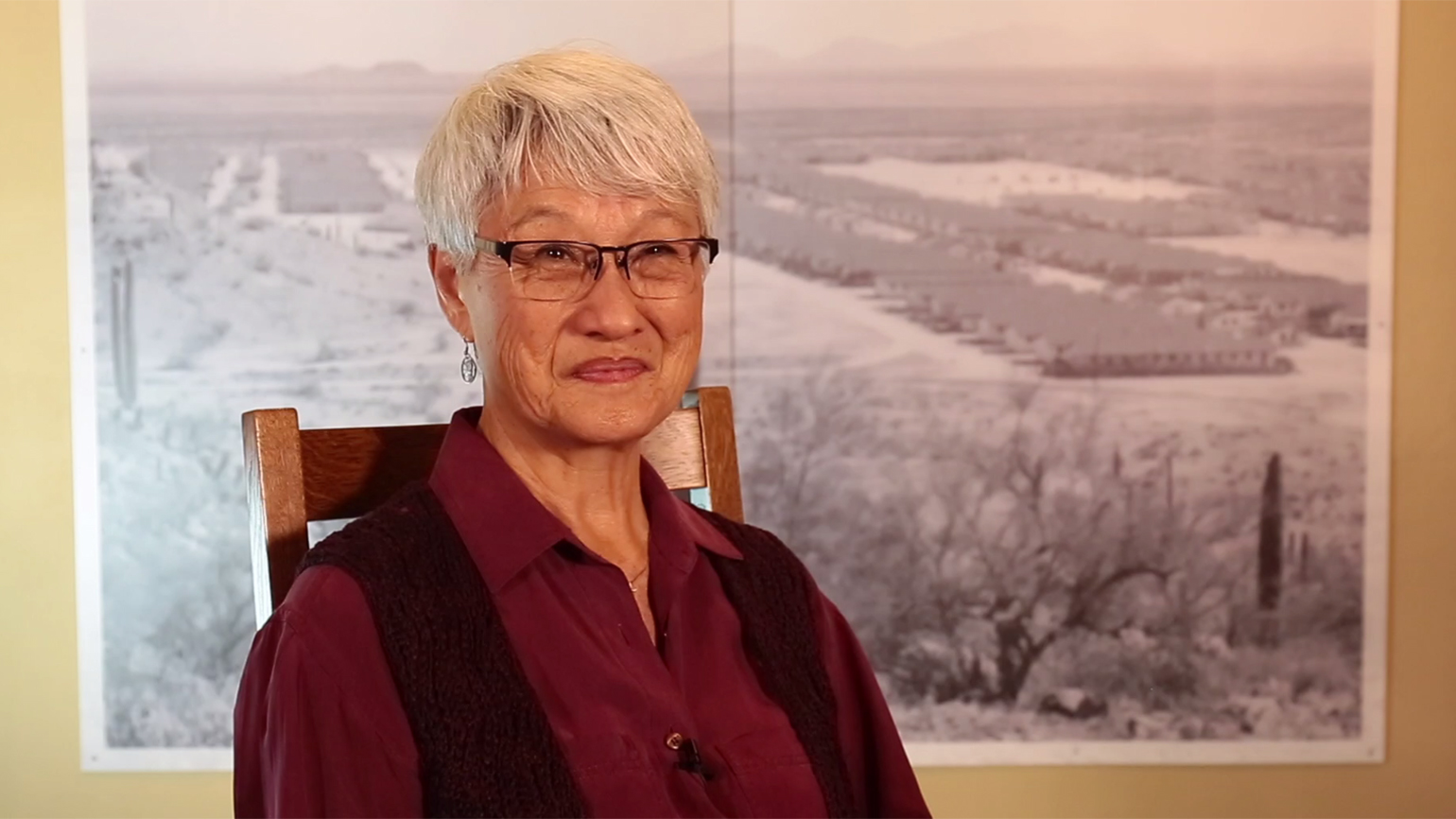
My name is Midori Hall; I live in Gilbert, Arizona. I was born in the Gila River Japanese Internment Camp in August of 1942.
I am at the Chandler Museum which featured people who were taken to the Gila River Japanese Internment Camp in 1942, and this is significant to me because my family was in camp there, and it was at one of the exhibits at the Chandler Museum where I met Tom Koseki, who was also interned in the Gila Camp, and he was seven years old when his family was taken there.

It was at the dedication of the Nozomi Park in January of 2017, where Tom spoke all about his memories of his experience at the camp. It was afterwards that I introduced myself to him. I told him that my family was in the Gila Camp, but also in the Canal Camp, and he said he was also there and that we were probably neighbors, and that’s where our friendship began.
In our discussion of memories, Tom leaned back in his wheelchair and said, “I’ll never forget those pomegranates,” and I looked at Tom and I said, “Tom! I have a pomegranate memory!” And so I told him the memory of seeing three boys coming from the desert, pushing a cart and some red fruit in it. There’s an older boy pushing the cart and two younger on either side of the cart, laughing and having such a great time.
And then Tom looked at me and he put his arms on my shoulders and said, “Midori, that was me and my two friends.”
The week after I met Tom and we share the pomegranate stories, I wanted to draw a picture of what I remembered, this picture that I’ve had in mind since I was about two years old. And so I’m not an artist, but I got a piece of paper and a pencil and I drew what I remembered seeing.
When I showed this picture to Tom, I asked him, I said, “Which boy do you think is you?” And he said, “That one, right there,” and I thought so too. When my husband took a picture of this—it was in a glass frame—there were two lights behind Tom and me, and when my husband took the picture, the reflection on my hand and on part of Tom’s picture was the shape of a heart, which was a reflection of the lights that were behind us.
The joy and the bond that we have developed is truly amazing. God had his hand in this whole story about the pomegranates and Tom and I meeting. There was such joy; it was a thrill. We cried and hugged.
For me, it was a confirmation that what I had in my mind all these years was a reality, and I believe that God had a plan for both Tom and me to meet after 72 years. I believe that I was meant to be there when these three boys were coming from the desert with this fruit. He had a plan, and the plan was, 72 years later, for us to meet.
And it was a closure. I didn’t know why I had this memory in my mind that was so vivid. There had to be a reason and it became a reality when Tom and I met. So Tom is my new friend that is actually my old friend. It just took us 72 years to meet.
Memories Are Erased but Love Remains

“I’m not married,” she said. Not married? Then who was I, standing at my wife Krickitt’s hospital bedside since our car accident, praying during the three weeks she’d spent in a coma?
“No, Krickitt, you are married,” the rehabilitation nurse said gently. She asked again, “Who is your husband?”

My wife stared blankly. “I told you. I’m not married.”
But we were! We’d said vows before God and family, “till death do us part.” This felt almost worse than death.
We’d met just a year earlier when I called to order jackets for the college baseball team I coached, the New Mexico Highlands University Cowboys, and a cheerful sales rep with an unusual name answered. I was smitten.
I called Krickitt “to follow up on my order.” Eventually she gave me her home number in Anaheim, California.
Krickitt was actually a nickname her great-aunt gave her at age two, back in Phoenix, Arizona, because she kept hopping around. She hopped her way to becoming an Academic All-American gymnast in college.
Maybe what attracted me most was Krickitt’s faith. She wasn’t just a Sunday morning Christian. She saw God’s plan in every aspect of her life.
She told me a knee injury her senior year of college was a sign for her to quit gymnastics and help poor communities in Hungary on a church mission trip. Every day, she recorded her thoughts about God in a prayer journal.
I was a Christian, but I’d never had her passion. It scared me a little, fascinated me even more. I began to understand. God had brought us together.
She flew out to meet me and we hugged at the airport like old friends. That night we talked until the sun came up about faith, our lives, our dreams. Krickitt gave me a gift—a Bible, with my name embossed on the cover in gold lettering.
“Have you ever read the Book of Job?” she asked, turning to the story. “Life isn’t fair. Everybody has times when they feel like God’s just not there. But he’s always there, bringing you closer to him.”
She read the passage, and warm waves rippled through my body, as if her faithwere flowing into me.
I visited California, met her family and friends, even her pastor. That June I proposed, and we married in September, a large ceremony at Scottsdale Bible Church in Arizona.
“I promise to love and respect you fully,” I vowed, “to devote myself to your every need and desire. I promise to be the man you fell in love with. Thank you, Jesus, for the blessing you have provided me.”
Krickitt was driving us to her parents’ house for Thanksgiving dinner that November when she swerved to avoid a slow-moving truck. Another truck hit us instead.
And now my wife had forgotten me. How did that fit into God’s plan? I stormed out of the recovery room and punched the wall. The pain barely registered. My heart hurt worse.
Krickitt’s neurophysiologist took me aside. “The injuries to the frontal lobe of Krickitt’s brain caused retrograde amnesia,” he explained. “She’s disoriented and seems to have lost memory of ever meeting, dating or marrying you. The effects could be permanent.”
I returned the next day with photos. These will jog her memory, I hoped.
There was no emotion looking at the photos. Only a dazed and empty stare. If she doesn’t know me, I thought, how can she love me?
Krickitt learned to walk again and worked with a speech therapist. I spent every day by her side. She didn’t seem to mind my presence. But when I tried to push her in physical therapy, giving in to my coaching instincts, Krickitt lost it.
“Why are you bossing me around?” she shouted. “Leave me alone! I don’t know you.”
Then one afternoon Krickitt made an entry in her prayer journal. “Therapy is very confusing. But I know that’s the way things are. And I know the Lord has me safe in his right pocket.”
Krickitt’s faith was still strong. Her brain was damaged, but maybe her faith lay somewhere deeper, a place that couldn’t be injured. Faith brought us together once. Could it do it again?
Krickitt moved back to her parents’ house in Phoenix while she completed outpatient therapy. Familiar surroundings were supposed to help her recover. Everyone agreed I should return home and resume coaching.
During the week she was in therapy. I flew in to see her and help with the rehab. Krickitt seemed healthier each time. She seemed to accept what everyone said—we actually were married. Still, the intimacy we’d shared was missing, that interlinking of two souls.
I longed to feel her embrace me the way she once did. With love.
Finally, Krickitt was deemed healthy enough to come back to our apartment. “She is very eager to return to her husband in New Mexico,” her progress report said. Did she really feel that way? I was ecstatic. My wife is coming home.
Yet Krickitt couldn’t recognize the furniture we’d picked out, the china patterns she’d spent weeks deciding on. Her vision was cloudy sometimes; she tired easily. Rarely a day passed without her accidentally breaking something or us arguing.
Krickitt got a part-time job as an exercise technician at a hospital fitness center, but I worried about her leaving the house and getting lost.
“Maybe you should have someone go with you to work,” I suggested.
“Stop treating me like a child!”
“Stop acting like one!”
My athletic director noticed how worn out I was, and suggested taking time off to see a therapist. I was incredulous. Krickitt was injured. Not me.
One afternoon I returned from work and Krickitt was standing in the kitchen, looking lost. I asked what was wrong. Krickitt broke down. “How did I do the wife thing? Did I cook for you? Make you lunch? I don’t know what to do!” What you did was love me, I wanted to yell.
I lay in bed beside Krickitt that night, wanting to hold her, but afraid to. I felt like I was sleeping next to a stranger. In the darkness, Krickitt’s words from what felt like long ago came to me.
“Everybody has times when they feel like God’s just not there. But he’s always there, bringing you closer to him.” Were Job’s difficulties as baffling as this? Lord, help me to accept what happened. Help us to move forward and lean on you.
I resigned as coach and before long got into therapy. “Why do you think Krickitt married you in the first place?” the therapist asked in my first session.
“Because of the way I treated her,” I said. “She helped me grow in my faith, and I looked up to her for that. I loved her for that more than anything.”
The therapist stared at me. Of course. Faith was the key to the bond between Krickitt and me that could not be destroyed. “Maybe you should start over, rebuild your relationship as before,” the therapist said. “Start from scratch.”
Krickitt and I went for long walks through town, shoe shopping, dress shopping, her favorite activities. We went out for pizza, bowled, took in a few ball games. All the things we did when we first courted.
One afternoon we went to Walmart, and like two teenagers, filled a bag of candy and ate it as we shopped. We had long talks again, about faith and the Bible. We prayed together again. We laughed more.
We stripped away everything except why we fell in love in the first place—our shared love of God, a love that can never be forgotten.
“I hope I’m proving why you liked me the first time around,” I said one night as we cuddled on the couch.
Krickitt turned to me. “I do know now,” she said. “I do.” She gave me a kiss. “I just wish I remembered our wedding.”
“We can make that happen again,” I said. So on Valentine’s Day 1996, two and a half years after the accident, I proposed to her again.
A few months later, Krickitt and I renewed our vows at a rustic country chapel in front of 30 of our closest friends and family. A much smaller affair than our first wedding. But more meaningful in many ways.
Our love had been tested in a way we could never have imagined. Yet memories are a record of the past. Like Job, we move closer to God by going forward, to a future with new memories.
We forged my old wedding ring together with a new one. In a way, we’d been reforged ourselves, into something greater, stronger than ever.
Download your FREE ebook, The Power of Hope: 7 Inspirational Stories of People Rediscovering Faith, Hope and Love
Memorial Day: A Time for Heroes
I leaned against an oak at the side of the road, wishing I were invisible, keeping my distance from my parents on their lawn chairs and my younger siblings scampering about.
I hoped none of my friends saw me there. God forbid they caught me waving one of the small American flags Mom bought at Ben Franklin for a dime. At 16, I was too old and definitely too cool for our small town’s Memorial Day parade.
I ought to be at the lake, I brooded. But, no, the all-day festivities were mandatory in my family.
READ MORE: 7 THINGS TO REMEMBER ON MEMORIAL DAY
A high school band marched by, the girl in sequins missing her baton as it tumbled from the sky. Firemen blasted sirens in their polished red trucks. The uniforms on the troop of World War II veterans looked too snug on more than one member.
“Here comes Mema,” my father shouted.
Five black convertibles lumbered down the boulevard. The mayor was in the first, handing out programs. I didn’t need to look at one. I knew my uncle Bud’s name was printed on it, as it had been every year since he was killed in Italy. Our family’s war hero.
And I knew that perched on the backseat of one of the cars, waving and smiling, was Mema, my grandmother. She had a corsage on her lapel and a sign in gold embossed letters on the car door: “Gold Star Mother.”
I hid behind the tree so I wouldn’t have to meet her gaze. It wasn’t because I didn’t love her or appreciate her. She’d taught me how to sew, to call a strike in baseball. She made great cinnamon rolls, which we always ate after the parade.
What embarrassed me was all the attention she got for a son who had died 20 years earlier. With four other children and a dozen grandchildren, why linger over this one long-ago loss?
I peeked out from behind the oak just in time to see Mema wave and blow my family a kiss as the motorcade moved on. The purple ribbon on her hat fluttered in the breeze.
The rest of our Memorial Day ritual was equally scripted. No use trying to get out of it. I followed my family back to Mema’s house, where there was the usual baseball game in the backyard and the same old reminiscing about Uncle Bud in the kitchen.
Helping myself to a cinnamon roll, I retreated to the living room and plopped down on an armchair.
There I found myself staring at the Army photo of Bud on the bookcase. The uncle I’d never known. I must have looked at him a thousand times—so proud in his crested cap and knotted tie. His uniform was decorated with military emblems that I could never decode.
READ MORE: AT HOME ON MEMORIAL DAY
Funny, he was starting to look younger to me as I got older. Who were you, Uncle Bud? I nearly asked aloud.
I picked up the photo and turned it over. Yellowing tape held a prayer card that read: “Lloyd ‘Bud’ Heitzman, 1925-1944. A Great Hero.” Nineteen years old when he died, not much older than I was. But a great hero? How could you be a hero at 19?
The floorboards creaked behind me. I turned to see Mema coming in from the kitchen, wiping her hands on her apron.
I almost hid the photo because I didn’t want to listen to the same stories I’d heard year after year: “Your uncle Bud had this little rat-terrier named Jiggs. Good old Jiggs. How he loved that mutt! He wouldn’t go anywhere without Jiggs. He used to put him in the rumble seat of his Chevy coupe and drive all over town.
“Remember how hard Bud worked after we lost the farm? At haying season he worked all day, sunrise to sunset, baling for other farmers. Then he brought me all his wages. He’d say, ‘Mama, someday I’m going to buy you a brand-new farm. I promise.’ There wasn’t a better boy in the world!”
Sometimes I wondered about that boy dying alone in a muddy ditch in a foreign country he’d only read about. I thought of the scared kid who jumped out of a foxhole in front of an advancing enemy, only to be downed by a sniper. I couldn’t reconcile the image of the boy and his dog with that of the stalwart soldier.
Mema stood beside me for a while, looking at the photo. From outside came the sharp snap of an American flag flapping in the breeze and the voices of my cousins cheering my brother at bat.
“Mema,” I asked, “what’s a hero?” Without a word she turned and walked down the hall to the back bedroom. I followed.
She opened a bureau drawer and took out a small metal box, then sank down onto the bed.
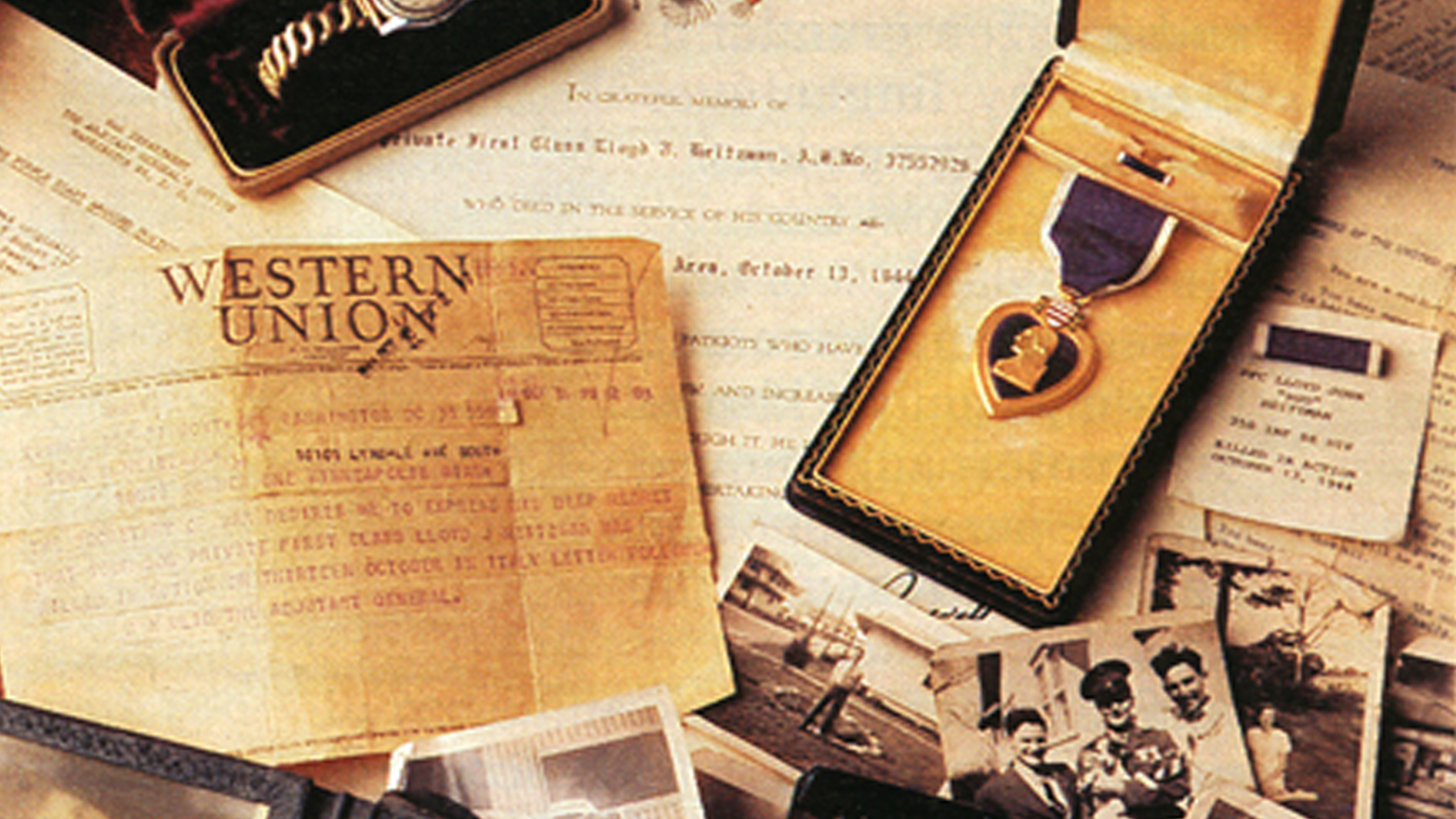
“These are Bud’s things,” she said. “They sent them to us after he died.” She opened the lid and handed me a telegram dated October 13, 1944. “The Secretary of State regrets to inform you that your son, Lloyd Heitzman, was killed in Italy.”
Your son! I imagined Mema reading that sentence for the first time. I didn’t know what I would have done if I’d gotten a telegram like that.
“Here’s Bud’s wallet,” she continued. Even after all those years, it was caked with dried mud. Inside was Bud’s driver’s license with the date of his sixteenth birthday. I compared it with the driver’s license I had just received.
A photo of Bud holding a little spotted dog fell out of the wallet. Jiggs. Bud looked so pleased with his mutt.
There were other photos in the wallet: a laughing Bud standing arm in arm with two buddies, photos of my mom and aunt and uncle, another of Mema waving. This was the home Uncle Bud took with him, I thought.
I could see him in a foxhole, taking out these snapshots to remind himself of how much he was loved and missed.
“Who’s this?” I asked, pointing to a shot of a pretty dark-haired girl.
“Marie. Bud dated her in high school. He wanted to marry her when he came home.” A girlfriend? Marriage? How heartbreaking to have a life, plans and hopes for the future, so brutally snuffed out.
Sitting on the bed, Mema and I sifted through the treasures in the box: a gold watch that had never been wound again. A sympathy letter from President Roosevelt, and one from Bud’s commander. A medal shaped like a heart, trimmed with a purple ribbon. And at the very bottom, the deed to Mema’s house.
“Why’s this here?” I asked.
“Because Bud bought this house for me.” She explained how after his death, the U.S. government gave her 10 thousand dollars, and with it she built the house she was still living in.
READ MORE: REMEMBERING MEMORIAL DAY
“He kept his promise all right,” Mema said in a quiet voice I’d never heard before.
For a long while the two of us sat there on the bed. Then we put the wallet, the medal, the letters, the watch, the photos and the deed back into the metal box. I finally understood why it was so important for Mema—and me—to remember Uncle Bud on this day.
If he’d lived longer he might have built that house for Mema or married his high-school girlfriend. There might have been children and grandchildren to remember him by.
As it was, there was only that box, the name in the program and the reminiscing around the kitchen table.
“I guess he was a hero because he gave everything for what he believed,” I said carefully.
“Yes, child,” Mema replied, wiping a tear with the back of her hand. “Don’t ever forget that.”
I haven’t. Even today with Mema gone, my husband and I take our lawn chairs to the tree-shaded boulevard on Memorial Day and give our three daughters small American flags that I buy for a quarter at Ben Franklin.
I want them to remember that life isn’t just about getting what you want. Sometimes it involves giving up the things you love for what you love even more. That many men and women did the same for their country—that’s what I think when I see the parade pass by now.
And if I close my eyes and imagine, I can still see Mema in her regal purple hat, honoring her son, a true American hero.
Meet Wally, the Emotional Support Alligator
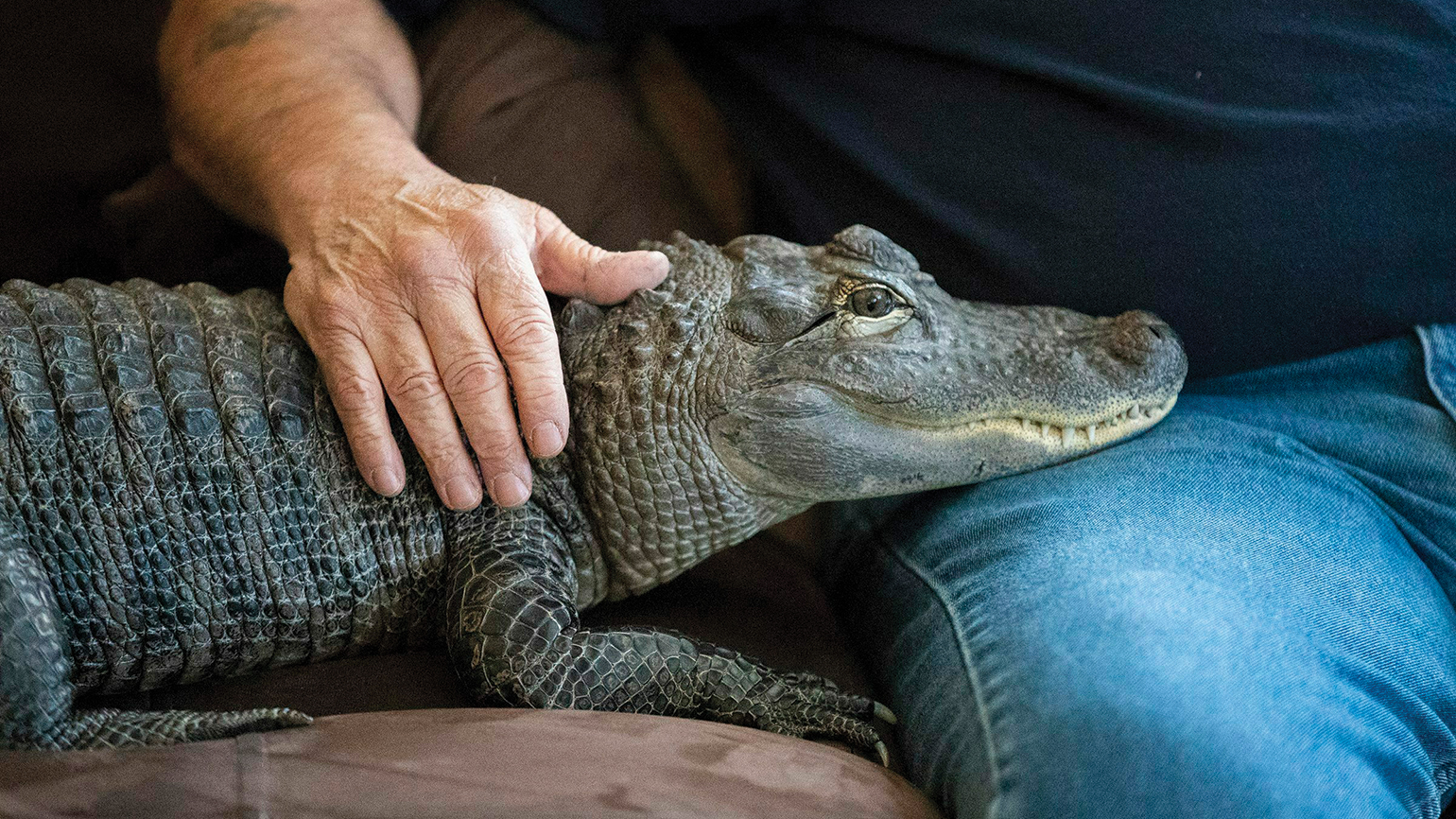
Cute and calming is how most people would describe the dogs, cats and bunnies that visit hospitals, schools and nursing homes to offer emotional support. Scary and dangerous are the words many would choose upon seeing Joie Henney’s comfort companion. His name is Wally, and he’s a five-foot-long alligator.
Joie (pronounced like Joe) grew up on a farm in Dover, Pennsylvania, an “adrenaline junkie” who delighted in handling poisonous snakes and head-butting his pet bull. He has been a Marine, a bull rider, a construction worker, a woodworker and a parent—a full, interesting life. It got even more interesting three years ago, when friends in Florida offered him a “nuisance” alligator named Wally.

Alligators are deemed a nuisance when they prowl backyards, posing a threat to people or pets, but removal means they’re either killed or put into captivity. Joie said he’d take Wally in. What do you do when a 14-month-old alligator arrives at your door? “I held him a lot,” Joie says. Then he put him in an aquarium. Wally now enjoys a 300-gallon basin (a sturdy pond liner) in the center of the living room. It’s also a prime TV-viewing spot for the reptile, whose favorites are Gator Boys, Swamp People and The Lion King. “If you start that movie and he hears the music, he’ll stop eating. He’s mesmerized by it,” Joie says.
Joie says Wally is like a toddler—crazy one minute and affectionate the next. He’ll stick his head in a kitchen cupboard and start scattering canned goods. But he’ll also crawl up on the couch and rest his head on Joie’s lap.
Some may say he’s jealous of the two other alligators in the house, Scrappy and Luna (both rescues who joined the family after he did), because he flips water on Joie when Joie holds them. Joie is convinced Wally acts silly to make him smile—something that was tough for him to do not long ago. The deaths of several family members and four close friends within a brief period sent Joie into depression. “I had no desire to do anything,” he recalls. When his doctor asked him to think about what truly makes him happy, “I realized it was Wally.” Now Wally is a registered emotional support animal—he even wears a medallion on his harness that recognizes his role in Joie’s life.
To better socialize the gator, Joie takes Wally to senior centers and schools—sometimes with his teen stepsons—and he has witnessed how his scaly friend lifts others’ spirits too.
At one school, Wally met a boy with Tourette’s syndrome. “While he was petting Wally, his tics stopped,” Joie says. “Wally was about to lose a tooth, which happens often, so I pulled it and gave it to the boy. I still get letters from his family about how much that tooth means to him.” Understandably, people are skeptical that a 65-pound alligator is safe to be around, but Joie insists that he has trained Wally well. “He knows commands and doesn’t open his mouth around people. He might hiss, but that’s his way of saying hello.” Wally won’t eat unless he’s inside his pond and hears the sound of Joie’s clicker. He’s also terrified of cats.
The real danger comes when people get alligators and crocodiles as pets, then can’t care for them once they are grown. Joie is building a habitat where he can give abandoned alligators a home. He may need a bigger TV, though, so they all can watch The Lion King together.
Follow Wally on Facebook @wallygator and on Instagram @wallygatornjoie.
Did you enjoy this story? Subscribe to All Creatures magazine.
Meet a Real-Life Father Goose
You’ve heard Mother Goose stories. How about a heartwarming Father Goose story?
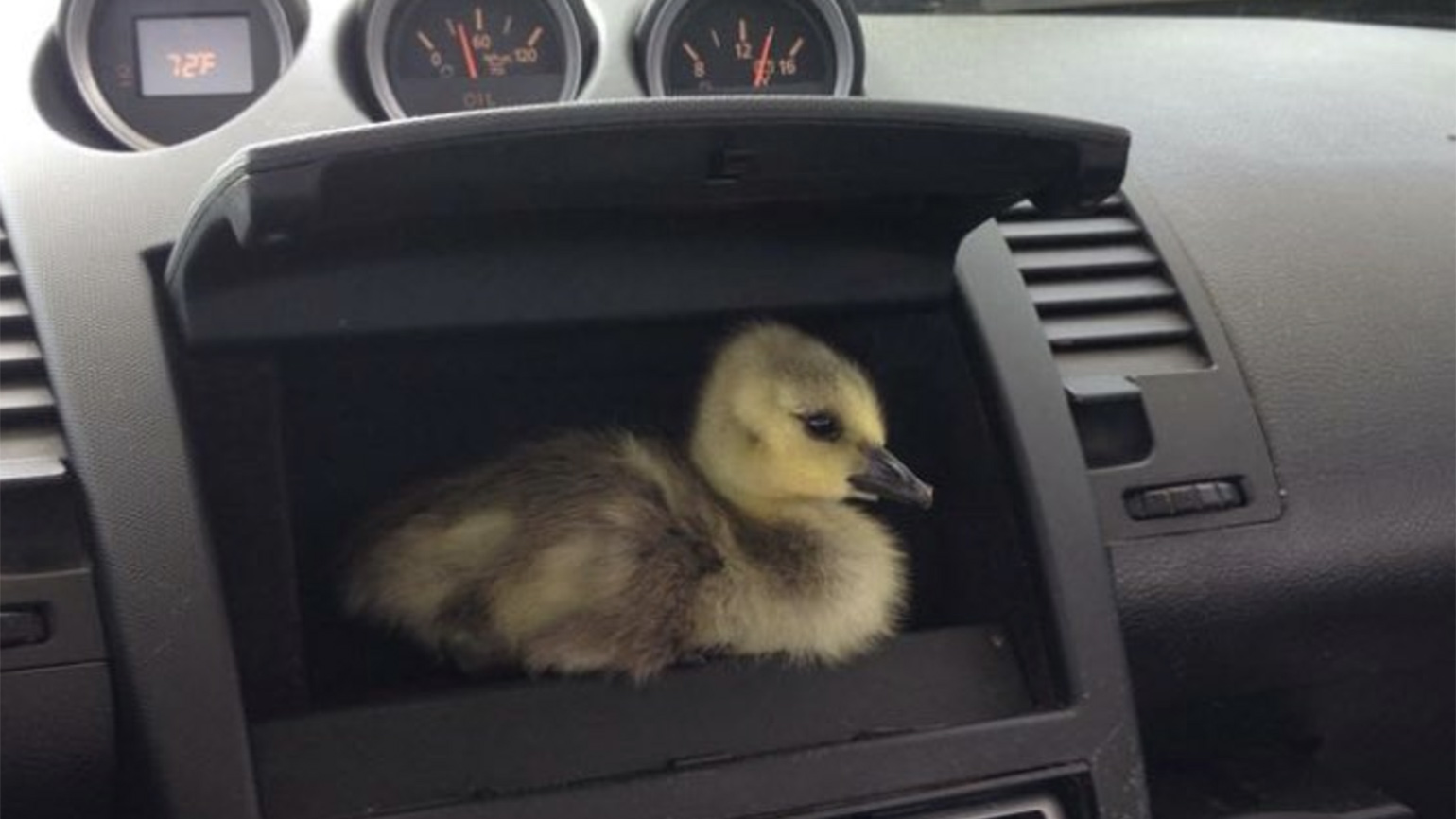
Once upon a time…well, one spring day in 2014, Mike Jivanjee was boating on Lake Oswego, near Portland, Oregon, with friends when they spotted a tiny Canada gosling in the water. “Mother geese do not typically leave goslings alone, so we knew that it was in trouble,” Mike said. They rescued it and found its family. But the mother rejected the gosling because it had a crooked foot.
Knowing that the baby bird would die on its own, Mike took it home and named it Kyle. “I decided I’d care for him until he was old enough to fly,” he says. “Boy, was I wrong!”
Mike was wrong about something else too. Kyle turned out to be a female.
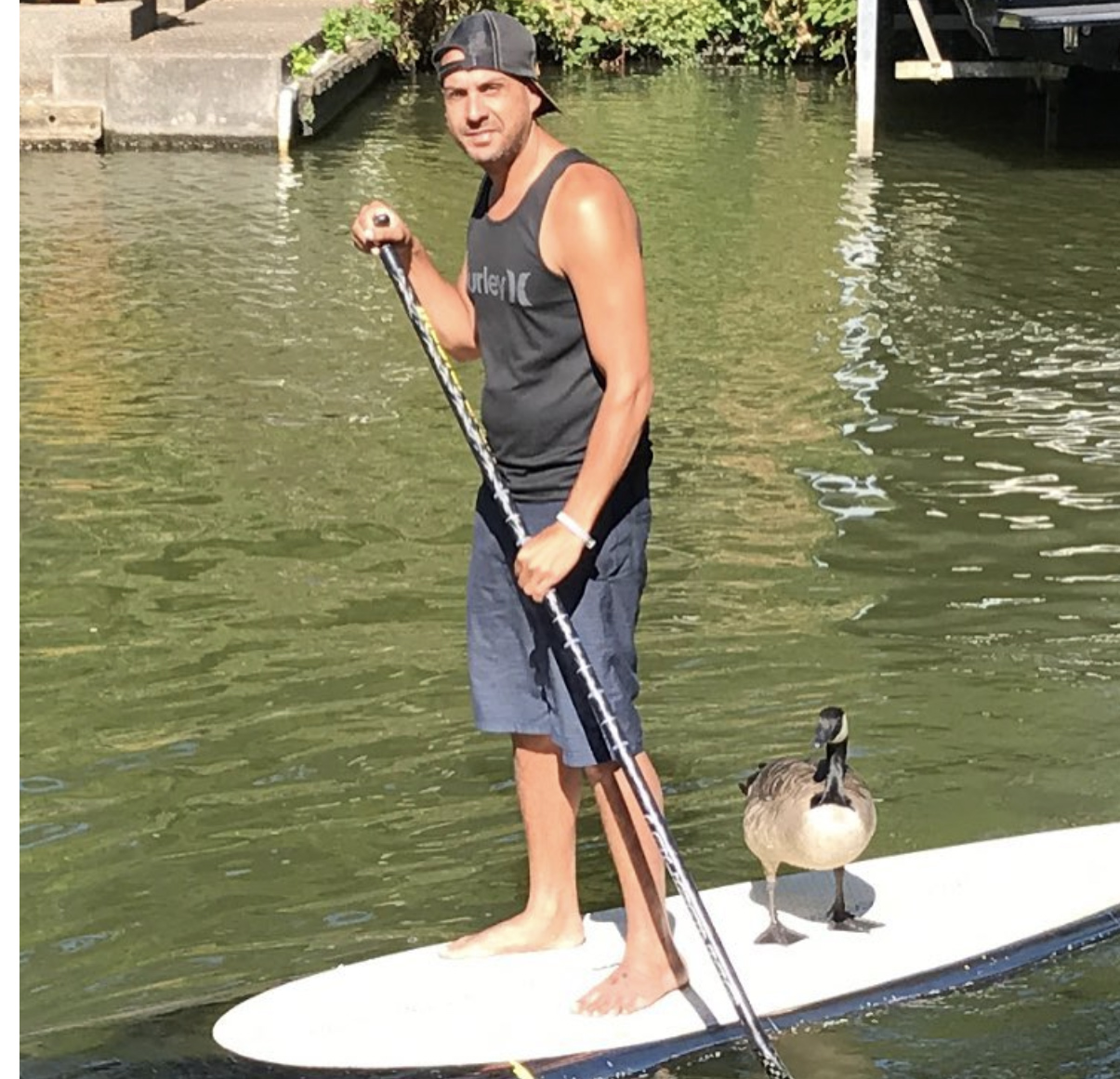 They spent a lot of time together in the water so Kyle would learn survival skills. “I’d hop on my paddleboard and have her swim after me,” Mike says. “Once she developed her flight feathers, she followed my boat.” Soon, the two were inseparable. If Mike walked into town for coffee or groceries, Kyle was right behind him. And every night, she tailed him home. Eventually, her bad foot straightened out.
Once Kyle could fly well and find food, Mike knew it was time for her to live independently. He drove to another lake nearby and released the one-year-old. “But when I got home, Kyle was sitting in my boat, waiting for me,” Mike says with a laugh.
In 2016 a male goose started hanging out in Mike’s yard. Kyle showed interest in the new visitor, who was dubbed Eugene. They had two goslings that year, but one was eaten by a fish soon after hatching. “Unfortunately, Kyle wasn’t that great of a mother,” Mike says. “She didn’t stay with her babies. I stepped in to keep the surviving gosling, Jack, safe from predators.”
Last year, Kyle had three more babies: Bravo, Delta and Echo. Echo was killed by a mink, but Bravo and Delta are still with Kyle and their older brother, Jack.
And Kyle is still with Mike. It’s not unusual to see the whole family chasing Mike’s boat, sometimes causing mischief. They have been known to steal things like wallets, keys and flip-flops and drop the items into the water. “They’re still wild animals, after all,” Mike says.
The rescued flock has gotten a lot of unexpected attention. “Kyle has made me very popular,” Mike says. “I try to use the spotlight to be an advocate for animal rights and raise money for school districts, animal rehab facilities and other charities.” His favorite thing to do is invite children with disabilities out to the lake to watch Kyle and her kids interact with him.
As much as Mike loves the geese, they do not consume his life. Last fall he spent six months in Hawaii. “The geese are self-sufficient, and neighbors messaged me to let me know they were doing fine,” he says.
When he returned to Oregon, all Mike had to do was let out a whistle by the lake for Kyle and her kids to show up. “Kyle is my best friend,” he says. “I feel like I was chosen to watch over her.”
Kyle’s family is expected to expand once again. She is currently nesting and will likely have goslings this year. We have no doubt that Father Goose will be close by.
Did you enjoy this story? Subscribe to All Creatures magazine.
Meagan Good: Lessons Her Mother Taught Her

People sometimes ask who my hero is. I’m an actress and I would love to someday play a hero. If I do, I’ll have the perfect role model: my mother, Tyra Wardlow. So much of how I live my life comes from growing up watching Mom stay strong in the face of adversity and make sacrifices for the people she loves. Here are some of the most important lessons I’ve learned from my mom, my real-life hero.
RISE ABOVE YOUR CIRCUMSTANCES.
Mom married a military man and had her first child at 19—my brother, Colbert. At 18 months old, he was a bright toddler—curious, playful, already putting words together in sentences. One day he got such a high fever that he went into convulsions. He was rushed to the base hospital.
Even though he came home the next day, Mom knew that something was wrong. He wasn’t talking anymore, as if his speech had just dissipated. She took him to a specialist. Colbert had suffered brain damage, which caused some learning disabilities.
Shop Guideposts Mother’s Day Gifts!
Mom could have unraveled. Instead, she went into action. She enrolled Colbert in a good special-education program and worked with him daily to develop his skills. And Colbert thrived. He regained his speech, earned top honors in his classes, mastered video games and became a great athlete. He now has a good job, lives on his own and still competes in the Special Olympics.
Colbert’s confident, independent, a fighter. He understands his disability, but he doesn’t let it define him. As Mom says, “Any challenge you put in front of him, he will strive to overcome it.” I have that same go-getter attitude, and I know we both got it from our mom.
SHOW COMPASSION FOR OTHERS.
Mom’s well of empathy runs deep. She has always been the one that people turn to when they have nowhere to go. She opens her heart—and even her home—to them. There was one summer when I was a teenager and my uncle’s girlfriend and their two small children needed a place to stay.
Our house was already full, with Mom and my stepdad; my stepbrother; my brother; my older sister, La’Myia; and me. But Mom told my uncle’s girlfriend, “You and the kids can stay in one of the girls’ rooms until you get on your feet.” I grudgingly agreed to move into La’Myia’s room to make space for them. They’re family, I reminded myself. This is temporary.
But the next thing I knew, my grandma needed a place to stay. Then our cousin. Then two young music producers La’Myia and I had been working with. And then another cousin and her new baby girl, Lexus. By the time all was said and done, there were 15 people living in a three-bedroom house with a built-on addition.
READ MORE: KATE BOSWORTH ON FAITH AND FILM
Everyone shared everything and I felt suffocated. What teenager wouldn’t, with no privacy and no personal space? I was upset with my mom. Why did she sacrifice our comfort to help all of these people? To me, it seemed like they were just taking advantage of her kindness.
Eventually things improved for everyone and they moved out. Looking back now, I understand what Mom was teaching us. That even when you think people should have it together, sometimes they don’t. That you should reach out to them if you’re able to because it’s a blessing to be in a position to help and blessings are meant to be shared. That you don’t have to worry about people taking advantage of you if you let God guide you in how to help them.
FOLLOW YOUR HEART.
My acting career began at age four, when I appeared in my first TV commercial. La’Myia and I had big personalities practically from birth, and when Mom saw how we loved being in front of the camera at family gatherings, getting us into acting seemed like a natural step. (Well, maybe it’s natural if you live in Los Angeles!)
She didn’t put any pressure on us, so auditions and jobs were fun, not work. My love for acting grew. By the time I was 10, I was landing roles on TV shows. I started getting callbacks for roles in films.
Then, when I was 13, Mom and my stepdad split up. Just like when she found out Colbert had learning disabilities, she could’ve unraveled. But just like back then, she picked herself up and kept going.
She knew she’d have to be even more careful with her budget as a single mom. She sold our three-bedroom house, moved us to an apartment in Santa Clarita, traded in her new car for a used one. She kept our lives as normal as possible otherwise. She cooked, cleaned, ironed our clothes at night, got us up for school the next morning and always dropped us off on time.
READ MORE: MISTY COPELAND—MADE TO DANCE
She took us to auditions after school, had dinner on the table, looked over our homework and made sure we were in bed before she headed out to work the night shift as a customer-service supervisor for the Bank of America call center. She’d walk in the door at 5:00 a.m., just as our day was about to begin.
She was also going back and forth to court because she was in the process of adopting our baby cousin, Lexus. Her mother wasn’t able to take care of her and Mom was doing everything she could to make sure Lexus stayed with family.
Things were hectic. The drive from Santa Clarita to Los Angeles was 35 miles on the map, but it could take a couple of hours in traffic. It was impossible for Mom to get us to and from auditions and still make it to work.
She sat my sister and me down one day after school and explained the situation. “Girls, I have to take you out of the business,” she said.
“We love acting,” La’Myia said, in tears. “Please don’t make us quit.”
I was crying too. “Mom, this is what we want to do more than anything!”
She looked into our eyes for a long moment. Then she nodded. “I can see your hearts are really in acting,” she said. “I believe God gave you the talent and love for it. But if you’re going to make it in the industry, it’s going to take a full-time manager and mother.”
READ MORE: CARRIE ANN INABA ON THE POWER OF PRAYER
She resigned from her job and dedicated herself to managing our careers. It wasn’t easy, and money was short. Somehow, though, we made the rent every month. You can probably guess what Mom said about that: “God is a miracle worker.”
My first major television role was on Cousin Skeeter, a Nickelodeon series that ran for three years. After that, I was offered a role on another TV show. I wanted to move to film, where I’d get to play different characters and see the world. But with the threat of a writers’ strike, film studios were shelving projects, and there were very few jobs.
Reluctantly I signed on with the TV show. I was grateful to be making good money for a 19-year-old. Then the writers’ strike was averted. Out of the blue, I was offered an incredible role in a movie called Deliver Us From Eva. The problem was, I had my TV contract and we were only halfway through the season. And I wouldn’t make nearly as much working on the movie for two months as I would on the TV show, which could run for a few years.
I didn’t want to put our family in a financial bind. I thought Mom would tell me to stay put even though I wasn’t happy, because I had already committed to the show. But she told me, “Follow your heart, Meagan. No amount of money can bring you the fullness of trusting your spirit.”
We asked the TV studio to give me time off to do the film. To my surprise, it did.
Even though the studio ultimately fired me, Mom and I weren’t discouraged. We trusted that more opportunities would come. What mattered to Mom was that I was happy, that I was doing what I loved. Even now, I don’t choose roles based on the size of the paycheck or the audience. I follow my heart, and even more, I follow God’s lead. I’ve found that if I’m listening closely, they take me to the same place.
MAKE FAITH YOUR FOUNDATION.
Not that she ever let on, but there were times when Mom must have felt overwhelmed, especially after she and my dad divorced. She didn’t want Colbert, La’Myia and me to miss out on anything, even though we had only one parent at home. She filled the role of both parents and held things together for us.
There were nights Mom would go in her room, close the door and turn up the music. I’d hear Marvin Gaye from the hallway and I knew. I knew it was because she didn’t want us to hear her cry. She never wanted us to feel the sadness and hurt she felt. She didn’t want us to see her break. And we didn’t. Instead of taking her troubles to another human being, she went to God.
Mom wasn’t a regular churchgoer but she read her Bible, prayed a lot and encouraged us to do the same. She talked about God all the time (she still does) and taught us that he was the best father we could ever have. She wasn’t one of those people who felt like we needed to be in church every Sunday to be close to God. Faith could develop in many ways—church, Bible study, prayer groups, mission work, private devotional time.
Mom showed us that a true relationship with God could also grow from having an ongoing conversation with him, talking to him and listening when he talks to us. “Without him,” she has told me, “I would’ve fallen apart.”
On one level, that’s hard to believe, because my mom is the strongest person I know. But deep in my heart, deep in my soul, I know what she means. Because her strength comes from making faith the foundation of her life, and she has instilled that strength in me. See why she’s my hero?
Did you enjoy this story? Subscribe to Guideposts magazine.
Max Lucado Shares Why He Loves Christmas

I love all the trappings of Christmas. Bing and his tunes, Macy’s balloons, mistletoe kisses, Santa Claus wishes, the tinsel and the clatter and waking up “to see what was the matter.” I don’t even complain about the crowded shops. The flight is full, the restaurant is packed. Well, it’s Christmas!
Why do I love it so much? Because someone somewhere will ask the question “What’s the big deal about the baby in the manger?”
Christmas is how it all began, the perpetual presence of Christ in our lives. He called himself “Immanuel,” which means “God with us.” God where we are: at the office, in the kitchen, on the plane, around the tree. The manger invites, even dares us to believe that the best is yet to be. And it could all begin today. This is the moment….
When love came down to save us from ourselves.
One busy holiday season traffic had turned the streets near the mall into chaos. I made a right turn onto the avenue just as a kid in a low-riding, wide-wheeled, exhaust-puffing jalopy made a reckless U-turn around the median. We nearly shared paint. I honked at him, not a polite “Ahem, excuse me,” but a long, strong, “Do you know what you almost did?!?”
As the car accelerated, a long arm came out of the passenger’s-side window and gave me a backhanded, one-fingered wave.
I sped up. Thanks to a traffic light, I was soon side by side with the perpetrator. “You need to watch that wave, son,” I said. In an ideal world he would have apologized, and I would have wished him a merry Christmas, but he smirked and said, “Make me!”
When was the last time I heard someone say, “Make me?” Not since high school. The boy was a skinny, floppy-haired, testosterone-laden adolescent riding shotgun in his buddy’s car. I’m a 60-year-old pastor. The saints in heaven and all the angels were saying, “Drive away, Lucado.”
Did I listen? No. That punk had activated the punk inside me. “Okay, where do you want to go?” I snarled. Yes, I really did.
The light turned and I accelerated. In my side-view mirror I could see that the two boys were engaged in an animated exchange. By the time I reached the next stoplight, they were nowhere to be seen. Boy, was I relieved. I drove the rest of the way asking myself, Did you really just dare a kid to fight? Are you crazy?
In that moment I forgot that the teen was a creation of God. He was a disrespectful jerk and I let him bring out the disrespectful jerk in me. The Bible has a name for this punkish tendency: our sinful nature, the stubborn, selfcentered attitude that says, “My way or the highway.”
Each of us entered the world with a sinful nature. God entered the world to take it away. Christmas commemorates the day and the way God saved us from ourselves.
READ MORE: LIONEL BARRYMORE ON A CHRISTMAS CAROL
When hope is there for the hopeless.
Two years ago, the second weekend of Advent, I came home one night to find my wife, Denalyn, waiting for me in the kitchen. Her expression said that something was terribly wrong.
“Max,” she said, “Jenna is pregnant.” Jenna, our oldest daughter.
Denalyn’s announcement did not match her demeanor. She should have been waving her arms and hugging me. We would be grandparents at last! But her eyes were filled with tears. “She’s in the emergency room,” she said.
Emergency rooms do not wear Christmas decorations well. A garland does not make an X-ray machine festive. Red and green bulbs cannot shed a happy glow on a gurney. An ER is still an ER, even at Christmas, and our daughter was in the ER.
A nurse led us down the hallway into a room. Jenna was on the bed. She tried to be stoic, and succeeded, for about 10 seconds. Then she began to cry. She had wanted to surprise the family. She wanted to make a big deal out of a Christmas pregnancy. She wanted to have a baby.
By the next morning, the doctor informed us it wasn’t to be. Our family’s December turned gray with sorrow.
Flash forward. A year after Jenna suffered her miscarriage, her sadness was replaced by joy. Christmas brought the excitement of a healthy pregnancy—so healthy, in fact, that Jenna gave each of us an assignment.
She was at the point in her pregnancy when the baby was developing the ability to hear, so she asked family members to record messages that she could play for her yet-to-be-born daughter.
Who could refuse such an opportunity? I retreated to a quiet corner and captured this welcome: “Dear, dear child, we are so excited to welcome you into the world. We are waiting for you. Your parents have prepared a place for you. You have grandparents, aunts and uncles ready to shower you with love. We cannot wait to spend time loving you and showing you your wonderful new home.”
When heaven’s treasure became humanity’s gift.
I was only four years old and the large box sat unexplained in the corner of our living room. It had appeared soon after Thanksgiving.
Unlike other boxes near the Christmas tree, this one bore no wrapping paper or ribbons. It had no name, neither of giver nor receiver. It was taped shut, tightly shut, or my brother and I would have opened it. All we could do was inquire about it.
Mom had no explanation. She seemed uninterested. “Just something your dad bought for Christmas,” she said. If anything, she assumed Dad had used the holiday as an excuse to buy himself something. We knew he wanted a new outboard motor for his fishing boat.
On Christmas morning, while my older sisters opened gifts and my brother and I scampered about, playing with our new toys, my mom noticed the still-unopened elephant of a box.
“Jack,” she said, “aren’t you going to open the big present?”
Dad could no more keep a straight face than he could walk to the moon on a moonbeam. He began to smile, his eyebrows arched like little rainbows, and he looked at her with a Santa sort of twinkle. “It’s for you,” was all he said.
My brother and I stopped our play. Dad winked at us. We looked at Mom. She was staring at Dad. We knew something fun was about to happen. Mom stepped toward the box. Dad grabbed the eight-millimeter camera, and we kids scurried over.
READ MORE: A CHRISTMAS STROLL THROUGH NYC HISTORY
Mom cut the tape on the nondescript box. She reached in and pulled out nothing but tissue paper. One armful after another.
The image in the film, which our family later loved to watch again and again, starts to shake as Dad begins to giggle. “Keep digging, Thelma,” he says from behind the camera.
“What’s in here?” she asks, still pulling out paper. Finally she strikes pay dirt. A box within the box. She opens it to find another box. She opens it, then another box. This happens a couple more times until at last she reaches the smallest of the boxes. A ring box. My brother and I shout, “Open it, Mom!” She beams at the camera. “Jack.”
I didn’t understand the tender significance of the new ring. Not then. But I did learn a lesson that Christmas: A remarkable gift can arrive in an unremarkable package.
One did in Bethlehem. No one expected God to come the way he did. Yet the way he came was every bit as important as the day itself. The manger is the message.
Did you enjoy this story? Subscribe to Guideposts magazine.
Marriage–Finding a Pause
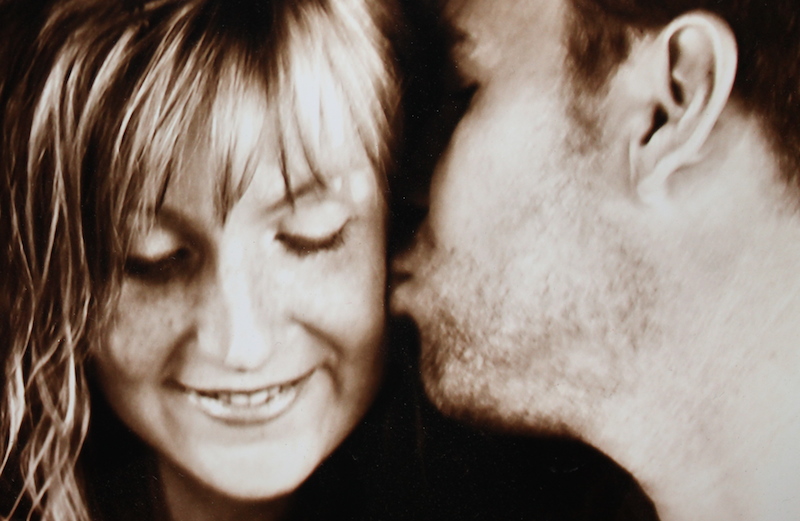
The children are in bed and Lonny and I are in the schoolroom. He’s at one end of the boys’ school table, working on his computer. I’m on the other end, working on mine. I look up and see him there, work-face pulling his brows. The clickity-clack of his keyboard is the only sound.
“Hey,” I say. “Can you stop? For just a sec?”
Lonny looks up.
And it’s quiet.
Perfectly, beautifully, unusually quiet.
 “Listen,” I say.
He listens. Then a smile tugs the corners of his lips. A wave of gentle washes over his face. His expression is soft. Easy.
And there is no sound. It’s strange, at first, as the week has been wild. Divide-and-conquer has been the name of our game.
Swim club practice. Soccer games. Scouts. Lonny’s spent the evenings shuttling sons one direction, and I’ve shuttled other sons in the opposite.
But here we are.
And all is still.
“Shall we sit?” I ask.
A moment later we’re close on the sofa, a well-loved 1920’s find that sags in just the right places. His arm goes around my shoulders, as it has for over two decades, and my head finds a resting place beneath his chin.
We’ve found a quiet moment.
My friend calls these treasured times a pause. A couple of months ago, Lonny and I planned an anniversary vacation to the Caribbean. My friend and I chatted about my get-away adventure as she and I took a morning run.
“What are you looking forward to the most when you think about your trip?” she asked.
“Together time. Being still with my best friend,” I said.
“Oh, “she said. “You’re looking forward to a pause.”
As I sit here and remember that day, I think my friend nailed it. The pause. Life is busy. Full and frantic. Lonny and I are constantly working to achieve the order we want in our home. The Lord first. Marriage second. Children third.
But busyness and activity and wants and needs press hard and fast and often time for our marriage seems to be shuffled to the back.
Or lost.
Lord, help us to take time for one another. To live and learn and grow together. Let us find joy in one another’s company. In intentional times, like a date or a trip. But especially in the every day–in the grace-gift moments, like this time right here.
Lonny and I begin to talk and the quiet fills with expressions of our days. His fingers lace over mine and this is comfortable and familiar.
It’s necessary, too.
Life is rich with many wonderful things. Raising children. The blessing of maintaining a home. Commitments to good and true things.
But taking the time to step back from the busy and connect at a heart-level with my husband is sustaining.
And the Lord meets us here. In this peaceful place.
Thank you, Lord, for the pause.
Marion Bond West on the Lists That Revived Her Marriage
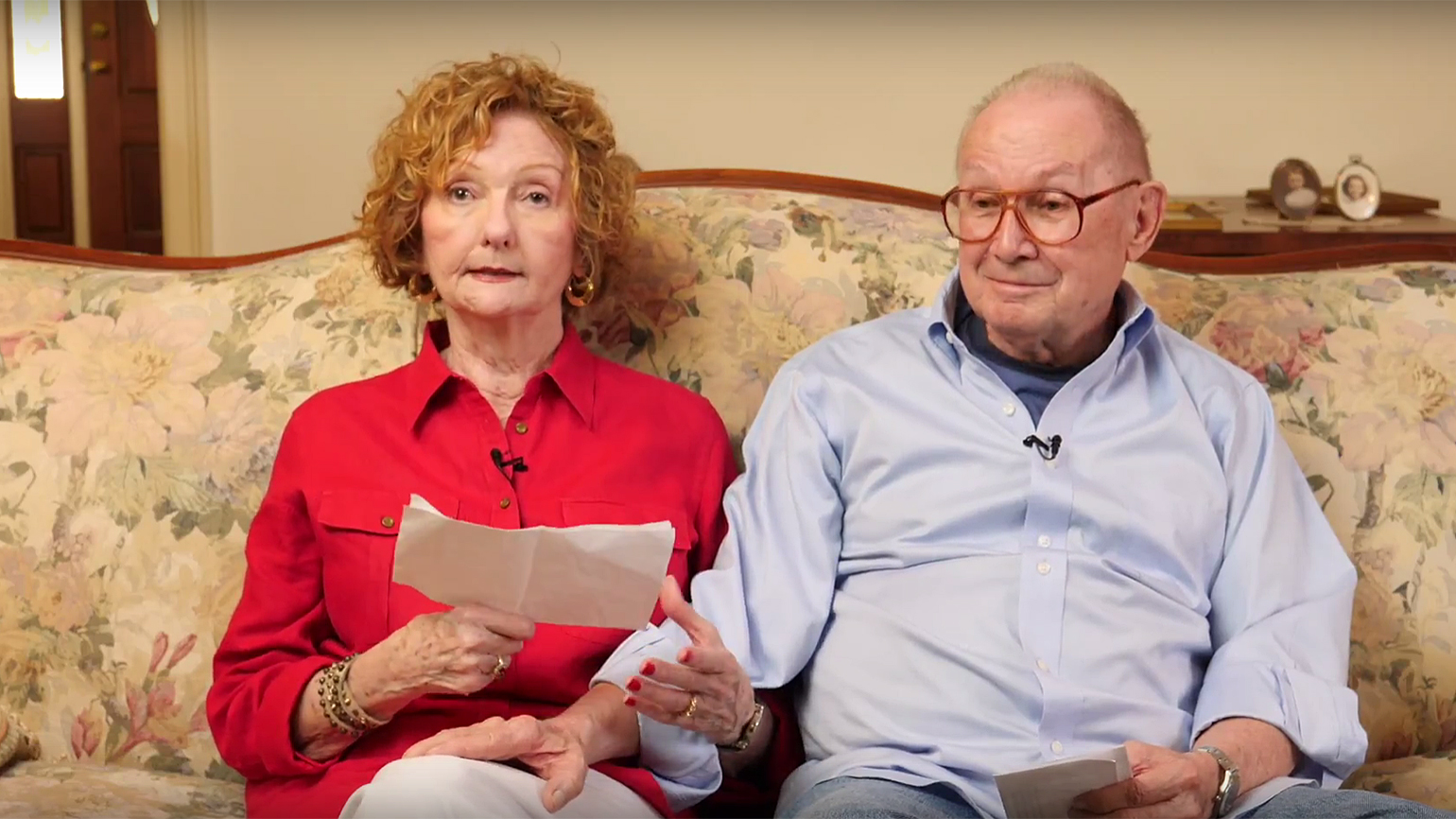
Marion: Hey, y’all—I’m Marion Bond West.
Gene: I’m Gene Acuff, her husband.

Marion: I have written a story for Guideposts, and it’s called The List. When I saw my rheumatologist one day, he gave me a form to fill out and it said, “Are you happy, generally?,” and it had never said that before.
That day, I was not happy—I had not been happy for a while—and I said, “No, I’ve lost my joy.” So my rheumatologist said, “Tell me about losing your joy,” and I said, “My marriage, something’s wrong with my marriage.”
He said, “It’s just broken, but it can be fixed. You need to go to counseling.”
The first thing the counselor had us do was to make a list of things…my list would be things that Gene does that let me know he loves, because I really needed to know that. Ten things.
And then Gene had to make a list of things that I do that he realizes that I love him. And these are small things. These are not like going on a trip or a big gift. Small things that we do around the house and we realize that each other loves us.
There is another list involved in this story: When I was a widow—I’d been a widow for four years—I made a list and I told God, “I really want to be a wife again if you’ll bring me someone.”
This list that I made of what I wanted in a husband was turned into an article that went into Guideposts, and I got some calls from some fellows who wanted to be married. But I got a call from a fellow in Oklahoma who was a professor and a small-time farmer and a minister. And I kind of wanted to marry a minister, not knowing what it would be like to be a minister’s wife.
I’m going to share with you a list. I came straight home from counseling, sat down at my typewriter, and immediately made my list. So here are my things that let me know that he does love me:
Eye contact around the house.
A wink around the house.
Holding my foot when walking by the bed—and there’s a story that goes with this: One night he just walked by and grabbed my toe, and I was so excited! I thought, “He really, really does still love me; he grabbed my toe!”
Going to sleep holding my hand.
Letting my cats sleep with us and loving my cats.
And praying with me.
Gene: First thing on my list was when we first go to bed and we hold each other.
Second thing on my list was when you get your hair done and you come home and I get to see all your curly hair.
When you cook me a roast.
Marion: Yes.
Gene: And when you make me soup after we’ve had the roast.
Marion: Yes.
Gene: When you go with me to Social Circle.
Marion: To Blue Willow.
Gene: To Blue Willow. That’s my list of what makes me happy about her.
[cut to interior of car]
Gene: Let’s sing it together, honey.
Marion: It’s been a long time.
Both (singing): Have I told you lately that I love you? Can I tell you once again somehow?
March Mud and Spiritual Cleanliness

There are four sets of footprints. They stretch cross the closed porch. Through the kitchen. Over the dining room hardwoods. Three sets of boy prints and one set of paws.
It must be March.
“Hey, Mom, did we do that?” Samuel asks as he comes around the corner. I raise my eyebrows. Sam smiles and gets the wash bucket from under the cupboard in the laundry room.
We fill it with water and the frothy bubbles rise.
Boys and mud. It’s just like this. I’m not sure about girls, but muddy puddles and boyhood are deeply entwined.
As Sam and I take the bucket to the dining room, I remember one summer day when the little boys dug a hole in the side yard. They pushed their shovels deep. Turned over earth. Made a trench.
They filled the whole thing with sun-warmed water from the hose and then jumped right in. When they came to the back door they were covered. Encrusted. They were dirty, smiling boys behind smears and smudges and masks of mud.
I’d carried this same bucket of water to the patio. I plunged little brown arms into the warm suds. I rinsed Mississippi valley mud from the crescents of small knuckles and scrubbed fingers until we found nailbeds pink as shells.
They put their feet in the wate,r and I washed where earth had webbed their toes. I dabbed mud from dirty faces while eyes squinted in the sun. I rinsed soil from hair soft as silk.
And under the summer sky they came clean.
It’s the same thing that Jesus does for me.
He sees my grit. He sees my grime. And He washes me with mercy ‘til the water runs clean with grace.
Purify me from my sins, and I will be clean; wash me, and I will be whiter than snow. (Psalm 51:7, NLT)
Oh, if not for the perfectly cleansing, soul-saving blood of Jesus!
Thank you, Lord…
Samuel and I dip our sponges in the water, and we set about cleaning the floor. We’re side-by-side. We’re kneeling.
And I think about how beautiful it is to come clean.
Mama’s Success
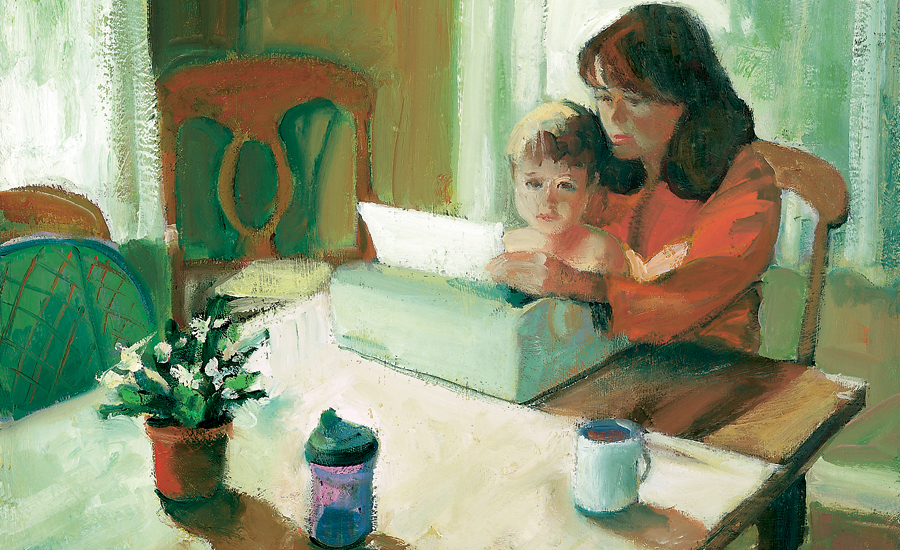
I wished that I hadn’t opened the old cedar chest, for there, under the quilt I’d come for, was the familiar box with the words “Acceptance Letters” penciled on it.
Now the rose fragrance that Mama always wore wafted faintly toward me and I looked again at Mama’s writing box. Memories rushed in and sadness filled me. Her great dream of being a writer had never become a reality.

I first knew Mama was really serious about being a writer about 20 years earlier. She sat at the kitchen table with a tear sneaking down her cheek as she put on paper how she had just been forced to sell a horse, an old paint, that she loved. We had needed the money for a payment on the house.
Mama never sent the article anywhere, but after that day I saw a new light in her eyes. “Children,” she told us, “your mama is going to be a writer. I feel that the Lord wants me to write stories so that others might feel uplifted.”
First she bought stationery and business cards with her name, address and the words “Writer and Lecturer” on them. She said it was important to handle things correctly and in a businesslike manner. She believed that editors would be more likely to read her work if the cover letter looked proper.
She then cleared a corner in the basement, made a desk by putting a door across two file cabinets and borrowed a typewriter from Grandpa.
But what I remember most was the box that she carefully placed on the desk beside her stationery. The box had been covered with a piece of cream-colored cotton strewn with tiny blue forget-me-nots.
She had tied a pale-blue ribbon around it and confidently written those words, “Acceptance Letters.” I guess it must have never occurred to her that she might get some rejections.
Mama gathered her notes, got a copy of Writer’s Market and began writing. However, before she finished even one article, Dad left us. Mama was suddenly solely responsible for the care and support of her children.
She always found time to write us encouraging notes to slip into our lunch boxes or leave on our dressers—but never enough time to write her stories. Mama always told us, though, “Don’t worry about my writing, darlings. God gave me the dream, and God will take care of the dream.”
Years came and went; I don’t recall now when Mama put the box and stationery away, but I do recall that one day they were no longer on the desk.
Occasionally when I’d see her sitting there, I’d think, Now she is writing her stories. But it was always a letter to one of my brothers in the service, a card to a friend or a cheerful note to Grandpa.
As we children grew up and began to leave home, Mama would comment on how she would soon have the time to write.
But something would always come up—Mama’s brother was in a serious car accident and she went to be with him; my sister needed help with her baby; Grandpa got sick and came to live with us; a neighbor had no one but Mama to turn to.
Mama never had an article published, for Mama never had a chance to write.
Now I reached down into the cedar chest and picked up the acceptance box. To my surprise, it was very heavy. Its ribbon was worn from tying and untying.
“What could she possibly have kept in here?” I mused aloud. Carefully I opened it. I began to read the “acceptance letters” that lay inside.
“Thank you, Mom, for your daily letters. I could never have made it through boot camp without them.”
“Just a note to tell you how much my sister appreciated your support in the many letters you sent her during her years of illness.”
“Thank you for writing me during these long months that I’ve been carrying my baby.”
“Thank you for taking the time to send me the pretty note cards. Sometimes an old man like me gets to feeling like no one wants to bother with him.”
“Your letter came when I was at my lowest point. You dared me to be my best, and I am now one of the top salesmen in my organization.”
“Mama, your many letters have helped me retain my sanity during this difficult time. Thank you so much for your constant support, prayers, hope and, most of all, your love.”
God does fulfill people’s dreams. Mama was a writer.
For more inspiring stories, subscribe to Guideposts magazine.