


Embrace God's truth with our new book, The Lies that Bind

How Veteran Skye P. Marshall Brought Her Military Experience to the Set of ‘Indivisible’

Skye P. Marshall always knew she wanted to join the military. She had practical reasons for wanting to enlist—getting a bachelor’s degree without going into debt—but also felt it would fulfill her purpose. Marshall has always felt led to inspire others. What better place for inspiration than the armed forces?

Although not religious when she enlisted, in hindsight, she says God’s guiding hand is evident, down to which branch she joined. Originally she signed up to join the Navy.

Pray a Day Vol 2 In Article Ad

“I was in line to swear in with the Navy. I looked across the hallway and saw the Air Force line,” Marshall told Guideposts.org. “This feeling overcame my body and I’ve always been one to trust my instinct.”

She left the Navy line and went straight back to the Air Force recruiting office, resigning herself to a lifetime of people asking her if she joined the Air Force because her name was Skye. Marshall served for three years. When her enlistment ended she attended college and eventually got a corporate job in New York City. On the outside, everything was going exactly as planned. But something was missing.

“I called my mother and told her I’d worked so hard for this cubicle, but I’ve been here two years and I’m not happy,” Marshall said. “She said, ‘Ask God for clarity, but whatever you receive you can’t judge it.”

At the time, Marshall didn’t have a relationship with God, but she didn’t have any other ideas so she decided to give her mother’s advice a try.

“I prayed every day and within two weeks I woke up before my alarm clock and the answer was clear as day,” Marshall said. She should be an actress.

Marshall has always had a penchant for theatrics. As a child, she would entertain relatives at family gatherings. She performed in high school theater productions and military talent shows, but she never thought of acting as a career.

“I tried to fight it, to come up with excuses. High school drop outs can be actors. It was a year after the economy crashed,” Marshall said. “But I couldn’t unhear my mom’s voice saying that whatever next steps God delivers, you can’t judge them.”

Marshall decided to listen to the answer she received in prayer. She quit her job and moved to Los Angeles. Marshall relied on God after she made the move. She also humbled herself—and it was through this humbling that she got her first breaks. She met someone at a catering gig who got Marshall her first part. She started praying more specifically for roles and soon landed parts on shows like NCIS, Black Lightning and Grey’s Anatomy.

“I’ve learned in the practice of prayer the more specific I can get in my prayer the faster I’m going to manifest my desires,” Marshall said. And so she began to pray in earnest for her dream. “I prayed for a military role.”

She dreamed of a military role and even had a few auditions, but was told she was too attractive to play a military member. Everything changed when she worked with the actress Sarah Drew on an episode of Grey’s Anatomy. Little did Marshall know, Drew was producing Indivisible, a faith-based film with prominent military roles.

Read Sarah Drew’s inspiring Guideposts cover story.

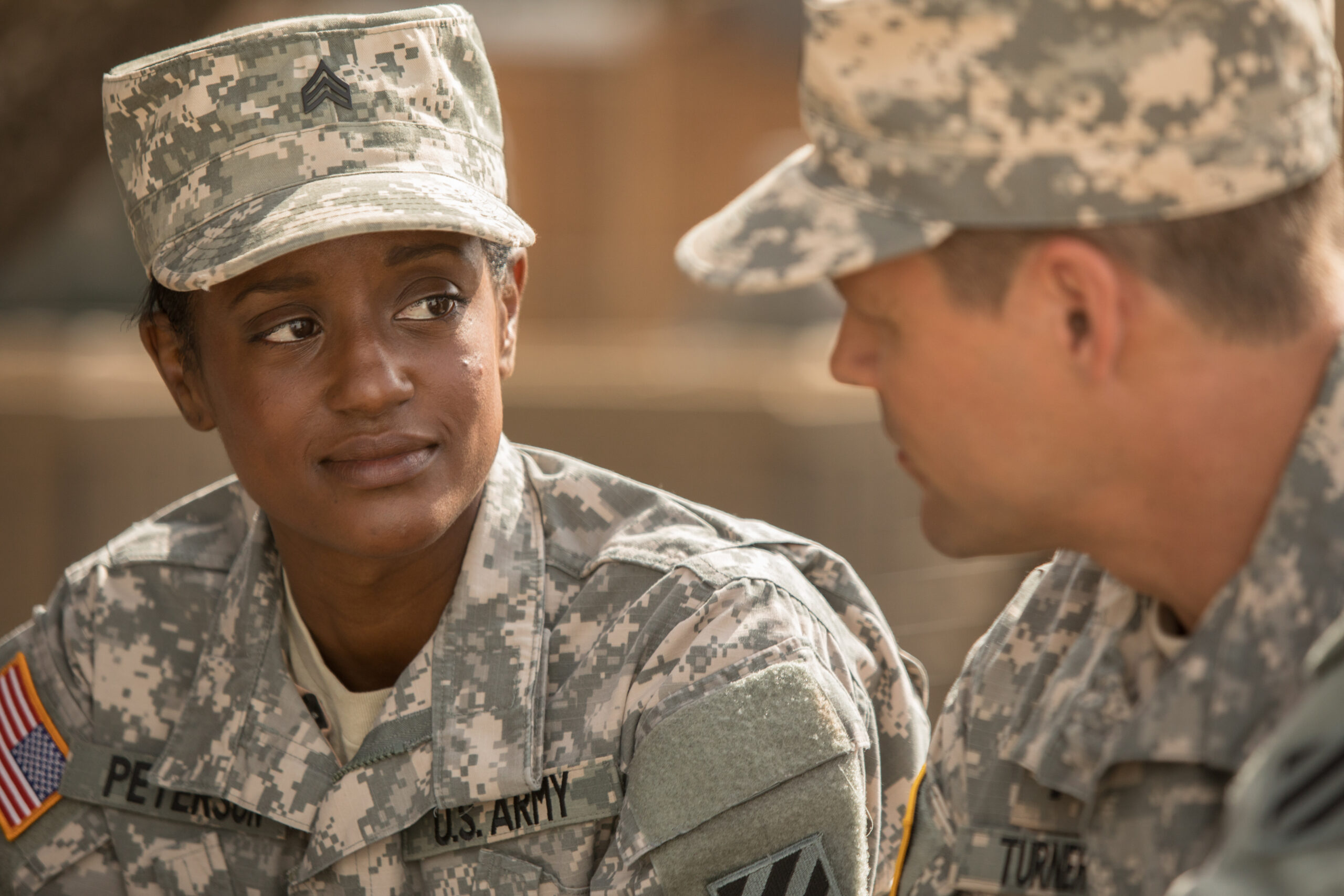
Indivisible tells the true story of Army Chaplain Darren Turner as he struggles with faith, combat and his marriage before and during his time deployed. Drew plays his wife Heather in the film. Marshall was brought in to audition for the part of Sgt. Shonda Peterson, who is tasked with protecting Turner.

“It was the exact role I’ve been praying for,” Marshall said. She was elated when she got the part, but there was one big drawback.

“I had to put on an army uniform,” Marshall jokes.

During the shoot, Marshall kept herself busy making sure everything looked right. She straightened hats, tucked in laces and adjusted postures. She even found herself pausing mid-conversation to address actors playing officers in the movie.

“My military experience helped me out in every aspect [of this film],” Marshall said. “From knowing the way you hold an M16 to the way you carry yourself in uniform.”

Going from the military to corporate America to acting might not seem like a natural progression, but Marshall sees the thread tying everything together.

“There is a difference between your career and what you’re passionate about,” Marshall said. “Purpose is God given. I enjoy and am passionate about acting, but my purpose is to motivate and inspire.”

Playing Sgt. Peterson was the perfect combination of Marshall’s career and purpose.

“Faith is at the core of every credit I have every obtained,” Marshall said. “I don’t believe any opportunity found me without me planting the seed—and the seed began in prayer. I realized how powerful I am when I co-create with God. It’s limitless.”

Marshall’s biggest hope is that Indivisible speaks to military members.

“When the battle in uniform is over and they have to face battles out of uniform—whether within marriage or with their mental health—I hope this movie inspires them to fight for their lives,” Marshall said. “And I hope it inspires them to be open and available to receiving help from their communities and God because both are available 24/7.”

Indivisible is in theaters now.
How Two Kittens Helped Her Daughter with Special Needs

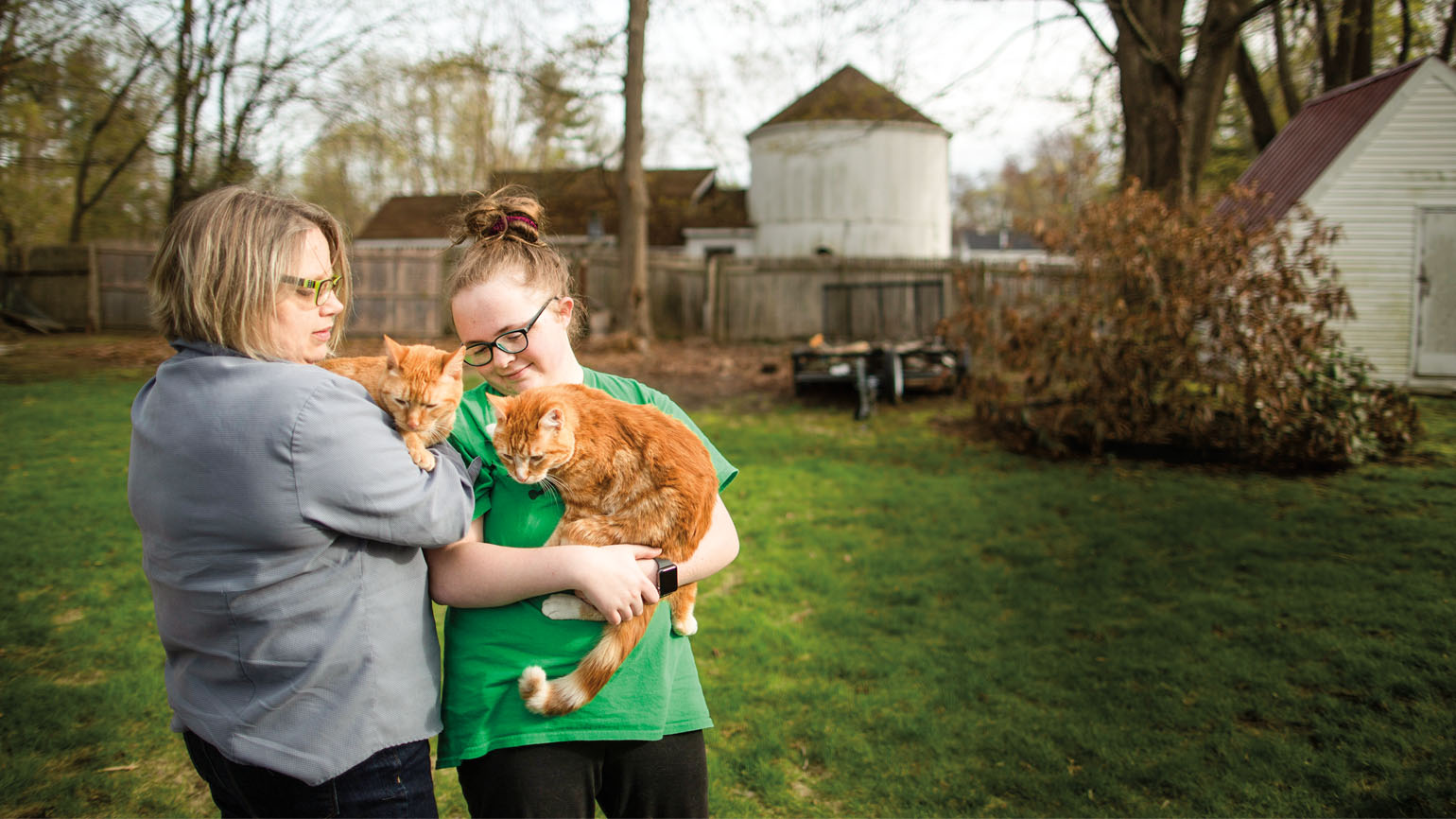
It was the ski trip that did it. I had taken my 11-year-old daughter, Bayleigh, to a Special Olympics Winter Games event at a ski resort here in New Hampshire. Bayleigh has cerebral palsy and had been skiing with an adaptive ski program since she was four. We enjoyed skiing together, and I thought she would have fun at the games. But her anxiety got the better of her. Despite my coaxing and encouragement, she wouldn’t leave our cabin the entire time. It made me sad to see her missing out not only on some great skiing but also on making new friends.

I went home convinced that I had to do something to make Bayleigh face her fears. I fought fiercely for my daughter when people put limitations on her. In fact, I’d been known to go full-on mama bear in her defense, maybe because I was a single mom and I didn’t trust anyone else to look out for my little girl. Still I understood that if she never stepped out from under my protection, she would never grow. Sometimes a person needs to be pushed in order to overcome a challenge and make a breakthrough. I’d seen that in my work as a speech pathologist and in my own journey learning to live with a visual impairment from a traumatic brain injury I’d sustained years ago in a car accident

Faithful Paws and Purrs In Article Ad

Why not use Bayleigh’s love of animals as motivation? We’d been looking for a friend for our cat, Chloe, ever since our other cat died several months earlier. Now I shifted my search to adopting from another state, one far enough away that we would have to take a plane to pick up our new pet. Bayleigh was afraid of flying, going to unfamiliar places and meeting new people. If she wanted another kitty, she’d have to do all those things.

Every day I checked animal rescue websites, looking for a cat that my daughter wouldn’t be able to resist. My search eventually led me to Best Friends Animal Sanctuary in Kanab, Utah. As soon as I read the write-up on Popcorn and Cheddar, a pair of orange tabby kittens, I knew they were meant for us, even though I hadn’t intended to adopt two cats. They were brother and sister, 12 weeks old. Both had been diagnosed with cerebellar hypoplasia—the feline version of cerebral palsy. The female kitten, Cheddar, also had a visual impairment.

I showed their listing to Bayleigh. “What do you think?” I asked.

“Popcorn and Cheddar are like me and you!” she said, her face lighting up. “We have to adopt them!”

“We’ll have to fly all the way to Utah to get them,” I said. “Are you okay with that?”

Bayleigh nodded slowly. That’s progress, I thought. She hadn’t even been willing to consider flying before. As it turned out, the sanctuary arranged to fly the kittens to an airport near us. No need for us to get on a plane, to Bayleigh’s relief—and my disappointment. Would I be able to come up with something else to help her overcome her fears?

The Best Friends staff told us Popcorn and Cheddar’s neurological condition caused them to walk with an unsteady gait and fall down often. They couldn’t climb stairs or jump up onto the couch. Bayleigh and I kitten-proofed our house before their arrival. We covered sharp corners and hung cloth under the kitchen table and chairs to make low hammocks for them to sleep in. We bought a low-profile litter box that would be easier for them to use.

Bayleigh and I were used to making adaptations. We’d done it all her life. She was born six weeks early, and immediately doctors informed me something wasn’t right. At just two days old, my little girl was diagnosed with cerebral palsy. I was told she would never walk, run or be able to live a normal life. Bayleigh defied the doctors’ predictions and took her first steps when she was two and half years old.

I was so proud of how far she’d come. Bayleigh still had her struggles. She had learning disabilities associated with cerebral palsy. School was difficult for her, academically and socially. Being different from her peers bothered her. She hesitated to attempt new things and clammed up around others, particularly in public settings.

Yet she braved the airport not once but twice to pick up the kittens. While we waited for the flight, Bayleigh watched the planes take off. I could see the tension in her body, but she didn’t ask to leave. Minutes before their flight was due to arrive, I got a call from a Best Friends staff member. The kittens weren’t on the flight. During their layover, an airline employee noticed they seemed wobbly and took them to a vet to be checked out. “I explained about their neurological condition,” the staffer said. “But the airline wanted to be sure. They’re spending the night at the vet, and they’ll be on a flight to you tomorrow.”

I was surprised and grateful the airline took such care with our new babies. Bayleigh didn’t even mind having to come back to the airport the next day to get them. We fell in love with Popcorn and Cheddar right away. They were curious, playful and so much fun. We’d had the kittens for only a few days when one of Bayleigh’s friends came over to meet them. I overheard her friend ask, “Will they ever be able to climb the stairs?”

“You never know,” Bayleigh said. “I wasn’t supposed to walk, but now I can run I’m not going to let anyone tell these kittens what they can and can’t do.”

Yes! I’d said that about Bayleigh so often, but this was the first time I heard her take the same stance. I felt like doing a fist pump.

Something shifted in Bayleigh as she watched the kittens grow. It was as if a light switched on: Being different wasn’t a bad thing. It just required an adjustment in perspective. When she taught Popcorn and Cheddar something new, such as how to play with feather toys, she’d say, “It’s all right if it takes you some time to get this. Even a baby step is a step in the right direction.”

Bayleigh adopted this positive, accepting attitude toward herself. One day she was playing with Cheddar and the kitten got startled. Her muscles tensed up, and for a moment she couldn’t move. “Mom, Cheddar’s body is doing what mine does when there’s a fire drill at school,” Bayleigh said. “I hope she’s not scared. It’s just something that happens to our muscles, and it’s okay.”

The kittens’ personalities emerged. Popcorn likes to live life in the fast lane. He does this little hop-roll move to chase toys and our other cat, Chloe. He’s fearless and daring. Cheddar falls down a lot more often than her brother. She moves slowly and carefully, with determination in her eyes. Her condition hasn’t stopped her from learning to walk outside on a leash.

Popcorn thriving outdoors.

Popcorn and Cheddar thrived despite their challenges, and Bayleigh did the same. “Mom, I want to learn how to ride a bike,” she said one day.

“You already know how to ride.”

“I ride an adapted bike. I want to ride a two-wheeler.”

I was blown away by how Bayleigh’s confidence had blossomed. But it also had me navigating a new parenting path. Could she really handle these bigger tests? Two weeks later, Bayleigh was riding a two-wheeler, and the smile on her face was all the answer I needed.

Welcoming Cheddar and Popcorn into our family has been good for me too. Every other week I put them in a stroller and we walk to the painting class I take at an art studio. Passersby stop to pet them and ask about their condition and how they’re doing. Seeing people accept our cats has made me notice how many people accept Bayleigh too. I used to automatically go on the defensive, but now I see so many folks are cheering for her to do well.

And she has. This past February, Bayleigh and I returned to the Special Olympics Winter Games event. This time I didn’t have to plead with her to leave our cabin or ride the ski lift. She did those things on her own. She introduced herself to other kids and competed in two downhill ski races. She fell a few times and picked herself right back up. She even took home two gold medals.

I’d adopted two kittens with special needs two years ago knowing it would change their lives. I never dreamed that it would change our lives too. Popcorn and Cheddar accomplished something I hadn’t been able to. They helped Bayleigh see that she could be just like them—fearless and determined.

Did you enjoy this story? Subscribe to All Creatures magazine.

How Truffles the Cat Helps Kids Who Need Glasses

Imagine being a child, unable to see well. Your eyes are tested, dilated, puffed with air or squirted with liquid, and now you’re told you’ll need to wear glasses. Or perhaps, an eye patch. It can all be very scary.

Enter master optician Danielle Crull, who started her practice in Mechanicsburg, Pennsylvania, specifically for youth—infants through teens—who need glasses. In 2002, she opened A Child’s Eyes, the first independent optical shop of its kind in the United States, and now runs the practice with the help of her husband and their three children, who are all in their twenties and board-certified opticians.

GP In Article Desktop

Wearing glasses as a kid prompted Danielle’s interest in the field and she jumped in with an apprenticeship right out of high school, before earning her national certifications. Her work with a pediatric ophthalmologist gave her hands-on experience and made her see the need for child-focused opticians.

While her practice was her priority, Danielle also made time to sing in the family band at a nearby church camp. They were a big hit—and not just with people. Stray cats and their kittens would roam around as the band jammed. After one gig, her kids begged her to keep the last kitten from a litter. They already had two cats at home, “but of course they wore me down,” says Danielle. “She was this little growling furball who didn’t want to be held.”

Yet Danielle and the Maine Coon, Truffles, bonded quickly, and the kitten revealed her treat-motivated personality. “That discovery showed me she could be taught very easily,” Danielle says. Truffles quickly learned to sit, stand, high-five and wave. “I’m no cat trainer. She’s just really smart,” Danielle admits.

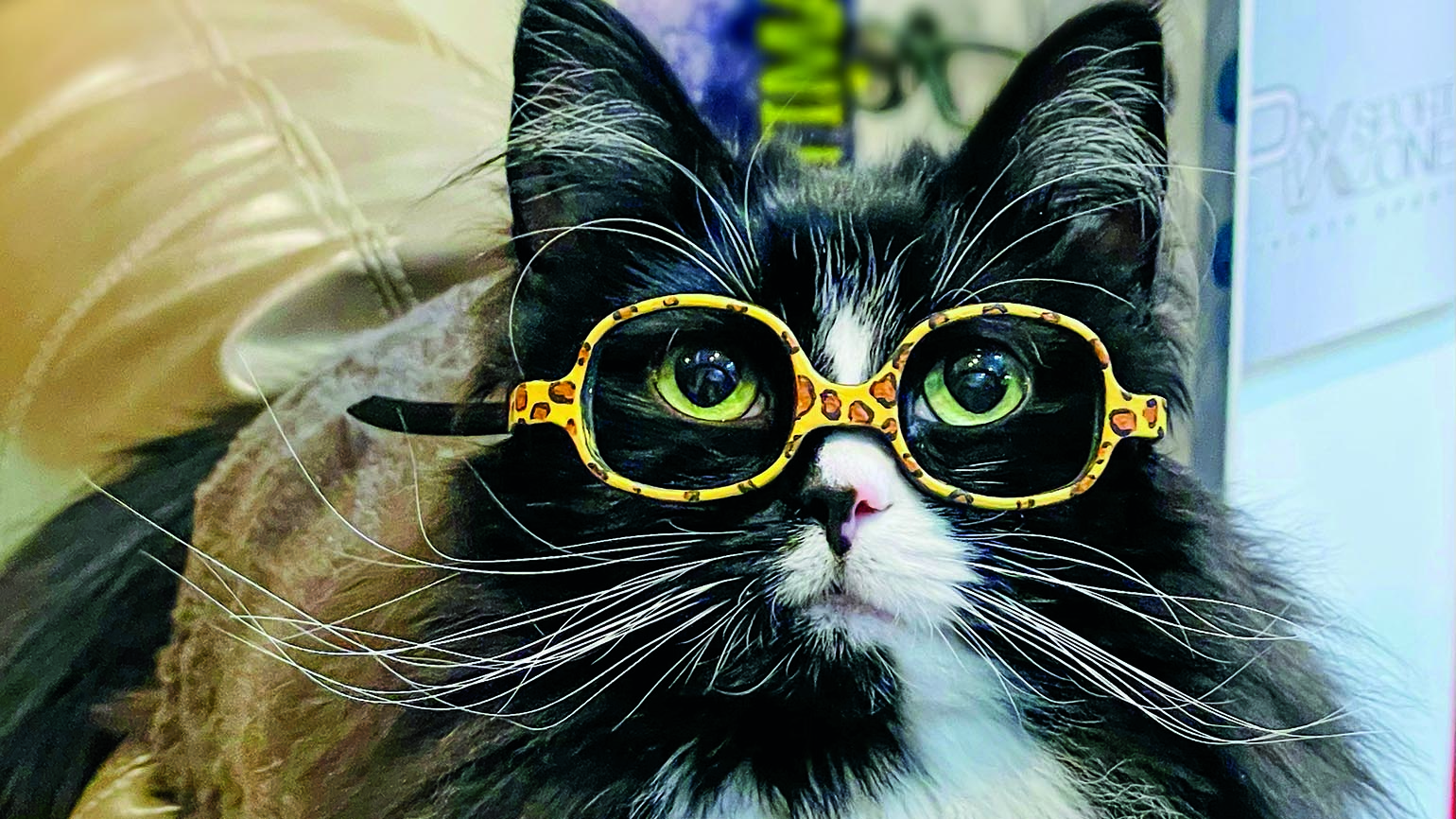
Truffles first accompanied Danielle to A Child’s Eyes in 2018, joining a bird and hermit crabs Danielle describes as her “weapons to get kids distracted and comfortable.” She fit the fuss-free feline with glasses (without lenses), sizing her frames just as she would for a child.

“She is magic with the kiddos,” says Danielle, whose customers range from four months to 18 years old. “The young children are especially leery after all the testing they’ve gone through. I’ll say, ‘Truffles wants to show you her glasses,’ and she normalizes it for them within just a few minutes.” Truffles also uses her super smarts to allay kids’ fear of testing. She demonstrates how to do a shape test, identifying an apple and a circle with a tap of her paw.

Just like a growing kid, Truffles had to be refitted after a few years. She’ll bat her glasses off when she’s tired but has also been known to fall asleep in them. If a child suffers from amblyopia (a weaker eye) and needs an eye patch, Danielle adds a patch to Truffles’ glasses. And for kids who can’t visit the office, Truffles stars in a series of videos about eye exams and glasses care on trufflesthekitty.com.

“Every day I see Truffles fulfill her purpose through these children,” says Danielle. “If God had a plan for Truffles, then there isn’t anyone on this earth that he doesn’t have a plan for.”

For daily animal devotions, subscribe to All God’s Creatures magazine.

How Trouper the Raccoon Changed Her Life

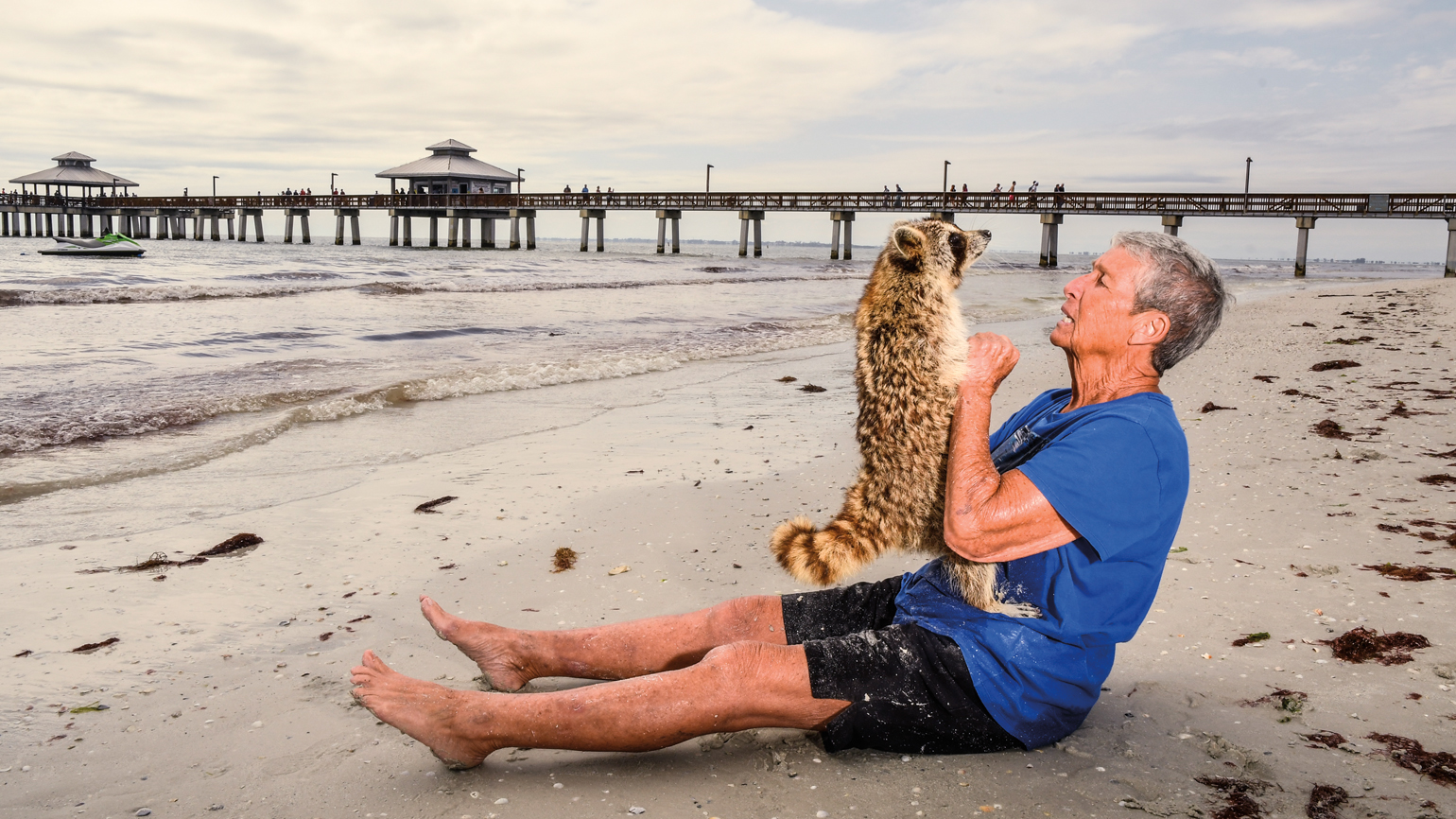
One hot June morning in 2009 a friend phoned me from the golf course near my North Carolina home. He had seen a golfer beat a baby raccoon with a golf club. It wasn’t unusual for me to get these types of calls. A licensed wildlife rehabilitator, I took in and cared for injured animals until they could be released back into the wild. The kit—just eight weeks old—was in bad shape. His face was so swollen I could barely find his eyes. I didn’t think he’d live through the night. But I took him home and put him on a heating pad inside a crate. I gave him fluids and cleaned his wounds, hoping for a miracle. He didn’t move for four days. I fed him formula with a dropper, but I had to massage his throat to help him swallow it. I can’t release an animal like this back into the wild, I thought. How would he forage for food?

On the fifth morning, I made the decision I always dreaded as an animal rehabber. This raccoon had no quality of life, and I was qualified to end his pain. I held the kit in my arms and looked into his beautiful black eyes. “I’m sorry,” I whispered. Just then, he opened his mouth and yawned. He stretched his legs. Then he shook himself. It was as if he were saying, “I’m still fighting!” Maybe there was a chance he could bounce back. I knew he had to strengthen his limbs. I put him in a bathtub full of water. Immediately, he started kicking. That was the confirmation I needed that he was going to be okay. But a few weeks later I was helping him practice walking when a wind slammed my back door shut. The kit didn’t jump. Oh no, I thought. He’s deaf. He couldn’t see or smell either. My own vision was failing. I knew what it felt like to be without all your senses.

Mys of Blackberry Valley In Article Ad

My mind went back to the day I had prepared to say goodbye. Maybe this life is just too hard for him. Maybe… “Don’t do it!” a voice said. I lived alone. Was God talking to me? I looked down at the raccoon. “You’re a real trouper, you know that?” In that moment, I promised both myself and Trouper that I was in it for the long haul. “No human will ever hurt you again,” I told him. Knowing I wouldn’t be legally able to keep a raccoon in North Carolina, I researched states where I could. There were only two. Virginia and Florida, my home state. Six weeks later, with my dog in the back seat and Trouper beside me in his crate, we crossed three state lines to start a new life. (I stopped driving a year later.)

Trouper, now 10, is a licensed wildlife ambassador and service animal. I take him to schools, churches and community centers to teach about the importance of respecting all life. People ask if he’s my raccoon. I say we take care of each other. I’ve healed many animals in need, but Trouper has helped me share that work with others. He’s a constant reminder that every creature deserves a chance. What’s more, he’s captured my heart. Every night I hold him in my arms and say, “Thanks for coming into my life and making it better.”

For more inspiring stories, subscribe to Guideposts magazine.

Advice for Newlyweds from Happily Married Couples

While not all married couples have wonderful relationships, those who have achieved the magic of a deeply happy marriage have much to share with us. Most will admit that marital joy isn’t magic at all, but a lifelong commitment to building and sustaining a meaningful life together in ways both big and (seemingly) small. Whether you’re about to celebrate your wedding anniversary or just about to walk down the aisle, this advice for newlyweds from the happily married may make a difference in your relationship.

READ MORE: How to Increase Joy in Marriage

Community Newsletter

Get More Inspiration Delivered to Your Inbox


7 Pieces of Advice for Newlyweds:

Newlywed couple hugging each other in their home

1. Greet Each Other Every Day

Claudia, who lives in California with her husband of 36 years, shares a daily routine that fosters connection first, life stresses second. “Unless the house is on fire, don’t greet one another at the door with a complaint about the job, kid, parent, in-law, or spouse,” she says. “We have a routine where the first person home greets the second one with ‘Welcome back.’ The other answers, ‘Glad to be back.’” This is her advice for any newlyweds looking to start a daily positive habit. “It’s like saying goodnight. If you don’t say it, you miss it. If you do, it provides completeness to the day.”

READ MORE: 6 Positive Habits for Your New Marriage

Newlywed couple giving each other advice during their coffee date

2. Have a Daily Date

Lisa and her husband meet every morning at the Starbucks in their hometown of Deerfield, Illinois after they get their three teenaged girls off to school. It’s 20 minutes for coffee and conversation before they get into their days. Their phones are off, and everything is on the table. “Even if we are [angry] at each other, we meet there and work it out,” Lisa says. “This special time—more than trips to Tuscany and the South of France—has been the secret of our deep love and friendship.”

Wife riding on her husbands back and smiling at some newlywed advice

3. Assume the Best of Each Other

Over 27 years of marriage, Mary and her husband, who live in Moraga, California, have learned not to take personally quips and quirks that don’t have to do with the relationship at all. This is their tip for newlyweds as well. “My husband and I were taking turns destroying each others’ sleep with our snoring,” Mary recalls. “I was so whacked out from lack of sleep, I convinced myself he was doing it to me. He, in turn, had been putting up with my snoring without complaining. We agreed to a gentle pillow tug to turn the snorer’s head. If snoring goes on, one of us volunteers to sleep in the guest room for a night or two. The spirit of compromise and the understanding that we aren’t out to get each other is vital.”

Newlyweds holding each other hands giving advice and comfort

4. Be Present to Each Other’s Pain

Stacey, who lives in Los Angeles, lost her mother recently. She worries about how her grief might be affecting her husband of 8 years—and he is heartbroken that she is in so much pain. Their advice for newlyweds during difficult times like this? Simply be present to each other through it all. “We’re hanging on tighter to each other,” Stacey says. “Right now I’m picturing how he held me in the driveway of my mother’s now-empty home Saturday afternoon while I wept.”

Parents discussing financial advice with the teen son on the laptop

5. Build on Your Common Values

Wendy and her husband, who live in San Francisco, “bring our values into everyday interactions,” she says. The couple’s oldest child is in high school, and as he grapples with making college decisions, Wendy enjoys how she and her husband are approaching their advice-giving from the same perspective. They encourage their son to take the time to find and pursue his life’s passions. “If we didn’t agree on this approach,” she says, “we’d be playing out our values battle through our son. Instead, we’ve grown closer.”

READ MORE: A Devotion to Help Strengthen Your Marriage

Young newlywed couple on the beach making a heart with their hands

6. Compliment Each Other—in Public

Telling others about your spouse’s strengths reinforces the things you most love about each other. Keith, who lives in Santa Cruz, California, gives this advice to every couple, both newlyweds and the long-time married. “Once I was in a large meeting explaining to a testy customer that if we planned correctly, we could meet their entire demand. He responded by asking me, ‘Are you telling me you have infinite capacity?’ I answered, ‘Sir, the only thing in this universe I am sure has infinite capacity is my wife’s patience.’ Everyone laughed, but I was serious. I’m fully aware every single moment of the day how thankful I am for her patience and love.”

Happy couple hiking together in the woods after getting some advice

7. Learn and Grow Together

Wendy and her husband, who live in West Orange, New Jersey, celebrate their 48th anniversary this month. Her advice for newlyweds to attain long-term happiness is to cultivate a spirit of growth and learning in their relationship. “Do something surprising and adventurous together—going to a yoga retreat, whitewater rafting, taking different courses, traveling, and having other learning experiences,” she says. “One of the best things my husband and I did was to go to Omega Institute, a holistic learning center, to take workshops. He initially didn’t want to go, but later he became a big proponent, and we went maybe 10 times. We brought the kids!”

7 Bible Verses for Newlyweds:

Newlywed couple dancing in their kitchen
  1. I am my beloved’s and my beloved is mine. —Song of Solomon 6:3
  2. And over all these virtues put on love, which binds them all together in perfect unity. —Colossians 3:14
  3. I found the one my heart loves. —Song of Solomon 3:4
  4. Mercy, peace and love be yours in abundance. —Jude 1:2
  5. Be devoted to one another in love. Honor one another above yourselves. —Romans 12:10
  6. My command is this: Love each other as I have loved you. —John 15:12
  7. Two are better than one, because they have a good return for their labor: If either of them falls down, one can help the other up. —Ecclesiastes 4:9-10

READ MORE ADVICE FOR NEWLYWEDS:

How to Stay Connected with Your Grandchild While Social Distancing

“Aubree’s school has closed,” my granddaughter Kaitlyn wrote in an email. “I’m working from home.”

“We’re sheltering in place,” I responded. “I wish I could hug you guys.”

God's Constant Presence In Article Ad

This time away for my six-year-old great-granddaughter Aubree from her teacher and classroom would be hard for Aubree. And being separated from her, without physical interaction, would be hard for me too. How could I stay connected with Aubree?

I knew Aubree was missing the projects and affirmations she got every day at school, so I asked Kaitlyn if it would be okay if I sent some assignments. With her permission, I came up with a few projects for Aubree. 

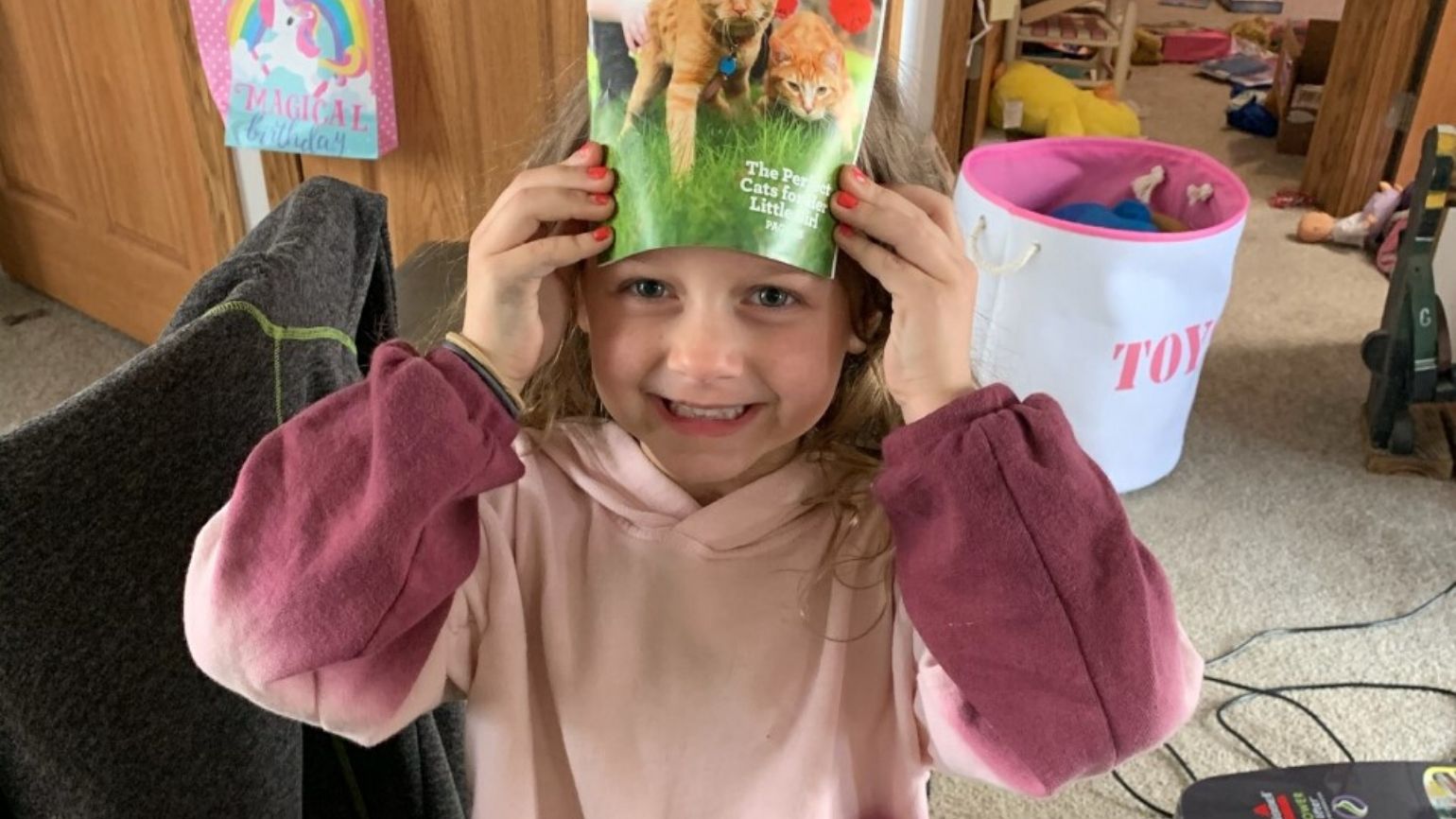
The next day I sent Aubree (through her mommy’s cell phone) a selfie of me with a paper birthday cone hat on my head and asked her to send back a picture of herself with something on her head. Her mom helped her respond by sending a picture of Aubree wearing the All Creatures magazine I had gifted her proudly perched on top of her head. Her big smile made me smile too. “Thank you for the cute picture,” I texted back. 

The following day I sent this message: “Your next assignment is to take a picture of a blank page in a coloring book and send the picture to me. Then tomorrow, send me a picture of that page colored in by you. Take your time. Make it pretty and your best work. Grandma is going to save every picture you send me. Love you!” I ended with a red heart.

Kaitlyn texted back. “From Aubree: “I love you Grandma.” Attached was the uncolored picture.

About 40 minutes later my phone pinged. There was Aubree holding a beautifully colored picture. Kaitlyn texted, “You gave her an assignment and she was determined to get it done today!” 

I’ve prompted her with photos, like the one I sent of a rainbow-colored sheep I keep on my desk. My text told her the picture reminds me that I’m different, and it’s okay to be unique. I told her to take a picture of her favorite animal and tell me why she likes it so much. 

Other tasks have included sending a picture of herself helping mommy wash, dry and put away the dishes. Or organizing all of her stuffed animals into neat rows in her room and all of her baby dolls and clothes into plastic bins. 

To step it up a notch, I asked Aubree to put together a puzzle, then to take a photo with it and send it to Grandma. 

In every reply, I’m sure to express my admiration with an emoji high five, a “good job” or an “awesome.. Instant over-the-internet encouragement.

Right now I can’t see Aubree in person and get a warm hug or stand at the kitchen counter, bake a cake and lick the beaters after we frost it. But with a little creativity and intention, I’m staying connected to my granddaughter—and helping mommy keep her busy too!

How to Shake Grumpy Mom Syndrome

An elderly woman in the grocery store smiled at my children and sweetly said, “Aren’t they just precious.” Through clenched teeth, I smiled back and said, “Thank you!” But in my head, my answer was, “No. No they are not!”

My cherub angels melting the hearts of strangers were quite the opposite of precious that day. They’d tested the boundaries of my patience so severely, that my sweet mama voice had transformed into sounds straight out of The Exorcist.

Mys of Blackberry Valley In Article Ad

I love them. I know this. But those fuzzy feelings had gotten buried under frustration, fatigue, anger and other emotions that made it difficult to be the mother I want to be that day. I was suffering from Grumpy Mom Syndrome, or as I call it, GMS, and I needed to get it under control. So when I feel myself in its grip, these are some of the things I do to shake it off.

1) Pray.

Taking a moment to pray in a quiet place and collect your thoughts is always a great thing to do. But often I’ll ask my boys to pray for me. I let them know I’m having a hard time and I could use some intercession. It helps them understand that I’m human. I’m flawed. It allows them to know it’s okay to ask for help when needed. They get to witness my faith when I say I know God can make it better. Usually they’re happy to take part in being a solution to my problem, and after I hear their sweet voices speak to the Lord on my behalf, my restoration is already half way there.

2) Get Silly.

When I find myself barking off a list of instructions, sometimes I’ll just go into a Scottish accent. I have a variety of accents I pull from, and soon enough, saying “Put on your socks, go find your shoes, pick up your toys,” doesn’t make me sound like such a nag anymore. They’re cracking up, I’m chuckling at myself, and they’re doing as they’re told so they can hear the next instruction in “Valley Girl”, “Old lady from Jersey”, or “Southern Belle”. It’s hard to be a grump when you’re being a clown!

3) Dance it out.

Sometimes I’ll put on some fun music and dance around – release those endorphins (chocolate helps too).  Turn clean up time into a dance party or a game with your kids. Commit to just turning the atmosphere around and have fun with it.

Shop Guideposts Mother’s Day Gifts!

4) Make some “me time.”

Instead of a quick shower before bed, draw a bath and light some scented candles for a bit of aromatherapy. While this is much harder to do with a newborn, when they’re older, make sure you carve out quiet time for yourself to decompress and de-stress before falling asleep, to ensure you get a higher quality of rest and wake up feeling refreshed.

5) Ask for Help.

Reach out. Don’t isolate yourself and try to do everything on your own. Let the people in your life help you with the areas in which you’re struggling. I’ve learned that most people are not just willing to help, but happy for the opportunity to be a blessing. Go ahead! Make their day!

6) Make a Life Change

If your GMS is chronic, it might be time to step out in faith and make a radical change in your life. After a career change last year, my life drastically changed for the better. It was a scary move, but it taught me that sometimes playing it safe is often more dangerous for you and your family than taking a chance. Seek outside help to get to the root of what’s keeping you unhappy and come up with a plan for how to change your life for the better.

Grumpy Mom Syndrome will happen. We won’t always respond to our children in ways that make us proud. But we must also remember this – we are not alone. We need to forgive ourselves ask our kids for forgiveness, and keep moving forward. With a little patience and grace, we’ll remember that even in those moments when our children don’t seem so precious…they absolutely are.

How to Rekindle a Friendship

There is a saying that people come into your life for a reason, a season—or a lifetime. But what if you’re longing for a friend from your past to be a part of your present life? Friendships dissipate for a number of reasons.

Sometimes there’s a big falling out and the relationship ends with a bang. More often, people drift apart due to time and circumstances. “Friendships ebb and flow,” says Adam Smiley Poswolsky, author of Friendship in the Age of Loneliness.

Pray a Day Vol 2 In Article Ad

“Maybe you are roommates, but then one of you moves across the country and you don’t talk as often.” Or maybe the pandemic has shrunk your social circle.

Whether your friendship was put on pause by Covid or you want to reconnect with an old buddy you haven’t spoken to in decades, you should get crystal-clear on why you want to re-establish the bond before reaching out.

“Is it coming from a positive place?” psychologist and friendship expert Marisa Franco asks. “Or are you feeling lonely and caught up in nostalgia for a happier time? Really evaluate if this friend will add something to your current life.”

Once you’ve decided to move forward, stay positive. “It helps to think of it as a dormant relationship instead of one that’s over,” Franco says. “Assume that the other person wants to hear from you. You can open up the connection again.”

It’s natural to be nervous about the possibility of rejection. Forge ahead anyway. As Franco says, “We all have a tendency to underestimate how enjoyable our social interactions will be”—and how much other people like us.

Are you hesitant to reach out because you’re mired in doubt and guilt for letting the relationship lapse? “People think it’s awkward because they haven’t spoken in so long,” Poswolsky says. “Just let it go. Be the first to reach out and say, ‘Hi, I miss you. Can we talk?’ Try breaking the ice with a funny picture or a happy memory.”

A phone call can be overwhelming, notes psychologist Kyler Shumway, the author of The Friendship Formula. “Start small by sending a text or email or even a letter,” he suggests. “It’s a way to send a simple, non-threatening message. The other person can sit with the message while they decide how to respond—or even if they want to respond at all.”

How about a friendship that’s dissolved due to a conflict? “It’s easy to think about what the other person has done wrong,” Shumway says. “But are you willing to reach out and own any hurt you may have caused and ask forgiveness? It goes a long way if you can say, ‘I prioritize us over the disagreement.’”

Your message should depend on the level of friendship you’re seeking, Franco says. “Do you want to be in an intimate friendship with them? Then you need to be able to talk through the conflict.” Which means sooner rather than later, you’ll have to move beyond text or email and talk on the phone or in person.

If your friend doesn’t respond to your initial overture, Shumway suggests following up—once. Still no response? “They are not ready, and you have to respect their need for space,” he says.

And what if you never hear back? “Rejection can sting,” Shumway says. “Let yourself feel hurt. Then give yourself some grace and compassion. You can rest easy knowing you planted a seed by trying. They can think on it, pray on it. Then maybe they will feel in a place where they will come to you.”

Poswolsky says acceptance is key, no matter what the outcome is. “You can’t control how somebody responds. It doesn’t mean they hate you. It just means they don’t want to reconnect right now. That’s it. Maybe you’ll hear from them in three months or three years.”

If your bid to reconnect is successful—“It’s common that people who reach out are surprised and delighted to hear: ‘Oh my goodness, I’ve been thinking about reaching out to you!’” Shumway says—then it’s time to shift into maintenance mode. Poswolsky is a big proponent of regularly scheduled meetups.

“I like having rituals that you return to,” he says. “I have a boys hike with my closest college friends each year where we go off the grid for a few days. I have a monthly game night with some other friends.”

“It’s important to prioritize working on friendships. They’re crucial to our well-being. The stronger our connections to others, the happier and healthier we are. “You have to have intention; you need to take initiative,” Franco says. “Science tells us that people who see friendships as a matter of luck are lonelier. Sometimes we get too busy and take our friendships for granted.”

She has found that pulling back from social media has given her time to become a more thoughtful friend. “Social interaction is a muscle. The more you use it, the stronger it becomes.” So go flex that muscle!

For more inspiring stories, subscribe to Guideposts magazine.

How to Pray for a Friend Who Has Angered You

Not long ago a trusted friend said some very unkind things to me. She was suffering physically and struggling emotionally. So, although I wanted to scream, “How can you treat me this way?” I also understood there were extenuating circumstances. But wow, I felt abused.

Fortunately, holidays intervened, and we didn’t see each other for a couple of weeks. My rawest emotions subsided, though I remained hurt. She didn’t apologize, and in fact seemed unaware she had done any harm. Before saying anything to her about it, I decided to pray. I find that when someone hurts me, they feel like an enemy even if they are someone I love. Jesus had good advice on that: “Love your enemies and pray for those who persecute you” (Matthew 5:44). 

Daily Strength for Women in Article ad

Jesus didn’t say to pray about our enemies, but to pray for them. My take on that is that we’re meant to pray for their good. Haltingly at first, I prayed blessings upon my friend each morning for a week. I asked God to shower her with the grace she needs to grow in love of Him. I asked Him to fill her with the Holy Spirit and guide her into all truth. I asked Him to open her heart to being His servant.

I do not know the details of how those prayers played out in my friend’s life, but I do know how they affected mine. As I centered my prayers on what was good for my friend’s soul, my heart shifted to a better place. By the time we met up again my temporary wounds were less important to me than how she was doing—and how to resume our friendship. 

How to Maintain Long-Distance Friendships

In my 20s, I left Kentucky and moved to Ohio. Then California. Then Colorado. And then back to California before finally returning to my hometown. Every relocation meant there would be friends I’d have to leave behind to set off on my next adventure. Over the years, I’ve learned a lot about keeping the lifelines to a friendship intact no matter how many miles are between you.

1) Manage Expectations

Pray a Day Vol 2 In Article Ad

You and your friend might not be able to hop on the phone every day or even every week. We’re all busy and there are probably in-person friends and family making demands on your pal’s time. That doesn’t mean they care about you any less. It just means when you do get time on the phone or a chance to video chat, you must make the most of those moments. I had a friend move to China for work. Sometimes when she called me, it’d be 1 a.m. my time, but I’d stay up and chat with her because I knew how hectic her expat life was.

2) Be ready to go the extra mile.

If you or your friend travel anywhere remotely near each other, go out of your way to get together. A friend of my mine flew from Orange County to Nashville for a marathon. I drove three hours from Kentucky to spend time with her. When I lived in California, I had friends who extended business trips so that we could spend a couple of days together.

3) Schedule time to chat

My best friend from high school was a new mom and I was in a different time zone in grad school. But she made an effort every few weeks to call me on her drive home from work. We’d have a good 30-40 minutes of uninterrupted chatting. This continued even after she had a second baby. When I moved back home our friendship felt like I’d never left.

4) Vacation together

Most people have a limited amount of vacation time and funds. If you don’t live someplace vacation-worthy, why not plan a trip with your buddy? One friend and I hadn’t lived in the same state in 5 years, but I saw her on a trip, whether it be to Costa Rica or a quick weekend trip to Vegas. Not only were we staying in touch, we were creating new memories together.

5) If you feel it, say it

When my friends are far away, I make a point to remind them of how special they are to me. When there’s distance, it can be harder for people to see how they’re contributing to your happiness. Sometimes after I’ve vented to a friend on the phone, I’ll send a quick follow up text thanking them for their time. I’ve received cards and “just because” gifts in the mail from friends who want me to know they’re thinking about me.

6) Connect over little things

If you’d read our text messages you’d think some of my friends and I saw each other all the time. We text each other about the mundane things like having to work late or losing an earring. By being able to connect over little, casual things and not just the big life events, we’re creating a more steady, constant presence in each other’s lives. Another friend and I maintained our connection over a TV show we both watched each week. We always had an excuse to text each other.

7) Use Social Media

Social media has been such a blessing when it comes to keeping my long-distance friendships going. It’s allowed me to not only keep up with my friend’s lives passively, but I’ve also come to learn more about their other friends in the comments section and that makes me feel more deeply connected to them.

8) Know when to hold ‘em and when to fold ‘em

Not every friendship is a friendship that can survive long distance. Some friendships are solely dependent on your proximity to that person – and there’s nothing wrong with that. It’s kind of like that work pal you stopped eating lunch with when you got a new job. When I lived in Denver I had a friend I saw several times per week. Shortly before she moved to Atlanta, we realized we didn’t have much in common besides our desire to move to new cities. So, we didn’t stay in touch.

Keeping friendships alive after a big move takes work. But as we get older it can be harder to make new friends and there’s something deeply gratifying about having someone in your life whose known you for many, many years. So, make the effort! Your kindness and commitment will be rewarded by having more people in your life that care about you – and a couch to crash on anytime you’re in your friend’s city!

How to Have Joy: A Lesson from Grandkids

I’ve spent a lot of time with all six of my grandchildren the past few weeks. We’ve had pool parties, sleepovers, picnics, and birthday parties. And in all the hours we’ve spent together, I’ve been reminded of something: Children are sheer joy.

I know for sure that they bring me joy. Simply seeing their sweet faces always makes me smile—and I suspect that every grandparent will agree with me that grandchildren are one of God’s best inventions.

Journey With Jesus in article ad

One night recently as I sat and watched them play and run with delight in the field behind my son’s house, my heart melted as I watched my grandchildren’s happiness at being with their cousins. I thought about some of the life lessons about joy that we can learn from the little ones:

  • Spending time with those we love truly does make life better.
  • It doesn’t take something big to make them happy. They find joy in the little moments, in little acts of kindness—whether it’s stopping to help a little playmate up when he or she falls or coloring a picture for their parents or grandparents. The same is true for us as adults. Acts of kindness to others enrich our lives.

When’s the last time that we slowed down long enough to truly appreciate the beauty of a sunset, the perfection of a dew-covered rose, or the blessing of a loved one’s hand clasped in ours?

God has given us some reminders—some precious verses about joy in His Word.

Weeping may endure for a night, But joy comes in the morning. Psalm 30:5

A merry heart does good, like medicine . . . Proverbs 17:22

Now the God of hope fill you with all joy and peace in believing, that ye may abound in hope, through the power of the Holy Ghost. Romans 15:13

Rejoice in the Lord alway: and again I say, Rejoice. Philippians 4:4

. . . ask, and ye shall receive, that your joy may be full. Acts 16:24

What could you do today to bring joy into your life—and to give it away to someone else? 

How to Find Hope and Joy in the Face of Tragedy

Most of us have watched news footage of crimes that been committed against innocent folks and had our hearts ache for what they went through. We care, but after a few moments of empathy, we go back to our daily routines.

But for those who have been touched by those horrific events, life is never the same again.

God's Constant Presence In Article Ad

I remember thinking about that a number of years ago when I watched a movie, Nightmare in Columbia County

It was the tragic story of 17-year-old Shari Smith who’d been abducted from her driveway, leading to national media attention and the largest manhunt that had ever been conducted in South Carolina.

After murdering Shari, her abductor placed eight phone calls to Shari’s family, often talking with her sister, Dawn, in chilling, heart-rending conversations. The murderer eventually gave Dawn directions to Shari’s body.

I couldn’t imagine the depths of grief and fear the Smiths went through, and I’d often wondered what happened to them in the years after that. So I looked forward to meeting Dawn Smith Jordan when I discovered that she’d do the music for the worship sessions at the Carolina Christian Writers Conference where I’d also be on faculty.

When Dawn stepped onto the platform, I immediately noticed her beauty. No surprise since she was crowned as Miss South Carolina (1986) and was 2nd runner-up to Miss America.

But what struck me was her joy. She literally glowed as she sang. Where so many people would have been bitter, allowing those horrible moments to ruin their lives, Dawn chose joy—and because of that, God’s been able to use her life in an amazing way.

Read More: Mornings with Jesus Devotional

I spent a little time with Dawn later that day at the conference. I asked her how she’d survived those awful days, and I loved her reply:  “The marvelous thing about God is that the deeper the tragedy, the greater the grace.”

Dawn said that part of the healing came from her sister, Shari: “Shari’s murderer allowed her to write a letter of farewell to us, saying: ‘Please don’t let this ruin your lives. Just keep living one day at a time for Jesus. Remember, everything works out for the good to those that love the Lord. Some good will come of this.’”

Dawn and Shari’s words are a vivid reminder that none of what we live through goes to waste. God can use all of it for His glory if we’ll tell others about what He’s done for us.

That’s what Dawn has accomplished, sharing her testimony across the country, proving that God can bring joy in the midst of our darkest days…if we’ll just let Him.

How could God use your life story to help someone else?