

Embrace God's truth with our new book, The Lies that Bind

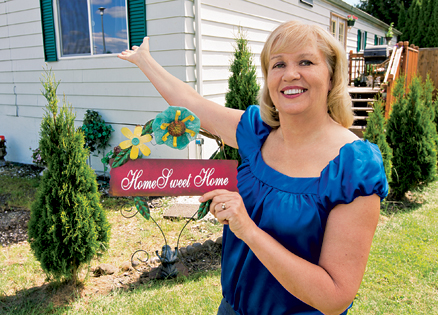
Foster Mom Finds Her Dream Home

I was doing the dishes when the strangest urge hit me. The wildest urge, considering where I was in my life—54 years old, recently divorced, raising two teenage foster daughters on a fixed income. I’d had health problems a few years back that forced me to stop working and go on disability, as much as I hated to.

I looked around my cramped apartment: The kitchen so tiny that my girls and I couldn’t all be in there at the same time. The early American garage sale furniture. The dull as, well, dishwater shade of beige on the walls that I couldn’t change because I was just a renter, and I could barely make the rent.

Pray A Word a Day - 2023 In article

I was tired of having my dreams squashed. Especially one dream I’d cherished ever since I was a little girl. I wanted a house, a place I could paint and decorate just the way I liked, a place I could really call my own.

I rinsed the dishes and sighed. I knew I had a lot to be grateful for. I was starting to put my finances back together after the divorce. My foster daughters were resilient and seemed to be adjusting to being in a single-parent home. Our apartment was small but it was a roof over our heads.

Still, I couldn’t help feeling I’d made a mess of my life. I closed my eyes and hung my head. Suddenly I felt something strange. An urge to pray came over me, and it wasn’t in a way I’d ever prayed before. This was as if some presence outside of me was gently moving my lips and telling me what to say.

“Lord, I want a house of my own,” I murmured. “A nice house, big enough for me and my daughters, with three bedrooms and two bathrooms and a large kitchen so we can fix meals together. And a separate living room and family room so the girls can have a place to hang out with their friends.

"And a yard for the dog. And no stairs, since stairs are hard for me. And hardwood floors and a heat pump. And could it please be in the girls’ school district? A place like this is way more than I can afford, Lord, but you know how much I want this. I put it in your hands. Amen.”

My eyes flew open. I didn’t know whether to laugh at myself or cry. What had I just prayed? Had I really dared to give this ridiculous list of requirements, this wild dream of mine, to God? I put away the dishes and tried to put away thoughts of nice new houses too.

Yet every time I stepped outside something got me going again. Down the street newly built condos were for sale. “No Down Payment!” the sign boasted. I took a look. These condos were tiny, even smaller than my apartment! Who was I kidding?

“Why don’t you try a mobile home?” a friend suggested. I hate to admit it but I thought a mobile home just didn’t fit my dream. I looked over the budget I’d made for myself after the divorce. My friend was right. A mobile home was what I could afford.

Even then maybe not. My only financial wiggle room was my monthly tithe to church. And I was not about to stop tithing.

I opened the newspaper. I looked in the classifieds under mobile homes. Whoa! New mobile homes were expensive. Plus you have to rent space and pay to move them. I was so poor I couldn’t even afford a mobile home!

Next column over I saw a section for used mobile homes. I looked closer. The prices were much lower. Maybe there was something under thirty thousand dollars. A mortgage payment for that amount would equal my current monthly rent. I spotted two places in that price range.

I called the numbers. Before I knew it, I had two appointments.

All right, Lord, I’ll give it a shot.

The next day I drove outside town along a narrow, rutted road. I pulled up to what looked like a shack surrounded by junked cars. The ad said the house had three bedrooms. Really?

A woman opened the door. Whoa. The air smelled like mold—and worse. The place was falling apart. The carpet was black with stains. I tried not to show my feelings. The third bedroom turned out to be a wall torn out of the trailer’s side with an extra room tacked on.

I told the owner the house wasn’t quite right for me and hurried back to my car. I couldn’t face the thought of my next appointment. Obviously this was all I could afford—a dump. I thought about calling to cancel. But the woman at that other house had sounded so eager. I just hoped her place smelled better than this one.

At least the road there was nicer. Lots of wildflowers. I pulled up to a well-kept property with a lovely single-story house perched on a hillside. I looked around for the trailer. It must be out back.

A woman emerged from the house. “Hi, I’m Kathy,” she said. “Come on in.” She showed me into a spacious room with hardwood floors. Two teenage boys sprawled on the sofa playing a video game.

“This is the living room,” said Kathy. “We just put in the floors but it really needs a new paint job. We figured the new owners would want to pick their own colors. The kitchen’s through here.”

“Wait,” I said. “This is the mobile home?”

Kathy smiled. “You like it? My husband and I have remodeled several times. But now we want to build a permanent home. So we need to sell this one. Come on. Let me show you around.”

I followed Kathy in a daze. She led me through three big, bright bedrooms. Two bathrooms. A laundry room. A nook for a home office. She showed me where the heat pump was.

The kitchen had ivory floor tiles, green counters, gleaming white cabinets, a cooking island and brand-new appliances. I could just picture my girls and me fixing dinner together.

“Here’s the family room,” Kathy said. “Perfect for teenagers. Do you have kids?”

I told her about my foster daughters.

“Wow,” said Kathy. “That’s great of you to take kids in like that. Mark and I have talked about it. Maybe we should do it now that our boys are older. You like the house?” She opened a huge linen closet.

“I love it!” I said. This was one of the nicest homes I’d ever seen—mobile or otherwise. “I just—I can’t believe the price is so low.”

“Well, you know, used mobile homes depreciate a lot,” Kathy said. “And like I said, Mark and I really want to get started building. So we’d like to sell.”

Kathy walked me out to my car. I told her I’d be back in touch when I secured a loan. We clasped hands. It was like we were already friends.

I called the bank as soon as I got home. “A used mobile home?” said the bank officer. “I’m sorry, we don’t issue loans for those.”

I called another bank. And another. They all said the same thing. I called Kathy and asked for more time. I called more banks. Mortgage companies. Three days later I had to admit defeat. I called Kathy back. “I’m sorry,” I said, practically in tears. “I can’t get a loan anywhere. I’m afraid I won’t be able to buy your house.”

“Oh, I’m so sorry,” said Kathy. “You seemed to like it so much. And it sounded perfect for your daughters. Well, best of luck.”

I hung up and cried. So much for that dream of mine.

Then came a worse blow: My grandmother passed away. She left me twelve thousand dollars, which was wonderfully generous but nowhere near enough to buy a home as nice as Kathy’s. I sat through the funeral feeling lower than ever. That big, wild prayer I prayed…why did you let me hope, Lord?

A few days later the phone rang. “Barbara? It’s Kathy. With the mobile home, remember?”

Oh yes, I remembered. Kathy went on, “We’re having trouble selling. Everyone seems to have the same problem getting a loan as you did. But we really like you and we want you to have the house, especially for your girls. So we’d like to offer to carry the loan. Don’t worry about a credit check or anything. We’ll work out payments that you can afford. You’ll just have to cover the cost of moving the home.”

I hardly dared to ask. “How much would that be?”

“Around twelve thousand dollars,” Kathy said.

I almost dropped the phone.

“I’ll take it,” I managed to say. For a fleeting instant I felt that same presence, the One who had been there urging me to ask for my wildest dream, to utter my biggest prayer ever. I closed my eyes. This time no one needed to guide my lips. “Thank you, Lord, for all you do and all you have given me.”

You probably won’t be surprised to learn that I found the very last available mobile home site in the girls’ school district, with a yard for the dog. Or that it turned out my mom had been squirreling away money for when I finally bought a house, enough for new furniture and paint so the girls and I could decorate just the way we liked.

Or that about a year after I moved into the house of my dreams, Kathy told me I’d inspired her and Mark to take in foster kids.

You could call all of these things coincidences. I think they’re the fruits of faith. Faith is the greatest resource we have for coping with tough times. I know God doesn’t always answer prayers exactly the way he did mine. But he does answer. Always.

Download your FREE ebook, A Prayer for Every Need, by Dr. Norman Vincent Peale
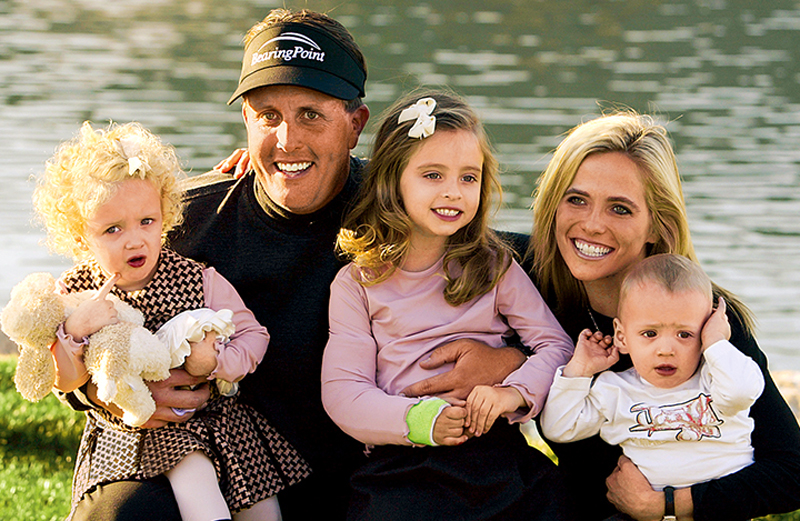
For Phil Mickelson, Family Comes First

To celebrate Phil Mickelson’s thrilling comeback victory in the 2013 British Open—he came from five back at the beginning of play on the tourney’s final day to win by three strokes—we bring you this Guideposts Classic, in which Mickelson recalls the occasion in 1999 when he resolved that golf would take second place to his responsibilities as a husband and father.

My caddie slid the black pager into his pocket. It was one of those models that vibrate, like the type the hostess sometimes gives you when you’re waiting for a table at a crowded restaurant. Only one person—my wife, Amy—knew the code.

God's Constant Presence In Article Ad

“If that pager goes off, you tell me,” I instructed my caddie as we walked from the practice range through the crowd to the first hole.

I was about to tee off at North Carolina’s Pinehurst Golf Club in the final round of the 1999 U.S. Open, one of golf’s most prestigious tournaments. I had never won the Open—had never won any of golf’s four major events—though I had come tantalizingly close. Now I trailed by a stroke.

But a message on the pager would mean just one thing: Amy had gone into labor with our first child. I was determined to fly back to Arizona to be with her. In fact, I had a private jet standing by.

“If she calls,” I said to the caddie as he handed me my driver, “I’m out of here. I don’t care if I’m on the fourteenth hole with a five-stroke lead.”

My caddie looked at me like I was nuts. Payne Stewart, who was in first place and with whom I was paired that day, shook his head. They didn’t understand what this baby meant to Amy and me. More than golf. More than anything.

We’d been trying to have a child for three years. Doctors told us we might not be able to. Family was everything to Amy and me. We were both brought up to believe that raising children would be the most important work of our lives.

We married in 1996 and honeymooned in Hawaii. We lolled on the beach, imagining the size of our future family. We had a small difference of opinion.

“I want two kids,” I said.

“I’m hoping for at least eight,” Amy said. She grew up in Provo, Utah, on a cul-de-sac with eight houses—and 45 kids. Three were her siblings. “I’m just used to having a lot of children around,” she said.

We compromised that day. We decided to stop at three. Well, maybe four.

If only.

Over the next couple of years we tried and prayed, tried and prayed some more. Sometimes I’d watch Amy while she slept and think, Lord, can’t you see what a wonderful mother she’d make?

After three years we had just about given up. Though we loved each other as much as two people could, we felt somehow incomplete. We talked about adoption. “I want a child so badly,” I said.

That winter we returned to Hawaii for a friend’s wedding. Maybe it was something in the sultry, tropical air, but not long after, Amy shared the biggest news of our lives. She was pregnant at last.

Amy and I read every baby book we could find. We wanted to be ready for anything and everything. We knew from tests that our baby would be a girl. We decided to name her Amanda.

I went back on the road, back to the professional golf tour. Amy traveled with me much of the time, but the weeks apart were difficult. I’d call at night after finishing a round. “I felt Amanda kicking today,” she’d say. “It felt like someone was playing the bass drum inside me.”

Afterward, I’d sit back on my hotel bed and think of my own parents and how they raised my brother and sister and me. They were always there for us. Mostly, they taught us that goodness comes to those who work hard and have strong values, and that’s what families are for. To instill those values.

Dad was very patient with us; never got upset, never yelled. He managed our Little League and soccer teams. He was a good teacher. He’d show us a skill—catching a ball, solving a math problem—and then give us time to learn it. He was always willing to help, but only after he knew we’d done everything to help ourselves.

My mom was very competitive. She was captain of her high school basketball team. She loved to win, and for her children to win. But it was never everything to her. Doing your best and doing what’s right always came first.

Most of all, I watched how my parents treated each other. They never argued in front of us, and were always supportive. My siblings and I knew how much they loved us, and each other. “I just want to follow their example,” I told Amy. “I want to do for our children what my parents did for me.”

We already knew Amanda’s due date: about two weeks after the U.S. Open.

“What if she comes early?” Amy asked.

It’s funny. When I was still in college, a great golfer named Larry Mize made headlines when he announced he was skipping the Masters—another of golf’s major tournaments—so as not to miss the birth of his child.

I remember shaking my head and thinking, It’s the Masters, man, what are you doing? It wasn’t until Amy finally got pregnant that I was able to understand Larry’s feelings. Totally.

“Honey, I’ll do exactly what Larry did,” I said.

The day before I was to leave Arizona for the Open, Amy and I went to see her doctor. “Nothing to worry about,” he assured me. “Get on the plane.” But looking at Amy’s swollen belly, I didn’t find it so easy.

“Amanda and I will wait for you,” Amy promised.

“I’m going to come home with the U.S. Open trophy, we’re going to have the baby and it’s going to be the best week of our lives,” I said. “I’m not leaving you like this just so I can finish in the top ten.”

I had a reputation as one of the world’s greatest golfers. But I had another reputation too, a not so great one. The media called me the best player who had never won one of the sport’s major events.

I knew a lot of great players had gone far longer without winning a big one. I was still young and had plenty of time. But it was getting to me, all the talk every time I got within striking distance of one of those titles. I wanted to put that criticism to rest.

During the first three days of the four-round U.S. Open, I had let nothing interfere with my golf. Nights were another story. I shared a house with Fred Couples, another top golfer, and our caddies. We would watch a game on TV, then Fred would go to bed and I’d call Amy.

“I’m doing fine, Phil,” she kept saying.

At the end of the third round, I was just one stroke off the lead. I felt great. What I didn’t know—what Amy didn’t tell me—was that after we talked that night she went to the hospital. The baby, it seemed, was on the way. But Amy was so selfless, she didn’t want me to leave the tournament.

She told her doctor, “I want to wait for Phil. Please give me something to slow the contractions.” It worked. She was home Sunday, ready to watch me, oblivious to what was going on back in Arizona, go for the win on TV.

I stepped to the first tee. Payne and my caddie looked on. The pager made a little bulge in my caddie’s pocket. I half wondered if I’d be able to see it vibrate.

I took a deep breath and flushed everything but golf from my mind. I addressed the ball and boomed a long drive straight down the fairway. I was off to a good round.

So was Payne. The whole way we played neck and neck. On the sixteenth hole Payne made a long, winding 25-footer. Payne and I were tied. He birdied the seventeenth to pull ahead and sank an improbable 18-foot putt to clinch the win on the final hole. The crowd roared and I tipped my hat to Payne.

Payne walked over and hugged me. “Being a father is greater than anything you can imagine, Phil,” he said. “Greater than this. I’m so happy for you and Amy.”

That night I was on the plane, headed home to Arizona. I found myself thinking about Larry Mize. Back then nothing was more important to me than winning. I was like my mom, but without her healthy perspective. Then I fell in love with Amy and it changed me.

Thank you, God, for giving Amy to me, and for the baby you are about to give us. I didn’t think another minute about my loss.

Fans still remember that final round of the 1999 U.S. Open. They’ll come up to me and say, “If only Payne’s putt had rimmed out, you would have tied and gone into a playoff. You could have won.”

I have to smile. Amy gave birth to our daughter Amanda the next day, the day our playoff would have been held. Heck, I would have packed up my clubs the minute the pager went off. Payne would have won anyway!

And God knows, I won something much bigger.

Download your FREE ebook, Rediscover the Power of Positive Thinking, with Norman Vincent Peale

Forgiving Hank

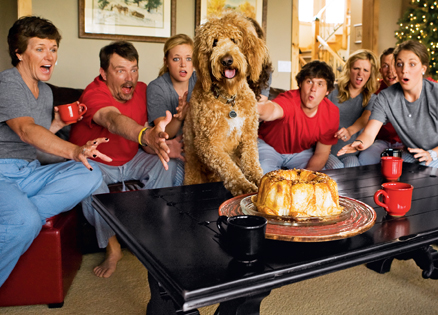
“You ruined Christmas!” I hissed at Hank. He stood guiltily next to the empty Bundt pan on the kitchen floor, swallowing the last bite of raw dough for my favorite and most an­ticipated family tradition: Christmas pull-aparts—delectable doughy treats mixed with butter, butterscotch pudding mix, sugar and nuts.

Then he licked my hand as if to say, “Those were delicious! May I have more?” The nerve!

Faithful Paws and Purrs In Article Ad

I should probably mention that Hank is a dog. My sister Meggie’s golden-retriever-poodle-mix puppy, to be exact. He was always getting his paws into some­thing. But now he’d gone too far. I had been looking forward to those pull-aparts this Christmas more than ever.

A year earlier my fiancé, Jeremy, and I got married and moved from my home state of Washington to California for his new job. I ’d missed my family something fierce and was thrilled that we were back at my parents’ celebrating Christmas with them and my three sisters.

We had a blast on Christmas Eve preparing the pull-aparts—our family’s breakfast tradition for as far back as I can remember. We rolled two dozen dough balls, all of us joking and laughing—my sisters and I wear­ing our matching pajamas (another beloved tradition my mom keeps up even though we’re all grown).

Then we’d put them in the pan and set them on the counter to rise over­night. Now, thanks to Hank, they were his­tory. And so was my perfect Christmas.

I stomped out of the kitchen and plopped on the couch. “Ugh. I can’t believe Hank ate all the pull-aparts,” I said, sighing, expecting my family to be just as annoyed.

“Oh, Lacie, you’re so dramatic,” Mom said. My sisters and Jeremy burst out laugh­ing. “Really, Lace. It’s not a big deal,” Meg­gie added. “We’ll eat something else.” What? Was no one else upset that this rambunc­tious puppy had spoiled our extra-special Christmas breakfast?

Dad sensed my aggravation. “C’mon honey,” he said. “Let’s see if there’s a gro­cery store open. Maybe you can make a new batch.” I nodded and grabbed my coat. Hank followed us. What did he want now? He dashed out into the snow and stopped suddenly. Uh-oh. Yup, you guessed it. Hank got sick.

Serves him right, I thought. Meggie ran over and rubbed Hank’s fur, her eyes filled with worry. My heart softened a little. But I just couldn’t shake my anger.

Dad and I found an open grocery store and they had all the ingredients I needed. Back home, I sprinted inside, anxious to get started on round two of the pull-aparts. But Hank was sprawled out on the kitchen floor, whining. He tried to get up, teetered forward and hit his face.

Oh, no! I dropped the grocery bags, helped him to his feet and took him outside. He swayed back and forth and got sick again.

Meggie frantically looked up Hank’s symptoms online. “Sounds like alcohol poi­soning caused by the pull-apart dough fer­menting in his stomach,” she said. “We have to take him to the vet. It’s serious.”

We piled in the car. At the emergency veterinary clinic they confirmed that Hank had alcohol poisoning. They pumped his stomach and attached an IV bag of fluids to his little leg. I’d never seen him look so in­nocent. So helpless. Lord, forgive me for not forgiving Hank. And help him get better.

A few hours later we took Hank home. He rested quietly on his doggie blanket while we worked on the pull-aparts. They were a hit, as always. Warm, gooey and delicious. I looked around the room at my husband, at my family—the ones who’d do anything to make me happy—and at Hank.

I knelt down and petted his golden head. “I ’m so sorry, buddy,” I said. No, he hadn’t ruined anything. He’d made me realize that I had all the ingredients for a perfect Christmas right in front of me. Including one sweet, mischievous puppy.

Try Lacie’s recipe for Christmas Pull-Aparts!

Forgiveness in the Family

My son, Patrick, looked so handsome in his cream-colored suit, leading his bride, Danielle, onto the scuffed hardwood floor at the center of the old-time dance hall for their first dance as husband and wife. Hands entwined, Danielle’s satin train swishing at their feet, they twirled in unison.

Until Patrick missed a step. He made a goofy face. They both laughed, and picked up right where they’d left off.

“They’re so great together,” my husband, James, whispered. That was for sure. I squeezed his hand and nodded.

But then my gaze wandered to the other side of the hall, where my ex-husband, Terry, stood, a reminder of the one item left on my wedding checklist. God, I know what I have to do, I thought. But I don’t think I can do it.

I’d dreamed of this day—my son’s wedding—for a long time. What mother doesn’t? But for me, it was more than a celebration of Patrick marrying the love of his life. It was a validation of the relationship I’d struggled to rebuild with him after his father and I divorced, 11 years earlier.

Patrick was only 15 at the time, and he took the breakup really hard. He stayed with his father, and for two and a half years he refused to speak to me, not even by text. Now he was holding in his arms the girl I’d introduced him to, and smiling whenever his eyes met mine. All the pain of the past seemed to be forgiven.

I sensed, however, that one thing still bothered Patrick. It definitely bothered me. The rift between my ex-husband and me.

Both of us had moved on—I’d married James, and Terry was now engaged. But since the divorce papers were signed we’d hardly spoken—except when it was absolutely necessary for parenting Patrick and his sister, Lindsey.

I’d lost contact with Terry’s siblings, cousins, nieces and nephews too—relatives I’d loved as my own. Patrick’s wedding had brought us together again, and I didn’t want the estrangement to tarnish his special day.

I’d thought a lot about Terry and me sharing a dance. One dance, for Patrick’s sake. But all of our history stood in the way.

I’d thought Terry was Mr. Right when I married him, straight out of college. Some couples who marry young grow together. Terry and I grew apart. Criticism and arguments slowly smothered our relationship.

We stayed together so long—20 years—because I wanted the marriage to work. I didn’t want to hurt Patrick and Lindsey. Finally, though, I made what I thought was the most emotionally healthy choice for all of us and left the marriage.

Still, guilt plagued me. Terry—and his entire family, I assumed—blamed me for the divorce. And I felt like I deserved it. The same way I’d deserved Patrick’s anger.

Patrick and Danielle’s first dance ended, and my son wrapped his arms around his bride, leaning in for a kiss. Everyone applauded. I clapped extra hard. Reconciling with my son hadn’t been easy. We’d come a long way. Now we shared an extra-special connection—Danielle.

Her great-grandfather was my close friend. He had officiated at my wedding to James. So when I learned Danielle had transferred to the same college as Patrick, I’d pestered him (nicely) to ask her out. Several months later, Patrick called with some news. “Mom, the stars line up over Danielle!” he gushed. “She’s the one!”

I was elated, but planning their April wedding meant facing Terry.

My time with Terry leading up to the wedding was, thankfully, short (he probably was glad of that too). He immediately agreed to contribute toward the wedding costs, and left James and me in charge of the rehearsal dinner, which we hosted at a restaurant downtown.

All through the meal I wanted so badly to talk to Terry and remind him of some funny moments when Patrick was little. But I couldn’t, and he didn’t say much to me either.

The DJ blasted a pop song and the dance floor filled. Through the crowd, across the way, I saw one of Terry’s sisters-in-law. Go, Sheryl, talk to her, that voice inside my head urged. But I resisted. What if she didn’t want to have anything to do with me?

I looked at Patrick, having the time of his life. You used to think he’d never talk to you again either, I reminded myself. But I’d prayed, and I’d cried, and I’d prayed some more. I sent e-mails even though he didn’t answer. I kept reaching out.

Today I owed it to him to cross the dance floor, to close the rift, to reach out again.

Lord, here I go…

One foot in front of the other. It seemed to take forever. Then through the throng of dancers, I saw Terry’s sister-in-law’s face, saw her smile.

“Sheryl, I love your green dress!” she exclaimed when I reached her. “It’s so wonderful to see you again!” The sincerity in her voice cut through the music. She hugged me, and it felt no different from all the times she’d hugged me in the past. I hugged back, hard.

“Oh, you’ve got to introduce me to your husband!” she said, nodding toward James, jiving on the dance floor with my cousin’s little girl. “Y’all look so great together!” Other family members of Terry’s walked up to congratulate me on Patrick’s beautiful bride.

They don’t hate me, I thought. Maybe they never did.

I felt lighter as I rejoined James on the dance floor. Until I saw Terry and his fiancée at their table, talking with friends. We haven’t spent any time together all evening, I thought. Patrick was bound to notice.

“What’s wrong?” James asked.

“James…should I ask Terry to dance?”

“Go ahead,” he said. “I don’t have any problem with that.”

But would Terry? I could still picture the look on his face when I’d asked for a divorce. Shocked. Hurt. Bitter. What if he reacted the same way tonight?

The evening was almost over. I was running out of time. I took a deep breath and walked over to Terry’s table. This was it. “Would you like to dance, Terry?”

He looked surprised. “Sure,” he said, pushing back his chair.

He took my hands in his and we jitterbugged in slow circles. Terry smiled at me, his eyes crinkling. I smiled back, with tear-filled eyes. I just couldn’t stop the emotions that flooded through me. Joy for all the years we’d shared. Sadness for what we’d lost. Regret for the pain we’d caused each other and our children.

“It’s okay,” Terry said, his hand on my waist as he turned me under his arm. It’s okay. At that moment, all the tension left my body.

This dance wasn’t just an item on my wedding checklist, I realized. It was something I’d needed to do ever since I’d left Terry all those years ago. Assurance that my decision hadn’t invalidated what we’d built in 20 years together.

Patrick had forgiven me. Terry’s family no longer held any grudge. And now, Terry himself was telling me everything was okay. Anger alone hadn’t caused our estrangement. My feelings of guilt had also played a part. I couldn’t change the past. But I could let it go. It was time for me to reconcile with myself.

“We did good, didn’t we?” I said. “I mean, our kids, right?”

Terry nodded, turning me under his arm one last time. “Yes, we did, Sheryl. We sure did. Thank you for asking me to dance.”

The music stopped and we hugged. It had felt good, really good, to have a dance with Terry that celebrated what we shared, especially the best part of it—our love for our children. We’d all come full circle.


Download your FREE ebook, A Prayer for Every Need, by Dr. Norman Vincent Peale

Forget Your Troubles; Make Someone Else Happy

My mom had certain sayings she repeated so frequently that I came to think of them as Mom’s maxims. “Don’t be a snoop.” (Often intoned around Christmastime.) “Only a fool tells all he knows.” (Nobody wants to be a fool.) “Know when to leave a party.” (No one loved a party more.)

And the maxim that really stood out for me because I saw her put it into action so many times: “When you’re feeling blue, do something nice for someone else.”

The Lies That Bind In Article Ad

For Mom that often meant baking, and she didn’t necessarily have to feel blue to do it. I can still picture her in her kitchen, her gingham apron tied with a big optimistic bow, her red hair dusty with flour, wrapping thick slices of her famous favorite chocolate Bundt cake (that’s what we called it) in cellophane.

The last dozen years of her life, when her vision started failing, Mom lived with us in an attached in-law apartment. All that separated our households was the wall between our two kitchens.

I could hear the thump of her cabinet doors, the clink of her Pyrex measuring cup against the side of a ceramic bowl, the whir of her Sunbeam electric mixer, the creak of her oven door. The chocolaty aroma wafting through the wall signaled that a slice of Bundt cake might be in my future.

She always baked for her Bible study luncheons at Grace Church. If anyone was feeling down in the dumps or ailing or grieving, they were sure to get a slice. As one of her friends told me at her memorial service, “She showed that she loved us with her baking.”

It had been several years since Mom’s death, and my husband, Tom, and I decided to tear down the wall between the two kitchens and turn the space into a new kitchen and bedroom for us. The day before the contractors came, I took one last walk around Mom’s kitchen.

There were the three rows of extra-bright halogen lights Tom had installed to help her see. The temperature dial on the oven still had the blob of fluorescent-orange paint I’d used to mark 350 degrees. Mom was gone. Her Bible study had disbanded. And tomorrow her kitchen would be gone too.

I closed the door to the apartment behind me, feeling blue. I went upstairs to check my e-mail and was startled by a subject line: “Grace Church Bible Study Reunion.” From Fleming Rutledge, the pastor and Bible study leader.

“Kitty, I know you were not an official member of our Bible study,” she wrote, “but would you join us at our upcoming Reunion Luncheon to stand in for your dear mother? And one more thing, if you have the recipe, would you please bring her wonderful chocolate cake?”

What about the crew coming the next morning to tear down the wall and remove our old appliances, Mom’s oven and mine? I’d just have to bake the cake tonight and store it in the freezer in our garage.

“Yes!” I typed and hit send.

That night I lay in bed, comforted by the familiar chocolaty aroma that lingered in the air. Just before I drifted off I thought of Mom’s maxim: “When you’re feeling blue, do something nice for someone else.” What could be nicer than her chocolate Bundt cake?

Try Mom's Famous Favorite Chocolate Bundt Cake for yourself!
 

Following His Health Crisis, Their Marriage Is Stronger Than Ever

KM: Hi Guideposts, I’m Karla McIntyre from Pittsburgh, Pennsylvania.

TM: Hi Guideposts, this is Todd McIntyre here from Pittsburgh, Pennsylvania.

Community Newsletter

Get More Inspiration Delivered to Your Inbox


KM: In order to lower your stress and prevent burnout, it’s important to recognize self-care, and to make sure that you take time to take care of yourself. This isn’t something I always recognized earlier on, and often when people would ask me if I wanted them to provide me help, I would turn it down, because I wanted to constantly be present and make sure that Todd was cared for in the best way possible.

So it was hard for me at first to accept help and recognize the signs of burnout, so I would strongly encourage everybody to take time for themselves, even if it’s just a quick walk outside or looking at nature or stopping to play with your dog for a second. Whatever it is that you need to do to just take a few moments each day to do self-care and take care of yourself. It’s really important to recognize that is not a sign of weakness, but it’s actually a sign of strength.

TM: One of the things that you have to subscribe to is being humble enough to recognize that you can’t do this alone. And frankly, my recovery has been the combination of efforts from the entire village. I would’ve never got to the point that I’ve gotten to, had I not had the ability and support from all these people around me, to allow them to do kind things and ask for help when I needed it.

So yeah, to recognize that, although you may have been the primary bread winner and care provider for your family before your illness, once your wife becomes the primary caregiver, you have to recognize that she’s trying and capable and allow her to do those things you need her to do. Which is sometimes humbling, but it’s something that needs to be done to allow you to get to the next phase.

KM: The best advice that I would have to people who doubt these situations is to recognize, as soon as you can, that surprises are inevitable and you need to adjust to that the best that you can, and always remain faithful to yourself and to your heart, and to what you believe. If you do that, then taking surprises will be a little bit more easier for you.

TM: The most difficult part for me is honestly being patient in the level of recovery that I’ve gotten. Although in my opinion I’ve been blessed to make great gains, it has taken four years of on-and-off effort to get to this point, and honestly I can say that originally when I was in the hospital, I predicted I would walk right out of the hospital. I never would have imagined that it would’ve taken this long. So having the patience endure the multiple therapy sessions has really been the most difficult for me.

KM: The hardest part about being a caregiver for Todd was seeing my husband deteriorate in front of my eyes, and there wasn’t anything I could do about it. No matter how good of a caregiver I was, it wasn’t changing the situation; it wasn’t helping him improve or get better.

Losing that companionship for almost a year, while he was in the sickest part of his illness, was very hard and not having my best friend beside me. So although his recovery is not where he desires it to be, it is so relieving to me to have him back beside me and for us to be able to do things together as a family.

We are not able to do all the same activities that we once did. So we had to find new ways to enjoy our time together, ways that he would be able to participate in, and we have found those new pathways and we are able to enjoy our time together in ways that we maybe we wouldn’t have done before.

When we’re just sitting and watching television, I often will think, “Man, there was a time when I was told this would never be possible.” So we find enjoyment even in the smallest aspects of life now, and our faith has also grown considerably. We pray together a lot more than we did before the event, we attend church regularly together, we take walks together.

TM: One would be surprised, but my faith has gotten stronger from this whole event and I’m sure that people think I’m somewhat crazy when I would say that at the end of the day, I truly feel blessed in that a lot of people have less positive outcomes from my events, but my strength and my faith has gotten stronger each day.

Because there are times, as I said, you have to humble yourself and recognize you’re not capable of doing certain things without greater strength than we [have] and frankly, my faith in God has allowed me to do those things in times of need and frustration that he’s picked me up and he’s helped me get to the next level when I needed it.

KM: So our life is far richer and greater than what it was before this event happened.

Five Quilts for Five Sisters: A Goodbye Gift from Their Mother

Mama loved to surprise us. A box of her homemade fudge. A recording of a poem she’d memorized. Little gifts she’d brought back from a trip. Even with 10 of us—five boys and five girls—she always found ways to make each of us feel special.

Mama passed away in December 1997 at age 93. Two months later, on a cold gray February morning, four of us sisters gathered at our childhood home in Clarkesville, Georgia, to go through her things. Only our middle sister, Jackie, couldn’t make it; she’d stayed in Florida to nurse her sick husband.

Witnessing Heaven In Article Ad 827x123

Years before, Mama had already given each of us the big items she’d wanted us to have. Today we had a system: We each took the gifts we’d given her, then made stacks of items for the rest of the family, including her 34 grandchildren.

We sorted Mama’s many handkerchiefs. “She never went without a handkerchief tucked into her dress,” Pat, the oldest, reminded us. We went through the cupboards and linen closet; each teapot or embroidered pillowcase sparked more memories. Then it was time to go upstairs.

Although Mama hadn’t been able to climb the steps for a long time, she knew exactly where everything was up there. She would send someone to fetch a pair of scissors or a skein of yarn, telling them not just which drawer to check, but whether left, right, back or front. She knew every knickknack in every box, in the cedar chest, in the nooks and crannies of her enormous closet.

It took hours to divide her treasures into orderly batches. We piled them on the beds, the dressers, even the window ledges. But we still hadn’t tackled Grandfather’s big black trunk. It was more than a hundred years old and sat at the very back of the closet.

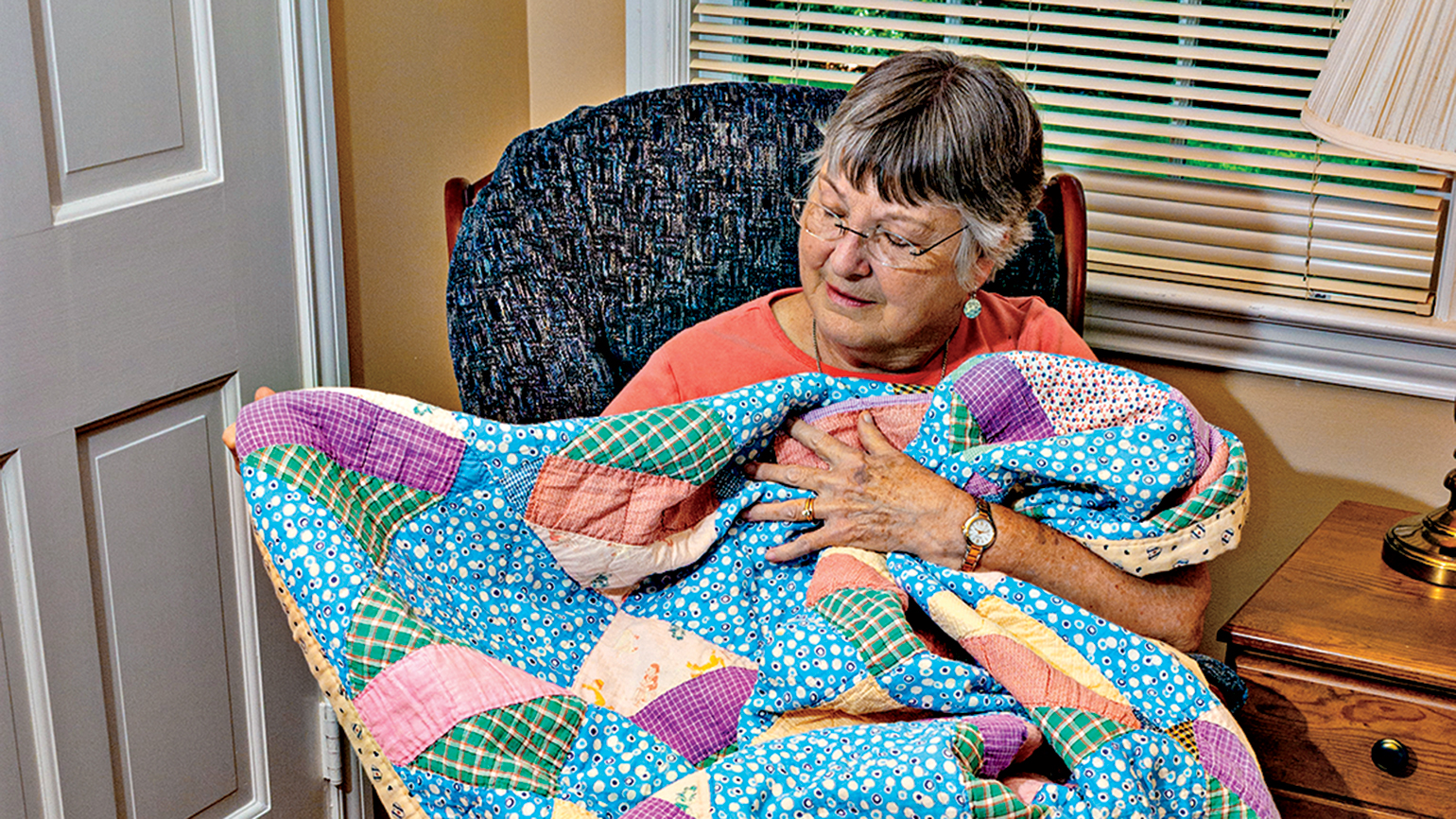
The trunk’s hinges groaned as we raised the heavy lid. We pulled out old coats, prom dresses, baby sweaters, all things we remembered. An old, yellowed sheet was spread across the bottom of the trunk. Was there something beneath it? I pulled back the sheet. We all gasped. There lay a mosaic quilt top, tiny squares of velvet in burgundy, green and gold.

Ginger lifted it carefully. Another quilt top, this one patterned with triangles of blue and pink. One by one, four quilt tops and one full quilt emerged from the trunk. “Five quilts, five girls,” Suzanne said in awe.

“Have any of you ever seen these before?” Pat asked. We shook our heads.

“Mama knew they were here,” Ginger said, fingering the velvet. “Why didn’t she tell us?” We had no answer.

“Do you think she made them herself?” I asked.

“Could be,” Suzanne said, though as far as we knew, Mama had never had the time to make quilts as fine as these. Hers were practical, made for warmth with scraps of old coats and trousers, nothing fancy like these.

We searched the trunk for a note, but there were no clues to the quilts’ origins. We decided to give Jackie the completed quilt. I got the top with the blue gingham triangles that matched the dress Mama had described wearing when she met Daddy.

Over six months of quilting parties, I turned that top into a finished quilt. On chilly nights, I snuggle under its warmth, its patchwork of memories and mysteries. We’ll never know for sure if Mama made the quilts, but we do know she put them in the trunk for her daughters to find. She gave each of us one last beautiful surprise.

For more inspiring stories, subscribe to Guideposts magazine.

Finding Time for Family

The mall was a madhouse. I hurried my 6-year-old daughter, Micah, to the shoe store. School would start tomorrow and it seemed like every student was here today. Which was exactly why I’d planned for us to be somewhere else doing something relaxing. But that morning I’d pinched the toe of Micah’s sneaker and discovered my soon-to-be first grader’s feet had grown a whole size since summer began. We should have been going for a bike ride and then having a picnic so Micah could talk about any apprehension she had about going to school all day after half-day kindergarten. So much for my plans! Here we were at the shoe store waiting for a sales clerk to bring us size twos.

There was so much I needed to do. Make dinner. Do the laundry. Lay out Micah’s clothes and supplies for tomorrow. I had to admit, with her in school all day now I might finally get some things done. I could grocery shop without a long discussion about which snacks she could have. I could clean house without stepping over Barbies. I’d be organized for once and not be doing things at the last minute, like today.

extraordinary women of the bible

The clerk returned and shook her head. The only shoe we liked wasn’t available in size two. Onto the next store. “Keep up, honey,” I said.

“Mom, look!” Micah pointed to a poster of cartoon guinea pigs in front of the movie theater. “G-Force! I want to see that. Please, Mom?” she begged. The movies? We had errands to run. Besides, that movie got terrible reviews.

“No, honey. We can’t have you going to school barefoot tomorrow.”

Micah hung her head. “You promised we’d have fun today.”

“I know, but the day hasn’t gone the way I planned.”

We finally found sneakers and dress shoes at the third shop we tried. I looked at my watch. 4:30. It was 30 minutes back to our house and I needed to cook dinner and get Micah to bed by eight.

That night, I laid out Micah’s new plaid jumper, red headband, knee socks and black Mary Janes. “You’ll be a big first grader tomorrow,” I said. “We’ll take a picture, just like when you started kindergarten, and send it to Grammy.”

Micah climbed into bed. “Mom, why aren’t you fun like Grammy?”

“What do you mean, honey?”

“Grammy plays with me and you just tell me what to do,” Micah said.

I tucked the covers around her. “Say your prayers, silly girl,” I said, trying to ignore the twinge in my heart. “Daddy will come in to kiss you goodnight.”

I finished the dishes, threw in the last load of laundry and trudged into our family room. Michael paused the football game and I told him what Micah had said. “Do you think I’m fun?” I asked.

“A mother’s job isn’t really to be fun,” he said. That was probably true. My mom, Micah’s Grammy, certainly wasn’t always fun when I was growing up. But all I’d wanted was for us to have a fun day before Micah started first grade, and it slipped away. Lord, help me be the mother I want to be, I prayed.

The next morning I tiptoed into Micah’s room. “Time to wake up, first grader!”

She dressed and ate breakfast. I took her outside to snap a few photos, then we hopped in the car and drove to school. Micah let go of my hand at the classroom door. She found her desk, sat down and arranged her school supplies. I lingered in the doorway, hoping to give her a goodbye wave. She never looked up.

Back home, I went  over my to-do list. Finally, time to get everything done! But the burst of energy I’d expected wasn’t there. Instead, I felt a little sad. I uploaded Micah’s first-day-of-school photo onto my computer and logged into my e-mail. “Micah started first grade today,” I wrote. I attached the picture and sent it to my mom and a few friends.

The phone rang minutes later. Mom. “Micah looks so grown up!” she said.

“She wishes I was fun like you,” I said. Mom laughed.

“I didn’t have the heart to tell her you weren’t always fun,” I continued.

“I was so busy working and raising you kids,” she said. “If I had it to do again, I’d make more time for fun.”

“Mom, you did a great job. I turned out okay, didn’t I?” We hung up.

My e-mail dinged. Responses to Micah’s picture. “Be careful. Once they start first grade it flies by.” “Cherish the day. My grandkids are graduating and I wonder where the time goes.” “Today first grade, tomorrow college!”

My daughter smiled at me from the computer. Sparkling eyes. The red headband that held back her long brunette locks. Small hands that fanned out her plaid skirt. In all my busyness, I had forgotten how much I’d been blessed. God, thank you for the gift of motherhood. I didn’t want to miss another moment.

I was the second car in line when school let out. Micah climbed in the backseat, talking a mile a minute. She didn’t notice where we were going. Finally she asked, “Why are we at the mall?”

“Mommy forgot something important yesterday,” I told her.

We sat down for the last matinee. I balanced a sack of popcorn on my lap and put my arm around Micah’s shoulders. The lights dimmed, but I could still see her beaming smile. The to-do list could wait. Now it was time for my daughter and me to watch genetically altered guinea pigs save the universe.                             

True Inspirational Stories Download your FREE ebook, True Inspirational Stories: 9 Real Life Stories of Hope & Faith

Finding Hope in an Animal Sanctuary

December 21. Winter solstice. The longest night of the year, when some churches hold a service for those who are grieving or hurting. Sadness tinged with hope…I knew that feeling well. It was part of the reason I was having one of my big bonfires—to celebrate the changing of the seasons and to honor the loss that led me to these 20 acres in northwestern Oregon that I’ve turned into a home for rescued farm animals.

The animals here at Enchanted Farm Sanctuary love the bonfires. I don’t know if it’s the sight and sound of me stacking wood in the firepit or the light and heat of the flames that draw them, but they all come from the barn or the fields and gather around. I read them stories, play a little music. I think they sense it’s a special, sacred time to be together.

Walking with Jesus L&E evergreen_in article ad

That year I piled sticks and logs in the pit and opened the barn door. All the animals came out, except the one I wanted most desperately to reach. Ronnie, the five-year-old donkey who had arrived at the sanctuary so depressed, he seemed to have lost the will to live. I took one last look at him, standing listlessly in his stall, and went to light the fire, leaving the barn door ajar in case he wanted to come out.

I’d hoped our serene setting and the company of other animals would give him a fresh start. But Ronnie had been here for three months and nothing had changed. He ignored the two other donkeys, which was unusual because donkeys are extremely social. He showed no interest in food either. He never touched the hay I put in his stall. I made special treats, like molasses-and-beet-pulp muffins, to tempt him, but he barely took a bite.

I’d been so sure that I could get through to him, that I could show him I understood his pain better than anyone else. Now I wondered: Had I made the right decision in taking Ronnie in? Maybe bringing him here had only traumatized him further.

I thought back to that dark time five years earlier, in 2007, when I too had felt there was no reason to live. My home was in Colorado then. My beautiful little boy, Danny, died from sudden infant death syndrome. He was two months old. I fell into a depression so deep that it blotted out everything else. I couldn’t eat, couldn’t sleep, couldn’t function. I spent entire days curled up on the floor. My fiancé, Danny’s father, dealt with his grief in his own way.

This continued for months, until I woke up from a fractured sleep one morning and realized I couldn’t go on like this anymore. I loved my son with every fiber of my being. Where would that love go now?

I needed someone to talk to. I went online and googled bereaved mother to find a counselor or support group. What popped up was totally unexpected: a video of a mother cow who’d had her calf taken from her. She was devastated.

I couldn’t tear my eyes away from that cow, mourning the loss of her baby. She’s going through the same thing I am, I thought. Something shifted inside me, and suddenly I knew what I needed to do. I needed to help animals and their babies, to save other creatures who were suffering.

My 10-year relationship with my fiancé had fallen apart by then. I left Colorado. I didn’t know where I was headed. I just got in the car with my two dogs and started driving. I was on the road for the next three years, getting to know different parts of the country, searching for the perfect farm for the animals I planned to rescue.

Finally I found the right place, a 20-acre property with a tiny farmhouse in Newberg, Oregon. It needed a lot of work, but rebuilding would have to be done bit by bit because word spread quickly about how I wanted to rescue animals. Just 10 days after I closed on the property, neighbors called. They had passed a garage sale that had a mini horse in a cage. Within minutes, I was there in my truck. Molly had been severely beaten. She was the first rescue I brought to Enchanted Farm Sanctuary. Her physical wounds healed quickly. It took a lot longer for her spirit to heal.

The sanctuary became home to many more animals: chickens, ducks, horses, llamas, goats, donkeys, pigs, turkeys and dogs, all of whom had suffered abuse, neglect or some other traumatic experience. I saw a little bit of myself in each of them. But the one I identified with most was Ronnie.

A full barn at Enchanted Farm Sanctuary.

His owners, a farm couple, had come across the sanctuary’s Facebook page and sent me a message. “We’re worried about our donkey. We think your sanctuary would be a better home for him after what he’s gone through.”

Normally I rescued animals from abusive owners. This was unusual—caring owners who wanted better for their animal. I rented a horse trailer and drove an hour and a half to their place. The couple led me to a field. There, staring at the barbed-wire fence edging the field, stood Ronnie. Everything drooped—his ears, his head, his shoulders, his tail. He looked so forlorn.

“He hardly leaves that spot since the accident a year ago,” the woman said. “He won’t eat.”

She and her husband told me the story. Ronnie’s son, Jack, had been a few months old, still learning to walk. He stumbled into the barbed wire and got tangled up. Ronnie saw his child in distress and ran to help. He bit at the barbed wire, trying so frantically to free Jack that he got a bunch of cuts around his mouth. But it wasn’t enough. The little donkey died.

An aching for my own little boy hit me so hard that for a few moments it hurt to breathe.

“People make fun of me for saying this,” the man told me, “but Ronnie is depressed.”

I nodded. I understood.

“He’s the only donkey here now,” he said. “We’re hoping that being around the others at your sanctuary will help him with his grief.”

I got closer to Ronnie so I could look into his eyes. I wanted him to really see me, to see that I knew his pain and that he could trust me to help him. He didn’t look away. Still, it took quite a bit of coaxing—and lots of carrots—to get him into my trailer. When we arrived at Enchanted Farm Sanctuary, he was eager to get out.

That was the only time he’d been eager to do anything. In the three months since, his depression hadn’t lifted. He’d retreated further into himself, further from life

Now it was the winter solstice, a time of ending and beginning. Which would it be for Ronnie? It was possible for an animal to die of a broken heart. I didn’t want that for Ronnie, and I would never give up on him, but if he gave up…

I knelt by the pit and lit the bonfire. With a whoosh, it went up. I sat back to watch the flames dance in the night sky. The animals watched with me. I looked at them, all gathered around the fire, and felt a surge of love. This was where the love I had for Danny went—to this sanctuary, to my rescues.

Then I heard a sound behind me. I turned. There was Ronnie, coming out of the barn, walking toward us. He stopped right beside me. The other animals were looking at him, but his gaze was fixed on the fire. We stayed out there for a while longer. I read stories aloud and played wind chimes. A sense of peace settled over us.

The next morning I went to the barn to feed the animals. I couldn’t believe my eyes. Ronnie was eating! He was chomping down the hay in his stall. When the other animals went out to roam the sanctuary, he joined them. It was as if his anguish had burned away on the night of the winter solstice and a spark of life was lit again.

It’s been five years since Ronnie’s bonfire breakthrough. He’s very active, social and vocal. Stylish too—he likes to wear scarves. He’s the head honcho at Enchanted Farm Sanctuary, out and about every day, checking on the other animals. They all look to him, especially the other two donkeys, Merlin and Morrison. He’s a father figure to them.

As for Ronnie and me? We will always have an unspoken bond. Both of us have known the deepest love and the deepest loss. And we have both found a place for that love to go.

Did you enjoy this story? Subscribe to All Creatures magazine.

Finding Her Roots

Growing up, Yvette Manessis Corporon would often hear the incredible story of her grandmother's bravery during World War II. A child of Greek immigrants from the main island, Corfu, Corporon wouldn't come to understand or appreciate just how amazing her grandmother really was until Corporon became an adult and started doing some research into her family history.

During Nazi Germany's occupation of Corfu, Jewish residents were rounded up and sent to their deaths at Auschwitz. But Corporon's grandmother and a group of her fellow islanders worked to keep a Jewish tailor named Savas and his family safe until Corfu was liberated from the Nazis.

The Lies That Bind In Article Ad

"The Nazis came to search my grandmother's home when my father was 9 years old," Corporon tells Guideposts.org, "and the Nazis said, 'We will kill you all and your entire family.'" Still, no one in the community gave up that Corporon's grandmother was hiding the Jewish family, and the Nazis never found them.

"My grandmother risked her life, risked everything simply because it was the right thing to do. She had nothing to gain. Despite that there was famine on the island, they barely had enough food for themselves, but every day she would put food aside to make sure this family had something to eat. Those moments, those nuggets of information really put a new perspective on things."

The Emmy Award winning-writer and producer was so inspired by her grandmother's story that she turned it into the plot of her novel, When the Cypress Whispers. Using the ancestry website MyHeritage.com, Corporon was not only able to dig deeper into her own family history, she was able to find and contact the descendants of Savas but was surprised to learn that they knew nothing of the trauma their ancestors had gone through on account of the Nazis in Greece.

"[The family] had no idea what I was talking about. They never discussed the War [or the Holocaust]. But through MyHeritage.com, I was able to find two families my grandmother helped 70 years after the Holocaust. I was able to fill in the blanks for them about what happened back then. It's simply incredible."

As a result of finding her roots, Corporon now feels a new sense of purpose and encourages everyone to find out as much as possible about their ancestry.

"As a child of immigrants, it’s not unique to want to be all-American and I wasn’t; we were very Greek. And I was a little embarrassed by that. I wanted to have Rice Krispy treats and my grandmother made fishead soup. She wore black and didn’t speak a word of English. So I wanted to be like everyone else, I wanted to blend in. So when I look back on what I thought of her and how I really didn’t take the time to acknowledge and recognize just how really magnificent she was, it makes me really sad. It also makes me really inspired to make sure other people don’t make the same mistakes I did, to value where we come and celebrate it."

This holiday season, she says, is a perfect time for families to start making these connections to the past. "Everyone’s gathered around the table, lots of generations. Maybe this is the one shot a year so take advantage of it. I have two children and there are no phones allowed at our dinner table ever, except…to record their grandparents. I want them to record video of them asking their grandparents, getting to know them, what their childhood was like. I want the kids to be involved. Other people should do that as well."

"Get in the kitchen, document those wonderful family recipes that have been passed down for generations. Many years down the line, they’ll all be really grateful that they have that."

Find your family history at MyHeritage.com and get 30% off using Corporon's code "CYPRESSWHISPERS".

Finding Faith and Hope as a New Parent

It’s easy to feel overwhelmed, and maybe even a little scared, when you find out you’re expecting. How will you be as a parent? What changes should you expect?

The important thing is to keep faith that everything will turn out well, that you’ll have a village to support you along the way, and most importantly, that it’s a journey worth taking.

Daily Strength for Women in Article ad

How Your Life Changes Forever

Having a child is a life-changing event. From the moment parents find out they are expecting, their lives are filled with new worries and concerns. They worry about the health of their baby, whether or not they will be able to afford all the necessary supplies, and how life will change once the baby is born. For some parents, pregnancy also brings about a newfound sense of spirituality. They begin to see their unborn child as a miracle from God, and they start to think more carefully about the choices they make in life. No matter what happens during pregnancy, one thing is for sure: it is a time of great change for every parent who experiences it.

You Suddenly Have a Tiny Human Depending on You

As any new parent knows, the arrival of a child is both an exhilarating and overwhelming experience; you suddenly have someone completely dependent on you for everything from food and shelter to love and care. It can be a lot to take in, and faith in God can sometimes be the only thing that gets you through.

With His help, you will find the strength you need to meet the demands of parenting. You will also discover a new level of love and joy that you never knew existed. So if you are feeling lost or alone, just remember that you are not alone; God is with you every step of the way.

It’s Easy to Feel Overwhelmed and Scared

It’s easy to feel overwhelmed and scared during the first few months after birth, but it’s important to stay positive and remember that God is watching over you and your child. While things may be tough now, God has a plan for you and your family. Have faith that everything will work out in the end, and lean into your spirituality to help you through this difficult time. You’ll get through it, just take it one day at a time.

Find Your Parenting Village

There are plenty of people willing to help you along the way, especially your loved ones and close friends. Create and seek a community that’s vast and supportive; many even have experienced a lot of the concerns and fears you’re currently going through. In addition, many churches and faiths offer support groups for new parents. Whatever your situation, know that you are not alone in this journey. There are plenty of people who want to help you succeed.

Take Time for Yourself and Enjoy the Journey

They say that time flies when you’re having fun, but it seems to fly even faster when you’re a parent. One day your child is taking their first steps, the next they’re off to college. In the blink of an eye, they’re grown up and starting a family of their own. That’s why it’s so important to take some time for yourself and enjoy the journey. It’s easy to get caught up in the hustle and bustle of everyday life, but taking a few minutes to relax can make all the difference. So go ahead and take that break—you deserve it.

When Baby Arrives, How Everything Changes

Having a baby is a miracle. It’s also when you feel incredibly close to God. Most parents experience feeling a deep sense of gratitude for His grace. Everything changes when you become a parent. It’s a beautiful thing, and it’s worth all the blessings it brings.

Finding a Way to Forgive His Only Remaining Family

Marsha seemed like a nice enough lady, 96 years old, surrounded by photos of her family members, wearing a faded pink nightgown. She had a weak heart and only months to live. That’s why I was visiting her at the nursing home. She was glad to hear me read from the Bible, but then all of a sudden, she burst out in inexplicable anger—and not for the first time. “When I get to heaven,” she said, “I’m going to tell God to kick my father out of there. I don’t ever want to see him again.”

I didn’t know how to respond to that. My training as a hospice volunteer hadn’t prepared me for this. I tried to distract her. I pointed to different photos, and Marsha rattled off her grandchildren’s and great-grandchildren’s names and ages. There was nothing wrong with her mind. Just this one topic that she returned to again and again. Her father and what a terrible man he had been.

Journey With Jesus in article ad

“I tell you,” she continued, “God should know that my father does not belong in heaven. If he’s there, I will do all I can to get him out.”

Beneath that faded pink nightgown was a red-hot rage. It rattled me. Was it possible to reach the age of 96 and still hold on to such resentment?

I went home, wondering if I would be like Marsha at her age. I had so much to be grateful for. Not just my wife, Kathie, but my career as a manager in the oil business and the ability it gave me to retire early and do volunteering like this. I saw myself as a natural caregiver. I wanted to help. “It sounds as if you need to forgive your father,” I imagined telling Marsha the next time I visited. Yet a louder voice inside me was forcing an uncomfortable question: Isn’t there somebody you need to forgive?

Frankly that was something I didn’t want to think about.

I’d grown up outside Chicago, one of three kids. I adored my big sister Joan. And then there was my brother, John.

John was 12 years older than me. I looked up to him—naturally—and wanted to be like him. Except I’d sit down at the breakfast table and he’d say, “You smell. Didn’t you take a shower this morning?” Or at dinner, “Stop picking at yourself. Sit up straight.” Or I’d be poring over my homework and glance up for a moment. “You idiot, always staring into space. You’re going to flunk out of school.”

John himself had never been much of a student. He’d dropped out of high school, gone into the Army, served two years and then come back home, bouncing between jobs. Mom and Dad would try to stop him whenever he got on my case, but I think they were just as intimidated by him as I was. I wasn’t like John at all. I was bookish, the quiet youngest kid.

I finished high school, went straight to college—the first in my family to do so—and graduated. Like John, I served in the Army for two years. Afterward John invited me down to visit him in Miami, where he was working as a truck driver. Maybe this could be the beginning of something. Something brother to brother.

He’d bought a slick 24-foot, three-hull sailboat, his pride and joy. He was eager to take me out on Biscayne Bay. We motored out into the open water. John let me take the tiller while he unfurled the jib.

“Turn to port,” he yelled at me.

“How do you do that?” I asked, mystified. I’d never been on a sailboat before in my life.

“To the left. Port. Don’t you know anything?” Just like that, it was my childhood all over again. He kept yelling at me. Everything I did was wrong. Didn’t I learn anything at that college I went to? What an idiot I was. I clammed up, didn’t speak to him for the rest of the trip. No wonder he wanted to get me out on that boat.

I took a job in Baton Rouge in the oil business and was soon working 12- hour days, six days a week. Dad had died by then, but I managed to go back home to see Mom and Joan. They kept me up on what was going on with John. He’d turned into a health and exercise nut, working out at the gym every day, lifting weights. A serious bodybuilder. I was—I must confess—still a sleep-deprived, two-pack-a-day smoker.

The one time I saw John back at home—he’d driven up from Miami— the first thing he said to me was “Take that cigarette out of your mouth.” No “Hello,” no “How are you doing?” Just: “You trying to kill yourself? You always were dumb.” I drove home early rather than take it anymore.

I saw my brother again at Mom’s funeral. Then I cut him off. I couldn’t relate to him anyway. He didn’t have much of a family. Married twice, divorced twice. One son. Just his boat, his truck and the gym. There was something sad about that way of living, but I refused to feel sorry for him.

When I retired, Kathie and I might have considered moving to Florida like a lot of other retirees. Not a chance. I didn’t even want to be in the same state as John. We chose Tennessee to be closer to Joan. I was glad to see her more often, even as her health took a turn for the worse. Complications from COPD. Those last few days, I was able to spend a lot of time at her bedside, listening, talking about our family, reading the Bible and praying. The last thing she said to me was “I hope you’re not left to deal with John the rest of your life.”

It was those last precious days with Joan that made me want to become a hospice volunteer. So much healing can happen as we approach death. I believed the Lord was opening a door for me. I visited patients in their houses and at nursing homes. I really felt I was helping. Until I met Marsha. I could see how old wounds festered, how this could suffocate us even in the last days of life. As my sister had said, it was just John and me now. And my brother still had a hold on me, still infuriated me, the way Marsha’s dad still tormented her.

I read all I could about forgiveness, including everything I could find in the Bible. I told myself it was to help Marsha, but truth be told, I was desperate to help myself. Like they say, when you can’t forgive someone, the person you end up hurting the most is yourself. Holding on to that kind of deep resentment is indeed like drinking poison and expecting the other person to die.

I sat with Marsha and found out more. “My dad left us when I was six,” she said. “He never contacted us, was never in touch. Mom had to work her fingers to the bone just to keep food on the table for the two of us. I could never forgive him for that.”

“Forgiving someone doesn’t mean saying they were right,” I said, as much to myself as to Marsha. “It’s a way of putting the past in the past.” I turned to my Bible. “Jesus said, ‘If you forgive other people when they sin against you, your Heavenly Father will also forgive you.’” The more I talked with Marsha, the more I knew I needed to contact John, no matter how difficult that would be.

One day, I finally got up the courage to call him. “What do you want?” he said.

“John, I know we haven’t had the best relationship….”

“Well, Ken, if you would ever listen to me…”

It took all my power to resist slamming the phone down. To fight back against my anger, the anger that was poisoning me.

“I don’t want to be mad at you anymore,” I said. “We’re all that’s left of our family. I’m ready to start over. Whatever our problems have been are in the past.”

There was silence on the other end. “I agree,” John said at last. “I’ll try to do better.”

I didn’t say “I forgive you, John” aloud, but I said it in my heart. “I’ll call you next week,” I said.

John and I have stayed in touch. We call. We talk. Sometimes he still gets on my case. Sometimes I want to hang up. But we’re trying to work through it. “Mom and Dad always made me feel like a loser,” John admitted during one of our conversations. Maybe John had been trying to help me back then. Correcting me was the only way he could show he cared.

I was able to visit Marsha several more times. “I need help getting rid of these thoughts in my head,” she said. “I can’t do it on my own.”

“You don’t have to,” I said. “God will help you.” We prayed the Lord’s Prayer together. How God forgives us as we forgive each other.

The last time I saw Marsha, she was too weak to talk. I read the Bible and then held her hand. Her face was relaxed. She seemed at peace. Thanks to her, I knew what that felt like. I don’t know if she forgave her father or gave him hell when she got to heaven. Either way, I bet they worked it out.

For more inspiring stories, subscribe to Guideposts magazine.