

Embrace God's truth with our new book, The Lies that Bind

Abraham, a Rooster to Remember

For two years, I’d wanted to raise chickens. I read books about them. I did research on the internet. I pored longingly over Pinterest pictures. I prayed to have my own flock one day.

When Jacob and I married and settled into our new home in the country, I was ready to finally become a “chicken lady.” The problem was, we didn’t have chicken accommodations and it was too close to winter. All my research told me that winter was not the time to buy chicks.

That didn’t stop me from dreaming. And dropping hints about what I wanted for my birthday, in November. “First things first,” Jacob patiently reminded me. “Wait for spring chickens.”

I was determined. I took my case to the Lord again. Only this time I not only asked him for chickens, but I also specified the number and breed—eight Rhode Island Reds—that I wanted for our beginner farm.

A few days later we stopped by the feedstore to pick up dog food for our Great Dane, Max. I walked in and heard a peeping sound, which drew me like a magnet to the back of the store. There I found a cardboard box dotted with airholes. I looked inside and instantly fell in love: wiggly, cheeping yellow fluff balls—baby chicks!

The store clerk told us that this was their last batch of chicks. They were on sale and we could have them at an even better price if we bought them now. “Please, Jacob? It’s almost my birthday,” I said. “And these are the exact breed and number I prayed for!”

Jacob agreed. After all, how could he argue about an already boxed birthday gift and an answered prayer? We left the store carrying the box of chicks.

“You realize that we have nothing prepared to raise this little brood, right?” Jacob said on the drive home. I thought quickly and answered, “We’ve got that empty guinea pig cage. We can keep them there for the time being.”

That night the chicks slept cozily in the cage, which we set up in the guest bathroom. It turned into an extended stay. My peeps were so little and it was an unusually cold winter. Plus, I was having trouble finding just the right house for them. My brood stayed in that bathroom for three months, moving from the guinea pig cage to Max’s huge crate as they grew.

It seemed as if I was constantly feeding and cleaning up after them. Still, I loved my noisy little flock. I was officially a chicken lady now! When I let the chicks out of the crate to scamper around the bathroom floor, our cat, Bolt, would pat each one on the head as if keeping count. “Bolt is just checking the menu,” Jacob would tease.

One especially friendly chick stole my heart. Every time I called “chick, chick,” she was the first in line, even scrambling up onto my lap. Jacob thought the chick was just afraid of Bolt, but I was convinced she’d bonded with me.

In late winter Jacob found the perfect house for our growing young ladies—a child’s play house, sparkling white with bright red shutters and trim. He drove six hours roundtrip to pick it up, and he modified it for the girls. He was thrilled that our noisy, messy houseguests finally had a home of their own.

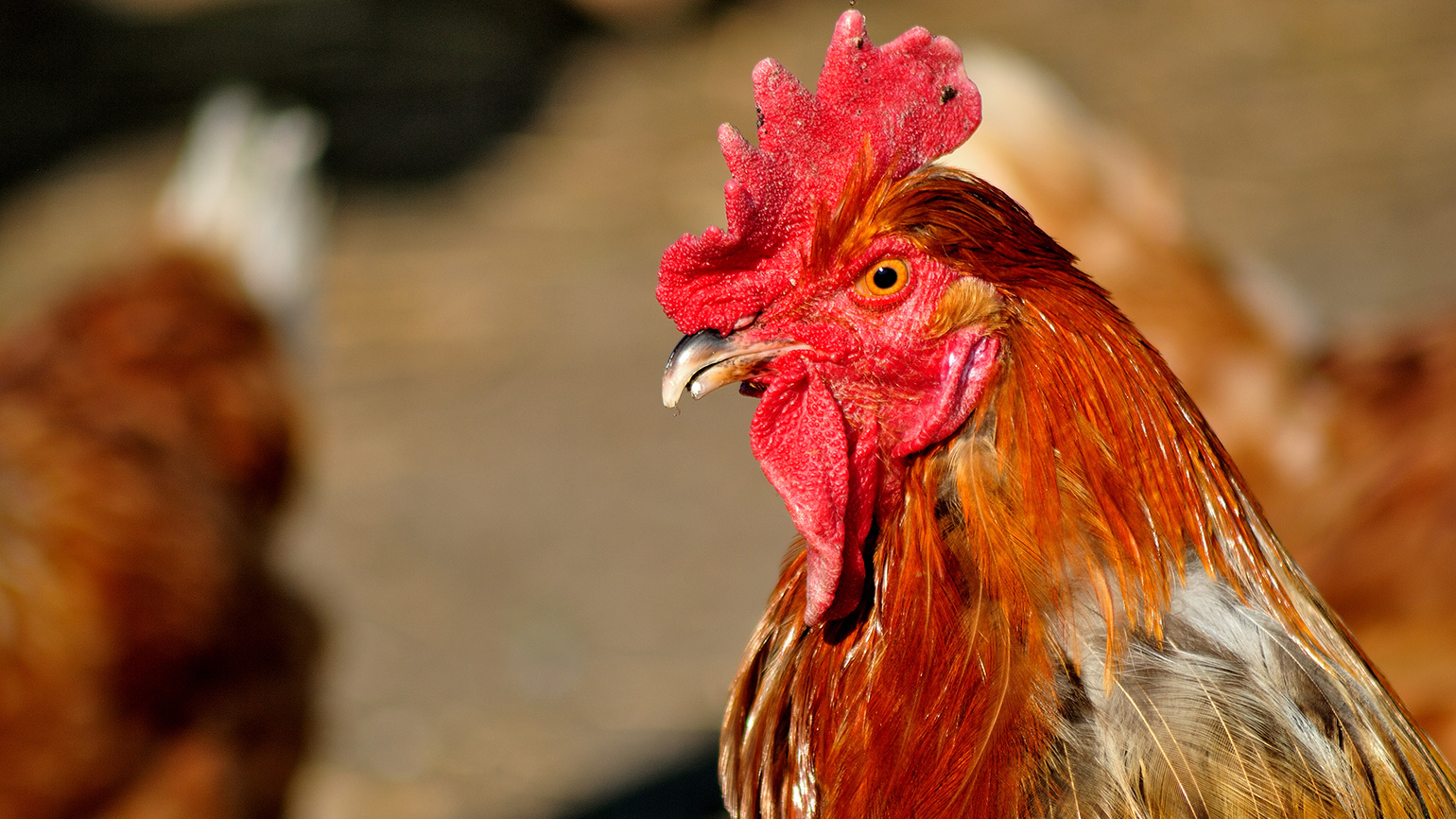
Even after the move outdoors, they continued to follow me everywhere, and the friendliest chick still hopped onto my lap every time I sat on the grass near their coop. One morning while petting her head, I felt a telltale growth. Our little pullet was in fact a rooster! I named him Abraham, hoping he would live up to his biblical namesake and father a brood “as numerous as the stars in the sky and as the sand on the seashore.”

Abraham was four to five months old when he began finding his voice—weak, broken crows that sounded like the squeaks of a teenage boy. That didn’t stop him from throwing his head back and crowing early each morning. After his song got the ladies’ attention, he would strut around to impress his admiring flock.

Even though Abraham was growing into his duties as yard master, I found out from my mom that he hadn’t forgotten his easy-living days as a houseguest.

Mom lives next door. On pretty days, she’d crack open her porch window so her cat could come in and out. It never crossed her mind that her porch window resembled the window that Abraham used to enter the henhouse. One afternoon while she was resting in the living room with her feet up on the ottoman, she opened her eyes to see him squeeze through the porch window, walk into the living room, jump up on the ottoman and perch by her feet. She didn’t know how Abraham would react if she reacted, so she sat very still. She did manage to snap a picture with her phone before he hopped down and left the same way he came in.

One day she came home to find the cat outside and Abraham inside, feasting at the cat’s bowl. The following day Mom had Dad install a rooster-proof cat door, and she permanently closed the porch window. That was the end of Abraham’s forays next door.

By summer we’d added to our flock and were enjoying an abundance of fresh eggs—enough for ourselves, family and friends. Our chickens and rooster provided as many entertaining moments as eggs.

Abraham was in his prime, strutting around the yard, head high, chest out, bossing his ladies. He took good care of them too, even leading them to the biggest, most perfectly ripened tomatoes in my garden. He seemed to know the exact moment the tomatoes reached their peak. That’s when he and his ladies would launch a raid. All I managed to salvage from the garden were jalapeño peppers. He was too smart to bite the one vegetable that bit back.

Abraham had a temper as fiery as those jalapeños when it came to protecting his flock. Our neighbor’s pit bull puppy, Tank, was sweet and gentle, yet his every attempt to make friends with the chickens failed. As soon as Abraham spotted him, he would jump on the pup’s back, flog him with his wings and ride him like a rodeo star all the way to the edge of the yard. He was doing what good roosters do.

Some of his ways surprised us, though, especially his compassion for and commitment to one particular hen. She had a crooked foot, and the other chickens constantly pecked at her. That’s how a flock works out its social hierarchy, or pecking order. Bigger, stronger chickens peck the others into submission. A chicken gets access to food, water and nesting spots based on its rank.

Abraham seemed to sense this hen’s disability. He intervened and defended her from her tormentors. Even more amazing, he teamed up with her. They became the alpha pair—Abraham, a big shiny Rhode Island Red with blue plumed tail feathers, and Crooked Foot, a plump bossy black-and-white Barred Rock hen. They were devoted to each other, and together they ruled the roost.

At maturity Abraham had a fullbodied crow and was true to his namesake. He and his ladies produced the large, healthy flock I had prayed for. I was so happy to be living my dream of being a chicken lady.

Coming home from work one day, I turned off the highway onto our two-lane road. In the distance I could see a man standing in our driveway. Something was wrong, I could just tell.

I pulled into the driveway and recognized the man as our neighbor Mr. Proctor. He was visibly shaken. “Lacy, two stray dogs attacked the chickens.”

I ran to the backyard. All I could see were feathers and blood and dead chickens. I walked to the torn chicken wire that surrounded their pen and coop. There in the opening lay the broken body of my beloved Abraham. I looked inside the chicken house, its white paint now splattered with blood. Through my tears I saw Crooked Foot, huddled on her nest, fearfully brooding over her two remaining eggs. The only survivors.

Shaking from shock and loss, I scooped Abraham’s limp body into my arms and held him. Mr. Proctor quietly filled in the details.

He’d been working near his barn when he heard loud barking and shrieking. He crossed the fence between our farms just in time to see the end of the massacre. Abraham had fearlessly jumped on the strays, flogging and spurring them, but even my big brave rooster was no match for two large dogs. It was Max, our Great Dane, and Tank, another neighbor’s pit bull, who fought and chased off the strays as Abraham lay dying and Crooked Foot hid on her nest.

That night, after cleaning up the carnage, we buried Abraham under my favorite oak tree. Jacob made a mosaic-encrusted plaque with “ABRAHAM” carved in the middle.

Whenever I see Abraham’s marker, I’m reminded of the life lessons he taught me:

  • Start the day with a joyful noise.
  • Strut your stuff.
  • Tomatoes taste best straight from the garden.
  • Love without boundaries.
  • Defend the weak.
  • Explore new frontiers.
  • Stand strong in the face of adversity.

Even though we’ve replenished our flock, we will never be able to replace Abraham. He did leave a legacy, however. Of the two surviving eggs that his partner Crooked Foot hatched, one turned out to be a little rooster. He looks nothing like his father, but his personality is exactly the same. He comes running when I call him, and he climbs onto my lap every time he sees me sit on the grass. I named him Lincoln.

For more inspiring animal stories, subscribe to All Creatures magazine.

9 Interesting Memorial Day Facts

Memorial Day—it’s a solemn day for military families. It’s a time of remembering those who’ve paid for their service with the ultimate sacrifice. It’s also a day overshadowed with the possibility that our loved one may be called to do the same. Here are some things worth knowing about this important observance.

1) Memorial Day didn’t officially become a federal holiday until 1971. It began in May of 1868 when General John A. Logan, the commander-in-chief of Grand Army of the Republic (a Union veterans’ group) issued a decree that May 30 should recognized nationwide as day to commemorate the more than 620,000 soldiers killed in the recently ended Civil War. He referred to it as Decoration Day. That first year, 27 states adopted the holiday. By 1890 all the states had declared it a state holiday, but for 50 years it only commemorated those killed during the Civil War.

2) The date of May 30 was chosen because it was a day that didn’t fall on a Civil War battle anniversary.

3) When Memorial Day was officially adopted as a federal holiday, the date was changed to the last Monday in May. Many veterans’ organizations were concerned that the American public would focus on the fact that the weekend marked the start to summer vacation season and lose its original intent. In fact many organizations are still fighting to have the date changed back to the original May 30.

4) One Memorial Day tradition is to have all flags fly at half-staff until noon, then raised to the top of the staff. The first part of the day is in honor of those who sacrificed their lives while serving. The second part of the day honors those who are still with us.

5) In 2000, Congress passed the National Monument of Remembrance Act which requires all Americans to pause at 3 p.m. to remember and honor those who have died serving their country. This one-minute moment of remembrance is recognized by many large companies to this day.

6) Where was the first Memorial Day celebrated? That is still hotly debated. There are several places that claim the honor including Warrington, Virginia; Gettysburg, Pennsylvania; and Savannah, Georgia.

7) Wearing red poppies, a popular Memorial Day tradition, originated, in part, from a poem, In Flanders Fields, written by Lieutenant-Colonial John McCrae in 1915.

8) In 1924, faced with a shortage of poppies, the first artificial poppy factory was opened in Pittsburg, Pennsylvania. It employed out-of-work veterans.

9) One long-standing Memorial Day tradition, to honor our late veterans and troops, is to have a picnic on the grounds of a military cemetery.

9 Coping Tricks of a Military Mom

Having a child—or for that matter a spouse—who serves in the military can require a certain skill set. Today I’m going to share some of the coping tricks I’ve learned as a military mom.

1) Disagree gracefully.
I now have the ability to smile and nod—even when I don’t agree with the person across from me. I learned early on that announcing I had a child in the military didn’t always bring the positive response I thought it deserved. I also discovered that arguing with those who didn’t have a positive response got me nothing but frustrated. So I developed the talent of looking pleasant and engaged even when I was seething with hostility.

2) Learn the lingo.
I now speak another language. It’s not an official language, but military lingo definitely sounds foreign unless we have a loved one who serves.

3) Practice patience.
Dates and times for visits home are general targets, not promises. One of the first things I learned was that military precision doesn’t really apply in time-driven situations. This isn’t something your child can control, so be patient. He’s more frustrated by this than you’ll ever be.

Read More: A Single Mom Paints Tributes to Our Veterans

4) Welcome everyone.
I learned to accept and love the friends my military child brought home with him on leave. Those in the military don’t make a lot of money. And leave times are often short—even during the holidays. This means that military families get the opportunity to be family to those who can’t make it home.

5) Use a military filter.
I learned to run everything military-related through a filter of patience. There’s lot out there that can be frustrating, but getting irritated doesn’t help anyone. By knowing snafus will happen, we can often forestall adding fuel to an already volatile situation.

6) Carry a cell phone. Always.
I developed the ability to never go anywhere without my cell phone—especially during deployments. Those serving don’t always have the option of calling back if we don’t answer, so we learn to always have our phones within arm’s reach.

7) Be generous.
I had to develop the ability to share. Our son had other people who cared about him, so when he was at home, I couldn’t be stingy with them about the time he had to share.

Read More: Faith to Overcome the Darkness of Depression

8) Write letters.
I learned how to write letters again. Some of them were sent as emails, but many were physical letters. It’s just not possible to carry an email with you on patrol, so I made sure my son had tangible evidence of just how much I loved and missed him.

9) Become a prayer warrior.
I became a warrior too—a prayer warrior. When we have a child in the military, we enter into a war of epic proportions, and our role isn’t minor.

Overall, my son wasn’t the only one with things to learn when he enlisted in the military. I also had a job to do by supporting him.

8 Ways to Navigate Grief After Losing a Pet

The days immediately following a pet’s death can weigh heavy on the heart. Coming home to an empty house is difficult. You miss your beloved friend and family member. Here are some ideas to help you move through the grief.

1. Revisit happier times.

After my golden retriever Ike died, all I could think of were his final days—his painful expression, our fear and anguish. I went over those last moments again and again, wondering if we did all we could, if the vet had done all she could. Then one day my husband sat close to me, and together we looked through pictures and videos of Ike when he was spry and healthy. That shifted my focus from the grief to the happy times we spent together, which started the healing process.

2. Donate supplies.

People react to loss and grief differently. Does seeing your dog’s favorite plush monkey or your cat’s comfy bed make you feel closer to your late pet, or does it make your heart break? If the latter, consider giving the toys and supplies to another pet. It might make you feel better to know that your pet’s bed, toys and leash are helping another animal. Do you have leftover pet food? If you don’t have a neighbor or friend who could use it, donate it. Shelters and rescue groups are often in need of supplies and, in most cases, are willing to accept a bag of food, even if it’s been opened.

3. Create a memorial.

If you prefer to hang onto your pet’s things, select a few special items to keep on display. Some people keep their dog’s collar or their cat’s favorite toy. For Brooks, the first senior golden retriever we rescued, we made a framed collage with some favorite photos, a paw print, a lock of his fur and his dog tag. You can get creative—turn a dog bowl into a planter, for instance. Place a cross or stone in the garden. We received a gift of beautiful Vermont slates, engraved with our dogs’ names and dates of birth and death.

4. Frame a picture.

Select your favorite picture and keep it in a frame on the mantel or on a table where you will notice it frequently. Or have a picture enlarged, matted and framed to hang on the wall. Order a painting or drawing of your pet to frame (Etsy is great for this).

5. Write a tribute.

Putting down on paper your memories of your pet can be cathartic. If you feel inspired to write the story of your pet’s life, you can even have it printed and bound. You could write a poem or a letter to your pet. Some people write an obituary for their pet and publish it in the local newspaper.

6. Hold a service.

Many pet parents are comforted by the feeling of closure they get from a memorial service. It can be as simple or as elaborate as you like. Do it just for yourself and your family or invite a few close friends. Select a reading that is meaningful to you, such as “The Rainbow Bridge,” and say a few words of remembrance. You could even play a song that expresses how you feel. End with a prayer.

7. Plant a tree.

Add a shrub or tree to your yard that you can watch grow. If you don’t have a yard or enough room in your yard for a tree, select a meaningful indoor plant or flower to grow in a pot by a window. Watching a living thing thrive and bloom can do wonders for the heart.

8. Hug a friendly pet.

As a therapy dog handler, I’ve seen firsthand the benefits of spending time with animals. When we lost one of our dogs, we asked a friend to stop by with her therapy dog. I’ll never forget the comfort I felt putting my arms around her dog. Visiting with another animal can ease your grief. Or, if it feels right, it may be time to add a new pet to your family. Remember, there is no right or wrong amount of time to wait. Rescuing an animal from the shelter can be a way to honor your late pet and the love you shared.

For daily animal devotions, subscribe to All God’s Creatures magazine.

8 Ways to Help Your Kids Help the Environment

It’s easy to become overwhelmed reading and learning about the latest indicators of climate change and its impact on our planet’s future. For parents and kids alike, it can feel out of reach to make a measurable difference against the tide of changes we face.

But just like with other global problems, we find hope when we seek contributions that we can  make, each of us, every single day. Cumulatively, simple actions come together to make a real difference, helping us to be part of the solution to the climate crisis, and, as Mahatma Gandhi famously said, to “be the change we want to see in the world.”

Help your kids help the environment and respect their local and global environment by encouraging these simple habits.

Help your kids help the environment by not littering.

1)  Don’t Litter

Classic advice, but still as relevant as ever to young generations. If you generate trash in the course of going about your daily life, take responsibility for disposing of it properly. A simple lesson that lasts a lifetime.

Father and daughter help the environment by composting

2)  Compost

Food waste is a major contributor to the climate crisis. Find out what options your town offers for compost collection, or if you have the space, learn about how to start a compost pile in your yard. What a great family project! Put your food scraps to use in the service of growing new food to feed yourself and nourish the planet.

Two boys carrying weeds and pruned branches.

3)  Ask Questions

“Which recycling symbols are accepted in our town?” “Can I add autumn leaves to my compost pile?” Show your kids how to ask questions and be curious about learning about how trash works, so you can lower your environmental impact and maximize your care in taking care of your own garbage.

Father and daughter reading up on climate change.

4)  Seek Out Success Stories

When you come across a news story about an environmentally-friendly invention or discovery, share it excitedly with your kids. Doing this boosts their hope for the future, and their sense of empowerment that creativity and ingenuity will be our salvation.

Family hiking outdoors. Help your kids help the environment.

5)  Appreciate Nature

Want to have kids who care about the planet? Spend some time exploring it! Visit parks, natural areas like mountains, rivers, lakes, forests, or the ocean, and marvel at the beauty of our world.

Child and parent hold donation money. Help your kids help the environment.

6)  Make Your Money Count

Put your dollars behind your environmentally-friendly values, supporting nonprofits and businesses that are leading the way to put our planet first.

Woman shopping in a thrift store.

7)  Swap, Borrow, and Re-Use

Push back against the mentality that everything is disposable by teaching your kids to seek out opportunities to re-use, repurpose, and share items that don’t need to be bought new. Thrift stores, used bookstores, buy-nothing organizations, and asking a neighbor for a tablespoon of a hard-to-find spice are easy ways to get into this earth-friendly, community-oriented habit.

Family on bikes instead of in the car. Help your kids help the environment.

8)  Walk, Ride, or Bike When You Can

Show your kids how to lower your carbon footprint by reducing the amount of driving you do. When possible, take public transportation, walk, or bicycle around your neighborhood or on local errands. Doing so is a chance not only to help the environment, it reinforces safety practices like looking both ways and wearing a bike helmet.

How can you help your kids help the environment?

READ MORE: 15 Bible Verses for Earth Day

8 Ways to Cultivate Positive Relationships

We have been taught from childhood that—in the right relationship—love is effortless. Once we find Mr. or Mrs. Right, our relationship will mature into a beautiful bond shielded from arguments, tears or frustration.

The truth is that every committed partnership, friendships and work relationships included, goes through—what I like to call—puberty, full of pimples and ugly haircuts. How we navigate through that formative stage, however, determines the level of intimacy we will later enjoy. Here are eight ways to cultivate positive relationships in your life.

1. Communicate, don’t assume.

Assumptions are the termites of any relationship, eroding the communication that is the foundation of trust and vulnerability. You may think you know exactly what your partner is thinking—enough even to finish his or her sentence. However, it is impossible to fully know what’s going on inside their head.

Cast aside your assumptions and articulate your feelings as best you can, with as much detail as possible. Ask your partner to do the same. Resist the urge to judge the other’s feelings. Replace any “right” and “wrong” categories of emotions with an umbrella of unconditional acceptance.

2. Listen.

American-German philosopher Paul Tillich once said, “The first duty of love is to listen.” It demonstrates respect. Giving a person our wholehearted attention is bestowing the gift of time, a precious pearl in our multitasking culture.

While we can accomplish more if we put a friend on speakerphone, as we fold the laundry or clean up our desk, we lose some of the connection. We are best to imitate Mary in the Gospel of Luke, who sat at Jesus’ feet listening to what he had to say, as opposed to her sister, Martha, who busied herself in the kitchen preparing a meal for their guest.

3. Practice manners.

We know to say please and thank you, but there are other courtesies that generate a sense of appreciation and respect between partners.

For example, call when you are going to be late, greet your partner at the beginning of the day, check in periodically to say “I love you,” say good night before bed, have dinner together or let your partner know why you won’t be home.

Shakespeare once said, “He does not love who does not show love.” Try to express love in small ways every day.

4. Affirm your partner.

In her book For Women Only: What You Need to Know About the Inner Lives of Men, nationally syndicated newspaper columnist Shaunti Feldhahn synthesizes what she learned from interviewing more than 1,000 men about their needs. One key finding is that men crave affirmation. When they receive encouragement and support from their partners, they become much more secure and confident in everything they do.

Jed Diamond says much the same in his piece for Stand Magazine. “We long for that safe harbor where we don’t have to pretend to be something we’re not in order to be chosen,” he writes. “We long for someone who sees us for who we are and wants us anyway, who can hold us and touch, not just our body, but our hearts and souls.” Be that person. For your male or female partner.

5. Use good body language.

Research shows words account for only 7 percent of the message we communicate to a person, while our body language (55 percent) and tone of voice (38 percent) do most of the talking.

We may carefully craft our phrases, however, our memo is lost on the other person if our speech isn’t consistent with our posture, hand gestures and tone of voice. Make sure your body and tone of voice match the intention of your words.

6. Know each other’s love language

According to pastor and author Gary Chapman, emotional needs are met in five ways: words of affirmation, quality of time, receiving gifts, acts of service, and physical touch. You need not waste your time penning a lengthy love letter if your partner hears “I love you” more directly in a folded load of laundry. Familiarize yourself with your partner’s love language so that you can communicate love and appreciation most effectively.

7. Do an activity together

Friedrich Nietzsche once said, “It’s not a lack of love, but lack of friendship that makes unhappy marriages.” A meaningful friendship is critical to all primary relationships, not just marriage.

Participating in an activity together is a great way to foster a playful connection. Not only do you discover common interests, but you bond in an environment away from work, the kids, or responsibilities at home. Consider signing up for a cooking class, visiting a museum, or training together for a 5K. Venture outside of your comfort zone and try something new.

8. Pray together

A friend once told me that when you invite God into your relationship, you create a braid that protects your union from fraying. This third string of faith becomes a unifying force in the partnership, joining the strands together in a deeper commitment.

In her piece When Two Pray, Stormie Omartian writes, “Just as physical intimacy reaffirms your oneness, so does praying together. When you pray as a couple, you are not only communicating with God, but also with each other. You can learn so much about one another by sharing prayer requests and listening to each other pray.”

My husband and I have recently benefited from the power of praying together. I sometimes envision the braid that is being woven during our moments of petition before God.

Any relationship that is meaningful requires work. In striving to be kinder, more considerate people, we nurture the bonds of lasting friendship and deepen our intimacy with one another. We also transform ourselves – we become better people. Listen, communicate, affirm, and pray. These are the seeds that will

8 Uplifting Movies to Enjoy on Mother’s Day

Many of us saw our first movies with our mothers. I remember when, throughout my childhood, Disney used to release classic movies like Snow White and Cinderella back into the movie theaters, and my mom would take my sister and me for a special afternoon out. The aroma of popcorn and the creamy bite of Junior Mints reminds me of those times to this day.

Now that I’m an adult, and a mother myself, movies are part of my memory, threads of connection with my relationships, my growth as a person and my place in my family.

This Mother’s Day, if you are looking for a movie to uplift, to make you laugh (and maybe cry just a little), and to reflect on your connection with your mom, your kids, or both, start with these eight films (popcorn and Junior Mints optional).

Brave
This 2012 Disney Pixar film set in medieval Scotland is the fantastical tale of a princess, Merida, who longs to ride horses and fire a bow and arrow like the men in her clan. Her mother, Queen Elinor, becomes enchanted and turns into a bear, unable to speak and requiring her daughter’s aid to lift her curse. The fierceness of the love between Merida and Elinor—complicated as it often is between mothers and daughters—makes this beautiful viewing for mothers or daughters of any age.

Freaky Friday
Based on the famous young adult novel, this 2003 movie (or the 1976 original adaptation) hilariously explores the question of what would happen if a teenage girl and her harried working mother—who aren’t getting along very well—switch bodies for a day. The experience of spending a day in another’s shoes is not only pure comedy, it reveals a new level of respect and love the mother and daughter come to share.

The Kids Are All Right
This 2010 comedy features not one but two powerhouse mothers, a married same-sex couple whose 18-year-old daughter researches and locates Paul, the sperm donor who enabled the couple to have their two children. The relationship between the two mothers is complicated by Paul’s presence, and the family goes through a journey back to each other.

Mamma Mia!
A romantic comedy set to the exuberant music of ABBA, this 2008 film follows Sophie, a young woman who has never known who her father is—and invites three possible candidates to her wedding on the Greek island where her mother owns a hotel-villa. Her mother’s best friends—more mother figures to Sophie—go on the journey of discovery, emotion and celebration in this beautiful, moving story that also was a Broadway musical.

Soul Food
Matriarchy is a theme of this 1997 film about a close-knit African American family that lives in Chicago and is reeling after the death of “Big Mama,” whose Sunday meals kept the family connected and nourished—emotionally as well as physically. The experiences of Big Mama’s three grown daughters and their respective families and relationships are woven together and are brought back to the table by 11-year-old Ahmad’s desire to see the family’s traditions survive.

Forrest Gump
Of all the famously quotable lines from this 1994 Oscar-winning film, it’s “What’s my destiny, Mama?” that always brings a tear to my eye. The title character’s mother is a fierce protector of her son’s unique strengths and challenges, the moral heart of her son’s life and the kind of mother whose impact is felt well beyond her years on earth.

The Joy Luck Club
Chinese immigrant mothers and their daughters are at the heart of this powerful 1993 film based on the Amy Tan novel. The story unfolds as the mothers choose carefully when to share their stories—or not—with their daughters, as we see the beauty and complexity of generational connection and discovery in flashback scenes interspersed with current issues for the main characters.

Steel Magnolias
This 1989 classic film about mothers, daughters and lifelong friends is a famous tearjerker, but it is also rich with humor, joy and deep and honest love. Don’t kid yourself—keep the tissues nearby. But if you need to let out some feelings this Mother’s Day, you can consider this movie your first stop.

What are your favorite uplifting movies for Mother’s Day?

8 Tips for Introducing Your Grandchild to Your Pet

Pets and grandchildren…you love them both, and for good reason—they’re adorable! But putting the two together requires attention and understanding. When our granddaughters, ages one and three, visit, they get so excited by our puppy, Petey, that they run around the house, laughing and squealing. Petey follows, jumping and tugging at their pant cuffs. I regularly remind the girls to stay calm and move slowly around Petey and our senior golden retriever, Ernest.

I’m always careful with any interaction between our granddaughters and our dogs. Even the most docile pet can be unpredictable around young children. And some kids may unintentionally stress or injure your pet. Here are some tips for introducing your grandchildren—or any child that visits your home often—to your pet, and setting them up to become best buds.

1. Take it slow and easy. For the initial introduction, get the grandkids seated on the floor or couch. Tell them that your pet will feel more comfortable if they are quiet and still. Let your pet come to them on its own terms. Explain that sniffing is the way your cat or dog learns about them. Show them how to offer the back of their hand to your dog for a first meet-and-greet sniff.

2. Let them offer treats. Your pet will learn that good things happen when the grandkids visit if you have the kids give it a treat. Teach them to hold the treat on the flat palm of their hand so that little fingers won’t end up in eager mouths.

3. Never leave pets and kids unattended. This might seem unnecessary if you have a cat who loves to cuddle, or a dog who wouldn’t bother a ladybug. But don’t take a chance. A wailing infant, crawling baby or rambunctious schoolchild might accidentally provoke a snarl, scratch or even a snap. Keep a watchful eye on them.

4. Consider your pet’s temperament. Ernest instinctively approaches babies softly and stays calm around young children. Some pets, however, feel frightened by kids’ quick movements and loud voices. If you already know that your cat or dog doesn’t enjoy children, don’t force it. Keep your pet in a separate room with some toys when the grandchildren visit.

5. Enforce safety rules. Repeat and reinforce these three basic rules: Never put your face close to the pet’s face. Never bother the pet when it’s eating. Never bully or tease any animal.

6. Show kids how to handle your pet. Demonstrate how your cat prefers to be held and places your dog likes to be patted. Petey likes a scratch behind the ears and Ernest enjoys a belly rub. Explain that it hurts when they hug Kitty too tight, or try to take pony rides on Fido. If you have a small pet, make sure that your grandchild is old enough to handle it, and demonstrate how to safely pick it up. Be sure, as well, that the children understand signs that an animal doesn’t want to be held or played with. Older dogs may tire out before the kids!

7. Let them help care for your pets. During one visit, my older granddaughter, Grace, ran up to me with the measuring scoop and said, “Ernest and Petey so hungry. Time for din-din.” It wasn’t feeding time, but I wanted to encourage her so I said, “Let’s feed them together.” We told the dogs to sit and wait, then I guided her hand as we poured the kibble into their bowls. She was so proud, and learned that having a pet involves responsibility too. Older kids can brush the cat or help take the dog for a walk.

8. Teach them empathy. I knew I’d done something right when I heard Grace talking to Ernest. “Nice boy,” she said—the very same words and intonation as I use—and gently stroked his head. She was learning empathy and kindness. Take every opportunity to teach your grandchildren about compassion for your pets. When they are kind and fair to animals, they also learn to treat people with the same respect.

PEGGY FREZON is author of books about the human-animal bond, including Faithfully Yours: The Amazing Bond Between Us and the Animals We Love.  She and her husband rescue senior golden retrievers and are involved in therapy dog work. Connect with her on Facebook at facebook.com/peggyfrezonbooks, on Twitter @peggyfrezon and at The Writer’s Dog.

For inspiring animal-themed devotions, subscribe to All God’s Creatures magazine.

8 Lessons Learned by a Military Mom

I stumbled into being a military mom without much preparation. My dad wasn’t a military man, and neither was my husband. So when our son enlisted, I found myself with a big learning curve. Here are 8 lessons I learned as a result:

1. Adulthood comes on quickly.
The gradual transition from my little boy becoming a man ended the day he enlisted. He left for boot camp as a gangly teenager and returned weeks later a strong man.

2. Parents have fears, too.
I was lucky our kids didn’t suffer much from bad dreams. When they hit the teen years, I assumed I’d avoided that particular parenting challenge altogether. Instead, I began to wake up from nightmares of my son being wounded, or worse, on the battlefield. Prayer helps here.

3. A wardrobe speaks volumes.
Red, white and blue were the basis of my wardrobe. I was so proud of our son that I wanted to shout from the rooftops. Instead, I adopted a patriotic wardrobe. Even to this day I have a hard time passing up a flag-embellished t-shirt or scarf.

4. The phone is a lifeline.
In generations past, the mailman was a military mom’s best friend. These days, we have our ever-present cell phones ready to receive a text, picture or even a call when our kids are deployed far from home.

5. You’ll get to know the post office.
I got to know—and be known—by our local post office employees. Especially during deployments, I was there every week sending a care package from home.

6. And learn to tell military time.
I learned to think in military time. I no longer have any trouble knowing instantly that o-eight-hundred is 8 a.m.; fourteen hundred is 2 p.m.

7. Become an expert in military jargon.
As a military mom, I had to learn a whole new language—military jargon. The military has an acronym for everything. Beyond that, they have odd phrases that still populate my own way of speaking. From “He’s got your six,” which means someone is watching your back, to “no man left behind,” which means that no one is ever abandoned on the battlefield—or anywhere else.

8. Turn to God for peace.
I thought I spent a lot of time praying for our kids as they were growing up. But when one of them joined the military, I didn’t realize I’d wear out the floor in my favorite prayer spot. Even now when I drop to my knees to pray, I’m overcome by the times God met me right there with His covering of peace as He answered my prayers.

Being the mom of a son who served was a privilege and a joy. But I thought it would be nice if I could pass on some of the things I wish I’d known when the journey started.

7 Ways Women Are Great Friends to Each Other

I’m grateful to have numerous, awesome women in my life. They make my life better in so many ways. What would we women do without our girlfriends? The world would be a sad place without them. So why are girlfriends so special?

1. Girlfriends give wise counsel. Sometimes it’s hard to say the truth—and sometimes it’s not easy to hear it—but when done in love, it’s an amazing gift.

2. They supply companionship, and they’re someone to talk to about whatever is going on in our lives. Even the goofy stuff.

3. Girlfriends provide laughter. Is there anything better than laughing until tears are streaming down your cheeks with someone who shares your sense of humor?

4. Girlfriends give encouragement during hard times—when we need a champion and when we just need to hear the words, “It’s going to be okay.”

5. For those of us who are fashion and hairstyle-impaired, girlfriends can give us sage advice that gives us confidence and keeps us from major fashion flubs. But even so, they love us just the way we are.

6. Girlfriends are there when we need them, no hesitation. I’ll never forget the sweet friends who brought dinner and spent the evening with me for weeks while I was in the hospital after a car wreck. Precious medicine indeed.

8. The best girlfriends will encourage us in our faith and inspire us to become the women that God desires us to be. And they’ll pray us through all the moments of our lives.

I want to be that kind of girlfriend to my friends. I want to be the older woman who will mentor the younger, who will provide an example of how God wants us to treat others. And I’ve been blessed beyond words with friends who taught me exactly how to do that.

Do you have some special girlfriends? Today would be a great time to write them a note or to call them and say how blessed you are to have them in your life. And it would be the perfect opportunity for all of us to thank God for the gift of friends who will walk through life with us.

7 Lessons from ‘A Charlie Brown Christmas’

The first Christmas our son was deployed proved challenging. Every winking light, glittering ornament or wrapped present reminded me of him. Surprisingly, one of the hardest parts of the holidays was watching television. Our family always loved viewing Christmas specials together.

I did my best to join in the fun with our two youngest sons, but everyone could tell my heart just wasn’t in it. So I sent up a quick prayer one evening, right before we sat down to watch A Charlie Brown Christmas, asking God to help me through. And did He ever! He used that specific show to teach me some lessons about Christmas and having a son deployed:

1) Feeling down during Christmas isn’t unusual
Early on, Lucy reminds Charlie Brown that he’s not the only one who gets down during the holidays. God reminded me that it’s normal for military families too—especially when someone they love won’t be home.

2) Turn to your friends
Charlie Brown did exactly the right thing. He told his friends how he was feeling. And sure enough, one of them came up with a suggestion to help him out. Likewise, when I reached out to my friends while our son was gone, they helped me come up with ways to lift my spirits.

3) Get involved
When we take our focus off ourselves, our problems shrink. By having something to do that benefits others, we find purpose and blessings for ourselves.

4) Avoid the commercial side
I don’t think there’s anyone out there who isn’t aware of the commercial side of Christmas. It’s often too big to fight, but we can learn to avoid it. Find ways to work around the spend-spend-spend of the season and stay connected with friends and family.

5) Look for magic in unexpected places
Charlie Brown found it in a tiny, scruffy tree. I found it that year in an abandoned bird’s nest. Our youngest son brought it inside to me—so proud of his gift. Now, every year it nestles in our Christmas tree beside the blown glass and handmade offerings.

6) Trust your instincts
Yes, Charlie Brown found the tree, but he lost faith in what it could be. It took his friends to remind him that his instincts were spot on. Don’t lose sight of what you feel in your heart.

7) Don’t forget why we celebrate
Ultimately we need to remember why we celebrate Christmas at all. When we honor the love God showed us through a tiny baby, it puts everything in perspective.

Yes, the holidays are tough on military families who are in the midst of a deployment. But there is still hope and a reason to celebrate. So dust off your family traditions and ask God to give you some new ones as you think about what makes Christmas so special.